
稳增长政策

Search documents
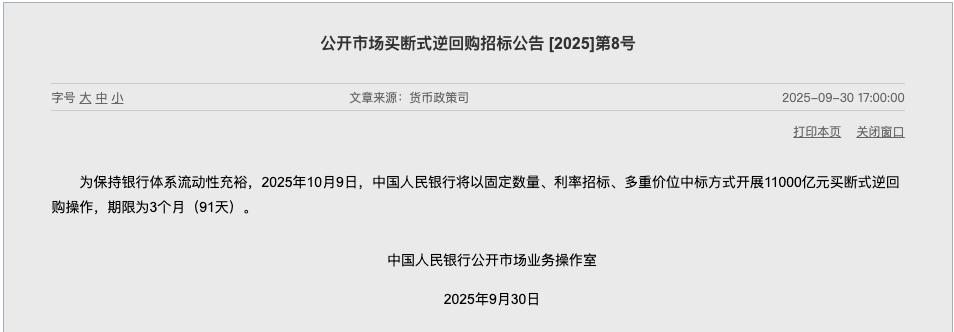
释放呵护流动性宽松信号 央行公告节后加量续作买断式逆回购
2 1 Shi Ji Jing Ji Bao Dao· 2025-09-30 15:34
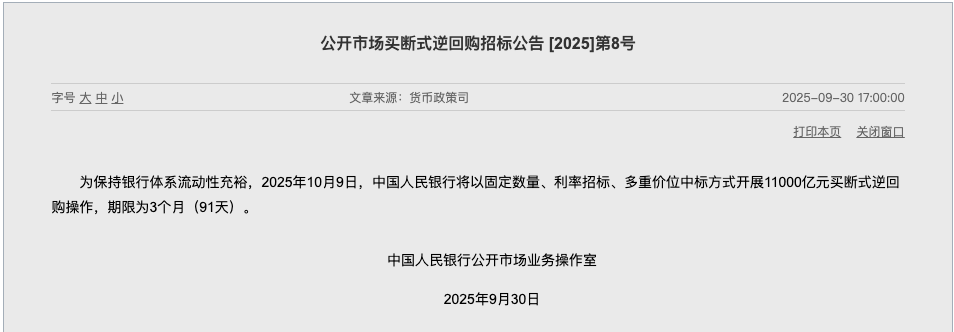
Core Viewpoint - The People's Bank of China (PBOC) is set to conduct a 1.1 trillion yuan reverse repo operation on October 9, 2025, to maintain liquidity in the banking system, with a term of 3 months [1] Group 1: Reverse Repo Operations - In October, 800 billion yuan of 3-month reverse repos and 500 billion yuan of 6-month reverse repos are set to mature [3] - After the 1.1 trillion yuan reverse repo operation on October 9, there will be a net injection of 300 billion yuan in 3-month reverse repos [3] - The PBOC is expected to continue injecting medium-term liquidity through reverse repos for the fifth consecutive month [3] Group 2: Market Conditions and Government Actions - The government is expected to issue a large volume of bonds in October, and the National Development and Reform Commission has announced the acceleration of 500 billion yuan in new policy financial instruments [4] - The strong performance of the stock market and the "migration" of household deposits in October may tighten liquidity, prompting the PBOC to inject medium-term liquidity [4] - Analysts suggest that the PBOC's reverse repo operations are aimed at stabilizing liquidity ahead of the holiday season [4] Group 3: Future Expectations - The PBOC may continue to use reverse repos and Medium-term Lending Facility (MLF) tools to inject liquidity, but the scale of net liquidity injection may decrease from the previous monthly level of 600 billion yuan [5] - There is speculation that the PBOC may implement a new round of reserve requirement ratio (RRR) cuts in the fourth quarter, which could lead to a larger scale of long-term liquidity injection [5] - Overall, the PBOC's policy stance is expected to remain supportive, with a focus on fiscal strength and monetary easing [5]

1.1万亿买断式逆回购节后落地
第一财经· 2025-09-30 15:16
Core Viewpoint - The People's Bank of China (PBOC) is implementing a significant liquidity injection through a 1.1 trillion yuan reverse repo operation to maintain ample liquidity in the banking system ahead of the holiday season [3][4]. Group 1: Reverse Repo Operations - On October 9, the PBOC will conduct a 1.1 trillion yuan reverse repo operation with a term of 3 months (91 days) [3]. - Prior to this, the PBOC executed a 1 trillion yuan reverse repo operation on September 5 and a 600 billion yuan operation on September 15, both with varying terms [3][4]. - A total of 800 billion yuan in 3-month reverse repos will mature in October, indicating a net increase of 300 billion yuan in the upcoming operation [3]. Group 2: Market Expectations and Analysis - Analysts expect the PBOC to conduct another 6-month reverse repo operation in October, likely maintaining the same amount as previous operations [4]. - Factors such as government bond issuance and seasonal cash demand due to holidays are contributing to a potential liquidity tightening, prompting the PBOC's proactive measures [4][5]. - The PBOC's actions are aimed at stabilizing the funding environment, supporting government bond issuance, and encouraging financial institutions to increase credit supply [5]. Group 3: Future Outlook - The PBOC is expected to continue using both reverse repos and Medium-term Lending Facility (MLF) tools to inject liquidity into the market [5]. - There is an anticipation of a decrease in the scale of net liquidity injections compared to previous months, with a focus on fiscal support and monetary easing in the fourth quarter [5].
央行出手,1.1万亿买断式逆回购来了
2 1 Shi Ji Jing Ji Bao Dao· 2025-09-30 13:05
Core Viewpoint - The People's Bank of China (PBOC) is set to conduct a 1.1 trillion yuan reverse repurchase operation on October 9, 2025, to maintain liquidity in the banking system, with a term of 3 months [1] Group 1: Reverse Repo Operations - In October, 800 billion yuan of 3-month reverse repos and 500 billion yuan of 6-month reverse repos are set to mature [3] - After the 1.1 trillion yuan operation on October 9, there will be a net injection of 300 billion yuan in 3-month reverse repos [3] - The PBOC is expected to continue injecting medium-term liquidity through reverse repos for the fifth consecutive month [3] Group 2: Market Conditions and Government Actions - The government is expected to issue a significant amount of bonds in October, and the National Development and Reform Commission has announced plans to accelerate the issuance of 500 billion yuan in new policy financial instruments [4] - The strong performance of the stock market and the seasonal "migration" of household deposits are anticipated to tighten liquidity [4] - The PBOC's actions aim to stabilize liquidity and support government bond issuance while encouraging financial institutions to increase credit [4] Group 3: Future Expectations - Analysts predict that the PBOC will likely continue to use reverse repos and Medium-term Lending Facility (MLF) tools to inject liquidity into the market [5] - There is a possibility of a new round of reserve requirement ratio (RRR) cuts in the fourth quarter, which may lead to a reduction in the scale of medium-term liquidity injections [5] - The overall monetary policy stance is expected to remain supportive, with a focus on fiscal strength and monetary easing [5]
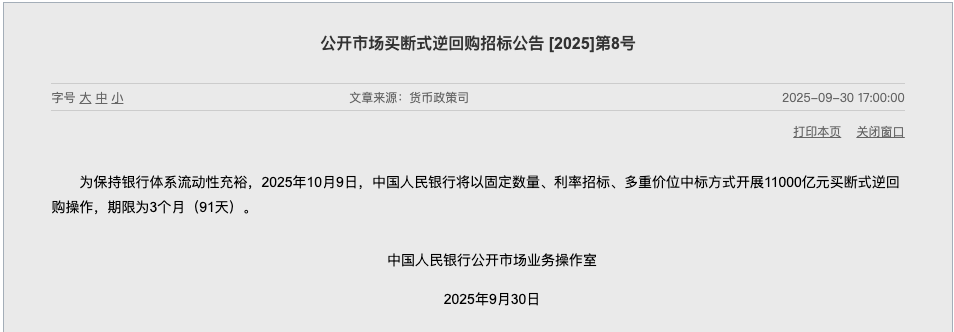
央行出手,1.1万亿买断式逆回购来了
21世纪经济报道· 2025-09-30 13:03
Core Viewpoint - The People's Bank of China (PBOC) is implementing a 1.1 trillion yuan reverse repurchase operation to maintain liquidity in the banking system, indicating a supportive monetary policy stance amid potential tightening of liquidity in October [1][3][4]. Group 1: Reverse Repo Operations - On October 9, the PBOC will conduct a 1.1 trillion yuan reverse repurchase operation with a term of 3 months (91 days) [1]. - In October, 800 billion yuan of 3-month reverse repos and 500 billion yuan of 6-month reverse repos are set to mature, leading to a net injection of 300 billion yuan after the new operation [3]. - The continuation of reverse repo operations for both maturities indicates a sustained injection of medium-term liquidity for the fifth consecutive month [3][4]. Group 2: Market Conditions and Government Actions - The government is expected to issue a significant amount of bonds in October, and the National Development and Reform Commission is accelerating the promotion of 500 billion yuan in new policy financial instruments, which will likely increase loan disbursements [4]. - The strong performance of the stock market and the seasonal "migration" of household deposits are anticipated to tighten liquidity, prompting the PBOC's actions to stabilize the financial environment [4][5]. Group 3: Future Expectations - Analysts suggest that the PBOC may conduct another 6-month reverse repo operation in October, with a high likelihood of maintaining the same amount as previous operations [3][5]. - There is a possibility of further liquidity injections to counterbalance the pressure from maturing Medium-term Lending Facility (MLF) loans, with expectations of a stable yet slightly relaxed monetary policy [5][6]. - The PBOC may implement a new round of reserve requirement ratio (RRR) cuts in the fourth quarter, indicating a shift towards more aggressive monetary easing to support economic growth [5][6].
1.1万亿买断式逆回购节后落地 10月仍有望加量续作
Di Yi Cai Jing· 2025-09-30 13:01
Group 1 - The People's Bank of China (PBOC) announced a 1.1 trillion yuan reverse repo operation on October 9, with a term of 3 months, to maintain ample liquidity in the banking system [1] - Previous reverse repo operations included 1 trillion yuan on September 5 and 600 billion yuan on September 15, both with a 3-month term [1] - A total of 800 billion yuan in 3-month reverse repos will mature in October, indicating a net increase of 300 billion yuan in the upcoming operation [1] Group 2 - The PBOC's actions are influenced by the large-scale issuance of government bonds in October and the acceleration of 500 billion yuan in new policy financial tools, which are expected to significantly boost loan disbursement [2] - Seasonal cash demand is expected to rise due to the holiday factor, alongside increased fiscal deposits, leading to a potential liquidity gap [2] - The PBOC's announcement of reverse repo operations before the holiday signals a commitment to maintaining a loose liquidity policy [2] Group 3 - The PBOC's reverse repo operations aim to counteract potential liquidity tightening effects and ensure stable funding conditions, supporting government bond issuance and encouraging financial institutions to increase credit supply [3] - An additional 700 billion yuan in Medium-term Lending Facility (MLF) is set to mature in October, with expectations for the PBOC to continue or slightly increase the volume of these operations [3] - Future liquidity injection may decrease from the previous monthly level of 600 billion yuan, as new growth-stimulating policies are anticipated in the fourth quarter, focusing on fiscal support and monetary easing [3]
风口智库|节前利好!央行宣布买断式逆回购操作,有何考量?
Sou Hu Cai Jing· 2025-09-30 11:37
Core Viewpoint - The People's Bank of China (PBOC) is implementing a significant liquidity injection through a 110 billion yuan reverse repurchase operation to maintain ample liquidity in the banking system, indicating a proactive approach to manage potential liquidity tightening in the market [2][3]. Group 1: Reverse Repo Operations - On October 9, 2025, the PBOC will conduct a 110 billion yuan reverse repurchase operation with a term of 3 months (91 days) to ensure sufficient liquidity in the banking system [2]. - The reverse repurchase operations will be conducted monthly, with a maximum term of 1 year, targeting primary dealers in the open market [2]. - The operation will include various types of securities such as government bonds, local government bonds, financial bonds, and corporate credit bonds [2]. Group 2: Market Impact and Expectations - In October, 800 billion yuan of 3-month reverse repos will mature, and the PBOC's new operation indicates a net increase of 300 billion yuan in this category [3]. - An additional 500 billion yuan of 6-month reverse repos is expected to mature in October, with a high likelihood of another operation in this category, suggesting a continued liquidity injection for the fifth consecutive month [3]. - The PBOC aims to stabilize the funding environment amid potential tightening effects from large-scale government bond issuances and new policy financial tools [3]. Group 3: Monetary Policy Outlook - The PBOC's monetary policy committee emphasizes the need for proactive and targeted monetary policy adjustments based on domestic and international economic conditions [4]. - Future liquidity injections may be lower than the previous monthly average of 600 billion yuan due to potential reserve requirement ratio (RRR) cuts in the fourth quarter [4]. - The anticipated new policies aim to support economic growth and stabilize the real estate market, with a focus on increasing social financing and money supply in line with economic growth targets [4].

释放呵护流动性宽松信号,央行公告节后加量续作买断式逆回购
2 1 Shi Ji Jing Ji Bao Dao· 2025-09-30 10:56
Core Viewpoint - The People's Bank of China (PBOC) is set to conduct a 1.1 trillion yuan reverse repo operation on October 9, 2025, to maintain ample liquidity in the banking system, with a term of 3 months [1] Group 1: Reverse Repo Operations - In October, 800 billion yuan of 3-month reverse repos and 500 billion yuan of 6-month reverse repos are set to mature, leading to a net injection of 300 billion yuan after the PBOC's operation [4] - The PBOC's actions indicate a continuation of liquidity support, with expectations of further 6-month reverse repo operations to match the maturing amounts [4][5] - The central bank's strategy aims to counter potential liquidity tightening due to government bond issuances and seasonal cash demand increases [5] Group 2: Market Conditions and Expectations - The PBOC's liquidity measures are designed to stabilize the financial environment amid significant government bond issuances and a strong stock market [5] - Analysts predict that the central bank will utilize both reverse repos and Medium-term Lending Facility (MLF) tools to inject liquidity, although the scale of net liquidity injection may decrease from previous high levels [6] - There is an expectation of a new round of monetary easing, including a potential reserve requirement ratio (RRR) cut, to support economic growth and stabilize the real estate market [6]
9月PMI:新动能接力旧动能:中采PMI点评(25.09)
Shenwan Hongyuan Securities· 2025-09-30 10:56
Group 1: PMI Overview - In September, the manufacturing PMI improved to 49.8%, up 0.4 percentage points from 49.4% in August[1][7] - The non-manufacturing PMI decreased to 50.0%, down from 50.3% in the previous month[1][7] Group 2: Manufacturing Sector Insights - The production index rose to 51.9%, marking a 1.1 percentage point increase, the highest in nearly six months[2][8] - The new orders index increased by only 0.2 percentage points to 49.7%, indicating weaker demand recovery compared to production[2][8] - New export orders improved by 0.6 percentage points to 47.8%, outpacing the increase in domestic orders[2][3] Group 3: Industry Performance - The equipment manufacturing PMI rose by 1.1 percentage points to 51.6%, while high-tech manufacturing PMI remained in the expansion zone at 51.9%[3][16] - High-energy consumption industries saw a decline in PMI by 0.7 percentage points to 47.5%, reflecting ongoing weakness in real estate and infrastructure[3][16] Group 4: Non-Manufacturing Sector Trends - The construction PMI slightly improved by 0.2 percentage points to 49.3%, while the service sector PMI fell by 0.4 percentage points to 50.1%[4][20] - The service sector's new orders index dropped significantly by 1.0 percentage point to 46.7%, indicating reduced consumer activity[4][34]
制造业PMI连续两个月回升,后续怎么看?:——2025年9月PMI点评
EBSCN· 2025-09-30 10:42
Manufacturing Sector - The manufacturing PMI for September 2025 is 49.8%, an increase of 0.4 percentage points from the previous month, aligning with seasonal recovery trends[2][5] - The production index rose to 51.9%, up 1.1 percentage points from last month, indicating accelerated production activities as extreme weather impacts dissipate[5][14] - The new orders index increased slightly to 49.7%, suggesting persistent demand insufficiency, with a widening production-demand gap of 2.2 percentage points[5][14] Industry Performance - Equipment manufacturing PMI rose significantly to 51.9%, up 1.4 percentage points, while high-tech manufacturing PMI remains stable at 51.6%[5][15] - Consumer goods manufacturing PMI reached its highest level of the year at 50.6%, driven by seasonal factors like the upcoming holiday[5][15] - Traditional high-energy-consuming industries saw a decline in PMI to 47.5%, influenced by weak demand from real estate and infrastructure investments[5][15] Economic Outlook - The fourth quarter is expected to show a positive trend in manufacturing PMI due to the end of extreme weather and the onset of the traditional production peak season[5] - Recent economic stimulus measures, including policy adjustments and new financial tools, are anticipated to support economic growth in the fourth quarter[5] Service Sector - The service sector business activity index for September is 50.1%, a decrease of 0.4 percentage points from the previous month, reflecting a cooling in service consumption post-summer[31] - Financial services continue to show strength, with the business activity index rising above 60%, indicating robust support for the real economy[31] Construction Sector - The construction sector's business activity index increased slightly to 49.3%, ending a two-month decline but remaining at historically low levels due to reduced demand from real estate and infrastructure[35] - Anticipated government projects and new financial tools are expected to bolster construction activity in the upcoming quarter[35]
1.1万亿买断式逆回购节后落地,10月仍有望加量续作
Di Yi Cai Jing· 2025-09-30 10:37
Group 1 - The People's Bank of China (PBOC) is set to conduct a 1.1 trillion yuan reverse repo operation on October 9, with a term of 3 months, to maintain liquidity in the banking system [2] - In October, there will be 8 billion yuan of 3-month reverse repos maturing, and the PBOC's operation indicates an increase of 300 billion yuan in this category [2] - The market anticipates another 6-month reverse repo operation due to 500 billion yuan of 6-month reverse repos maturing in October [2] Group 2 - The PBOC's actions are influenced by the large-scale issuance of government bonds and the acceleration of 500 billion yuan in new policy financial tools, which are expected to significantly boost loan disbursements [3] - Seasonal cash demand and increased fiscal deposits are expected to create a liquidity gap, prompting the PBOC to signal a supportive monetary policy through reverse repo operations [3][4] - The PBOC is likely to continue using both reverse repos and Medium-term Lending Facility (MLF) tools to inject medium-term liquidity into the market [4]