美元贬值

Search documents
有色金属板块延续强势,沪镍涨停
Qi Huo Ri Bao· 2026-01-07 23:57
Core Viewpoint - The non-ferrous metal sector continues to show strength, with significant price increases in nickel, tin, and alumina driven by low valuations, supply disruptions, and rising demand [1][2]. Group 1: Nickel Market - Nickel prices are surging due to tightening supply expectations from Indonesia and increased market sentiment, with nickel being relatively undervalued compared to other metals [2]. - Recent policy changes in Indonesia, including a reduction in nickel ore production quotas and a revision of the pricing formula for nickel, are expected to increase production costs [1][2]. - The solid-state battery industry's rapid development is anticipated to boost long-term demand for nickel, despite the current market fundamentals remaining weak [2]. Group 2: Tin Market - Tin prices are rising due to supply constraints and continuous demand growth, with recent production issues in Myanmar impacting supply significantly [2]. - The decline in ore quality from overseas sources is also contributing to the supply challenges in the tin market [2]. Group 3: Alumina Market - The increase in alumina prices is primarily driven by low valuations and the impact of differential electricity pricing policies, which are expected to lead to industry upgrades and higher operational costs [2]. - Electricity costs account for 13% to 15% of alumina production costs, making the differential pricing policy a significant factor in market sentiment [2]. Group 4: Market Outlook - The current lack of downstream demand for non-ferrous metals and limited acceptance of high-priced goods in the spot market may lead to a gradual adjustment in pricing through the futures market [3]. - The non-ferrous metal sector may face significant correction risks in the medium to long term, particularly for alumina and lead, while the performance of nickel is heavily reliant on overseas policy factors [3]. - The market is expected to continue trading based on macroeconomic policies and supply security, with stronger performance anticipated for tin, copper, and aluminum, while nickel, zinc, and lead may perform relatively weaker [3].
格林大华期货早盘提示-20260108
Ge Lin Qi Huo· 2026-01-07 23:30
1. Report Industry Investment Rating - The report gives a "downward" rating for the global economy in the macro and financial sector [1] 2. Core View of the Report - The global economy is facing significant uncertainties and challenges. The US's political and economic policies, along with the development of AI and the performance of financial markets, all contribute to an overall downward trend in the global economy [1][2] 3. Summary by Relevant Catalogs 3.1 Important Information in the Morning Session - Musk states that once Starship achieves full and rapid reuse, launch costs will drop below $100 per kilogram, and a 100GW - level "space solar AI satellite array" can be built through 10,000 flights per year to send 1 million tons of payload into orbit [1] - Musk believes the future bottleneck of AI lies in electricity, not chips. The lack of power, heat dissipation, and liquid - cooling may prevent GPUs from working, which is why TSMC is worried about over - expansion [1] - Musk predicts that the next three to seven years will be an extremely turbulent transition period. AI will rapidly replace many white - collar jobs, causing unemployment and social unrest, while at the same time, production efficiency will be fully released, leading to an abundance of goods and services [1] - J.P. Morgan Asset Management warns that the prosperity of the US stock market is dominated by generative AI, and trillions of capital expenditures face uncertainties in profit returns and US power infrastructure bottlenecks. If expectations are not met, the market will face a severe liquidation risk [1] - Goldman Sachs warns that the current P/E ratio of the S&P 500 is approaching the 2000 bubble peak, and the top ten stocks account for 41% of the market value. This "high valuation + extreme concentration" combination is similar to that before previous market crashes [1] - Since April, the US dollar has been flat while the commodity index has risen significantly. Goldman Sachs' Privorotsky believes this may indicate either a full - scale depreciation of the US dollar or a rapid recovery of the global economy [1] - Citigroup points out that the copper price may rise to $14,000 per ton in the next three months but may peak this month without new catalysts, which could balance the global copper spot market in 2026 [1] - Global investors' confidence in emerging market bonds has reached a 13 - year high, with the risk premium relative to US bonds narrowing to about 2.5 percentage points, the lowest since early 2013 [1] 3.2 Global Economic Logic - The US's actions against Venezuela's president bring great uncertainty to the global economic and political order. Nomura expects the uncertainty of the Federal Reserve to peak from July to November 2026, which may lead to a "flight from US assets" [2] - The Federal Reserve cuts interest rates by 25 basis points in December, buys $40 billion in short - term bonds monthly, and restarts the expansion of its balance sheet. Trump may fire Fed Chairman Powell [2] - Goldman Sachs analysts warn that the decline in Las Vegas gambling revenues is similar to the early warning signals before the 2008 financial crisis [2] - The US releases a new National Security Strategy, abandons global hegemony, and will adjust economic relations with China to revitalize its economic autonomy [2] - The Federal Reserve's Beige Book shows that consumer K - shaped differentiation is intensifying, with high - income consumers maintaining spending while middle - and low - income families are cutting back [2] - The Bank of Japan raises interest rates by 25 basis points, and the yield of Japan's 10 - year government bonds rises to 2.0% [2] - Google's AI infrastructure head says the company must double AI computing power every six months and achieve an additional 1000 - fold increase in the next 4 to 5 years [2] - NVIDIA CEO Huang Renxun believes China will win the AI competition due to a more favorable regulatory environment and lower energy costs [2] - J.P. Morgan strategists think the construction boom of AI data centers will require at least $5 trillion in the next five years [2] - The US unemployment rate rises to 4.6%, and economists worry that large - scale corporate layoffs are an economic warning signal [2] - The US's return to the Monroe Doctrine and global contraction will have a profound and subversive impact on major asset classes such as the global economy, US bonds, US stocks, the US dollar, precious metals, and industrial metals [2] - Due to the US's continuous wrong policies, the global economy has passed its peak and is starting to decline [2]
还在升!!
Sou Hu Cai Jing· 2026-01-06 02:43
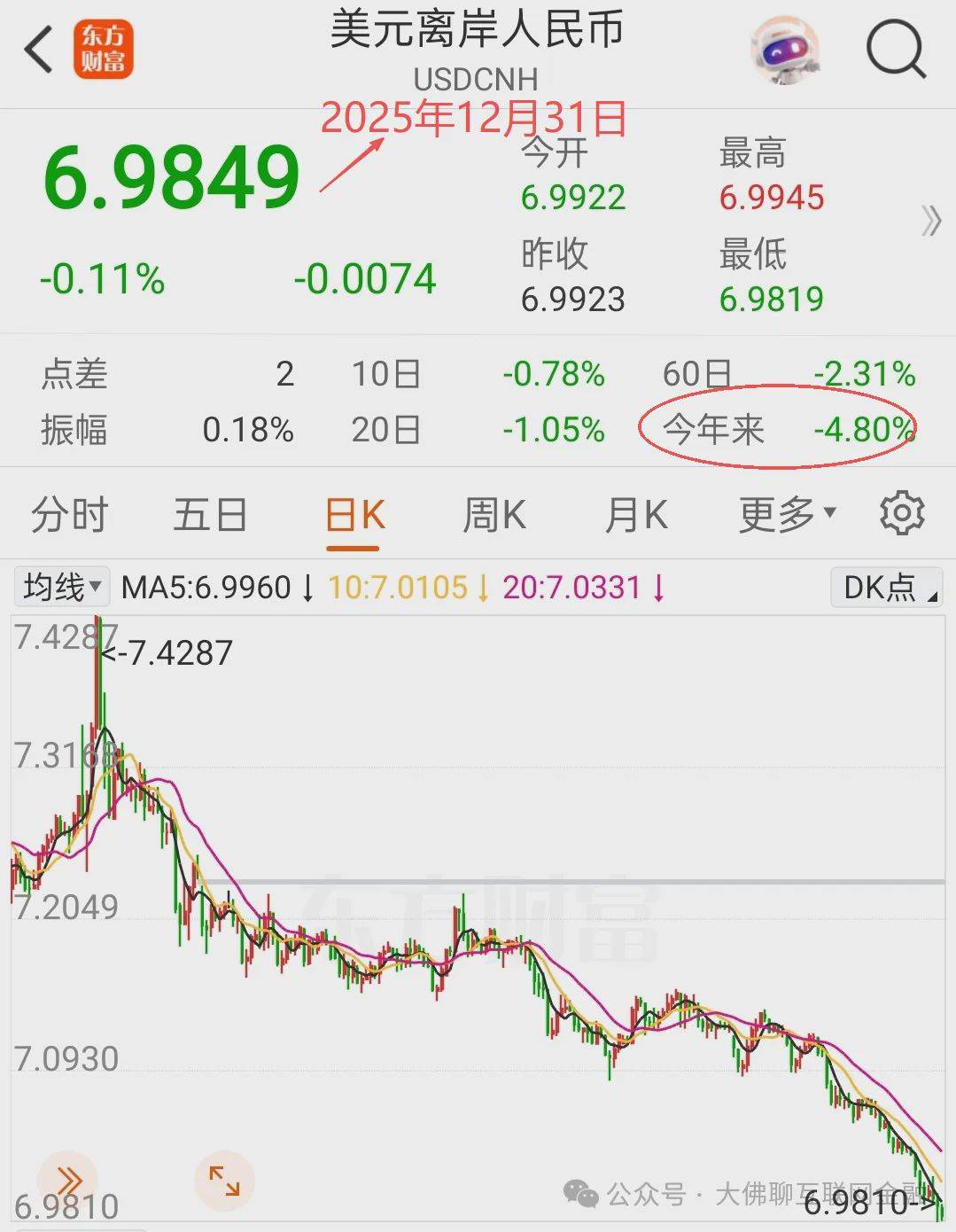
Group 1 - The offshore RMB exchange rate has appreciated from 7.3-7.4 at the beginning of the year to 6.98 before New Year's Day [1] - The USD has depreciated by 4.8% against the RMB this year, with the USD index dropping nearly 10% [3] - The appreciation of RMB has rendered previous investments in high-yield USD deposits or US Treasury bonds less profitable, as the exchange rate loss offsets the interest earned [5] Group 2 - Current non-standard urban investment bonds present a potential investment opportunity, especially as year-end products are likely to emerge [6] - A conservative strategy focusing on stable returns is emphasized, with expectations of achieving 5-6% returns from non-standard urban investment bonds [6] - The RMB is expected to maintain a strong upward momentum in the short to medium term, with potential for further appreciation [6][8] Group 3 - The depreciation of the USD encourages foreign trade companies to convert their USD earnings into RMB, further supporting RMB appreciation [8] - The weakening of the USD due to the Federal Reserve's interest rate cuts allows for capital to flow back to domestic markets, which may also boost the RMB [8] - The current environment allows for more flexible monetary policy, as the pressure on RMB depreciation is reduced, facilitating a more accommodative stance [9] Group 4 - The experience accumulated over the years in investing in urban investment bonds has been positive, with a focus on maintaining a long-term investment strategy [9][10] - The investment philosophy emphasizes steady returns over short-term gains, aligning with the broader goal of sustainable growth [10]

管涛:或不一样的美元贬值
Sou Hu Cai Jing· 2026-01-05 11:34
Core Viewpoint - The Intercontinental Exchange (ICE) US Dollar Index has experienced its worst performance since 1973, with a cumulative decline of over 10% in the first half of 2025, driven by economic slowdown, high trade and fiscal deficits, and policies from the Trump administration that have eroded the credibility of the dollar [1][6]. Historical Dollar Depreciation Cycles - The ICE US Dollar Index, established in 1973, has undergone three major depreciation cycles since 1971, primarily driven by economic cyclical factors [2]. - The first cycle (1971-1978) was influenced by the collapse of the Bretton Woods system and domestic economic challenges, leading to a 32% depreciation of the dollar index by 1978 [3]. - The second cycle (1985-1995) involved coordinated policy interventions and economic weaknesses, resulting in a 51% decline in the dollar index by 1995 [4]. - The third cycle (2001-2011) was linked to major crises, with the dollar index dropping 34% by the end of 2011 [5]. Unique Logic and Impact of Dollar Depreciation Since 2025 - The dollar depreciation since 2025 is characterized by non-economic, policy-driven factors, diverging from historical cycles that were primarily influenced by economic fundamentals [6][7]. - Trump's policies have introduced significant uncertainty, impacting the dollar's credibility through trade tariffs, fiscal deficits, and interference with the Federal Reserve [8][9]. Damage to Dollar's Credibility - Political foundations have been weakened due to damaged alliances and increased trade tensions, leading to a loss of trust among allies [8]. - Capital flows have been disrupted by tariff policies, which threaten the traditional dollar liquidity cycle [8]. - The independence of the Federal Reserve has been compromised, raising concerns about the politicization of monetary policy [9]. - The dollar's safe-haven status is under threat due to rising fiscal deficits and increasing national debt [9]. Erosion of "American Exceptionalism" - The concept of "American exceptionalism," which has historically supported the dollar's resilience, is showing signs of decline, as evidenced by unusual market behaviors and capital flight from dollar assets [10]. - The dollar's depreciation has not yielded the expected improvements in trade balances, with significant increases in the trade deficit despite a 5.6% decline in the dollar's effective exchange rate [11]. Future Trends of Dollar Depreciation - Short-term fluctuations in the dollar index are expected, but the foundation for a sustained rebound appears weak [12]. - Long-term depreciation pressure is anticipated due to high valuations and the ongoing shift towards a multipolar currency system [13]. - The trajectory of the dollar will largely depend on the direction and magnitude of Trump's policy adjustments, particularly regarding tariffs and Federal Reserve independence [14].
机构:相较于黄金,白银似乎更能受益于美国的降息
Xin Lang Cai Jing· 2026-01-02 10:12
Core Viewpoint - In a potential declining interest rate environment, silver may benefit more than gold due to its higher sensitivity to monetary policy changes [1] Group 1: Market Analysis - Rania Gule, a senior market analyst at XS.com, highlights that silver's high liquidity, ease of trading, and relatively low cost make it an attractive safe-haven asset for both retail and institutional investors [1] - Silver has increased by nearly 148% in 2025, reflecting its multifaceted nature as a safe-haven asset, currency hedge, and a key mineral for the U.S. economy [1] Group 2: Demand Factors - The anticipated depreciation of the U.S. dollar is expected to enhance the appeal of silver priced in dollars for non-U.S. buyers, thereby driving global demand [1]
黄金暴走,揭开了美联储难以启齿的秘密?
Jin Shi Shu Ju· 2026-01-02 05:30
Core Viewpoint - The global market is undergoing a significant transformation as gold prices reach historical highs, with a notable increase of over 64% in 2025, marking the strongest annual growth since 1979 [2][3]. Group 1: Gold Price Dynamics - Gold prices surpassed $4,500 per ounce in 2025, despite a slight pullback from a previous surge [2]. - The annual increase in gold prices is the highest since 1979, driven by geopolitical uncertainties and inflation concerns [2]. - Comparisons are being drawn between the current market environment and the late 1970s, highlighting similar factors influencing gold demand [2]. Group 2: Currency and Economic Factors - The U.S. dollar has weakened significantly, with the dollar index (DXY) dropping 10.6% in the first half of 2025, the worst performance since 1973 [3]. - This depreciation makes gold more attractive to holders of other currencies, contributing to increased demand [3]. Group 3: Federal Reserve Policy Changes - The Federal Reserve has shifted to a rate-cutting cycle, with the current short-term interest rate at 3.5%-3.75%, the lowest since 2022 [6][7]. - Market expectations suggest that the Fed may lower rates at least two more times in 2026, reflecting concerns about the U.S. economy [7][8]. Group 4: Political Influences on Monetary Policy - Observers note that the Trump administration aims to influence the Federal Reserve's independence, potentially impacting future monetary policy [9]. - The anticipated appointment of a more dovish Fed chair could lead to a focus on maintaining lower interest rates rather than aggressively combating inflation [9][10]. Group 5: Investment Demand for Gold - The decline in confidence regarding the Fed's independence is expected to support strong demand for gold and silver as alternative investments [10]. - Historical precedents suggest that political pressure on the Fed can lead to prolonged inflation, further driving investors towards gold as a hedge [10][11]. - If the Fed's independence is compromised, assets like gold and cryptocurrencies may benefit as they are viewed as effective inflation hedges [11].
英国金融时报:美元或将创下近十年来最大年度跌幅
美股IPO· 2026-01-01 16:08
Core Viewpoint - Analysts predict that the Federal Reserve's interest rate cuts will lead to a depreciation of the US dollar by 2026 [1] Group 1: Dollar Performance and Predictions - The US dollar is facing its largest annual decline since 2017, with a 9.5% drop against a basket of major currencies this year [3][4] - The euro has gained nearly 14% against the weak dollar, reaching over 1.17 USD, the highest level since 2021 [3] - Analysts expect the Federal Reserve to cut rates two to three times by the end of 2026, each by 25 basis points, while other central banks, including the European Central Bank, may maintain or raise borrowing costs [4] Group 2: Impact of Federal Reserve Policies - The dollar's initial weakness was triggered by aggressive tariffs imposed by Trump in April, leading to a 15% drop against major currencies [4] - The Fed's return to rate cuts in September has continued to pressure the dollar, with expectations of further cuts influencing market sentiment [4][5] - The dollar's decline is seen as beneficial for US exporters but detrimental for many European companies with sales in the US [4] Group 3: Future Leadership and Market Sentiment - The potential successor to Fed Chair Jerome Powell could influence the dollar's trajectory, especially if they are perceived to be more accommodating to the White House's demands for aggressive rate cuts [5] - Concerns about the erosion of the dollar's dominance due to political influences are noted, indicating a long-term worry among market participants [5] Group 4: Market Reactions and Investor Behavior - The dollar has rebounded 2.5% from its September low, partly due to the absence of recession predictions stemming from the trade war [6] - Investors are hedging against dollar exposure when purchasing US stocks, reflecting a structural reassessment by global investors, particularly from Europe [6][7]
美元创2017年以来最大年跌幅,美联储动向将左右后市
Sou Hu Cai Jing· 2026-01-01 07:45
Core Viewpoint - The US dollar experienced its largest annual decline in eight years by approximately 8% in 2025, driven by investor expectations of significant interest rate cuts by the next Federal Reserve chair [1] Group 1: Dollar Performance - The dollar spot index fell about 8% over the year, with traders betting on further depreciation [1] - The decline in the dollar was influenced by President Trump's new tariff policy announced in April, which led to a lack of significant rebound [1] Group 2: Federal Reserve Influence - The Federal Reserve is expected to be the primary factor affecting the dollar's performance in the first quarter, particularly regarding meetings in January and March [1] - The appointment of a dovish successor to Jerome Powell, whose term ends next year, is anticipated to further impact the dollar's value [1]
The Investment Scorecard for 2025: Top Performers and Biggest Decliners
Investopedia· 2026-01-01 01:00
Group 1 - Gold prices reached inflation-adjusted levels not seen since the Carter administration, indicating a strong demand for safe-haven assets amid economic uncertainties [1][2] - Silver surged by 146%, leading all major asset classes, driven by demand from solar panels, data centers, and electric vehicles [1][3] - The VIX, a measure of market volatility, decreased by 16%, suggesting that Wall Street remained relatively unfazed by geopolitical tensions and economic challenges [2] Group 2 - The performance of hard assets, such as gold, silver, and copper, was favored over digital assets due to factors like AI developments, tariff issues, and a weaker dollar [3] - Energy prices initially held steady despite geopolitical conflicts but later declined due to concerns over oversupply [2] - The demand for copper and silver is expected to continue, supported by their essential roles in technology and renewable energy sectors [3]
美元的好日子到头了?华尔街预判:避险光环消退,2026年持续贬值
Sou Hu Cai Jing· 2025-12-31 17:22
Core Viewpoint - The prediction that the US dollar may face a weakening turning point by 2026 is gaining traction among major banks and financial institutions, indicating a significant shift in global capital flows and asset allocation strategies [1][4]. Group 1: Dollar's Current Status - The dollar has maintained its position as the dominant global currency due to multiple advantages over the past few years [1]. - Analysts believe that the "golden strong period" of the dollar is nearing its end, with signs indicating a gradually unfavorable market environment for the dollar [1][3]. Group 2: Federal Reserve's Policy Impact - The Federal Reserve's shift in monetary policy is viewed as a key catalyst for the dollar's potential decline, as expectations grow that the Fed will be forced to initiate a rate-cutting cycle, ending a prolonged tightening phase [1][4]. - The aggressive interest rate hikes previously implemented by the Fed had attracted global capital, but the anticipated rate cuts will diminish the attractiveness of dollar-denominated assets [1][3]. Group 3: Economic Concerns - The US faces significant fiscal challenges, including a large federal budget deficit and high public debt, raising concerns about the long-term sustainability of its finances [3]. - The persistent current account deficit indicates a heavy reliance on foreign capital inflows to sustain the US economy [3]. Group 4: Global Market Reactions - A decline in the attractiveness of dollar assets could lead to a substantial reduction in foreign capital inflows that support the US economy [4]. - The diminishing "safe-haven" status of the dollar may weaken its support, prompting many countries to reduce their dollar reserves and increase holdings in gold or other currencies for trade [4]. Group 5: Future Implications - The market consensus suggests a moderate but sustained depreciation of the dollar by 2026, particularly against major currencies like the euro and yen [4]. - This potential shift will likely trigger a series of reactions in global markets, including a redistribution of capital and increased interest in foreign assets, necessitating adjustments in currency allocation strategies for investors [4].