
高端化

Search documents
中国手机厂商加码海外高端市场 荣耀结构性转变
2 1 Shi Ji Jing Ji Bao Dao· 2026-01-21 03:55
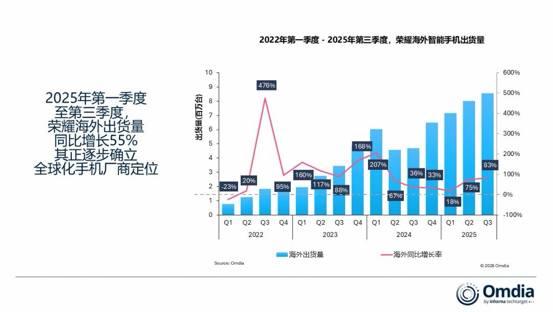
Core Insights - The global smartphone market is projected to grow in 2025, with an expected shipment volume of 1.26 billion units, reflecting a year-on-year increase of 1.9% [1] - Chinese smartphone manufacturers are increasingly focusing on both domestic and overseas markets, with significant growth in international shipments, particularly for Honor [1][3] Industry Overview - The smartphone industry is experiencing a recovery phase, but it still faces long-term challenges [1] - Chinese manufacturers hold approximately 60% of the global smartphone shipment share, with brands like OPPO, vivo, Xiaomi, and Honor leading the market [1] - Honor's overseas smartphone shipments are expected to grow by about 55% year-on-year in the first three quarters of 2025, marking significant international expansion [1][3] Strategic Shifts - Chinese companies are adopting two main strategies for overseas markets: full AI integration and brand premiumization [3] - Honor's international business has undergone a structural transformation, with overseas shipments rising from less than 10% of total shipments in early 2021 to nearly 50% by the third quarter of 2025 [3] - The competition is shifting from a focus on scale to a focus on stability and capability, with high-end positioning becoming essential for profit restructuring and brand recognition [6][9] Market Positioning - Honor is targeting the mid-to-high-end market segment, with 23% of its overseas shipments in the $300–500 price range during the first three quarters of 2025 [4] - Europe is a critical battleground for high-end consumer electronics, and Honor aims to solidify its position in key Western European markets [6] - Latin America and the Middle East and Africa are emerging as core regions for Honor's overseas shipment growth [6] Product Development - Product strength is crucial for penetrating the high-end market, with manufacturers enhancing their high-end offerings [7] - Honor has introduced innovative products like the Magic8 series and the ROBOT PHONE, which integrates AI capabilities and advanced imaging [7][8] - The AI capabilities of Chinese manufacturers are becoming a competitive advantage, with advancements in localized AI applications enhancing user experience [8][9] Future Outlook - The trends of high-end positioning and globalization are expected to continue shaping the market landscape [8][9] - Honor's "Alpha Strategy," launched in March 2025, signifies its transition from a smartphone manufacturer to a leading AI terminal ecosystem company, with global shipments projected to exceed 71 million units [9] - The new management team faces the challenge of balancing scale expansion, AI capability implementation, and profitability to maintain a leading position in the competitive landscape [9]

未知机构:中泰科技消费丨家电TCL电子拟和索尼成立合资公司经营索尼品牌电视中资在全-20260121
未知机构· 2026-01-21 02:15
Summary of Conference Call Notes Company and Industry Involved - **Company**: TCL Electronics - **Partner**: Sony - **Industry**: Consumer Electronics, specifically Television Manufacturing Core Points and Arguments - **Joint Venture Formation**: TCL Electronics and Sony announced the establishment of a joint venture to operate Sony-branded televisions, with TCL holding a 51% stake and Sony 49%. The new company is set to commence operations on April 27, 2026 [1] - **Business Transition**: Between 2026 and 2027, Sony will transfer its television-related operations, including factories, logistics, and after-sales services, to the joint venture, which will continue to operate under the "Sony" and "BRAVIA" brands [1] - **Sony's Market Share Decline**: Sony's share of the global television market has decreased from 6% in June 2015 to 3.7% in 2025, indicating a weakening position in the television sector [1] - **Strategic Benefits for Sony**: The joint venture allows Sony to revitalize its television division while retaining its brand and sharing financial profits with TCL [1] - **Advantages for TCL**: - TCL gains direct access to operate a globally recognized high-end television brand - Sony's expertise in picture and sound quality enhances the joint venture's product offerings - The combined scale of operations could potentially surpass Samsung, positioning TCL as the largest player in the global television market [2] Important but Overlooked Content - **Market Dynamics**: The partnership signifies a shift towards increased Chinese influence in the global television market, as TCL's acquisition of Sony's television operations reflects a broader trend of Chinese companies replacing South Korean competitors [2] - **Risk Consideration**: The agreement is currently in its preliminary stages, and there are uncertainties regarding the collaboration's execution and success [3]
乘用车行业点评报告:1月车市正值淡季,关注高端化、智能化主线
CAITONG SECURITIES· 2026-01-20 10:35
Investment Rating - The industry investment rating is "Positive" (maintained) [1][8] Core Insights - In January 2026, the passenger car market and the new energy vehicle market showed weak performance due to market policies. According to the China Passenger Car Association, retail sales of passenger cars from January 1 to 11 were 328,000 units, down 32% year-on-year and 42% month-on-month; among these, new energy vehicle retail sales were 117,000 units, down 38% year-on-year and 67% month-on-month, with a penetration rate of 35.5% for new energy vehicles [4] - The decline in sales is attributed to policies falling short of expectations. The reduction in purchase tax exemptions and the proportional subsidies have increased costs for mid-to-low-end vehicles, leading to a stronger consumer wait-and-see sentiment. This has resulted in a shift back to traditional fuel vehicles, and the anticipated demand release in January did not materialize [4] - The weakening demand for passenger cars is not necessarily negative, as it allows for clearer visibility of the competitive landscape in the mid-to-low-end market. The current market is characterized by a high preference for cost-effectiveness, and the focus remains on the new car cycle, with expectations for a surge in new car launches around the Beijing Auto Show in late April [4] Summary by Sections Market Performance - The passenger car market is currently in a seasonal downturn, with a significant drop in sales figures for both traditional and new energy vehicles [4] Investment Recommendations - The report suggests maintaining the existing strategy for the automotive sector, focusing on: 1. **High-end Market**: Recommend companies with a strong brand and clear competitive advantages, such as Jianghuai Automobile and Xiaomi Group, while paying attention to the new car cycle of BAIC Blue Valley [4] 2. **Intelligent Vehicles**: Highlighting the importance of smart technology in the automotive sector, with a core recommendation for XPeng Motors [4] 3. **Overseas Expansion**: While acknowledging the long process of overseas expansion, BYD is recommended for its potential contributions from international markets [4]
强达电路:深耕PCB细分领域以技术与创新铸就高成长性
Huan Qiu Wang· 2026-01-20 06:33
Core Viewpoint - The company, Qiangda Circuit, is a leading player in the high-end PCB market, demonstrating strong growth and resilience in the face of industry challenges, driven by its unique competitive advantages and strategic focus on small-batch, high-quality production [1][5][6]. Group 1: Company Overview - Qiangda Circuit, established in 2004, specializes in high-end PCB samples and small-batch boards, recognized as a top 100 enterprise in the electronic circuit industry for three consecutive years from 2022 to 2024 [3]. - The company has nearly 3,000 active clients, including over 100 listed companies, establishing long-term partnerships through rapid response and flexible manufacturing capabilities [3]. Group 2: Financial Performance - In the first three quarters of 2025, Qiangda Circuit achieved a revenue of 706 million yuan and a net profit of 96.32 million yuan, reflecting steady growth [1]. - For the first half of 2025, the company reported a revenue of 456 million yuan, a year-on-year increase of 17.25%, and a net profit of 58.75 million yuan, up 4.87% year-on-year [5]. Group 3: Competitive Advantages - Qiangda Circuit's success is attributed to its "rapid response + flexible production + technological leadership" strategy, which enhances its delivery efficiency [4]. - The company holds 133 authorized patents, including 12 invention patents, and invests significantly in R&D, focusing on cutting-edge technologies such as automotive radar and AI servers [4]. Group 4: Future Outlook - The company plans to expand into high-layer boards and HDI boards while consolidating its position in the high-end sample and small-batch board markets [6]. - With the global PCB industry moving towards high-end and refined products, Qiangda Circuit is well-positioned to capitalize on emerging opportunities in sectors like AI servers and new energy vehicles [5][6].
财政部:扩展设备更新贷款支持领域,增加航空器材、人工智能等领域
Xin Lang Cai Jing· 2026-01-20 04:33
Core Viewpoint - The Ministry of Finance has issued a notice to optimize the implementation of the financial subsidy policy for equipment renewal loans, expanding the supported sectors significantly [1] Group 1: Expanded Support Areas - The policy now includes additional sectors such as construction and municipal services, energy equipment, aviation materials, electronic information, safety production, facility agriculture, fishing vessels, cold chain facilities, grain and oil processing, waste recycling, small hydropower, commercial facilities, artificial intelligence, and elderly care [1] - The focus is on enhancing support for high-end, intelligent, green, and digital equipment renewal [1]
财通证券:汽车销量走弱来自政策的不及预期 关注高端化智能化主线
智通财经网· 2026-01-20 03:53
Core Viewpoint - The passenger car market and new energy vehicle market are showing weak performance due to market policies, but the overall vehicle sector is believed to have bottomed out after multiple adjustments. The company maintains its existing vehicle strategy and suggests focusing on three structural directions: high-end, intelligent, and overseas expansion [1][3]. Market Performance - From January 1 to 11, 2026, nationwide retail sales of passenger cars reached 328,000 units, representing a year-on-year and month-on-month decline of 32% and 42%, respectively. Among these, new energy vehicle sales were 117,000 units, with a year-on-year and month-on-month drop of 38% and 67%. The penetration rate of new energy vehicles stands at 35.5% [2]. Demand Weakness Analysis - The decline in sales is attributed to policies falling short of expectations. The reduction in purchase tax and the proportional subsidy have increased costs for consumers in the mid-to-low-end market, leading to a stronger wait-and-see sentiment among buyers. This has resulted in a shift back to traditional fuel vehicles, with anticipated demand in January not materializing. The effectiveness of the subsidy policy appears weak at this time [3]. Market Dynamics - Weak demand for passenger cars may not necessarily be negative, as it could clarify the competitive landscape in the mid-to-low-end market. The current market is characterized by a high preference for cost-effectiveness, and the focus remains on the new car cycle. The market is currently in a low season with fewer new car launches, but a wave of new car releases is expected around late April during the Beijing Auto Show [4]. Investment Recommendations - High-end Focus: Given the weak performance in the mid-to-low-end market, the company recommends selecting firms with structural beta and a clear high-end path, such as Jianghuai Automobile and Xiaomi Group, while paying attention to the new car cycle of BAIC Blue Valley [5]. - Intelligent Development: Intelligent technology is seen as a necessary path for the next phase of the automotive industry, with a core recommendation for XPeng Motors, focusing on opportunities related to new valuations [5]. - Overseas Expansion: Although the process of overseas expansion is lengthy, opportunities still exist, with BYD being a key recommendation, particularly regarding its overseas progress and potential profit contributions [5].

2025手机大战:华为赢销量,苹果守利润,米OV被夹击
首席商业评论· 2026-01-19 05:09
Core Viewpoint - The smartphone market in 2025 is characterized by intense competition and differentiation, with Apple and Samsung maintaining their dominance while other brands like Huawei, Xiaomi, vivo, and OPPO face significant challenges [5][9]. Global Market Summary - The global smartphone market saw a 1.9% growth in 2025, with total shipments reaching 1.26 billion units. Apple and Samsung accounted for nearly 40% of the market share, with shipments of 247.8 million (up 6.3%) and 241.2 million (up 7.9%) respectively [6][7]. - Xiaomi, vivo, and OPPO experienced mixed results, with Xiaomi's shipments declining by 1.9% to 165.3 million, while vivo and OPPO saw slight increases and decreases in their market positions [6][7]. Chinese Market Summary - In China, the smartphone market saw a slight decline of 0.6% in 2025, with total shipments of 28.46 million units. Huawei reclaimed the top position with 46.7 million units (16.4% market share), narrowly surpassing Apple at 46.2 million units (16.2% market share) [8][10]. - The competition among the top five brands in China is fierce, with Huawei, Apple, and vivo closely contesting for market share, while Xiaomi and OPPO lag behind [8][10]. Competitive Dynamics - Huawei's success is attributed to its self-developed Kirin chips and the growing maturity of its HarmonyOS ecosystem, which enhances user experience across devices [15][19]. - Apple, despite losing the annual championship, demonstrated strong brand loyalty and market presence, particularly in the high-end segment, achieving a 21.1% market share in Q4 2025 [12][17]. - The competition among Xiaomi, vivo, and OPPO is marked by varying strategies, with Xiaomi focusing on global expansion and automotive ventures, while vivo maintains a stable domestic presence and OPPO struggles with market share [21][24]. Future Outlook - The smartphone market is expected to face challenges in 2026, with predictions of a 3-4% decline in overall shipments. However, the high-end market is projected to grow, leading to increased competition and differentiation based on cost and technology [26][28]. - Key trends for 2026 include the rise of foldable phones and AI integration, with companies like Apple and Huawei preparing to enhance their product offerings in these areas [29][32]. - The market will likely see a consolidation of power among leading brands, with those possessing strong brand equity and technological capabilities gaining a competitive edge [33].


古越新章 智风和畅——绍兴传统产业以创新突破发展瓶颈
Shang Hai Zheng Quan Bao· 2026-01-18 18:15
Core Viewpoint - Shaoxing is experiencing a transformation in its traditional industries through green and intelligent upgrades, maintaining its historical essence while adapting to modern trends [1] Industry Summary - The textile, pharmaceutical, and chemical industries, which have historically formed the foundation of Shaoxing's economy, are revitalizing through innovation and technology integration [1] - The manufacturing sector in Shaoxing is showing significant growth, with the industrial added value of above-scale enterprises increasing by 9.8% year-on-year from January to November 2025 [1] Company Summary - Xilinmen, starting from small workshops, focuses on health sleep solutions by integrating innovative technology into smart mattresses [1] - Wanfeng Co., known for its substantial R&D investments, is leading the green upgrade in high-end printing and dyeing, beginning with a high-temperature dye [1] - The computer communication and electronic equipment manufacturing industry, representing new growth momentum, achieved a growth rate of 20.1%, while the chemical raw materials and chemical products manufacturing industry also saw a 20% increase [1]
我省三大产业优化升级实施方案落地
Xin Lang Cai Jing· 2026-01-18 17:25
Group 1: Core Insights - The Anhui provincial government has approved three implementation plans focusing on the optimization and upgrading of the non-ferrous metals, building materials, and textile industries, aiming for high-quality development in manufacturing [1][2] - The non-ferrous metals industry is a key pillar for Anhui, with a target to exceed 500 billion yuan in revenue by 2027, cultivating two trillion-level industries (copper and aluminum) and two hundred billion-level industries (magnesium and lead) [1] - The building materials industry is competitive, with cement and glass as trillion-level segments, aiming for 270 billion yuan in revenue by 2027 and the establishment of 20 advanced intelligent factories and 50 provincial-level green factories [2] - The textile industry is crucial for Anhui's economy, with a goal of achieving approximately 120 billion yuan in revenue by 2027, fostering 2-3 nationally recognized consumer brands, and improving energy efficiency and recycling of textile waste [2] Group 2: Industry-Specific Goals - The non-ferrous metals sector aims for significant breakthroughs in key technologies and enhanced resource security, with a focus on creating innovative enterprises and industrial clusters [1] - The building materials sector emphasizes innovation with products like flexible foldable glass and high-generation display glass substrates, maintaining a leading market share domestically [2] - The textile industry is positioned as a vital part of the manufacturing strategy, enhancing competitiveness and creating new economic growth points through optimization and upgrading [2]
数码家电行业周度市场观察-20260118
Ai Rui Zi Xun· 2026-01-18 05:08
Investment Rating - The report does not explicitly provide an investment rating for the digital home appliance industry Core Insights - The digital home appliance industry is undergoing a transformation driven by data quality and AI integration, with a focus on high-end market growth and consumer emotional value [2][5] - The report highlights significant trends in various sectors, including the rise of AI in logistics, healthcare, and retail, emphasizing the importance of data-driven decision-making and technological innovation [5][8] Industry Environment - Data quality is more critical than algorithms in determining the effectiveness of AI, with successful companies maintaining clean and unified data [2] - The 2025 report on China's high-end home appliance market indicates a 10.2% year-on-year growth in retail sales, driven by consumer demand for emotional value and quality [2] - The healthcare AI market is projected to reach 16.4 billion yuan in 2024, with significant advancements in efficiency and precision in medical applications [5] - The logistics sector is expected to grow to 965.5 billion yuan by 2025, transitioning from scale competition to value-driven strategies [5] - The smartphone market is experiencing a shift towards AI integration, with AI smartphones expected to account for 15% of global shipments by 2024 [5] - The retail industry is facing challenges in data integration and supply chain efficiency, with AI technologies being pivotal for transformation [5] Top Brand News - Honor aims to regain market share through AI smartphones and overseas expansion, facing competition from established players [19] - Ant Group is enhancing its C-end applications with AI health solutions, targeting the underserved market [20] - Xiaomi's flagship model features advanced AI capabilities, aiming to strengthen its hardware ecosystem [21] - DingTalk is expanding into AI hardware, marking a strategic shift in its offerings [21] - ByteDance is significantly increasing salaries to attract AI talent, reflecting the competitive landscape in the AI sector [23]


