
产业升级

Search documents
“真金白银”投入 “创新”成高频词 | 观察·外资持续给中国经济投下信任票↓
Yang Shi Wang· 2025-08-31 05:25
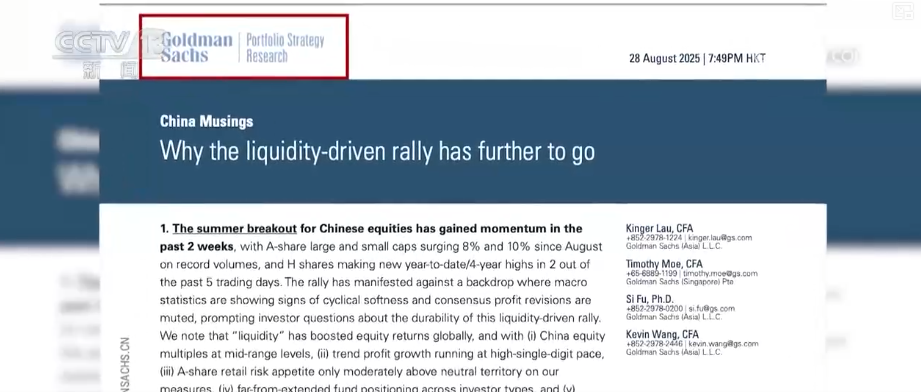
Group 1 - Multiple international investment banks have raised their forecasts for China's economic growth for the year and shifted their asset allocation recommendations from neutral to "overweight" [1][3] - Goldman Sachs maintains an "overweight" stance on Chinese stocks, while Standard Chartered Bank also keeps its "overweight" rating for Chinese equities in its global market outlook for the second half of 2025 [3] - Hedge funds have rapidly increased their net purchases of Chinese stocks, with China being the largest market for net purchases by hedge funds in August [5] Group 2 - Data from the State Administration of Foreign Exchange shows that foreign capital net increased holdings of domestic stocks and funds by $10.1 billion in the first half of 2025, with significant increases in May and June [7] - Foreign financial institutions are optimistic about the upcoming fourth quarter, with S&P Global maintaining China's sovereign credit rating at "A+" with a stable outlook [9] - Foreign investors are focusing on high-end manufacturing, technological innovation, and consumption sectors that align with China's economic transformation [10] Group 3 - Qualified Foreign Institutional Investor (QFII) holdings indicate that as of August 27, QFII entered 374 new stocks in the second quarter and increased holdings in 157 stocks, primarily in chemicals, pharmaceuticals, machinery, and power equipment [12] - Technology innovation is a recurring theme in reports from foreign financial institutions, highlighting China's capabilities in AI, innovative pharmaceuticals, humanoid robots, and smart driving [13][16] - Foreign financial institutions have significantly increased their research efforts on Chinese listed companies, with 680 foreign institutions conducting over 5,620 A-share company surveys in 2025 [14][17]




东北又一座“空城”诞生?房价从1万跌至6千,本地人却大量“逃离”
Sou Hu Cai Jing· 2025-08-31 02:20
Core Insights - The article discusses the decline of a resource-dependent city in Northeast China, highlighting the significant drop in property prices and population outflow as indicators of its economic struggles [1][2]. Group 1: Economic Decline - The city's property prices have plummeted from over 10,000 yuan per square meter to around 6,000 yuan, representing a decline of over 40% [1]. - The local population has decreased from approximately 1 million in 2015 to about 750,000 in 2025, indicating a loss of nearly 25% in just ten years [1]. Group 2: Resource Depletion - The city's economy was heavily reliant on coal, with peak annual production reaching 20 million tons, providing over 100,000 jobs [3]. - By 2024, the available coal reserves had dwindled to less than 20% of their peak, leading to the closure of numerous mines and significant job losses [3]. Group 3: Industrial Transition Challenges - The local economy is overly dependent on resource-based industries, which account for 65% of the secondary sector, while high-tech industries only make up 5% [4]. - The transition to new industries is hindered by a lack of technology, talent, and market access, despite government support [4]. Group 4: Employment Issues - In 2024, the city created only 35,000 new jobs, while the number of new labor entrants, including graduates, was 62,000, highlighting a significant employment gap [5]. - High-paying job opportunities are scarce, prompting local talent to seek better prospects in southern cities [5]. Group 5: Housing Market Dynamics - The city's real estate market is experiencing a downturn, with a 38% year-on-year decrease in property transactions in the first half of 2025, marking a ten-year low [6]. - High vacancy rates are evident, with some residential complexes having less than 40% occupancy [6]. Group 6: Demographic Shifts - The aging population is becoming a pressing issue, with 23% of residents aged 65 and older, significantly above the national average [6]. - The outflow of young people exacerbates the demographic imbalance, leading to a decline in the city's vitality [6]. Group 7: Climate and Environmental Factors - Harsh winter conditions, with an average annual temperature of 4.3°C and winter lows reaching -30°C, contribute to the migration towards warmer southern regions [7]. Group 8: Public Service Deficiencies - The city faces significant gaps in healthcare and education services, with a low number of doctors per capita and a lack of prestigious universities, driving families to relocate for better opportunities [8]. Group 9: Digital Economy Lag - The city ranks low in digital economy development, with less than 15% of its GDP coming from this sector, compared to over 30% in developed cities [9]. Group 10: Business Environment Challenges - Administrative inefficiencies and high operational costs deter businesses, with low scores in service efficiency and bureaucratic processes [9]. Group 11: Cultural and Lifestyle Factors - The lack of diverse cultural and recreational activities in the city compared to larger urban areas diminishes its attractiveness to younger generations [10]. Group 12: Impact of Falling Property Prices - The decline in property values has led to a significant reduction in residents' wealth, with an estimated loss of 400,000 yuan in value for a typical 100-square-meter home from 2020 to 2025 [10]. - This decline in wealth is likely to suppress consumer spending, contributing to a downward economic spiral, as evidenced by a 5.8% drop in retail sales in 2024 [10]. Group 13: Path to Recovery - The article suggests that the city must undergo a transformation to diversify its economy and reduce reliance on single-resource industries [11]. - Successful case studies indicate that cities should focus on their unique strengths and develop suitable industries rather than chasing high-profile sectors [11]. Group 14: Urban Quality Improvement - Enhancing urban quality through better infrastructure, cultural offerings, and environmental improvements is essential for attracting residents and businesses [13]. Group 15: Digital Transformation Opportunities - Embracing digital transformation and developing smart city initiatives can provide new growth avenues for the city [13]. Group 16: Community Involvement - The article emphasizes the need for collaborative efforts among government, businesses, and citizens to facilitate the city's long-term recovery and transformation [14].

最新GDP发布!广东继续领跑,山东稳居第三,浙江首次跨入“9万亿俱乐部”
Sou Hu Cai Jing· 2025-08-31 01:44
Core Insights - The GDP data for the first half of 2025 reveals a dynamic and evolving landscape of China's economic development, highlighting both the consolidation of leading regions and the emergence of new competitive dynamics [1] Group 1: Economic Performance - Guangdong maintains its position as the economic leader with a GDP of 68,725.4 billion RMB, adding 2,085.4 billion RMB in economic output compared to the same period in 2024 [3] - Jiangsu follows closely with a GDP of 66,967.8 billion RMB, achieving an economic increment of 2,543.8 billion RMB, surpassing Guangdong's growth by 458.4 billion RMB [3] - Shandong ranks third with a GDP of 50,046 billion RMB, showing a nominal growth rate of 4.5% and an economic increment of 2,157 billion RMB [3] Group 2: Emerging Competitors - Zhejiang's GDP reached 45,004 billion RMB, with a notable economic increment of 2,450 billion RMB and the highest nominal growth rate of 5.76% among the top four provinces [4] - The competition intensifies among provinces ranked fifth and below, with Sichuan (31,918.2 billion RMB) and Henan (31,683.8 billion RMB) closely contending for position [4] - Hubei's GDP stands at 29,642.61 billion RMB, with a remarkable nominal growth rate of 6.22%, driven by post-pandemic recovery and industrial optimization [4] Group 3: Structural Trends - The economic development model is shifting from scale expansion to quality enhancement, as evidenced by Hubei's leading growth rate [11] - The rise of central and western regions is notable, with Sichuan emerging as a key economic driver in the west and Henan transitioning from agriculture to industry [11] - Innovation is becoming a crucial growth engine, with provinces like Zhejiang leveraging digital economy and Jiangsu focusing on advanced manufacturing [11] Group 4: Quality of Growth - Provinces are increasingly prioritizing growth quality, with Shanghai leading in per capita GDP despite its overall GDP ranking [12] - The focus on improving living standards and social welfare is evident across provinces, reflecting a broader commitment to sustainable development [12] - The competition among provinces is expected to intensify in the second half of 2025, driving continuous improvements in development quality and business environments [13]

工业企业利润增速降幅收窄,三季度末预计小幅转正|宏观经济
清华金融评论· 2025-08-30 10:48
Core Viewpoint - The industrial enterprises' revenue and profit data for July 2025 indicate a slight stabilization in growth, with expectations for improved profit growth in the third quarter compared to the second quarter due to factors like "anti-involution" benefiting some upstream industries [1][21]. Revenue Analysis - In July, the revenue of industrial enterprises increased by 0.9% year-on-year, remaining stable compared to the 1.0% growth in May and June. The cumulative revenue growth for the first seven months was 2.3%, slightly lower than the 2.5% in the first half of the year [2][3]. - The revenue growth trend shows a continuous slight slowdown over four months from April to July, with April's revenue growth at 2.6% and March at 4.2% [2]. Profit Performance - The total profit of industrial enterprises in July decreased by 1.5% year-on-year, an improvement from the 4.3% decline in June. The cumulative profit for the first seven months showed a decline of 1.7%, slightly better than the 1.8% drop in the first half [3][12]. - The profit margin for the first seven months was 5.15%, down by 0.21 percentage points year-on-year, with a slight improvement in July's profit margin compared to June [6][7]. Industry Breakdown - Positive profit growth in the first seven months was concentrated in four sectors: upstream raw materials (e.g., non-ferrous metals, steel), midstream equipment manufacturing, essential consumer goods, and some public utilities [8][9]. - The sectors with the highest profit growth included non-ferrous mining (39.1%), food manufacturing (10.6%), and transportation equipment (24.8%). Conversely, the coal industry saw a significant profit decline of 55.2% [10][13]. Marginal Changes in Profitability - The "anti-involution" trend has led to profit improvements in some upstream industries, with raw materials manufacturing profits rebounding from a 5% decline in June to a 36.9% increase in July [11][12]. - High-tech manufacturing profits increased by 18.9% in July, with notable growth in aerospace and semiconductor-related sectors [12][13]. Inventory and Debt Analysis - As of the end of July, the inventory of industrial enterprises showed a year-on-year increase of 2.4%, indicating a significant reduction in inventory levels over the past four months [16]. - The asset-liability ratio for industrial enterprises remained stable at 57.9%, with a slight year-on-year increase of 0.2 percentage points, reflecting cautious capital expenditure and investment sentiment [18]. Future Outlook - The profit growth for industrial enterprises in the third quarter is expected to be better than in the second quarter, with potential for cumulative profit growth to turn slightly positive by the end of the quarter [21][22].

院士企业家支招“二次创业”,佛山举行“十五五”规划专家座谈会
2 1 Shi Ji Jing Ji Bao Dao· 2025-08-30 06:45
Group 1: Core Insights - The city of Foshan is entering a "transitional phase" as it shifts from high-speed growth to a focus on quality and efficiency in its development strategy [1] - The meeting highlighted the need for Foshan to undergo a "second entrepreneurship" through industrial upgrading, urban branding, and cultural economy [1][2] - Key themes for Foshan's future include "intelligent, cutting-edge, and green" industrial transformation, as emphasized by experts [2][3] Group 2: Industrial Transformation - Foshan faces challenges such as weak high-end talent attraction and low venture capital participation, despite its traditional industrial advantages [2] - The establishment of research platforms like Jihua Laboratory aims to convert research density into industrial concentration, requiring collaboration between government and enterprises [2] - Recommendations include leveraging local funds and attracting market-oriented investment to create a closed-loop system for project funding and industrial support [2] Group 3: Global Engagement - Foshan must address how to expand its enterprises globally in the "post-American era," transitioning from "scale dividends" to "innovation dividends" [3] - The city is encouraged to deepen cooperation with Hong Kong and Macau, exploring joint industrial funds and facilitating cross-border transactions [3] Group 4: Cultural and Brand Development - Foshan needs to enhance its "soft power" by improving its image and narrative, moving beyond its identity as a manufacturing hub [6] - Suggestions include creating aesthetic landmarks and integrating cultural resources to enhance the city's appeal and attract talent [6][7] - The city is urged to develop a unique promotional slogan to foster a warmer, more relatable image that resonates with younger generations [7] Group 5: Systemic Challenges - Foshan's economic slowdown and declining city reputation are identified as significant challenges, necessitating a comprehensive restructuring of its industrial, functional, spatial, and image systems [7][8] - The city faces multiple contradictions, such as a high manufacturing ratio with underdeveloped service sectors and disparities in public services despite low urban-rural income ratios [8] - The goal is to achieve a balanced development model that integrates manufacturing strength with service sector growth and equitable resource distribution [8]

你好,小镇丨安徽东联:东立潮头
Yang Guang Wang· 2025-08-30 05:27
编者按:小镇烟火气,最抚凡人心。乡镇是连接城乡的枢纽,也是承载中国文明传承与现代化发展协调统一的关 键一环。为贯彻落实党的二十届三中全会精神,央广网特别策划推出《你好,小镇》系列主题报道,走进全国特 色乡镇,以"接地气、烟火气、有朝气"的融媒体表达,讲述小镇的人与事,从不同维度探索中国式现代化的乡镇 实践路径与经验,展现气象万千的魅力中国。 当第一缕晨光漫过江面,货船的汽笛揉碎薄雾,安徽省铜陵市义安区东联镇在钢铁与晨露的交响中醒来。 天气晴朗时,东联镇一家钢铁企业的技术骨干陈宗斌常常带着儿子沿着湿地公园慢跑。多年前,他站在江苏无锡 的高楼里眺望家乡;如今,他与家人的每一步都踏着小镇新生的脉搏。他的故事,恰似一支画笔,将产业升级的 铿锵、烟火街巷的温热、田园栖居的诗意,绘进"东立潮头"的壮阔画卷里。 东联镇航拍图(央广网记者 徐鹏 摄) "工业医生"的共富故事 "在别人眼里我是工人,其实我更像'医生'。"在公司的车间里,陈宗斌手持听针贴近轰鸣的轧机,耳朵紧贴金属 表面,金属的"心跳"通过针尖传到耳中,"这台设备的'心跳'必须稳,参数就像人的血压,差一丝都可能'生病'。" 陈宗斌如今是厂里的"设备医生"。"经我们 ...

大庆萨尔图区:调研桌搬到车间 科技红利“流”进企业
Zhong Guo Fa Zhan Wang· 2025-08-29 12:45
Core Insights - The Daqing City Economic Development Bureau has been actively facilitating connections between high-tech enterprises and academic institutions to enhance product development and industrialization, resulting in significant revenue increases for companies like Shengkun Instrument Manufacturing Co., which reported a revenue boost of over 3 million yuan [1][2] Group 1: Government Initiatives - The Economic Development Bureau has been conducting on-site visits to various high-tech and small-to-medium enterprises, focusing on understanding their challenges and providing tailored solutions [1] - The bureau's approach includes direct engagement with company leaders and technical staff to discuss issues such as talent acquisition and funding for technology transfer [1][2] Group 2: Economic Impact - The collaboration between the bureau and enterprises has led to successful projects, such as the "blocking ball" research project by Xinwantong, which is expected to generate an economic benefit of 15 million yuan upon production [2] - The ongoing support from the bureau aims to ensure that innovative ideas from laboratories are transformed into marketable products, thereby stabilizing and energizing the industrial upgrade in the Daqing region [2]
科技创新释放产业升级红利:1688泰州“平台经济+产业带”培育计划启动
Sou Hu Cai Jing· 2025-08-29 12:17
Core Viewpoint - The collaboration between the Taizhou Market Supervision Administration and Alibaba's 1688 platform aims to enhance the digital transformation and high-quality development of local manufacturing enterprises through a comprehensive support plan [1][3]. Group 1: Special Support for Taizhou Manufacturing Enterprises - A special support plan has been launched for 300 manufacturing enterprises in Taizhou, which includes measures such as traffic support, operational training, supply chain upgrades, and localized services [3]. - Taizhou is focusing on a comprehensive digital transformation of its industrial system, promoting the integration of "platform + industry" to enhance small enterprises' connection with major platforms [3]. Group 2: Platform and Industry Integration - The 1688 platform, as China's largest B2B supply chain platform, has an annual online transaction scale exceeding 800 billion yuan, serving over one million industry merchants [5]. - The initiative aims to help Taizhou enterprises achieve three major advancements: enhancing product quality to establish a "Taizhou manufacturing" brand, building a resilient supply chain ecosystem through digital tools, and facilitating global market access for local brands [5][6]. Group 3: Technological Innovation and Industry Upgrading - The 1688 industrial procurement trend report highlights that product innovation is driving new trends in industrial procurement, with new materials, processes, energy sources, and smart technologies being key areas of focus [7]. - Data from super factories on the platform shows significant increases in search volumes for automated production machinery (up 55%), low-altitude drones for agriculture (up 18%), and smart city flood prevention robots (up 270%) [7]. - The initiative will inject new momentum into Taizhou's specialized industrial clusters, including fine chemicals, shipbuilding, pharmaceuticals, and food processing, promoting high-end, intelligent, and green development [7].

长盛同盛LOF: 长盛同盛成长优选灵活配置混合型证券投资基金(LOF)2025年中期报告
Zheng Quan Zhi Xing· 2025-08-29 11:29
Fund Overview - The fund is named Changsheng Tongsheng Growth Preferred Flexible Allocation Mixed Securities Investment Fund (LOF) and was established on December 26, 2014 [3] - The fund is managed by Changsheng Fund Management Co., Ltd. and custodied by Bank of China [2][3] - The fund aims to achieve long-term asset appreciation by focusing on sectors related to economic transformation, industrial upgrading, model innovation, and policy hotspots [3] Investment Strategy - The fund employs a combination of top-down industry selection and bottom-up stock picking to identify companies with high growth potential and reasonable valuations [3] - The asset allocation strategy involves dynamic adjustments among stocks, stock index futures, bonds, and money market instruments to control market risk and enhance allocation efficiency [3][4] Performance Metrics - As of June 30, 2025, the fund's net asset value was approximately RMB 385.95 million, with a total of 266,920,910.72 fund shares [3][20] - The fund achieved a net asset value per share of RMB 1.446, with a net value growth rate of 7.51% during the reporting period [15][20] - The fund's total realized income for the period was RMB 20.45 million, with a total profit of RMB 26.42 million [5][21] Financial Indicators - The fund's total assets amounted to RMB 388.83 million, with liabilities totaling RMB 2.87 million [19][20] - The fund's profit distribution for the reporting period was not implemented, in accordance with legal regulations and fund contract agreements [17] - The fund's performance benchmark is set at 50% of the CSI 300 Index return plus 50% of the China Bond Composite Index return [4][7] Management and Governance - The fund management company, Changsheng Fund Management Co., Ltd., was established in March 1999 and is one of the first ten fund management companies in China [8] - The company has a registered capital of RMB 206 million and manages a total of 73 open-end funds as of June 30, 2025 [8][9] - The fund management adheres to principles of honesty, diligence, and responsibility, ensuring fair treatment of all investment portfolios [12][13]

莲花控股中报解码:当调味品巨头开始“算”未来
Zheng Quan Zhi Xing· 2025-08-29 10:17
Core Insights - The domestic seasoning industry is experiencing a shift from incremental expansion to stock integration, with Lianhua Holdings achieving a revenue growth of 32.7% and a net profit growth of 60.01%, significantly outperforming the industry average [1] - Lianhua's revival strategy is based on a clear dual-driven approach of product and channel development, enhancing retail coverage and expanding digital marketing to reach new consumer demographics [2][3] - The company's focus on product innovation has led to significant growth in various segments, with amino acid seasoning revenue reaching 1.081 billion yuan, compound seasoning revenue increasing by 58.28%, and liquid seasoning revenue soaring by 916.79% [3] Business Strategy - Lianhua's strategy emphasizes maintaining its core seasoning business while gradually expanding into related capabilities, leveraging existing R&D systems, channel networks, and brand assets [3] - The company has made substantial progress in its second growth curve, the computing power business, with 34 signed projects and a contract value exceeding 1.5 billion yuan, showcasing a 209% year-on-year growth in computing service revenue [4][9] - The technology sector's layout is systematic, focusing on computing power, algorithms, and semiconductor materials, with a recent patent obtained in collaboration with Zhejiang University [7][8] Market Positioning - Lianhua's computing power business is built on a solid infrastructure, emphasizing domestic solutions and full-stack services, which redefine the deployment model for AI applications across various industries [9][10] - The company's approach illustrates a sustainable model for traditional enterprises transitioning to technology, highlighting the importance of leveraging core competencies from existing fields to enter new markets [10]

