国产替代

Search documents
东海证券晨会纪要-20251223
Donghai Securities· 2025-12-23 04:17
Group 1 - The core viewpoint of the report emphasizes that the semiconductor industry is experiencing an upward cycle, driven primarily by high growth in AI, storage, and equipment sectors. The first half of 2026 is expected to continue this structural high growth trend, while the second half will require attention to demand recovery and policy stimulation [5][6][7]. - Global semiconductor product sales from January to October 2025 showed a year-on-year increase of 21.19%, with silicon wafer shipment area increasing by 4.99% in Q1-Q3 2025. Storage module prices have surged between 140% to 600% since the beginning of 2025, indicating a significant supply-demand mismatch that may persist into the first half of 2026 [5][6]. - The report highlights that AI is experiencing a comprehensive resonance from cloud servers to edge applications, with long-term growth trends remaining strong despite short-term concerns about investment overheating. The AI industry is driving rapid growth in various upstream sectors, benefiting domestic companies in China [6][7]. Group 2 - Micron's performance exceeded expectations, with Q1 2026 revenue reaching $13.64 billion, a 57% year-on-year increase. The company anticipates further revenue growth to approximately $18.7 billion in the next quarter, driven by strong demand for high-bandwidth memory (HBM) [11][12]. - Xiaomi has launched its new large model MiMo-V2-Flash, showcasing significant performance improvements and cost-effectiveness in inference, which could accelerate the application of large models in China. The model's API call cost is only 2.5% of comparable closed-source models, indicating a breakthrough in performance-to-cost ratio [13]. - The report suggests focusing on structural opportunities in AI computing, AIOT, semiconductor equipment, and rising storage prices, as the electronic industry continues to recover from previous downturns [11][16].
5.5万台!英伟达服务器出货量有望翻倍,寒武纪涨超3%,科创芯片50ETF(588750)放量冲击三连涨!26年投资主线展望,机构:AI仍是强主线
Sou Hu Cai Jing· 2025-12-23 03:57
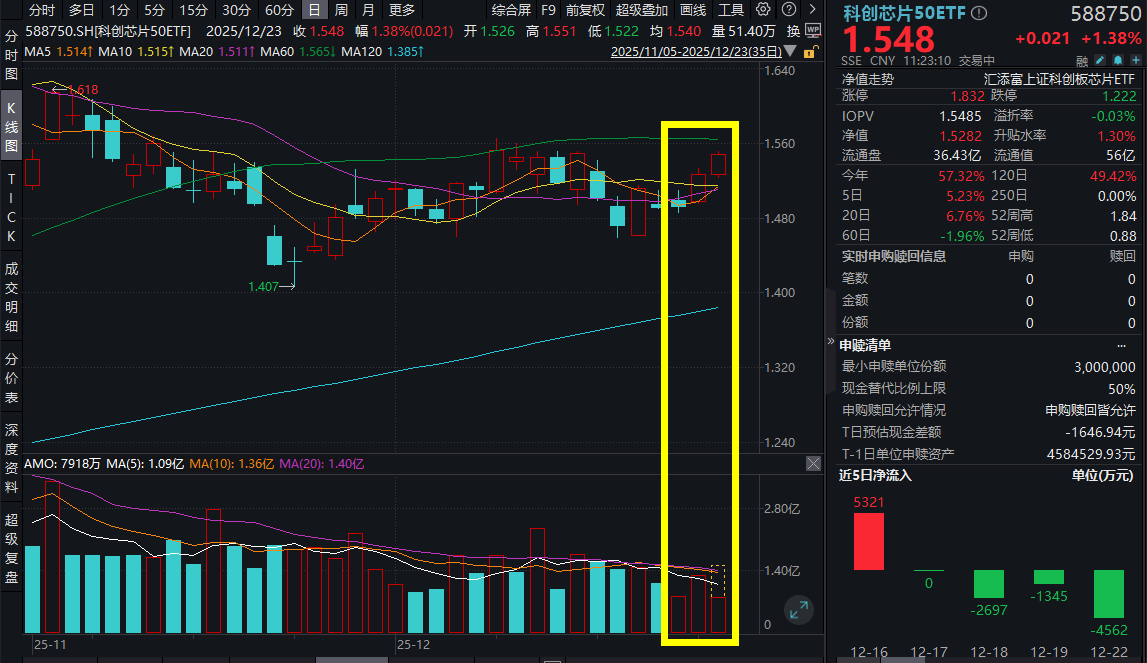
Core Viewpoint - The A-share market experienced fluctuations with the hard technology sector showing resilience, particularly the Kexin Chip 50 ETF (588750), which rose by 1.38% and achieved a trading volume exceeding 79 million yuan [1][3]. Group 1: Kexin Chip 50 ETF Performance - The Kexin Chip 50 ETF (588750) saw most of its constituent stocks rise, with Haiguang Information and Cambricon both increasing over 3%, while companies like Tuojing Technology and Yuanjie Technology rose over 1% [3]. - The top ten constituent stocks of the Kexin Chip 50 ETF include Haiguang Information and Cambricon, both of which are in the electronics sector and showed significant gains [4]. Group 2: Global Semiconductor Trends - Nvidia's stock rose nearly 2%, with plans to export H200 series chips to China in mid-February, with an expected shipment of 5,000 to 10,000 modules, corresponding to approximately 40,000 to 80,000 H200 chips [5]. - The global AI server cabinet shipments from Nvidia are projected to reach 55,000 units in the next year, marking a 129% year-on-year increase, driven by major companies like Microsoft and Meta [5]. Group 3: AI and Semiconductor Market Outlook - The AI wave is driving strong demand for chips and related hardware, with expectations for the global AI computing chip market to exceed $370 billion by 2026 and $460 billion by 2027 [7]. - The semiconductor supply chain's self-sufficiency in China is seen as a core theme with long-term investment value, supported by domestic policy and strong internal demand [6]. Group 4: Domestic AI Chip Development - China's domestic AI chip market is characterized by a diverse range of manufacturers, with significant advancements in technology and production capabilities [13]. - By 2028, China's local chip self-sufficiency rate is expected to rise to 93%, up from 58% in 2025, indicating a substantial increase in domestic production capacity [13]. Group 5: Kexin Chip Index Characteristics - The Kexin Chip 50 ETF focuses on the core segments of the semiconductor industry, with a high concentration of 96% in upstream and midstream sectors, indicating strong growth potential [17][20]. - The index's quarterly rebalancing allows it to respond quickly to trends in the semiconductor industry, enhancing its performance compared to other indices [18]. Group 6: Investment Opportunities - The Kexin Chip 50 ETF is highlighted as a high-elasticity investment option, with a maximum increase of 173% since September, outperforming peers in risk-adjusted returns [21][22]. - Investors are encouraged to consider index-based investment strategies in the Kexin Chip sector to capitalize on the ongoing demand for semiconductor technology [16].




科创芯片ETF南方(588890.SH)涨1.00%,寒武纪涨2.74%
Jin Rong Jie· 2025-12-23 03:53
Core Viewpoint - The A-share market showed slight gains, with the Sci-Tech Innovation Board leading the rise, driven by advancements in semiconductor materials and AI technologies [1] Group 1: Market Performance - The semiconductor materials sector increased by 1.47%, while the automotive chip sector rose by 0.26%, and domestic chip stocks gained 0.47% [1] - The Sci-Tech Chip ETF (588890.SH) rose by 1.00%, and Cambricon Technologies increased by 2.74% [1] Group 2: Industry Opportunities - AI inference technology is creating structural opportunities in key areas such as storage, ASIC, super nodes, and domestic computing power [1] - The storage sector is experiencing a surge in demand from data centers, coupled with breakthroughs in domestic storage technology (e.g., HBM3/SSD), leading to an upward trend in the industry chain [1] - ASIC chips are benefiting from increased demand for AI inference customization, with domestic CSP manufacturers accelerating their market share growth [1] - Upgrades in infrastructure are supporting the expansion of computing power, driven by demands for high-speed interconnects, liquid cooling, and PCB [1] Group 3: Domestic Computing Power - Improvements in advanced process yield and packaging technology, along with the commercialization of domestic large models, are gradually breaking supply-side bottlenecks [1] - The demand side is expected to see increased volume in training, with innovations at the endpoint such as AI smartphones and smart wearable devices driving upgrades in chip efficiency and integration [1] Group 4: Investment Value - The Sci-Tech Chip ETF (588890.SH) focuses on high-growth sectors such as storage, ASIC, advanced manufacturing, and endpoint innovation, presenting medium to long-term investment value amid accelerated domestic substitution and the global AI wave [1]
半导体产业链股强势 美埃科技、同飞股份等涨停
Zheng Quan Shi Bao Wang· 2025-12-23 03:08
Group 1 - The semiconductor industry is experiencing a collective rise in stock prices, with companies like Meit Technology and Tongfei Co., Ltd. reaching a 20% limit-up, and others like Anda Intelligent and Kema Technology showing significant gains [1] - In 2025, global semiconductor sales are projected to reach approximately $612.1 billion, reflecting a year-on-year growth of 21.9%, driven by demand from AI computing, data centers, and smart driving [1] - The semiconductor market in mainland China is expected to achieve sales of about $169.4 billion in 2025, with a year-on-year increase of 12.5% [1] Group 2 - According to Everbright Securities, the expansion of semiconductor sales and wafer capacity is being driven by AI computing and data center construction, particularly in advanced processes and high-bandwidth memory (HBM) [2] - There is a growing long-term demand for high-purity, low-defect semiconductor materials due to increasing technical barriers and customer certification requirements in the semiconductor materials industry [2] - Companies with technological accumulation, production capacity, and deep ties with downstream wafer manufacturers are recommended for investment, as they are likely to gain market share and profit growth amid advancements in processes and domestic substitution trends [2]

印度叫停对华钛白粉反倾销税,西湖集团关停在美4家工厂 | 投研报告
Zhong Guo Neng Yuan Wang· 2025-12-23 03:02
Industry Overview - The chemical sector showed a weekly performance ranking of 5th with a change of 2.58% from December 15 to December 19, 2025, outperforming the Shanghai Composite Index by 2.55 percentage points and the ChiNext Index by 4.83 percentage points [1] Key Insights - The chemical industry is expected to continue its differentiated trend in 2025, with a focus on synthetic biology, pesticides, chromatography media, sugar substitutes, vitamins, light hydrocarbon chemicals, COC polymers, and MDI [1] Synthetic Biology - The arrival of a pivotal moment in synthetic biology is anticipated, driven by energy structure adjustments. Traditional chemical companies will face competition based on energy consumption and carbon tax costs, with a shift towards green energy solutions and integrated advantages to reduce costs [2] - Companies like Kasei Bio and Huaheng Bio are highlighted as leaders in the synthetic biology sector [1] Refrigerants - The third-generation refrigerants are expected to enter a high prosperity cycle starting in 2024, with supply entering a "quota + continuous reduction" phase. The demand for refrigerants is projected to grow due to the development of heat pumps and the cold chain market [2] - Companies such as Juhua Co., Sanmei Co., Haohua Technology, and Yonghe Co. are positioned to benefit from this trend [2] Electronic Specialty Gases - Electronic specialty gases are critical for the electronics industry, with high technical barriers and added value. The domestic market is facing a mismatch between rapid upgrades in wafer manufacturing and insufficient high-end electronic specialty gas capacity [2] - Companies like Jinhong Gas, Huate Gas, and China Shipbuilding Gas are expected to capitalize on the domestic substitution opportunities [2] Light Hydrocarbon Chemicals - The trend towards light raw materials in the olefin industry is becoming global, with a shift from heavy naphtha to lighter low-carbon alkanes like ethane and propane. This shift is characterized by lower carbon emissions and energy consumption [3] - Satellite Chemical is recommended for investment in the light hydrocarbon chemical sector [3] COC Polymers - The industrialization of COC/COP (cyclic olefin copolymer) is accelerating in China, driven by domestic companies achieving breakthroughs and the shift of downstream industries to domestic sources [4] - Akolai is identified as a key player in the COC polymer production segment [4] Potash Fertilizers - Potash fertilizer prices are expected to rebound as the industry enters a destocking cycle, with supply constraints due to Canpotex withdrawing new quotes and Nutrien announcing production cuts [5] - Companies like Yara International, Salt Lake Potash, and Cangge Mining are noted as leading firms in the potash sector [5] MDI Market - The MDI market is characterized by oligopoly, with demand steadily increasing due to the expansion of polyurethane applications. The supply structure is expected to improve as major producers like Wanhua Chemical and BASF maintain significant market shares [6] - Wanhua Chemical is highlighted as a key company to watch in the polyurethane sector [6] Price Tracking - The top five price increases this week included SBS (4.52%), PTA (3.04%), and others, while the largest decreases were seen in nitric acid (-14.29%) and sulfur (-5.06%) [6] Supply Side Tracking - A total of 168 chemical enterprises had their production capacities affected this week, with 6 new repairs and 3 restarts reported [7]

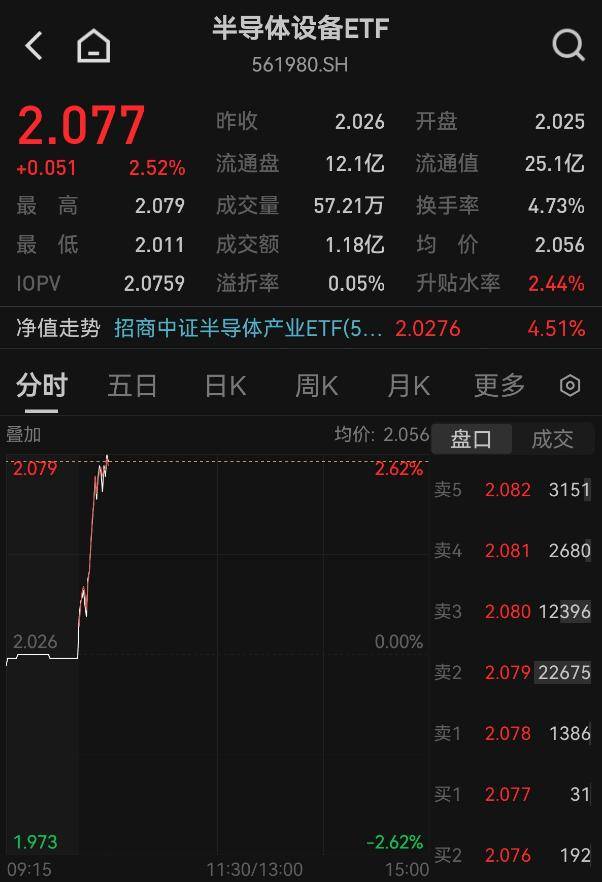
半导体设备ETF(561980)大涨2.52%,光刻机进口激增指引先进逻辑扩产爆发!
Sou Hu Cai Jing· 2025-12-23 02:55
Group 1 - The semiconductor equipment sector is experiencing a strong performance, with the semiconductor equipment ETF (561980) opening up over 2% and currently up 2.52%, driven by significant gains in constituent stocks such as Kema Technology, which surged 15% [1] - Customs data revealed that China's import value of lithography machines reached 4.6 billion yuan in November, with a total import scale of nearly 15 billion yuan for the three months from September to November, indicating a doubling compared to the entire import volume of 2023 and signaling a surge in advanced logic expansion demand for 2024 [1] Group 2 - Open Source Electronics predicts that advanced logic expansion is likely to see a significant surge in 2026, with high demand for storage already laying the foundation for semiconductor equipment orders in the coming year [2] - Guojin Securities emphasizes that semiconductor equipment is the cornerstone of the semiconductor industry chain, with ample room for domestic substitution as storage expansion and self-sufficiency resonate [2] - The International Semiconductor Industry Association (SEMI) forecasts that global semiconductor manufacturing equipment sales will reach $133 billion in 2025, a 13.7% increase year-on-year, driven by investments related to artificial intelligence [2] Group 3 - Looking ahead to 2026-2027,招商证券 believes that the growth in AI demand will accelerate global storage and advanced process capacity expansion, with the domestic equipment technology level continuously breaking through [3] - The semiconductor equipment ETF (561980) tracks the CSI semiconductor index, with nearly 60% of its components being equipment, and over 90% of the index comprising semiconductor equipment, materials, and integrated circuit design, indicating a broad space for domestic substitution [3] - As of December 22, the CSI semiconductor index has seen a year-to-date increase of 61.86%, with a maximum increase of over 80%, positioning it as the top performer among major semiconductor indices during the new semiconductor upcycle [5]
ETF盘中资讯 | 谁能成为中国的英伟达?寒武纪领涨超3%,重仓国产AI产业链——科创人工智能ETF(589520)盘中摸高0.88%
Jin Rong Jie· 2025-12-23 02:50
Group 1 - The core viewpoint of the news highlights the rapid growth of China's AI industry, particularly following the emergence of DeepSeek, which has led to a new era of domestic AI models [2] - The total market capitalization of China's top three AI chip companies, Cambricon, Moore Threads, and Muxi, has surpassed 1 trillion yuan, but there remains a significant gap compared to Nvidia's market cap of approximately 4.4 trillion USD (around 30 trillion yuan) [2] - The competition among Cambricon, Moore Threads, and Muxi is intensifying, with the potential for one to emerge as a leader in the Chinese AI chip market as market and policy benefits continue to unfold [2] Group 2 - The Sci-Tech Innovation Artificial Intelligence ETF (589520) is focused on the domestic AI industry chain and has shown a price increase of 0.88% in early trading, with a current rise of 0.18% [1] - The ETF's top ten holdings account for over 70% of its weight, with the semiconductor sector representing more than half of this concentration, indicating a strong offensive strategy [3] - East China Securities recommends focusing on the domestic supply chain due to the urgent need for domestic semiconductor production amid comprehensive overseas restrictions on advanced logic and storage industries [2]

谁能成为中国的英伟达?寒武纪领涨超3%,重仓国产AI产业链的——科创人工智能ETF(589520)盘中摸高0.88%
Xin Lang Ji Jin· 2025-12-23 02:49
Core Insights - The Chinese AI industry has made significant progress this year, particularly following the rise of DeepSeek during the Spring Festival, leading to a new era of "deep thinking" among domestic AI models [2] - The market capitalization of China's top three AI chip companies—Cambricon, Moore Threads, and Muxi—has exceeded 1 trillion yuan, but they still lag behind Nvidia's market cap of approximately 4.4 trillion USD (around 30 trillion yuan) [2] - The domestic AI supply chain is becoming increasingly important due to comprehensive restrictions on semiconductors from overseas, highlighting the urgency for domestic supply chain localization [2][3] Industry Analysis - The Sci-Tech Innovation Artificial Intelligence ETF (589520) is focused on the domestic AI industry chain, with over 70% of its top ten holdings concentrated in the semiconductor sector, indicating a high concentration and aggressive investment strategy [3] - The ETF serves as an efficient tool for investors looking to gain exposure to domestic computing power, being a financing and margin trading target [3] - Analysts suggest that the competition among Cambricon, Moore Threads, and Muxi is intensifying, and the ongoing market and policy benefits may lead to the emergence of a leading player in China's AI chip sector [2]
谁能成为中国的英伟达?寒武纪领涨超3%
Xin Lang Cai Jing· 2025-12-23 02:48
Group 1 - The core viewpoint of the news highlights the rapid growth of China's AI industry, particularly following the rise of DeepSeek during the Spring Festival, leading to a new era of domestic AI models [2] - The A-share AI chip industry is dominated by three major players: Cambricon, Moore Threads, and Muxi, with a combined market capitalization exceeding 1 trillion yuan, yet still significantly trailing behind Nvidia's market cap of approximately 4.4 trillion USD (around 30 trillion yuan) [2] - Domestic companies are accelerating their breakthroughs in the AI chip sector amidst a reshaping global landscape, with increasing competition among Cambricon, Moore Threads, and Muxi, potentially leading to the emergence of a leading player in China's AI chip market [2] Group 2 - The Sci-Tech Innovation Artificial Intelligence ETF (589520) is focused on the domestic AI industry chain, with a strong emphasis on domestic substitution characteristics, where the top ten holdings account for over 70% of the portfolio [3] - The semiconductor sector constitutes over half of the ETF's holdings, indicating a high concentration and aggressive investment strategy [3] - The ETF serves as an efficient tool for investors looking to gain exposure to domestic computing power, being a financing and margin trading target [3] Group 3 - East China Securities recommends focusing on the domestic supply chain due to the urgent need for domestic production in the semiconductor sector, particularly in advanced logic and storage industries [2] - There is significant potential for domestic companies in various fields such as equipment, components, materials, and EDA, as their global supply share remains relatively low [2] - Some domestic enterprises have achieved breakthroughs in niche markets, benefiting from accelerated localization and long-term growth in the industry [2]

H200春节前重返中国,黄仁勋有多少胜算?
Tai Mei Ti A P P· 2025-12-23 02:35
Core Viewpoint - Nvidia aims to export H200 chips to China before February 17, 2024, with an expected initial shipment of 40,000 to 80,000 units, primarily from inventory capacity [2][3] Group 1: Export Plans and Market Dynamics - Nvidia plans to increase production of H200 chips to supply the Chinese market in Q2 2024 [2] - The export of H200 chips to China is subject to significant uncertainty, as there is currently no approval from Chinese authorities for any related procurement [3] - Following the announcement by Trump allowing Nvidia to export H200 chips to China, the company must pay 25% of sales proceeds to the U.S. government [3][4] Group 2: Regulatory Environment and Challenges - The U.S. government has initiated a review process for the export of H200 chips, which may take up to 30 days, with Trump holding the final decision-making power [4] - There is opposition within the U.S. Congress regarding the export, with calls for more transparency on whether the chips could be used for military purposes [6] - Concerns about "backdoor" security risks have been raised, with previous incidents involving Nvidia's H20 chip [6][9] Group 3: Market Demand and Competition - Major Chinese tech companies like Alibaba, ByteDance, and Tencent are expected to be the first buyers of H200 chips, indicating strong demand in the AI infrastructure sector [7] - Despite the potential for Nvidia's return to the Chinese market, domestic chip manufacturers are rapidly improving their capabilities, posing a competitive threat [9] - AMD and Intel are also targeting the Chinese market, with AMD having already secured export licenses for its AI chips [10][11] Group 4: Financial Implications - The estimated sales revenue from the initial shipment of H200 chips could range from $1 billion to $4 billion, considering the market price and the required tax [8] - Nvidia's previous quarterly revenue from the Chinese market was significantly lower, indicating challenges in regaining market share [8]