资产配置

Search documents
不追热点、不加杠杆,怎样投资能睡得安稳?
Hu Xiu· 2025-08-11 04:23
这篇文章将聚焦非专业投资者都能参考的资产配置思路。我将全球可投资资产分为三类:与中国经济高 度相关的资产;与美国经济高度相关的资产;与中美经济都不怎么相关的资产。 一、房地产、股票与黄金 我之所以推荐把资产分成这三大类别,源于对全球格局的观察——当今世界的经济版图,基本由中国与 美国两股力量主导。 两国之间既有深度的经济联系,又存在激烈的竞争关系,呈现此消彼长的格局。争夺全球霸主地位是一 场长期博弈,两者将会长期对垒。 我们无法断言中国必胜美国,尽管身为中国人自然希望这一刻到来,但投资上不能被情绪驱动。中国相 关的资产,必须要配置一部分。但美国的科技与金融实力同样强大,必须承认并尊重。 2021年中国房地产触顶、美国深陷疫情时,"东升西降"一度成为投资圈的流行判断,但很快在2022年偃 旗息鼓。 本文来自微信公众号:投资人黄海 (ID:haivcconsumer),作者:黄海,头图来自:AI生成 日常生活中,不少朋友会私下向我们咨询投资建议——手中有一笔资金,该如何配置? 美国依然是一个强大的经济体。虽然已不复1990年代的巅峰,但体量与实力仍不可小觑。2025年初,随 着DeepSeek的横空出世,中国资产 ...

美国经济处于什么状态?
伍治坚证据主义· 2025-08-11 03:24
Core Viewpoint - The U.S. economy is currently in a delicate state, avoiding a hard landing but still facing underlying structural issues that could lead to future instability [2][6][7] Economic Indicators - The unemployment rate decreased to 4.1% in June 2025, with initial non-farm employment data showing an increase of approximately 147,000 jobs, although subsequent revisions revealed a significant drop to only 14,000 jobs added [2] - Average hourly wages increased by 3.9% year-on-year in June, still above the Federal Reserve's 2% inflation target, indicating that consumer income can support spending [2] GDP and Growth Dynamics - The U.S. GDP contracted by 0.3% in Q1 2025, marking the first quarterly decline since 2022, with net exports negatively impacting GDP by approximately 4.6 percentage points [3] - Consumer and private fixed investment grew by 3.0%, suggesting some internal economic support, but growth in durable goods orders and residential investment is slowing [3] Policy Environment - The "One Big Beautiful Bill" is projected to increase the budget deficit by $3.3 trillion over ten years, with a stable deficit rate around 6% of GDP, indicating ongoing high fiscal deficits that may support the economy in the short term but pose long-term sustainability risks [4] - The marginal effects of fiscal stimulus may diminish in a context of tight monetary policy [4] Trade Policy Implications - Recent trade barriers, including a 20% tariff on imports from Vietnam and a 10% base tariff on nearly all imports starting April 2025, may raise production costs and weaken international competitiveness [5] - Such protectionist measures could lead trade partners to seek alternative markets, potentially exerting downward pressure on U.S. exports [5] Capital Market Performance - The S&P 500 index rebounded quickly after a 15% decline, recovering in just 15 trading days, the fastest in 75 years, driven by expectations of interest rate stabilization and fiscal stimulus [5] - Historical data suggests that similar rebounds typically lead to average gains of 6%, 10.5%, and 16.5% over the next three, six, and twelve months, respectively [5] Structural Challenges - The current economic state resembles a temporarily balanced situation, with underlying structural issues such as productivity growth slowdown, aging population, rising debt burdens, and international trade tensions still present [6][7] - Investors are advised to remain cautious, as superficial data and market rebounds may obscure the true economic resilience [6][7]


低利率时代“稳中求进”,华夏 6 个月持有期债券开辟闲钱理财新航道
Xin Lang Ji Jin· 2025-08-11 03:09
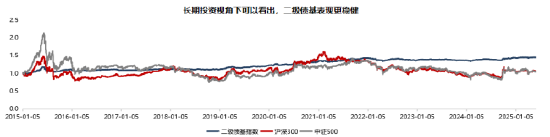
Core Viewpoint - The A-share market is characterized by multiple driving forces, with sectors like computing power, innovative pharmaceuticals, and cyclical industries alternating in performance, reflecting a complex macroeconomic environment influenced by unprecedented structural shocks [1] Market Environment - Global central banks are adopting loose monetary policies due to inflation and economic growth pressures, while China's potential economic growth is slowing as it transitions to a high-quality development model [2] - As of July 21, 2025, the yield on China's 10-year government bonds has decreased to 1.68%, highlighting the unique appeal of the bond market as a safe haven [2] - The A-share market continues to exhibit structural trends amid index fluctuations, with an increase in market risk appetite driven by profit-making effects [2] Investment Strategy - The secondary bond fund, as a representative of "fixed income +", aims to balance risk and return by investing at least 80% of its assets in bonds for stable coupon income while flexibly participating in the stock market with up to 20% of its assets [2][4] - The mixed bond secondary fund index has shown a five-year annualized return of 3.3%, significantly outperforming major indices like the CSI 300 and CSI 500, which had returns of -0.14% and 0.99% respectively [2][4] Fund Characteristics - The 华夏 6-month holding period bond fund (A Class: 024296 / C Class: 024297) is designed to invest primarily in high-grade fixed income assets with low credit risk and good liquidity, while also diversifying across different bond types [4] - The fund has a six-month holding period to minimize short-term volatility interference and encourage long-term investment, which helps in managing redemption pressure effectively [4][5] Management and Performance - The fund manager, Wu Fan, has over eight years of experience in securities and more than two years in public fund management, focusing on top-down asset allocation and macro strategy research [5] - The fund's representative product, 华夏希望债券 A, achieved a one-year net value growth rate of 5.29%, outperforming its benchmark [5] Future Outlook - In the context of low interest rates and increased market volatility, the "fixed income enhancement" strategy remains a core tool for investors to achieve their investment goals [6][7] - The current environment suggests that the bond market's profit-making effect has weakened compared to the previous year, while the equity market is expected to see increased activity and diverse investment opportunities [6][7]
恒泰证券康诚:推动投顾行业从“产品销售”向“资产配置”与“综合财富规划”转型
Xin Lang Zheng Quan· 2025-08-11 02:43
专题:第二届新浪财经金麒麟最佳投资顾问评选 新浪财经主办、银华基金独家合作的"第二届金麒麟最佳投资顾问评选"活动火热进行中! 我国财富管理行业迈入超级大年,随着居民理财意识逐渐升华,中国财富管理行业已经迎来高增长周 期,投资顾问作为财富管理"最后一公里"的引路人,其触达客户、沟通客户、服务客户的属性直接影响 着全民资产配置的走向。在此背景下,投资顾问面临哪些机遇和挑战?他们该如何"修炼内功"? 基于此,新浪财经与银华基金共同打造"金麒麟最佳投资顾问评选"品牌活动,寻找优秀投资顾问,赋能 投顾IP建设,共建展业平台!金麒麟最佳投资顾问评选活动旨在为投资顾问提供一个展示形象、扩围服 务、提升能力的舞台,为优秀投资顾问与大众投资人搭建沟通对话的桥梁,助推中国财富管理行业健康 发展。 恒泰证券顾问服务部负责人康诚受邀成为本次大赛的评审委员会评委。 康诚表示,值此新浪财经·金麒麟最佳投资顾问评选之际,谨代表恒泰证券向大赛的举办表示热烈祝 贺!作为评委,自己欣喜地看到行业精英荟萃,切磋技艺,这正是投顾行业蓬勃生命力的生动写照,希 望参赛者以赛促学,展现专业风采,更期待大家将比赛中锤炼的智慧与经验,转化为服务客户的卓越实 ...

A股分析师前瞻:存款搬家将如何影响权益市场?
Xuan Gu Bao· 2025-08-10 23:46
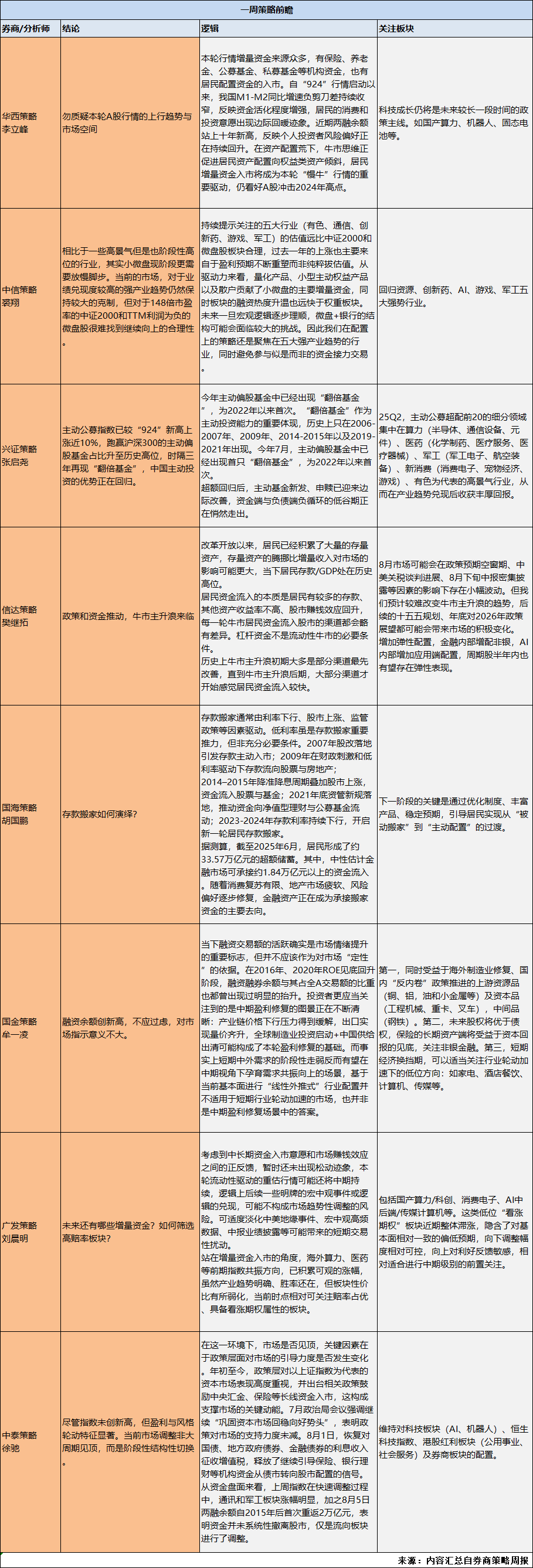
Group 1 - The focus of various brokerage strategies this week is on the impact of deposit migration on the equity market [1] - The Huaxi strategy team believes that the current upward trend in A-shares and market space should not be questioned, with margin trading balances reaching a ten-year high, indicating a recovery in individual investor risk appetite [1][2] - The Xinda strategy team highlights that the main upward wave of the bull market is coming, driven by policy and capital, with a significant amount of existing assets available for market impact [1][3] Group 2 - The Guohai strategy team estimates that by June 2025, residents will have accumulated approximately 33.57 trillion yuan in excess savings, with the financial market capable of absorbing over 1.84 trillion yuan in inflows [1][3] - The current market sentiment is reflected in the active financing transaction volume, which is an important indicator of market sentiment improvement, although it should not be the sole basis for market characterization [3] - The strategy from Zhongxin emphasizes the need to slow down in high-valuation sectors, as the market remains cautious about sectors with high earnings visibility [1][2] Group 3 - The Guangfa strategy team suggests focusing on high-odds sectors such as domestic computing power, consumer electronics, and AI, which are currently underperforming but have low downside risk and are sensitive to positive news [2][4] - The market is expected to experience fluctuations due to various factors, including policy expectations and the upcoming mid-year report disclosures [3] - The overall investment sentiment is improving, with a notable increase in the proportion of actively managed equity funds, indicating a return of active investment advantages [2][4]
做资产配置应该如何避免追涨?用科学的模型框架做多元化分散
雪球· 2025-08-10 13:04
Core Viewpoint - The article discusses the common misconception that asset allocation is synonymous with chasing rising assets, highlighting the cognitive trap that confuses market price phases with allocation logic [4][5][6]. Group 1: Investment Theory - The classic Markowitz portfolio optimization theory indicates that asset allocation is directly proportional to expected returns and inversely proportional to volatility [9]. - Historical data is often used to estimate future expected returns and volatility, leading to a "chasing" effect where assets with higher past returns receive higher allocation [10][12]. - The Black-Litterman model and other improved versions of portfolio optimization incorporate subjective investor expectations, yet still exhibit a tendency to chase rising assets due to cognitive biases [13]. Group 2: Behavioral Finance - The concept of "availability bias" in behavioral finance explains why investors tend to chase rising assets, as they rely on easily recalled information rather than comprehensive data [14]. - In the digital age, the prevalence of real-time information and social media amplifies this bias, leading to potentially detrimental investment decisions [14]. Group 3: Avoiding Chasing Behavior - Establishing an objective analysis framework is crucial for independent judgment and contrarian investing, as demonstrated by the analysis of U.S. inflation trends [16][21]. - Recommendations for avoiding chasing behavior include distinguishing between long-term logic and short-term variables, minimizing the pursuit of short-term performance, and diversifying asset allocation to create a richer "return stream" [23][24][25]. - Understanding the difference between style beta and alpha is essential for investors to avoid chasing funds based solely on past performance [28]. Group 4: Investment Strategy - The article advocates for a simplified investment strategy, such as the "Snowball Three-Part Method," which emphasizes diversification across global asset classes to mitigate volatility and enhance long-term returns [29][30].

境内“黄金+”产品征途
经济观察报· 2025-08-10 04:27
Core Viewpoint - The global capital system is undergoing a deep reassessment, with asset management institutions shifting from a "return-first" approach to a "certainty-first" strategy, highlighting the renewed importance of gold as a stabilizing asset in diverse investment portfolios [1][14]. Group 1: Gold's Role in Asset Management - Gold's unique attributes, such as independence from cash flow and sovereign credit, make it a crucial stabilizing asset, or "ballast," in various investment strategies [1][14]. - The price of gold has increased by over 27% this year, leading to a surge in "gold+" financial products, with some products achieving annual returns of 31.38% [2]. - Asset management institutions are accelerating the development of "gold+" products as a new source of stable returns amid declining fixed-income yields and increased volatility in equity assets [2][3]. Group 2: Domestic vs. Global Trends - Domestic insurance asset management institutions have a higher allocation to "gold+" compared to banks and public funds, with some products allocating up to 50% to gold [3]. - In contrast to global asset managers who view "gold+" as a strategic component for hedging against extreme market conditions, domestic managers often see it as a tactical investment tool [3][11]. - The understanding of "gold+" as a long-term strategic asset is still developing in domestic markets, with many managers focusing on short-term gains rather than long-term stability [11][12]. Group 3: Factors Driving "Gold+" Adoption - Global asset managers are increasingly adopting "gold+" strategies to hedge against stock and bond market volatility, currency depreciation, geopolitical risks, and inflation [7][8]. - The performance of gold during past financial crises has demonstrated its effectiveness as a protective asset, leading to a growing interest in increasing gold allocations in investment strategies [8]. - A report indicates that 21% of family offices globally plan to increase their allocation to gold and precious metals, particularly in the Asia-Pacific and Middle East regions, which may drive further development of "gold+" products [9]. Group 4: Challenges and Future Outlook - Domestic asset management firms face challenges in integrating "gold+" into their long-term strategies, often viewing it as a short-term tactical investment rather than a strategic asset [11][12]. - There is a need for improved communication within the industry to enhance understanding of gold's role in risk mitigation and long-term returns [4][12]. - The World Gold Council is working with domestic asset management institutions to promote the benefits of "gold+" strategies in navigating financial market risks and achieving stable returns [13].

3600点再现!与其琢磨抄底逃顶,不如做好这件事
雪球· 2025-08-09 13:31
Core Viewpoint - The article discusses the limitations of market timing in investment strategies, emphasizing that long-term asset allocation is more critical for achieving investment success than attempting to time the market [3][16]. Group 1: Market Timing Analysis - Peter Lynch's analysis from 1965 to 1995 shows that even with perfect timing, the difference in annualized returns between the best and worst timing investors is minimal, with only a 1.1% difference [4][6]. - In the Chinese A-share market, from 2005 to 2024, the annualized return for the worst timing investor is 3.71%, while the best timing investor achieves 7.82%, indicating a 4.11% difference in a more volatile market [9][10]. - The costs associated with active management in China are approximately 2.2% annually, which can diminish the perceived benefits of market timing [12][15]. Group 2: Asset Allocation vs. Market Timing - Research by Brinson, Hood, and Beebower indicates that 91.5% of investment returns are determined by asset allocation, far exceeding the impact of market timing and stock selection [18]. - Asset allocation is defined as a long-term strategy (5-10 years) that involves creating a diversified portfolio based on risk-return objectives, while market timing is a short-term strategy focused on buying low and selling high [20][21]. - Tactical asset allocation can enhance returns during market cycles but should be a disciplined adjustment around a strategic asset allocation framework [23]. Group 3: Costs of Market Timing - The article highlights that market timing is a probability game that can lead to significant costs, including missing out on market rebounds and compounding returns [25][29]. - A hypothetical scenario illustrates that even with a 70% success rate in timing, the actual benefits may be negligible when considering transaction costs and the risk of missing out on bull markets [30][31]. - The importance of being invested during market opportunities is emphasized, as asset allocation allows investors to remain engaged in the market without the need for precise predictions [31].

8月市场或重回杠铃结构:资产配置及A股风格月报-20250808
Bank of China Securities· 2025-08-08 10:33
Group 1 - The report indicates that in August, the market may return to a barbell structure, with an increase in commodity asset allocation and a marginal rise in risk asset allocation [2][4][6] - The updated BL model suggests that the allocation of risk assets will continue to show relative strength, with a marginal increase in commodity asset positions and a slight decrease in stock assets [4][8] - The report highlights that the A-share market style is expected to shift towards low valuation, weak profitability, and small-cap stocks, with a potential short-term recovery in the barbell style [4][20][23] Group 2 - The report notes that the high profitability and high valuation factors performed strongly in July, aligning with previous predictions [13][20] - It is anticipated that the market will face a phase of adjustment in August, particularly for the profitability factor, which has rebounded quickly but may be overvalued [20][23] - The report emphasizes that the focus for the upcoming month should be on the North China 50 and Shanghai Composite Index, as they align with the predicted market style [23][24]

日本投资者连续三月抛售海外股票 7月净撤资5364亿日元转战高收益债券
Zhi Tong Cai Jing· 2025-08-08 09:04
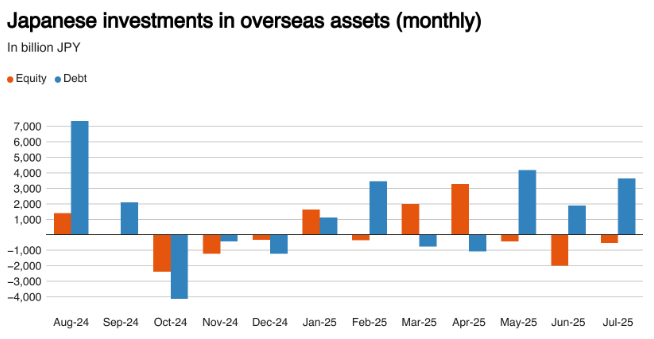
Group 1 - Japanese investors sold foreign stocks for the third consecutive month, withdrawing approximately 536.4 billion JPY (about 3.64 billion USD) in July, following a 1.99 trillion JPY sale in June due to high valuations after a significant stock market rise [1] - In contrast, Japanese investors purchased foreign bonds worth 3.63 trillion JPY in July, marking the third month of net buying, driven by a depreciation of the yen that increased yields [1] - The yen depreciated by about 4.5% against the dollar in July, representing the largest monthly decline since December 2024 [1] Group 2 - Japanese trust accounts (pension funds) also net sold foreign stocks for the third month, with a net sale of 1.52 trillion JPY in foreign equities and a net purchase of 419.6 billion JPY in long-term bonds [4] - The Bank of Japan, investment trust management companies, and insurance companies had net inflows into foreign stocks of 445.5 billion JPY, 333.5 billion JPY, and 207.1 billion JPY respectively in July [4] - The overseas bond market received 3.82 trillion JPY in Japanese long-term bond investments, while short-term notes saw a net withdrawal of 196.6 billion JPY [4]