
财政可持续性

Search documents
凯投宏观:美英债市波动揭示人物与政策对投资者同等关键
news flash· 2025-07-14 14:54
Core Insights - Recent volatility in the U.S. and U.K. sovereign bond markets highlights the critical importance of both personnel and fiscal policy for investors [1] Group 1: U.K. Bond Market - The U.K. bond market faces risks due to the potential replacement of Chancellor of the Exchequer, Reeves, by someone less committed to fiscal rules [1] Group 2: U.S. Bond Market - In the U.S., fiscal stability may hinge on Treasury Secretary Yellen's ability to maintain influence over President Trump and secure his favor [1] Group 3: Investor Concerns - Over the past few months, both U.S. Treasuries and U.K. bonds have experienced significant sell-offs as investors express concerns over fiscal sustainability [1]
国际城市观察|约翰内斯堡11个战略重点对中国城市规划的启发
Xin Lang Cai Jing· 2025-07-10 07:41
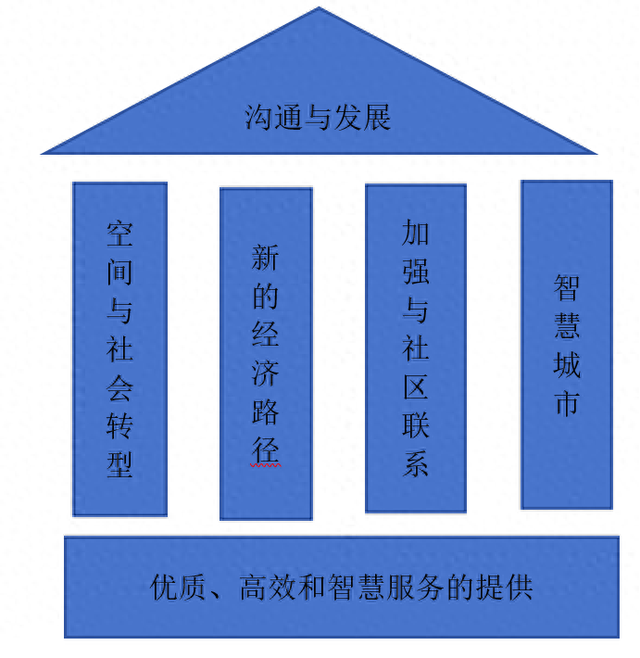
Core Insights - Johannesburg is set to host the G20 summit in November 2025, marking the first time an African nation will lead this event, enhancing its global city status [1] - The 2024/25 Integrated Development Plan (IDP) outlines 11 strategic priorities aimed at transforming Johannesburg into a world-class African city by 2040 [1][3] Strategic Priorities - **Fiscal Sustainability**: Ensuring long-term financial stability to provide essential services and fund key initiatives [3][5] - **Sustainable Energy Structure**: Diversifying energy sources and investing in renewable energy and energy efficiency technologies [6] - **Infrastructure Development and Renewal**: Addressing spatial imbalances and enhancing urban planning to improve living conditions [7] - **Sustainable Service Provision**: Aiming for high-quality services for all residents while addressing challenges in infrastructure and resource management [8] - **Good Governance**: Fostering effective administration, accountability, and citizen participation in governance [9] - **Job Creation**: Establishing urban development zones and public works programs to combat unemployment [11] - **Safety in the City**: Enhancing security measures to protect citizens from crime and natural disasters [12] - **Active Citizenship**: Encouraging citizen involvement in urban planning and decision-making processes [13] - **Economic Growth**: Focusing on targeted interventions to address unemployment, poverty, and inequality [14] - **Green Economy**: Implementing environmental policies to balance development needs with ecological preservation [15] - **Smart City Initiatives**: Utilizing technology to improve urban services, governance, and overall city resilience [16][17] Recommendations for Chinese Cities - Strengthening stakeholder participation in urban planning processes to enhance collaborative efforts [18] - Developing international relations planning to boost regional and global leadership roles [19] - Increasing cooperation with global southern cities in development planning to foster sustainable urban growth [21][22]

美国关税仍存不确定性,国内PMI边际改善
Guo Mao Qi Huo· 2025-07-07 09:19
1. Report Industry Investment Rating - No relevant information provided 2. Core Views of the Report - This week, domestic commodities continued a slight rebound, with both industrial and agricultural products extending their upward trends. The main reasons were the economic resilience of China and the US, a mitigation of geopolitical risks, and a weakening US dollar, which improved market risk appetite and led to the commodity market rebound [3]. - The US labor market showed some resilience in June, but due to a high proportion of government employment and potential future downward revisions, continued monitoring is needed. The Fed may increase the flexibility of interest - rate cuts, and there is a possibility of a rate cut in September [3]. - The "Big and Beautiful" tax and spending bill passed by the US Congress is expected to boost the GDP by an average of 1.0% over ten years (2025 - 2034) and increase long - term GDP by 1.2%. However, it may widen the wealth gap and raise concerns about US fiscal sustainability [3]. - The US is in the final stage of trade negotiations, and Trump has signed tariff letters for 12 countries with tariff rates ranging from 10% to 70%, set to take effect on August 1 [3]. - China's official manufacturing PMI in June was 49.7, up 0.2 percentage points from the previous value, indicating an overall improvement in the domestic economy. However, the manufacturing sector has not emerged from contraction, and small enterprises and emerging industries face significant pressure. There are still concerns about the domestic economic development, and new incremental policies may be introduced in the second half of the year [3]. - In the short term, uncertainty in the commodity market has increased, and market volatility may intensify. Although there are positive factors such as economic resilience and geopolitical easing, the approaching end of the US tariff suspension period and slow negotiation progress may cause market disruptions [3]. 3. Summary by Relevant Sections PART TWO: Overseas Situation Analysis - **US Labor Market**: In June, the US added 147,000 non - farm jobs, higher than the expected 106,000, and the unemployment rate was 4.1%, lower than the expected 4.3% and the previous value of 4.2%. However, due to a high proportion of government employment and potential future downward revisions, continued monitoring is required. The Fed may increase the flexibility of interest - rate cuts, and a rate cut in September is possible [3]. - **US Tax Bill**: The "Big and Beautiful" tax and spending bill passed by the US Congress is expected to boost the GDP by an average of 1.0% over ten years (2025 - 2034) and increase long - term GDP by 1.2%. But it may widen the wealth gap and raise concerns about US fiscal sustainability [3]. - **US Trade Negotiations**: The US is in the final stage of trade negotiations. Trump has signed tariff letters for 12 countries with tariff rates ranging from 10% to 70%, set to take effect on August 1 [3]. PART THREE: Domestic Situation Analysis - **China's PMI**: China's official manufacturing PMI in June was 49.7, up 0.2 percentage points from the previous value, indicating an overall improvement in the domestic economy. However, the manufacturing sector has not emerged from contraction, and small enterprises and emerging industries face significant pressure. The Strategic Emerging Industries PMI (EPMI) decreased by 3.1 percentage points to 47.9%, a new low for the year [3][21]. - **Domestic Economic Concerns**: There are still concerns about the domestic economic development. Externally, the end of the US tariff suspension period is approaching, and the progress of trade negotiations is slow. Domestically, the real estate market has seen a decline in both volume and price, and emerging industries face pressure. New incremental policies may be introduced in the second half of the year [3]. PART FOUR: High - Frequency Data Tracking - **Industrial Data**: On July 4, the operating rates of PTA plants, polyester plants, and POY were 76%, 89%, and 64% respectively [32]. - **Automobile Sales Data**: The data shows the trends of factory wholesale and retail sales and their year - on - year changes [35]. - **Agricultural Product Prices**: The data presents the average wholesale prices of various agricultural products such as vegetables, pork, fruits, and the Agricultural Product Wholesale Price 200 Index [40].
美国“大而美”法案通过,马斯克表态
Guan Cha Zhe Wang· 2025-07-05 02:12
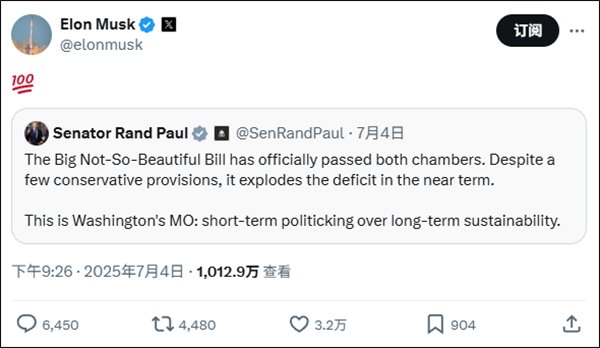
Group 1 - Elon Musk responded to the "Big and Beautiful" bill passed by the U.S. Congress, criticizing it for potentially exploding the deficit and undermining long-term fiscal sustainability [1][2] - The Congressional Budget Office (CBO) estimates that the bill will add approximately $3.4 trillion to the U.S. national debt over the next decade, with the current federal debt totaling $36.2 trillion [2] - The bill includes significant tax cuts, increased immigration enforcement spending, and cuts to federal funding for healthcare, solar, wind, and electric vehicle projects, which directly impacts industries reliant on clean energy subsidies, including Tesla [2] Group 2 - Musk initiated a poll on social media regarding the establishment of a new political party, the "American Party," with 64.3% of approximately 930,000 participants voting in favor [1] - Following a public dispute with Donald Trump, Tesla's stock price experienced a significant drop, losing $152 billion in market value on June 5, with the company's total valuation briefly falling below $1 trillion [2]

特朗普法案落地:美股、美元迎变局?
Wind万得· 2025-07-04 22:43
Core Viewpoint - The "Big and Beautiful" tax and spending bill signed by President Trump is expected to have significant implications for the U.S. economy, including potential increases in national debt and impacts on healthcare coverage for millions of Americans [1][4]. Group 1: Economic Implications - The tax and spending bill aims to provide policy certainty, reduce tax burdens for the middle class, incentivize industries, and adjust federal fiscal structures [3]. - The Congressional Budget Office (CBO) estimates that the bill will increase national debt by $4.1 trillion by 2034 and result in 11.8 million Americans losing health insurance [4]. - The International Monetary Fund (IMF) warns that the bill contradicts its recommendations for mid-term fiscal deficit reduction, raising concerns about fiscal sustainability [4]. Group 2: Market Reactions - There is significant divergence in market outlooks regarding the U.S. dollar and stock market performance following the bill's implementation [5][6]. - Morgan Stanley predicts a 40% chance of U.S. economic recession in the second half of the year due to trade policy impacts [4]. - Morgan Chase remains optimistic about U.S. stock resilience, citing consumer and economic fundamentals, while also predicting a potential rise in the S&P 500 index to 6000-6200 points [8]. Group 3: Fiscal Policy Changes - The bill raises the national debt ceiling by $5 trillion, which may lead to increased fiscal pressure [15]. - The legislation includes significant cuts to clean energy subsidies and expands oil and gas exploration on federal lands, indicating a shift in energy policy [16][18]. - Various financial institutions have differing views on the bill's impact, with some seeing it as beneficial for economic growth while others express concerns about rising fiscal deficits and potential downward pressure on the dollar [20].

法国五年期国债收益率2005年来首超意大利,欧元区债市秩序重构
Zhi Tong Cai Jing· 2025-07-04 11:38
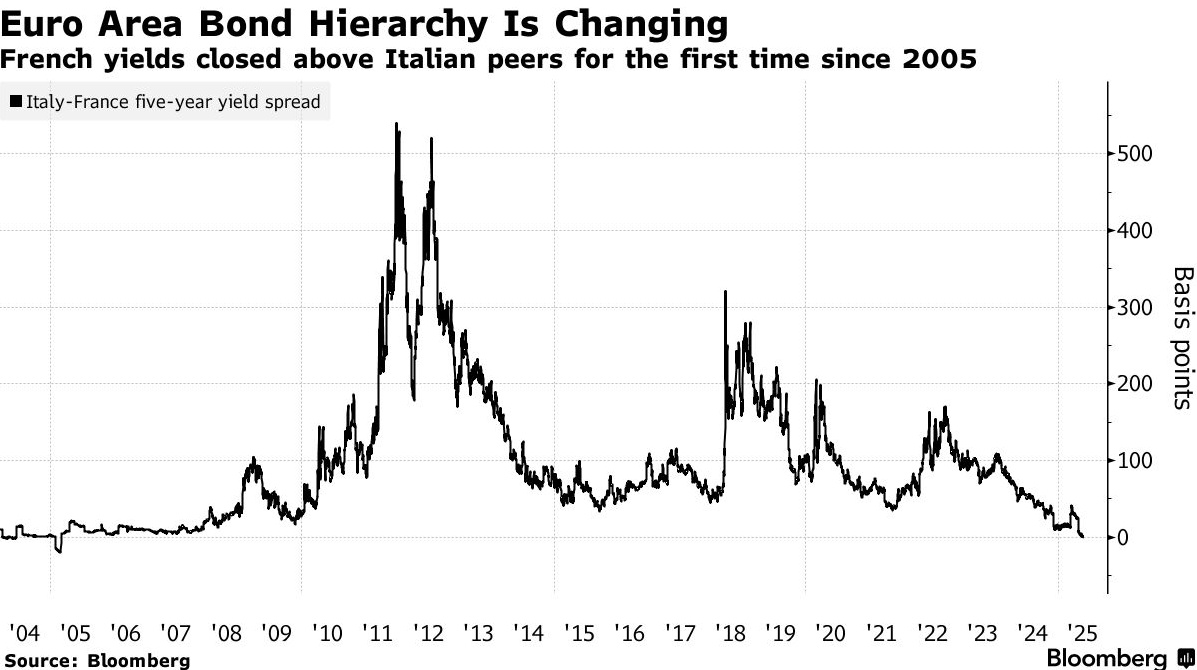
Group 1 - The eurozone bond market is experiencing a historic shift, with French five-year government bond yields surpassing Italian counterparts for the first time since 2005, marking France as the highest-yielding bond among major eurozone economies [1] - The traditional "core-periphery" divide in the bond market is rapidly dissolving, with market focus shifting towards when French ten-year bonds will align in yield with Italian bonds [1] - The yield premium of Italian ten-year bonds over French bonds has narrowed to 17 basis points, the lowest since 2007, down from nearly 200 basis points three years ago, indicating a significant change in risk pricing [3] Group 2 - The current political deadlock and stalled fiscal reforms in France have substantially impacted the attractiveness of French debt, which is now priced similarly to traditionally riskier Italian bonds [3] - France's benchmark government bond yields have exceeded those of Greece and Portugal, making it the weakest-performing bond market among core eurozone countries [4] - The dual challenges of fundamental and political issues facing the French bond market are unprecedented, as the European Central Bank's policy shift increases sensitivity to fiscal sustainability across countries [4]
英国财长上任周年:增税压力与财政困境交织
Xin Hua Cai Jing· 2025-07-04 09:08
Core Viewpoint - The UK Chancellor Rachel Reeves faces significant challenges in achieving her economic stability goals due to weak economic growth, market volatility, and internal divisions over welfare reforms, leading to expectations of new tax increases later this year [1][2][3] Group 1: Economic Conditions - The UK economy is experiencing stagnation, with public debt nearing 100% of GDP, prompting concerns about fiscal sustainability [1] - The government's current policies to stimulate economic growth have shown minimal effectiveness, leading to a potential need for hundreds of billions in new tax revenue to address the expanding fiscal gap [1][2] Group 2: Taxation and Fiscal Policy - Reeves initially promised up to £40 billion in tax increases, the largest in 30 years, to fund infrastructure investments and establish "non-negotiable" fiscal rules [2] - Analysts emphasize that any new tax measures must be substantial and clear to restore market confidence, avoiding fragmented approaches that raise accounting concerns [2][3] Group 3: Political Landscape - Prime Minister Keir Starmer is attempting to bolster public confidence by highlighting progress in trade agreements, foreign investment, and spending in education and healthcare, yet recent polls show the Labour Party trailing behind right-wing reform parties [2] - Investors criticize the government's leadership, noting a lack of awareness among voters and businesses regarding the necessity of fiscal tightening and structural reforms [3]
美国参议院通过“大而美”税收与支出法案
Xin Hua She· 2025-07-01 19:08
Group 1 - The U.S. Senate passed the "Big and Beautiful" tax and spending bill with a vote of 51 in favor and 50 against, which includes extending tax cuts for corporations and individuals initiated by President Trump in 2017 [1] - The bill will eliminate tax credits for electric vehicles starting September 30, and only wind and solar projects that begin production before the end of 2027 will qualify for tax credits [1] - The Senate version of the bill is expected to raise the U.S. debt ceiling by an additional $5 trillion, exceeding the amount proposed in the House version [1] Group 2 - The Congressional Budget Office estimates that the House and Senate versions of the bill will increase the U.S. deficit by $2.8 trillion and nearly $3.3 trillion, respectively, from 2025 to 2034 [1] - Modifications to Medicaid and the Affordable Care Act in the Senate version are projected to increase the number of uninsured Americans by nearly 12 million by 2034 [1] - Some Democratic senators criticized the Senate version of the bill as a "gift to billionaires," with Senator Bernie Sanders labeling it as "robbing the poor to pay the rich" [1]
国际清算银行年度报告:经合组织成员国利息支付占GDP比例在2024年已达4%
news flash· 2025-06-30 09:45
Core Insights - The International Bank for Settlements (BIS) annual report indicates that interest payments by OECD member countries have reached 4% of GDP in 2024 and are expected to continue rising [1] Group 1 - Concerns regarding fiscal sustainability may lead to refinancing difficulties [1] - Pressure in the sovereign debt market could transmit to inflation and financial stability [1]
“央行的央行”拉响警报:特朗普或将美联储推入滞胀泥潭
Jin Shi Shu Ju· 2025-06-30 09:38
AI播客:换个方式听新闻 下载mp3 BIS指出,增长前景恶化,同时消费者价格稳定、公共财政和金融系统的风险加剧。面对挑战,官员们 建议央行专注核心使命以维护信任,并增强行动有效性。 卡斯滕斯强调美联储在当前环境中尤其艰难,其主席鲍威尔坚决抵制来自白宫的降息压力。"在美国, 美联储可能面临非常困难的局面,即通胀压力上升或通胀预期偏离,同时经济放缓,"他说,"这是央行 通常觉得特别棘手的情况。" BIS报告频繁强调通胀风险,包括贸易中断如何冲击已受人口老龄化和劳动力短缺挤压的经济体,并损 害商品供应。官员们强调,疫情后消费者敏感度上升,结合仍高企的生活成本预期,可能对价格稳定构 成新挑战。 这一分析结合近期原油价格飙升(随后部分回落)可能让政策制定者警惕。BIS经济顾问申炫松(Hyun Song Shin)称:"一朝被蛇咬,十年怕井绳,确保一次性价格上涨不转化为持续通胀至关重要。" 报告还指出,部分国家积累的史无前例的国债构成风险。经合组织成员国利息支付占GDP比例去年达 4%并将继续上升。"通胀和金融稳定风险更易源自主权债市压力或通过其传播,"BIS称,"对财政可持 续性的担忧可能引发再融资挑战,并潜在颠覆通 ...