中国资产重估

Search documents
美国股汇债三杀,A股与国足双双走强
Sou Hu Cai Jing· 2026-01-21 12:59
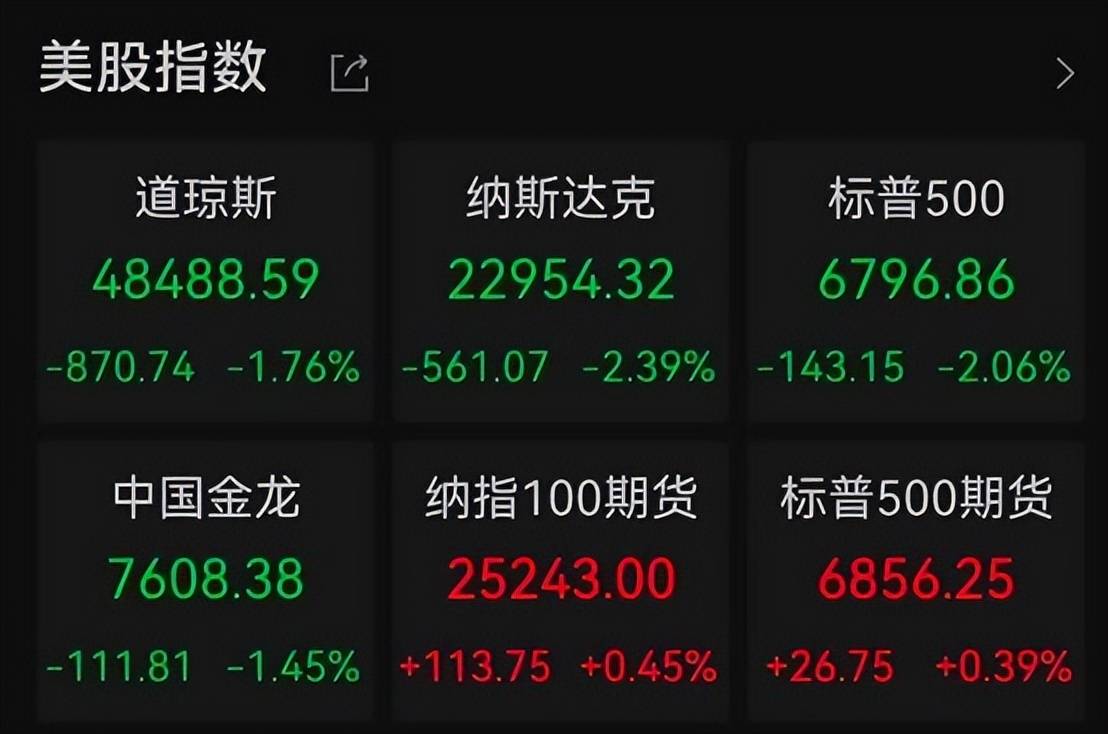
美股集体跳水,纳斯达克指数下跌2.39%,标普500下跌2.06%,道琼斯指数下跌1.76%。 美股7巨头遭遇重挫,英伟达、特斯拉暴跌超过4%,连一向以抗跌著称的苹果罕见下跌了3.46%。 债市更是一片狼藉,十年期美债收益率单日飙升1.84%,直冲4.291%。 美元指数也扛不住了,一下子被砸到98.55。 股汇债三杀,杀的是市场信心,破的是"美债是全球资产定价之锚"这个长期共识。 资本正在用脚投票,全球资产格局一夜生变! 昨夜,一则消息引发全球资产巨震:丹麦养老金宣布将逐步退出美债。 市场瞬间炸了,美国遭遇股、汇、债三杀! | 美股指数 L | | | | --- | --- | --- | | 道琼斯 | 纳斯达克 | 标普500 | | 48488.59 | 22954.32 | 6796.86 | | -870.74 -1.76% -561.07 -2.39% -143.15 -2.06% | | | | 中国金龙 | 纳指100期货 | 标普500期货 | | 7608.38 25243.00 6856.25 | | | | -111.81 -1.45% +113.75 +0.45% +26.75 ...

一个经济学家的2025年资本市场十大年度词汇
Xin Lang Cai Jing· 2026-01-20 08:11
Group 1: Tariffs and Global Market Dynamics - The concept of "reciprocal tariffs" continues to disrupt global capital markets, reflecting the interplay between major power competition and asset pricing [2][17] - The implementation of these tariffs by the Trump administration has led to significant inflationary pressures in the U.S., with household food costs rising and a technical bear market in U.S. stocks [2][17] - China's strategic response, including precise tariff adjustments and supply chain optimization, has stabilized its export share and accelerated high-end manufacturing [2][18] Group 2: Revaluation of Chinese Assets - The systematic revaluation of Chinese assets in 2025 is driven by deepening institutional reforms, technological breakthroughs, and an upgraded global role [3][19] - Institutional reforms are reshaping the capital market ecosystem, transitioning from a "scale-oriented" to a "quality-first" approach, enhancing policy consistency and attracting long-term capital [3][19] - Technological advancements, particularly in AI and high-end manufacturing, are creating a closed loop of "technological breakthroughs—commercial realization—capital feedback," leading to a systemic increase in asset profitability [3][19][20] Group 3: Gold Market Dynamics - The price of gold reached historical highs in 2025, reflecting a resurgence of "gold faith" in the capital market amid a restructuring of the global financial order [4][21] - The strength of gold is attributed to cracks in the U.S. dollar credit system, with political influences on Federal Reserve decisions undermining the dollar's status as a global public good [4][21] - The rise of gold tokens and the structural differentiation in investor behavior highlight the contrasting logics of "certainty defense" versus "growth speculation" [4][21] Group 4: Class Stabilization Funds - The introduction of class stabilization funds in China represents a significant governance innovation aimed at redefining capital market functions and correcting market failures [5][22] - These funds are designed to mitigate risks associated with asset price volatility, providing a dual protective mechanism through substantial capital reserves and market interventions [5][22] - The timely actions of these funds have effectively restored investor confidence and shifted market sentiment from pessimism to rational value assessment [5][22] Group 5: Inclusivity in Capital Markets - The concept of "capital market inclusivity" emerged as a core consensus in 2025, facilitating a multi-dimensional breakthrough in the "technology-industry-finance" ecosystem [6][24] - The establishment of the Sci-Tech Innovation Board has enabled the acceptance of unprofitable hard-tech companies, aligning capital with new productive forces [6][24] - Regulatory clarity and market-oriented principles have balanced government intervention with effective market operations, enhancing the capital foundation for industrial upgrades [6][24] Group 6: ETF Market Growth - The ETF market in 2025 reached nearly 60 trillion yuan, becoming the largest in Asia and symbolizing a significant ecological transformation in capital markets [7][25] - The rise of ETFs reflects an evolution in market efficiency, with their low management fees making them accessible to younger and smaller investors [7][25] - ETFs have also played a crucial role in stabilizing market expectations through strategic interventions by central financial authorities [7][25] Group 7: The Rise of "Han Wang" - The emergence of "Han Wang" as the new stock king in A-shares signifies a shift from consumption-driven to innovation-driven economic paradigms in China [8][27] - The rapid growth and profitability of Han Wang highlight the transition of the AI chip industry from technological challenges to commercial success [8][27] - This shift reflects a broader trend of capital markets transitioning from supporting traditional industries to empowering new productive forces [8][27] Group 8: Rare Earths as Strategic Assets - Rare earths have become a core focus in A-shares, driven by the convergence of resource revolutions and technological changes [9][29] - China's advancements in extraction technology and its dominance in global refining capacity underscore the strategic importance of rare earths in the tech revolution [9][29] - The complete industrial chain of rare earths positions China as a stabilizing force in key sectors like AI and renewable energy, enhancing its competitive edge [9][29][30] Group 9: Emotional Consumption Trends - "Emotional consumption" has emerged as a new mainline in A-share consumer sectors, reflecting a shift from material satisfaction to emotional value [10][30] - This trend is characterized by structural changes in consumer demand, with companies that resonate emotionally with consumers experiencing significant revenue growth [10][30] - The capital market's ability to capture this trend through differentiated valuation systems is crucial for the sustainable growth of the consumer sector [10][30] Group 10: Narrative Trading - "Narrative trading" has become a central symbol of ecological transformation in A-shares, intertwining behavioral finance with asset pricing [11][31] - This phenomenon has led to shifts in household asset allocation, with increased investments in thematic products driven by collective narratives [11][31] - The rise of narrative trading highlights the need for enhanced investor education to maintain market stability amid potential valuation bubbles [11][31]


创金合信基金魏凤春:中国资产重估的必要条件和充分条件
Xin Lang Cai Jing· 2026-01-13 01:47
Group 1 - The market trend is currently influenced by the acceleration of AI industrialization, which is seen as a core driver for economic transformation and asset appreciation [1][4] - The recent market style has shifted towards a focus on AI and hard technology, while low-valuation defensive sectors are under pressure [1][4] - The new "dumbbell strategy" has emerged, favoring precious metals and technology over traditional defensive assets like long bonds and dividends [2][17] Group 2 - The discussion around the Shanghai Composite Index's 17 consecutive days of gains reflects a debate on market adjustments, but the strategic configuration of dominant industries and the validity of China's asset revaluation are deemed more significant [4][19] - The asset revaluation process is characterized by a systematic reset of asset pricing anchors, influenced by both necessary and sufficient conditions [6][23] - External shocks, such as geopolitical tensions and domestic political risks, are considered low-probability but high-impact events that could affect asset revaluation judgments [4][20] Group 3 - Necessary conditions for asset revaluation include a reconstruction of the capital market ecology and a confirmation of market order, which have seen significant improvement compared to 2025 [8][24] - Sufficient conditions involve a reduction in risk premiums and the implementation of action plans for capital market failures, which are expected to strengthen in 2026 [8][26] - The role of ETFs is becoming increasingly important, as they are expected to enhance market liquidity and pricing efficiency, thus supporting asset revaluation [8][27] Group 4 - The economic recovery signals, such as the rise in CPI and PPI in December 2025, are crucial for restoring corporate pricing power and improving profit margins [29][30] - The transition from liquidity-driven to profit-driven market dynamics is anticipated to become the core theme in the capital market [29][30] - The balance between external liquidity disturbances and internal profit recovery trends is essential for maintaining strategic asset allocation [30]
四大证券报头版头条内容精华摘要_2026年1月12日_财经新闻
Xin Lang Cai Jing· 2026-01-12 00:00
Group 1 - The China Securities Regulatory Commission (CSRC) emphasizes the importance of the "14th Five-Year Plan" for advancing China's modernization and building a strong financial nation, focusing on risk prevention, strong regulation, and promoting high-quality development [1][9]. - The CSRC plans to deepen comprehensive reforms in investment and financing, enhancing the adaptability and inclusiveness of the system to improve the quality and reasonable growth of the capital market [1][9]. - The number of A-share stocks priced over 100 yuan has reached 212, an increase of 141 stocks compared to the same period last year, marking a growth rate of approximately 200% [17]. Group 2 - Jia Mei Packaging has resumed trading after a suspension, reporting no significant changes in its main business and no undisclosed major information, with a total market value of 15.147 billion yuan as of January 6 [2][19]. - The new mechanism for merger notes is being optimized, facilitating corporate financing and alleviating reliance on credit resources, thus providing more flexible medium to long-term funding support for industrial integration [5][23]. - The termination of the overseas acquisition by Defu Technology, originally planned for 1.74 million euros (approximately 1.413 billion yuan), was due to the failure to obtain unconditional approval from foreign authorities [8][26]. Group 3 - The upcoming week will see two new stock subscriptions, one on the Beijing Stock Exchange and one on the Sci-Tech Innovation Board, indicating ongoing market activity [3][20]. - The CSRC is committed to enhancing the entry scale of medium to long-term funds into the market and advancing reforms in the Sci-Tech Innovation Board and the Growth Enterprise Market [9][27]. - The recent China Chief Economist Forum highlighted the transformation of Chinese assets from being "optional overseas" to "globally unavoidable," driven by policy stability, industrial innovation, and unprecedented capital market support [7][25]. Group 4 - The National Business Work Conference has outlined eight key tasks for 2026, including actions to boost consumption and innovate in the retail sector [10][28]. - The China Financial Futures Exchange is revising its trading rules to include new regulations for algorithmic trading, which is expected to enhance regulatory execution and oversight [12][31]. - Foreign investment institutions are increasingly optimistic about Chinese assets, as evidenced by significant inflows into Hong Kong stocks and overseas thematic ETFs [13][32]. Group 5 - The "whistleblower" system in the capital market has undergone a significant upgrade, with new regulations enhancing reward standards and protection mechanisms for whistleblowers [14][33]. - The upcoming Chinese New Year film market is seeing competitive entries from major film companies, indicating a vibrant entertainment sector [15][34].
众口一词的 人民币升值“真相”
Sou Hu Cai Jing· 2026-01-11 16:35
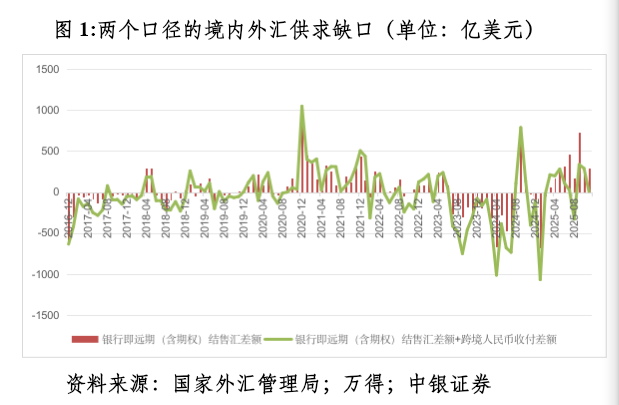
Group 1 - Japan's current account surplus to GDP ratio is projected to reach 4.5% in 2024, increasing by 0.9 percentage points, and further rise to 5.1% in the first three quarters of 2025, exceeding the international warning line for two consecutive years [1] - The Chinese yuan (RMB) is expected to appreciate against the US dollar, with foreign investment banks suggesting that the RMB is structurally undervalued, predicting that RMB appreciation is the "highest conviction" trade for 2026 [1] - The RMB exchange rate has shown signs of appreciation since March 2025, with a cumulative surplus of $273.3 billion in bank foreign exchange settlements by November 2025, although there are concerns about the sustainability of this trend [2][3] Group 2 - The improvement in the foreign exchange situation is attributed more to a decrease in the motivation to purchase foreign currency rather than an increase in the willingness to settle foreign exchange [3] - The actual effective exchange rate (REER) of the RMB has depreciated by 16.7% since March 2022, indicating a potential undervaluation, but this does not guarantee an appreciation of the nominal exchange rate [5] - The RMB's REER has shown a weaker trend compared to other major currencies, with significant fluctuations in the exchange rate not necessarily correlating with the bank's foreign exchange settlement surplus [9][10] Group 3 - The trade balance indicates that while China has a strong goods trade surplus, it faces deficits in service trade and investment income, leading to a current account surplus to GDP ratio of 2.2% in 2024, which is below the international warning line [7][8] - The dynamics of the RMB's appreciation and its impact on asset prices are complex, with historical data showing that RMB appreciation does not always correlate with positive outcomes for Chinese assets [10][12] - The transition of China's private sector from net external debt to net external assets by 2025 may lead to net exchange losses for listed companies if the RMB appreciates significantly, affecting their profitability [11][12]
管涛:众口一词的人民币升值“真相”|立方大家谈
Sou Hu Cai Jing· 2026-01-11 14:53
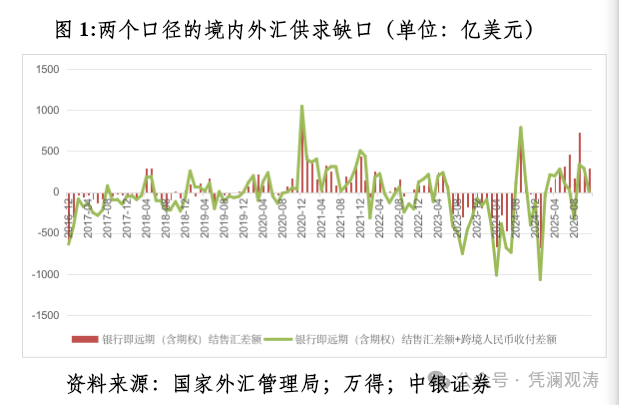
Core Viewpoint - The article discusses the recent strengthening of the RMB against the USD, highlighting that the narrative around RMB appreciation lacks substantial data and theoretical support, despite claims from foreign investment banks about its structural undervaluation and potential asset revaluation in China [1][2][4]. Exchange Rate Trends - From July 2023 to February 2025, the RMB faced overall pressure, with a notable shift to a surplus in bank foreign exchange settlements starting March 2025, accumulating a surplus of $273.3 billion by November 2025 [2][4]. - In November 2025, the bank's foreign exchange settlement surplus was $29.7 billion, a modest increase from the previous month, indicating a lack of strong market consensus on RMB appreciation [2][4]. Market Behavior - The improvement in the foreign exchange situation is attributed more to a decrease in the motivation to purchase foreign currency rather than an increase in the willingness to settle foreign exchange [4]. - The average settlement rate for foreign currency receipts increased to 54.6% from July 2023 to February 2025, while the payment rate decreased to 58.8%, suggesting a natural hedging against exchange rate risks rather than a bullish sentiment towards RMB [4]. Real Effective Exchange Rate (REER) - The RMB's real effective exchange rate (REER) has depreciated by 16.7% since March 2022, contrasting with the appreciation of other major currencies, indicating a complex relationship between REER and nominal exchange rates [7][11]. - Despite the depreciation of the REER, it does not necessarily imply that the RMB is undervalued or will appreciate, as historical data shows inconsistent relationships between REER movements and nominal exchange rates [7][18]. Trade Balance and Economic Indicators - China has maintained a significant trade surplus, while Japan has faced trade deficits since 2021, yet China's overall current account surplus remains within international warning limits [12][15]. - The article emphasizes that while a trade surplus may suggest RMB undervaluation, domestic economic conditions, such as low inflation and nominal growth rates, could indicate overvaluation [15][23]. Impact on Corporate Earnings - Analysis of A-share listed companies from 2015 to 2022 shows that a higher percentage of non-financial firms reported net exchange gains during depreciation years compared to appreciation years, suggesting that RMB appreciation may not necessarily benefit corporate earnings [21][23]. - The shift from net external debt to net external assets for Chinese firms raises concerns that significant RMB appreciation could lead to net exchange losses, adversely affecting corporate profitability [23].
管涛:众口一词的人民币升值“真相”︱汇海观涛
Di Yi Cai Jing· 2026-01-11 12:53
Group 1 - The article discusses the recent strengthening of the RMB against the USD, which has been characterized by a reversal of the previous trend of depreciation over the past three years, particularly since November 2024 [1] - Foreign investment banks have suggested that the RMB is structurally undervalued, predicting that RMB appreciation will be a high-confidence trade in 2026, while domestic voices echo that RMB revaluation will lead to a reassessment of Chinese assets [1][2] - However, the article argues that these significant judgments lack data, facts, or theoretical support, indicating skepticism about the sustainability of the RMB's appreciation [1] Group 2 - From July 2023 to February 2025, the RMB exchange rate faced overall pressure, with a notable shift to a surplus in bank foreign exchange settlements starting in March 2025, accumulating a surplus of $273.3 billion by November [2] - In November, the bank's foreign exchange settlement surplus was $29.7 billion, which was significantly lower than the surpluses recorded in September and October [2] - The article highlights that the improvement in the foreign exchange situation is not due to an increase in market settlement willingness but rather a decrease in the motivation to purchase foreign currency [4] Group 3 - The RMB broke the 7 mark in December 2025, with the domestic trading price showing a consistent strength against the central parity and offshore RMB rates [5] - The article compares the current situation to December 2020, when the RMB was also appreciating, noting that the average transaction volume in the interbank market decreased by 14.3% in December 2025 compared to the previous month [5] - The article emphasizes that the relationship between the actual effective exchange rate (REER) and the nominal exchange rate is complex, with REER depreciation not necessarily indicating that the nominal exchange rate is undervalued [7] Group 4 - The article notes that while China has a growing trade surplus, it also faces deficits in service trade and investment income, leading to a mixed picture in the current account balance [12] - In contrast, Japan has a trade deficit but benefits from significant investment income, resulting in a stronger current account position compared to China [12] - The article suggests that the equilibrium exchange rate is influenced by both external and internal factors, with the RMB potentially being undervalued due to trade surpluses but overvalued due to domestic economic conditions [14] Group 5 - The article discusses the complexities of the relationship between exchange rates and asset prices, arguing that a strong RMB does not automatically lead to a revaluation of Chinese assets [18] - Historical data shows that during years of RMB appreciation, a lower percentage of non-financial companies reported net exchange gains compared to years of depreciation [20] - The shift from net external debt to net external assets for Chinese companies may lead to net exchange losses if the RMB appreciates significantly, impacting corporate profitability [23]
外资开年频频加仓中国资产
Shang Hai Zheng Quan Bao· 2026-01-10 06:36
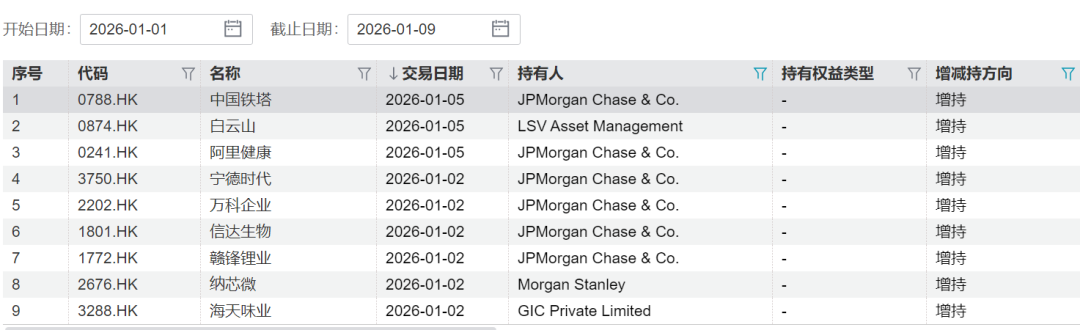
Group 1: Foreign Investment Trends - Foreign institutions are increasingly enthusiastic about allocating assets in China, reflecting expectations of economic stabilization and the attractiveness of undervalued Hong Kong stocks [2][9] - In the first trading days of 2026, JPMorgan Chase significantly increased its holdings in several Hong Kong-listed companies across various sectors, including new energy and biomedicine [1][4][8] Group 2: Specific Investments by JPMorgan - JPMorgan Chase invested over 700 million HKD to increase its stakes in multiple Hong Kong stocks, including approximately 793,478 shares of Ningde Times at an average price of 514.76 HKD per share, totaling around 408 million HKD [4][6] - The bank also acquired shares in other companies such as Sinopharm and Ganfeng Lithium, with notable investments including 317.3 million shares of Sinopharm at an average price of 78.45 HKD, amounting to about 249 million HKD [6] Group 3: Broader Market Sentiment - The trend of foreign capital inflow into Chinese technology ETFs has been strong, with funds like Invesco's China Technology ETF seeing a 6.53% increase in assets to 3 billion USD since the end of 2025 [12][14] - Analysts believe that the long-term growth logic of China's technology sector remains solid, with expectations for continued performance in 2026, particularly in AI and advanced manufacturing [15][16] Group 4: Future Outlook - The outlook for 2026 suggests that foreign capital will continue to actively invest in China's advanced industries, with a focus on sectors like biomedicine and new energy, which have shown strong appeal to foreign investors [8][10] - Predictions indicate that the MSCI China Index and the CSI 300 Index could rise by 20% and 12% respectively in 2026, driven by accelerated corporate earnings growth [10]
中金研究 | 本周精选:宏观、策略、银行
中金点睛· 2026-01-10 01:06
Group 1: Banking Industry - The capital market's focus on the trend of deposit migration has increased, indicating a growing certainty in this narrative. It is projected that by 2026, residents may add approximately 2-4 trillion yuan of activated funds to non-deposit investment areas due to this trend [4][3]. - The report discusses potential beneficiaries of the deposit migration, highlighting the sectors and products that may attract these funds [4]. Group 2: Macroeconomy - In 2026, the pressure from mid-term elections may lead to a softening of Trump's foreign policy, shifting focus to domestic issues, which could effectively promote fiscal and monetary easing, alleviating three major constraints on the U.S. economy in 2025 [6]. - The technology, industrial, and resource sectors are expected to continue leading the market in 2026, while consumer and financial sectors may catch up as nominal cycles improve. A weaker dollar could provide room for the renminbi to appreciate, benefiting A/H shares [6]. Group 3: Strategy - Historical analysis of Japan's market in the 1990s shows that failure to address structural issues like household balance sheets and weak livelihoods led to prolonged economic stagnation. In contrast, significant policy shifts towards improving livelihoods and debt resolution post-2000 resulted in a long bull market [8]. - The report suggests that prioritizing policies that support household balance sheets and debt resolution could effectively enhance domestic demand resilience and lead to a stable revaluation of Chinese assets [8]. Group 4: Strategy - The A-share market in 2025 exhibited a trend of steady upward movement, with the Shanghai Composite Index reaching a ten-year high. Key drivers included the restructuring of international order and domestic industrial innovation, which propelled the revaluation of Chinese assets [12]. - The market saw active participation from individual investors and a shift in funds due to deposit migration, with small-cap stocks outperforming large-cap stocks and growth stocks outperforming value stocks by the end of the year [12].


人民币汇率,藏着A股的牛市密码
财富FORTUNE· 2026-01-07 13:04
Core Viewpoint - The A-share market has shown a strong performance at the beginning of 2026, characterized by a structural shift where sectors like commercial aerospace, artificial intelligence, and robotics are thriving, while many stocks lack macro and industrial narrative support [1] Group 1: Market Performance and Trends - The A-share market experienced a "14 consecutive days of gains," with the Shanghai Composite Index surpassing 4000 points, marking a ten-year high [1] - The market is witnessing a shift in investment style, driven by a stable RMB exchange rate, which is becoming a key anchor for global capital reassessing the value of Chinese assets [1][3] - In 2025, the RMB appreciated over 4.2% against the USD, and this trend continued into 2026, with the RMB remaining below 7.0 [3] Group 2: Foreign Investment and Capital Flows - Foreign net inflows into the Chinese stock market reached $50.6 billion in the first ten months of 2025, significantly exceeding the total for 2024 [4] - The RMB's appreciation is enhancing the attractiveness of A-shares in global asset portfolios, allowing foreign investors to diversify risks and benefit from China's economic growth [3][4] Group 3: Economic and Policy Outlook - The People's Bank of China aims to maintain the RMB exchange rate's basic stability, indicating a policy that allows for fluctuations but prevents excessive volatility [3] - The macroeconomic backdrop includes uncertainties in global economic policies, with potential risks such as concentrated currency settlement that could lead to an over-appreciation of the RMB [4] Group 4: Sector Focus and Investment Strategies - Investment strategies are increasingly focused on technology innovation, with sectors like AI, commercial aerospace, and high-end manufacturing attracting long-term capital [5] - Analysts predict that China's GDP growth will exceed market consensus, with stock market growth supported by earnings growth and valuation re-rating [5][6] - The current market dynamics suggest a transition from liquidity-driven to fundamentals-driven growth, with institutional investors taking a more significant role [6] Group 5: Future Implications for Investors - The anticipated appreciation of the RMB and the transformation of the Chinese economy are expected to lead to a global revaluation of high-quality core assets priced in RMB [6][7] - Investors are encouraged to shift from a trading mindset focused on market volatility to a holding strategy that embraces industrial trends and focuses on sectors with strong consensus [7]