
价值重塑

Search documents
告别规模赛,全球锂电装备迎“新秩序”
高工锂电· 2025-12-10 11:02
Core Viewpoint - The ultimate goal of the new global lithium battery equipment order is to reshape industry value, with Chinese equipment companies aiming to become not only "order winners" but also "value leaders" in the global supply chain [1][21]. Group 1: Industry Trends - By 2025, the global lithium equipment industry is expected to experience a significant "order wave," with leading companies like Hai Moxing, Xian Dao Intelligent, Ying He Technology, and Li Yuan Heng signing and holding orders totaling over 30 billion yuan, marking a year-on-year increase of 70% to 80% [2]. - The current expansion cycle focuses on "high safety, high reliability, high performance, and high value," moving away from the previous emphasis on mere scale [3][7]. - The industry is transitioning from a phase of rapid scale competition to one centered on high-quality internal growth supported by global expansion [6]. Group 2: Equipment Demand and Value Creation - Customer demands for equipment have evolved from simply "being able to produce" to requiring "stable mass production, technological upgrades, and long-term service" [8]. - The shift in value perception means that customer trust now relies on quality and service over mere capacity guarantees, prompting companies to evolve from "equipment suppliers" to "lifecycle partners" [8][9]. - This expansion of value dimensions aligns with battery companies' demands for "high value" and distinguishes Chinese equipment firms from their overseas counterparts [9]. Group 3: Strategic Pathways for Leadership - Achieving a "leading position" in the new order requires a collaborative approach across technology, market, and globalization [12]. - Technological iteration is identified as the core variable and competitive advantage for equipment companies, with Hai Moxing adopting a dual-line R&D strategy to address challenges in solid-state battery production [13][14]. - The diversification of market dynamics provides essential support for Chinese equipment companies, allowing them to mitigate risks and expand their operational space [15]. Group 4: Globalization and Localization - The trend of "capacity going global" is a significant feature of the new order, necessitating enhanced globalization capabilities for Chinese companies [16]. - Chinese equipment firms should focus on "localization of organization, service, and innovation" to deeply integrate into the global industrial ecosystem [18]. - Hai Moxing's global strategy includes establishing 11 overseas subsidiaries and an innovation lab in Silicon Valley, emphasizing localized service and rapid response to customer needs [19][20]. Group 5: Value Restructuring Directions - The three main directions for value restructuring include transitioning from "equipment providers" to "standard co-creators," from "cost competition" to "technology premium," and from "individual efforts" to "ecosystem collaboration" [21][22][23]. - Hai Moxing collaborates with leading battery companies and research institutions to advance the standardization and industrial application of solid-state battery equipment [22]. - The focus on ecosystem collaboration aims to enhance the resilience and efficiency of the global supply chain, addressing common industry challenges [23].



机构看好中药行业年底需求回暖及后续基本面和估值改善机会 | 券商晨会
Sou Hu Cai Jing· 2025-11-20 00:31
Group 1: Aviation Sector - The aviation industry is expected to continue its recovery trend in ticket prices due to low supply growth, industry self-regulation, and a low base effect [1] - The overall revenue levels in the aviation sector are anticipated to improve [1] Group 2: Oil Transportation Sector - The oil transportation sector is projected to maintain high prosperity driven by multiple factors including OPEC+/U.S. production increases, cross-regional price arbitrage, low oil prices boosting inventory replenishment, and geopolitical disturbances [1] Group 3: Highway Sector - The highway sector is expected to have upward potential as insurance funds begin year-end allocations, and the market's risk appetite experiences fluctuations [1] - The attractive dividend yields of AH highway stocks contribute to the sector's appeal [1] Group 4: Liquor Industry - The liquor industry is experiencing a "volume increase, price drop" phenomenon, with traditional e-commerce platforms seeing prices fall below critical levels due to dealer inventory pressures and platform subsidies [2] - Emerging channels like instant retail and Douyin are showing growth, indicating a shift in consumer purchasing behavior towards "buy now, drink now" [2] - Major liquor companies are initiating anti-counterfeiting actions to stabilize prices and balance online and offline channel interests [2] Group 5: Traditional Chinese Medicine Sector - The traditional Chinese medicine industry is expected to see demand recovery by year-end, with inventory levels clearing up [3] - There are opportunities for fundamental and valuation improvements in the sector [3] - The innovation sector is seen as a potential second growth curve for traditional Chinese medicine companies [3] Group 6: Blood Products and Vaccine Industries - The blood products sector is focused on the "14th Five-Year" plan for plasma station construction and industry consolidation [3] - The vaccine industry is monitoring sales improvements of key products and progress in innovative pipelines, with policies and international expansion expected to drive further development [3]
聚焦大湾区农交会|“媒体+”解码珠三角地标家底:岭南乡土的产业明珠
Nan Fang Nong Cun Bao· 2025-11-14 03:00
Core Viewpoint - The upcoming 2025 Greater Bay Area Agricultural Products Trade Fair and Specialty Products Expo, scheduled for December 12-14 in Guangzhou, aims to showcase the unique agricultural products of the Pearl River Delta, highlighting their industrial value and development potential [16][95]. Group 1: Geographic Indications and Agricultural Products - As of June this year, Guangdong has approved 229 geographic indication products, ranking among the top in the country [10][13]. - Ten products, including the Xinhui dried tangerine peel, have been included in the "China-EU Geographic Indication Product Mutual Recognition and Protection List," enhancing the international profile of Guangdong's agricultural products [14][15]. - The trade fair will serve as a significant platform for showcasing these products and their unique industrial values [15][95]. Group 2: Urban Agriculture Development - Guangzhou and Shenzhen, with a combined population of nearly 37 million, are reshaping the agricultural value chain through industrialization and information technology [21][22]. - In 2024, the planting area for lychee in Zengcheng is expected to reach 200,000 mu, with a total output of approximately 50,000 tons [22]. - The trade fair will provide an important showcase for urban agricultural development [25]. Group 3: Industry Innovations and Market Expansion - The Guangdong region is seeing significant growth in its agricultural sectors, with the Xinhui dried tangerine peel industry alone generating a total output value of 26.018 billion yuan [51]. - The trade fair is viewed as a crucial opportunity for connecting with international markets [54]. - The integration of technology, culture, and health into the agricultural sector is expected to enhance the competitiveness of geographic indication products [90][92]. Group 4: Future Development and Strategic Opportunities - The construction of the Guangdong-Hong Kong-Macao Greater Bay Area presents unprecedented strategic opportunities for the geographic indication agricultural products of the Pearl River Delta [86]. - The trade fair is anticipated to elevate the brand influence and market competitiveness of these products [87]. - The future development of these products will focus on "value reconstruction," transforming them into a complex industry IP that integrates technology and global trade [90][92].

太二第三季度销售改善,九毛九集团“价值重塑”战略显效
Sou Hu Cai Jing· 2025-11-10 08:46
Core Insights - Jiumaojiu Group (09922.HK) reported a decline in same-store daily sales for its brands, with Taier, Song Hotpot, and Jiumaojiu experiencing year-on-year decreases of 9.3%, 19.1%, and 14.8% respectively in Q3 2025, although the declines narrowed compared to Q2, indicating effective operational adjustments and brand upgrades [1][4] - The Chinese dining market is undergoing a significant transformation in consumer perception of "value," particularly among younger consumers who now equate it with a combination of "cost-performance" and "experience," prompting brands to enhance dining environments, service quality, and social attributes to meet new market demands [1] Company Strategy - Jiumaojiu Group's strategic adjustments are representative of industry trends, with its core brand Taier launching the "5.0 Fresh Model" restaurant upgrade and layout optimization, focusing on fresh ingredients like live fish, fresh chicken, and fresh beef, which aligns with consumer demands for quality and freshness [3][4] - As of the announcement date, Taier has established 106 new model restaurants, with same-store daily sales showing continuous improvement for three consecutive quarters, particularly achieving positive year-on-year growth in first-tier cities like Beijing and Shanghai in Q3 [4] - The group plans to accelerate the rollout of the "5.0 Fresh Model" restaurants, aiming to expand to over 200 locations by the end of 2025 due to positive market feedback [4] Brand Development - Song Hotpot is focusing on dual upgrades in product offerings and atmosphere, enhancing its fresh product categories and positioning a joyful atmosphere as a core brand asset, transforming dining into a fun and quality social space to attract younger customers [4] - Jiumaojiu's Northwest Cuisine brand is targeting the children's dining sector by developing children's meals, opening experience stores, and incorporating interactive activities to increase family customer loyalty and market competitiveness [4] - The average customer spending level across the main brands has remained relatively stable over several quarters, indicating a shift from reliance on short-term promotions to strengthening product quality and enhancing customer experience, marking a critical step in adapting to the new market normal [4]

四川新首富诞生,1500亿
投资界· 2025-09-07 07:19
Core Viewpoint - The article highlights the remarkable rise of Baili Tianheng, a Chinese biopharmaceutical company, which has seen its stock price surge over 1,000% since its IPO, driven by significant licensing deals and a shift towards innovative drug development [3][9][13]. Company Overview - Baili Tianheng's stock reached a historical high of 38.8 yuan, with a market capitalization exceeding 150 billion yuan, marking a more than tenfold increase from its IPO price of 24.70 yuan [3][7]. - The company was founded by Zhu Yi, a Sichuan entrepreneur, who transitioned from traditional pharmaceuticals to innovative drug research, establishing a cash flow system for R&D through previous successes in generic drugs [5][6]. Key Developments - In June 2023, Baili Tianheng's clinical data for its ADC drug BL-B01D1 generated significant interest, leading to a landmark licensing deal with Bristol-Myers Squibb worth approximately 84 billion yuan [9][10]. - The company reported a revenue of 5.823 billion yuan in the previous year, a staggering increase of 936.31%, and turned a profit with a net income of 3.708 billion yuan, a 575.02% year-on-year growth [10]. Market Context - The Chinese biopharmaceutical sector is experiencing a resurgence after a period of downturn, with several companies successfully listing and achieving significant stock price increases [13][14]. - The market is witnessing a shift where innovative drug companies are gaining recognition and valuation, as evidenced by the performance of Baili Tianheng and other firms in the sector [14][15]. Future Outlook - Zhu Yi aims for Baili Tianheng to become a multinational pharmaceutical company within five years, focusing on global commercialization of its products [11]. - Despite the current success, the company faces challenges in sustaining growth due to the high costs and risks associated with innovative drug development [10][12].

中国大陆面板厂上半年占全球面板业总营收首次超过50%
第一财经· 2025-09-04 09:36
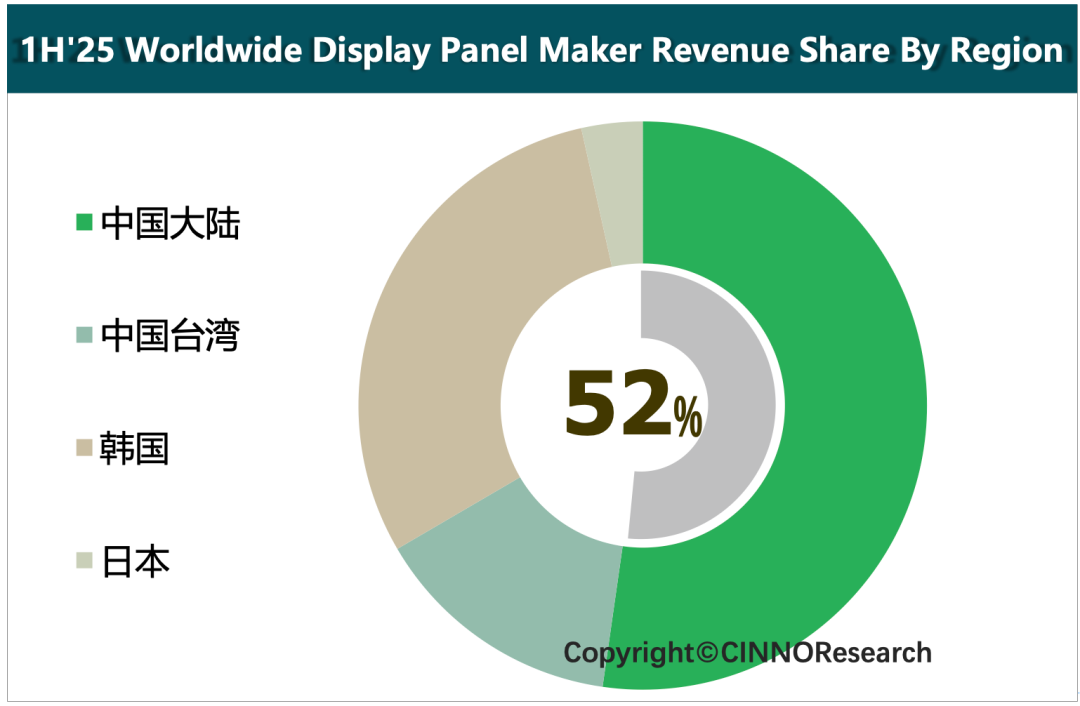
Core Viewpoint - The global display panel industry is experiencing a shift from "scale expansion" to "value restructuring," with Chinese manufacturers gaining market share and profitability [2][4]. Revenue and Market Share - In the first half of 2025, global panel manufacturers' revenue reached approximately $56.2 billion, remaining stable year-on-year, with Chinese manufacturers surpassing 50% market share for the first time [2]. - Chinese mainland panel manufacturers generated about $29.3 billion in revenue, a year-on-year increase of approximately 7%, capturing around 52.1% of the global market share, up 3.3 percentage points [2]. - Korean panel manufacturers saw a revenue decline of 9.5%, with their market share dropping to 30%, down 3.2 percentage points [2]. - Taiwanese panel manufacturers experienced a revenue increase of 4.4%, holding a market share of 13.2%, up 0.6 percentage points [2]. - Japanese panel manufacturers faced a revenue decline of 16.7%, with their market share decreasing to 3.5%, down 0.7 percentage points [2]. Company Performance - BOE Technology Group led the revenue rankings with 101.28 billion yuan, a year-on-year growth of 8.45% [3]. - TCL Huaxing followed with 50.43 billion yuan in revenue, a year-on-year increase of 14.4%, narrowing the revenue gap with Samsung Display and LG Display [3]. - Samsung Display remains the leader in operating profit, but the gap with Chinese manufacturers is closing [3]. - TCL Huaxing reported a net profit of 4.32 billion yuan, up 74% year-on-year, while BOE's net profit was 3.247 billion yuan, a 42.15% increase [3]. - Other companies like AUO, Innolux, Tianma, and Huike reported revenues above $2 billion, but their operating profits were below $100 million [3]. Industry Trends - The display panel industry is transitioning towards high-value products such as Mini LED, OLED, and AI applications, which are expected to drive structural growth in the Chinese mainland display panel market in the second half of 2025 [4][5]. - TCL Technology indicated that demand for TV panel inventory is expected to recover in the third quarter, with the acquisition of LGD's Guangzhou LCD production line anticipated to become a significant profit source [4]. - BOE stated that the global economic slowdown and price declines are compressing profit margins, prompting the company to enhance AI applications and advance its "screen IoT" strategy [4].


中国大陆面板厂上半年占全球面板业总营收首次超过50%
Di Yi Cai Jing· 2025-09-04 06:05
Group 1 - The core viewpoint of the articles indicates that the display panel industry is transitioning from "scale expansion" to "value reshaping," with Chinese manufacturers gaining market share while Korean manufacturers face revenue declines [2][6] - As of the first half of 2025, the total revenue of major global panel manufacturers is approximately $56.2 billion, remaining stable year-on-year, with Chinese manufacturers surpassing 50% market share for the first time [4] - Chinese mainland panel manufacturers achieved total revenue of about $29.3 billion in the first half of 2025, a year-on-year increase of approximately 7%, while Korean panel manufacturers experienced a revenue decline of 9.5% [4] Group 2 - BOE led the panel manufacturers with a revenue of 101.28 billion yuan in the first half of the year, reflecting a year-on-year growth of 8.45% [5] - TCL Huaxing's revenue reached 50.43 billion yuan, growing by 14.4%, narrowing the revenue gap with Samsung Display and LG Display [5] - Samsung Display remains the leader in operating profit, but the gap with Chinese manufacturers is closing, with TCL Huaxing's net profit increasing by 74% to 4.32 billion yuan [5] Group 3 - The demand for TV panel inventory is expected to recover starting in the third quarter, with TCL's acquisition of LGD's Guangzhou LCD production line anticipated to become a significant profit source [6] - BOE plans to deepen AI applications and advance its "screen and IoT" strategy to cope with external challenges, as the global economic growth slows and downstream prices decline [6] - CINNO Research forecasts structural growth opportunities for the Chinese mainland display panel market in the second half of 2025, driven by the increase in shipments of large-size, Mini LED, OLED, and AI high-value-added products [6]
CINNO Research:上半年全球主要面板厂营收总额达到约562亿美元 同比基本持平
智通财经网· 2025-09-04 05:56
Core Insights - The global display panel revenue for the first half of 2025 is approximately $56.2 billion, showing a year-on-year decline of 4.2% but a quarter-on-quarter increase of 5.8% [1] - Chinese mainland panel manufacturers achieved a revenue of about $29.3 billion, capturing 52.1% of the global market share, marking a year-on-year increase of 3.3 percentage points [1] - Korean panel manufacturers' revenue share decreased to 30%, down 3.2 percentage points year-on-year, while Taiwanese manufacturers increased their share to 13.2%, up 0.6 percentage points [1] Regional Revenue Changes - In the first half of 2025, Chinese mainland panel manufacturers saw a year-on-year revenue growth of approximately 7%, while Taiwanese manufacturers grew by 4.4% [2] - Korean panel manufacturers experienced a significant decline of 9.5%, and Japanese manufacturers faced a 16.7% drop in revenue [2] - Compared to 2020, the global revenue share of Chinese mainland panel manufacturers increased by 18.6 percentage points, while Taiwanese, Korean, and Japanese manufacturers saw declines of 2.3, 10.3, and approximately 6 percentage points, respectively [2] Company Rankings - BOE maintained its position as the world's top panel manufacturer in the first half of 2025, with TCL's CSOT showing significant revenue growth, narrowing the gap with Samsung Display and LG Display [4] - AUO, Innolux, Tianma, and HKC are in the third tier, each exceeding $2 billion in revenue [4] Profitability Analysis - In the first half of 2025, seven publicly listed panel companies achieved profitability, an increase from the previous year, with AUO and Tianma joining the profitable ranks [7] - Samsung Display remains the leader in operating profit, but its advantage has significantly decreased; TCL and BOE are closely following, with operating profits around $600 million [7] - The largest operating losses were reported by Visionox, JDI, and EDO, each exceeding $100 million, while LG Display showed significant improvement in reducing its losses [7] Industry Trends - The display industry is transitioning from "scale expansion" to "value reconstruction," with Chinese mainland manufacturers leveraging capacity advantages and technological breakthroughs to enhance competitiveness [9] - Korean manufacturers face challenges in maintaining high-end positions and controlling costs [9] - The second half of 2025 is expected to see structural growth in the Chinese mainland display panel market, driven by the increasing demand for large-sized displays and high-value products like Mini LED and OLED [9]


洋河股份中报:深蹲蓄力,行业变局中的反脆弱“进化”
Huan Qiu Lao Hu Cai Jing· 2025-08-28 12:38
Core Viewpoint - The white liquor industry is undergoing significant adjustments, with companies like Yanghe Co. demonstrating strong resilience and adaptability in the face of uncertainty and pressure [1][2]. Industry Overview - The Chinese liquor industry is entering a "three-phase overlap" period, characterized by policy adjustments, consumption structure transformation, and deep competition among existing players [2]. - The industry is shifting from "scale expansion" to "value reconstruction," facing challenges such as policy impacts and changing consumer preferences [2]. Company Performance - Yanghe Co. reported a revenue of 14.796 billion yuan and a net profit of 4.344 billion yuan in the first half of 2025, reflecting year-on-year declines of 35.32% and 45.34% respectively [2][7]. - Despite the decline in revenue and profit, the market reacted positively, with the company's stock rising by 5.36% following the earnings report [4]. Strategic Adaptation - Yanghe Co. is implementing a tactical "deep squat" strategy, focusing on long-term growth and building resilience against market fluctuations [2]. - The company has reduced production capacity and inventory, achieving a 51.63% decrease in production volume and a 33.96% reduction in inventory [7]. Product and Market Strategy - Yanghe Co. has successfully launched new products, such as the "Yanghe Daqu High-Line Light Bottle Wine," which quickly gained popularity among consumers [8]. - The company maintains a strong presence in the mid-to-high-end liquor market, contributing over 80% of its revenue with a gross margin of 80.27% [8]. - Yanghe Co. is expanding its online sales channels, achieving 220 million yuan in sales from platforms like Tmall and JD.com in the first half of 2025 [8]. Research and Development - The company increased its R&D expenditure to 73.2 million yuan, a 58.6% year-on-year increase, aiming to enhance brewing technology and product quality [10]. - Yanghe Co. has successfully expanded its market presence from Jiangsu to nationwide, with revenue from Jiangsu at 7.121 billion yuan and from outside Jiangsu at 7.392 billion yuan in the first half of 2025 [10]. Investor Confidence - Yanghe Co. has committed to a cash dividend policy, ensuring annual dividends of no less than 70% of net profit, which enhances investor confidence [11]. - The company is viewed positively by various securities firms, indicating a potential for recovery and growth in the medium to long term [12].


反内卷加速全产业链价值重塑,光伏龙头走上价值修复之路
Sou Hu Cai Jing· 2025-08-28 03:20
Core Insights - The core viewpoint of the articles emphasizes the transformation of the photovoltaic industry from price competition to value reconstruction, driven by government policies aimed at regulating competition and promoting technological innovation [1][3][8] Industry Overview - The Ministry of Industry and Information Technology, along with multiple departments, held a meeting on August 19 to address the photovoltaic industry, aiming to eliminate outdated production capacity and establish a pricing monitoring mechanism [1] - The implementation of the revised Anti-Unfair Competition Law and the Central Financial Committee's stance against "disorderly low-price competition" marks a significant shift in the industry, indicating a move towards healthier competition [1][3] Company Performance - Tongwei Co., Ltd. reported a revenue of 40.509 billion yuan in the first half of 2025, with a significant market share in multiple segments: 30% in polysilicon, 49.89 GW in solar cells, and 24.52 GW in modules [2] - The company maintained a strong financial position with cash and financial assets totaling 33.229 billion yuan, ensuring liquidity and financial flexibility [2][4] Market Dynamics - The photovoltaic industry has experienced a "price avalanche," with prices falling below cash costs, leading to a situation where increased production results in losses [3] - Recent policies have set a price floor for products like silicon materials and modules, aiming to curb "suicidal pricing" and restore reasonable price levels [3][4] Price Recovery - Since the second quarter of 2025, the photovoltaic supply chain has seen a recovery in prices, supported by policies limiting low prices and reducing inventory levels [5] - The price of polysilicon has shown a significant increase, with the latest data indicating a price range of 45,000 to 52,000 yuan per ton, marking an increase of 3.37% [5] Competitive Landscape - The competitive landscape is shifting towards consolidation and technological advancement, with policies encouraging the exit of inefficient production capacities [4][7] - Tongwei's advantages in technology, scale, and cost position it well to maintain and potentially increase its market share amid these changes [4][6] Investor Sentiment - The positive changes in the photovoltaic industry have been reflected in the capital markets, with significant stock price increases for leading companies like Tongwei [7] - The concentration of market share among the top five silicon material companies is nearing 80%, which is expected to stabilize the industry and enhance profitability for leading firms [7][8] Future Outlook - The ongoing transformation driven by policy, market dynamics, and corporate strategies is expected to favor companies that prioritize technological innovation and efficiency [8] - Tongwei's comprehensive approach, combining green energy and agriculture, positions it uniquely to capitalize on the long-term growth of the photovoltaic sector while mitigating cyclical risks [7][8]
