
全球债务危机

Search documents
11.16黄金直线暴跌180美金 大空再探4000
Sou Hu Cai Jing· 2025-11-16 03:58
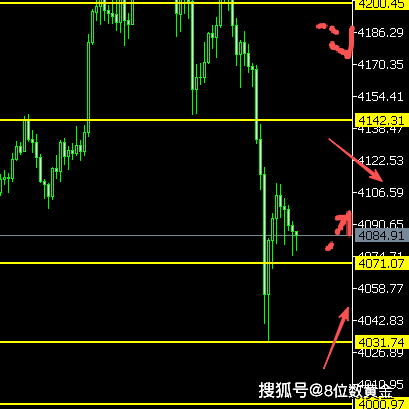
Market Overview - Gold experienced significant volatility this week, with a sharp rise followed by a dramatic drop of $180, potentially testing the $4000 level again [1] - After a rebound of $80, gold returned to $4100 before closing lower, with expectations to test $4071 next week [3] - The upper resistance levels are set at $4142 and $4200, with potential adjustments if these levels are breached [4][5] Influencing Factors - The U.S. government returned to focus, but October data showed a significant downturn, leading to increased uncertainty regarding the Federal Reserve's policies [6] - Internal divisions within the Federal Reserve have intensified, with unexpected hawkish signals suggesting no interest rate cuts in December, negatively impacting global assets including gold [6] - The expansion of U.S. tariff exemptions has led to a decline in economic expectations, further pressuring gold prices downward [7] Upcoming Events - The upcoming Federal Reserve monetary policy meeting is crucial, as it will test the balance between hawkish and dovish factions amid a lack of supportive data [8] - Key economic indicators such as PMI data and consumer confidence index will be released, which are vital for assessing the strength of the U.S. economy and may impact stock and bond markets [8] Investment Strategy - Investors are advised to focus on entry and exit points for gold investments, emphasizing the importance of accuracy in trading decisions [8] - Risk management and the ability to maximize profit opportunities while minimizing risk are essential for investors [8] - The gold trading team claims a high accuracy rate of 85% or more, with significant profit potential per trade [8]

贵金属:今冬蛰影藏幽意,明春芳华绽可期
Fang Zheng Zhong Qi Qi Huo· 2025-11-03 06:47
Report Industry Investment Rating No relevant content provided. Core Views of the Report - London gold and London silver experienced a sharp correction after accelerating their upward movement in October but remained the best - performing global asset classes this year. The decline in late October was mainly a technical correction, and the medium - to - long - term upward logic remained intact [90]. - The direct driver of the precious metals' rally since late August was Powell's unexpectedly dovish speech at the global central bank meeting, followed by the Fed's consecutive interest rate cuts in September and October and the end of QT since 2022. Sticky US inflation and falling real yields on US Treasuries were positive for precious metals [90]. - Deeper concerns stemmed from the market's worries about the Fed's future independence. Trump's dismissal of Fed governor Cook challenged the Fed's independence, leading to the ineffectiveness of the Fed's forward - guidance and irreversible damage to the US dollar's credit [90]. - Since the third quarter, long - term interest rates in major global economies have risen uncontrollably, approaching a global debt crisis. US Treasuries are no longer considered a safe - haven asset, and the US dollar index is expected to decline in the medium - to - long - term, leading to the return of the traditional monetary attributes of gold and silver [90]. - Gold and silver are being re - defined as anti - inflation, risk assets, and important components of global asset allocation, with a surge in investment demand [90]. - In the remaining part of the year, the precious metals market is expected to consolidate, with volatility gradually decreasing, in preparation for the next upward movement. In the medium - to - long - term, silver is undervalued compared to gold and likely to have stronger upward potential [90]. Summary by Directory Part 1: Market Review Gold - In October, the global gold market accelerated its upward movement, then retreated after hitting a high. The Shanghai gold futures contract briefly exceeded 1,000 yuan/gram, and London gold neared $4,400/ounce. However, it later suffered a significant one - day drop, with London gold falling over 6% and breaking below $4,000 and $3,900/ounce, with a cumulative decline of over 10% [15]. - The decline was a technical correction of the previous rapid rise. The spot market remained relatively stable, with the world's largest gold ETF's holdings decreasing by less than 2% in late October [15]. Silver - In October, the global silver market also accelerated its upward movement, setting a new record high before falling back. The Shanghai silver futures contract exceeded 12,000 yuan/kg, and London silver approached $55/ounce, breaking the 2011 high. The year - to - date gain was over 80% [19]. - The rally was driven by both the gold price and a shortage of physical silver liquidity. After the liquidity shortage eased and the gold price corrected, the silver price dropped rapidly. The decline was also a technical correction, and the physical market remained relatively optimistic, with the SLV silver holdings decreasing by less than 4% in late October [19]. Part 2: Macro Logic Manufacturing Reshoring and the Decline of the US Dollar's Reserve Currency Status - The US dollar index has been in a downward trend since the beginning of the year, and the market consensus on its medium - to - long - term decline has been strengthened. The "Sea Lake Manor Agreement" aims to rebalance trade, but it may lead to a reduction in the US dollar's global settlement share and weaken its reserve currency status [24]. - Global central banks have been accelerating the process of "de - dollarization" and increasing their gold reserves. In 2024, the US dollar's share in global foreign exchange reserves dropped to 58%, a 30 - year low [24]. The Pennsylvania Plan and the US Debt Crisis - The Pennsylvania Plan aims to shift the demand for US Treasuries from external to domestic investors to stabilize the US debt market. However, it has not been very effective so far, and long - term US Treasury demand remains weak [25]. Digital Currencies and the US Debt - The US has established a regulatory framework for digital stablecoins. In the short term, stablecoins may increase the demand for US Treasuries, but in the long term, they may accelerate the collapse of the US dollar's credit if the US fails to address its twin deficits [27]. Global Debt Crisis and the Flight to Precious Metals - Global debt levels are high, and major economies' sovereign credit ratings have been downgraded. Traditional credit - based monetary systems are being questioned, leading to an inflow of funds into precious metals and cryptocurrencies [29]. - US Treasuries are no longer considered a safe - haven asset, and global central banks' gold holdings have exceeded their US Treasury holdings. As the Fed enters a new interest - rate cut cycle, central banks are expected to continue reducing their US Treasury holdings and increasing their gold reserves [32]. Shifting Asset Allocation - Global investors have been reducing their exposure to US dollar - denominated assets and increasing their allocation to non - US assets, benefiting precious metals [34]. US Economic Situation and the Fed's Policy - The US economy is still expanding, but inflation remains above the Fed's target. The Fed started a new interest - rate cut cycle in September, which is positive for precious metals [37]. - US non - farm payroll data has been disappointing, and the Fed's focus has shifted from inflation to employment. Powell's stance has turned dovish, and the market is concerned about the Fed's independence [40][43]. Redefinition of Gold - Gold is being re - defined as an anti - inflation and risk asset, and it has become an important part of global asset allocation. Global high - net - worth individuals have increased their gold allocation, driving up its price [47]. Part 3: Fundamental Logic Central Bank Gold Purchases - Global central bank gold purchases slowed down in the first half of 2025 but accelerated in the third quarter. Most central banks expect to increase their gold reserves in the next 12 months [52]. Gold Investment Demand - Gold investment demand has been increasing, with global gold ETFs attracting significant inflows in the third quarter. The gold market has returned to a supply - deficit situation [55]. Silver Supply and Demand - Silver supply growth has been slow due to factors such as high production costs and long project cycles. Industrial demand, especially from the photovoltaic and automotive sectors, has been driving up silver demand [58][61]. - The global silver market has been in a supply - deficit situation, and the supply - demand gap is expected to persist in the medium - to - long - term. The inventory structure shows a shortage of freely - tradable silver [64]. Gold - Silver Ratio - The gold - silver ratio reflects the premium of gold over silver in terms of safe - haven demand. Historically, it has been negatively correlated with copper prices. Currently, the ratio is expected to decline further, indicating more upside potential for silver [65][67]. Asset Management and ETF Holdings - COMEX gold non - commercial net long positions increased in the third quarter, and the world's largest gold ETF's holdings reached a new high. COMEX silver non - commercial net long positions decreased, and the SLV silver holdings declined in October [70][73]. Options Markets - Gold and silver option historical volatilities have fluctuated, and their weighted implied volatilities are currently at high levels. Strategies such as selling slightly out - of - the - money put options or selling straddles can be considered [76][79]. Technical Analysis - Gold is in a long - term bull market, and based on historical experience, it still has room for growth in both time and price. Silver usually lags behind gold in entering a bull market but has a larger cumulative increase. The technical charts of both metals show positive signals [84][87]. Part 4: Summary and Outlook - In the remaining part of the year, the precious metals market is expected to consolidate, with volatility gradually decreasing. In the medium - to - long - term, silver is undervalued compared to gold and has stronger upward potential [90]. - The price ranges for the rest of the year are estimated: London gold is expected to trade between $3,800 - 3,900/ounce and $4,100 - 4,200/ounce; Shanghai gold futures between 880 - 900 yuan/gram and 940 - 960 yuan/gram; London silver between $44 - 46/ounce and $53 - 55/ounce; and Shanghai silver futures between 10,000 - 10,500 yuan/kg and 12,000 - 12,500 yuan/kg [89].
金价5000美元是开始?达利欧一句话点破美元危机,散户血亏前必看
Sou Hu Cai Jing· 2025-10-25 16:33
Core Viewpoint - The current surge in gold prices is unprecedented, driven by a combination of geopolitical risks, changing interest rates, and a decline in the credibility of the US dollar [1][3][12]. Group 1: Market Dynamics - Gold prices have recently surpassed $4,200, marking a significant historical high, with both international and domestic markets experiencing a bullish trend [1]. - The ongoing geopolitical tensions, particularly in the Middle East, have led to increased demand for gold as a safe-haven asset [3][12]. - The global interest rate environment is shifting, with expectations of a nearing end to the Federal Reserve's rate hike cycle, enhancing gold's appeal as a non-yielding asset [3][12]. Group 2: Central Bank Actions - Central banks worldwide have been net buyers of gold for several years, setting historical records in gold purchases [4]. - Many countries are repatriating gold stored in foreign vaults, reflecting a growing distrust in the current international monetary system [4]. Group 3: Institutional Perspectives - Major investment banks are adjusting their gold price targets upward, indicating a consensus among institutions regarding the value of gold [6]. - Notable figures, such as Ray Dalio, emphasize gold as a fundamental alternative to debt, highlighting concerns over the sustainability of the global debt system [6][8]. Group 4: Debt Concerns - The global debt has reached three times the total GDP, raising alarms about the sustainability of this debt level and the trust in traditional currency systems [7]. - The US national debt has surpassed $37 trillion, leading to skepticism about the government's ability to meet its financial obligations [8]. Group 5: Market Risks - Despite the bullish outlook, there are risks in the gold market, including potential volatility and historical precedents of sharp price corrections [11]. - The use of leverage in modern gold trading can amplify both gains and risks, making the market susceptible to sudden reversals [11]. Group 6: Future Outlook - The peak of the current gold rally is uncertain and will depend on the persistence of key driving factors, including geopolitical tensions and interest rate movements [12][13]. - The ongoing "de-dollarization" process and adjustments in foreign exchange reserves by central banks suggest a long-term shift in the monetary landscape, with some institutions projecting gold prices could reach as high as $5,000 [15].
中美现在最大的一个共识,可能就是不要爆发系统性的危机,以现在的全球化程度而言,如果再发生类似于1929年那样的世纪大萧条
Sou Hu Cai Jing· 2025-10-22 17:02
Economic Overview - The global economic growth rate for this year is approximately 3.1%, which is one percentage point lower than the pre-pandemic average [3] - The total U.S. federal debt has surpassed $34 trillion, with the Federal Reserve maintaining interest rates above 5% [3] - Germany's GDP declined by 0.4% year-on-year in the third quarter, while inflation in France remains high [3] Debt and Financial Stability - Global debt has reached 330% of GDP, significantly higher than the 150% ratio during the 1929 crisis, indicating a precarious financial situation [3] - The 2008 financial crisis was mitigated by aggressive monetary policy, but this has led to a larger global debt bubble that now affects all countries [5] Income Inequality - There is a growing disparity between developed and developing countries, with the wealthiest 10% holding over 76% of global wealth, while the bottom half of the population receives less than 2% [5] - In the U.S., the top 1% has seen their income nearly quadruple over the past 30 years, while the bottom 50% has experienced stagnant real wages [5] Trust and Systemic Risks - The erosion of trust in economic systems is evident in political conflicts in the U.S. and social unrest in Europe, signaling a struggle for resource distribution [7] - The current U.S.-China relationship is characterized by a race against time, with both nations trying to maintain stability to avoid global repercussions [7] Long-term Economic Outlook - The current stability in the global economy is described as "false stability," with past reliance on globalization, low interest rates, and technology bubbles no longer sustainable [9] - The IMF's statement about entering a "new era of long-term low growth" highlights structural issues rather than cyclical ones [10]

贵金属涨疯了!
Di Yi Cai Jing Zi Xun· 2025-10-14 00:32
Core Viewpoint - Gold prices have surged significantly due to geopolitical tensions, economic uncertainty, and expectations of interest rate cuts in the U.S., with prices recently surpassing $4,130 per ounce, marking a historic high [2][3]. Group 1: Gold Market Dynamics - Gold prices have increased nearly 60% this year, driven by strong demand from central banks and investor concerns over the global economic and political landscape [3]. - The market anticipates a 97% probability of a 25 basis point rate cut by the Federal Reserve in October, with a 100% probability for December, which typically benefits non-yielding assets like gold [3]. - Analysts from major banks, including Bank of America and Societe Generale, predict gold prices could reach $5,000 per ounce by 2026, with short-term corrections viewed as healthy for the long-term upward trend [4]. Group 2: Silver Market Dynamics - Silver prices have also surged, breaking historical highs due to the rising demand for industrial applications, particularly in electric vehicles and solar panels [5]. - The silver market has been in a supply-demand imbalance since 2021, with increasing demand and limited capacity for rapid production expansion [5]. - Analysts predict silver prices could reach $65 per ounce by 2026, driven by ongoing geopolitical tensions and fiscal deficits [5]. Group 3: Supply Constraints and Market Conditions - The London silver market is experiencing significant tightness due to a shortage of available inventory, leading to a premium on spot prices compared to futures [6]. - The largest silver ETF, SLV, requires 15,415 tons of silver to back its issued shares, equivalent to seven months of global silver production [6]. - Current physical demand for silver far exceeds supply, with borrowing rates for silver skyrocketing above 100%, indicating a need for higher prices to restore balance [7][8].
贵金属涨疯了!白银时隔45年创新高,黄金突破4130美元
Di Yi Cai Jing· 2025-10-13 23:53
Core Insights - The silver market in London is experiencing a historic short squeeze, driven by renewed trade tensions and expectations of interest rate cuts in the U.S. [1] - Gold prices have surged nearly 60% this year, surpassing $4,000 per ounce, influenced by geopolitical uncertainties and strong demand from central banks [2] - Analysts from major banks predict significant future price increases for both gold and silver, with gold potentially reaching $5,000 per ounce by 2026 and silver hitting $65 per ounce [3][4] Gold Market Analysis - Gold's price increase is attributed to geopolitical and economic uncertainties, with a 97% probability of a 25 basis point rate cut by the Federal Reserve in October [2] - The rise in gold prices is also linked to concerns over the potential disruption of the dollar-based economic order by political actions [2] - The Brookings Institution highlights that the market is trading not just on dollar depreciation but on the general devaluation of all fiat currencies relative to gold [2] Silver Market Dynamics - Silver prices have reached levels not seen since the 1980s, with New York silver futures rising by 6.8% to $50.13 per ounce [3] - The demand for silver is structurally increasing, particularly in electric vehicles and solar panels, leading to a supply-demand imbalance [4] - Analysts note that the silver market has been in a state of deficit since 2021, with a forecasted peak in demand in 2025 due to accelerated solar panel installations in China [4] Supply Constraints - The London silver market is facing significant inventory shortages, with physical silver prices showing a substantial premium over futures prices due to a lack of available stock [5] - The largest silver ETF, SLV, requires 15,415 tons of silver to back its issued shares, equivalent to seven months of global silver production [5] - The current supply tightness is exacerbated by the time required to bring new silver mines into production, which can take about ten years [4] Market Sentiment and Future Outlook - Analysts predict that the ongoing macroeconomic environment will keep safe-haven assets like silver in demand, with prices expected to rise further [4][6] - The silver borrowing rate has surged above 100%, indicating a significant demand for physical silver [6] - Despite the bullish outlook, there are warnings of increased short-term volatility due to overbought technical indicators for both gold and silver [7]
4000美元不是梦? 金价未来走势如何
Di Yi Cai Jing Zi Xun· 2025-09-30 00:32
Core Insights - Gold prices have surged to a historic high of $3,800, driven by factors such as expectations of U.S. interest rate cuts, concerns over a potential government shutdown, and escalating geopolitical tensions [2] - The market anticipates continued support for gold prices from a weakening dollar, central bank purchases, and strong demand for gold ETFs [2][3] Economic Indicators - The U.S. Commerce Department reported a 0.2% month-on-month increase in the core Personal Consumption Expenditures (PCE) index, with a year-on-year rate stable at 2.9%, aligning with market expectations [3] - Traders are predicting a nearly 90% chance of a Federal Reserve rate cut in October and about a 65% chance in December [3] Government Shutdown Concerns - The U.S. government faces a shutdown risk, with negotiations ongoing between President Trump and congressional leaders regarding funding extensions [4] Market Sentiment - Investor focus on potential government shutdowns has increased demand for safe-haven assets, contributing to rising gold prices [5] - The SPDR Gold Trust reported an increase in holdings from 996.85 tons to 1005.72 tons, a rise of 0.89% [5] Central Bank Purchases - Central banks have been increasing gold purchases, with annual net purchases exceeding 1,000 tons since 2022, and projections suggest this will continue [6] - The World Gold Council indicates that central bank purchases will account for 23% of total demand from 2022 to 2025, double the average from the previous decade [6] Dollar Weakness - The dollar index fell nearly 0.3%, dropping below 98, with a cumulative decline of over 10% this year due to Fed rate cut expectations and trade policies [7] - The inverse relationship between gold and the dollar has strengthened, with gold serving as an effective diversification tool amid rising uncertainty [7] Gold ETF Demand - Gold ETFs have become a significant source of demand, with inflows reaching 397 tons in the first half of the year, the highest since 2020 [8] - The total holdings in global gold ETFs reached 3,615.9 tons by the end of June, marking the highest level since August 2022 [8] Retail Investment Trends - Retail demand for gold products has shown notable changes, with bar investment expected to grow by 10% in 2024, while coin purchases are projected to decline by 31% [10] - The physical gold investment volume is expected to increase by 2% in 2025, reaching 1,218 tons, driven by optimistic price expectations in Asian markets [10] Jewelry Demand - Jewelry demand is sensitive to price changes, with high gold prices leading to a 14% decline in demand in Q2 2025, the lowest since Q3 2020 [11] - The World Gold Council attributes the drop in demand primarily to high prices affecting consumer purchasing behavior in major markets like China and India [11]
黄金飞升,谁在“爆买”?
Jin Shi Shu Ju· 2025-09-29 12:29
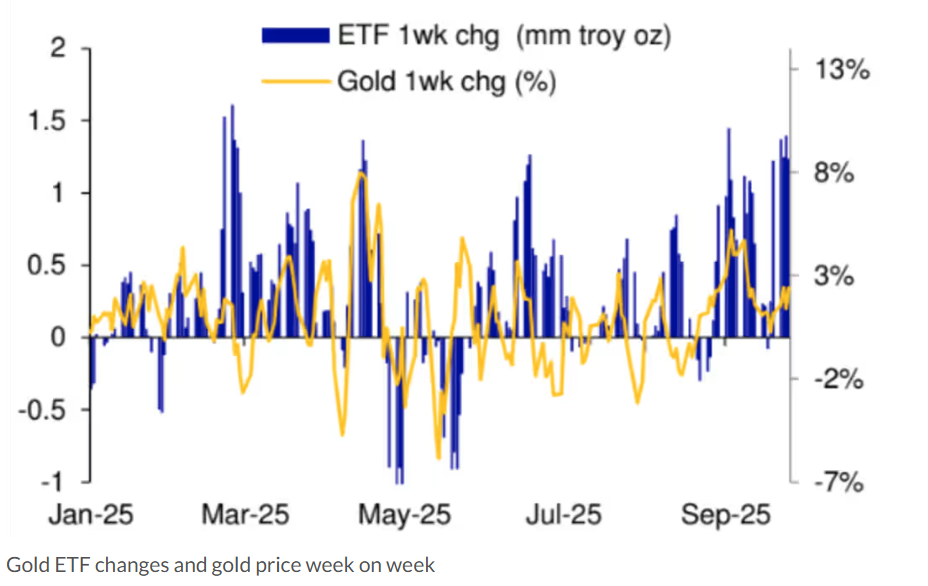
Core Insights - The current surge in gold prices is driven by two main forces: central banks and exchange-traded funds (ETFs) [1] - Gold prices reached a new historical high of $3,830, marking a year-to-date increase of over 45% [1] - Deutsche Bank's report indicates that the influence of ETFs on gold pricing has increased by 50% over the past three years, supporting their bullish target price of $4,000 for gold [1] Group 1: ETF Influence - ETF investors are experiencing one of the highest gold holdings years since the product's inception, with the SPDR Gold Shares ETF being particularly popular [1] - The assets under management (AUM) for ETFs in dollar terms are 70% higher than in 2020, yet the current gold holdings of 15 million ounces are still below the 17 million ounces seen in 2020, indicating potential for growth [1][2] - A recent analysis using the Granger causality test revealed that changes in gold prices drive ETF fund flows, rather than the other way around [2] Group 2: Demand Dynamics - Official demand from central banks is less sensitive to price changes, with an annual increase of 400 to 500 tons of gold demand over the past three years coinciding with significant price increases [4] - In contrast, jewelry demand is highly sensitive to price fluctuations, with rising gold prices leading to decreased jewelry demand, and increased jewelry demand potentially signaling a bearish outlook for gold prices [4] - ETF investors exhibit lower demand elasticity, which may explain why gold prices have consistently exceeded analyst predictions [4] Group 3: Market Trends - Recent data from Michael Hartnett's weekly fund flow report indicates a record inflow of $17.6 billion into gold funds over the past four weeks, highlighting strong demand for gold ETFs [5] - Hartnett attributes the rise in precious metal prices to inflation policies and a "war bull market," suggesting that despite being overbought from a tactical perspective, gold should be held long-term due to its structural underallocation in portfolios [5]

9.4黄金突发跳水50美金 再探3500
Sou Hu Cai Jing· 2025-09-04 07:22
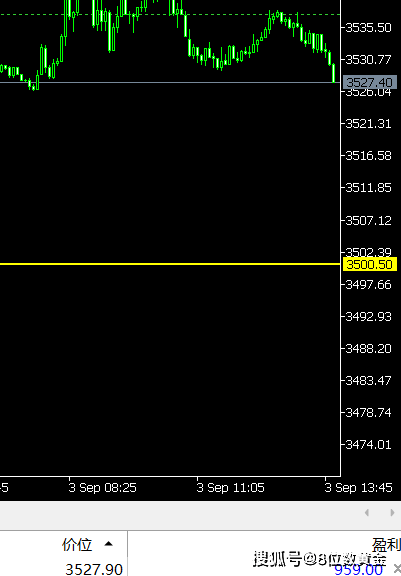
Group 1 - Gold prices experienced significant volatility, initially rising by $50 to reach a historical high before dropping by $50, erasing previous gains and potentially testing the $3500 level again [1][6][7] - The recent surge in gold prices is attributed to a combination of global debt crises and disappointing U.S. job vacancy data, which has raised expectations for a Federal Reserve rate cut in September, benefiting gold [8][9] - The gold market has shown a strong upward trend, breaking through historical highs after four months of consolidation, with potential targets set at $3600 and support levels at $3510 and $3470 [7][8] Group 2 - The labor market data, including corporate layoffs and unemployment claims, is expected to influence the Federal Reserve's decision on interest rates, impacting gold investment strategies [9] - The current market environment emphasizes the importance of precise entry and exit points for gold investments, with a focus on risk management to maximize profit opportunities [9] - A trading team with over ten years of experience claims to achieve a high accuracy rate of 85% or more in gold trading, highlighting the potential for significant profit margins [9]
中美日最新负债公开,美国40万亿,日本9.2万亿,中国呢?
Sou Hu Cai Jing· 2025-07-03 01:52
Global Economic Overview - The global economy is experiencing an unprecedented debt crisis, with rising government debts and increasing repayment risks, particularly in the US and Japan, while China remains relatively stable but faces challenges [1][22]. US Debt Situation - As of the end of May, the total federal debt in the US reached $36.2 trillion, with local government debt around $4 trillion, totaling over $40 trillion [3]. - The US debt market is facing a supply-demand imbalance, with a recent $720 billion bond auction failing, prompting the Federal Reserve to purchase over $40 billion in bonds in a month [8]. - The yield on US Treasury bonds has surged from approximately 0.5% in 2020 to 4.4% currently, leading to an increase in interest payments, which could reach $1.1 trillion from 2020 to 2024 [6][8]. Japan's Debt Crisis - Japan's government debt exceeds 1,323 trillion yen (approximately $9.2 trillion), accounting for 219% of its GDP, which is significantly higher than other major economies [13]. - The Bank of Japan's Yield Curve Control (YCC) policy, which involved unlimited bond purchases, was halted last year, leading to a decline in bond prices and rising credit risks [14]. China's Debt Challenges - As of May, China's government debt stood at 88.1 trillion yuan (approximately $12.3 trillion), representing 65% of its GDP, with a significant amount of hidden debt, particularly in local government financing [17][18]. - The Chinese government has implemented a 10 trillion yuan plan to address local government debt and has been reducing interest rates to lower repayment costs [18]. Conclusion on Global Economic Trends - The trend of de-dollarization is becoming more apparent, providing China with an opportunity to challenge the dominance of the US dollar and establish a more equitable international economic order [22].
