全球再平衡

Search documents
中国银河章俊:技术必须扎根产业土壤,方能避免沦为资本泡沫
2 1 Shi Ji Jing Ji Bao Dao· 2025-12-15 05:29
Group 1 - The core viewpoint emphasizes the need for technology innovation to be rooted in the industrial system to avoid becoming a capital bubble [1] - The Southern Finance Forum 2025 focused on the economic trends and capital market outlook for the "14th Five-Year Plan" period [1][2] - The forum gathered prominent representatives from finance, academia, and industry to discuss key issues [1] Group 2 - The consensus among experts indicates that domestic demand will be the main growth engine for China's economy in 2026, with consumption and investment driving growth [2] - Technology innovation is identified as a dual driving force for both the real economy and capital markets, with China's tech industry gaining global competitiveness [2] - A global economic rebalancing and moderate inflation are anticipated, with PPI expected to end its long-term negative growth trend, boosting market confidence [2] Group 3 - The discussion on A-share value reassessment highlighted the significant role of the capital market in economic transformation, moving beyond just a financing platform [3] - The potential for a "Davis Double Play" in A-shares hinges on PPI recovery and its correlation with corporate earnings [3][4] - A-shares are currently valued reasonably, aligned with the average nominal GDP growth rate over the past six years, and could transition to a profit-driven phase if inflation progresses smoothly [4] Group 4 - Concerns regarding the U.S. AI bubble were raised, with experts acknowledging its structural risks while noting that the timing and extent of adjustments depend on U.S. Federal Reserve policies and inflation trends [5] - China's advantages in AI applications were highlighted, with a strategic shift towards prioritizing technology implementation over capital narratives [5] - The resilience of A-shares is expected to remain intact even if a global AI bubble bursts, supported by solid fundamentals [5] Group 5 - Experts warned of potential systemic risks stemming from overlooked uncertainties, including the reversal of yen carry trade risks and pressures in constructing a self-sufficient modern industrial system [6][7] - Liquidity risks may arise from accumulated debt bubbles and shadow banking, potentially triggered by political uncertainties [7] - Geopolitical tensions could lead to unexpected global inflation, posing significant risks in 2026 [8] - The acceleration of technology replacing labor could transform youth unemployment from a potential risk to a real pressure [9]

全球“再平衡”之后,如何布局?
Sou Hu Cai Jing· 2025-11-17 08:14
Group 1 - The core viewpoint of the report is that global stock markets are undergoing a structural "rebalancing," with funds rotating from the technology sector to lower-valued sectors [1] - The report highlights two strategies for positioning in the A-share market for the upcoming year: one is that overseas disturbances provide a window for growth in sectors like AI; the other is that expectations of marginal improvement in economic conditions and structural rebalancing offer valuation recovery opportunities for cyclical sectors [1] - Key sectors to focus on include technology growth and cyclical sectors such as rising resource prices, new consumption, and service consumption [1] Group 2 - The report expresses a bullish outlook on the A-share market, indicating that overseas disturbances accelerate internal rebalancing, which provides opportunities for both AI growth and cyclical sectors [2] - It notes that the current pullback in the TMT sector has reached a relatively high value area for short-term investment [2] - The report emphasizes the potential for sustainable valuation recovery opportunities in cyclical sectors [2]


美银Hartnett:当美国负债38万亿美元时,该买入美债、美股还是黄金?这很棘手
3 6 Ke· 2025-10-20 13:06
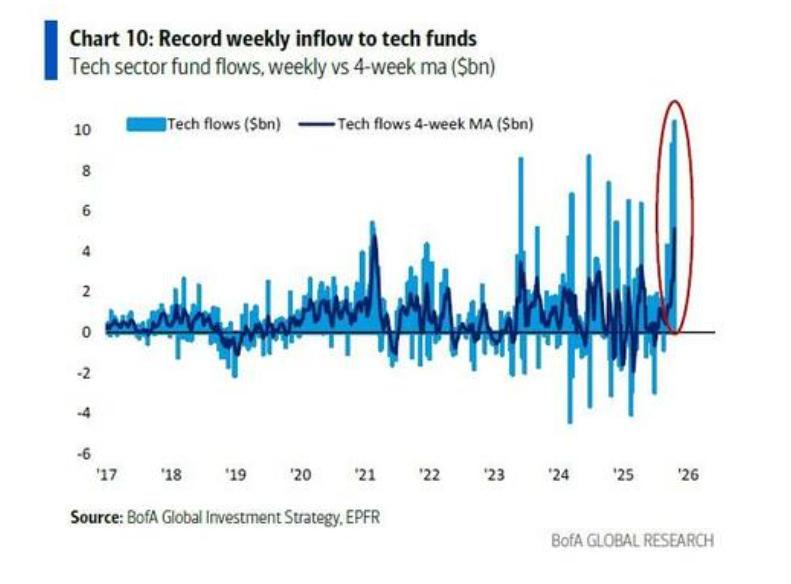
Group 1 - The core viewpoint highlights the challenges investors face as global central banks enter a rate-cutting cycle, with various asset classes presenting unique dilemmas [1] - The U.S. government debt has reached $38 trillion, diminishing the appeal of sovereign bonds as a safe haven [1] - Corporate bonds are offering insufficient risk compensation due to narrow credit spreads, while U.S. stock valuations are at historical highs, indicating significant correction pressure [1] Group 2 - Despite a cautious outlook, there has been a significant inflow of funds into risk assets, particularly technology stocks and gold, with $24.6 billion flowing out of cash assets in the past week [2][4] - The stock market attracted $28.1 billion, with technology stocks seeing a record inflow of $10.4 billion in a single week [2] - The gold market has experienced a cumulative inflow of $34.2 billion over the past 10 weeks, marking a historical high [4] Group 3 - The Chinese stock market has seen its largest weekly inflow since April 2025, amounting to $13.4 billion, reflecting a strong risk appetite amid rate cut expectations [7] - Global stock market capitalization has surged by $20.8 trillion this year due to the ongoing global rate-cutting trend, although risks are accumulating beneath the surface [9] - Hartnett warns of potential economic deterioration if asset prices decline and impact the wealthy, alongside emerging cracks in the credit market [9] Group 4 - Hartnett's "BIG" strategy emphasizes a focus on bonds, international markets, and gold, maintaining a bullish stance on long-term U.S. Treasury bonds with expectations of yields dropping below 4% [10][11] - The forecast for global earnings per share (EPS) growth is 9% over the next 12 months, surpassing market consensus, with a shift from "American exceptionalism" to "global rebalancing" anticipated [13] - Hartnett remains extremely bullish on gold, predicting prices could exceed $6,000 per ounce by spring next year, despite current high positioning in fund manager surveys [14][16]
美银Hartnett:当美国负债38万亿美元时,该买入美债、美股还是黄金?这很棘手
华尔街见闻· 2025-10-20 09:24
Core Viewpoint - The current investment landscape is challenging due to anticipated interest rate cuts by central banks, high government debt levels, narrow credit spreads, and elevated stock valuations, leading to a complex decision-making environment for investors [2][11]. Group 1: Market Conditions - The U.S. government debt has reached $38 trillion, diminishing the appeal of sovereign bonds as a safe haven [1][2]. - Credit spreads are at a 20-year low, providing insufficient risk compensation for corporate bonds [2]. - The CAPE ratio for stocks is at a high of 40, indicating significant potential for market corrections [1][2]. Group 2: Fund Flows - There has been a substantial outflow from cash assets, totaling $24.6 billion, with $28.1 billion flowing into the stock market, particularly technology stocks which saw a record inflow of $10.4 billion in one week [3][5]. - The gold market has also experienced a surge, with a cumulative inflow of $34.2 billion over the past 10 weeks, marking a historical high [5]. - The Chinese stock market recorded its largest weekly inflow since April 2025, amounting to $13.4 billion, reflecting a strong risk appetite among investors [8]. Group 3: Global Economic Trends - The global stock market capitalization has increased by $20.8 trillion this year, driven by a wave of liquidity from the global interest rate cuts [10]. - There are emerging risks in the market, with potential impacts on the wealthy class if asset prices decline, leading to economic deterioration [11]. Group 4: Investment Strategies - The strategy proposed by Hartnett includes maintaining a long position in long-term U.S. Treasuries, with expectations that the 30-year Treasury yield will fall below 4% [13]. - Hartnett is optimistic about international markets, predicting the Hang Seng Index will rise above 33,000 points, and expects a 9% growth in global EPS over the next 12 months [15]. - For gold, Hartnett maintains a bullish outlook, forecasting prices could exceed $6,000 per ounce by spring next year, despite current high positioning among fund managers [17][19].

央行连续增持,牛市“吹号手”,最新发声
Zheng Quan Shi Bao· 2025-10-07 04:17
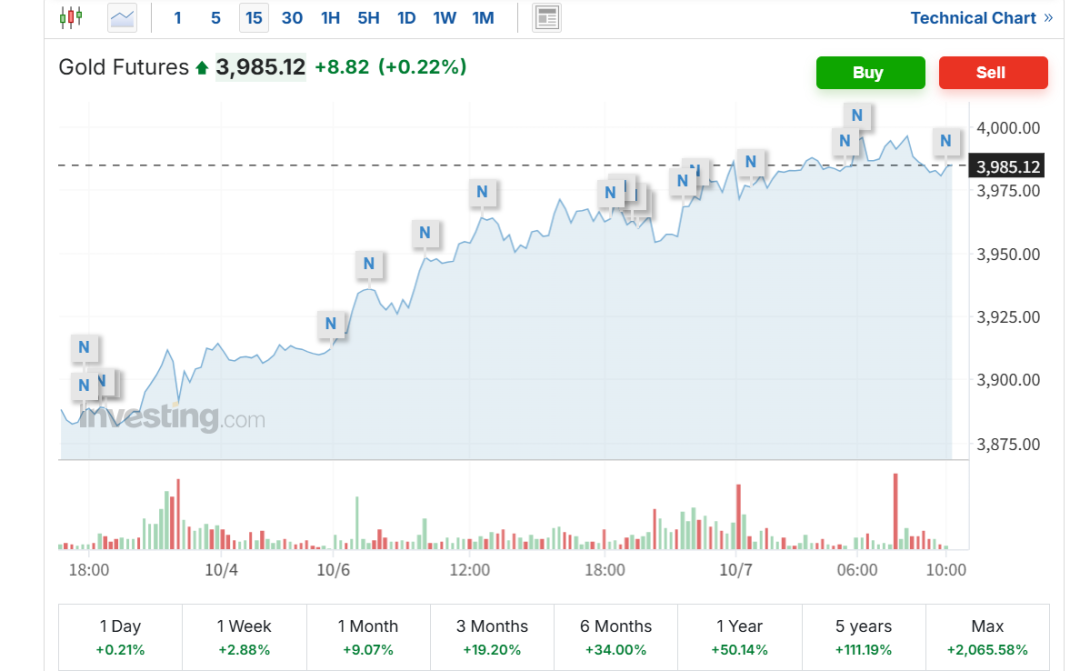
Core Viewpoint - Gold prices have reached historic highs, with New York futures hitting $4000 per ounce and spot gold nearing $3980 per ounce, driven by macroeconomic uncertainties and a shift towards hard assets [1][4][6]. Group 1: Gold Price Trends - As of October 7, New York futures reached $4000 per ounce, marking a new historical peak, although prices later retreated slightly [4]. - Goldman Sachs has raised its gold price forecast for December 2026 to $4900 per ounce, up from a previous estimate of $4300, citing strong demand from emerging market central banks [2][8]. - The continuous increase in gold prices is attributed to a lack of significant sell-offs and sustained demand for gold as a safe-haven asset [6]. Group 2: Central Bank Activities - The People's Bank of China reported a gold reserve of 74.06 million ounces at the end of September, marking the 11th consecutive month of gold accumulation [2][6]. - A survey indicated that over 95% of central banks expect to continue increasing their gold reserves in the next 12 months, the highest percentage since the survey began in 2019 [9]. - UBS forecasts that central bank demand for gold will remain between 900 to 950 tons in 2025, highlighting the importance of central banks as major buyers in the gold market [9]. Group 3: Market Analysis - Analysts from City Index and FOREX.com noted that macroeconomic uncertainties and a weakening dollar are contributing to the upward trend in commodity prices, including gold [6]. - The shift in reserve asset structures from dollar-denominated bonds to physical assets like gold is seen as a significant global rebalancing [6].
黄金股市齐创新高 本轮“泡沫”该如何交易?
智通财经网· 2025-09-22 22:38
Group 1 - The Federal Reserve is initiating interest rate cuts, leading to a surge in global asset prices and creating a bubble driven by loose monetary policy [1] - As of September 22, gold has risen by 35.4%, Bitcoin by 17.2%, and global stock markets by 14.3%, while the dollar index and oil prices have fallen by 9.3% and 11.4% respectively [1] - Michael Hartnett from Bank of America highlights a "run-it-hot" policy environment supported by tariff cuts, tax reductions, and interest rate cuts, providing implicit guarantees for the economy and stock market [1][4] Group 2 - Current market sentiment reflects a belief that "money is depreciating, and holding it is less favorable than spending or investing," driving funds into risk assets [3] - Fund managers are compelled to chase high-risk, high-beta investments to keep up with market benchmarks as the year-end bonus season approaches [3] Group 3 - Historical data suggests that the current market rally may still have room to grow, with past bubbles averaging a 244% rise from low to peak [4] - The "Magnificent Seven" tech stocks have increased by 223% since March 2023, with a dynamic P/E ratio of 39, indicating potential for further gains [4] Group 4 - Hartnett proposes five trading strategies to navigate the current bubble: 1. Go long on core bubble assets 2. Construct a "barbell" portfolio with bubble assets and undervalued value stocks 3. Short corporate bonds of bubble stocks 4. Short U.S. bonds 5. Go long on bond volatility while shorting stock volatility [6][7][8] Group 5 - The ongoing dollar weakness presents opportunities in international markets, with a theme of "global rebalancing" emerging in the latter half of the 2020s [11] - A notable correlation between the yen and Japanese stocks suggests a potential bull market in Japan, indicating a synchronized rise in the yen and stock market [11]
全世界的财富密码,都藏在这26个数字里?
财联社· 2025-09-01 02:19
Group 1 - The article highlights significant trends and changes in the global economy and financial markets, emphasizing the impact of populism, inequality, monetary policy, productivity, valuation, artificial intelligence, protectionism, global rebalancing, dollar depreciation, and the rise of cryptocurrencies [1] - In 2024, 32 political elections are expected globally, with 26 resulting in the ousting of incumbents, indicating a shift in political sentiment [1] - The U.S. government debt has reached a historical high of $37 trillion, surpassing the combined GDP of China, Japan, Germany, and India [1] Group 2 - The average unemployment rate for U.S. college graduates has surged to 8.1%, the highest since July 2021, reflecting potential challenges in the job market [3] - The capital expenditure of the "Big Seven" U.S. stocks has increased to 55% of their operating cash flow, up from 20% in 2012, indicating a shift in investment strategies [3] - The effective import tariff rate in the U.S. has reached 15%, the highest since 1937, suggesting a trend towards protectionism [3]

霍华德·马克斯:重要的不是发生在你身上的事,而是你对它所有的反应
聪明投资者· 2025-08-31 02:03
Group 1 - The article highlights the importance of defining a company's strategy, as illustrated by the examples of Jeff Bezos and Bill Miller, emphasizing that a precise definition can lead to strategic decisions on what to add or subtract in a business [1] - A conversation about Bill Miller's long-term investment in Amazon is recommended, showcasing the insights and details that contribute to understanding his investment philosophy [2] - Warren Buffett's recent activities, including increasing his stake in Mitsubishi and clarifying Berkshire Hathaway's position on railway acquisitions, are noted, reflecting his ongoing engagement in investment decisions [2] Group 2 - The article mentions various investment opportunities and insights from industry experts, such as the potential in Hong Kong stocks and the focus on innovation by companies like CATL [2] - Howard Marks' latest memo discusses the current market conditions in the U.S., indicating a shift towards a more concerning outlook, which investors should be aware of [2] - The article encourages readers to engage with investment wisdom through video content, promoting a deeper understanding of investment strategies [2]

港股现在“水大鱼多”!景林资产蒋彤最新交流:红利股是基本仓,全球再平衡带来很多好机会
聪明投资者· 2025-08-28 07:34
Core Viewpoint - The article emphasizes the importance of fundamental research and analysis in investment decision-making, highlighting the insights of Jiang Tong, a partner and fund manager at Jinglin Asset Management, regarding market dynamics and emerging sectors [3][4]. Group 1: Market Dynamics - Jiang Tong believes that the stock market's fundamentals are consistently better than the average macroeconomic performance, attributing this to the capital market's ability to represent the most dynamic and error-tolerant economic units [7]. - The government is enhancing its ability to address market failures through structured interventions, which aim to create long-term competitive advantages for industries [7][8]. - The "anti-involution" policy is seen as a significant indicator of this process, promoting reasonable profit margins for enterprises and reducing irrational pricing in international competition [7][8]. Group 2: Economic Indicators - Jiang Tong suggests that investors should start considering GNP (Gross National Product) alongside GDP (Gross Domestic Product) as the economy transitions to a moderate growth phase, with GNP growth outpacing GDP [9]. - There is a growing interest from foreign investors in Chinese assets, particularly in advanced manufacturing and new consumer trends [9]. Group 3: AI and Emerging Technologies - The article discusses the transition of AI from theoretical models to practical productivity tools, enhancing labor efficiency across various sectors [11]. - Jiang Tong identifies two key trends: the peak of capital expenditure in the U.S. due to tax incentives from the "Big and Beautiful" Act, and the increasing role of AI as a productivity tool, which is expected to yield returns for AI model companies [12][13]. - The article highlights the importance of tracking advancements in quantum computing, controllable nuclear fusion, and AI applications, particularly in drug discovery and scientific research [14]. Group 4: Investment Strategies - Jiang Tong's investment strategy includes a diversified portfolio across A-shares, Hong Kong stocks, and U.S. stocks, with a focus on sectors like advanced manufacturing, new consumption, and AI-related assets [15][16]. - The article notes that high-dividend stocks are considered a stable foundation in Jiang Tong's portfolio, with a strategy to reduce holdings in stocks with declining dividend attractiveness while maintaining positions in high-dividend leaders [17]. - To capture opportunities in emerging markets, Jiang Tong emphasizes the need for curiosity, continuous learning, and a systematic approach to research and investment [18].