
全球贸易不确定性

Search documents
全球媒体聚焦|外媒:美法院否决关税政策全球贸易不确定性仍将持续
Xin Lang Cai Jing· 2026-02-21 13:08
当地时间2月20日,美国最高法院裁定特朗普政府大规模关税政策违法后,引发全球媒体高度关注。 英国路透社2月21日发表分析文章指出,美国最高法院裁定关税政策违法,虽然这标志着其将关税作为经济武器的策略遭遇重大挫折,但 全球经济短期内难获喘息的机会。 路透社网站报道截图 专家预测,在现行关税体系被判定非法后,市场将再度陷入抑制经济活动的混乱状态,而美国政府几乎必然会寻求其他法律途径重新实施 关税。目前仍存在多重不确定性:白宫还将推出何种新关税?被撤销关税的已征税款是否需要退还?与美国达成关税缓解协议的经济体是 否面临协议重新审查? 文章援引欧洲政策中心(EuropeanPolicyCentre)分析师瓦格·福克曼的话说:"这只会开启全球贸易新的高度不确定期,最终局面很可能换 汤不换药。"荷兰国际集团(ING)经济学家也认为:"'脚手架虽已拆除,但建筑仍在施工'。无论判决如何,关税政策不会消失。" 英国路透社报道截图 英国《卫报》2月21日刊载的评论文章说,这一裁决令人耳目一新。但别急着开香槟庆祝——这份裁决既无法让美国重拾"可信赖经济体"的 声誉,也难以修复二战后建立的多边贸易体系。 英国《卫报》报道截图 文章援 ...

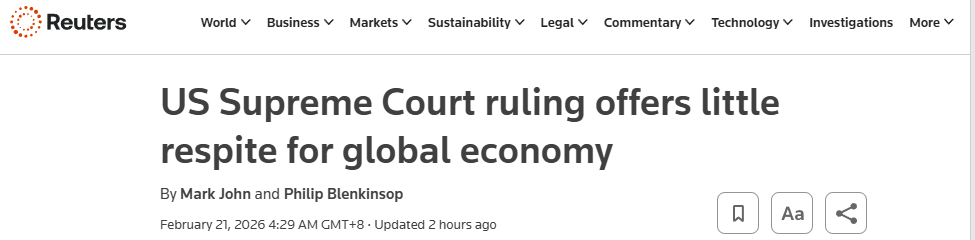
外媒:美法院否决关税政策 全球贸易不确定性仍将持续
Xin Lang Cai Jing· 2026-02-21 12:06
当地时间2月20日,美国最高法院裁定特朗普政府大规模关税政策违法后,引发全球媒体高度关注。 英国路透社2月21日发表分析文章指出,美国最高法院裁定关税政策违法,虽然这标志着其将关税作为经济武器的策略遭遇重大挫折,但 全球经济短期内难获喘息的机会。 文章援引欧洲政策中心(European Policy Centre )分析师瓦格·福克曼的话说:"这只会开启全球贸易新的高度不确定期,最终局面很可能 换汤不换药。"荷兰国际集团(ING)经济学家也认为:"'脚手架虽已拆除,但建筑仍在施工'。无论判决如何,关税政策不会消失。" 英国路透社报道截图 英国《卫报》2月21日刊载的评论文章说,这一裁决令人耳目一新。但别急着开香槟庆祝——这份裁决既无法让美国重拾"可信赖经济体"的 声誉,也难以修复二战后建立的多边贸易体系。 英国《卫报》报道截图 文章援引总部位于瑞士的监测组织"全球贸易警报"(Global Trade Alert)发布的数据,裁决将使美国贸易加权平均关税从15.3%降至8.3%。 但8.3%的税率仍远高于历史平均水平。更重要的是,最高法院对贸易战的核心问题——那些荒诞的加税借口——始终避而不谈。 文章认为,全球 ...
国债期货日报:资金面宽松,国债期货大多收涨-20260211
Hua Tai Qi Huo· 2026-02-11 05:42
国债期货日报 | 2026-02-11 财政:(3)财政:2025年全年财政收支整体未达预期,收入受税收走弱与非税高基数拖累,全年一般公共预算收 入同比下降1.7%;支出节奏前置,年末力度减弱,全年完成度偏低。结构上呈现分化特征,民生支出总体稳定, 基建类支出占比下降,土地财政收入持续疲软。展望2026年,财政政策预计延续积极,强调"总量增加、结构更优", 支出力度有望加强,节奏继续前置,对稳增长形成支撑。(4)金融:2025年前12个月份社会融资规模增量累计为 35.6万亿元,比去年同期3.34万亿:12月末,M2余额340.29万亿,同比+8.5%;M1余额115.51万亿,同比+3.8%。 12月末人民币贷款余额同比+6.2%,存款余额同比+8.7%。信贷方面居民与企业融资明显分化,居民贷款减少反映 内生需求仍弱,企业贷款则同比多增,体现政策支持效果逐步显现。(5)央行:2026-02-10,央行以固定利率1.4%、 数量招标方式开展了3114亿元7天的逆回购操作。(6)货币市场:主要期限回购利率1D、7D、14D和1M分别为1.362%、 1.531%、1.604% 和1.551%,回购利率近期回落。 ...
国债期货日报:PMI超预期,国债期货涨跌分化-20260203
Hua Tai Qi Huo· 2026-02-03 05:20
Report Summary 1. Report Industry Investment Rating No investment rating information is provided in the report. 2. Core Viewpoints - The bond market oscillates between stable growth and easing expectations. Influenced by the stock market, the Political Bureau meeting signaled loose monetary policy, the LPR remained unchanged, and the Fed's rate - cut expectations and global trade uncertainties increased the uncertainty of foreign capital inflows. Short - term attention should be paid to policy signals at the end of the month [3]. 3. Summary by Directory I. Interest Rate Pricing Tracking Indicators - **Price Indicators**: China's CPI (monthly) had a 0.20% month - on - month increase and a 0.80% year - on - year increase; China's PPI (monthly) had a 0.20% month - on - month increase and a - 1.90% year - on - year decrease [9]. - **Monthly Economic Indicators**: Social financing scale was 442.12 trillion yuan, with a month - on - month increase of 2.05 trillion yuan (+0.47%); M2 year - on - year growth was 8.50%, with a month - on - month increase of 0.50% (+6.25%); Manufacturing PMI was 49.30%, with a month - on - month decrease of 0.80% (-1.60%) [10]. - **Daily Economic Indicators**: The US dollar index was 97.61, up 0.49 (+0.50%); The offshore US dollar to RMB exchange rate was 6.9411, down 0.011 (-0.16%); SHIBOR 7 - day was 1.49, down 0.10 (-6.01%); DR007 was 1.49, down 0.10 (-6.40%); R007 was 1.68, up 0.17 (+11.44%); The 3 - month inter - bank certificate of deposit (AAA) was 1.58, unchanged (+0.00%); The AA - AAA credit spread (1Y) was 0.09, unchanged (+0.00%) [11]. II. Overview of the Treasury and Treasury Futures Market The report provides multiple charts showing the trends and proportions related to the treasury futures market, including the closing prices, price changes, precipitation of funds, positions, and net positions of various treasury futures varieties [13][14][18]. III. Overview of the Money Market Liquidity The report presents charts on the inter - bank pledged repurchase transaction statistics, local government bond issuance, the spread between China Development Bank bonds and treasury bonds, treasury bond issuance, Shibor interest rate trends, and the yield trends of inter - bank certificates of deposit (AAA) [24][27][29]. IV. Spread Overview The report shows the trends of inter - period spreads of various treasury futures varieties and the spreads between spot bond term spreads and futures cross - variety spreads through multiple charts [34][35][37]. V. Two - Year Treasury Futures The report includes charts on the implied interest rate and the maturity yield of the two - year treasury futures main contract, the IRR of the TS main contract and the funding rate, and the three - year basis and net basis trends of the TS main contract [43][45]. VI. Five - Year Treasury Futures The report provides charts on the implied interest rate and the maturity yield of the five - year treasury futures main contract, the IRR of the TF main contract and the funding rate, and the three - year basis and net basis trends of the TF main contract [47][55]. VII. Ten - Year Treasury Futures The report offers charts on the implied yield and the maturity yield of the ten - year treasury futures main contract, the IRR of the T main contract and the funding rate, and the three - year basis and net basis trends of the T main contract [56][57]. VIII. Thirty - Year Treasury Futures The report contains charts on the implied yield and the maturity yield of the thirty - year treasury futures main contract, the IRR of the TL main contract and the funding rate, and the three - year basis and net basis trends of the TL main contract [62][67]. 4. Strategies - **Unilateral**: As the repurchase rate declines, the prices of treasury futures oscillate [4]. - **Arbitrage**: Pay attention to the decline of the 2603 basis [4]. - **Hedging**: There is medium - term adjustment pressure, and short - sellers can use far - month contracts for moderate hedging [4].
Stock market benchmark indices trade lower on foreign fund outflows, renewed concerns over tariff hikes
BusinessLine· 2026-01-09 04:37
Market Overview - Benchmark indices Sensex and Nifty experienced a decline in early trade due to foreign fund outflows and concerns over potential US tariff hikes [1][3] - The BSE Sensex fell by 78.84 points to 84,102.12, while the NSE Nifty decreased by 21.50 points to 25,850.85 [1] - The previous trading day saw the Sensex drop by 780.18 points (0.92%) to 84,180.96 and the Nifty tumble by 263.90 points (1.01%) to 25,876.85 [2] Institutional Activity - Foreign institutional investors sold equities worth ₹3,367.12 crore, while Domestic Institutional Investors (DIIs) purchased stocks worth ₹3,701.17 crore [3] - The Indian equity market is characterized by a cautious sentiment following the significant sell-off in the previous session [3] Sentiment and External Factors - Concerns regarding potential US tariff actions related to India's Russian oil imports have contributed to fragile market sentiment [4] - The lack of progress in US-India trade discussions is causing caution among institutional investors, particularly foreign ones [4] - In contrast, Asian markets showed mixed performance, with South Korea's Kospi, Japan's Nikkei 225, and Shanghai's SSE Composite indices trading higher, while Hong Kong's Hang Seng index declined [4] Commodity Prices - Brent crude oil prices increased by 0.53% to $62.32 per barrel [5]

全球贸易在2026年前景如何?分析师:这四个“不确定性”很关键
第一财经· 2025-12-26 12:28
Core Viewpoint - Despite the construction of tariff barriers by the largest global economy, international trade in goods is expected to maintain a relatively strong momentum in 2025, although the trajectory of trade is shifting with a decline in U.S. imports and robust growth in imports from developing economies in Africa, the Middle East, and Latin America [3] Group 1: Trade Dynamics - Global container shipping volume increased by 2.1% year-on-year in October, but the global container supply chain is beginning to adjust and reshape trade patterns [3] - The U.S. container import volume is projected to decline significantly in 2025, contrasting with a 15.2% increase in 2024 [3] - Trade experts anticipate increased turbulence in international trade over the next year, driven by four key uncertainties: the review of the USMCA, the reopening of the Red Sea route, agreement uncertainties, and the U.S. Supreme Court's ruling on tariffs [3] Group 2: USMCA Review - The U.S., Canada, and Mexico are set to review the USMCA, which allows for updates six years after its implementation [5] - Over 1,500 responses were received during the public consultation period, with many stakeholders supporting the agreement but calling for improvements [6] - Tensions between the U.S. and Canada have escalated following the suspension of trade talks due to a tariff advertisement controversy [6] Group 3: Shipping Concerns - Shipping companies express concerns about the upcoming year, with potential disruptions similar to those experienced during the pandemic [7] - The return to the Red Sea shipping route could lead to increased market capacity and severe port congestion in Europe [7] - Demand from the U.S. economy may not see significant growth, with estimates suggesting a maximum increase of less than 5% [8] Group 4: Trade Agreements - The Trump administration's trade agreements with various partners lack traditional legal binding and enforcement mechanisms, raising concerns about their stability [10] - The agreements with the UK and EU are described as non-binding, with the term "deal" lacking legal significance [10] - Ongoing negotiations with the EU and India are expected to continue into the new year, with potential retaliatory measures from the U.S. against the EU [10] Group 5: Supreme Court Ruling - A significant unknown in global trade for 2026 is the upcoming U.S. Supreme Court ruling on the legality of the Trump administration's tariffs [12] - If the Trump administration loses, it may have to refund tariffs paid by U.S. importers, although the process remains uncertain [12] - The likelihood of the Trump administration losing the case is estimated at 75%, which could force the government to utilize other powers to impose tariffs [12]

研究机构预估台湾2026年经济增速放缓至3.71%
Zhong Guo Xin Wen Wang· 2025-12-22 11:01
Economic Outlook - Taiwan's GDP growth rate is projected to slow down to 3.71% in 2026 due to high base effects, global trade uncertainties, and structural differentiation within the domestic industry [1] - The export performance of Taiwan is expected to be supported by electronics and information communication products, while traditional industries face challenges from US tariffs, slowing global demand, and competition from the mainland [1] Trade and Export - The growth rate of Taiwan's goods and services exports is expected to drop significantly from 32.09% in 2025 to 8.41% in 2026 [1] Domestic Consumption - Private consumption in Taiwan is recovering slowly, with a projected real growth rate of only 1.35% for the entire year due to uncertainties from US tariff policies and financial market volatility [1] - Despite expected tax adjustments and related subsidies to boost consumption, the growth rate for private consumption is anticipated to rise modestly to 2.13% in 2026, constrained by uneven industrial prosperity and employment concerns [1] Private Investment - The real private investment growth rate for 2025 is estimated at 10.56%, but is expected to decline to 1.81% in 2026 due to high base effects [2] - The real fixed capital formation growth rate is projected to decrease from 10.17% in 2025 to 2.13% in 2026 [2]
台湾五年来首见税收短征 媒体忧军购挤压民生
Zhong Guo Xin Wen Wang· 2025-12-18 09:08
Group 1 - Taiwan's tax revenue is projected to fall short by NT$30 billion to NT$50 billion in 2025, raising concerns about the impact on social welfare and tax reduction space due to increasing military expenditures [1][2] - The recent military procurement from the U.S. includes over US$11.1 billion for eight arms sales, which is part of Taiwan's NT$1.25 trillion defense special budget awaiting legislative approval [1] - The slowdown in tax revenue growth amidst rising economic growth rates highlights structural imbalances in Taiwan's industry and tax base distribution, with reliance on exports and high-tech industries while consumer markets remain sluggish [1] Group 2 - The scale of special budgets in Taiwan has been expanding, with the upcoming fiscal year including budgets for "enhancing defense resilience" and "social resilience," totaling NT$2.2 trillion, nearing the total of NT$2.57 trillion during the previous administration [2] - The normalization of special budgets is weakening existing budget review mechanisms, posing challenges to fiscal discipline [2] - Taiwan's credit outlook for 2026 indicates potential economic growth slowdown to 2.4% due to reduced investment momentum in AI infrastructure and increased global trade uncertainties, which may exacerbate fiscal pressures [2]
韩国预计今年全年出口额将首次超过7000亿美元
Xin Lang Cai Jing· 2025-12-07 04:43
Core Insights - The South Korean government forecasts that the country's export value will exceed $700 billion for the first time in 2025, setting a new historical record, although exports excluding semiconductors are expected to decline year-on-year [1][3][4]. Export Performance - From January to November, South Korea's total export value reached $640.2 billion, marking a year-on-year increase of 2.9%, the highest level for the same period, surpassing the previous record of $628.7 billion in 2022 [1][3]. - Exports excluding semiconductors amounted to $487.6 billion during the same period, reflecting a year-on-year decrease of 1.5% [5]. Sector-Specific Trends - The automotive, shipbuilding, biopharmaceutical, and computer sectors saw export growth of 2%, 28.6%, 7%, and 0.4%, respectively, while all other sectors experienced declines [5]. - Notable declines were observed in machinery exports (down 8.9%), petroleum products (down 11.1%), petrochemicals (down 11.7%), and steel exports (down 8.8%). Additionally, exports of automotive parts, displays, home appliances, and secondary batteries fell by 6.3%, 10.3%, 9.4%, and 11.8%, respectively [5]. Semiconductor Dependency - In November, semiconductors accounted for 28.3% of South Korea's total export value, the highest proportion recorded this year, raising concerns about the country's over-reliance on the semiconductor industry [5]. - Historically, from 2002 to 2010, semiconductors represented about 10% of South Korea's total exports [5].
流动性相对宽松,国债期货涨跌分化
Hua Tai Qi Huo· 2025-12-02 02:26
1. Report Industry Investment Rating - Not provided in the content 2. Core Viewpoints of the Report - The bond market fluctuates between stable growth and easing expectations, affected by the stock market, delayed Fed rate - cut expectations, and increased global trade uncertainties. It is recommended to pay attention to the policy signals at the end of the month in the short term [1][3] - For trading strategies, the 2603 contract of treasury bond futures is neutral for unilateral trading; pay attention to the decline of the 2603 basis for arbitrage; and short - side investors can use far - month contracts for appropriate hedging due to the medium - term adjustment pressure [4] 3. Summary by Relevant Catalogs 3.1 Interest Rate Pricing Tracking Indicators - Price indicators: China's CPI (monthly) has a month - on - month and year - on - year increase of 0.20%; China's PPI (monthly) has a month - on - month increase of 0.10% and a year - on - year decrease of 2.10% [9] - Economic indicators (monthly update): Social financing scale is 437.72 trillion yuan, with a month - on - month increase of 0.64 trillion yuan and a growth rate of 0.15%; M2 year - on - year is 8.20%, with a decrease of 0.20 percentage points and a decline rate of 2.38%; Manufacturing PMI is 49.20%, with an increase of 0.20 percentage points and a growth rate of 0.41% [10] - Economic indicators (daily update): The US dollar index is 99.42, with a decrease of 0.05 and a decline rate of 0.05%; The US dollar against the offshore RMB is 7.0710, with a change of 0.000 and a decline rate of 0.01%; SHIBOR 7 - day is 1.45, with an increase of 0.02 and a growth rate of 1.18%; DR007 is 1.46, with a decrease of 0.01 and a decline rate of 0.60%; R007 is 1.51, with a decrease of 0.02 and a decline rate of 1.24%; The 3 - month inter - bank certificate of deposit (AAA) is 1.59, with a change of 0.00 and a decline rate of 0.11%; The AA - AAA credit spread (1Y) is 0.10, with a change of 0.00 and a decline rate of 0.11% [10] 3.2 Overview of the Treasury Bond and Treasury Bond Futures Market - On December 1, 2025, the closing prices of TS, TF, T, and TL were 102.41 yuan, 105.84 yuan, 108.04 yuan, and 114.37 yuan respectively, with the corresponding price changes of 0.03%, 0.10%, 0.12%, and - 0.08% [3] - The average net basis of TS, TF, T, and TL was - 0.037 yuan, - 0.149 yuan, - 0.143 yuan, and - 0.139 yuan respectively [3] - There are multiple figures showing the closing price trends, price changes, capital flow, position ratios, etc. of treasury bond futures [7][12][15] 3.3 Overview of the Money Market Funding Situation - From January to October 2025, the general public budget revenue increased by 0.8% year - on - year, with tax revenue improving for eight consecutive months, but non - tax revenue dragging down the overall growth rate. The general public budget expenditure increased only by 2% year - on - year and slowed down for three consecutive months [2] - At the end of October, the social financing and credit maintained a low - level expansion, while government bond issuance remained strong, and the financing demand of enterprises and residents was weak. The M1 declined, and the M2 - M1 gap widened, indicating weak business vitality in the real economy [2] - On December 1, 2025, the central bank conducted 107.6 billion yuan of 7 - day reverse repurchase operations at a fixed interest rate of 1.4% [2] - The main term repurchase rates of 1D, 7D, 14D, and 1M were 1.307%, 1.454%, 1.477%, and 1.519% respectively, and the repurchase rates have rebounded recently [2] - There are multiple figures showing the Shibor rate trends, inter - bank certificate of deposit yields, bank - to - bank pledged repurchase transactions, and local government bond issuance [7][26][29] 3.4 Spread Overview - There are multiple figures showing the inter - term spread trends of treasury bond futures and the term spread between spot bonds and cross - variety spreads of futures [7][28][33] 3.5 Two - year Treasury Bond Futures - There are figures showing the implied interest rate and maturity yield of the two - year treasury bond futures main contract, the IRR of the TS main contract and the funding rate, and the three - year basis and net basis trends of the TS main contract [7][36][46] 3.6 Five - year Treasury Bond Futures - There are figures showing the implied interest rate and maturity yield of the five - year treasury bond futures main contract, the IRR of the TF main contract and the funding rate, and the three - year basis and net basis trends of the TF main contract [7][48][52] 3.7 Ten - year Treasury Bond Futures - There are figures showing the implied yield and maturity yield of the ten - year treasury bond futures main contract, the IRR of the T main contract and the funding rate, and the three - year basis and net basis trends of the T main contract [7][54][56] 3.8 Thirty - year Treasury Bond Futures - There are figures showing the implied yield and maturity yield of the thirty - year treasury bond futures main contract, the IRR of the TL main contract and the funding rate, and the three - year basis and net basis trends of the TL main contract [7][61][67]