
全面牛

Search documents
申万宏源傅静涛:下半年有望迎来“全面牛”
Zheng Quan Shi Bao· 2026-01-04 17:48
Core Viewpoint - The A-share market is expected to experience a "structural bull" in 2025, followed by a potential "full bull" market in the second half of 2026 [1] Group 1: Market Phases - The A-share bull market follows a "two-stage" pattern, with previous examples being the structural bull in 2013 followed by a full bull in 2015, and another structural bull from 2016 to 2017 followed by a full bull from 2020 to 2021 [1] - During the structural bull phase, institutional holdings and valuations of core sectors reach initial high points, leading to a qualitative change in the accumulation of institutional profit effects [1] Group 2: Future Expectations - The potential full bull market in 2026 is supported by cyclical improvements in fundamentals, a new phase in technology industry trends, and a positive cycle of incremental capital inflow [1] - The A-share market is expected to embrace global "competitive thinking," transitioning from "following" to "leading" in external circulation, which opens up transformation space for China's development [1] Group 3: Investment Focus - The leading investment themes for the 2026 bull market will focus on three main areas: the extension of AI industry trends from computing power to applications, breakthroughs in the robotics industry, and the revaluation of advanced manufacturing in energy storage and photovoltaics [1] - In the first half of 2026, cyclical and value sectors are likely to have relative advantages during market consolidation, with particular attention on excess returns in the basic chemicals and industrial metals sectors [1]

下半年有望迎来“全面牛”
Zheng Quan Shi Bao· 2026-01-04 17:30
申万宏源研究A股策略首席分析师傅静涛表示,2025年是典型的"结构牛",2026年下半年则有望迎 来"全面牛"。 傅静涛提出,A股牛市行情遵循"两段论"规律:2013年迎来结构牛,随后就是2015年的全面牛;2016— 2017年迎来结构牛,随后就是2020—2021年的全面牛。在结构牛阶段,机构对核心板块的持仓与估值同 步触及首轮高位,叠加机构赚钱效应完成从量变到质变的积累。进入全面牛阶段,核心产业趋势进一步 升级,基本面改善的领域持续扩容,再与增量资金形成正向循环,最终使得估值提升到历史高位的赛道 明显增加。 傅静涛认为,2026年下半年可能迎来"全面牛"。基本面周期性改善、科技产业趋势新阶段演绎以及增量 资金流入正循环,构成全面牛的基本盘。A股将拥抱全球"竞争思维",中国外循环从"跟跑"到"领跑", 外循环取得突破,打开了中国发展转型空间。 他表示,2026年牛市的领涨主线,将聚焦在三大方向:AI产业趋势从算力向应用延伸,机器人产业实 现突破,储能、光伏领域等中国先进制造重估。顺周期与价值板块,大概率在2026年上半年的市场休整 阶段占相对优势,其中,周期领域的超额收益可重点关注基础化工、工业金属赛道。 ...


申万宏源:上证综指连续阳线后,春季行情仍有纵深
Xin Lang Cai Jing· 2026-01-04 08:47
Group 1 - The December 2025 PMI shows a significant month-on-month improvement, reinforcing the absence of downward risks for the spring season [1][5] - The favorable economic conditions are supported by the late timing of the 2026 Spring Festival, which has led to a pre-emptive increase in export orders [1][5] - The spring season is expected to provide a continuous window for risk appetite, with key events such as the February pre-Spring Festival rebound and the March Two Sessions potentially enhancing policy catalysts [1][5] Group 2 - The economic and industrial variables are slow-moving, while capital supply and demand are fast-moving, a characteristic that may become more pronounced in the spring market [1][5] - The A500 ETF has entered a stable phase, and the influx of new capital at the beginning of the year is expected to coincide with a recovery in foreign investment activity due to the appreciation of the RMB [1][5] - The A-share market is anticipated to have a positive start, with widespread profit-making effects likely to emerge [1][5] Group 3 - The conditions for a comprehensive bull market in 2026 are gradually being established, with a dynamic development process underway [2][6] - The market's previous skepticism regarding foreign capital inflows is shifting, as the recent appreciation of the RMB enhances the competitiveness of Chinese manufacturing, potentially accelerating foreign capital return [2][6] - The second half of 2026 is expected to witness a bull market driven by various positive factors, including cyclical improvements in fundamentals and increased asset allocation towards equities by residents [2][6] Group 4 - The spring market structure remains unchanged, with higher elasticity in thematic trading opportunities, particularly in AI computing chains and cyclical sectors [3][7] - The thematic rotation includes industrial themes (commercial aerospace, robotics, nuclear fusion), capital themes (A500, insurance, foreign capital return), and policy themes (service consumption, Hainan) [3][7] - The investment focus is on sectors with Alpha logic, while cyclical sectors are recommended only for those with strong fundamentals [3][7]
申万宏源策略一周回顾展望:开门红
Shenwan Hongyuan Securities· 2026-01-04 03:04
Group 1 - The report highlights that the December 2025 PMI, production, new orders, and new export orders showed significant improvement compared to seasonal trends, reinforcing the absence of downward economic risks for spring 2026 [5][8][11] - The report suggests that the spring season presents a favorable window for market performance, with key events such as the Chinese New Year and the Two Sessions potentially catalyzing positive market sentiment [11][16] - The report indicates that the economic and industrial variables are slow-moving, while capital supply and demand are fast-moving, which may become more pronounced in the spring market [11][15] Group 2 - The report anticipates that conditions for a comprehensive bull market in 2026 will gradually be fulfilled, driven by various factors including improved supply-demand dynamics in the manufacturing sector and increased foreign capital inflow [15][16] - The "two-stage bull market" theory remains unchanged, with the current market in a high-level consolidation phase, while the second stage of the bull market is expected in the second half of 2026 [16][17] - The report emphasizes that spring themes will likely include high elasticity in thematic trading, with a focus on AI computing chains and cyclical opportunities [16][17] Group 3 - The report notes that the A-share market is expected to see a "red opening" at the beginning of the year, supported by increased capital inflow from insurance and foreign investments, which may enhance overall risk appetite [15][21] - The report provides insights into the performance of various sectors, indicating that sectors like defense, machinery, and automotive are continuing to expand, while others like consumer goods and healthcare are experiencing contraction [21][22] - The report tracks key ETFs, noting significant changes in their share volumes and performance, which reflect broader market trends and investor sentiment [23][24]
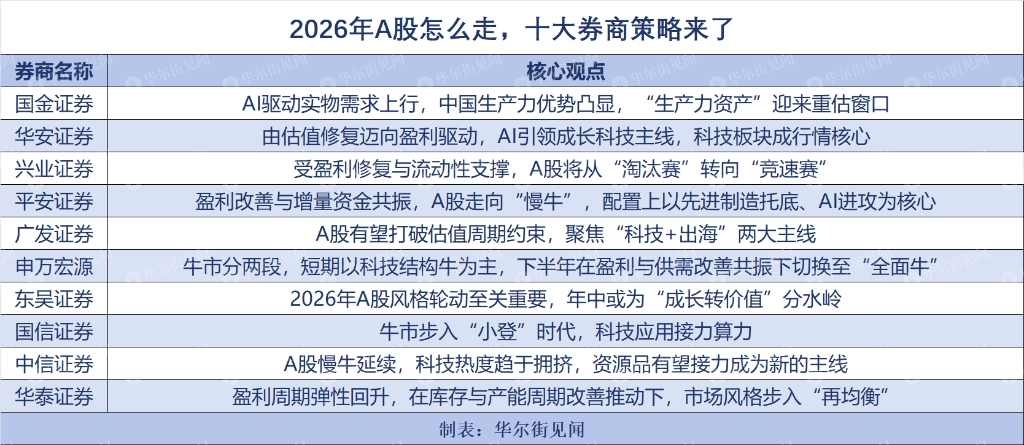
科技领跑、周期接力、慢牛到全面牛……2026年A股怎么走,十大券商策略来了
Hua Er Jie Jian Wen· 2025-12-20 04:57
Core Viewpoint - The A-share market is transitioning from a liquidity and valuation-driven phase to a new stage that emphasizes fundamentals and profit recovery, with a projected double-digit profit growth for the entire A-share market in 2026 [1][2][4]. Group 1: Market Outlook - Most major domestic securities firms believe that the A-share market will remain in a bull market in 2026, with profit recovery being a key variable for market sustainability [1][2]. - The overall profit growth for the A-share market is expected to rise from 8.2% in 2025 to 10.3% in 2026, with the growth rate for non-financial sectors projected at 7.7% [12][64]. - The first half of 2026 is anticipated to maintain market momentum, but a significant transition may occur mid-year, particularly for sectors that have seen substantial gains [1][2][27]. Group 2: Sector Focus - The technology sector remains a consensus direction for 2026, with a shift from infrastructure investment to application and performance realization in AI, focusing on areas like robotics and smart driving [2][21]. - The "anti-involution" policy is expected to drive profit recovery in sectors such as steel, chemicals, and new energy, while resource products may present opportunities as they follow the technology sector [2][27]. - The report highlights four main areas for investment opportunities: AI, new energy, military industry, and innovative pharmaceuticals, with a focus on sectors that are expected to benefit from the "15th Five-Year Plan" [34][40][79]. Group 3: Investment Strategies - The investment strategy should prioritize "manufacturing as a shield and technology as a sword," emphasizing advanced manufacturing and AI as core components [40][44]. - The report suggests a rotation in market style from growth to value, particularly around mid-2026, as the market may shift focus based on liquidity and industry trends [68][69]. - The report emphasizes the importance of identifying high-performance sectors within the "future industries" and suggests a focus on resource security and energy [79][91]. Group 4: Financial Metrics and Predictions - The overall A-share market is expected to see a significant recovery in profitability, with non-financial net profit growth projected to rebound from 6.5% in 2025 to 16.5% in 2026 [33][64]. - The report predicts that the supply-side reforms will lead to a more balanced market, with a focus on sectors that have undergone significant price recovery and demand stimulation [27][92]. - The report indicates that the current market valuation structure remains healthy, with no signs of overheating, suggesting further upward potential [80][89].




申万宏源“牛市两段论”:科技结构牛或在2026年春季达到高峰
2 1 Shi Ji Jing Ji Bao Dao· 2025-11-19 02:33
Core Insights - The conference held by Shenwan Hongyuan focused on investment opportunities during the "14th Five-Year Plan" period, emphasizing various sectors including asset allocation, high-end manufacturing, artificial intelligence, and consumption [1][3]. Group 1: Economic Development and Innovation - Liu Jian, Chairman of Shenwan Hongyuan, highlighted the shift in China's economic growth model towards innovation-driven development, with a focus on original innovation and technological breakthroughs [3]. - China's R&D expenditure is projected to exceed 3.6 trillion yuan in 2024, representing approximately 2.69% of GDP, surpassing Japan and South Korea in terms of R&D scale [3]. Group 2: Market Outlook and Bull Market Analysis - Zhao Wei, Chief Economist at Shenwan Hongyuan, indicated that 2026 will be a pivotal year for reform and development, suggesting that accelerating reforms will create significant opportunities [3][4]. - The "bull market two-stage theory" proposed by Fu Jingtao suggests that the first stage, characterized by a technology-driven market, may peak in spring 2026, followed by a comprehensive bull market in the second half of 2026 [4][5]. - Fu Jingtao noted that the current bull market is still in its early stages, with a shift in asset allocation towards equities expected to drive market growth [5].

申万宏源傅静涛:“牛市1.0”科技结构牛可能在2026年春季来到高峰
2 1 Shi Ji Jing Ji Bao Dao· 2025-11-18 04:52
Core Viewpoint - The analysis presented by Shenyin Wanguo's chief analyst suggests a two-phase bull market, with 2025 representing the "Bull Market 1.0" focused on technology, and a potential transition to a broader bull market in the second half of 2026 [1] Group 1: Market Phases - The "Bull Market 1.0" in 2025 is characterized by a technology-driven structure, with expectations of a peak in the spring of 2026 [1] - The second half of 2026 may initiate a comprehensive bull market, termed "Bull Market 2.0" [1] Group 2: AI Industry Insights - The AI industry trend is expected to continue evolving, but the stock prices of A-share AI industry chain companies are currently in a long-term low cost-performance zone [1] - This situation is reminiscent of previous market phases, such as the early 2014 ChiNext, early 2018 food and beverage sector, and early 2021 new energy sector [1] Group 3: Historical Context - Historically, markets often undergo a phase of skepticism before continuing with industry trend-driven rallies [1]
申万宏源策略一周回顾展望(25/11/10-25/11/15) :牛市“1.0”阶段的高位区域
Shenwan Hongyuan Securities· 2025-11-15 13:37
Core Insights - The report indicates that the current "Bull Market 1.0" phase is at a high level, with insufficient long-term cost-effectiveness in the technology sector, and increasing resistance to further upward breakthroughs. The cyclical market is still in a "running ahead" phase, with mid-term logic showing gaps, and conditions for the initiation of "Bull Market 2.0" are not yet complete. It is advised to focus on small wave rhythms based on short-term cost-effectiveness in a high-level oscillation market [1][4][6] - The A-share AI industry chain is currently in a state of "the major industrial trend has not ended + small fluctuations + long-term low cost-effectiveness area." Historical experience suggests that future trends will typically be divided into "high-level oscillation phase" and "adjustment phase" [1][4][6] - The report outlines three challenges that the A-share market may face in the spring of 2026, which could be a potential peak: 1. Long-term low cost-effectiveness in technology, which may trigger adjustments; 2. A critical verification period for demand-side conditions; 3. Conditions for the transition to "Bull Market 2.0" are not yet mature [1][6][7] Market Phases - The high-level oscillation phase makes it increasingly difficult to earn valuation money, and new industrial catalysts or sustained high growth in performance are less likely to lead to upward breakthroughs. This phase typically lasts at a quarterly level, and adjustments may not occur immediately [4][5][6] - The adjustment phase is usually triggered by intermediate disturbances in industrial trends, which do not signify the end of structural bulls but may adjust to reasonable levels between bull and bear markets [5][6][7] Investment Focus - In the current high-level oscillation zone, both cyclical and technology sectors should focus on Alpha opportunities. Short-term cyclical investments should prioritize sectors with favorable supply-demand dynamics, such as basic chemicals and industrial metals, as well as high-dividend-rewarding coal and leading oil companies in Hong Kong [1][6][7] - Short-term opportunities in technology growth mainly come from small wave rebounds, with a focus on sectors with new catalysts or significant industrial space, particularly energy storage and storage solutions. Additionally, sectors with upward economic outlooks and relatively high cost-effectiveness may see early gains before spring 2026, especially in innovative pharmaceuticals and national defense industries [1][6][8]
宁德时代市值再超贵州茅台!能否将超越定格在收盘?
Shang Hai Zheng Quan Bao· 2025-09-30 04:04
Group 1 - CATL's market capitalization reached 1,818.4 billion yuan, surpassing Kweichow Moutai's 1,809 billion yuan, marking a significant milestone in the A-share market [1][2] - On September 30, CATL's stock price hit a historical high of 408.88 yuan per share, reflecting a 2.90% increase [2] - The market sentiment indicates a strong "technology bull market," suggesting that the rise of CATL is part of a broader trend in the A-share market towards technology-driven investments [3] Group 2 - Zhongyin Securities predicts a "structural bull market" in the A-share market, potentially transitioning to a "comprehensive bull market" due to strong trends in the technology sector and a reallocation of market funds [4] - The National Development and Reform Commission and the National Energy Administration have outlined a plan for new energy storage, aiming for an installed capacity of over 180 million kilowatts by 2027, which will drive direct investment of approximately 250 billion yuan [4]



中银证券:A股当前为“科技结构性牛市”,未来或转入“全面牛”
Ge Long Hui A P P· 2025-09-26 09:27
Group 1 - The core viewpoint of the reports suggests that the current bull market in A-shares is expected to evolve into a "mixed bull market," characterized by a "structural bull" phase followed by a "comprehensive bull" phase, similar to the market dynamics observed in 2013-2014 and 2016-2017 [1] - The report highlights that each bull market is driven by significant incremental capital, which allows the market to start independently of fundamental and liquidity constraints. The previous bull markets relied on different main channels for capital inflow, with the upcoming bull market expected to see insurance funds play a major role starting in the first half of 2025 [1] - Current data indicates that there has not been a significant increase in financing balances, insurance, actively managed equity fund issuance, or passive ETF issuance since August, suggesting that the main capital channels have not yet emerged [1] Group 2 - The current structural bull market in technology is driven by positive feedback from market funds towards the structural prosperity of AI hardware and strong industrial trends. The expectation is that the A-share market will transition into a "comprehensive bull" phase [2] - The report draws parallels to the market rotation structure observed during the macroeconomic U-shaped recovery from 2012 to 2017, indicating a potential shift from a technology-focused bull market to a cyclical blue-chip bull market, moving from small-cap to large-cap stocks [2] - As macroeconomic improvement signals emerge, the report anticipates further expansion into sectors characterized by "comprehensive bull" attributes, such as anti-involution and consumption [2]
