
半导体自主化

Search documents
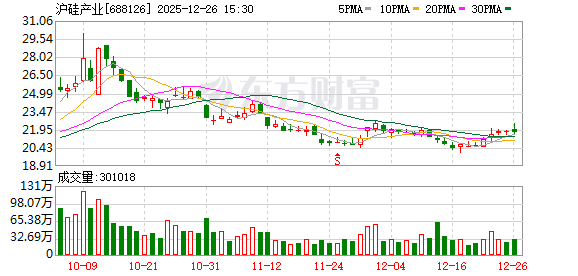
沪硅产业常务副总裁李炜:并购+扩产 半导体硅片商谋求更高质量发展
Shang Hai Zheng Quan Bao· 2025-12-28 19:12
Core Viewpoint - The Chinese semiconductor industry, particularly in large silicon wafers, has made significant progress towards self-sufficiency, but still has a low global market share and substantial growth potential [2][4]. Group 1: Industry Development - As of October 2025, Hu Silicon Industry has achieved cumulative sales of 20 million large silicon wafers, marking a significant milestone in its ten-year development journey [3]. - In chip manufacturing, semiconductor silicon wafers account for approximately 35% of the total wafer manufacturing cost, making them the most significant integrated circuit material [3]. - The top five global semiconductor silicon wafer companies hold over 90% of the market share, but Chinese companies are gradually increasing their market presence [3][4]. Group 2: Market Opportunities - The demand for 12-inch silicon wafers is expected to grow, with global demand projected to exceed 10 million pieces by 2029, while the global monthly production capacity is estimated at 8.4 million pieces by 2025, indicating a supply gap [5]. - Domestic companies like Hu Silicon Industry and others are actively pursuing market share through expansion and acquisitions [5]. Group 3: Company Strategies - Hu Silicon Industry recently completed an acquisition involving a total transaction price of 7.04 billion yuan, which includes stakes in several subsidiaries, enhancing its strategic development and operational efficiency [6]. - The company has engaged in various capital market activities, including targeted placements and bond issuances, to support its growth and technological advancements [7].


“港股GPU第一股”,要来了
华尔街见闻· 2025-12-22 11:39
Core Viewpoint - Wallan Technology, one of the "Four Little Dragons" of domestic GPUs, is making significant strides towards becoming the first GPU stock in Hong Kong by planning an IPO to raise approximately HKD 48.55 billion [3][6]. Group 1: IPO Details - Wallan Technology plans to issue 247,692,800 H-shares at a price range of HKD 17.00 to HKD 19.60 per share, with the maximum fundraising amount being approximately HKD 48.55 billion if the upper limit is used [3][8]. - The stock code for Wallan Technology is "6082," and it is expected to officially start trading on the Hong Kong Stock Exchange on January 2, 2026 [3][8]. - The entry fee for investors is approximately HKD 3,959.54 based on the upper limit price [9]. Group 2: Fund Utilization - The funds raised from the IPO will primarily be used to advance the development of next-generation chips such as BR20X and BR30X, as well as to invest in core technologies and enhance commercialization capabilities [12][18]. Group 3: Business Performance - Wallan Technology has accumulated a total of 24 binding orders valued at approximately RMB 821.8 million, along with five framework sales agreements and 24 sales contracts totaling RMB 1.24 billion, indicating a strong potential revenue reserve exceeding RMB 2 billion [14][15][19]. - The company reported rapid revenue growth, with revenues of RMB 62.03 million in 2023 and RMB 589.03 million in the first half of 2025, reflecting a year-on-year increase of 49.9% [20][24]. Group 4: Market Landscape - The smart computing chip market presents both opportunities and challenges, with the market share of Chinese enterprises expected to grow from approximately 20% in 2024 to about 60% by 2029 [28]. - However, the market is highly concentrated, with the top two players expected to hold 94.4% of the market share by 2024, leaving limited space for other participants [28]. Group 5: Investment and Strategic Decisions - Wallan Technology has attracted significant capital, having completed multiple rounds of financing totaling over RMB 9 billion, with notable investors including Qiming Venture Partners and IDG Capital [31]. - Initially targeting the A-share Science and Technology Innovation Board for its IPO, the company ultimately chose Hong Kong for its diverse investor base and capital acquisition opportunities [33].

美日争相发展半导体 研调:2030年美国先进产能估占全球28%
Jing Ji Ri Bao· 2025-12-20 23:54
Core Insights - The global semiconductor industry is experiencing regional diversification in production capacity due to geopolitical factors, with the U.S. expected to account for 28% of global advanced process capacity by 2030 [1] Group 1: Semiconductor Industry Developments - The semiconductor industry is recognized as a critical strategic resource, with the U.S. actively promoting domestic semiconductor manufacturing while China, Japan, the EU, and India are also strengthening their semiconductor sectors [1] - TSMC is continuing to deepen its presence in Taiwan, contributing to further growth in the Taiwanese semiconductor industry [1] Group 2: Capacity Growth Projections - IDC forecasts a compound annual growth rate (CAGR) of approximately 2.8% for Taiwan's wafer foundry capacity from 2025 to 2029 [1] - The U.S. is expected to see a CAGR of 8.4% in wafer foundry capacity due to TSMC's expansion in Arizona and increased capital expenditures from Samsung and Intel [1] - Japan's wafer foundry capacity is projected to grow at a CAGR of 10% due to TSMC's expansion in Kumamoto and contributions from Rapidus [1] - The EU's wafer foundry capacity is anticipated to grow at a CAGR of about 6.3% [1] Group 3: China's Semiconductor Landscape - Due to restrictions on advanced process equipment, China is focusing on expanding its mature process capacity, with projections indicating that by 2030, China's mature process capacity may account for 52% of the global total, surpassing Taiwan's 26% [2]
中国大陆IC设计市占率,超越中国台湾
半导体行业观察· 2025-12-06 03:06
Group 1 - The core viewpoint of the article highlights the significant growth of the global semiconductor market, projected to reach $889 billion by 2026, driven by AI advancements and major players like NVIDIA and AMD [1] - IDC forecasts that by 2026, China's IC design market share will expand to approximately 45%, surpassing Taiwan's expected 40%, marking a shift in the competitive landscape [1] - The rapid expansion of China's IC design sector is attributed to domestic semiconductor policies and a strong internal market, with companies like Cambricon seeing increased AI chip shipments [1] Group 2 - Despite competitive pressures, Taiwan's critical position in the global semiconductor supply chain remains unchanged, with TSMC expected to achieve a revenue growth rate of 22% to 26% by 2026 [2] - The global wafer foundry market is projected to grow by about 20% by 2026, with TSMC maintaining a dominant market share of approximately 73% [2] - Taiwan's packaging and testing industry is anticipated to experience a compound annual growth rate of about 9.1% from this year to 2029, driven by strong AI orders [2]

IDC:大陆IC设计市占2026年上看45%,超越台湾地区
Jing Ji Ri Bao· 2025-12-05 23:37
Group 1 - The global semiconductor market is projected to reach $889 billion by 2026, driven by AI advancements and companies like NVIDIA and AMD [1] - Chinese mainland IC design companies are expected to surpass Taiwan's market share by 2025, with projections indicating a market share of approximately 45% for mainland China and about 40% for Taiwan by 2026 [1] - The lack of self-developed AI chips is a key factor in Taiwan's declining market share, as most Taiwanese firms, except for MediaTek, have minimal AI chip revenue [1] Group 2 - The rapid expansion of China's IC design landscape is supported by semiconductor self-sufficiency policies and domestic market demand, with companies like Huawei's HiSilicon and Cambricon making significant technological advancements [2] - Despite competitive pressures, Taiwan's critical position in the global semiconductor supply chain remains unchanged, with TSMC's revenue growth rate projected to be between 22% and 26% by 2026, maintaining a market share of approximately 73% [2] - The advanced packaging sector is expected to see a significant increase in TSMC's CoWoS capacity by about 72% by 2026, but demand from AI giants will keep the market in a supply-demand imbalance [2]

ETF市场日报 | 创新药相关ETF领涨!下周一将有6只产品同步募集
Sou Hu Cai Jing· 2025-10-31 09:37
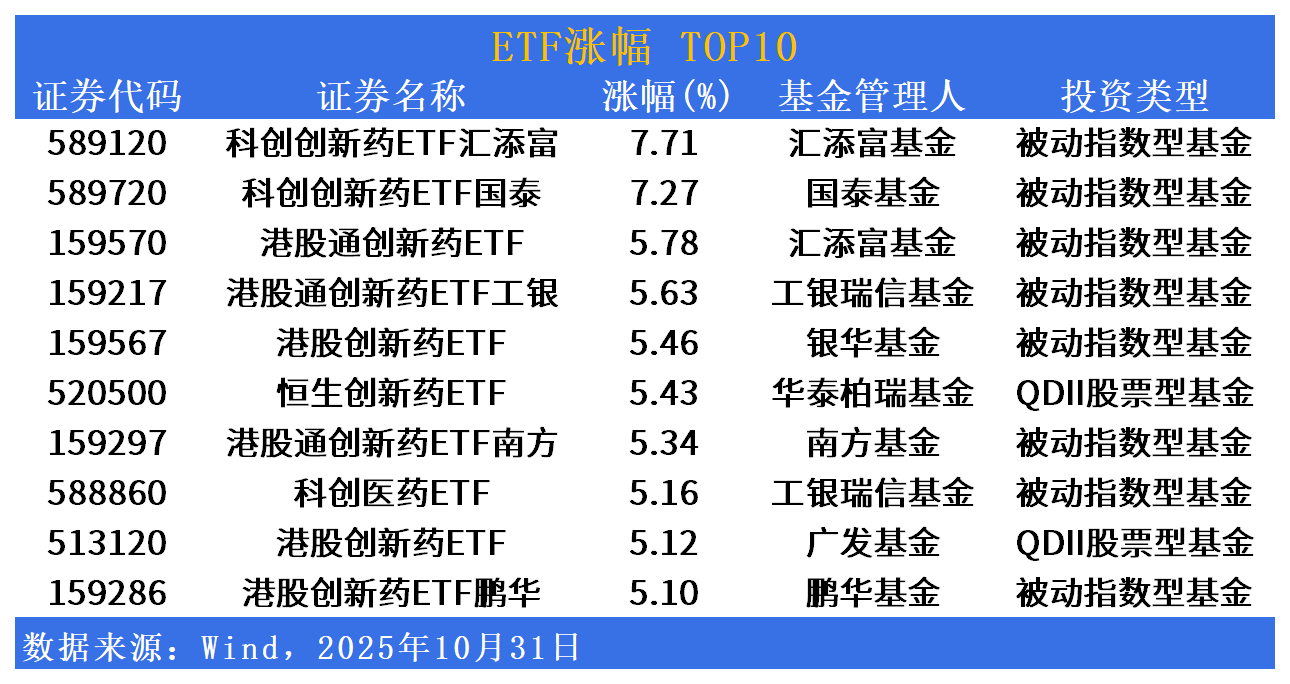
Market Overview - The A-share market experienced a collective pullback on October 31, 2025, with the Shanghai Composite Index down by 0.81%, the Shenzhen Component Index down by 1.14%, and the ChiNext Index down by 2.31%. The total trading volume in the Shanghai and Shenzhen markets reached 2,317.8 billion yuan [1]. Innovation Drug Sector - The innovative drug sector saw significant gains, with the top-performing ETFs including the Sci-Tech Innovation Drug ETF managed by Huatai-PB, which rose by 7.71%, and the Sci-Tech Innovation Drug ETF managed by Guotai, which increased by 7.27% [2][3]. - The 2025 ESMO annual meeting, held from October 17 to 21 in Berlin, featured 35 Chinese studies, with 14 presented as formal oral reports, marking a substantial increase from 5 in 2024. The inclusion of 23 studies in the Late-Breaking Abstracts (LBA) category also set a new record [3]. Funding in Innovative Drug Development - From 2015 to 2024, the cumulative financing scale in China's innovative drug sector exceeded 1.23 trillion yuan, providing strong capital support for the industry's explosive growth. Successful research outcomes are expected to attract more funding into innovative drug development, creating a positive feedback loop [4]. Semiconductor Sector - The semiconductor industry in China is undergoing a "collective charge" towards self-sufficiency, driven by external pressures and internal demands. Various regions are launching semiconductor projects, with a focus on vertical integration and filling domestic gaps in key areas such as large silicon wafers and MEMS sensors [6]. ETF Trading Activity - The Short-term Bond ETF (511360) led in trading volume with 40.356 billion yuan, followed by the Hua Bao Tian Yi ETF (211990) with 21.464 billion yuan and the Yin Hua Ri Li ETF (211880) with 20.665 billion yuan [7]. - The 5-Year Local Government Bond ETF (511060) had the highest turnover rate at 212%, indicating strong trading activity in this segment [8]. Upcoming ETF Issuances - Six new ETFs are set to begin fundraising on the upcoming Monday, including the E Fund Hang Seng Automotive ETF and the Southern Hong Kong Stock Dividend ETF, which focus on specific sectors such as automotive and agriculture [9][10].
新凯来“从0到1”,国产芯片关键工具破局
2 1 Shi Ji Jing Ji Bao Dao· 2025-10-16 13:05
Core Insights - New Kai Lai's subsidiary Wanliyan has developed a 90GHz bandwidth real-time oscilloscope, positioning itself as a leader in high-end electronic measurement instruments in China, overcoming Western technology restrictions [1][11][14] - The company has also launched two EDA software products with complete independent intellectual property rights, filling a gap in the domestic high-end electronic design software market [2][10][17] - New Kai Lai is seen as a key player in China's semiconductor self-sufficiency movement, with its innovations expected to reshape the industry and investment landscape [7][14][17] Company Overview - New Kai Lai was established in August 2021 and is headquartered in Longgang District, Shenzhen, covering approximately 200,000 square meters with multiple R&D branches across China and plans for international expansion [4][5] - The company operates eight subsidiaries, each focused on achieving breakthroughs in semiconductor manufacturing technologies [6] Product Innovations - Wanliyan's oscilloscope is the first of its kind in China to exceed 60GHz bandwidth, addressing significant supply challenges in high-end electronic measurement instruments [11][16] - The EDA software from Qiyunfang is designed to support seamless switching between domestic and foreign software, reducing development cycles by 40% and enhancing design capabilities [10][17] Market Impact - New Kai Lai's advancements are expected to disrupt the reliance on foreign equipment in the semiconductor industry, with significant purchases from institutions like Shanghai Jiao Tong University indicating growing acceptance of domestic products [15][16] - The launch of these products has led to a positive response in the capital markets, with related stocks experiencing significant gains [17] Strategic Importance - The emergence of New Kai Lai is viewed as a critical signal for the enhancement of China's semiconductor supply chain capabilities, moving from merely filling gaps to establishing foundational technologies [17] - The company's growth trajectory reflects a broader shift in the investment landscape, directing funds towards core technology sectors such as semiconductors and artificial intelligence [17]

SEMI:今年全球300mm晶圆厂设备支出将首次逾1000亿美元
Zheng Quan Shi Bao Wang· 2025-10-12 06:25
Core Insights - The global spending on 300mm wafer fab equipment is projected to reach $374 billion from 2026 to 2028, driven by the regionalization trend and surging demand for AI chips in data centers and edge devices [1][2] - The report anticipates that global spending on 300mm wafer fab equipment will exceed $100 billion for the first time in 2025, growing by 7% to $107 billion [1] - Significant investments are expected in Logic and Micro sectors, totaling $175 billion from 2026 to 2028, primarily driven by foundries benefiting from sub-2nm process capacity [1] Investment Projections - In 2026, equipment spending is expected to grow by 9% to $116 billion, followed by a 4% increase in 2027 to $120 billion, and a 15% rise in 2028 to $138 billion [1] - Memory sector is projected to rank second with $136 billion in spending over three years, marking the beginning of a new growth cycle [2] - DRAM-related equipment investment is expected to exceed $79 billion, while 3D NAND investment will reach $56 billion, driven by AI training and inference needs [2] Regional Insights - China is expected to lead global 300mm equipment spending with a total investment of $94 billion from 2026 to 2028, supported by national policies [2] - South Korea is projected to invest $86 billion, ranking second globally, to support the demand for generative AI [2] - The Americas are expected to invest $60 billion, rising to fourth place, as U.S. suppliers expand advanced process capacity [3]
半导体设备ETF(159516)盘中净流入1000万份,近10日净流入超2.5亿元!规模超30亿元,位居同类第一!
Mei Ri Jing Ji Xin Wen· 2025-08-11 06:57
Group 1 - The semiconductor equipment ETF (159516) has seen a real-time net inflow of 10 million units, indicating strong demand for semiconductor equipment assets [1] - Longzhong Securities states that the growth momentum of semiconductor equipment and materials is significantly influenced by the demand in the semiconductor industry, with both showing synchronized growth [1] - Global semiconductor sales are expected to grow by 11.2% year-on-year in 2025, while the sales growth rates for semiconductor equipment and materials are projected to be 7.7% and 8% respectively [1] Group 2 - ASML forecasts stable expansion demand for various products, with average monthly increases of 340,000 wafers for mature processes, 240,000 wafers for advanced processes, 160,000 wafers for DRAM, and 40,000 wafers for NAND [1] - Chinese wafer foundries have growth opportunities not only from local design companies returning from overseas but also from some foreign companies willing to collaborate in the mature process sector [1] - The semiconductor equipment ETF (159516) tracks the semiconductor materials and equipment index (931743), which includes listed companies involved in semiconductor materials and equipment manufacturing [1]
资讯日报-20250808
Guoxin Securities Hongkong· 2025-08-08 05:17
Market Overview - The Hang Seng Index closed at 25,081.63, down 0.69% for the day but up 25.15% year-to-date[3] - The Hang Seng Technology Index rose to 5,546.73, increasing by 0.26% daily and 23.24% year-to-date[3] - The S&P 500 index closed at 6,340.00, down 0.08% for the day and up 7.33% year-to-date[3] Stock Performance Highlights - Xiaomi's stock fell nearly 4% ahead of its Q2 2025 earnings announcement, with expected revenue of 112.6 billion RMB, slightly below market expectations[7] - Sands China Ltd. shares rose over 5% due to a strong recovery in Macau's gaming industry, driven by increased outbound tourism and higher gaming budgets[7] - Apple Inc. shares surged 5% after announcing a $100 billion investment in the U.S., boosting related stocks like AAC Technologies, which rose over 9%[7] Sector Movements - Semiconductor stocks were active, with the Philadelphia Semiconductor Index rising 1.5%[9] - Gold stocks saw widespread gains, with China Gold International up over 7% as Citigroup adjusted its bearish outlook on gold prices, predicting a rise due to economic conditions[7] - The healthcare sector faced challenges, with Eli Lilly's stock dropping 14.14% after disappointing clinical trial results for its weight-loss drug[9] Economic Indicators - U.S. job market data showed a decline in confidence, contributing to mixed performance in U.S. markets[7] - The Atlanta Fed President indicated a potential interest rate cut later this year, reflecting ongoing concerns about inflation and economic growth[13] - Japan's government revised its GDP growth forecast down to 0.7% for the fiscal year, impacted by U.S. tariffs and inflationary pressures[13]
