
地缘政治

Search documents
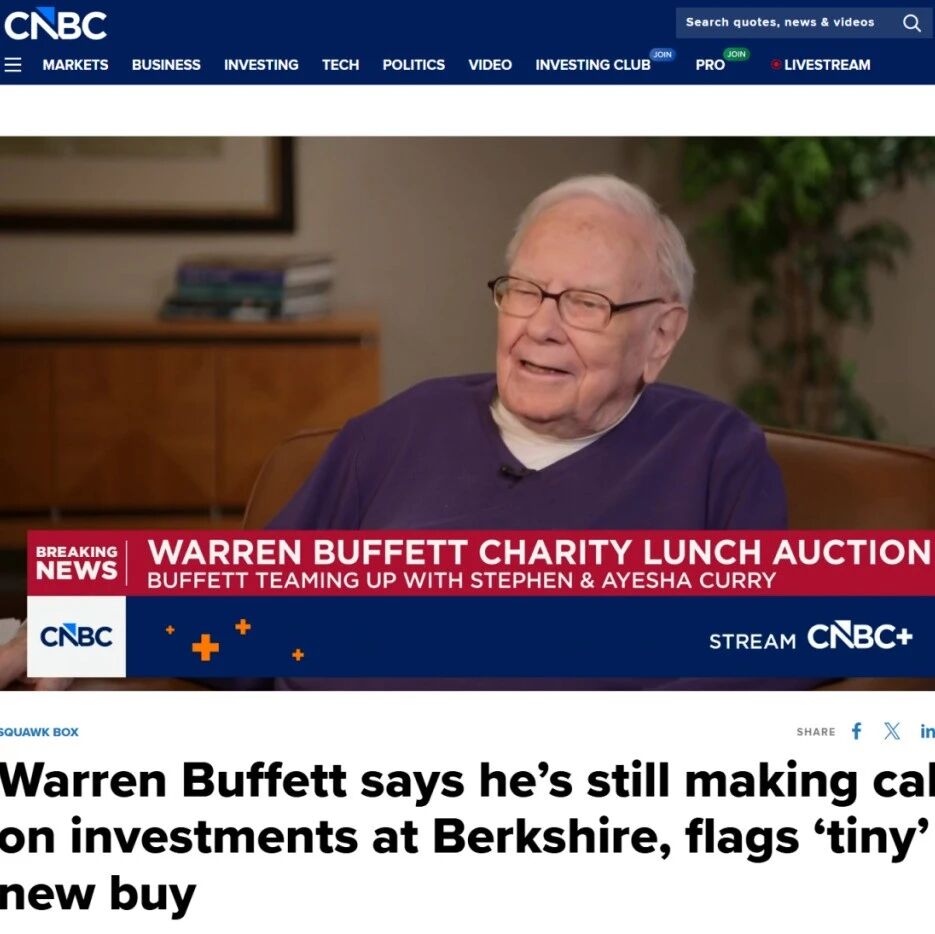
95岁巴菲特,最新发声!现在的波动“不值一提”,卖苹果卖早了!携手库里重启“慈善午餐”
证券时报· 2026-04-01 01:53
Market Insights - Warren Buffett believes current market valuations lack attractiveness, stating that recent market declines are insignificant compared to historical downturns [2][4] - Berkshire Hathaway has not found many large-scale investment opportunities during this year's market downturn, but Buffett hinted at a potential small-scale new investment [4] - Berkshire Hathaway purchased $17 billion in government bonds this week, with cash equivalents exceeding $370 billion, primarily in government bonds [5] Leadership Transition - Buffett will hand over the CEO position to Greg Abel in early 2026 but continues to work daily and maintain high market sensitivity [6][7] - He emphasizes that he will remain involved in investment decisions and will not make any investments that Abel disagrees with [7] Apple Investment - Buffett's investment in Apple has yielded over $100 billion in profits, and it remains Berkshire's largest holding [8] - He expressed regret over selling Apple shares too early and indicated a willingness to buy more if the stock price becomes attractive [8] Philanthropy Initiatives - Buffett announced the relaunch of a charity lunch auction in collaboration with NBA star Stephen Curry, with proceeds supporting vulnerable groups and children's development projects [12][13] - The auction will start on May 7, with a historical fundraising total exceeding $50 million over 20 years, and the 2022 auction set a record of $19 million [14] Personal Relationships - Buffett has distanced himself from Bill Gates since the Jeffrey Epstein incident, stating he does not want to be involved in any legal implications [10][11]


五矿期货能源化工日报-20260401
Wu Kuang Qi Huo· 2026-03-31 23:42
1. Report Industry Investment Rating No information provided in the content. 2. Core Viewpoints of the Report - For crude oil, recommend a bearish strategic allocation, widen the Platts north - south different oil - type spread before Libya's mid - year production increase, short the high - sulfur fuel oil cracking spread, and short the INE - Brent cross - regional spread [2]. - For methanol, suggest taking profits at high prices and widening the MTO profit at low prices [5]. - For urea, suggest a short - selling allocation, and expect short - term demand support when the substitution valuation reaches the extreme [8]. - For rubber, suggest flexible trading, taking profits on butadiene rubber out - of - the - money call options, starting to allocate put options, and continuing to hold the long NR main contract and short RU2609 position [14]. - For PVC, although the short - term fundamentals do not fully reflect the supply shock, the narrative logic turns to the blockade of the Strait of Hormuz, which may offset the negative impact of the cancellation of export tax rebates [18]. - For pure benzene and styrene, due to the continuous geopolitical conflict in the Middle East, it is recommended to stay on the sidelines [21]. - For polyethylene, wait for the marginal increase in the number of ships passing through the Strait of Hormuz and then short the LL2605 - LL2609 contract reverse spread at high prices [24]. - For polypropylene, in the short term, geopolitical conflicts dominate the market, and in the long term, the contradiction shifts from the cost side to the production mismatch [28]. - For PX, although the short - term increase is large, the valuation is expected to rise as the raw - material shortage logic further develops [30]. - For PTA, it is difficult to enter the de - stocking cycle, and the processing fee is expected to be difficult to rise, but PXN may rise significantly [33]. - For ethylene glycol, the inventory is expected to decline, but the short - term increase is large, so be aware of risks [36]. 3. Summary by Relevant Catalogs 3.1 Crude Oil - **Market Information**: INE main crude oil futures closed down 22.40 yuan/barrel, a decline of 2.94%, at 740.60 yuan/barrel; high - sulfur fuel oil futures closed down 175.00 yuan/ton, a decline of 3.79%, at 4446.00 yuan/ton; low - sulfur fuel oil futures closed down 221.00 yuan/ton, a decline of 4.11%, at 5159.00 yuan/ton [1]. - **Strategy Viewpoint**: Recommend a bearish strategic allocation, widen the Platts north - south different oil - type spread before Libya's mid - year production increase, short the high - sulfur fuel oil cracking spread, and short the INE - Brent cross - regional spread [2]. 3.2 Methanol - **Market Information**: The main contract changed by 159.00 yuan/ton, reported at 3229 yuan/ton, and the MTO profit changed by 104 yuan [4]. - **Strategy Viewpoint**: Suggest taking profits at high prices and widening the MTO profit at low prices [5]. 3.3 Urea - **Market Information**: In the spot market, Shandong, Henan, and Northeast China had no price changes; Hubei decreased by 10 yuan/ton; Jiangsu increased by 10 yuan/ton; Shanxi increased by 20 yuan/ton. The main futures contract changed by - 8 yuan/ton, reported at 1874 yuan/ton [7]. - **Strategy Viewpoint**: Suggest a short - selling allocation, and expect short - term demand support when the substitution valuation reaches the extreme [8]. 3.4 Rubber - **Market Information**: Butadiene was strong in the spot market due to import demand from Japan and South Korea. As of March 26, 2026, the operating load of all - steel tires in Shandong tire enterprises was 69.26%, up 0.04 percentage points from last week and 1.17 percentage points from the same period last year. The operating load of semi - steel tires in domestic tire enterprises was 77.10%, down 0.07 percentage points from last week and 5.52 percentage points from the same period last year. The export orders declined, and the tire inventory pressure increased. As of March 22, 2026, China's natural rubber social inventory was 1.36 million tons, a decrease of 0.4 million tons, a decline of 0.3%. The total social inventory of dark - colored rubber was 921,000 tons, an increase of 0.1%. The total social inventory of light - colored rubber was 439,000 tons, a decrease of 1% [10][12]. - **Strategy Viewpoint**: Suggest flexible trading, taking profits on butadiene rubber out - of - the - money call options, starting to allocate put options, and continuing to hold the long NR main contract and short RU2609 position [14]. 3.5 PVC - **Market Information**: The PVC05 contract fell 198 yuan, reported at 5353 yuan. The spot price of Changzhou SG - 5 was 5220 (- 230) yuan/ton, the basis was - 133 (- 32) yuan/ton, and the 5 - 9 spread was - 106 (+ 2) yuan/ton. The overall operating rate of PVC was 80.9%, up 0.8% month - on - month; the calcium carbide method was 85.2%, up 0.5% month - on - month; the ethylene method was 70.7%, up 1.5% month - on - month. The overall downstream operating rate was 46%, up 4.3% month - on - month. The in - plant inventory was 339,000 tons (- 27,000 tons), and the social inventory was 1.374 million tons (+ 3,000 tons) [16]. - **Strategy Viewpoint**: Although the short - term fundamentals do not fully reflect the supply shock, the narrative logic turns to the blockade of the Strait of Hormuz, which may offset the negative impact of the cancellation of export tax rebates [18]. 3.6 Pure Benzene and Styrene - **Market Information**: The cost - side East China pure benzene was 8940 yuan/ton, with no change. The closing price of the pure benzene active contract was 8790 yuan/ton, with no change. The pure benzene basis was 150 yuan/ton, an increase of 272 yuan/ton. The spot price of styrene was 10750 yuan/ton, a decrease of 150 yuan/ton; the closing price of the styrene active contract was 10597 yuan/ton, a decrease of 192 yuan/ton; the basis was 153 yuan/ton, an increase of 42 yuan/ton; the BZN spread was - 49.5 yuan/ton, a decrease of 33.5 yuan/ton; the EB non - integrated plant profit was - 268.6 yuan/ton, a decrease of 230 yuan/ton; the EB consecutive 1 - consecutive 2 spread was 69 yuan/ton, a decrease of 19 yuan/ton. The upstream operating rate was 69.95%, a decrease of 0.51%. The Jiangsu port inventory was 168,400 tons, an increase of 59,000 tons. The demand - side three - S weighted operating rate was 40.67%, a decrease of 0.27%. The PS operating rate was 51.40%, a decrease of 0.20%, the EPS operating rate was 63.27%, an increase of 2.27%, and the ABS operating rate was 62.60%, a decrease of 4.50% [20]. - **Strategy Viewpoint**: Due to the continuous geopolitical conflict in the Middle East, it is recommended to stay on the sidelines [21]. 3.7 Polyethylene - **Market Information**: The closing price of the main contract was 8614 yuan/ton, a decrease of 190 yuan/ton. The spot price was 8700 yuan/ton, a decrease of 225 yuan/ton. The basis was 86 yuan/ton, a decrease of 35 yuan/ton. The upstream operating rate was 74.57%, a decrease of 1.41% month - on - month. The production enterprise inventory was 587,900 tons, an increase of 19,600 tons month - on - month, and the trader inventory was 56,300 tons, an increase of 1,500 tons month - on - month. The downstream average operating rate was 40%, an increase of 2.41% month - on - month. The LL5 - 9 spread was 149 yuan/ton, an increase of 29 yuan/ton [23]. - **Strategy Viewpoint**: Wait for the marginal increase in the number of ships passing through the Strait of Hormuz and then short the LL2605 - LL2609 contract reverse spread at high prices [24]. 3.8 Polypropylene - **Market Information**: The closing price of the main contract was 9103 yuan/ton, a decrease of 166 yuan/ton. The spot price was 9300 yuan/ton, a decrease of 50 yuan/ton. The basis was 197 yuan/ton, an increase of 116 yuan/ton. The upstream operating rate was 67.65%, a decrease of 2.72% month - on - month. The production enterprise inventory was 499,700 tons, a decrease of 96,500 tons month - on - month, the trader inventory was 177,800 tons, a decrease of 15,840 tons month - on - month, and the port inventory was 69,600 tons, a decrease of 2,300 tons month - on - month. The downstream average operating rate was 46.36%, an increase of 0.65% month - on - month. The LL - PP spread was - 489 yuan/ton, a decrease of 24 yuan/ton. The PP5 - 9 spread was 366 yuan/ton, an increase of 28 yuan/ton [27]. - **Strategy Viewpoint**: In the short term, geopolitical conflicts dominate the market, and in the long term, the contradiction shifts from the cost side to the production mismatch [28]. 3.9 PX - **Market Information**: The PX05 contract fell 140 yuan, reported at 9700 yuan, and the 5 - 7 spread was 18 yuan (+ 20). The Chinese PX load was 84%, a decrease of 0.6% month - on - month; the Asian load was 72.7%, a decrease of 2.1% month - on - month. Some plants restarted or shut down. The PTA load was 81.8%, an increase of 1% month - on - month. In March, South Korea's PX exports to China were 311,000 tons, a year - on - year decrease of 28,000 tons. The inventory at the end of February was 4.8 million tons, an increase of 160,000 tons month - on - month. The PXN was 120 US dollars (- 11), the South Korean PX - MX was 112 US dollars (- 3), and the naphtha crack spread was 364 US dollars (- 4) [29]. - **Strategy Viewpoint**: Although the short - term increase is large, the valuation is expected to rise as the raw - material shortage logic further develops [30]. 3.10 PTA - **Market Information**: The PTA05 contract fell 84 yuan, reported at 6684 yuan, and the 5 - 9 spread was 96 yuan (+ 4). The PTA load was 81.8%, an increase of 1% month - on - month. The downstream load was 86.8%, a decrease of 0.8% month - on - month. The social inventory on March 27 was 2.8 million tons, an increase of 69,000 tons month - on - month. The on - disk processing fee increased by 8 yuan to 321 yuan [32]. - **Strategy Viewpoint**: It is difficult to enter the de - stocking cycle, and the processing fee is expected to be difficult to rise, but PXN may rise significantly [33]. 3.11 Ethylene Glycol - **Market Information**: The EG05 contract fell 141 yuan, reported at 5218 yuan, and the 5 - 9 spread was 116 yuan (- 9). The ethylene glycol load was 65.8%, a decrease of 0.6% month - on - month. The downstream load was 86.8%, a decrease of 0.8% month - on - month. The import arrival forecast was 117,000 tons, and the East China departure on March 30 was 12,000 tons. The port inventory was 1.075 million tons, an increase of 36,000 tons month - on - month. The naphtha - based production profit was - 3137 yuan, the domestic ethylene - based production profit was - 2727 yuan, and the coal - based production profit was 1176 yuan. The cost - side ethylene rose to 1500 US dollars, and the Yulin pit - mouth bituminous coal powder price rebounded to 690 yuan [35]. - **Strategy Viewpoint**: The inventory is expected to decline, but the short - term increase is large, so be aware of risks [36].
国投期货化工日报-20260331
Guo Tou Qi Huo· 2026-03-31 13:24
1. Report Industry Investment Ratings Bullish - Methanol, Urea, PX, Ethylene Glycol, Bottle Chips: ★★★, indicating a clearer long - term trend with relatively appropriate investment opportunities currently [1] Bearish - Soda Ash: ★☆☆, suggesting a bearish bias with a downward - driving trend but poor operability on the trading floor [1] Neutral - Propylene, Plastic, Polypropylene, Pure Benzene, Styrene, PTA, Short Fibers, PVC, Caustic Soda, Glass: White stars, meaning the short - term long/short trend is in a relatively balanced state with poor operability on the trading floor, and it's advisable to wait and see [1] 2. Core Views - The chemical market is significantly affected by factors such as geopolitical situations, supply - demand relationships, and policy regulations. Different chemical products show diverse trends and investment opportunities due to their unique fundamentals [2][3][6] 3. Summary by Relevant Catalogs Olefins - Polyolefins - Propylene: Futures prices fell on the day. Supply is expected to decline, while demand has improved, and short - term inventory pressure has eased [2] - Plastic and Polypropylene: Futures prices dropped. For polyethylene, supply pressure is not high, and demand has increased slightly. For polypropylene, supply has tightened, but downstream procurement willingness is low, and market transactions are blocked [2] Polyester - PX and PTA: Prices fluctuated with oil prices, affected by the US - Iran situation. PTA is facing inventory accumulation and weak downstream demand [3] - Ethylene Glycol: Load decreased slightly, port inventory increased, and it is expected to fluctuate at a high level [3] - Short Fibers: Load increased weekly, downstream demand recovery slowed down, and it is affected by the Middle East situation [3] - Bottle Chips: Benefits are acceptable, load decreased slightly, and attention should be paid to the industry's load performance [3] Pure Benzene - Styrene - Pure Benzene: Futures prices are strong. Supply has decreased, and it fluctuates with crude oil due to geopolitical instability [5] - Styrene: Futures prices fluctuated. Cost support exists, but supply - demand fundamentals are expected to weaken [5] Coal Chemical Industry - Methanol: The price on the trading floor dropped. Import supply is expected to tighten, and the market is expected to remain strong [6] - Urea: Futures prices remained high. Production decreased slightly, and the market is expected to remain generally stable with minor fluctuations under policy restrictions [6] Chlor - Alkali Industry - PVC: The price dropped significantly. Supply decline was less than expected, and exports are expected to be good in March - April [7] - Caustic Soda: The price trended weakly. Supply increased, and the decline in futures prices is expected to narrow [7] Soda Ash - Glass - Soda Ash: The price dropped significantly. Supply is high, demand is weak, and it is expected to be under pressure at a high level [8] - Glass: The price trended weakly. Inventory pressure is still high, and futures prices are expected to fluctuate widely in a range [8]
供应减量不及预期,PVC承压下行
Zhong Xin Qi Huo· 2026-03-31 11:18
Report Summary 1. Report Industry Investment Rating No information provided. 2. Core Viewpoints - On March 31, the main PVC contract dropped 5.39% to close at 5,353 yuan/ton. The weak performance was due to two reasons: the profit recovery boosted the开工 willingness of calcium carbide - based PVC enterprises and the load of ethylene - based enterprises also increased, resulting in the supply reduction of PVC falling short of expectations; the US released a signal of geopolitical easing, cooling the commodity market sentiment and causing PVC to give back the geopolitical premium [1]. - In the short - term, PVC production stopped falling and stabilized, with the load of domestic ethylene - based enterprises increasing and the marginal calcium carbide - based enterprises starting up more. In the medium - term, the stability of raw material supply for ethylene - based enterprises should be noted. Overseas, chlor - alkali plants in Japan, South Korea, Western Europe, and South Asia have cut production due to raw material supply disruptions [2]. - PVC downstream start - up improved month - on - month, but the enthusiasm for chasing price increases was poor. Domestic export orders remained normal as foreign buyers made rigid purchases. [2] - The price of calcium carbide rebounded moderately, and the dynamic comprehensive cost of calcium carbide - based PVC changed relatively little. The price of ethylene was strong, and the cost of ethylene - based PVC increased. The supply and demand of calcium carbide both increased, and the rising rate of calcium carbide may slow down. Due to the supply disruption of crude oil and naphtha and the reduction of overseas cracking load, ethylene remained strong [2]. - Looking forward, the PVC market is under pressure due to the uncertain geopolitical expectations and the domestic PVC production cut falling short of expectations. If the geopolitical situation is not substantially alleviated, there is still a risk of production cuts for PVC at home and abroad, and domestic exports will still be favorable, giving the market the momentum to rebound [2]. 3. Summary by Related Catalogs Supply - Short - term: PVC production stopped falling and stabilized. The load of domestic ethylene - based enterprises increased, and the marginal calcium carbide - based enterprises started up more [2]. - Medium - term: Pay attention to the stability of raw material supply for ethylene - based enterprises. If raw material procurement is difficult, ethylene - based enterprises may still cut production [2]. - Overseas: Chlor - alkali plants in Japan, South Korea, Western Europe, and South Asia have cut production due to raw material supply disruptions [2]. Demand - PVC downstream start - up improved month - on - month, but the enthusiasm for chasing price increases was poor. Overseas and domestic prices soared, foreign buyers made rigid purchases, and domestic export orders remained normal [2]. Valuation - Calcium carbide price rebounded moderately, and the dynamic comprehensive cost of calcium carbide - based PVC changed relatively little. Ethylene price was strong, and the cost of ethylene - based PVC increased. The supply and demand of calcium carbide both increased, and the rising rate of calcium carbide may slow down. Due to the supply disruption of crude oil and naphtha and the reduction of overseas cracking load, ethylene remained strong [2].
有色商品日报(2026 年 3 月 31 日)-20260331
Guang Da Qi Huo· 2026-03-31 11:16
1. Report Industry Investment Rating - No information provided in the given content. 2. Core Viewpoints of the Report - **Copper**: Overnight, both domestic and international copper prices rose and then fell. The import window for domestic refined copper spot opened, but the import profit margin significantly narrowed. Fed Chair Powell's dovish stance led the market to bet on a possible interest - rate cut this year. Geopolitical factors, such as the US - Iran conflict, remained a focus. Domestic downstream restocking was significant, driving the rapid reduction of social inventories. Short - term, it is recommended to operate within a range and gradually build long positions at key support levels, focusing on copper prices in the range of 90,000 - 100,000 yuan/ton [1]. - **Aluminum**: Overnight, alumina fluctuated weakly, while Shanghai aluminum and aluminum alloy fluctuated strongly. The domestic alumina plant inventory was at a three - month high, and the inventory was turning to a cumulative trend. The high premium on the futures market accelerated the registration of warehouse receipts, pressuring alumina. Attacks on two large aluminum plants in the Middle East were expected to drive up overseas aluminum prices. The domestic aluminum ingot inventory accumulation situation showed signs of significant improvement, and a de - stocking inflection point was expected in April. In the short term, the influence of Middle - East geopolitics was dominant, and the pattern of weak Shanghai and strong London was difficult to quickly converge [1][2]. - **Nickel**: Overnight, LME nickel and Shanghai nickel both rose. Under the dual influence of tight nickel ore supply and rising freight rates, nickel ore prices continued to strengthen, and the weekly nickel - iron quotes and transaction prices both increased. However, the primary nickel market showed great pressure. Due to the tightening of Indonesia's nickel ore quotas, there were short - term trading opportunities to go long based on the cost line, but attention should be paid to overseas geopolitics and market sentiment, as well as the expected additional quotas in July and the pressure from primary nickel inventory [2]. 3. Summary by Relevant Catalogs 3.1 Research Views - **Copper**: Macroscopically, Powell's dovish remarks led to market expectations of an interest - rate cut. Geopolitically, the US - Iran conflict situation was complex. In terms of inventory, LME copper inventory increased by 2350 tons to 362,600 tons, Comex copper inventory decreased by 723 tons to 533,540 tons, SHFE copper warehouse receipts decreased by 6105 tons to 230,971 tons, and BC copper warehouse receipts decreased by 303 tons to 13,055 tons. Domestic downstream restocking was significant, indicating strong domestic demand [1]. - **Aluminum**: Alumina futures closed at 2900 yuan/ton, down 0.99%. Shanghai aluminum closed at 24,745 yuan/ton, up 0.9%. Aluminum alloy closed at 23,585 yuan/ton, up 0.3%. The SMM alumina price rebounded to 2788 yuan/ton, and the aluminum ingot spot discount was 90 yuan/ton. The domestic alumina plant inventory was high, and the inventory was accumulating. Attacks on Middle - East aluminum plants were expected to boost overseas aluminum prices, and the domestic aluminum ingot inventory accumulation situation was improving [1][2]. - **Nickel**: LME nickel rose 0.64% to 17,325 US dollars/ton, and Shanghai nickel rose 0.23% to 136,220 yuan/ton. LME inventory remained at 281,574 tons, and SHFE warehouse receipts increased by 104 tons to 57,173 tons. The LME 0 - 3 month premium remained negative, and the import nickel premium decreased by 150 yuan/ton to - 350 yuan/ton. Due to tight supply and rising costs, there were short - term long - trading opportunities, but attention should be paid to inventory pressure [2]. 3.2 Daily Data Monitoring - **Copper**: The price of flat - water copper decreased by 140 yuan/ton to 95,175 yuan/ton, and the flat - water copper premium increased by 25 yuan/ton to - 75 yuan/ton. The price of 1 bright scrap copper in Guangdong increased by 200 yuan/ton to 85,600 yuan/ton, and the refined - scrap price difference decreased by 574 yuan/ton to 3728 yuan/ton. LME inventory increased by 2350 tons, SHFE warehouse receipts decreased by 6105 tons, and the total social inventory (domestic + bonded area) decreased by 43,000 tons to 486,000 tons [4]. - **Lead**: The average price of 1 lead remained at 16,400 yuan/ton. LME inventory decreased by 75 tons to 283,000 tons, and SHFE warehouse receipts increased by 404 tons to 52,867 tons. The weekly inventory decreased by 8531 tons to 57,579 tons [4]. - **Aluminum**: The Wuxi and Nanhai aluminum prices increased by 690 yuan/ton and 710 yuan/ton respectively. The Nanhai - Wuxi price difference increased by 20 yuan/ton to - 90 yuan/ton. LME inventory decreased by 2200 tons to 418,675 tons, SHFE warehouse receipts increased by 4255 tons to 412,452 tons, and the total social inventory of electrolytic aluminum increased by 24,000 tons to 1.373 million tons, while the alumina social inventory decreased by 38,000 tons to 320,000 tons [5]. - **Nickel**: The price of Jinchuan nickel decreased by 1300 yuan/ton to 140,250 yuan/ton. LME inventory remained unchanged at 281,574 tons, SHFE warehouse receipts increased by 104 tons to 57,173 tons, and the total social nickel inventory increased by 1359 tons to 89,808 tons [5]. - **Zinc**: The main settlement price increased by 0.7% to 23,420 yuan/ton. LME inventory decreased by 100 tons to 115,275 tons, and the social inventory decreased by 400 tons to 214,000 tons [7]. - **Tin**: The main settlement price increased by 2.5% to 364,570 yuan/ton. LME inventory decreased by 55 tons to 8665 tons, and SHFE inventory decreased by 1642 tons to 8400 tons [7]. 3.3 Chart Analysis - **3.3.1 Spot Premium**: Charts show the historical trends of spot premiums for copper, aluminum, nickel, zinc, lead, and tin from 2019 - 2026 [9][10][13]. - **3.3.2 SHFE Near - Far Month Spread**: Charts display the historical trends of the near - far month spreads for copper, aluminum, nickel, zinc, lead, and tin from 2019 - 2026 [14][20][21]. - **3.3.3 LME Inventory**: Charts present the historical trends of LME inventories for copper, aluminum, nickel, zinc, lead, and tin from 2019 - 2026 [22][24][26]. - **3.3.4 SHFE Inventory**: Charts show the historical trends of SHFE inventories for copper, aluminum, nickel, zinc, lead, and tin from 2019 - 2026 [28][30][32]. - **3.3.5 Social Inventory**: Charts display the historical trends of social inventories for copper (including bonded areas), aluminum, nickel, zinc, stainless steel, and 300 - series from 2019 - 2026 [34][36][39]. - **3.3.6 Smelting Profit**: Charts show the historical trends of copper concentrate index, rough copper processing fee, aluminum smelting profit, nickel - iron smelting cost, zinc smelting profit, and stainless steel 304 smelting profit margin from 2019 - 2026 [40][42][44]. 3.4有色金属团队介绍 - **展大鹏**: A science master, currently the director of non - ferrous research at Everbright Futures Research Institute, a senior precious metals researcher, and a medium - level gold investment analyst. He has over a decade of commodity research experience, serves many leading spot enterprises, and has published dozens of professional articles in public newspapers and magazines. His team has won the Best Metal Industry Futures Research Team Award from Futures Daily and Securities Times for four consecutive sessions [47]. - **王珩**: A master of finance from the University of Adelaide, Australia, currently a non - ferrous researcher at Everbright Futures Research Institute, mainly researching aluminum and silicon. He is the 18th Best Green Finance New Materials Futures Analyst from Futures Daily and Securities Times and an outstanding new analyst of the Shanghai Futures Exchange in 2022 [47]. - **朱希**: A master of science from the University of Warwick, UK, currently a non - ferrous researcher at Everbright Futures Research Institute, mainly researching lithium and nickel. She is the 18th Best Green Finance New Materials Futures Analyst from Futures Daily and Securities Times [48].
南华期货2026黄金、白银二季度展望:地缘裂变叠加政策转向,震荡调整孕育长期机遇
Nan Hua Qi Huo· 2026-03-31 10:48
1. Report Industry Investment Rating No relevant content provided. 2. Core Viewpoints of the Report - In Q2 2026, the evolution of the Middle East situation, Fed policies, and supply - demand fundamentals will jointly determine the rhythm of the precious metals market. Geopolitical event - driven impacts may gradually weaken, and prices may return to being driven by monetary policy corrections and fundamentals [1][149]. - The prices of precious metals are expected to bottom out through oscillations in Q2 and gradually recover previous losses. Short - term adjustments do not change the long - term upward trend. However, more data such as the recovery of Fed rate - cut expectations or the acceleration of central bank gold purchases are needed to support the upward drive, and this time window may appear in the second half of Q2 or Q3 [2][150]. - Gold has strong support at $4100 - 4400 per ounce in Q2, with resistance at $5000; silver has strong support at $60 - 65 per ounce, with resistance at $100 [2][150]. 3. Summary by Directory 3.1 Precious Metals Market Review 3.1.1 Market Review - In Q1 2026, precious metal prices fluctuated sharply, showing a pattern of rising and then falling. The SHFE Shanghai Gold Index reached a peak of 1260.15 yuan/gram on January 29, and as of March 20, it closed at 1042.5 yuan/gram, with a maximum quarterly amplitude of 253.53 yuan/gram and a quarterly increase of 6.4%. The SHFE Shanghai Silver Index reached a peak of 31573 yuan/kg on January 30, and as of March 20, it closed at 17626 yuan/kg, with a maximum quarterly amplitude of 15455 yuan/kg and a quarterly increase of 3.2% [6][7]. - The London gold - to - silver ratio widened slightly from around 60 at the end of last year to 63. In January, the domestic silver price had a significant premium over the London price, and the spot price had a significant premium over the futures price, but this situation reversed in February [7]. 3.1.2 Influence Factor Analysis - In Q1 2026, the precious metals market showed an extremely volatile pattern, with the core drivers centered around geopolitical conflicts and Fed policy expectations. In early Q1, multiple positive factors such as geopolitical conflicts, Fed policy expectations, and supply - demand imbalances drove the rise of precious metal prices. In late January, the nomination of a hawkish Fed chairman and the tightening of market liquidity led to a peak - to - trough decline in prices. In February, geopolitical conflicts, policy expectation differentiation, and tariff policy uncertainties drove the prices to rise in oscillations. In March, the market was extremely volatile, first falling sharply due to negative factors and then rebounding rapidly [23][24][25]. 3.1.3 Rise - Fall Period Analysis - Since 2026, the rise of precious metal prices has mainly concentrated in the early Asian trading session, while the European and American trading sessions have shown a downward trend. The inflow and outflow of funds from US and Chinese gold ETFs are closely related to price trends. The decline in precious metal prices is mainly driven by the European and American markets, and the key to the price recovery lies in the return of investment demand in the European and American markets and the shift of monetary policy expectations from rate hikes to rate cuts [29][30]. 3.2 Analysis of the Impact of Geopolitical Conflicts on Precious Metal Prices 3.2.1 Core Events in the Middle East Geopolitical Situation in Q1 - In Q1, the Middle East geopolitical situation gradually escalated and was in a state of repeated tug - of - war. Key events included Iran's enhanced control of the Strait of Hormuz, the escalation of the US - Iran standoff, and the assassination of Iran's supreme leader. These events led to fluctuations in energy prices, changes in Fed policy expectations, and significant impacts on precious metal prices [38][39][40]. 3.2.2 Impact Analysis of the Middle East Geopolitical Situation on Precious Metals - **Disappearance of Safe - Haven Benefits**: The rise in the Middle East geopolitical situation in March did not lead to an increase in precious metal prices. This may be due to the fact that the safe - haven sentiment had been reflected in January, and in March, factors such as energy shocks, the dominance of the US dollar's safe - haven status, and liquidity management led to the suppression of precious metal prices [43][57][59]. - **Short - Term Hawkish Disturbance in Monetary Policy Does Not Change the Medium - Term Loose Tone**: Although the Fed's monetary policy expectations have shifted from rate cuts to rate hikes due to the Middle East geopolitical conflict, considering the US economic situation, the dovish signal released by the Fed's March FOMC meeting, the short - term nature of geopolitical impacts, and the political factors, the Fed is more likely to cut rates in the medium term [76][82][91]. - **High Inflation Reality but Controllable Inflation Expectations**: Although the Middle East geopolitical conflict has pushed up inflation, the market's expectations for a full - blown stagflation are relatively low, and the inflation expectations are still under control, so the positive impact on gold prices has not been effectively transmitted [94][95][96]. - **Damage to the Long - Term Credit of the US Dollar**: The Middle East geopolitical conflict is eroding the long - term credit foundation of the US dollar from multiple dimensions, promoting the diversification of the international monetary system and providing long - term strategic support for gold [100][101]. 3.2.3 Outlook for the Impact of the Middle East Geopolitical Situation on Precious Metals - In Q2 2026, the Middle East geopolitical situation may evolve in three paths: a baseline scenario (65% probability) with limited US ground intervention and a "cold confrontation" pattern; a high - risk scenario (20% probability) with a full - scale conflict escalation; and a low - probability scenario (15% probability) with a rapid cooling of the conflict. Different scenarios will have different impacts on precious metal prices [102][103][105]. 3.3 Precious Metals Research Framework: Central Bank Gold Purchases are the Key to Support, and Investment Demand is the Core Driver 3.3.1 Gold Supply - Demand Balance Sheet Analysis - Gold supply is relatively stable. In terms of demand, investment demand accounts for the largest proportion and has a large volatility, followed by central bank gold purchases. Gold ETF investment is the core driver of the medium - term trend of gold prices, while jewelry demand and central bank gold purchases play a role in constraining and buffering [109][110][111]. - Since 2026, global gold ETFs have flowed out after an inflow in January, and the central bank's gold - purchasing rhythm has slowed down. However, the long - term logic of central bank gold purchases has not changed, and the 4300 area may be an important support level for central bank gold purchases [117][121][125]. 3.3.2 Silver Supply - Demand Balance Sheet Analysis - In 2026, silver prices showed characteristics of high volatility, internal and external differentiation, and a combination of supply - demand gaps and macro - cycles. The global silver supply - demand gap is expected to continue in 2026, providing long - term support for prices. However, the silver market may face delivery squeeze risks, especially in the CME market [128][129][138]. 3.4 Market Outlook 3.4.1 Q2 Precious Metals Market Outlook - In Q2 2026, the evolution of the Middle East situation, Fed policies, and supply - demand fundamentals will jointly determine the precious metals market. Geopolitical impacts may weaken, and prices may return to being driven by monetary policy and fundamentals. The prices of precious metals are expected to bottom out through oscillations and then rise, but more data support is needed [149][150]. 3.4.2 Strategies and Risks - In the short term, interval trading or low - buying layout is recommended, with strict control of positions and stop - losses. In the long term, focus on central bank gold purchases, the de - dollarization trend, and monetary policy rate - cut expectations, and buy gold at low prices during oscillations, with silver as an elastic auxiliary configuration [3][151]. - Risks include a full - scale escalation of geopolitical conflicts leading to a liquidity crisis, a continuous shift back of Fed rate - cut expectations, a general decline in assets due to liquidity panic, a slowdown in central bank gold - purchasing rhythm, or weak industrial demand for silver [5][152].
日度策略参考-20260331
Guo Mao Qi Huo· 2026-03-31 07:23
1. Report Industry Investment Ratings - Not provided in the report 2. Core Views of the Report - The short - term overseas geopolitical situation may continue to suppress the stock index trend, but after a sharp market decline, the possibility of policy support increases, and the further decline space of the stock index is limited [1] - Multiple factors such as allocation demand, loose monetary policy expectations, supply pressure from fiscal efforts, and profit - taking behavior of trading desks lead to the bond market oscillating [1] - Geopolitical factors in the Middle East cause market sentiment to fluctuate, affecting the prices of various commodities, and most commodities show oscillating trends [1] 3. Summary by Industry Macro - finance - **Stock index**: Short - term geopolitical situation suppresses the trend, but the decline space is limited. Pay attention to long - position layout opportunities after the mitigation of geopolitical disturbances in the Middle East [1] - **Bonds**: Oscillate under the influence of multiple factors [1] Non - ferrous metals - **Copper**: Maintain an oscillating trend due to the complex Middle East situation [1] - **Aluminum**: The price rises due to the attack on UAE aluminum industry. Pay attention to low - buying opportunities as Middle East supply disturbances support the price [1] - **Alumina**: The price is supported to rise, but the supply surplus pattern remains unchanged, and the upward space is limited [1] - **Zinc**: With a weak fundamental outlook, it is considered for short - position allocation. The reversal depends on European natural gas prices [1] - **Nickel**: The price may oscillate at a high level due to Indonesia's policy and cost concerns. Operate with short - term low - buying and control risks [1] - **Stainless steel**: Oscillate. Pay attention to demand acceptance and consider short - term low - buying opportunities [1] - **Tin**: Considered relatively strong in the short term due to potential production impact from diesel supply shortages in major producing countries [1] Precious metals and new energy - **Precious metals**: Concerns about stagflation support price rebounds, but geopolitical risks may cause short - term fluctuations, and prices are expected to oscillate within a range [1] - **Platinum and palladium**: Geopolitical news drives price rebounds, but geopolitical escalation and a strong dollar may suppress prices. They are expected to oscillate widely before the Middle East situation is clear [1] - **Industrial silicon**: Supply resumes production, demand is weak, and explicit inventory is being depleted [1] - **Polysilicon**: Faces liquidity risks [1] - **Lithium carbonate**: Entering the de - stocking cycle, with limited total inventory pressure and a certain discount in futures prices, but demand is average [1] Ferrous metals - **Rebar**: Oscillate. Price drivers come from cost support and low futures price valuations [1] - **Hot - rolled coil**: Supply and demand are both strong and in the de - stocking cycle, but inventory is high. Consider an oscillating approach and gradually enter a new round of positive arbitrage positions [1] - **Iron ore**: The price may oscillate at a high level. Avoid chasing highs or lows and operate within a range [1] - **Coking coal**: There may be a rapid and sharp upward correction, but beware of risks from the development of the war. Exit long positions in time if the Strait is navigable [1] - **Coke**: The logic is the same as that of coking coal [1] Agricultural products - **Palm oil, soybean oil, and rapeseed oil**: High crude oil prices and increased US EPA quotas may push up the far - month price center. Pay attention to relevant policies [1] - **Cotton**: Internationally, the global cotton inventory is expected to tighten. Domestically, the price is expected to rise with demand recovery and reduced planting expectations [1] - **Sugar**: Globally, there is a structural surplus. Domestically, the supply is also abundant, and the price is expected to have limited fluctuations with an internal - strong and external - weak pattern [1] - **Corn**: The price is expected to oscillate and correct in the short term, but the correction range is limited [1] - **Soybean**: The May soybean arrival is sufficient, and there is delivery pressure. Wait for the callback to layout long positions in the far - month contracts [1] - **Paper pulp**: The basic situation is weak, and it is expected to oscillate weakly in the short term [1] - **Log**: The price is expected to rise due to the impact of the US - Iran war on the outer - market quotation [1] - **Live pigs**: The spot price is gradually stabilizing, and production capacity needs further release [1] Energy and chemicals - **Fuel oil**: Supply - side production cuts, transportation disruptions, and negotiation news disturbances affect the price [1] - **Asphalt**: The impact of Iranian imports on the domestic market is small, and it is relatively weakly affected in the energy sector [1] - **Natural rubber**: Supported by raw material costs, with positive market sentiment, normal climate in the producing areas, and a relatively high futures - spot price difference [1] - **BR rubber**: Affected by the US - Iran situation, prices rise, and the inventory may turn to de - stocking [1] - **PTA**: Affected by crude oil fluctuations and PX supply shortages, the Asian polyester industry chain may face production decline risks [1] - **Ethylene glycol**: Affected by the Middle East situation, the price rises due to raw material shortages [1] - **Crude oil**: Geopolitical factors drive the price to strengthen, and Northeast Asian refineries face supply shortages [1] - **Styrene**: Supply shortages of ethylene and benzene lead to profit inversion for non - integrated producers, and the supply - side crisis intensifies [1] - **Urea**: Export sentiment eases, and there is limited upward space, but there is support from anti - inversion and cost [1] - **Methanol**: Iranian imports are affected, but domestic production is high and inventory is at a historical high [1] - **PE and PP**: Geopolitical tensions limit raw material supply, and the fundamentals are weak [1] - **PVC**: Future prospects are optimistic as capacity is expected to be cleared, but ethylene - based production faces raw material shortages [1] - **PG**: The price is relatively strong, but the demand side is short - term bearish, and there is a divergence between the domestic and international markets [1] Others - **Container shipping on the European route**: Affected by the war, the price is generally stable, and shipping companies have a strong willingness to raise prices after the off - season in March [1]
国投期货综合晨报-20260331
Guo Tou Qi Huo· 2026-03-31 07:07
Report Industry Investment Rating No relevant information provided. Core Viewpoints - The geopolitical situation in the Middle East is the core factor affecting the market, with significant impacts on the prices of various commodities and financial products. The short - term price fluctuations of many commodities are large, and long - term trends depend on the development of the situation in the Middle East, especially the situation of the Strait of Hormuz [2]. - The Fed's stance on interest rates and inflation also has an impact on the market. Powell's remarks have suppressed the expectation of interest rate hikes [2]. Summary by Category Energy and Petrochemicals - **Crude Oil**: The possibility of a short - term negotiation agreement between Iran and the US is extremely low. The Strait of Hormuz has few ships passing through, and the short - term oil price has a large two - way fluctuation risk. In the long term, the core variable determining the oil price trend is whether the Strait of Hormuz can remain unobstructed [2]. - **Fuel Oil & Low - Sulfur Fuel Oil**: Geopolitical factors are the core trading logic. The supply shock in the Middle East has not been alleviated, and the crude - oil related products have strong fundamental support. Although the market will fluctuate, the downside support is solid [20]. - **Asphalt**: Due to concerns about imported raw materials, the supply of asphalt has shrunk. The price follows the trend of crude oil, with improved fundamentals and limited downside space [21]. - **Urea**: The urea market continues to be sorted at a high level. The daily output has declined slightly, and the policy restricts the price increase. It is expected to remain stable with minor fluctuations [22]. - **Methanol**: The import volume has decreased, the downstream device operation rate has increased, and the market is expected to remain strong. Attention should be paid to the development of geopolitical conflicts and the sustainability of downstream high profits [23]. - **Pure Benzene**: The domestic petroleum benzene device has reduced production, and the import has decreased. The demand has increased, and the price is affected by the geopolitical situation [24]. - **Benzene Ethylene**: The cost provides support, but the supply - demand fundamentals are expected to weaken. Attention should be paid to the implementation of supply reduction [25]. - **Polypropylene, Plastic & Propylene**: The supply of propylene is expected to decline, and the demand has improved. The supply of polyethylene is under little pressure, and the demand is stable. The supply of polypropylene has tightened, but the downstream demand is weak [26]. - **PVC & Caustic Soda**: PVC is running weakly, and the export is expected to be good. Caustic soda is oscillating weakly, and attention should be paid to the geopolitical situation [27]. - **PX & PTA**: The prices are oscillating. The PX load is high, and the PTA is accumulating inventory. The downstream demand is weak [28]. - **Ethylene Glycol**: The supply is expected to tighten, and the market is expected to oscillate at a high level. Attention should be paid to the development of the situation, export performance, and downstream load [29]. Metals - **Copper**: The market is still evaluating the risk of ground operations in the Middle East. The price has a downward adjustment risk, and it is advisable to short on rebounds [3]. - **Aluminum**: The overseas shortage expectation has increased, but the short - term war situation is difficult to ease. It is not advisable to chase the high price [4]. - **Zinc**: The fundamentals are strong, but the rebound space is limited by the geopolitical situation. It is expected to oscillate in the range of 22,500 - 23,700 yuan/ton [7]. - **Lead**: The price is consolidating at a low level. The cost supports the price, and it is advisable to try to go long at a low level [8]. - **Nickel and Stainless Steel**: The market is under pressure from the strong US dollar. The demand is less than expected, and the inventory is high. It is expected to oscillate weakly [9]. - **Tin**: The price may decline. It is advisable to short on rebounds or try to short against the MA20 moving average [10]. - **Carbonate Lithium**: The price is oscillating strongly. Attention should be paid to the demand change in April [11]. - **Industrial Silicon**: The demand is weak, and the price is expected to oscillate. The 8,000 - yuan/ton mark has support [12]. - **Polysilicon**: The price is under pressure, and there is still a downward pressure in the medium term [13]. - **Iron Ore**: The supply is expected to recover, and the demand is improving. The price is expected to oscillate [14]. - **Coke and Coking Coal**: The supply of carbon elements is abundant, but the energy concern may make the prices easy to rise and difficult to fall. Attention should be paid to geopolitical news [15][16]. - **Manganese Silicon**: The cost is expected to rise, and the demand is increasing. Attention should be paid to geopolitical news [17]. - **Silicon Iron**: The price is oscillating strongly. The demand is resilient, and the price may be driven by silicon basin [18]. Agricultural Products - **Soybean & Soybean Meal**: The expected planting area of US soybeans has increased. The market is affected by multiple factors, and attention should be paid to various dynamic changes [33]. - **Soybean Oil & Palm Oil**: Palm oil is strong due to the expected B50 policy in Indonesia. Attention should be paid to the procurement of methanol in Indonesia, the US planting report, and the climate [34]. - **Rapeseed Meal & Rapeseed Oil**: The supply of rapeseed is expected to increase, and it is advisable to wait and see in the short term [35]. - **Domestic Soybeans**: The price has rebounded. Attention should be paid to the impact of the Middle East situation on energy prices and market trends [36]. - **Corn**: The price may be affected by the increase in wheat auctions. The futures price is weak, and attention should be paid to various factors [37]. - **Pigs**: The far - month contracts are weak, and the industry's production capacity needs to be reduced. The market is in a state of oversupply [38]. - **Eggs**: The egg - laying hen inventory is expected to decline in the next five months, and the spot price has the basis to strengthen. Attention should be paid to whether the futures price stabilizes and rises [39]. - **Cotton**: The US cotton price is rising, and the planting area is expected to decrease. The domestic market is in a good season, and the medium - term strategy is bullish [40]. - **Sugar**: Internationally, the new - season sugar production in Brazil is expected to decline. Domestically, it is in a pattern of weak reality and strong expectation. Attention should be paid to the weather [41]. - **Apples**: The futures price has corrected. The market focuses on the demand side, and it is advisable to wait and see [42]. - **Wood**: The price is oscillating. The supply is short, the demand is recovering, and the inventory is low. It is advisable to wait and see [43]. - **Pulp**: The fundamentals are average. The inventory is high, and the price is expected to oscillate in a low - level range [44]. Financial Products - **Stock Index**: The A - share market has bottomed out and rebounded. The Fed's stance on interest rates has affected the market. It is advisable to go long on dips for broad - based indexes and consider using put options for protection [45]. - **Treasury Bonds**: The futures price has risen significantly, and the yield curve has steepened slightly. The short - end assets are more beneficial [46]. Shipping - **Container Shipping Index (European Line)**: The SCFIS European route index has risen. The supply in April is still relatively loose, and the airlines may push up prices in late April. The near - and far - month contracts have different trends [19].
国泰君安期货商品研究晨报-能源化工-20260331
Guo Tai Jun An Qi Huo· 2026-03-31 03:11
1. Report Industry Investment Ratings The report does not explicitly provide overall industry investment ratings. However, it offers trend intensities for various commodities, which can be used as a reference for investment tendencies: - **Strongly Bullish**: None - **Bullish**: PX, MEG, LLDPE, PP,烧碱, LPG,丙烯,尿素 - **Neutral**: PTA, rubber, synthetic rubber, paper pulp, glass, methanol, benzene, styrene, soda ash, PVC, short - fiber, bottle - chip, offset printing paper, pure benzene, container shipping index (European line) - **Bearish**: fuel oil, low - sulfur fuel oil [9][10][12] 2. Core Views of the Report - **PX, PTA, MEG**: In the short - term, they are in a volatile market, and in the medium - term, they tend to be bullish. PX faces the contradiction between high raw material costs and weak downstream demand. PTA has ample supply in the short - term but is expected to see a decline in inventory in April. MEG has a significant reduction in supply, with a clear decrease in Middle - East sources and a decline in domestic production capacity utilization [9][10]. - **Rubber**: It shows wide - range fluctuations. The rise in raw material prices in the tire industry has led to increased costs and reduced profits. The market is affected by geopolitical factors, and the downstream demand recovery is slow [12][14]. - **Synthetic Rubber**: It is expected to have wide - range fluctuations during the day. The decline in butadiene inventory has reduced the fundamental pressure on the synthetic rubber industry chain. Geopolitical conflicts may increase intraday volatility [16][18]. - **LLDPE and PP**: LLDPE's supply contraction continues, and there is a structural differentiation. PP will see an increase in cracking and PDH maintenance in April, with strong supply support. Geopolitical factors have increased the cost of raw materials, and the demand side shows different trends [19][20]. - **Caustic Soda**: It is at a low valuation level and may show a bullish - biased oscillatory trend later. Although there are short - term factors such as delivery pressure and high inventory, the expected improvement in domestic supply - demand contradictions and the potential increase in procurement prices support the market [24][25]. - **Paper Pulp**: It is in an oscillatory operation. The market lacks clear news guidance, and the upstream - downstream supply - demand contradiction persists. Attention should be paid to the changes in external market prices and downstream replenishment willingness [30][31]. - **Glass**: The price of the original sheet is stable. The downstream orders are weak, and the processing plants purchase on demand, with slightly slow recent transactions [34][35]. - **Methanol**: It shows a bullish - biased oscillatory trend. Geopolitical conflicts have led to a decrease in expected imports from Iran, and the port inventory is expected to decline [37][41]. - **Urea**: The price center moves up. The domestic fundamentals are in a neutral - to - bullish pattern, but policy constraints limit the upside space. It is expected to operate within a range [43][46]. - **Styrene**: It shows a bullish - biased oscillatory trend. The reduction in Asian pure - benzene supply, the increase in styrene exports, and the active replenishment of other downstream industries support the price [47][48]. - **Soda Ash**: The spot market changes little. The supply of soda - ash enterprises is relatively stable, and the downstream demand is tepid, with a lack of obvious driving factors [53][55]. - **LPG and Propylene**: LPG has geopolitical risks and frequent supply disturbances. Propylene has fundamental support and a bullish trend. Geopolitical factors affect the price and supply of LPG, and the fundamentals of propylene are relatively strong [59][63]. - **PVC**: It shows wide - range fluctuations. In the short - term, high inventory needs time to digest, and downstream demand is mainly for rigid needs. In the long - term, geopolitical factors and supply disturbances support the market [67][68]. - **Fuel Oil and Low - Sulfur Fuel Oil**: Fuel oil maintains a high level in the short - term, while low - sulfur fuel oil remains weak, and the price difference between high - and low - sulfur fuels in the external market continues to decline [71]. - **Container Shipping Index (European Line)**: The spot loading is under pressure. The near - month contract 2604 fluctuates in a narrow range, and the far - month contracts fluctuate with geopolitical factors. The supply and demand situation and geopolitical factors affect the market [73][83]. - **Short - Fiber and Bottle - Chip**: They are in a high - level oscillatory state, and the cost drive is still upward. The prices of upstream raw materials affect the prices of short - fiber and bottle - chip, and the market trading atmosphere is general [89][90]. - **Offset Printing Paper**: It is advisable to adopt a wait - and - see attitude. The market price is relatively stable, and the supply - demand contradiction persists [92][93]. - **Pure Benzene**: It shows a bullish - biased oscillatory trend. The decline in port inventory and the increase in market prices support the price [97][98]. 3. Summary by Commodity PX, PTA, MEG - **PX**: The closing price of the main contract was 9840 yuan/ton, down 0.77%. The spot price was 1275.67 US dollars/ton, up 12 US dollars. An East - China 100 - million - ton PX device is scheduled for maintenance. The price is affected by the contradiction between cost and demand, and it is recommended to go long on SC and short on PX, and go long on BZ and short on PX [5][9]. - **PTA**: The closing price of the main contract was 6768 yuan/ton, down 1.57%. A 70 - million - ton PTA device in Taiwan, China, restarted. The supply is sufficient in the short - term, and it is recommended to go long on EB and short on PTA [5][10]. - **MEG**: The closing price of the main contract was 5359 yuan/ton, up 1.52%. The port inventory was about 107.5 million tons, up 3.6 million tons. A 180 - million - ton/year synthetic - gas - to - ethylene - glycol device had part of its units restarted and part scheduled for maintenance. The supply is tight, and the 5 - 9 month spread should be in a long position [5][10]. Rubber - The closing price of the main contract was 16,540 yuan/ton during the day and 16,555 yuan/ton at night. The trading volume decreased, and the open interest decreased. The price of tire raw materials increased, and the profit of tires decreased. The market is affected by geopolitical factors and downstream demand [12][14]. Synthetic Rubber - The closing price of the main contract of cis - butadiene rubber was 17,725 yuan/ton, down 115 yuan. The trading volume and open interest decreased. The butadiene inventory decreased, and the synthetic rubber market is affected by geopolitical conflicts [16][18]. LLDPE and PP - **LLDPE**: The closing price of the L2605 contract was 8804 yuan/ton, down 0.72%. The plastic start - up rate was 74%. The supply contraction continues, and attention should be paid to geopolitical factors and cost transmission [19][20]. - **PP**: The closing price of the PP2605 contract was 9269 yuan/ton, down 0.47%. The start - up rate of PP decreased to 66%. The supply is supported by increased maintenance in April, and attention should be paid to the marginal changes of cracking and PDH devices [19][20]. Caustic Soda - The 05 - contract futures price was 2353 yuan/ton, and the spot price of 32% caustic soda in Shandong was 760 yuan/ton. Although there are short - term pressures, the long - term supply - demand situation is expected to improve [24][25]. Paper Pulp - The closing price of the main contract was 5182 yuan/ton during the day and 5162 yuan/ton at night. The trading volume and open interest decreased. The market lacks clear guidance, and the supply - demand contradiction persists [30][31]. Glass - The closing price of the FG605 contract was 1040 yuan/ton, up 0.39%. The domestic float - glass market price was generally stable, and the downstream orders were weak [34][35]. Methanol - The closing price of the main contract was 3319 yuan/ton, up 23 yuan. The methanol spot price index increased, and the port inventory decreased. Geopolitical factors support the price [38][41]. Urea - The closing price of the main contract was 1882 yuan/ton, up 5 yuan. The enterprise inventory decreased, and the market is in a neutral - to - bullish pattern, with the price center moving up [44][46]. Styrene - The closing price of the 2604 contract was 10,811 yuan/ton, up 144 yuan. The reduction in pure - benzene supply, the increase in exports, and the active replenishment of downstream industries support the price [47][48]. Soda Ash - The closing price of the SA2605 contract was 1207 yuan/ton, down 1.71%. The domestic soda - ash market was stable with light trading, and the supply and demand were tepid [53][55]. LPG and Propylene - **LPG**: The closing price of the PG2604 contract was 6616 yuan/ton, down 3.20%. Geopolitical risks and supply disturbances affect the market [59][64]. - **Propylene**: The closing price of the PL2605 contract was 8944 yuan/ton, down 0.62%. The fundamentals are supported, and the trend is bullish [59][63]. PVC - The 05 - contract futures price was 5551 yuan/ton, and the East - China spot price was 5450 yuan/ton. In the short - term, high inventory and weak demand limit the price increase, while in the long - term, geopolitical factors support the market [67][68]. Fuel Oil and Low - Sulfur Fuel Oil - **Fuel Oil**: The closing price of the FU2605 contract was 4619 yuan/ton, up 3.47%. It maintains a high level in the short - term [71]. - **Low - Sulfur Fuel Oil**: The closing price of the LU2605 contract was 5285 yuan/ton, up 2.48%. It remains weak, and the price difference with high - sulfur fuel oil continues to decline [71]. Container Shipping Index (European Line) - The closing price of the EC2604 contract was 1735.0, down 3.80%. The spot loading is under pressure, the near - month contract fluctuates in a narrow range, and the far - month contracts fluctuate with geopolitical factors [73][83]. Short - Fiber and Bottle - Chip - **Short - Fiber**: The closing price of the 2604 contract was 8278 yuan/ton, down 114 yuan. The futures price fluctuated, and the spot price increased. The sales were light [89][90]. - **Bottle - Chip**: The closing price of the 2604 contract was 8368 yuan/ton, up 44 yuan. The upstream raw material price increased, and the market trading atmosphere was general [89][90]. Offset Printing Paper - The prices in the Shandong and Guangdong markets were relatively stable, and the supply - demand contradiction persisted. It is advisable to wait and see [92][93]. Pure Benzene - The closing price of the BZ2605 contract was 9062 yuan/ton, up 182 yuan. The port inventory decreased, and the market price increased [97][98].
大越期货原油早报-20260331
Da Yue Qi Huo· 2026-03-31 02:56
1. Report Industry Investment Rating - Not provided in the given content 2. Core View of the Report - The short - term oil price will continue to oscillate at a high level under the influence of geopolitical factors. Investors should pay attention to position control. For SC2605, it is recommended to operate in the range of 755 - 785 and take a long - term wait - and - see attitude [3] 3. Summary According to the Directory 3.1 Daily Prompt - **Crude Oil 2605 Fundamentals**: The geopolitical situation is tense. Trump warns to destroy Iran's energy facilities if the Strait of Hormuz is not opened. Iran attacks a Kuwaiti oil tanker. The Fed can wait and see the impact of the Iran war on the economy and inflation. The overall situation is neutral [3] - **Basis**: On March 30, the spot price of Oman crude oil was $125.36 per barrel, and that of Qatar Marine crude oil was $105.82 per barrel. The basis was 38.60 yuan/barrel, with the spot at a premium to the futures, which is bullish [3] - **Inventory**: The API crude oil inventory in the US for the week ending March 20 increased by 2.348 million barrels, contrary to the expected decrease of 1.367 million barrels. The EIA inventory for the same week increased by 6.926 million barrels, higher than the expected increase of 0.477 million barrels. The Cushing area inventory increased by 3.421 million barrels. As of March 30, the Shanghai crude oil futures inventory remained unchanged at 3.511 million barrels, which is bearish [3] - **Disk**: The 20 - day moving average is upward, and the price is above the average, which is bullish [3] - **Main Position**: As of March 24, the main position of WTI crude oil was long, with an increase in long positions. The main position of Brent crude oil was also long, but with a decrease in long positions, which is neutral [3] - **Expectation**: Trump's attitude boosts the oil price. The possibility of ground troops entering Iran is increasing. The short - term oil price will continue to oscillate at a high level. SC2605 should be operated in the range of 755 - 785, and long - term investors should wait and see [3] 3.2 Recent News - On March 31, an Iranian attack on a Kuwaiti oil tanker and Trump's threat to strike Iranian civilian infrastructure led to a sharp rise in oil prices. WTI rose 3.7% to $106.70 per barrel, and Brent crude futures also rose more than 3%. The Strait of Hormuz is effectively closed, and global energy prices are soaring [5] - Trump warns to "completely destroy all Iranian power plants, oil wells, and Kharg Island" if Iran does not open the Strait of Hormuz. Iran deems the US peace proposal "unrealistic" and fires multiple rounds of missiles at Israel. The Houthi rebels and Lebanese Hezbollah also join the war [5] - Trump may end the US military action against Iran even if the Strait of Hormuz remains closed. He aims to achieve the goal of weakening the Iranian navy and missile inventory and will pressure Iran through diplomacy. If it fails, the US will ask its allies to reopen the strait [5] 3.3 Long - Short Concerns - **Bullish Factors**: The Strait of Hormuz has poor traffic conditions, and the Middle East situation is deteriorating [6] - **Bearish Factors**: Trump intends to end the war quickly, and IEA member countries may release strategic reserves. Sanctioned oil may return to the market [6] - **Market Driver**: In the short term, focus on geopolitical changes. In the long term, wait for the situation to ease before entering the market for a reversal [6] 3.4 Fundamental Data - **Futures Market**: The settlement prices of Brent crude, WTI crude, SC crude, and Oman crude all increased. The increases were 4.63, 4.16, 1.20, and 2.87 respectively, with corresponding increase rates of 4.76%, 4.61%, 0.17%, and 2.62% [7] - **Spot Market**: The prices of UK Brent Dtd, WTI, and Victory crude increased, while the prices of Oman crude and Dubai crude decreased. The increase rates were 7.05%, 4.61%, and 5.30% respectively, and the decrease rates were 100.00% and 9.10% respectively [9] - **API Inventory**: From January 2 to March 20, the API inventory showed fluctuations. For the week ending March 20, it increased by 2.348 million barrels [10] - **EIA Inventory**: From January 16 to March 20, the EIA inventory also fluctuated. For the week ending March 20, it increased by 6.926 million barrels [13] 3.5 Position Data - **WTI Crude Oil Fund Net Long Position**: As of March 24, the net long position was 233,620, an increase of 14,932 [17] - **Brent Crude Oil Fund Net Long Position**: As of March 24, the net long position was 407,125, a decrease of 21,579 [20]