
市场情绪指标

Search documents
量化择时周报:模型切换提示小盘风格占优,外部冲击下韧劲较强-20251013
Shenwan Hongyuan Securities· 2025-10-13 08:12
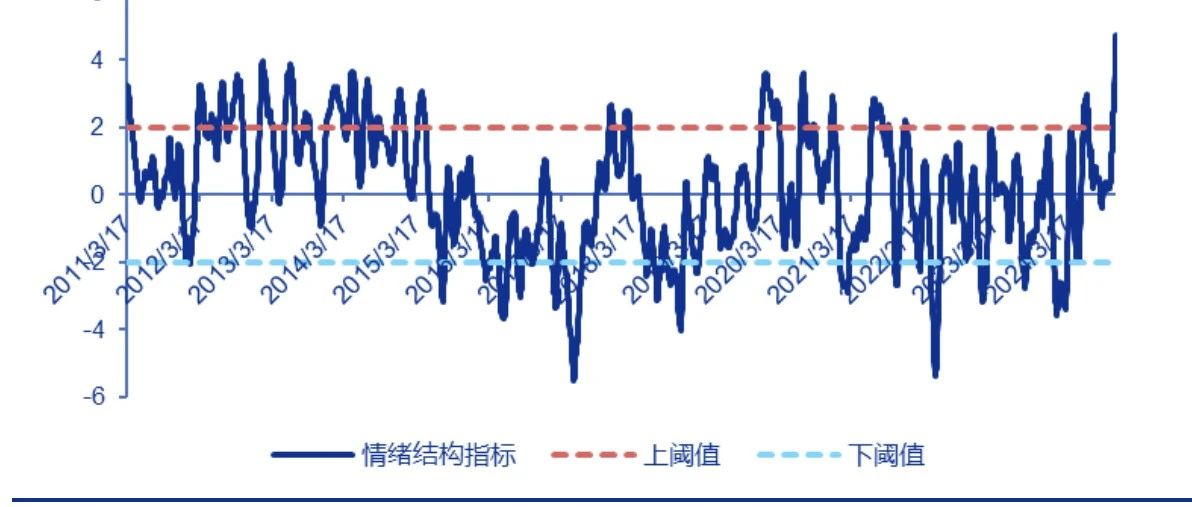
Group 1: Market Sentiment Indicators - The market sentiment index as of October 10 is 1.75, a slight decrease from 1.85 on September 26, indicating a bearish sentiment [8][11] - The financing balance ratio continues to rise, reflecting an increase in market leverage sentiment and improving trading atmosphere [27][11] - The industry trading volatility continues to decline, suggesting a slowdown in fund switching activity and a decrease in market participants' divergent views on short-term industry value [21][11] Group 2: Timing Model Insights - The model indicates a preference for small-cap value style, with a weak signal strength due to a slight decline in the 5-day RSI relative to the 20-day RSI [45][46] - The short-term trend scores for industries such as non-ferrous metals, power equipment, real estate, machinery, and electronics are notably strong, with non-ferrous metals scoring the highest at 98.31 [34][36] - The model maintains a strong signal for value style, suggesting potential for further strengthening in the future [45][46] Group 3: Industry Crowding and Performance - Recent high returns in non-ferrous metals and coal are accompanied by high fund crowding, indicating potential volatility risks due to valuation and sentiment corrections [42][41] - Industries like automotive and electronics show high crowding but lower returns, while sectors with low crowding such as pharmaceuticals and beauty care may present long-term investment opportunities as risk appetite increases [42][41] - The average crowding levels for industries as of October 10 show automotive, environmental protection, real estate, power equipment, and electronics as the highest, while agriculture, computers, defense, beauty care, and pharmaceuticals are the lowest [40][41]
美股4月以来暴涨,但市场情绪并不狂热,甚至整体仓位一直“偏空”?
Hua Er Jie Jian Wen· 2025-10-10 00:48
Core Insights - Despite a strong rebound in US stocks since April, overall investor sentiment remains cautious rather than euphoric [1][2] - JPMorgan analysts indicate that the current market rally is driven more by investors "chasing the trend" rather than excessive optimism [1][3] Market Positioning - JPMorgan's unique market sentiment indicator shows that investor positioning has been unexpectedly cautious, even "bearish," since early May [2][3] - This indicator turned negative in early May and peaked negatively by the end of June, indicating that investors found their positions to be more bearish than desired [3][4] Investor Behavior - As of early September, key participants such as hedge funds and speculative investors have not reached high stock exposure levels, reflecting a continued cautious sentiment [5][6] - Macro hedge funds' stock beta remains in a "moderate negative" range, while speculative investors' net long positions in US stock index futures have returned to near long-term median levels [5][6] Multi-Asset Fund Dynamics - The behavior of multi-asset investors shows a complex sentiment, with balanced funds' stock beta falling below average levels in recent weeks [7][8] - Risk parity funds exhibited more volatility, with their stock beta dropping below average in early April, rising above average in early August, and then falling again by the end of September [8]

牛市中的震荡如何演绎?
2025-09-15 01:49
Summary of Conference Call Records Industry Overview - The A-share market is currently experiencing a strong oscillation pattern, with limited upward potential and minimal downward risk, influenced by market sentiment, economic data, and Sino-U.S. relations [1][2][5] - The technology growth sector is performing exceptionally well, particularly companies with strong industrial trends. Cyclical industries and previously underperforming growth companies, such as the telecommunications sector, also present opportunities for low-cost positioning [1][3][12] Core Insights and Arguments - Key factors contributing to market oscillation include: 1. High-level financing leading to cooling risks, with a total inflow of nearly 60 billion since September 5, and financing balances exceeding 2.3 trillion, a historical high [5] 2. Economic data from August indicating a weak recovery, with export growth slowing to approximately 4% year-on-year and a decline in new social financing and RMB loans [5] 3. Increased risk from U.S.-China semiconductor sanctions, although ongoing trade negotiations may mitigate long-term impacts [5][10] - Historical patterns suggest that oscillations in bull markets typically end with significant policy changes or external events that positively influence risk appetite [6][12] - Current indicators for the end of the oscillation phase are not fully met: - The valuation percentile of the Shanghai Composite Index is around 66, above the neutral level of 50% [8] - Trading volume has decreased by a maximum of 37%, not exceeding the 50% threshold [8] - The turnover rate remains high at 72%, indicating insufficient cooling [8] Industry Rotation and Opportunities - Industry rotation is incomplete, with consumer and cyclical sectors not showing significant recovery. In the agriculture, forestry, animal husbandry, and fishery sector, only leading stocks have increased, with an average rise of 8.1%, while non-leading stocks only rose by 1.4% [9][12] - Recommended sectors for investment include: 1. Technology, Media, and Telecommunications (TMT) and non-ferrous metals, which are expected to continue their upward trend [13][14] 2. Telecommunications and innovative pharmaceuticals, which may show signs of recovery and potential for upward movement [13][14] Additional Important Insights - The current market sentiment remains relatively high, which could lead to a decrease in potential gains [5] - The overall liquidity environment is favorable, with policies supporting inflows and a low-risk external environment due to ongoing negotiations with the U.S. [11][12] - The short-term economic outlook remains weak, but there are signs of recovery in corporate earnings data, suggesting a potential for gradual improvement [11][12]
ETO Markets 市场洞察:黄金狂飙突进!央行30年首次"抛弃"美债,3500美元只是起点?
Sou Hu Cai Jing· 2025-09-02 04:34
Core Insights - Spot gold prices continue to rise strongly, with a cumulative increase of over 3% in the past five trading days, breaking through the historical high of $3,500 per ounce [1] - Global central banks are increasing their gold reserves, with the total gold reserve surpassing $3.9 trillion, exceeding the U.S. Treasury holdings for the first time in 30 years [3] - The market sentiment indicators show mixed signals, with the CNN "Fear and Greed Index" remaining in the "Greed" zone but trending downward, indicating potential increased demand for safe-haven assets like gold [4] Market Dynamics - The expectation of a rate cut by the Federal Reserve has strengthened, with the 10-year U.S. Treasury yield hovering around 4.2%, diminishing the attractiveness of bonds and reinforcing gold's position as a preferred safe-haven asset [3] - Technical indicators are showing bullish signals, with gold successfully breaking through the $3,450 per ounce resistance level, and if it holds above $3,500, it could open up further upside potential [6] - Immediate support has shifted to $3,450, with the $3,355 area serving as a critical defense line due to the convergence of the 50-period SMA and cloud support [7] Investment Considerations - The current market environment presents three favorable factors: structural demand support, expectations of a shift in monetary policy, and technical breakout signals [9] - Investors should focus on the effectiveness of the $3,500 breakthrough, the policy guidance from the Federal Reserve's September meeting, and changes in global central bank gold purchasing patterns [9]


金融工程量化月报:风险偏好持续提升,PB-ROE组合超额收益显著-20250901
EBSCN· 2025-09-01 08:21
- The "PB-ROE-50" strategy is based on the idea of identifying market expectation gaps and enhancing portfolio returns by incorporating surprise factors such as SUE and ROE year-on-year growth. It selects 50 stocks to construct the portfolio using the PB-ROE pricing model derived from Wilcox (1984)[29][33][36] - The "PB-ROE-50" strategy achieved positive excess returns in August 2025 for the CSI 800 and the entire market stock pools, with excess returns of 5.22% and 7.61%, respectively. However, it recorded a negative excess return of -0.54% for the CSI 500 stock pool[29][33][36] - The "Upward Count Proportion Sentiment Indicator" calculates the proportion of stocks in the CSI 300 index with positive returns over the past N days. It is used to gauge market sentiment, with higher proportions indicating optimistic sentiment. The formula is: CSI 300 Index N-day Upward Count Proportion = Number of CSI 300 Index constituent stocks with returns > 0 in the past N days / Total number of constituent stocks[12][13][15] - The "Upward Count Proportion Sentiment Indicator" is smoothed using two different window periods (N1=50, N2=35) to generate fast and slow lines. When the fast line exceeds the slow line, it signals a bullish market sentiment[13][15][16] - The "Moving Average Sentiment Indicator" uses eight moving averages (parameters: 8, 13, 21, 34, 55, 89, 144, 233) to assess the sentiment state of the CSI 300 index. The indicator assigns values based on the range of the moving averages, with values of -1, 0, or 1 corresponding to different sentiment states[19][24][23] - The "Moving Average Sentiment Indicator" signals a bullish sentiment when the current price exceeds the values of more than five moving averages[19][24][23] - The "Fund Concentration Degree Tracking" uses the standard deviation of cross-sectional returns of concentrated fund portfolios as a proxy for fund concentration. Lower standard deviation indicates higher concentration, while higher standard deviation suggests concentration is breaking down[25][28][26] - The "Institutional Research Strategy" includes public fund research stock selection and private fund research tracking strategies. It selects stocks based on the number of times a company is researched and its relative performance before the research. In August 2025, the public fund strategy recorded an excess return of -1.33%, while the private fund strategy recorded -5.05%[37][39][40] - The "Relaxed Interest-Bearing Debt Ratio" is calculated as: (Short-term loans + Interest payable + Transactional financial liabilities + Payable short-term bonds + Lease liabilities + Long-term loans + Payable bonds + Long-term payables + Other current liabilities + Liabilities classified as held-for-sale + Non-current liabilities due within one year) / Total assets. It is used to identify stocks with high liquidity risk[42][43][45] - The "Financial Cost Burden Ratio" is calculated as: Financial expenses: Interest expenses / Earnings before interest and taxes (EBIT). It measures the pressure companies face in paying interest costs. Stocks with high ratios are flagged for potential financial risk[46][47][48]
从结构化视角全新打造市场情绪择时模型——申万金工量化择时策略研究系列之一
申万宏源金工· 2025-08-26 08:01
Core Viewpoint - The article discusses the limitations of traditional market sentiment indicators and proposes a new approach to measure market sentiment through structural indicators, aiming to provide more detailed insights for market timing decisions. Group 1: Market Sentiment Measurement - The existing market sentiment indicators lack sensitivity and are not effective in signaling market reversals, as they are influenced heavily by a limited number of metrics [1][3][9] - The proposed sentiment temperature model consists of five indicators: total turnover rate, trading volume, northbound capital inflow, and volatility indices for options [1][3] - The methodology for constructing the sentiment temperature involves averaging the VIX percentiles and smoothing the data over a five-day period [1] Group 2: Structural Indicators - The article emphasizes the need for structural indicators to better capture market trading characteristics, especially in weak trend environments where investment hotspots shift rapidly [9][10] - Key structural indicators include: - **Industry Turnover Rate Consistency**: Measures the degree of consensus among funds regarding industry sectors, indicating whether market trading behavior is consistent or shifting [11][14] - **Industry Concentration**: Reflects the degree of trading activity concentration in specific sectors, with higher values indicating a lack of diversification in fund preferences [18][20] - **Industry Performance and Turnover Consistency**: Assesses whether the performance of leading sectors aligns with their trading volumes, indicating market sentiment stability [21][24] - **Growth Board Activity**: Indicates risk appetite among investors, with higher activity in the growth sector suggesting bullish sentiment [25][28] Group 3: Financing Data - The financing balance to free float market value ratio serves as a long-term sentiment indicator, with increases suggesting bullish sentiment and decreases indicating bearish sentiment [29][32] - The article also discusses the use of the Relative Strength Index (RSI) as a sentiment indicator, where values above 50 indicate strong buying power [33][34] Group 4: Timing Strategy - The sentiment structure indicators have been tested for their effectiveness in timing strategies, with daily strategies outperforming weekly ones in terms of annualized returns and risk management [91][92] - The backtesting results show that the sentiment indicators can provide significant excess returns compared to the benchmark index, with a notable reduction in drawdown and volatility [91][92]
双融日报-20250818
Huaxin Securities· 2025-08-18 01:34
Market Sentiment - The current market sentiment score is 93, indicating an "overheated" market condition, which suggests a potential resistance to further upward movement [6][9][17]. Hot Themes Tracking - **Brain-Computer Interface Theme**: The National Healthcare Security Administration has introduced a new pricing mechanism for innovative medical technologies, including a "brain-computer interface implantation fee," which is expected to accelerate the clinical application of innovative drugs and devices. Related stocks include Innovation Medical (002173) and Weisi Medical (688580) [6]. - **Robotics Theme**: The first World Humanoid Robot Games took place in Beijing, showcasing advancements in motion control and practical applications. Related stocks include Wolong Electric (600580) and Changsheng Bearing (300718) [6]. - **Logistics Theme**: The State Post Bureau held discussions to address issues in the express delivery industry, promoting high-quality development. The commercialization of unmanned logistics vehicles is also gaining traction, particularly in the "last mile" delivery segment. Related stocks include Shentong Express (002468) and SF Holding (002352) [6]. Capital Flow Analysis - **Top Net Inflow Stocks**: The top stocks with significant net inflows include Dongfang Caifu (573.36 million), Zhinanzhen (141.55 million), and Zhongke Sanhuan (62.22 million) [10]. - **Top Net Outflow Stocks**: The stocks with the highest net outflows include Dongshan Precision (-91.66 million), Heertai (-84.24 million), and Sifang Chuangxin (-74.04 million) [12][18]. - **Industry Net Inflows**: The non-bank financial sector saw the highest net inflow at 825.98 million, followed by electrical equipment (188.82 million) and household appliances (115.79 million) [15][16]. Investment Strategy Recommendations - In an "overheated" market, it is advisable to consider reducing positions to avoid buying at market peaks and to be cautious of potential market bubbles [17].
【金工】情绪指标发出看多信号,量化选股组合超额收益显著——金融工程量化月报20250701(祁嫣然/张威)
光大证券研究· 2025-07-02 13:14
Market Sentiment Tracking - As of June 30, 2025, the proportion of rising stocks in the CSI 300 has increased month-on-month, with over 60% of stocks rising, indicating high market sentiment [3] - The momentum sentiment indicator shows a fast line moving upwards and a slow line moving downwards, with the fast line above the slow line, suggesting a bullish outlook in the near term [3] - The short-term CSI 300 index is in a sentiment boom range [3] Fund Separation Degree Tracking - As of June 30, 2025, the fund separation degree has slightly increased and is currently at a low level, indicating a high degree of fund clustering [4] - The excess returns of clustered stocks have slightly increased, while the excess returns of clustered funds have slightly decreased [4] PB-ROE-50 Strategy Tracking - In June 2025, the PB-ROE-50 strategy achieved positive excess returns across various stock pools [5] - The strategy based on the CSI 500 stock pool gained an excess return of 0.92% [5] - The strategy based on the CSI 800 stock pool achieved an excess return of 3.92% [5] - The strategy based on the entire market stock pool obtained an excess return of 4.59% [5] Institutional Research Strategy Tracking - In June 2025, both public and private research selection strategies generated positive excess returns [6] - The public research selection strategy achieved an excess return of 5.55% relative to the CSI 800 [6] - The private research tracking strategy gained an excess return of 1.90% relative to the CSI 800 [6] Negative List - As of June 30, 2025, several stocks with high interest-bearing debt ratios ranked poorly, including Zhongyida, Guiding Compass, and Modern Investment, among others [7] - Stocks with high financial cost burden ratios include Liao Ning Cheng Da, Yin Bao Shan Xin, and A Shi Chuang, with all indicators exceeding 10 times [7]

市场主流观点汇总-20250701
Guo Tou Qi Huo· 2025-07-01 11:41
Report Summary 1. Report Industry Investment Rating No information provided regarding the report industry investment rating. 2. Core View of the Report The report aims to objectively reflect the research views of futures companies and securities companies on various commodity varieties, track hot - spot varieties, analyze market investment sentiment, and summarize investment driving logics. It is based on the publicly - released research reports of institutions in the current week, and the closing price data is from last Friday, with the weekly change calculated as the change in the closing price from the previous Friday [2]. 3. Summary by Relevant Catalogs 3.1行情数据 - **Commodities**: From June 23 to June 27, 2025, commodities such as coke, copper, and iron ore had price increases, with coke rising 2.67%, copper rising 2.47%, and iron ore rising 1.92%. Commodities like corn, gold, and palm oil had price decreases, with corn falling 1.04%, gold falling 1.56%, and palm oil falling 1.87%. Crude oil had a significant drop of 12.02% [3]. - **A - shares**: During the same period, the CSI 500 rose 3.98%, the SSE 50 rose 1.27%, and the CSI 300 rose 1.95% [3]. - **Overseas Stocks**: The Nikkei 225 rose 4.55%, the Nasdaq Index rose 4.25%, and the S&P 500 rose 3.44% [3]. - **Bonds**: The 5 - year Chinese Treasury bond rose 0.64%, the 10 - year Chinese Treasury bond rose 0.30%, and the 2 - year Chinese Treasury bond rose 0.19% [3]. - **Foreign Exchange**: The euro - US dollar exchange rate rose 1.69%, the US dollar index fell 1.52%, and the US dollar central parity rate fell 0.09% [3]. 3.2大宗商品观点汇总 3.2.1宏观金融板块 - **Stock Index Futures**: Among 8 institutions' views, 2 were bullish, 1 was bearish, and 5 were for a sideways market. Bullish factors included rising Fed rate - cut expectations, a low risk - premium rate of the CSI 300, increased issuance of equity - oriented public funds, and sufficient bottom - supporting funds. Bearish factors included short - term difficulty in improving corporate fundamentals, the central bank's change in monetary policy stance, and over - heated market sentiment [4]. - **Treasury Bond Futures**: Among 7 institutions' views, 3 were bullish, 1 was bearish, and 3 were for a sideways market. Bullish factors included net liquidity injection by the central bank, weak credit and inflation data, and strong demand for bond allocation. Bearish factors included the central bank's change in monetary policy stance, the stock - bond seesaw effect, and rising long - term interest rates [4]. 3.2.2能源板块 - **Crude Oil**: Among 9 institutions' views, 3 were bullish, 2 were bearish, and 4 were for a sideways market. Bullish factors included falling US and Cushing crude oil inventories, reduced Russian exports, and geopolitical tensions. Bearish factors included the decline in geopolitical premiums, expected OPEC production increases, and weak terminal demand [5]. - **Eggs**: Among 8 institutions' views, 2 were bullish, 2 were bearish, and 4 were for a sideways market. Bullish factors included postponed peak - season stocking, approaching stocking season, potential egg - price increases, and reduced supply due to heat. Bearish factors included limited decline in laying - hen inventory, high chick - replenishment volume, high new - production capacity, and postponed downstream stocking [5]. 3.2.3有色板块 - **Copper**: Among 7 institutions' views, 5 were bullish, 0 were bearish, and 2 were for a sideways market. Bullish factors included rising Fed rate - cut expectations, improved risk appetite, and falling global visible inventories. Bearish factors included the substitution effect of recycled copper, weakening downstream procurement, and weakening terminal demand [6]. - **Methanol**: Among 7 institutions' views, 0 were bullish, 1 was bearish, and 6 were for a sideways market. Bullish factors included limited port - available goods, expected low port inventories, and increased downstream demand. Bearish factors included expected increases in Iranian imports, port inventory accumulation, potential MTO device maintenance, and a loosening supply - demand pattern [6]. 3.2.4贵金属 - **Gold**: Among 7 institutions' views, 4 were bullish, 1 was bearish, and 2 were for a sideways market. Bullish factors included rising Fed rate - cut expectations, a downward trend in real interest rates, and the strengthening of gold's safe - haven property. Bearish factors included reduced safe - haven demand, capital flowing to risky assets, and technical - level sell - offs [7]. 3.2.5黑色板块 - **Iron Ore**: Among 8 institutions' views, 2 were bullish, 2 were bearish, and 4 were for a sideways market. Bullish factors included increased molten - iron production, expected decline in overseas shipments, and improved macro sentiment. Bearish factors included rising port inventories, increased global shipments, weakening demand for five major steel products, and narrowing basis [7].
量化择时周报:模型提示市场情绪指标进一步回升,红利板块行业观点偏多-20250505
Shenwan Hongyuan Securities· 2025-05-05 09:41
Quantitative Models and Construction Methods 1. Model Name: Market Sentiment Timing Model - **Model Construction Idea**: The model is built from a structural perspective to quantify market sentiment using various sub-indicators[7] - **Model Construction Process**: - The model uses sub-indicators such as industry trading volatility, trading crowding, price-volume consistency, Sci-Tech Innovation Board (STAR 50) trading proportion, industry trend, RSI, main buying force, PCR combined with VIX, and financing balance ratio[8] - Each sub-indicator is scored based on its sentiment direction and position within Bollinger Bands. Scores are categorized as (-1, 0, 1)[8] - The final sentiment structural indicator is the 20-day moving average of the summed scores. The indicator fluctuates around 0 within the range of [-6, 6][8] - **Model Evaluation**: The model effectively captures market sentiment trends and provides actionable insights for timing decisions[8] 2. Model Name: Moving Average Scoring System (MASS) - **Model Construction Idea**: This model evaluates long-term and short-term trends of indices using N-day moving averages to generate timing signals[18] - **Model Construction Process**: - For N moving averages (N=360 for long-term, N=60 for short-term), scores are assigned based on the relative position of adjacent moving averages. If a shorter moving average is above a longer one, it scores 1; otherwise, it scores 0[18] - The scores are standardized to a 0-100 scale and averaged to derive the trend score at a specific time point[18] - Long/short-term timing signals are generated based on the crossover of the trend score with its 100/20-day moving average[18] - **Model Evaluation**: The model provides clear signals for sector rotation and market style preferences, favoring value and defensive sectors in the current environment[18] 3. Model Name: RSI Style Timing Model - **Model Construction Idea**: The model uses the Relative Strength Index (RSI) to compare the relative strength of different market styles (e.g., growth vs. value, small-cap vs. large-cap)[22] - **Model Construction Process**: - For two indices A and B, calculate the standardized ratio of their net values over a fixed period[22] - Compute the average gain (Gain) and average loss (Loss) over N days, where gains on down days are treated as 0 and losses on up days are treated as 0[22] - RSI formula: $ RSI = 100 - 100 / (1 + Gain / Loss) $ - RSI values range from 0 to 100, with values above 50 indicating stronger buying pressure[22] - The model calculates 5-day, 20-day, and 60-day RSI values. When the 20-day RSI exceeds the 60-day RSI, the numerator style is favored; otherwise, the denominator style is favored[22] - **Model Evaluation**: The model effectively identifies style dominance, currently favoring large-cap and value styles while noting short-term strengthening of growth and small-cap styles[22] --- Model Backtesting Results 1. Market Sentiment Timing Model - Sentiment indicator value as of April 30, 2025: 0.8, indicating a recovery in market sentiment[9] 2. Moving Average Scoring System (MASS) - Short-term signals: Positive for sectors like beauty care (72.88), utilities (86.44), banking (74.58), and oil & petrochemicals (22.03)[19] - Long-term signals: Positive for sectors like banking (95.54), machinery (78.55), and steel (51.25)[19] 3. RSI Style Timing Model - Growth/Value (300 Growth/300 Value): RSI 20-day = 53.02, RSI 60-day = 50.42, favoring value[25] - Small-cap/Large-cap (SW Small/SW Large): RSI 20-day = 48.84, RSI 60-day = 53.62, favoring large-cap[25] --- Quantitative Factors and Construction Methods 1. Factor Name: RSI - **Factor Construction Idea**: Measures the relative strength of buying and selling forces over a specific period[22] - **Factor Construction Process**: - Calculate the average gain (Gain) and average loss (Loss) over N days[22] - Formula: $ RSI = 100 - 100 / (1 + Gain / Loss) $ - RSI values range from 0 to 100, with higher values indicating stronger buying pressure[22] - **Factor Evaluation**: Provides a robust measure of market momentum and style preferences[22] --- Factor Backtesting Results 1. RSI - Growth/Value (300 Growth/300 Value): RSI 20-day = 53.02, RSI 60-day = 50.42, favoring value[25] - Small-cap/Large-cap (SW Small/SW Large): RSI 20-day = 48.84, RSI 60-day = 53.62, favoring large-cap[25]