
沃什交易

Search documents
每周研选 | 持股还是持币?
Sou Hu Cai Jing· 2026-02-08 13:13
Core Viewpoint - The A-share market is experiencing fluctuations and adjustments ahead of the upcoming Spring Festival, with discussions on whether to hold stocks or cash during the holiday. Investors are concerned about external risks during the long holiday, while others fear missing out on potential gains post-holiday, known as the "red envelope market" [11]. Group 1: Investment Strategies - Dongwu Securities recommends holding stocks during the holiday, suggesting that the factors currently suppressing the market may weaken, leading to a potential rebound starting next week, with a focus on overvalued technology sectors such as semiconductor equipment and cloud computing [12]. - Guosen Securities supports holding stocks, citing historical data showing a high probability of market gains before and after the Spring Festival, with the Shanghai Composite Index having an 81% chance of rising in the week before the holiday [13]. - Huachuang Securities believes the current market adjustment may have reached its limit, advising investors to focus on high-dividend stocks and sectors with strong performance support [14]. - China Galaxy Securities suggests a cautious approach of "lightly holding stocks," balancing the risks of pre-holiday market adjustments with the potential for post-holiday gains [16]. - Huajin Securities indicates that the spring market is not over, with expectations for improved economic and profit forecasts during the holiday [17]. Group 2: Market Trends and Predictions - Shenyin Wanguo Securities notes that the market's overall profitability has returned to historical mid-high levels, and a second phase of upward movement may begin after identifying the lower limit of the current fluctuation range [15]. - CITIC Securities emphasizes the need to maintain a "resource + traditional manufacturing" base amid increasing global market uncertainties, suggesting that the Chinese capital market is transitioning towards quality improvement and efficiency [18]. - GF Securities highlights that February and the period around the Spring Festival are historically strong for market movements, with small-cap stocks showing a 100% probability of rising from the Spring Festival to March [19]. - Zhongtai Securities points out that high-dividend stocks currently offer more attractive yields than long-term bonds, with a potential shift in market style towards more stable, high-dividend sectors post-holiday [21]. Group 3: Sector Focus - The focus on cyclical stocks is emphasized by Founder Securities, which notes that improvements in the Producer Price Index (PPI) could drive excess returns in cyclical stocks, suggesting that sectors like power and machinery also present good investment opportunities [23].

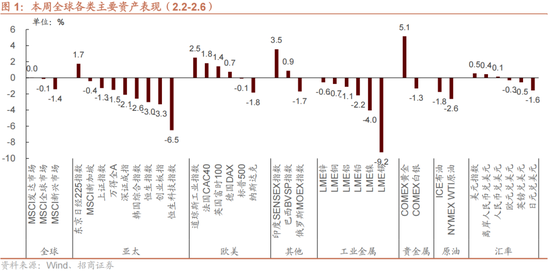
招商策略:一旦沃什交易冲击结束,恒科有望迎来补涨行情
Xin Lang Cai Jing· 2026-02-08 12:43
Core Viewpoint - Recent declines in technology stocks globally are attributed to liquidity shocks from the nomination of Kevin Warsh as the new Federal Reserve Chair and a lack of new catalysts in the AI sector, particularly following the release of Anthropic's new AI tool, which raised concerns about the disruption of traditional software business models [2][36] Market Analysis - The market is expected to experience volatility in February, with a potential for stronger performance post-holiday compared to pre-holiday levels. The main focus will shift towards sectors such as oil and petrochemicals, food and beverages, and construction materials benefiting from major projects outlined in the 14th Five-Year Plan [2][36] - The Hong Kong stock market, particularly the Hang Seng Tech Index, has shown signs of recovery potential, especially if the liquidity shock subsides or new catalysts emerge in the AI industry [8][19] Sector Performance - The A-share market has seen a mixed performance, with consumer leaders and large-cap value stocks performing well, while tech-heavy indices like the STAR Market and tech leaders have struggled [37] - The manufacturing sector's PMI has shown a decline, indicating a contraction in activity, while heavy truck sales have seen a significant year-on-year increase, suggesting some resilience in specific segments [40][52] Investment Trends - There has been a notable outflow of financing funds, with a net outflow of 34.59 billion yuan in the first four trading days of the week. However, there has been a net subscription in ETFs, indicating a shift in investor sentiment [4][56] - The recent launch of Anthropic's AI tool has triggered a sell-off in legal and data service stocks, raising fundamental questions about the profitability and growth prospects of the SaaS industry [22][26] Future Outlook - The software industry is undergoing a structural adjustment rather than a fundamental collapse, with a shift towards AI-native intelligent services expected to redefine business models [32][35] - The Chinese SaaS industry is positioned to benefit from ongoing digital transformation demands, with AI viewed as an enabling tool rather than a direct disruptor of existing business models [33][35]
A股投资策略周报:沃什交易及AI交易有望如何演绎?-20260208
CMS· 2026-02-08 05:04
Group 1 - The report highlights that the recent volatility in the market is primarily driven by the "Walsh trade," which has led to a rebound in the US dollar index and a significant decline in emerging markets and commodities [2][5][41] - The report suggests that the Hong Kong stock market, particularly the Hang Seng Technology Index, has reached a point of value for investment, indicating potential for a rebound once the impact of the Walsh trade subsides or new catalysts emerge in the AI sector [7][25][44] - The report emphasizes that the market is expected to experience a period of fluctuation in February, with a stronger performance anticipated after the holiday compared to before [2][7][44] Group 2 - The report discusses the structural adjustment in the software industry following the release of Anthropic's AI plugin tool, which poses a threat to traditional software pricing models and has triggered a sell-off in related stocks [6][28][43] - It notes that the Chinese SaaS industry is still in its growth phase, with ongoing digital transformation demands across various sectors, positioning AI as an enabling tool rather than a direct disruptor of existing business models [40][43] - The report indicates that the valuation of technology stocks, particularly in Hong Kong, is at historically low levels, suggesting potential for valuation recovery as the regulatory environment improves [25][44] Group 3 - The report identifies key sectors for investment, including cyclical and technology sectors, with a focus on industries such as electronics, media, machinery, and power equipment, which are expected to benefit from ongoing policy support and seasonal consumption trends [7][44] - It highlights that the market is currently in a spring rally phase, recommending a growth style investment approach, with a preference for larger-cap stocks initially before shifting to smaller-cap stocks [7][44] - The report also points out that the recent volatility in the technology sector is exacerbated by concerns over aggressive capital expenditure plans from major tech companies, which may not yield short-term profitability [38][39]
金价大跳水后又狂飙!黄金最新行情:看懂这三点不踩坑还能赚
Sou Hu Cai Jing· 2026-02-06 19:15
Core Viewpoint - The gold market experienced extreme volatility in early February 2026, with prices reaching a historical high of $5626 per ounce before plummeting below $4800, leading to significant losses and buying opportunities for investors [1][3]. Group 1: Market Dynamics - The immediate trigger for the volatility was the nomination of Kevin Walsh as the next Federal Reserve Chairman, who advocates for a significant reduction in the balance sheet, negatively impacting gold prices [3]. - The trading structure amplified the volatility, with increased margin requirements leading to forced liquidations and a chain reaction of sell-offs, resulting in a 30-day volatility rate for gold exceeding 44%, the highest since the 2008 financial crisis [3]. - Despite the fluctuations, global central banks continued to purchase gold, with a reported net purchase of 230 tons in Q4 2025, indicating sustained demand [3]. Group 2: Investor Behavior - The physical gold market reacted swiftly to price changes, with long queues forming for both selling and buying gold in major cities like Beijing and Guangzhou, reflecting a strong interest in physical gold despite price volatility [5]. - Institutional investors displayed a split in outlook, with Deutsche Bank predicting gold could rise to $6000 per ounce, while UBS set targets ranging from $4600 to $7200 per ounce depending on market conditions [6]. - Caution was expressed by some institutions, such as Citigroup, which suggested that gold prices might face structural declines in the latter half of 2026 due to reduced hedging demand [8]. Group 3: Market Data - As of February 5, 2026, gold was priced at $4812 per ounce, down 3.97% from the previous trading day, while domestic prices in China also saw significant declines [11]. - Analysts forecasted that domestic gold prices might fluctuate between 1070 and 1150 yuan per gram in the short term, indicating a period of consolidation [13]. - The trading volume of gold ETFs surged during this period, with significant daily transaction amounts reflecting heightened market activity and investor engagement [8].

跌崩!黑天鹅重演?
格隆汇APP· 2026-02-06 10:08
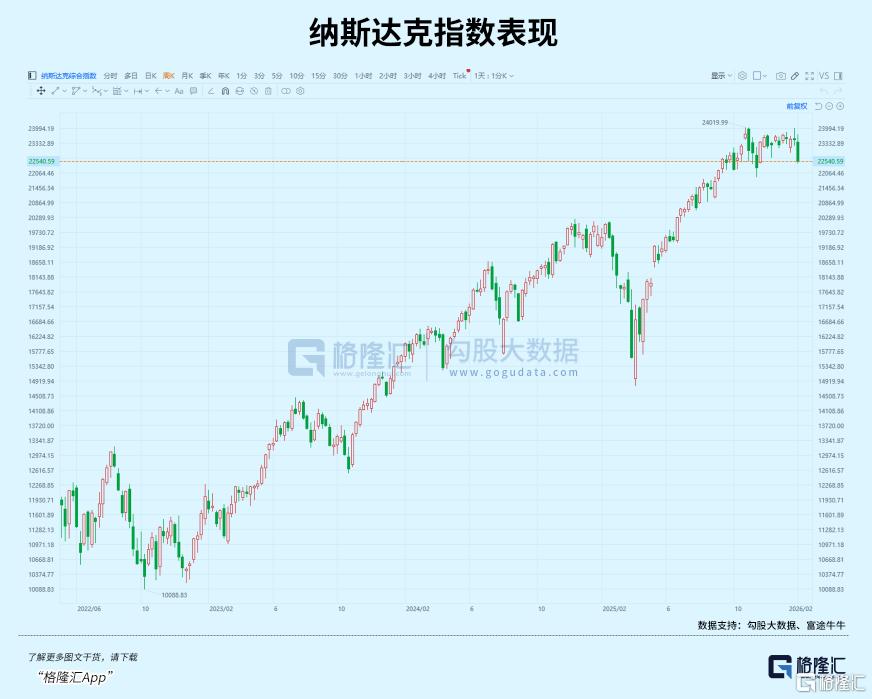
Core Viewpoint - The article discusses a significant downturn in the U.S. stock market, precious metals, and cryptocurrencies, indicating a potential major adjustment in the market dynamics, particularly in the tech sector driven by AI investments [3][4][5][8]. Group 1: Market Performance - U.S. stock indices fell over 1%, with the Nasdaq experiencing its worst three-day sell-off since April of the previous year [5]. - Precious metals like silver and gold saw drastic declines, with silver dropping over 20% and gold over 4% [4]. - The recent earnings reports from major tech companies like Google and Amazon, despite showing strong growth, did not excite the market and instead led to significant stock price drops [5][10][13]. Group 2: Capital Expenditure Concerns - Google reported a remarkable 48% growth in cloud business but indicated a capital expenditure guidance for 2026 of $175-185 billion, nearly double its 2025 spending [10]. - Amazon's capital expenditure plan for 2026 is projected at $200 billion, yet its stock also faced a 10% drop post-earnings [13]. - The combined planned investment of $660 billion by major tech firms for AI infrastructure by 2026 raises concerns about the efficiency of such massive capital expenditures, especially if they yield only marginal growth in cloud services [18]. Group 3: AI Investment Dynamics - The article highlights a shift from a "honeymoon phase" of AI investment to a more critical phase where the market questions the return on investment for high capital expenditures in AI infrastructure [17]. - The physical limitations of infrastructure, such as the U.S. power grid's inability to support explosive growth in data center capabilities, further complicate the situation [18][19]. - The emergence of autonomous AI applications threatens traditional software business models, as companies may reduce their reliance on SaaS products due to AI's ability to perform tasks previously done by human employees [22][23]. Group 4: Macroeconomic Factors - The nomination of Kevin Warsh as the Federal Reserve Chair has created uncertainty in the market, with fears of tighter monetary policy leading to higher long-term interest rates, which could negatively impact tech stock valuations [24][30]. - Warsh's hawkish stance on monetary policy contrasts with market expectations for continued liquidity support, raising concerns about the future of tech stock valuations [26][32]. - The potential for a liquidity crunch, combined with the current market dynamics, suggests an increased likelihood of a significant market correction [38][41].



跌崩!黑天鹅重演?
Ge Long Hui· 2026-02-06 09:22
Market Overview - The U.S. stock market, precious metals, and cryptocurrency markets experienced significant declines [1] - Spot silver fell over 20%, while spot gold dropped more than 4%, and international oil prices also saw substantial decreases [2] - All three major U.S. stock indices closed down over 1%, with the Nasdaq facing its worst three-day sell-off since April of the previous year [3] Company Performance - Major tech stocks like Google and Amazon reported "better-than-expected" earnings but still saw declines, which is considered unusual [4] - Google reported a remarkable 48% growth in its cloud business for Q4, yet its pre-market drop reached 6% [8] - Amazon's Q4 revenue and net profit were solid, with AWS cloud business growth at 24%, but it also faced a 10% drop in after-hours trading [11] Capital Expenditure Trends - Over the next few years, major tech companies including Amazon, Google, Microsoft, and Meta plan to invest a total of $660 billion in AI infrastructure, a 60% increase year-on-year [16] - The shift in market sentiment reflects a growing skepticism about the efficiency of massive capital expenditures, as investors question whether the returns justify the costs [15] AI and Software Industry Challenges - The AI investment landscape is transitioning from a "honeymoon phase" to a more challenging environment, with concerns about the effectiveness of capital spending [15] - The rise of autonomous AI applications is disrupting traditional SaaS business models, leading to a potential decline in demand for entry-level positions and related software subscriptions [18] - The software sector has seen significant stock price adjustments, with the iShares Software ETF (IGV) down 25% year-to-date, underperforming the broader market [18] Macroeconomic Factors - The market is reacting to potential changes in monetary policy under Kevin Warsh, who is perceived as hawkish, raising concerns about liquidity and future interest rates [25][26] - The anticipated tightening of liquidity could lead to higher long-term interest rates, negatively impacting tech stock valuations that rely on future cash flow [28] - The current macroeconomic environment, combined with the challenges faced by AI companies, suggests a potential for significant market corrections in the near future [34][35]
多头与空头狭路相逢 贵金属市场激烈博弈
Shang Hai Zheng Quan Bao· 2026-02-05 17:53
Core Viewpoint - The international precious metals market is experiencing extreme volatility, with significant fluctuations in gold and silver prices, indicating high uncertainty and ongoing market dynamics [1][2]. Market Dynamics - Gold prices recently fell below $4800 per ounce after briefly rising above $5000, while silver experienced even more dramatic swings, including a single-day drop of over 30% and a subsequent rise of more than 10% [1]. - The current market is characterized by a struggle between short-term and long-term investors, leading to a unique situation where buying and selling pressures coexist [5]. Investor Behavior - Retail investors, particularly those using high leverage, are facing challenges as institutional players may exploit market volatility to target these positions, leading to forced liquidations [4]. - Short-term traders are reacting quickly to price movements, while long-term investors maintain a steady approach, viewing gold as a long-term wealth preservation tool rather than a short-term profit mechanism [6]. Economic Influences - The nomination of Kevin Walsh as the next Federal Reserve Chair has introduced uncertainty regarding future monetary policy, contributing to the current market volatility [2]. - Analysts suggest that until the Federal Reserve's policy direction becomes clearer, precious metals may continue to experience high volatility [7]. Market Outlook - Analysts expect ongoing price fluctuations in gold and silver, with the previous trend of consistent price increases likely coming to an end [6]. - Despite short-term uncertainties, there is a belief that long-term structural support for gold remains intact due to central bank and institutional buying [7].
上证重回4100点
Tebon Securities· 2026-02-04 11:06
Market Analysis - The A-share market continues to rebound, with the Shanghai Composite Index returning to 4100 points, closing at 4102.20 points, up 0.85% [2][7] - The Shenzhen Component Index showed a modest increase of 0.21%, closing at 14156.27 points, while the ChiNext Index fell by 0.40% to 3311.51 points, indicating some adjustment pressure in the technology growth sector [2][7] - The overall market trading volume remained high at 2.5 trillion yuan, with 3252 stocks rising and 2126 falling, suggesting concentrated profit effects in cyclical and policy-themed sectors [2][7] Sector Performance - The coal sector experienced a surge, with a 7.61% increase in the sector index, driven by expectations of reduced production quotas from the Indonesian government, leading to supply contraction [5][13] - The aviation sector saw a 4.95% rise, supported by the commencement of the Spring Festival travel season, with passenger transport expected to reach 95 million during this period [5][7] - The photovoltaic equipment sector remained strong, with the space photovoltaic index rising by 5.10%, driven by expectations of accelerated projects from Elon Musk [5][7] - The media sector faced a decline of 3.28%, reflecting concerns over content industry substitution risks [5][7] Bond Market - The government bond futures market experienced slight adjustments, with the 30-year contract falling by 0.23% to close at 111.70 yuan [10] - The People's Bank of China continued to implement a net liquidity withdrawal, conducting a 750 billion yuan reverse repurchase agreement, indicating a stable monetary policy environment [10][17] - The overall bond market sentiment remains supported by long-term demand for ultra-long bonds, with expectations of further monetary easing [10][17] Commodity Market - The commodity index rose by 2.00%, with significant rebounds in precious metals and industrial products, including silver rising by 11.22% and gold by 7.29% [10][17] - The market sentiment has quickly recovered from previous panic, with expectations of a stabilization phase following rapid price fluctuations [10][17] - The focus on precious metals remains strong, with long-term upward trends expected due to global monetary credit system restructuring and geopolitical risks [10][17] Investment Opportunities - Key sectors to watch include photovoltaic technology, commercial aerospace, and precious metals, driven by policy support and industry trends [7][14] - The report highlights the potential for AI applications, quantum technology, and consumer upgrades as areas of growth, with ongoing monitoring of technological advancements and market conditions [14][17]
2月3日上期所沪金期货仓单较上一日增加3千克
Jin Tou Wang· 2026-02-03 09:40
| 上期所指定交割金库 | 期货 | 增减 | | --- | --- | --- | | | 103032 | 3 | "沃什交易"短期或被放大,恐慌情绪释放后市场有望回归理性。沃什的提名难以对贵金属造成趋势性利 空,缩表带来的长端利率抬升,以及对基本面的负向冲击是经济"不可承受之重",且可能加剧2025年四 季度以来美国货币市场流动性偏紧的现状,增加"钱荒"风险,落地较为困难,美债也对此反应平平。1 月上旬Polymarket曾显示沃什胜率一度跃升至最高,但市场反应有限,进一步佐证本次大跌更多是市场 情绪过热下,踩踏效应的放大。 上海期货交易所指定交割仓库期货周二(2月3日)仓单日报显示,黄金期货总计103032千克,今日仓单 较上一日增加3千克。 沪金主力盘内大幅回调,周二(2月3日)黄金期货开盘价1068.46元/克,截至目前最高1098.30元/克, 最低1033.50元/克。截止发稿报1093.78元/克,涨幅0.63%,成交量为726056手,持仓为179295手,日持 仓增加894手。 上海期货交易所黄金期货仓单日报(单位:千克) ...
金融期货早评-20260203
美国农业部· 2026-02-03 03:18
Group 1: Overall Market Analysis - The nomination of Kevin Warsh as the Federal Reserve Chairman triggered the "Warsh trade", leading to a rapid cooling of global risk appetite and a significant adjustment in commodities. The short - term market volatility contrasts with the long - term super - cycle main line, but the long - term support for the technology and non - ferrous metals main line remains solid [2] - The US ISM manufacturing index in January reached 52.6, the highest since February 2022, which made the US dollar index strengthen. The RMB exchange rate remained relatively resilient but the downward space of the US dollar against the RMB was narrowed [3] - The stock index continued to adjust, but the policy support limited the downward space. The bond market lacked upward momentum and was likely to continue to fluctuate [4][5][6] Group 2: Commodities Energy and Oil and Gas - Fuel oil was in a weak operation. The supply of high - sulfur fuel oil was gradually recovering, while the demand was weak, and the Iranian issue provided some support at the bottom [26] - Low - sulfur fuel oil had a low cracking spread. The supply was relatively abundant, the demand was stable, and the inventory decline provided a slight boost [27] - The asphalt price quickly fell back. The short - term price was expected to oscillate with limited upward and downward space [28][29] New Energy - For lithium carbonate, in the long - term, the demand from energy storage, new - energy vehicles still supported the price. Before the Spring Festival, it was recommended to reduce positions and pay attention to selling volatility strategies [10][11] - For industrial silicon and polysilicon, in the short - term, the demand was expected to increase due to the export - tax - rebate policy, and the price was likely to rise. Before the Spring Festival, it was recommended to reduce positions [11][12] Non - ferrous Metals - Copper prices fluctuated around important support levels after the release of market sentiment. It was recommended to conduct short - term range operations before the Spring Festival [13][16] - Aluminum prices got short - term support. In the long - term, the price was expected to rise, while alumina was expected to be weak in the long - term and casting aluminum alloy was recommended to pay attention to the price difference with aluminum [17] - Zinc prices were oversold during the day and adjusted at night. It was expected to maintain a wide - range shock [18] - Nickel and stainless - steel prices fell during the day and the decline slowed at night. It was necessary to pay attention to the macro - level situation and the news from Indonesia [18][19] - Tin prices showed a short - selling signal during the day and remained weak at night. It was recommended to enter the market with a light position [20][21] - Lead prices followed the sector. The cost of recycled lead provided support, and it was expected to oscillate in a range [21] Grains and Oils - Oilseeds oscillated and declined. The supply of imported soybeans in the first quarter might have a gap, and the domestic soybean meal and rapeseed meal prices were expected to oscillate [23] - Oils faced pressure. The short - term price was facing a test at the pressure level, waiting for new market drivers [24] Group 3: Chemicals - Pulp and offset paper futures prices continued to decline. The pulp market had many negative factors, and the supply - side reduction provided some support. It was recommended to wait and hold previous short positions [36][38] - LPG risk premium significantly retreated. The supply was neutral - low, the demand was weak, and it was necessary to pay attention to the situation of relevant talks [38][39] - PX - PTA's high processing fees were expected to be difficult to maintain. PX was in a tight supply - demand pattern in the first half of the year, and it was recommended to go long at low prices and shrink the processing fees on the disk [39][41] - MEG - bottle chips had difficulty finding upward drivers. It was necessary to pay attention to geopolitical risks, and the price was expected to oscillate widely with the macro - atmosphere [41][43] - Methanol prices fell. The trading logic was driven by the change of macro - sentiment, and it was recommended to wait for unilateral trading and do 3 - 5 reverse spreads and expand MTO profits [44][45] - PP and PE prices were affected by the macro - sentiment. PP's supply and demand decreased, and PE's supply increased while demand decreased. It was necessary to pay attention to the cost and macro - trends [45][46][48] - Pure benzene and styrene prices fell due to the retreat of geopolitical premium. Pure benzene's supply increased while demand decreased, and styrene's supply - demand pattern turned weak. It was recommended to wait and look for opportunities to go long on styrene after a callback [48][49] - Glass and soda ash prices were hovering at a low level. Soda ash had an oversupply expectation, and glass was in a situation of weak supply and demand, with no obvious trend [49][50][52] - Propylene prices were affected by cost and supply - demand. The cost decreased, but the short - term supply - demand provided some support, and it was necessary to pay attention to the change of fundamentals [52][53] Group 4: Black Metals - Rebar and hot - rolled coil prices had no driving force and oscillated in the bottom range. The supply was high, the demand was weak, and the price was supported by cost and policy [53][54] - Iron ore was a hedging variety. The supply was loose, the demand was expected to increase, and the price had limited downward space [54][55] - Coking coal and coke prices had relatively low valuations, but short - term driving forces had not appeared. The supply - demand structure was expected to improve during the Spring Festival, and the price might face downward pressure in the future [55][56][57] - Ferrosilicon and ferromanganese prices were supported at the bottom and pressured at the top. The supply was expected to be stable, the demand increment was limited, and the price was expected to oscillate in a range [57][58] Group 5: Agricultural and Soft Commodities - Hog prices stopped falling and stabilized, and it was recommended to sell call options [59][60] - Cotton prices were likely to rise due to the tight - balance expectation but were restricted by the internal - external price difference. It was recommended to go long on dips but not to chase the rise [61][62] - Sugar prices were dragged down by the decline of international raw sugar. The upward space was limited, and there was great pressure at the 60 - day moving average [62][63] - Egg prices opened low and went low. The spot price was expected to oscillate at a high level [64][65] - Apple prices saw the acceleration of pre - holiday stocking, and the spot price was loose. It was necessary to pay attention to whether the logic of the shortage of delivery products could return to the disk [65][66] - Red date prices were expected to oscillate at a low level in the short - term and be under pressure in the long - term. It was necessary to pay attention to the pre - holiday purchasing situation [66][67] - Log prices in Lanshan increased, and the four - port inventory slightly increased. The price was relatively balanced, with limited upward space and strong support below. It was recommended to continue holding the short - put strategy [68][69]