货币宽松周期

Search documents
2025Q1-Q3房地产板块财报综述:报表走弱告别旧模式,新模式孕育着新机遇
Shenwan Hongyuan Securities· 2025-11-03 14:47
Investment Rating - The report maintains a "Positive" rating for the real estate sector, indicating optimism about future opportunities despite current challenges [4][5]. Core Insights - The report highlights a transition from the old development model in the real estate sector to new opportunities, particularly through the "Good House" policy, which is expected to create new products, pricing strategies, and business models [4][5]. - The report emphasizes that the real estate sector remains a crucial pillar of the national economy, and stabilizing the sector is essential for overall economic stability [5]. Summary by Sections 1. Revenue and Profit Trends - In Q1-Q3 2025, the overall revenue of the real estate sector decreased by 10.4% year-on-year, with a notable decline in first-tier cities at 15.4% [12][13]. - The net profit for the sector saw a significant drop of 125.1% year-on-year, with first-tier companies experiencing a 144.1% decline [13][16]. 2. Margins and Costs - The gross margin for Q1-Q3 2025 was reported at 14.9%, a slight increase from the previous year, with third-tier companies leading at 18.4% [18][19]. - The net margin was negative at -6.6%, although the decline was less severe compared to the previous year, with third-tier companies showing the best performance at -1.1% [22][23]. - The overall expense ratio increased to 11.7%, with first-tier companies maintaining the lowest ratio at 8.2% [26]. 3. Debt and Liquidity - The overall debt-to-asset ratio for the sector was 73.7%, slightly down from the previous year, with first-tier companies at 71.8% [37][38]. - The net debt ratio rose to 89.4%, indicating increased leverage across all tiers of companies [47]. - The cash-to-short-term debt ratio was reported at 0.9, reflecting a slight decline, with first-tier companies at 0.9 and second-tier at 0.6 [54]. 4. Sales and Pre-sales - Sales cash inflow for Q1-Q3 2025 decreased by 15.5% year-on-year, although the decline rate has narrowed [58]. - The pre-sales lock-in rate fell to 0.53, indicating a continued downward trend, with second-tier companies performing better at 0.73 [61]. 5. Investment Recommendations - The report recommends focusing on quality companies under the "Good House" initiative, including Jianfa International, Binjiang Group, and China Resources Land [4][5]. - It also suggests looking into undervalued commercial real estate firms such as Xincheng Holdings and China Merchants Shekou [4].


一场资产大迁徙,正在上演!
Sou Hu Cai Jing· 2025-10-14 00:29
Group 1 - The core point of the article highlights a significant shift in global capital markets, indicating the beginning of a new monetary easing cycle following the Federal Reserve's recent interest rate cut [1][2][3] - From the end of 2021 to April 2025, savings deposits in China increased from 102.5 trillion yuan to 159.08 trillion yuan, significantly outpacing other financial products despite a drop in three-year deposit rates from 2.75% to 1.25% [1] - The Federal Reserve's decision to cut rates by 25 basis points signals a broader trend, with expectations of at least another 50 basis points of cuts within the year due to rising employment market risks and economic pressures [1][2] Group 2 - There is a notable increase in M1 money supply, rising from 1.5% to 6.0% since April, indicating that previously stagnant deposits are being mobilized into the market [5] - Investment is flowing into technology sectors such as AI and robotics, with Guangdong province reporting a 17.5% year-on-year increase in information transmission, software, and IT investments from January to August [6] - The stock market is experiencing a resurgence, with the Shanghai Composite Index returning to 3,800 points and record trading volumes, while the real estate market is seeing increased activity, particularly in core assets [6]


黄金,谨防国庆空杀多!
Sou Hu Cai Jing· 2025-09-23 05:54
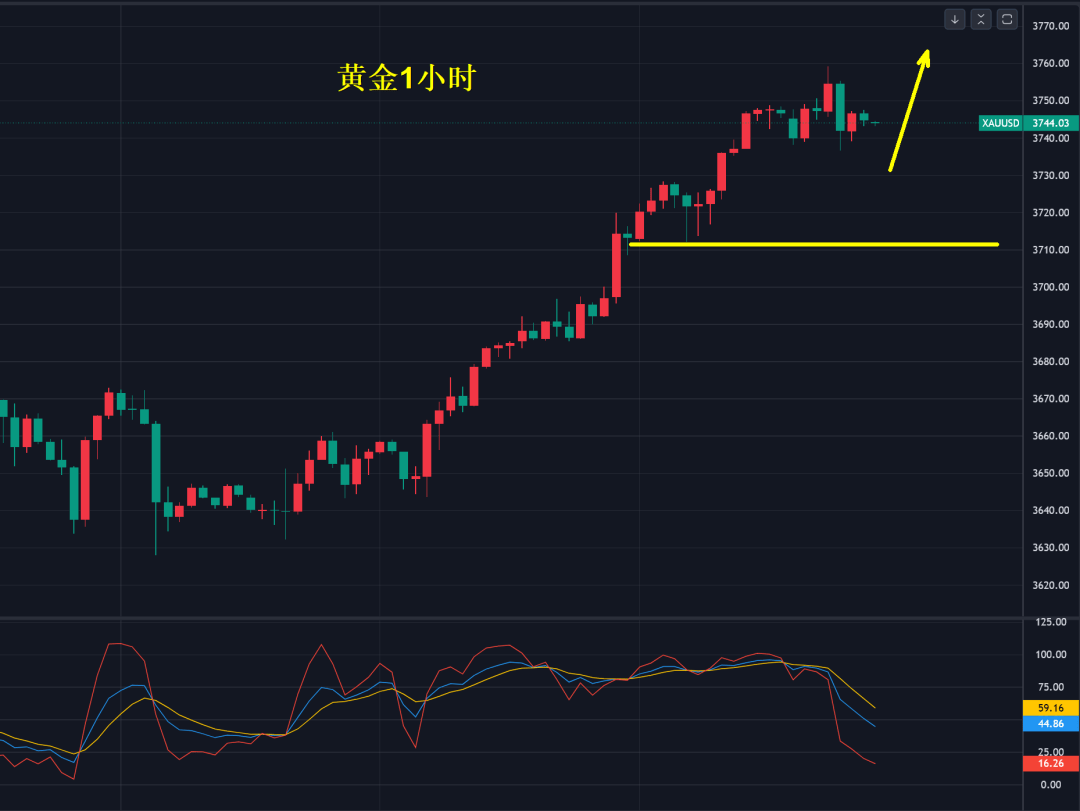
Core Insights - The recent surge in gold prices has significantly boosted investor confidence, with many users reporting substantial gains, some even doubling their investments [1][2] - The market is entering a long-term bullish phase, driven by expectations of continued monetary easing from the Federal Reserve, which is anticipated to support further price increases in gold [2] Group 1: Market Trends - Since August, gold prices have increased by 13%, with minimal adjustments, creating a favorable environment for investors [1] - The recent price adjustment in gold from $3700 to around $3610 has concluded, indicating a potential for further upward movement [2] Group 2: Technical Analysis - Key support levels to watch include $3710, with potential upward targets at $3750-55 and $3770 if the market breaks above these levels [3][4] - The strong upward momentum remains intact, with critical price points at $3735 and $3715, where failure to hold these levels could lead to a temporary pullback [4]
8月非农就业不及格,特朗普称是降息太迟所致!美国真要放水了?
Sou Hu Cai Jing· 2025-09-06 04:37
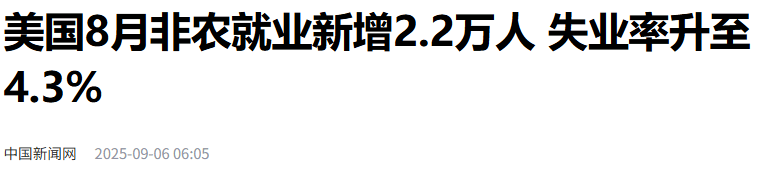
Group 1 - The core point of the article highlights the significant underperformance of the August non-farm payroll data, which recorded only 22,000 new jobs compared to the expected 75,000, raising concerns about the economic outlook [1][4] - The release of this data is particularly notable as it is the first non-farm report published after the dismissal of the previous Bureau of Labor Statistics director by the Trump administration, which has led to skepticism regarding data reliability [2] - The August data shows a decline of 15,000 federal government jobs, while the private sector added 38,000 jobs, indicating a mixed employment landscape that contrasts with Trump's manufacturing policy goals [4] Group 2 - The weak employment data has intensified fears of an economic recession, leading to a surge in expectations for interest rate cuts by the Federal Reserve, with a 98% probability of a 25 basis point cut in mid-September [4] - Following the release of the non-farm data, Trump criticized Federal Reserve Chair Powell for not acting sooner on interest rate cuts, indicating a shift towards a more accommodative monetary policy [6] - The broad money supply (M2) in the U.S. has also been increasing, surpassing $22 trillion in June 2025, suggesting a dual easing environment that could stimulate economic activity [6][7] Group 3 - Investors are facing challenges to the traditional "cash is king" belief, as inflation may erode the purchasing power of cash holders, while those with ample funds may find opportunities to convert cash into appreciating assets [8] - The current monetary easing cycle is accompanied by risks of asset price bubbles, necessitating a careful balance between opportunities and risks for investors [9] - Market participants are closely monitoring the Federal Reserve's upcoming September meeting for potential interest rate cuts and the implications of subsequent economic data [11]
韩国央行行长在政策会议前就贸易和增长风险发出警告
Xin Hua Cai Jing· 2025-08-19 05:33
Core Viewpoint - The Bank of Korea's Governor Lee Chang-yong indicated that while the South Korean economy showed signs of recovery in Q2, it still faces significant uncertainty due to the current trade environment [1] Economic Performance - The South Korean economy rebounded in the second quarter, supported by additional budget measures [1] - Economic momentum is expected to continue in the second half of the year due to this fiscal support [1] Financial Stability Risks - Rising overdue repayment rates among small and medium-sized enterprises and local developers are highlighting financial stability risks [1] - Despite government measures to cap mortgage lending, housing debt growth has slowed, yet property prices in certain areas of Seoul remain high [1] Trade Risks - Ongoing tariff negotiations with the United States pose a high risk to the economic outlook [1]
韩国家庭负债持续攀升 韩国央行面临“稳增长”与“防风险”双重大考
Xin Hua Cai Jing· 2025-08-19 05:31
Group 1 - South Korea's household credit reached 1952.8 trillion won in Q2, with a month-on-month growth of 1.3% in June, significantly up from 0.1% in March, and a year-on-year increase of 3.0%, the highest since June 2022 [1] - The Bank of Korea's Governor Lee Chang-yong emphasized the "high uncertainty" facing the economy, particularly due to challenging trade conditions and potential risks from US tariff negotiations impacting the export-driven economy [1] - Rising overdue repayment rates among SMEs and local developers indicate increasing debt repayment pressure in certain sectors, reflecting growing financial stability risks domestically [1] Group 2 - The Bank of Korea will hold a crucial monetary policy meeting on August 28 to assess multiple factors, including economic growth potential, inflation trends, and financial system vulnerabilities [2] - Governor Lee stated that if economic data meets expectations, there is a possibility of resuming a monetary easing cycle, provided the financial system remains stable [2] - Analysts note a policy dilemma for the Bank of Korea, balancing the need to stimulate domestic demand through rate cuts against high household debt levels and rising default risks in specific industries [2]
Vatee外汇:美元走弱与降息预期升温,金价能否进一步突破?
Sou Hu Cai Jing· 2025-08-14 11:01
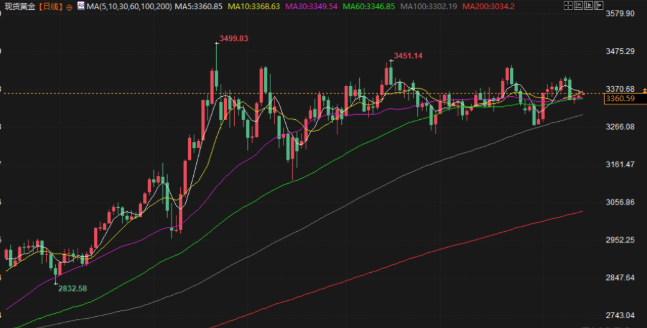
Group 1 - The core viewpoint is that the recent rise in gold prices is supported by a weaker dollar and declining U.S. Treasury yields, alongside expectations of potential interest rate cuts by the Federal Reserve [1][3] - Spot gold is trading around $3,360 per ounce, while December futures rose by 0.3% to $3,408.3 per ounce, with silver, platinum, and palladium also experiencing price increases [1] - The decline in the dollar makes gold cheaper for non-dollar buyers, stimulating physical gold demand, while lower bond yields reduce the opportunity cost of holding gold [3] Group 2 - The current rise in gold prices reflects both risk aversion and changes in macroeconomic expectations, with soft inflation data suggesting the Fed may not need to maintain a tight stance [3] - Key factors that could influence gold prices include the Fed's guidance post-September rate cut and global economic uncertainties, which could affect safe-haven demand [3][4] - Short-term, gold bulls are in control, but there is an increasing risk of price volatility at high levels, especially if the dollar rebounds or bond yields rise [4]
利率衍生品系列报告之二:利率互换倒挂历史复盘及降准降息预测效果探究
Shanxi Securities· 2025-07-28 03:28
Report Industry Investment Rating No information is provided in the content regarding the report's industry investment rating. Core Views of the Report - Interest rate swap curve inversions are mainly caused by economic fundamentals and capital price/liquidity factors, and in most cases, they can predict central bank reserve requirement ratio cuts and interest rate cuts, especially when reflecting market expectations of economic downturn and policy easing [2][67][68]. - The end of interest rate swap inversions usually means changes in the driving factors, which can be due to improved economic fundamentals, alleviated capital tightness, or implemented monetary policies. However, the monetary easing cycle may not stop immediately after the inversion ends [5][69]. - Interest rate swap inversions are not a necessary condition for monetary easing, which may be related to the central bank's control over inter - bank repo rates and the steeper yield curve after de - leveraging [6][70]. - When an interest rate swap curve inversion occurs, especially accompanied by weak economic fundamentals, it is a strong signal of future monetary policy easing. Investors and policymakers can use this signal to make decisions [7]. Summary by Directory I. Interest Rate Swap Curve Historical Inversion Situation Review - **2011 Inversion**: Occurred in August. On August 19, 5Y - 1Y/2Y - 1Y spreads turned negative. The deepest negative spreads of 5Y - 1Y and 2Y - 1Y were - 55.63bp and - 34.93bp respectively on September 6, 2011. High inflation in 2011 led to a tight monetary policy at first, but with inflation and economic growth down in Q3, long - term bond and IRS rates dropped rapidly under the expectation of monetary easing. The central bank cut the reserve requirement ratio in November [14][16]. - **2012 Inversion**: Had two rounds. The first was from the beginning of 2012 to mid - May, caused by capital rate fluctuations and easing expectations. The second was from July 11 to October 12, caused by reserve requirement ratio cut expectations due to weakening fundamentals. The end of the second inversion was related to the improvement of economic fundamentals [25][26][30]. - **2013 Inversion**: Concentrated in June. Due to tightened capital caused by factors like decreased foreign exchange inflows and the central bank's tight policy stance, it reached the extreme on June 20. The inversion ended after the central bank provided liquidity support on June 25 [36][38][39]. - **2015 Inversion**: Initially occurred at the end of 2014 and concentrated from late January to the end of March. It was caused by capital fluctuations and tightness during the New Year period and the stock market's "bull market". The inversion ended as capital prices dropped rapidly [43][44][51]. II. Whether the Interest Rate Swap Curve Can Predict Interest Rate Cuts - **2011**: The inversion predicted the central bank's reserve requirement ratio cut and interest rate cut, and foreshadowed a monetary easing cycle [54]. - **2012**: The first inversion accurately predicted reserve requirement ratio cuts, and the second predicted interest rate cuts [55]. - **2013**: The inversion did not predict reserve requirement ratio cuts or interest rate cuts due to the "cash crunch" [56]. - **2015**: The inversion predicted subsequent reserve requirement ratio cuts and interest rate cuts. The end of the inversion did not mean the end of monetary easing [57][59]. III. Summary - **Reasons and Characteristics of Interest Rate Swap Curve Inversion**: Mainly caused by economic fundamentals (such as economic slowdown and inflation decline) and capital price/liquidity factors (such as capital tightness) [67]. - **Prediction Effect of Interest Rate Swap Curve on Reserve Requirement Ratio Cuts and Interest Rate Cuts**: In most cases, it can predict reserve requirement ratio cuts and interest rate cuts, especially when reflecting economic downturn and policy easing expectations. It may lead the monetary easing cycle [68]. - **Meaning of the End of Interest Rate Swap Inversion**: It usually means changes in the driving factors, including improved economic fundamentals, alleviated capital tightness, or implemented monetary policies [69]. - **Interest Rate Swap Inversion Is Not a Necessary Condition for Monetary Easing**: This may be related to the central bank's control over inter - bank repo rates and the steeper yield curve after de - leveraging [70]. - **How to Use the Swap Inversion Signal**: When an inversion occurs, especially with weak economic fundamentals, it signals future monetary policy easing. Investors and policymakers can use it as a reference [71].
欧洲央行如期维持利率不变 等待美国关税政策明朗化
Zhi Tong Cai Jing· 2025-07-24 13:18
Group 1 - The European Central Bank (ECB) has decided to maintain the deposit rate at 2%, marking the first time in over a year that rates have not been changed, aligning with market expectations [1] - The ECB's statement highlights that inflation is currently at the mid-term target level of 2%, but the economic outlook remains highly uncertain due to factors such as trade disputes [1] - There is speculation among investors that the ECB may lower rates by 22 basis points by the end of the year, with a final 25 basis point cut anticipated in September [1] Group 2 - The ECB's meeting coincides with a critical deadline for U.S. tariffs, with reports suggesting optimism about reaching a 15% tariff agreement [2] - ECB Vice President Luis de Guindos has warned of stagnation in economic growth for the second and third quarters due to businesses preparing for potential higher tariffs [2] - The euro has appreciated over 13% against the dollar this year, which could exert upward pressure on consumer prices, prompting concerns from various ECB officials about inflation potentially remaining below target levels [2]
贸易协定影响有限 国际白银行情拉高回升
Jin Tou Wang· 2025-07-24 07:21
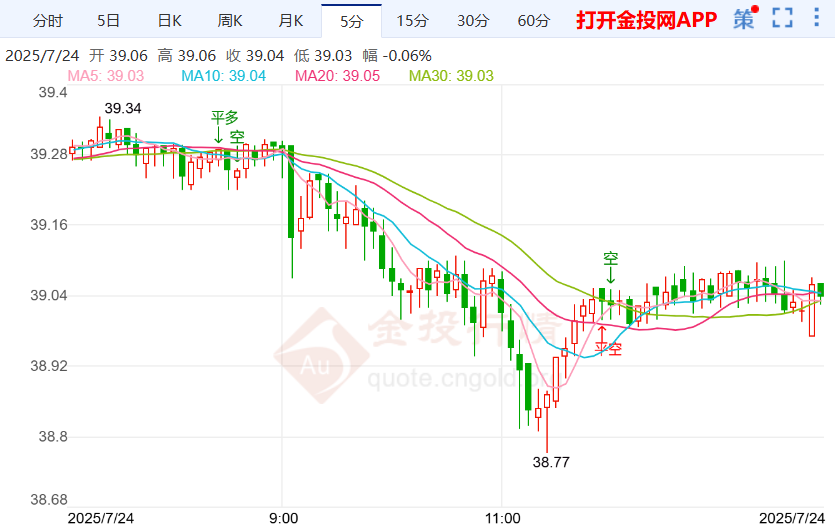
Group 1 - International silver is currently trading above $39.02, with a recent high of $39.34 and a low of $38.77, indicating a short-term sideways trend [1] - The European Central Bank (ECB) is expected to maintain interest rates at 2% during its upcoming decision, marking the first pause in over a year as policymakers assess the impact of U.S. tariffs on inflation [4] - A trade agreement limiting U.S. tariffs on EU goods is anticipated, with a proposed 15% tariff on most EU exports to the U.S., which is lower than the previous threat of 30% but still higher than current rates [3] Group 2 - The ECB's decision is influenced by concerns that inflation may fall below the 2% target again, despite having recently achieved it, leading to a split among officials regarding future policy paths [4] - The recent international silver market analysis indicates a potential resistance at $39.50 or $39.75, with support levels at $39.10 or $38.85 [5]