
逆周期调控

Search documents
专访朱光耀:看懂宏观经济政策的“积极有为”
Zhong Guo Jing Ji Wang· 2025-12-16 14:31
Group 1 - The core viewpoint of the article emphasizes the need for a more proactive macroeconomic policy in response to current economic challenges, highlighting the importance of both active fiscal policy and moderately loose monetary policy as a combined strategy [1][2] - The former Vice Minister of Finance, Zhu Guangyao, pointed out that the fiscal deficit rate is projected to be around 4% by 2025, with local special bond issuance expected to reach 4.4 trillion yuan, alongside 1.3 trillion yuan in ultra-long-term special government bonds and 500 billion yuan in special bonds for hospitals, which provide a solid foundation for effective policy implementation [1] - Zhu also noted that the core objective of the moderately loose monetary policy is to address price issues, aiming to guide prices towards a reasonable range of around 2% [1] Group 2 - Zhu highlighted that the current Consumer Price Index (CPI) is slightly above 0, while the Producer Price Index (PPI) has been in negative territory for 38 consecutive months, adversely affecting macroeconomic operations, corporate profits, and fiscal value-added tax revenues [2] - The article discusses the importance of integrating short-term and long-term strategies in economic policy, as reflected in the central economic work conference's emphasis on "counter-cyclical" and "cross-cyclical" adjustments, which aim to address immediate issues while also planning for future development [2]
国考报考年龄放宽,白银时隔45年创历史新高 | 财经日日评
吴晓波频道· 2025-10-15 03:37
Group 1 - The issuance of 1.3 trillion yuan of ultra-long-term special government bonds has been completed, providing a strong financial foundation for counter-cyclical adjustment policies in China [2] - The funds from these bonds are allocated to support "two new" policies and "two heavy" project constructions, with 8 billion yuan aimed at supporting project investments and 5 billion yuan for consumption subsidies [2] - The implementation of these policies has led to an uneven economic recovery, necessitating the introduction of more inclusive policies to support various industries [3] Group 2 - The newly revised Anti-Unfair Competition Law has come into effect, specifically targeting unfair competition in the platform economy and enhancing regulations on data and algorithm usage [4] - The law prohibits behaviors such as forced redirection and malicious uninstallation that disrupt competitors' services, as well as the misuse of data and platform rules to undermine competition [4][5] - This law aims to create a fair market environment, encouraging businesses to focus on improving product and service quality rather than engaging in chaotic competition [5] Group 3 - DJI has filed an appeal against the U.S. Department of Defense's decision to classify it as a "Chinese military enterprise," which has restricted its business operations in the U.S. [6][7] - The classification lacks substantial evidence, raising questions about the criteria used by the Department of Defense [6] - The ongoing legal battle may hinder DJI's ability to operate in the U.S. market, reflecting broader challenges faced by Chinese companies abroad [7] Group 4 - The National Civil Service Examination has relaxed age restrictions for applicants, now allowing candidates up to 38 years old, and up to 43 for master's and doctoral graduates [8][9] - This change is seen as a response to the growing calls against age discrimination in the job market, promoting a more inclusive employment environment [9] Group 5 - Samsung Electronics reported a significant increase in operating profit for Q3, reaching 12.1 trillion won (approximately 8.5 billion USD), driven by a recovery in the chip business [12] - The company's sales also grew by 8.7% year-on-year, marking a notable rebound in performance [12] - The demand for DRAM chips has surged, with prices increasing by 171.8% compared to the previous year, contributing to Samsung's strong financial results [12] Group 6 - Silver prices reached a historic high of $53.639 per ounce, driven by various market factors, including increased demand for safe-haven assets amid global uncertainties [14] - The sharp rise in silver prices has been attributed to a "short squeeze" phenomenon, where speculators pushed prices up due to a lack of available physical silver for delivery [15] - The overall market dynamics indicate a volatile environment, influenced by both speculative trading and fundamental supply-demand factors [15] Group 7 - The stock market experienced fluctuations, with the Shanghai Composite Index falling by 0.62% amid a mixed performance across sectors [16] - The market's volatility reflects the ongoing impact of external factors, including U.S.-China trade tensions, which complicate the investment landscape [17] - The rotation of market hotspots has become more pronounced, with new trends emerging at a pace that struggles to keep up with the decline of older ones [17]


东吴证券晨会纪要-20251014
Soochow Securities· 2025-10-13 23:31
Macro Strategy - The report indicates that the economic situation is influenced by the upcoming measures for counter-cyclical adjustments, with a focus on the timing of restarting government bond trading and the potential for interest rate cuts depending on the economic outlook for Q4 2025 [1][12][13] - The ECI supply index is at 49.99%, showing a slight decline, while the demand index is at 49.91%, indicating a mixed economic recovery influenced by the recent holidays [12][13] - The report highlights the potential limited impact of Trump's renewed tariff threats on the US economy, while emphasizing the need to monitor retaliatory measures and the escalation of trade conflicts into critical sectors like rare earths and semiconductors [1][12][14] Fixed Income - The report discusses the recent issuance of secondary capital bonds, with one bond issued at a scale of 1.2 billion yuan, and a total trading volume of approximately 44.5 billion yuan, which is a significant decrease from the previous week [3][20] - It notes the issuance of green bonds totaling approximately 15.25 billion yuan, with a decrease in trading volume to 41.8 billion yuan, indicating a cooling in the market [4][21] - The report suggests that investors should prioritize controllable pullbacks in convertible bonds and focus on performance improvement or valuation recovery rather than getting caught up in clause negotiations [15][18] Company Analysis - Hong Kong Travel (00308.HK) is focusing on core profitable businesses by divesting its tourism real estate assets, with projected net profits of 270 million, 420 million, and 600 million HKD for 2025-2027, corresponding to PE ratios of 31, 20, and 14 times [5][7] - Guangyang Co., Ltd. (002708) is expected to achieve revenues of 2.774 billion, 3.700 billion, and 4.795 billion yuan, with net profits of 108 million, 218 million, and 363 million yuan for 2025-2027, indicating a recovery in profitability and new growth opportunities in FPC, low-altitude economy, and humanoid robots [8] - Hengyi Petrochemical (000703) anticipates net profits of 430 million, 650 million, and 820 million yuan for 2025-2027, benefiting from the recovery of the polyester industry and the upcoming production of its Qinzhou project [9] - Rongsheng Petrochemical (002493) is projected to have net profits of 1.9 billion, 2.9 billion, and 4.1 billion yuan for 2025-2027, with a focus on benefiting from stable growth policies in the petrochemical sector [11]
宏观量化经济指数周报20251012:逆周期调控的增量举措渐行渐近-20251012
Soochow Securities· 2025-10-12 14:32
Economic Indicators - As of October 12, 2025, the ELI index is -0.64%, down 0.20 percentage points from last week, indicating a potential seasonal rebound in new loans for September[2] - The average growth of new loans from September 2022 to September 2024 was 2.12 trillion yuan, while in September 2024, only 1.59 trillion yuan was added, reflecting a policy shift away from scale[2] - The expected new loans for September 2025 are around 1.60 trillion yuan, a slight year-on-year increase of approximately 200 billion yuan[2] Government Financing and Social Financing - In September 2025, government net financing, including national and local government bonds, was 1.17 trillion yuan, a year-on-year decrease of 0.51 trillion yuan[2] - The expected social financing scale for September 2025 is 3.3 trillion yuan, with a month-end growth rate potentially declining to 8.6%[2] - The government is expected to implement "steady growth" measures in fiscal and monetary policies in the fourth quarter to counteract the decline in social financing growth[2] Supply and Demand Indicators - The ECI supply index is at 49.99%, down 0.04 percentage points from the previous period, while the demand index is at 49.91%, also down 0.01 percentage points[3] - The industrial production recovery post-holiday is slower than last year, with the operating rates for full steel and semi-steel tires dropping significantly[20] - The average daily sales of passenger cars in the last week of September were 97,631 units, a year-on-year decrease of 4,864 units, but the retail market for passenger cars grew by 6.0% year-on-year in September[28] Investment and Real Estate - The transaction area of commercial housing in 30 major cities fell by 25.22% week-on-week, indicating pressure on growth due to high base effects[34] - The supply of land in 100 major cities increased by 23.63% week-on-week, suggesting ongoing investment activity despite the real estate market's challenges[34] Risks and Policy Outlook - The uncertainty surrounding U.S. tariff policies remains a significant risk factor for the economy[4] - The effectiveness of policy measures may fall short of market expectations, particularly in the real estate sector[4]
140万亿!中国经济的“大逻辑”
Sou Hu Cai Jing· 2025-10-01 04:52
Core Viewpoint - China's GDP is expected to exceed 140 trillion yuan, reflecting a consistent and strategic economic growth rather than mere luck [1] Group 1: Strategic Determinants - The development strategy in China is characterized by long-term planning, including five-year plans and counter-cyclical adjustments, which contribute to stable economic acceleration [1] - The focus on theoretical innovation has evolved from "development is the hard truth" to "new development concepts" and "new quality productivity," impacting various sectors such as robotics and digital agriculture [1] Group 2: Societal Contributions - The significant reduction in poverty, with 100 million people lifted out, and the emergence of 400 million middle-income individuals, highlight the alignment between national goals and individual aspirations [1] - The establishment of the world's largest social security system enhances the overall productivity driven by the people's creativity [1] Group 3: Institutional Advantages - The dual-driven model of proactive government and effective market mechanisms fosters continuous vitality in the economy [1] - With a population of 1.4 billion, China's vast market facilitates rapid iteration of emerging industries, providing a broad stage for economic activities [1] Group 4: Future Outlook - The achievement of 140 trillion yuan is viewed not as a peak but as a new starting point for further economic development, emphasizing clarity in direction, innovation in theory, precision in regulation, strength in the populace, and expansiveness in the market [1]

李迅雷:大国债务——经济增长的代价
Sou Hu Cai Jing· 2025-09-03 04:47
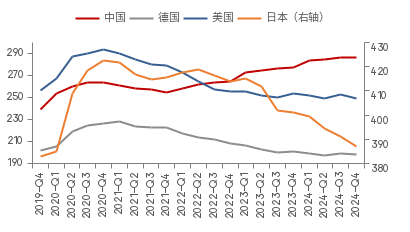
Group 1 - The macro leverage ratio in China has increased to 300.4% in Q2 2025, marking a significant rise from 298.5% in Q1 2025, indicating a growing debt burden associated with economic growth [1] - The rapid increase in debt levels in China is primarily driven by government departments and state-owned enterprises leveraging up [2][9] - The macro leverage ratio of China is projected to rise from 239.5% in 2019 to 286.5% by the end of 2024, showing the most significant increase among major economies [2][28] Group 2 - The leverage ratio of non-financial enterprises in China has shown a pattern of increase since 2022, reaching 139.4% by Q3 2024, driven by significant investments in emerging industries and high-end manufacturing [5][32] - The debt levels of state-owned enterprises are notably higher than those of non-state enterprises, with an average asset-liability ratio of 85.6% for state-owned enterprises compared to 78.3% for non-state enterprises [7][9] - Government leverage in China has risen from 59.6% at the end of 2019 to 88.4% by the end of 2024, contrasting with the trends in Germany, Japan, and the US, where government leverage has fluctuated [9][10] Group 3 - The nominal GDP growth in China has been slower compared to the actual GDP growth, which has implications for the macro leverage ratio as it is inversely related to the growth of nominal GDP [32][34] - The price levels in China have been declining, negatively impacting the growth of nominal GDP, which is crucial for managing the macro leverage ratio [36][37] - The efficiency of debt usage in China is under scrutiny, with suggestions for improving capital allocation and enhancing productivity to manage the rising leverage ratio effectively [38][44]
回忆《谈谈中国经济复苏与衰退问题》之二
Sou Hu Cai Jing· 2025-08-29 05:19
Core Viewpoint - The discussion centers on whether the Chinese economy is recovering or heading towards recession, with domestic economists leaning towards recovery while some foreign analysts predict a decline similar to Japan's "lost thirty years" [3][4]. Economic Conditions - The root cause of the current economic situation is identified as the shrinking final consumption rate and widening income distribution gap, leading to slower growth in household income compared to economic growth, resulting in insufficient consumer spending [3][4]. - Since the implementation of "proactive fiscal policy" after the 1998 Asian financial crisis, the final consumption rate has decreased annually by 1-1.4%, dropping from approximately 62.9% to around 50%, which is 15% lower than the world average and 20% lower than developed countries like the U.S. [3][4]. Demand and Recovery - Insufficient domestic demand is highlighted as a decisive factor for economic growth, and without improvements in national income distribution, genuine economic recovery is unlikely [4][5]. - The World Bank's 2023 report indicates China's Gini coefficient at 0.465, exceeding the international warning line of 0.4 and nearing the extreme inequality threshold of 0.5, which contributes to the current consumer spending inadequacy [6]. Policy Recommendations - To achieve healthy economic development, reforms in the redistribution system are necessary to narrow the income gap [6]. - The macroeconomic policy should shift focus to address existing issues rather than relying solely on "double proactive" and "counter-cyclical" measures, emphasizing adjustments in fiscal expenditure structure to increase social spending and reduce infrastructure investment [6][7]. Economic Cycle Insights - The existence of a socialist economic cycle is acknowledged, suggesting that the blind pursuit of high GDP growth disrupts economic development laws and leads to prolonged stagnation and slow recovery [7][8]. - The management approach post-crisis often neglects the restoration of economic proportional relationships, focusing instead on preventing downturns, which can extend stagnation periods [8].

大国债务:经济增长的代价
Hu Xiu· 2025-08-15 07:12
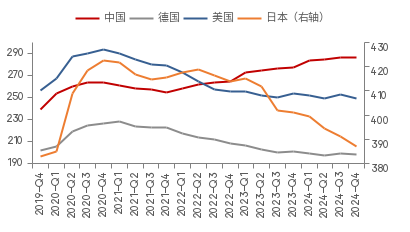
Group 1 - The macro leverage ratio is a relative indicator of debt levels, calculated as the ratio of non-financial sector debt to total GDP [1] - The increase in macro leverage ratio is driven by the growth rate of debt exceeding the growth rate of nominal GDP [2] - As of the end of 2019, the macro leverage ratios for China, Germany, Japan, and the United States were 239.5%, 202%, 382.9%, and 256.3% respectively, with projections for 2024 showing significant increases for China [3] Group 2 - The trend for Germany, Japan, and the United States shows a pattern of "sharp rise and fall," with their macro leverage ratios peaking in 2020 and returning to levels similar to 2019 by the end of 2024, while China's ratio continues to rise steadily [4] - The macro (non-financial sector) debt total is composed of household, non-financial enterprise, and government debt [6] Group 3 - Household leverage ratios in China, Germany, Japan, and the United States remained relatively stable, with changes within a range of approximately ±5 percentage points from 2019 to 2024 [7] - China's non-financial enterprise leverage ratio exhibited a pattern of "rise-fall-rise," with a notable increase since 2022, contrasting with the trends in Germany, Japan, and the United States [8][10] Group 4 - The government leverage ratio in China has been steadily increasing, projected to rise from 59.6% at the end of 2019 to 88.4% by the end of 2024, while the ratios for Germany, Japan, and the United States show an initial increase followed by a decline [14] - The increase in China's government leverage ratio is not solely linked to international economic crises, indicating a potential weakening of the effectiveness of counter-cyclical policies over time [24] Group 5 - The analysis indicates that the increase in China's macro leverage ratio is associated with a slower growth in nominal GDP, despite higher real GDP growth compared to the United States [38][39] - The nominal GDP growth in China from 2022 to 2024 is projected to lag behind that of the United States, Germany, and Japan [39] Group 6 - The current macro leverage ratio in China is significantly higher than the global trend, indicating a situation of "debt before wealth" [43] - The government debt levels in China have increased significantly, with the nominal value of government debt nearly doubling from 2019 to 2024, while the increases in Germany, Japan, and the United States are comparatively lower [33][34]
大国债务:经济增长的代价
李迅雷金融与投资· 2025-08-15 05:46
Group 1 - The core viewpoint of the article is that the rising macro leverage ratio in China, which has exceeded 300%, reflects the cost of economic growth, and this trend is analyzed in comparison with the leverage ratios of the US, Japan, and Germany [1][2][38] - The macro leverage ratio in China has increased significantly from 239.5% in 2019 to 286.5% in 2024, indicating a faster growth in debt compared to nominal GDP growth [2][34] - The article highlights that the increase in leverage is primarily driven by government departments and state-owned enterprises, with the government leverage ratio rising from 59.6% in 2019 to 88.4% in 2024 [15][29] Group 2 - The article breaks down the macro leverage ratio into three components: household, non-financial enterprises, and government, showing that the leverage ratio of non-financial enterprises in China has risen significantly since 2022, primarily due to state-owned enterprises [9][12] - The leverage ratio of households in China has remained relatively stable, with minor fluctuations, while the leverage ratios of non-financial enterprises and government have shown more pronounced changes [6][15] - The article notes that the increase in government leverage in China is not solely linked to international economic crises, suggesting a potential weakening of the effectiveness of counter-cyclical policies [26][29] Group 3 - The article discusses the impact of nominal GDP growth on leverage ratios, indicating that despite higher real GDP growth in China compared to the US, the nominal GDP growth has been slower, contributing to the rising leverage ratio [39][40] - It emphasizes the importance of improving the efficiency of debt resource utilization to lower the macro leverage ratio, suggesting that enhancing labor productivity and technological advancement are crucial [46][49] - The article concludes that China faces a situation of "debt before wealth," where the macro leverage ratio is high relative to per capita GDP, indicating a need for structural reforms to address the underlying economic issues [46][47]

政策性开发性金融工具持续落地 商业银行积极推进配套融资
Xin Hua Wang· 2025-08-12 06:19
Core Viewpoint - The implementation of policy-oriented development financial tools is expected to significantly boost investment growth and project advancement, particularly through the allocation of 300 billion yuan in financial instruments aimed at supporting major infrastructure projects [2][3]. Group 1: Policy-Oriented Development Financial Tools - The People's Bank of China supports the establishment of financial tools by the National Development Bank and Agricultural Development Bank, with a total scale of 300 billion yuan to address capital shortages for major projects, including new infrastructure [2][3]. - The financial tools are primarily directed towards three categories of projects: key infrastructure areas defined by the Central Financial Committee, major technological innovation fields, and other projects eligible for local government special bonds [2][3]. Group 2: Commercial Banks' Role - Commercial banks are actively engaging with the National Development and Reform Commission and policy banks to facilitate project financing, aiming for early involvement and effective planning [6]. - The Agricultural Bank of China has completed the first matching financing for a major infrastructure fund project, demonstrating the proactive role of commercial banks in supporting infrastructure development [4][5]. Group 3: Economic Impact - The 300 billion yuan financial tools are projected to leverage over 1 trillion yuan in additional financing for infrastructure projects, potentially reaching 1.5 trillion yuan [3]. - The current capital contribution ratio for major projects is around 20%, which could be reduced to as low as 15% with the new financial tools, thereby enhancing the feasibility of financing for infrastructure projects [3].
