通胀走势

Search documents
固收-年末波动,如何应对
2025-12-16 03:26
Summary of Conference Call Records Industry Overview - The records primarily discuss the bond market dynamics and strategies for 2026, focusing on the impact of institutional behaviors and economic indicators on bond performance [1][2][3][4]. Key Points and Arguments Bond Market Performance - The bond market has shown weakness in the fourth quarter, influenced by institutional behaviors such as banks facing duration assessment pressures and insurance companies shifting asset allocations towards equities [2][3]. - Despite a relatively balanced supply-demand structure, the pressure from bank duration limits persists, leading to a cautious attitude from public funds towards ultra-long bonds [1][4]. Future Expectations for 2026 - It is anticipated that the demand for ultra-long bonds will remain weak, with a projected allocation returning to around 20% [1][5]. - The 30-10 year yield spread is expected to fluctuate between 30 to 50 basis points, with the current market position being neutral [5]. Investment Strategies - The recommended strategy for the bond market in 2026 emphasizes holding 3-5 year interest rate bonds in Q4 2025, transitioning to credit bonds in Q1 2026, and focusing on 10-year government bonds for long-term trades [3][9]. - Investors are advised against bottom-fishing in the current adverse environment, suggesting a wait-and-see approach based on redemption data and market equilibrium [6][7]. Economic Indicators - November economic data indicates stronger resilience in production compared to demand, with an expected annual growth rate of around 5% [11]. - Manufacturing investment is projected to perform better in 2026, supported by resilient exports and government policies aimed at stabilizing investment [12][13]. Inflation and Market Impact - The inflation trajectory for 2026 will be influenced by adjustments in the consumer price index (CPI) and producer price index (PPI), with Q1 being a critical observation period for market expectations [14]. Risk Management - The central government has emphasized the importance of managing risks associated with local government financing platforms, indicating a proactive approach to mitigate potential financial instability [15][16]. Additional Important Content - Recent events such as the Zhejiang Financial Center incident and the acquisition of China Metallurgical Group's assets by China Minmetals are highlighted as significant influences on the credit market [17]. - The anticipated issuance of convertible bonds in 2026 is projected to be around 85 billion yuan, with a notable increase in medium-sized issuances [19][20]. - The demand for convertible bonds is shifting, with relative return institutions increasing their holdings, while absolute return institutions have reduced theirs [22]. This summary encapsulates the critical insights and projections regarding the bond market and related economic factors as discussed in the conference call records.
GTC泽汇资本:贵金属承压 美联储偏鹰风险上升
Xin Lang Cai Jing· 2025-12-09 10:22
Core Viewpoint - The precious metals market is experiencing downward pressure due to concerns over the Federal Reserve's potential hawkish stance and the delay in inflation data, which is expected to lead to price volatility in the short term [1][4]. Group 1: Federal Reserve and Market Impact - The Federal Open Market Committee (FOMC) is set to begin a monetary policy meeting, with a 90% probability of a 0.25% rate cut expected [4]. - Investors are advised to pay attention to any hawkish signals in the Fed's statements and Chairman Powell's press conference, particularly regarding persistent inflation concerns that may suppress precious metals' upward momentum [4][5]. Group 2: Precious Metals Price Movements - As of December 9, gold futures closed at $4215.50, down $27.60, while silver futures closed at $58.28, down $0.788 [1][4]. - Short-term price fluctuations for precious metals will be influenced by the Fed's policy expectations and the uncertainty surrounding delayed inflation data [1][4]. Group 3: International Market Trends - Global central banks are continuing to increase their gold reserves, with one central bank having added 30,000 ounces last month, bringing total holdings to approximately 74.12 million ounces [2][4]. - This trend indicates that central banks are reinforcing gold asset allocation amid a complex macroeconomic environment, which may provide long-term support for precious metals [2]. Group 4: Technical Analysis - For gold futures, the next bullish target is to break the historical high of $4433, while the bearish target is around $4100 [5]. - Current resistance levels for gold are at $4247.90 and $4285, with support levels at $4200 and $4150 [5]. - In silver, the bullish target is above $60, while the bearish target is below $55, with resistance at $59.90 and $60, and support at $57.77 and $56.85 [5].


【UNforex财经事件】政策转向信号强化 黄金在欧洲时段持续企稳
Sou Hu Cai Jing· 2025-12-05 09:57
Core Viewpoint - The recent rise in gold prices is primarily driven by dovish signals from the Federal Reserve and a weakening dollar, which has provided moderate support for precious metals [1][3]. Group 1: Market Dynamics - Gold prices are maintaining a steady upward trend below $4240, supported by the market's focus on dovish signals from the Federal Reserve and ongoing geopolitical tensions [1]. - The dollar is under pressure, nearing its lowest point since late October, which enhances the appeal of non-yielding assets like gold [1]. - The upcoming release of the September Personal Consumption Expenditures (PCE) data is expected to influence gold prices significantly, with overall inflation anticipated to rise from 2.7% to 2.8% and core PCE remaining at 2.9% [2]. Group 2: Employment Data Impact - The labor market shows strong performance, with a 53% month-over-month decrease in planned layoffs and initial jobless claims dropping to 191,000, the lowest in over three years [1]. - Despite robust employment data, market expectations for a 25 basis point rate cut by the Federal Reserve remain high, indicating that investors are more focused on inflation trends and policy direction rather than solely on employment figures [1]. Group 3: Technical Analysis - Key resistance levels for gold are identified between $4245 and $4250, with a breakthrough potentially targeting $4277 to $4278, and further towards the $4300 mark [4]. - Support levels are noted at $4163 to $4164, with stronger structural support between $4100 and $4090, including the 4-hour 200 EMA and an upward trend line [4]. - The market is advised to observe breakout directions around these levels rather than chasing high prices before the PCE data release [4].
GTC泽汇:黄金短线波动加剧与潜在回调布局期
Sou Hu Cai Jing· 2025-11-25 11:47
Core Viewpoint - Gold prices are currently fluctuating around $4,100 per ounce, showing strong resilience despite a potential downward adjustment in the coming months [1][3] Market Sentiment and Economic Indicators - Short-term market sentiment is influenced by Federal Reserve policy, with a 79% probability of a rate cut next month, although opinions among research institutions vary [3] - Inflation trends and holiday consumer spending are key variables affecting market expectations, with holiday shopping projected to reach $1 trillion, reflecting a year-on-year growth of 3.7% to 4.2% [3] Structural Risks and Long-term Outlook - Increased investment demand has led to concerns about market volatility due to new entrants lacking experience in a complete gold bear market [4] - Historical patterns indicate that gold price adjustments can be sharper and deeper than expected, with potential for significant short-term fluctuations if crowded trades are unwound [4] - Despite potential short-term corrections, the long-term outlook for gold remains solid, with a 15% price adjustment still maintaining key support levels [4]

参考封面|交易员成政府债务“隐形制约者”
Sou Hu Cai Jing· 2025-11-25 10:03
Core Insights - The article highlights a significant shift in the focus of London traders towards political dynamics, which has become a regular consideration in their decision-making processes [2] - This change is attributed to two main factors: the evolving political landscape, including frequent changes in UK prime ministers, and the transformation of the market environment following the rise in inflation in 2022 [2] - The emergence of "invisible investors" has created a new dynamic where government borrowing costs can suddenly spike due to their predictions regarding inflation trends and government debt [2] Political Landscape Changes - The UK has experienced frequent changes in leadership, which has heightened the attention traders pay to political events [2] - This political volatility has contributed to a more cautious and proactive approach among investors [2] Market Environment Transformation - The rise in inflation in 2022 marked the end of a long period of low borrowing costs that had persisted since 2008 [2] - This shift has led to increased scrutiny from investors regarding government fiscal policies and debt management [2] Role of Invisible Investors - A new group of investors, referred to as "invisible investors," has emerged, influencing government borrowing costs based on their assessments of inflation and debt [2] - These investors act as "obligatory monitors" in the bond market, impacting government financial strategies [2]

野村高路延:中期市场关注点将逐步转向财政刺激政策、通胀走势探讨及房地产市场政策支持等方面
Cai Jing Wang· 2025-11-17 07:15
Core Viewpoint - The market's focus is shifting towards fiscal stimulus policies, inflation trends post "anti-involution" actions, and support for the real estate market [1] Group 1: Market Conditions - The onshore stock market and steel-related commodity prices are performing steadily [1] - Recent stabilization in China-U.S. relations and attractive asset valuations suggest more upward space for long-term interest rates [1] Group 2: Liquidity Outlook - It is expected that liquidity will remain ample until the end of the year, with the average seven-day repo rate and seven-day reverse repo rate (OMO) maintaining levels similar to recent months [1] - The net supply of government bonds is manageable for November-December, and the exchange rate is stable, indicating no strong reasons for the central bank to tighten liquidity in the coming months [1] - There has been a recent increase in market leverage, which may prompt the central bank to moderately tighten liquidity if levels remain high [1] Group 3: Monetary Policy Expectations - Expectations for monetary easing policies, such as interest rate cuts, reserve requirement ratio reductions, or larger liquidity injections through net purchases of government bonds, are anticipated to continue [1]
第十七届中国投资年会及野村发言嘉宾观点集锦
野村东方国际证券· 2025-11-13 09:09
Group 1 - The global economy shows significant resilience despite rising tariffs, geopolitical tensions, and fiscal pressures, driven by AI transformation, flexible trade adjustments, and moderate monetary and fiscal policies [7] - China aims for resilient, stable, and inclusive economic growth from 2026 to 2030, focusing on self-reliance in technology, particularly in semiconductors and AI [10] - Japan's economic growth is expected to slow due to tariffs, but it can avoid recession, with core CPI inflation projected to drop below 2% by 2026 [13] Group 2 - The outlook for Asian economies (excluding Japan) is mixed, with strong performance in the tech sector but challenges in non-tech sectors due to high tariffs on labor-intensive industries [17] - The Chinese internet sector will focus on AI strategies and competition in instant retail, with expectations of reduced competitive intensity in the fourth quarter [20][21] - There is a growing trend in China to build a self-sufficient AI supply chain, with increased investment in AI infrastructure and diversified supply sources [24] Group 3 - Market attention is shifting towards fiscal stimulus policies, inflation trends, and support for the real estate market, with expectations of rising long-term interest rates [28] - Policy support, liquidity, and industrial upgrades are identified as core drivers for the future rise of A-shares, despite high valuations [31]

美债今年强势反弹 政府关门阴影下避险需求再起
智通财经网· 2025-09-30 23:05
Core Insights - U.S. Treasury bonds have shown strong performance this year, with investors accelerating purchases of this risk-free asset as the risk of a federal government shutdown looms [1] - The iShares 20+ Year Treasury Bond ETF (TLT.US) is expected to see a total return of 2.72% this quarter, with a year-to-date increase of 5.7%, marking its best performance since 2020 [1] - Long-term Treasury yields have been declining, with the 10-year yield down 45.2 basis points to approximately 4.1% year-to-date, compared to 4.6% at the beginning of the year [1] Group 1 - Factors driving the strength of U.S. Treasuries include stable supply maintained by Treasury Secretary Yellen, which alleviates market supply-demand pressures, and the Federal Reserve's recent interest rate cuts to support the job market [1] - The attractiveness of bonds as a safe haven has increased amid concerns over economic growth and recession [1] - Historical data indicates that government shutdowns tend to provide short-term benefits to the bond market, with TLT averaging a 0.2% increase in the week following a shutdown [2] Group 2 - If a government shutdown lasts too long, it could create a "data vacuum," delaying the release of key economic indicators and complicating monetary policy and investment decisions [2] - The uncertainty surrounding the duration of the shutdown raises concerns about potential permanent reductions in workforce size by the Trump administration [2]
当前股票回报是否过高
Guo Ji Jin Rong Bao· 2025-09-29 02:54
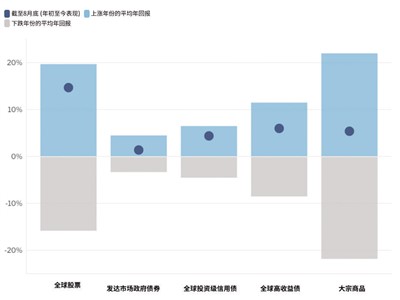
Core Insights - Global stock markets have shown strong performance since the beginning of 2025, with the MSCI Global Index rising approximately 15% year-to-date, continuing a robust trend from previous years [1] - The average annual return for global stocks since the end of the 2022 bear market has reached 20%, which may surprise some investors who typically anchor their expectations around a long-term average return of 7%-10% [1] - This strong performance is not an anomaly but a recurring feature in market cycles, with investment-grade credit bonds historically yielding 6%-7% during economic expansions, while high-yield credit bonds have averaged returns of 11%-12% [1] Investment Insights - Investors should not be deterred by strong market performance; the 15%-20% rise in stocks this year should not be a reason for concern unless an economic downturn is anticipated [2] - Managing downside risk is crucial for enhancing long-term average returns; investors may consider funds that maintain strong participation in rising markets while minimizing downside risk, such as defensive equity funds and hedge funds [2] - Assets with favorable return characteristics, such as credit bonds, are particularly valuable for asset allocators, as they tend to perform well in up years and experience smaller losses in down years [2] Areas of Focus - Key structural growth catalysts to watch include fiscal stimulus, policy reforms, and potential interest rate cuts by central banks [3] - Monitoring inflation trends and the potential rise in cross-asset correlations is essential, despite significant progress made by central banks in controlling inflation [3] - The ability of corporate earnings growth to extend beyond large tech companies to a broader range of industries will be critical for achieving a more balanced and sustainable market rally [5]
DLSM外汇平台:美联储关注焦点转向劳动力市场,央行年会即将登场
Sou Hu Cai Jing· 2025-08-21 10:55
Group 1 - The core theme of the Jackson Hole meeting will focus on the labor market, with debates among Federal Reserve policymakers regarding whether the tight labor market reflects a decline in labor participation or a broader economic slowdown [3] - The September policy decision is expected to depend more on the labor market outlook rather than price levels, although inflation trends will also play a reinforcing role [3] - Upcoming events, particularly the non-farm payroll data on September 5 and the consumer price index on September 10, are considered more critical for the market than the Jackson Hole meeting itself [3] Group 2 - If employment data disappoints again, the market may attempt to push expectations for a 50 basis point rate cut in September [3]