
通胀风险

Search documents
欧洲债市与油价联动凸显通胀风险 欧央行称通胀低于2%或考虑降息
Sou Hu Cai Jing· 2026-02-19 19:21
市场有风险,投资需谨慎。本文基于第三方数据整理,仅供参考,不构成任何投资建议,投资者据此操 作风险自担。 来源:市场资讯 近期,欧洲债市变动与油价上行形成联动,通胀风险成为市场核心关注方向。 欧洲央行官员德马尔科表示,若通胀持续低于2%,可能需要降息。欧洲央行副行长金多斯则指出,当 前区域增长风险处于均衡状态,地缘政治是主要潜在危险。 地缘政治紧张态势加剧能源供应不确定性,推动油价走高,市场担忧能源价格上行将推高通胀水平,打 破此前的通胀放缓预期。这一担忧传导至欧洲债市,成为近期债市调整的核心驱动因素之一。 ...
金价大涨!“1000克金条卖断货”,有人不问价直接出手,专家严肃提醒
Sou Hu Cai Jing· 2026-02-19 13:48
据智通财经2月19日消息,现货黄金再次站上5000美元/盎司,日内涨0.48%。 金价银价,反弹! 原因找到了 据央视财经消息,当地时间2月18日,美联储公布的1月货币政策会议纪要未改变市场对于6月将启动降 息的预期。美联储最新公布的会议纪要显示,其内部仍然对货币政策路径存在分歧,明确提到有联储官 员讨论加息的可能性,在就业下行风险有所缓和的背景下,通胀风险依旧是核心关注点。与会者普遍预 计,通胀将在年内回落,"但回落速度和时点仍不确定",并预计关税对价格的影响将在年内逐步减弱。 贵金属方面,当地时间2月18日,投资者评估持续发酵的地缘政治风险,大量避险资金涌入贵金属市 场。加之国际黄金和白银价格在经历前一交易日的大跌后,技术性反弹和逢低买入操作也支撑贵金属价 格大幅上涨。截至当天收盘,纽约商品交易所4月交割的黄金期价报每盎司5009.50美元,上涨2.11%;3 月交割的白银期价报每盎司77.598美元,上涨5.52%。 有持续利空影响 有分析认为,在美联储降息预期有所降温的背景下,黄金在5000美元关口遭遇阻力,叠加部分投资者获 利了结,加剧了价格下行压力。 汇丰银行首席贵金属分析师詹姆斯·斯蒂尔表示,黄 ...
国债和企业债的风险差异有哪些?
Sou Hu Cai Jing· 2026-02-19 12:46
Group 1 - The core difference between government bonds and corporate bonds lies in credit risk, with government bonds backed by national credit and having a very low default risk, while corporate bonds depend on the issuer's financial health and can face higher default probabilities, especially for lower-rated bonds [1] - Government bonds have a strong repayment guarantee as their repayment is included in the annual fiscal budget, while corporate bonds are subject to market fluctuations and operational risks [1] Group 2 - Interest rate risk affects both types of bonds, but government bonds are more sensitive due to their longer durations, while corporate bonds also face credit spread changes that can amplify price declines during market downturns [2] - Both bond types are vulnerable to inflation, but corporate bonds may have an advantage if issuers can adjust prices or optimize costs, thus maintaining more stable real returns compared to long-term government bonds [2] Group 3 - Liquidity risk varies significantly, with government bonds being highly liquid and easily tradable, while corporate bonds' liquidity depends on the issuer's size and credit rating, with smaller or lower-rated issuers facing potential liquidity issues [3] - High-rated corporate bonds from large state-owned enterprises tend to have better liquidity compared to those from smaller or lower-rated companies [3] Group 4 - Policy risk impacts government and corporate bonds differently, with government bonds influenced by macroeconomic fiscal and monetary policies, while corporate bonds are more susceptible to industry-specific regulations and policies that can directly affect their credit status [4] - Changes in fiscal policy and central bank operations generally do not pose substantial risks to government bond principal, whereas corporate bonds can be significantly affected by industry regulations that may increase financing costs or disrupt cash flows [4]
新西兰联储维持2.25%利率不变
Xin Lang Cai Jing· 2026-02-18 15:44
新西兰储备银行在新任行长上任后的首次决策中将官方现金利率维持在2.25%。当地评论指出,这是在 关注通胀风险的同时为经济复苏提供支持。 责任编辑:张俊 SF065 新西兰储备银行在新任行长上任后的首次决策中将官方现金利率维持在2.25%。当地评论指出,这是在 关注通胀风险的同时为经济复苏提供支持。 责任编辑:张俊 SF065 ...
东欧与苏联地区股票市场受地缘政治与政策影响
Jing Ji Guan Cha Wang· 2026-02-13 21:30
自2026年起,俄罗斯将增值税基本税率从20%提高至22%。经济学家预测此举可能加剧通胀风险,同时 该国投资增长已停滞,经济面临流动性下降挑战,或对当地企业盈利及股市情绪构成压力。 经济观察网近期东欧与苏联地区相关股票事件概览。截至2026年2月13日,东欧及苏联地区(如俄罗斯、 乌克兰)的股票市场主要受地缘政治、国际援助和经济政策调整影响。 近期事件 欧盟通过900亿欧元对乌贷款 欧洲议会于2026年2月11日批准总额900亿欧元的乌克兰援助贷款,其中300亿欧元用于宏观金融援助, 600亿欧元支持国防能力。首笔款项计划在2026年第二季度初发放,这可能间接影响与乌克兰相关的资 源类资产和国防产业链估值。 行业政策与环境 俄罗斯增值税率上调至22% 俄罗斯总统新闻秘书佩斯科夫在2026年2月12日重申,普京仅同意在莫斯科与乌克兰总统泽连斯基会 晤,而泽连斯基排除在俄、白俄会谈的可能。双方立场对立使谈判进展缓慢,地缘不确定性持续扰动东 欧资产风险溢价。 资金动向 欧洲资金流向东欧资产 截至2026年2月9日当周,欧洲股票基金吸引约140亿美元净流入,部分源于投资者减少对美股的依赖, 转向包括东欧的多元化市场。 ...
警惕大反转!花旗警告:通胀风险被严重低估
Jin Shi Shu Ju· 2026-02-13 03:10
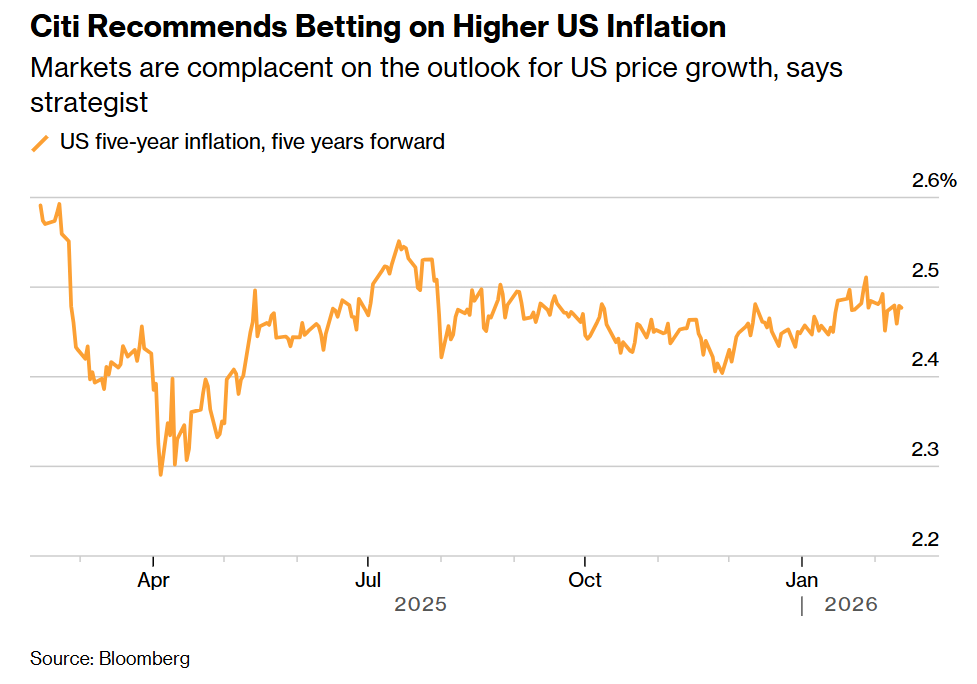
Group 1 - The core viewpoint of the article is that the market is overly complacent about the U.S. inflation outlook, making bets on rising inflation pressures significantly attractive [1] - Citigroup's rate trading strategist Benjamin Wiltshire suggests that investors may be underestimating the resilience of U.S. consumption, leading to a likely slight upward revision of market inflation expectations [1] - Wiltshire recommends buying five-year/five-year forward inflation derivatives, arguing that the current pricing level of about 2.5% is too low compared to the persistent core inflation indicator, which remains just below 3% [1] Group 2 - Recent strong U.S. employment data has exceeded market expectations, causing a surge in U.S. Treasury yields and prompting traders to lower their expectations for Federal Reserve rate cuts this year [4] - The market's reluctance to price in inflation risks is attributed to disappointment over last year's U.S. tariff policies not quickly translating into inflation [4] - Wall Street remains vigilant about inflationary risks, anticipating that a strong economic recovery in the U.S. could reignite price increases, especially if the next Federal Reserve chair, likely to be Waller, guides policymakers to lower rates more aggressively [4] Group 3 - UBS Group AG's senior trader Ben Pearson indicates that the "inflationary boom" led by the U.S. is one of the most underestimated risks by investors this year [4] - If inflationary pressures materialize, the Federal Reserve may remain inactive in the first half of the year, forcing the market to price in rate hikes for the second half [5] - Lazard's CEO argues that it is reasonable and likely for U.S. inflation to return above 4% by the end of the year [5] Group 4 - The complexity of predicting inflation has increased due to tariff tensions and rapid advancements in emerging technologies [5] - Investors must also contend with geopolitical risks affecting oil prices, particularly from intermittent threats related to Iran [5] - BlackRock's Tom Becker has been increasing short positions in long-term U.S. and U.K. government bonds, expecting strong economic growth and rising commodity prices to exert upward pressure on consumer prices [5] Group 5 - In this uncertain environment, TIPS (Treasury Inflation-Protected Securities) offer a potential hedging mechanism against inflation [6] - Vanguard's senior portfolio manager Brian Quigley notes that TIPS are not without risks, particularly if oil prices fall sharply, which could quickly lower the breakeven point for these securities [7] - Pimco views TIPS as inexpensive insurance against inflation, believing they provide good protection if inflation exceeds the Federal Reserve's target, similar to the past four to five years [7]


欧盟通过900亿欧元援乌贷款,俄罗斯上调增值税
Xin Lang Cai Jing· 2026-02-12 18:31
Group 1 - The European Parliament has approved a total of €90 billion in aid loans for Ukraine, with €30 billion allocated for macro-financial assistance and €60 billion for strengthening defense capabilities. The EU Council has reached an agreement on the loan framework, aiming to disburse the first tranche by early Q2 2026 [1] - Russia will increase its basic VAT rate from 20% to 22% starting in 2026, which economists predict may exacerbate inflation risks. The country's investment growth has stagnated, facing challenges from declining liquidity and geopolitical uncertainties [1] - European stock funds have seen strong inflows, attracting approximately $14 billion in net investments as of the week ending February 9, 2026, marking a new high in several months. This shift is partly due to investors reducing reliance on U.S. tech stocks and diversifying into markets including Eastern Europe [1] Group 2 - Alpha Bank's chief economist, Natalia Orlova, analyzes that the resource allocation in Russia remains imbalanced between military and civilian sectors, with reduced investment and economic slowdown being a natural phenomenon [2] - The Kiel Institute report indicates that as the U.S. withdraws funding, military aid to Ukraine will drop to its lowest level in 2025, with Europe bearing most of the related costs. Future tensions in U.S.-European relations may accelerate European defense expansion plans [2] - If the European Central Bank does not restart bond purchases, upward pressure on long-term interest rates may affect the valuations of military and security-related industries [2]
独家专访德银全球CIO:AI不是泡沫,中国资产吸引力上升
第一财经· 2026-02-12 09:03
Core Viewpoint - The investment environment in 2026 is characterized by significant global market uncertainty, with a focus on the principle that "discipline beats drama" in asset allocation [3][5]. Group 1: Artificial Intelligence (AI) Investment - AI remains a central theme for investment decisions in 2026, with a shift from merely focusing on chips to considering the entire AI value chain, including data centers and utilities [6][7]. - The current discussions around whether AI represents a bubble are deemed unfounded, as the sector is viewed as undergoing a structural transformation rather than a speculative bubble [7]. Group 2: Emerging Markets and China - Emerging markets, particularly Asia, South America, and Eastern Europe, are expected to perform well in 2026, supported by a weaker dollar and a global economic environment that has not entered recession [8]. - China's attractiveness as an investment destination is increasing, with rising interest from European and American investors, particularly outside the real estate sector [8]. Group 3: Currency and Dollar Outlook - Despite discussions about reevaluating dollar asset exposure, the U.S. market, especially AI-related companies, remains attractive, with equity returns exceeding 20% [9]. - The dollar is expected to maintain its importance in investment strategies, although diversification in currency exposure is anticipated [9]. Group 4: Inflation Risks - Inflation risk is highlighted as a significant concern for 2026, with potential implications for central banks' ability to lower interest rates if inflation exceeds expectations [10][11]. - Geopolitical factors, tariffs, and wage increases due to low unemployment rates are identified as drivers of inflation that should not be overlooked [11]. Group 5: Geopolitical Risks and Market Volatility - Geopolitical events are acknowledged as potential sources of market volatility, with a focus on their impact on energy prices and inflation [12]. - The need for reforms in the European Union to boost growth is emphasized, with optimism regarding economic growth in Europe, particularly driven by fiscal spending [12].


独家专访德银全球CIO:AI不是泡沫,中国资产吸引力上升
Di Yi Cai Jing Zi Xun· 2026-02-12 08:47
Group 1: Investment Environment in 2026 - The core principle for the investment landscape in 2026 is "discipline beats drama," emphasizing the need for disciplined investment strategies amidst market volatility [1][3] - Investors are encouraged to view market corrections as opportunities for positioning rather than engaging in cyclical trading behaviors [3] Group 2: Artificial Intelligence (AI) Investment - AI remains a focal point for investment decisions in 2026, with a broader perspective on the entire AI value chain rather than just chips [4][5] - The ongoing structural transformation in the AI sector is viewed as a significant opportunity for growth, efficiency, and productivity, rather than a bubble [5] Group 3: Emerging Markets and China - Emerging markets, particularly Asia, South America, and Eastern Europe, are expected to perform positively in 2026, supported by a weaker dollar and a global economic environment that has not entered recession [6] - China's attractiveness as an investment destination is increasing, with rising interest from European and American investors, particularly outside the real estate sector [6] Group 4: Currency and Dollar Outlook - While there is discussion about reevaluating exposure to dollar assets, the U.S. market, especially AI-related companies, remains attractive, with equity returns exceeding 20% [7] - The dollar is expected to maintain its importance in investment strategies, despite potential diversification in currency exposure [7] Group 5: Inflation Risks - Inflation risk is identified as a significant concern for 2026, with potential implications for central banks' ability to lower interest rates if inflation exceeds expectations [8] - Factors such as geopolitical events, tariffs, and wage increases due to low unemployment rates are highlighted as drivers of inflation [8] Group 6: Geopolitical Risks and Market Volatility - Geopolitical events are acknowledged as potential sources of market volatility, with a focus on their impact on energy prices and inflation [9] Group 7: European Economic Outlook - The overall economic growth outlook for Europe in 2026 is relatively optimistic, driven by fiscal spending, particularly in Germany, while acknowledging the need for further structural reforms [10]

专访德银全球CIO:AI不是泡沫 中国资产吸引力上升
Di Yi Cai Jing· 2026-02-12 08:46
进入2026年,全球市场不确定性依旧显著,针对人工智能(AI)投资风险的争论日益升温,资产配置 正面临新的考验。 德意志银行在最新发布的"2026年年度投资展望"中提出,"纪律胜过戏剧性波动"(discipline beats drama)将成为贯穿全年市场的重要原则。 在接受第一财经独家专访时,德银全球首席投资官(CIO)克里斯蒂安·诺尔廷(Christian Nolting)表 示,围绕AI的投资是一场正在展开的"结构性变革",尚不足以称之为泡沫;相关投资不应仅聚焦芯 片,而应放眼更完整的价值链;在这一过程中,数据中心、电力与基础设施等领域将同样受益。 诺尔廷:人工智能在2025年是最重要的主题之一,我认为在2026年仍将如此。当然,地缘政治风险同样 需要关注。对投资者而言,关键并不只是芯片,而是要放眼整个AI价值链。建设数据中心需要大量冷 却系统和电力供应,这意味着公用事业等相关领域同样会受益。这类资产通常更稳定,也具备分红特 征,有助于平衡投资组合。 第一财经:目前关于AI是否存在泡沫的争论不断,你怎么看? 诺尔廷:尽管当前AI领域的投资规模很大,市场也在讨论资金是否能够被有效配置,但我们仍然认 为, ...