金融抑制

Search documents
一场世纪豪赌的金融实验
Sou Hu Cai Jing· 2025-12-16 13:19
Group 1 - A significant tech sell-off has occurred due to disappointing earnings reports, with companies like Broadcom and Oracle experiencing substantial market value losses, raising concerns about the trust in AI infrastructure assets [1][4] - The AI hype has led to unprecedented capital inflows, with Nvidia's market cap surpassing that of Europe's largest economy and Broadcom's stock reaching new highs due to AI chip orders [3] - Despite strong sales growth in AI chips, Broadcom's profit margins are under pressure, and Oracle's debt-to-equity ratio has surged to 500%, indicating financial strain compared to competitors [4] Group 2 - The U.S. government and Wall Street are betting on AI to address unsustainable debt levels, with the Federal Reserve providing liquidity through a cleverly designed "quasi-quantitative easing" strategy [2][5] - The potential for AI to drive productivity growth is critical; failure to achieve significant improvements could lead to substantial financial losses and a crisis worse than the 2008 financial disaster [6] - The Federal Reserve's new tool, "Reserve Management Purchases," aims to stabilize short-term interest rates and maintain liquidity, creating an environment conducive to high-valuation tech stocks [6][7] Group 3 - The AI narrative is at risk of being "hijacked" by the financial system's vulnerabilities, where a failure in AI could lead to a sovereign debt crisis, significantly impacting the entire financial landscape [7] - The current market dynamics reflect a cycle of "prosperity—doubt—rebound—collapse," with participants navigating a precarious situation where the success or failure of AI could determine the economic future [8]
美联储RMP+美财政部美债发行管理≈ QE?
Hua Er Jie Jian Wen· 2025-12-15 06:40
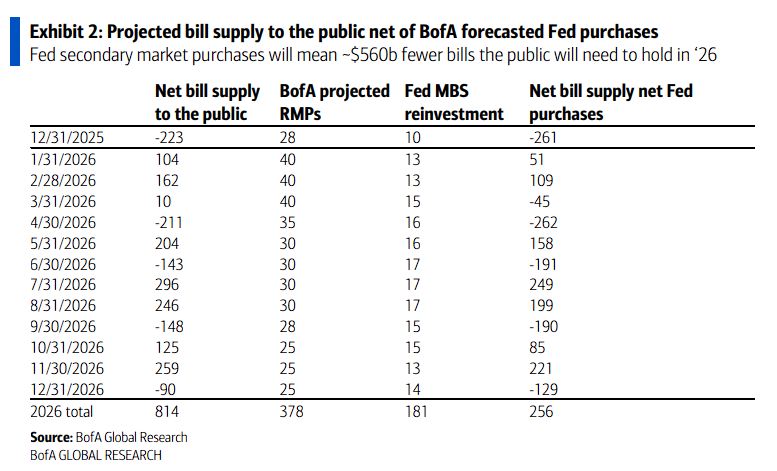
Core Viewpoint - The Federal Reserve's newly launched Reserve Management Purchases (RMPs) plan, in conjunction with the U.S. Treasury's bond issuance strategy adjustments, is creating a market effect similar to quantitative easing (QE) [1] Group 1: RMPs and Market Effects - The RMPs plan, while not traditional QE, allows the Treasury to increase short-term Treasury bill issuance and reduce the supply of medium- to long-term bonds [1][2] - Bank of America (BofA) projects that by 2026, the Federal Reserve will purchase a total of $560 billion in Treasury bills through RMPs and MBS reinvestments, while the Treasury plans to issue an additional $500 billion in short-term bills and reduce medium- to long-term bond issuance by $600 billion [1][2] Group 2: Treasury Issuance Adjustments - The Treasury is expected to issue $500 billion more in short-term bills in 2026 compared to 2025, while reducing medium- to long-term bond issuance by $600 billion [3][4] - This significant shift in supply structure aims to address the large amount of medium- to long-term bonds maturing in 2026 and the increased Treasury buyback operations [4] Group 3: Impact on Treasury Yields - The Treasury has indicated its intention to maintain stable long-term bond auction sizes in the coming quarters, focusing on increasing short-term Treasury bill issuance to meet financing needs [5] - BofA's scenario analysis suggests that a higher issuance of Treasury bills could lead to a net easing effect of 20-30 basis points on the 10-year Treasury yield [5][6] Group 4: Investment Opportunities - BofA recommends investors focus on three trading opportunities: 1. Going long on front-end swap spreads, currently at negative 18 basis points, with risks stemming from unexpected fiscal deficits [8] 2. Going long on 5-year real yields, currently at 103 basis points, supported by a historically accommodative financial environment [8] 3. Selling the volatility spread between 1-year and 10-year rates, currently at 2 basis points, with risks from rising uncertainty in Fed policy [8]


中国财险藏大招!三条道路暗中突围,碾压全球行业寒冬
Sou Hu Cai Jing· 2025-12-13 14:07
Core Viewpoint - The insurance industry is experiencing a stark contrast between life insurance companies, which are thriving, and non-life insurance companies, which are struggling due to various economic factors [1][3]. Group 1: Overall Market Trends - The global total premium growth rate is expected to decline from 3.1% in 2025 to 2.3% in 2026-2027, indicating a slowdown in growth [3]. - The life insurance sector is projected to grow at 2.5%, outperforming the overall industry [3]. - Non-life insurance growth is expected to drop to 2.1%, primarily due to stagnant premium increases, especially in the competitive non-auto insurance sector [5]. Group 2: Economic Environment Impact - The insurance industry's challenges stem from significant changes in the global economy, described as a "quicksand era," where stability is deceptive and can lead to pitfalls [6]. - Major economies in Europe and the U.S. have government debt-to-GDP ratios exceeding 100%, limiting central banks' ability to manage monetary policy independently [8]. - The current economic turmoil negatively impacts insurance companies that rely on long-term investment returns to cover claims, as asset yields decrease while liability costs rise [10]. Group 3: China's Insurance Market Dynamics - Despite global economic challenges, China's property insurance market is transitioning from scale to quality, with premium growth expected to maintain 5% to 6% from 2025 to 2030, outpacing GDP growth [11]. - The transition is driven by three key strategies that align with China's economic trends [11]. Group 4: Key Strategies for Transformation - The first strategy involves profitability breakthroughs in new energy vehicle insurance, which is expected to achieve overall profitability by 2027 after years of losses [13]. - The second strategy focuses on "index-based" agricultural insurance, which reduces operational costs and increases efficiency by using objective indicators for claims [16]. - The third strategy is to enhance insurance coverage for Chinese companies expanding overseas, addressing various risks associated with international operations [18]. Group 5: Conclusion on Industry Adaptation - The insurance industry must abandon outdated practices and accurately assess risks to adapt to the current economic landscape, with China's property insurance sector's strategies providing a potential pathway to navigate through economic cycles [20].

美国债务陷入危机,前高官建议减少支出,许多公民要遭罪
Sou Hu Cai Jing· 2025-12-09 00:06
Core Viewpoint - The U.S. debt crisis has reached a critical point, with public debt nearing 100% of GDP and interest payments consuming a significant portion of federal spending, leading to potential cuts in essential services for citizens [2][4][6]. Group 1: Current Debt Situation - The U.S. public debt now accounts for 99% of GDP, projected to exceed 107% by 2029, marking the highest level since World War II [2]. - Weekly interest payments on the debt exceed $11 billion, representing 15% of the federal budget for the current fiscal year, restricting funds from being allocated to economic recovery and social welfare [2]. Group 2: Historical Context and Structural Issues - Historically, debt expansion in any economy has limits, and exceeding these can lead to market confidence collapse and credit system crises [4]. - The U.S. has maintained its debt expansion due to the dollar's dominance and the perception of U.S. Treasury bonds as safe assets, but this advantage is diminishing [4][6]. Group 3: Economic Growth and Political Challenges - The root of the debt crisis lies in a structurally imbalanced economic growth model reliant on consumer spending and government borrowing, which is unsustainable during economic downturns [6]. - Political short-sightedness prevents necessary structural reforms, leading to an accumulation of debt and an increasingly severe crisis [6][20]. Group 4: Potential Solutions and Their Limitations - Six potential solutions to the debt crisis have been identified, but most are either unrealistic or carry significant costs, leaving only stringent fiscal tightening as a viable option [7]. - Accelerating economic growth is ideal but not feasible under current conditions, while low interest rates are no longer an option due to global inflation pressures [9]. Group 5: Implications of Default and Inflation - Debt default would destroy U.S. creditworthiness and could trigger a global financial crisis, which is unacceptable for the government [11]. - Allowing inflation to reduce the real debt burden would harm ordinary citizens' wealth and exacerbate social inequality, leading to potential unrest [11]. Group 6: Political Stalemate and Future Outlook - The political deadlock between parties hinders the implementation of fiscal tightening, with both sides prioritizing short-term political gains over long-term solutions [15][17]. - A significant fiscal crisis may be necessary to prompt reforms, but this would have severe repercussions for the global economy [19][22].

构建适应“十五五”未来产业发展的现代化金融体制
Jin Rong Shi Bao· 2025-11-24 02:11
Core Viewpoint - The construction of a financial system that adapts to the development of future industries is a complex system engineering task, requiring a balance between effective markets and proactive government intervention, while breaking path dependence and institutional barriers [1][22]. Group 1: Future Industry Characteristics - Future industries are characterized by the deep integration of technological and industrial innovation, representing a shift towards disruptive innovation driven by cutting-edge technologies [4]. - These industries face fundamental differences in financing needs compared to traditional industries, primarily due to their inherent uncertainty and the lack of established market applications [4][3]. - The rise of future industries necessitates a profound structural reform of the financial supply side to create a modern financial ecosystem that effectively accommodates their unique risk-return characteristics [3][4]. Group 2: Financial System Requirements - The financial system must develop mechanisms for prudent management of uncertainty, flexible operational mechanisms, inclusive development mechanisms, and transparent regulatory mechanisms to adapt to the uncertainties of future industries [4]. - There is a need for a financial infrastructure that can price and manage innovation-related uncertainties, utilizing financial technology for real-time risk monitoring and developing diversified investment tools [9][10]. Group 3: Capital Market Development - The capital market must evolve to support a modern industrial system, focusing on maintaining a reasonable proportion of manufacturing and enhancing the service capabilities of various market segments [5][7]. - A multi-layered capital market system should be established to enhance the service capabilities for specialized small and medium enterprises, particularly those with high intangible asset ratios [7][12]. Group 4: Investment and Financing Coordination - A seamless and complementary financing ecosystem is required to support the growth trajectory of future industries, necessitating a diverse "toolbox" of financing options tailored to different stages of enterprise development [12]. - The financial system should transition from a focus on collateral-based lending to a value discovery approach, emphasizing the importance of intangible assets and future growth potential [6][13]. Group 5: Innovation in Financial Products - Financial products must be innovated to align with the characteristics of future industries, including the development of green finance, digital finance, and inclusive finance to support various sectors of the economy [17][20]. - The establishment of a comprehensive financial service standard system is essential to support the growth of future industries and ensure that financial resources are effectively allocated [18][19]. Group 6: Regulatory Framework - A modern regulatory framework is necessary to ensure that financial resources are effectively directed towards innovation while managing risks, requiring a shift towards functional and penetrating regulation [21]. - The financial system must be equipped to handle systemic risks while promoting a culture of investment in innovative sectors, ensuring that financial resources are available for long-term projects [21].
美元,所有人的问题
Sou Hu Cai Jing· 2025-10-27 08:00
Core Viewpoint - The dominance of the US dollar as the global reserve currency continues to pose challenges for other economies, despite the emergence of alternative currencies like the euro and the renminbi [2][3][4]. Group 1: Historical Context - The end of the Bretton Woods system in 1971 marked a significant shift, with the US unilaterally decoupling the dollar from gold due to persistent deficits and inflation [2]. - The dollar has maintained its status as the first true global reserve currency, unlike previous dominant currencies which were limited to their regions [5][6]. Group 2: Current Dollar Dominance - The US GDP accounts for approximately 25% of the global economy, yet the dollar represents over 40% of international trade and 60% of foreign exchange reserves [6][7]. - The deep liquidity of the dollar market facilitates its use as a vehicle currency, making it the preferred medium for international transactions [6][7]. Group 3: Challenges for Other Currencies - The euro, despite being the second-largest currency, struggles to achieve global status and is primarily used within Europe [12][20]. - Emerging markets have adopted managed floating exchange rate systems to mitigate volatility, learning from past financial crises [13][14]. Group 4: US Fiscal Concerns - The US faces significant fiscal challenges, with federal debt nearing 100% of GDP and projected to rise to 166% in 30 years under current policies [14][15]. - Political polarization hampers effective fiscal management, leading to a consensus of "deficits don't matter" among policymakers [15][19]. Group 5: Future of the Dollar - Concerns about the sustainability of the dollar's dominance are growing, with potential risks including higher interest rates and inflation [19][20]. - The renminbi's internationalization is ongoing, but significant barriers remain, including the need for capital account liberalization and legal market development [21].

黄金迎来历史性转折:三大驱动力引爆1979年以来最强涨势
Jin Shi Shu Ju· 2025-09-16 03:09
Core Viewpoint - The article discusses the potential shift towards a fiscal-led era in the U.S. economy, driven by ongoing political pressures on the Federal Reserve and rising inflation due to tariffs, which may lead to gold replacing the dollar as the primary store of value [1][4]. Group 1: Economic and Market Dynamics - Gold has seen a year-to-date increase of 31.38% as of the end of August, marking its best performance since 1979, positioning it as one of the strongest asset classes for the year [1]. - The U.S. government's approach to the Federal Reserve is a significant factor in gold's recent rise and the dollar's continued weakness [1][2]. - The labor market data indicates a more severe economic slowdown than expected, while inflation data remains complex and concerning [2]. Group 2: Federal Reserve Independence and Political Pressure - The struggle for control over the Federal Reserve has significant implications for gold and the dollar, with President Trump’s actions raising unprecedented legal and constitutional questions regarding presidential power and central bank independence [2][3]. - The dismissal of a Federal Reserve board member due to alleged mortgage fraud has sparked concerns about the independence of the Fed, which has historically not seen such dismissals since its establishment in 1913 [2][3]. - The current political climate may lead to a more politicized Federal Reserve, potentially transforming it into a tool for the White House [3][4]. Group 3: Inflation and Gold Demand - Inflation risks are increasingly driven by monetary and fiscal policies rather than demand, which is favorable for gold [2]. - The anticipated rise in commodity costs due to tariffs is expected to increase inflationary pressures, further boosting gold demand as a hedge against purchasing power erosion [3][4]. - The potential for negative real interest rates, driven by fiscal policies and regulatory easing, may enhance gold's appeal as a store of value [4][5]. Group 4: Future Outlook and Global Financial System - The article suggests that the current dollar-centric global financial system may become unsustainable, with a shift towards gold as a neutral reserve asset [4][6]. - The increasing trust in gold over fiat currencies is evidenced by central banks accumulating gold reserves, highlighting its role as a stable alternative in a changing monetary landscape [4][5]. - The anticipated economic policies, including the "Great and Beautiful" Act and tax cuts, are expected to stimulate the economy, further supporting gold's upward trajectory [5][6].

国际金价近期屡创新高,背后上涨驱动因素是什么?记者观察
Sou Hu Cai Jing· 2025-09-05 23:49
Group 1 - The core viewpoint of the article is that the recent surge in international gold prices is driven by expectations of potential interest rate cuts by the Federal Reserve, concerns over government debt sustainability, and increased demand for gold as a safe-haven asset [1][3][5]. Group 2 - The first major reason for the rise in gold prices is the increasing market expectation that the Federal Reserve may begin to cut interest rates this month, with a probability of 99.4% for a 25 basis point cut following recent employment data indicating weakness in the U.S. job market [5][6]. - The second reason highlighted is the potential for a rebound in inflation if the Federal Reserve adopts a low-interest-rate monetary policy, which could lead to higher long-term U.S. Treasury yields and a decline in the stock market, prompting more retail investors to seek refuge in gold [7]. - The third reason is the significant sell-off of long-term government bonds from the U.S., Japan, the UK, and several Eurozone countries due to concerns over unsustainable government debt, with funds flowing into gold as a safe haven. Recent data shows a net inflow of $5.5 billion into global gold ETFs in August, primarily from North America and Europe [9][10]. Group 3 - Analysts suggest that the long-term trend of "financial repression" may lead to further increases in gold prices, as central banks continue to increase their gold reserves amid high levels of government debt [11]. - Current models indicate that gold prices are significantly above their long-term equilibrium price, suggesting that investors should focus on the long-term value of gold rather than short-term speculative opportunities [13].

国际金价近期屡创新高,背后上涨驱动因素是什么?记者观察→
Sou Hu Cai Jing· 2025-09-05 15:25
Core Viewpoint - The recent surge in international gold prices is driven by expectations of potential interest rate cuts by the Federal Reserve, concerns over government debt sustainability, and increased investment in gold as a safe haven asset [1][3][5]. Group 1: Factors Driving Gold Price Increase - The market's expectation of the Federal Reserve potentially starting to cut interest rates this month has risen significantly, with a probability of 99.4% following recent employment data indicating weakness in the U.S. job market [5][6]. - Major financial institutions, including Goldman Sachs, have indicated that if the Federal Reserve adopts a low-interest-rate monetary policy, inflation pressures may rebound, leading to higher long-term U.S. Treasury yields and a decline in the stock market, which could drive more retail investors towards gold [7]. - Concerns over unsustainable government debt have led investors to sell long-term government bonds from the U.S., Japan, the UK, and several Eurozone countries, with some of the outflow directed towards gold investments. In August, global gold ETFs saw a net inflow of $5.5 billion, primarily from North America and Europe [9]. Group 2: Long-term Outlook and Investment Strategy - Analysts suggest that gold and precious metal investments have structural characteristics, especially with central banks increasing their gold reserves. The long-term trend of "financial repression" may support future increases in gold prices [11]. - Current gold prices are reportedly above their long-term equilibrium price, indicating that investors should focus on the long-term value of gold rather than short-term speculative opportunities [13].

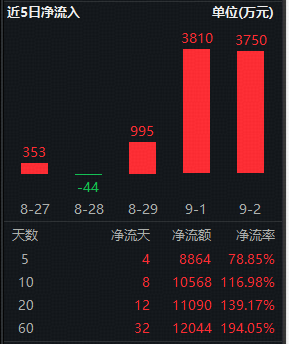
贵金属“完美风暴”已至?金价迭创新高!有色龙头ETF(159876)近两日吸金7560万元,规模创新高!
Xin Lang Ji Jin· 2025-09-03 01:35
Core Viewpoint - International gold prices have reached new highs, driven by expectations of interest rate cuts by the Federal Reserve, leading to significant inflows into the non-ferrous metals sector, particularly highlighted by the surge in the non-ferrous metal ETF (159876) which attracted 75.6 million yuan in just two days, reaching a new high of 207 million yuan as of September 2 [1][3]. Group 1: Gold Market Dynamics - On September 2, spot gold in London surpassed $3,500 per ounce, marking a new high, with Morgan Stanley projecting a year-end target of $3,800 per ounce [3]. - Multiple institutions predict that after four months of consolidation, precious metals are poised to enter a new upward trend [3]. - The macroeconomic environment is characterized by increased fiscal dominance in the U.S., leading to a trend of abundant dollar liquidity, which is favorable for global risk assets and supports gold as an anti-inflation asset [3]. Group 2: Non-Ferrous Metals Sector Outlook - The non-ferrous metals sector is experiencing a tight supply-demand balance, with high growth prospects due to several factors: 1. Supply-side improvements are expected as "anti-involution" initiatives accelerate the clearance of excess capacity, enhancing profitability for non-ferrous enterprises [3]. 2. Demand from emerging industries such as new energy, infrastructure, artificial intelligence, and robotics is increasing the need for non-ferrous metals [3]. 3. The global economic recovery, coupled with a depreciating dollar, is supporting non-ferrous metal prices [3]. - The industrial metals sector is currently undervalued, indicating potential for upward valuation adjustments, with a bullish market for non-ferrous metals beginning to take shape [4]. Group 3: Investment Strategy - The non-ferrous metal ETF (159876) and its linked funds are designed to track the CSI Non-Ferrous Metals Index, which includes significant weights in copper (25.3%), aluminum (14.2%), rare earths (13.8%), gold (13.6%), and lithium (7.6%), providing a diversified investment approach [5]. - The ETF's performance reflects a strategy to mitigate risks associated with investing in single metal sectors, making it suitable for inclusion in investment portfolios [5].