
钢材市场供需

Search documents
钢材:钢材转向累库,钢价延续震荡
Yin He Qi Huo· 2026-01-09 11:59
1. Report Industry Investment Rating - Not provided in the document 2. Core View of the Report - Steel prices are expected to maintain a volatile trend. The total steel inventory has turned to accumulation, but hot - rolled steel is still de - stocking. Seasonal factors have weakened the demand for building materials, and steel exports have declined in January. Although there is cost support, the weakening demand also limits the upward space of steel prices. [7] 3. Summary According to the Table of Contents Chapter 1: Steel Market Summary and Outlook Summary - **Supply**: This week, the small - sample production of rebar was 191.04 million tons (+2.82), and that of hot - rolled coil was 305.51 million tons (+1). The daily average hot - metal output of 247 blast furnaces was 229.5 million tons (+2.07), and the capacity utilization rate of 49 independent electric - arc furnace steel plants was 34.8% (-0.8). The profit of electric - arc furnace steel has declined, and the long - process steel profit remains profitable with an increase in hot - metal output. [4] - **Demand**: The small - sample apparent demand for rebar was 174.96 million tons (-25.48), and that for hot - rolled coil was 308.34 million tons (-2.43). Building material demand has seasonally declined, while hot - rolled coil demand is affected by pre - holiday restocking in the manufacturing industry but shows a decline in apparent demand due to a rapid drop in exports in January. Domestic project investment has insufficient growth, the real estate market is still weak, but the manufacturing industry shows some positive trends, and the auto industry maintains strong growth. [4] - **Inventory**: Rebar inventory increased by 16.08 million tons in total, hot - rolled coil inventory decreased by 2.83 million tons in total, and the total inventory of five major steel products increased by 21.77 million tons. [4] - **Outlook and Strategy**: The steel price will maintain a volatile trend with a short - term correction. It is recommended to short the spread between hot - rolled coil and rebar at high prices and hold the short position of the ratio between hot - rolled coil and coking coal. It is advisable to wait and see for options. [7][9] Chapter 2: Price and Profit Review Summary - **Spot Price**: The rebar summary price in Shanghai was 3310 yuan (+10), and in Beijing was 3170 yuan (+20). The hot - rolled coil price in Shanghai was 3280 yuan (+10), and in Tianjin was 3190 yuan (+10). [13] - **Profit**: The flat - rate electricity profit of the East China electric - arc furnace was - 44.58 yuan (-16.3), and the off - peak electricity profit was 120 yuan (-16). [32] Chapter 3: Important Domestic and International Macroeconomic Data Summary - **International Trade**: Mexico imposed preliminary anti - dumping duties on hollow profiles from China and the US, and Vietnam made a positive final ruling on the sunset review of cold - rolled carbon steel coils from China. [34] - **Monetary Policy**: The People's Bank of China will continue to implement a moderately loose monetary policy. [34] - **US Economy**: The number of initial jobless claims in the US rose to 208,000, slightly lower than market expectations. [34] - **Domestic Macroeconomy**: In November, the new social financing was 248.88 billion yuan, and the new RMB loans were 39 billion yuan. From January to November 2025, the cumulative year - on - year growth rate of China's fixed - asset investment was - 2.60%. Real estate development investment was - 15.9%, manufacturing investment was +1.9%, and infrastructure investment was +0.13%. [39] Chapter 4: Steel Supply, Demand, and Inventory Situation Summary - **Supply**: The daily average hot - metal output of 247 blast furnaces was 229.5 million tons (+2.07), and the capacity utilization rate of 49 independent electric - arc furnace steel plants was 34.8% (-0.8). The small - sample production of rebar was 191.04 million tons (+2.82), and that of hot - rolled coil was 305.51 million tons (+1). [56][61] - **Demand**: The small - sample apparent demand for rebar was 174.96 million tons (-5.5% year - on - year in the lunar calendar, - 25.48 million tons month - on - month), and that for hot - rolled coil was 308.34 million tons (-1.7% year - on - year in the lunar calendar, - 2.43 million tons month - on - month). Building material demand has declined, and hot - rolled coil exports may decline in January. [64][76] - **Inventory**: Rebar inventory increased, hot - rolled coil inventory decreased in total, and the total inventory of five major steel products increased. [4]
格林期货早盘提示:钢材-20251224
Ge Lin Qi Huo· 2025-12-24 05:11
Report Industry Investment Rating - Not provided Core View of the Report - The steel market supply and demand remain weak with no prominent contradictions, and the screw and coil futures may continue to fluctuate. Short - term operations are recommended [1] Summary by Relevant Catalogs Market Review - On Tuesday, rebar and hot - rolled coils closed higher, but closed lower at night [1] Important Information - In November 2025, China's stainless steel imports were 112,100 tons, a month - on - month decrease of 12,000 tons (10%) and a year - on - year decrease of 18,100 tons (14%). Imports from Indonesia decreased by 16% month - on - month and 17% year - on - year. The top 5 regions accounted for 93.34% of total imports [1] - From December 15th to 21st, the total transaction area of newly - built commercial housing in 10 key cities was 2.232 million square meters, a month - on - month increase of 23.3% and a year - on - year decrease of 32.9% [1] - From December 15th to 21st, global shipyards received 62 + 13 new ship orders, with Chinese shipyards getting 42+7, and South Korean shipyards getting 11 [1] - The Central Enterprise Leaders' Meeting was held in Beijing from December 22nd to 23rd. Li Qiang pointed out the need to provide strong support for major infrastructure construction [1] - In November 2025, the crude steel output of 70 countries/regions included in the World Steel Association's statistics was 140.1 million tons, a year - on - year decrease of 4.6% [1] Market Logic - In the short term, the market fundamentals have changed little, but demand has declined significantly year - on - year. Downstream buyers purchase as needed, and inventory continues to decline. The steel mill profitability rate was below 40% last week, and steel production is expected to remain low. The steel market supply - demand is weak, and the screw and coil futures may fluctuate. The rebar has a pressure level at 3200 and a support level at 3030 [1] Trading Strategy - Short - term operation is recommended [1]
钢材月报:弱现实与暖预期,钢价企稳迹象初显-20251205
Wu Kuang Qi Huo· 2025-12-05 14:17
1. Report Industry Investment Rating No information provided in the document. 2. Core Viewpoints of the Report - In November 2025, the steel industry faced weak supply - demand fundamentals. Steel mills' profitability was under pressure, with average profit margins narrowing. Supply showed signs of active contraction due to low steel prices and rising cost pressures. Demand for both rebar and hot - rolled coils declined year - on - year, and hot - rolled coil inventory remained at a high level. However, with the continuous implementation of domestic policies and the improvement of the external environment, there is a possibility of a stable recovery in terminal demand, and the industry may enter a window of marginal improvement. Key factors to watch include the pace of infrastructure fund investment, the strength of manufacturing recovery, overseas interest - rate cut processes, and signals from the domestic Politburo meeting [11][12][13]. 3. Summary According to Relevant Catalogs 3.1 Monthly Assessment and Strategy Recommendation - **Valuation**: In November 2025, steel mills' profitability continued to be under pressure, with average profit margins further decreasing. The blast furnace profit was about 31 yuan/ton, and the electric furnace profit was about 79 yuan/ton, both in a weak range [11]. - **Supply**: Rebar production in November 2025 was 8.2258 million tons, a year - on - year decrease of 3.4999 million tons; hot - rolled coil production was 12.6684 million tons, a year - on - year decrease of 2.7442 million tons. The daily average pig iron output was about 2.3551 million tons, a slight decline from the previous month. Affected by the significant compression of profits, the production enthusiasm of steel mills decreased, and the profitability rate dropped to 36.36%, at a low level within the year [11]. - **Demand**: In November 2025, the apparent consumption of rebar was 8.9362 million tons, a year - on - year decrease of 2.6604 million tons; the apparent consumption of hot - rolled coils was 12.7253 million tons, a year - on - year decrease of 3.1718 million tons. The demand for plates was significantly differentiated, with the demand for cold - rolled and medium - thick plates relatively strong, especially the demand for medium - thick plates in November approaching the high point of the same period in the past five years. The demand for hot - rolled coils was neutral, without obvious increments. Rebar demand was still weak due to the continuous weakness of real - estate investment [11]. - **Inventory**: As of the end of November 2025, rebar inventory was 5.3148 million tons, a year - on - year increase of 0.8384 million tons; hot - rolled coil inventory was 4.009 million tons, a year - on - year increase of 0.9518 million tons. The total inventory of the five major steel products remained at a neutral level, but there was significant differentiation among varieties. Hot - rolled coil inventory was in a relatively high range, and it was difficult to reduce social inventory. With the seasonal weakening of demand, there was still a certain inventory accumulation pressure before the end of the year [11]. 3.2 Futures and Spot Market - The document presents a series of charts showing the prices, trading volumes, basis, and price differences of rebar and hot - rolled coils in different regions and contract months, as well as the price differences between different steel products and regions, including rebar in North, East, and South China, hot - rolled coils, cold - rolled coils, and other steel products [25][27][30]. 3.3 Profit and Inventory - **Profit**: The document shows the disk profits of rebar and hot - rolled coils, the gross profit per ton of hot - rolled and cold - rolled coils, and the profits of rebar blast furnaces and electric furnaces through charts [81][83][84]. - **Inventory**: It presents the inventory data of rebar and hot - rolled coils, including total inventory, factory inventory, and social inventory, as well as the inventory of steel billets in Tangshan and 55 billet - rolling enterprises [95][98][106]. 3.4 Cost End - The document shows the ratios of rebar to iron ore and coke futures, daily average pig iron and crude steel output, the prices of billets, scrap steel, and the consumption of scrap steel through charts [114][117][120]. 3.5 Supply End - **Rebar**: The production, production capacity utilization rate, and cumulative year - on - year production of rebar are presented. In November 2025, rebar production decreased year - on - year, and the production capacity utilization rate also showed certain changes [136][138]. - **Hot - rolled Coils**: The actual production, production capacity utilization rate, and cumulative year - on - year production of hot - rolled coils are presented. The production of hot - rolled coils also decreased year - on - year [141][143]. 3.6 Demand and Import - Export - **Domestic Demand**: The apparent consumption and cumulative year - on - year consumption of rebar and hot - rolled coils are presented. The demand for both decreased year - on - year. In addition, the production and export data of household appliances such as refrigerators, washing machines, and air conditioners are also shown [148][151][153]. - **Import - Export**: The monthly import and export data of steel, rebar, and plates are presented. South Korea's anti - dumping tax on Chinese steel products will put pressure on China's steel exports [11][163][165].
格林大华期货早盘提示-20251204
Ge Lin Qi Huo· 2025-12-04 01:10
Group 1: Report Industry Investment Rating - The investment rating for the steel industry in the black building materials sector is "volatile" [1] Group 2: Core View of the Report - The market is in a macro - policy vacuum period, but there may be expectations later. The fundamentals show that last week, the output of rebar decreased, the output of hot - rolled coils increased, and the output of five major steel products increased. The apparent demand has changed from increase to decrease, and the inventory of rebar and hot - rolled coils continues to be destocked, but the destocking speed slows down. Overall, the supply and demand are both weak. The market trading logic may still be at the industrial level, with insufficient marginal increment on the demand side. In the short term, the upside space is cautiously viewed, and the market is mainly in a volatile trend. Later, attention should be paid to the transformation of the trading logic to macro - expectations [1] Group 3: Summary by Related Catalogs Market Review - On Wednesday, rebar closed flat and hot - rolled coils closed down. They also closed down at night [1] Important Information - In October 2025, the national stainless - steel crude steel output was 3.6244 million tons, a month - on - month increase of 78,700 tons or 2.22%. In October, China's stainless - steel imports were 124,100 tons, a month - on - month increase of 3,800 tons or 3.18% and a year - on - year decrease of 34,100 tons or 21.56%. From January to October, the total stainless - steel imports were 1.2621 million tons, a year - on - year decrease of 343,000 tons or 21.37%. In October, the domestic stainless - steel exports were 358,100 tons, a month - on - month decrease of 60,400 tons or 14.43% and a year - on - year decrease of 59,300 tons or 14.2%. From January to October, the cumulative exports were 4.1408 million tons, a year - on - year increase of 1,600 tons or 0.04%. In October, China's stainless - steel apparent consumption was 3.0459 million tons, a month - on - month increase of 166,300 tons or 4.68% [1] - Chinalco Group: The first shipment of iron ore from the Simandou project was successfully sent, carrying 200,000 tons of iron ore [1] - On December 3rd, the average cost of 76 independent electric - arc furnace construction steel mills was 3,320 yuan/ton, a day - on - day decrease of 3 yuan/ton. The average profit was a loss of 29 yuan/ton, and the off - peak electricity profit was 79 yuan/ton [1] - According to the preliminary statistics of the Passenger Car Association, in November, the national passenger car market retail sales were 2.263 million vehicles, a year - on - year decrease of 7%. Among them, the new - energy market retail sales were 1.354 million vehicles, a year - on - year increase of 7%, and the new - energy market retail penetration rate was 59.8% [1] Market Logic - In the macro - policy vacuum period, there may be expectations later. Fundamentally, last week, the output of rebar decreased, the output of hot - rolled coils increased, and the output of five major steel products increased. The apparent demand has changed from increase to decrease, and the inventory of rebar and hot - rolled coils continues to be destocked, but the destocking speed slows down. Overall, the supply and demand are both weak [1] Trading Strategy - The upward movement of the futures price is weak. The market trading logic may still be at the industrial level, with insufficient marginal increment on the demand side. In the short term, the upside space is cautiously viewed, and the market is mainly in a volatile trend. Later, attention should be paid to the transformation of the trading logic to macro - expectations. The main contract has been rolled over to the May contract. The resistance level of the rebar 2605 contract is 3,200, and the strong support level is around 3,050. It is not recommended to chase long for now [1]
光大期货钢材策略月报-20251201
Guang Da Qi Huo· 2025-12-01 07:47
1. Report Industry Investment Rating - Not provided in the document 2. Core View of the Report - The fundamentals of supply and demand in the steel industry have limited driving force, and macro - level disturbances may intensify. The demand side is under pressure due to the decline in investment growth, while the supply side is expected to see a further decline in production. The market will be in a situation of weak supply and demand in December, with prices likely to fluctuate within a range, and attention should be paid to macro - level events [4][193][196] 3. Summary by Relevant Catalogs 3.1 Price - In November, the prices of black - series commodities showed divergent trends. Coal and coke prices dropped significantly, while iron ore and steel prices fluctuated within a narrow range, with rebar performing stronger than hot - rolled coil. International hot - rolled coil prices showed mixed trends [6][7] - The basis of rebar and hot - rolled coil futures contracts changed in November. The difference between rebar and billet prices widened, the difference between first - and third - tier rebar resources in East China narrowed, and the difference between rebar and scrap steel prices widened [9][27] - In November, the 1 - 5 spread of rebar futures widened, and the 5 - 10 spread narrowed. The ratio of rebar to iron ore narrowed, and the ratio of rebar to coke widened [37][43] 3.2 Supply - In October, the production of crude steel and pig iron continued to decline. In November, the weekly production of rebar, hot - rolled coil, and five major steel products all decreased. The production of rebar decreased in the northern, eastern, and southern regions [47][55][62] - In November, the blast furnace operating rate, capacity utilization rate, and daily molten iron output declined, while the electric furnace operating rate, capacity utilization rate, and steel mill scrap steel inventory increased [71][77] 3.3 Demand - In October, the year - on - year decline in real estate investment, sales, new construction, and completion widened, while the year - on - year decline in construction narrowed. Infrastructure investment growth continued to be negative, and the growth rates of transportation, water conservancy, and power investment all declined [82][89] - In October, the growth rate of automobile production and sales rebounded, the growth rate of excavator sales declined, and the growth rate of heavy - truck sales increased. The production and export of household appliances showed mixed trends [95][102] - In November, the national building materials trading volume declined, the rebar delivery volume in Hangzhou increased, and the cement delivery volume increased. The trading volume in the eastern and northern regions declined, while that in the southern region increased. The operating rate of cement mills first decreased and then increased [105][113] - In November, the apparent demand for rebar and hot - rolled coil declined, while the apparent demand for five major steel products increased. The land transaction area in 100 large - and medium - sized cities and the commercial housing transaction area in 30 large - and medium - sized cities increased, while the passenger car sales volume declined [121][128] 3.4 Inventory - In November, the inventory of five major steel products decreased by 112.95 million tons, with rebar inventory decreasing by 71.04 million tons and hot - rolled coil inventory decreasing by 5.69 million tons. The inventory in Shanghai and Hangzhou for rebar increased, while that in Guangzhou and Beijing decreased. The inventory of hot - rolled coil in Shanghai and Chengdu increased, while that in Tianjin and Lecong decreased [133][144][156] 3.5 Profit - In November, the losses on the rebar and hot - rolled coil futures contract plates narrowed. The losses of long - process steel mills widened, while the losses of short - process steel mills narrowed. In Jiangsu, the losses per ton of steel for blast furnace steel mills widened, and the losses of electric furnace steel mills during peak - power hours narrowed [160][162] 3.6 Import and Export - From January to October, steel exports increased by 6.6% year - on - year, while in June, steel exports decreased by 12.5% year - on - year [165] 3.7 Liquidity - In October, the growth rate of the stock of social financing, M1, and M2 all declined. The year - on - year and month - on - month growth rates of medium - and long - term loans for enterprises and households decreased significantly [169][178] 3.8 Transaction Data - In November, the positions, settled funds, and trading volumes of rebar and hot - rolled coil all declined [181] 3.9 Steel Options - Information on the historical volatility, position - to - volume ratio of put - to - call options, and trading - volume ratio of put - to - call options of rebar options is provided [184][188]
降息大消息!期钢震荡飘绿!钢价要跌?
Sou Hu Cai Jing· 2025-11-26 08:29
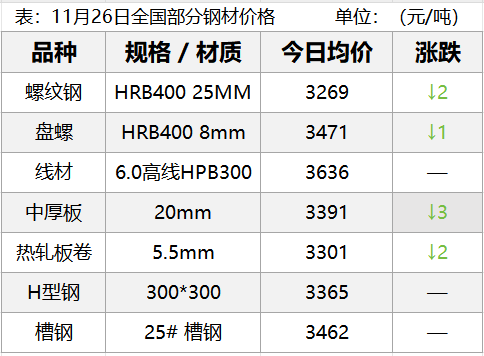
Core Viewpoint - The steel market is experiencing slight declines in both spot and futures prices, with a mixed outlook due to varying demand and supply factors, including a notable increase in housing project funding and ongoing pressures from rising crude steel production [1][10]. Group 1: Market Performance - On November 26, the domestic steel market saw a slight decline, with major futures contracts primarily trending downwards, including rebar down 0.06% and hot-rolled coil down 0.03% [1][4]. - The average price of rebar (HRB400 25MM) is reported at 3269 yuan/ton, with a slight increase of 12 yuan [5]. - The futures market closed with most major contracts showing declines, particularly rebar and hot-rolled coil, while iron ore saw a minor increase of 0.19% [6]. Group 2: Supply and Demand Analysis - According to the China Iron and Steel Association, key steel enterprises produced 1,943 million tons of crude steel in mid-November, with a daily production rate of 194.3 thousand tons, reflecting a 0.9% increase month-on-month [2]. - The inventory of steel materials reached 1,561 million tons, up 0.8% from the previous period, indicating increasing supply pressure that may negatively impact steel prices [2]. - The funding rate for housing projects has increased by 0.7% to 53.99%, reaching a recent high, while overall funding rates for construction sites have decreased by 0.24 percentage points to 59.56% [3]. Group 3: Raw Material Market - The price of imported iron ore has seen a slight increase, with supply from Australia and Brazil decreasing, but domestic arrivals rising significantly [9]. - Coke prices are stable, with supply gradually increasing due to higher operating rates in coke enterprises, although downstream purchasing enthusiasm is declining [9]. - Scrap steel prices remain stable with minor fluctuations, as supply tightens and demand shows divergence, particularly with electric arc furnace steel mills facing losses [9]. Group 4: Future Outlook - The overall market sentiment is cautious, with expectations of steel prices stabilizing or slightly declining in the near term due to weak seasonal demand and mixed performance in raw materials [10].

山金期货黑色板块日报-20251117
Shan Jin Qi Huo· 2025-11-17 03:42
1. Report Industry Investment Rating No relevant information provided. 2. Core Viewpoints of the Report - For the steel market, due to a significant decline in steel mill gross margins and the end of the consumption peak, the scale of steel mill production cuts may exceed the normal seasonal level, potentially triggering a phased negative feedback loop. Recently, the prices of coal and coke have shown signs of weakening, and the price of iron ore has fallen from its high, weakening the cost support for steel. Technically, the futures prices of rebar and hot - rolled coils have broken below the support of the 10 - day moving average, and are facing a direction choice after a short - term narrow - range oscillation [2]. - For the iron ore market, with the arrival of the consumption off - season, it is expected that the molten iron production will likely continue to decline along the seasonal trend, and the steel mill's production cuts will suppress the raw material prices. On the supply side, the global shipments have declined from their highs, and the port inventory is rising, suppressing the futures price. The slow destocking of steel also dampens the overall market sentiment [3]. 3. Summary by Relevant Catalogs 3.1 Rebar and Hot - Rolled Coils - **Supply and Demand**: Last week, the apparent demand for rebar decreased month - on - month, production declined, and inventory continued to fall. The inventory of hot - rolled coils decreased month - on - month but remained significantly higher than the same period in previous years. The national building steel output was 200.00 million tons, a decrease of 8.54 million tons (-4.10%); the hot - rolled coil output was 313.66 million tons, a decrease of 4.50 million tons (-1.41%) [2]. - **Price Data**: The closing price of the rebar main contract was 3053 yuan/ton, up 7 yuan (0.23%) from the previous day and 19 yuan (0.63%) from the previous week; the closing price of the hot - rolled coil main contract was 3256 yuan/ton, up 2 yuan (0.06%) from the previous day and 11 yuan (0.34%) from the previous week [2]. - **Operation Suggestion**: Maintain a wait - and - see attitude, do not chase up or sell down. Wait patiently for the price to stabilize and then go long on dips. It is a medium - term trading strategy. Do not short when the price is low [2]. 3.2 Iron Ore - **Supply and Demand**: The molten iron production of sample steel mills increased month - on - month last week, but the output of the five major steel products continued to decline. With the arrival of the consumption off - season, the molten iron production is expected to decline seasonally. The global shipments have decreased from their highs, and it is expected that the arrival volume will decline later. The continuous increase in port inventory suppresses the futures price, and the slow destocking of steel dampens the market sentiment [3]. - **Price Data**: The settlement price of the DCE iron ore main contract was 772.5 yuan/dry ton, up 12.0 yuan (1.58%) from the previous week. The SGX iron ore continuous - one settlement price was 102.59 US dollars/dry ton, down 0.93 US dollars (-0.90%) from the previous week [3]. - **Operation Suggestion**: Maintain a wait - and - see attitude, and patiently wait for the price to stabilize and then go long on dips [3]. 3.3 Industry News - As of November 14, according to Zhonglian Steel's research, the change in the national blast furnace start - up rate was small. The national blast furnace number start - up rate was 74.21%, flat compared with the previous week and up 0.33% year - on - year; the blast furnace volume start - up rate was 78.36%, down 0.18% compared with the previous week and up 1.21% year - on - year [6]. - As of November 14, according to Zhonglian Steel's research, the start - up rate of electric furnaces in the country increased. The national electric furnace number start - up rate rose 1.28 percentage points to 60.90% compared with last Friday, and the electric furnace capacity utilization rate rose 0.61 percentage points to 52.55% [6]. - On November 14, Hebei market steel mills raised the purchase price of coke by 50/55 yuan/ton [6]. - On November 14, Mongolia ETT Company conducted an online auction of coking coal. The starting price of 1/3 coking raw coal was 94.4 US dollars/ton, a decrease of 2.4 US dollars/ton compared with the previous period on October 31 [7]. - The total inventory of imported iron ore in 45 ports across the country was 15129.71 million tons, a month - on - month increase of 230.88 million tons [7]. - The total inventory of imported iron ore in steel mills across the country was 9076.01 million tons, a month - on - month increase of 66.07 million tons [7]. - According to Steelhome data, the total urban inventory this week was 910.07 million tons, a month - on - month decrease of 23.25 million tons (-2.49%) [8].
格林大华期货早盘提示:钢材-20251117
Ge Lin Qi Huo· 2025-11-17 02:31
1. Report Industry Investment Rating - Not provided in the given content 2. Core View of the Report - The price of steel products is expected to fluctuate in the short - term. The price of rebar at the 3000 level is still quite resilient, and short - term operations are recommended [1] 3. Summary by Relevant Catalogs 3.1. Market Review - Rebar and hot - rolled coils closed higher on Friday and continued to rise in the night session [1] 3.2. Important Information - The central bank's Tao Ling stated that it is necessary to restrain the "involution - style competition" in the financial industry and maintain a reasonable profit margin [1] - The National Bureau of Statistics said it is necessary to continue to expand domestic demand and optimize the market competition environment to promote a reasonable recovery of prices [1] - In October, China's automobile production was 3.279 million vehicles, a year - on - year increase of 11.2% [1] - From January to October, the national real estate development investment was 7.3563 trillion yuan, a year - on - year decrease of 14.7% [1] - In October 2025, China's crude steel production was 72 million tons, a year - on - year decrease of 12.1%; pig iron production was 65.55 million tons, a year - on - year decrease of 7.9%; steel production was 118.64 million tons, a year - on - year decrease of 0.9%. From January to October, China's crude steel production was 817.87 million tons, a year - on - year decrease of 3.9%; pig iron production was 711.37 million tons, a year - on - year decrease of 1.8%; steel production was 1.21759 billion tons, a year - on - year increase of 4.7% [1] - The third - round and fifth - batch of central ecological and environmental protection inspections have been fully launched, targeting Beijing, Tianjin, Hebei and several central enterprises, with an on - site inspection period of one month [1] - Many places in Henan and Hebei have lifted the emergency response to heavy pollution weather [1] 3.3. Market Logic - The real estate investment growth rate continued to decline in the first 10 months, and the steel - using indicators in the real estate sector deteriorated. The narrow - sense infrastructure investment growth rate was - 0.1%, the first time it has been negative since 2021. The manufacturing investment growth rate dropped to 2.7%, the lowest level since 2021. The domestic demand for steel is weak [1] - In the first 10 months, the year - on - year growth rate of crude steel production continued to decline, and the production of crude steel continued to be regulated. Last week, the supply of rebar continued to decline, and the inventory continued to be depleted. The supply of hot - rolled coils increased, and the inventory decreased slightly. The production and inventory of the five major steel products both decreased, and it is the off - season for steel demand [1] - Recently, more building material steel mills have resumed production, and the supply is expected to increase in the short - term. The environmental protection inspection team's entry into Beijing, Tianjin and Hebei may support the price. Steel mills have poor profitability, and the cost side provides strong support [1] 3.4. Trading Strategy - Maintain the judgment that the price will fluctuate in the short - term. The rebar price at the 3000 level has strong resilience, and short - term operations are recommended [1]
钢材:铁水下降空间仍存,成材强于原料
Yin He Qi Huo· 2025-11-15 15:25
1. Report Industry Investment Rating There is no information provided in the document regarding the report industry investment rating. 2. Core Viewpoints of the Report - The total output of five major steel products declined this week, with a greater reduction in rebar production than in plate production. The overall steel inventory continued to decrease, but hot-rolled coils showed a slight accumulation. The supply-demand structure constrained the performance of steel prices. It is expected that hot metal production will continue to decrease, squeezing raw materials and causing the center of steel prices to move downward. However, due to the launch of the 2025 Central Safety Production Assessment and Inspection, the supply of coking coal is unlikely to increase significantly, providing cost support for steel. Therefore, in the short term, steel prices will remain range-bound, and a breakthrough requires more factors. Hot-rolled coils are expected to perform better than rebar, and the spread between hot-rolled coils and rebar is expected to remain in an expansion cycle [7]. - In terms of trading strategies, it is recommended to maintain a range-bound trading approach for single positions, continue to hold long positions on the spread between hot-rolled coils and rebar for arbitrage, and adopt a wait-and-see approach for options [9]. 3. Summary by Relevant Catalogs Chapter 1: Steel Market Summary and Outlook Summary - **Supply**: This week, the weekly output of small-sample rebar was 200 million tons (-8.54), and that of small-sample hot-rolled coils was 313.66 million tons (-4.50). The daily average hot metal output of 247 blast furnaces was 236.88 million tons (+2.66), and the capacity utilization rate of 49 independent electric arc furnace steel mills was 32.9% (+0.4). Although the profit of electric arc furnaces improved slightly with the decline in scrap steel prices, it remained in a loss, leading to a slight increase in production. The profit of long-process steel also remained in a loss but improved slightly, and hot metal production increased this week [4]. - **Demand**: The apparent demand for small-sample rebar was 216.37 million tons (-2.15), and that for small-sample hot-rolled coils was 313.59 million tons (-0.71). Steel demand continued to decline recently, with difficulties in project payment collection for downstream construction sites and a decrease in the number of projects on hand in the fourth quarter, indicating significant demand pressure. From January to October, the growth rate of China's fixed asset investment declined month-on-month, with insufficient incremental investment in domestic projects. In October, the decline in housing sales, land acquisition, new construction, and completion areas widened, with the decline in new construction and completion falling to around -30%, indicating weak data and insufficient willingness among residents to purchase houses, and the real estate market continued to decline. In October, the official manufacturing PMI was 49%, and the S&P Global manufacturing PMI was 50.6%, showing a decline in the manufacturing PMI, with significant weakening in new orders and export data. In October, China's automobile production increased by 12.1% year-on-year, and exports increased by 41.6% year-on-year, maintaining strong positive growth in both domestic and foreign demand. In November, the production schedule of the three major white goods decreased by 21.2% year-on-year, showing a further decline. In the United States, the Markit manufacturing PMI in October was 52.5, up from the previous value of 52, indicating a continued recovery in the manufacturing industry. The number of initial jobless claims last week was 218,000, unchanged from the previous value. The initial value of the eurozone manufacturing PMI in October rose to 50, up from the previous value of 49.8, indicating an increase in the manufacturing PMI. The final values of the manufacturing PMIs in Germany and France, the two largest economies, were 49.6 and 48.8 respectively, remaining in the contraction zone and failing to break out of the predicament [4]. - **Inventory**: In terms of rebar inventory, the mill inventory decreased by 64,200 tons, and the social inventory decreased by 99,500 tons, resulting in a total inventory decrease of 163,700 tons. For hot-rolled coils, the mill inventory increased by 900 tons, and the social inventory decreased by 200 tons, resulting in a total inventory increase of 700 tons. The mill inventory of the five major steel products decreased by 126,100 tons, and the social inventory decreased by 136,100 tons, resulting in a total inventory decrease of 262,200 tons [4]. - **Outlook**: It is expected that hot metal production will continue to decrease, squeezing raw materials and causing the center of steel prices to move downward. However, due to the launch of the 2025 Central Safety Production Assessment and Inspection, the supply of coking coal is unlikely to increase significantly, providing cost support for steel. Therefore, in the short term, steel prices will remain range-bound, and a breakthrough requires more factors. Hot-rolled coils are expected to perform better than rebar, and the spread between hot-rolled coils and rebar is expected to remain in an expansion cycle. Future attention should be paid to coal mine safety inspections, overseas tariffs, and domestic macro and industrial policies [7]. Chapter 2: Price and Profit Review Summary - **Spot Prices**: On Friday, the aggregated price of rebar in Shanghai was 3,190 yuan (unchanged), and that in Beijing was 3,180 yuan (unchanged). The price of hot-rolled coils in Shanghai was 3,260 yuan (unchanged), and that of Hebei Steel's hot-rolled coils in Tianjin was 3,190 yuan (unchanged) [13]. - **Profit**: The flat - rate electricity profit of electric arc furnaces in East China was -240.38 yuan (+34), and the off - peak electricity profit was -75 yuan (+34) [28]. Chapter 3: Important Domestic and Foreign Macroeconomic Data Summary - **Domestic Macroeconomy**: In the first ten months, China's cumulative increase in social financing scale was 30.9 trillion yuan, an increase of 3.83 trillion yuan compared with the same period last year. At the end of October, the year - on - year growth rate of social financing stock was 8.5%, and the year - on - year growth rate of M2 was 8.2%, both down 0.2 percentage points month - on - month. In October, the newly added social financing was 81.49 billion yuan, a significant decline both year - on - year and month - on - month. The newly added RMB loans were 22 billion yuan. Residential loans decreased by 36.04 billion yuan, and corporate loans were 35 trillion yuan. Currently in the off - season of investment, credit demand is weakening, residential demand is cooling, the real estate market is further cooling, and the contribution of fiscal policy to social financing is weakening. However, it may improve at the end of this year and next year due to the impact of policy - based financial instruments. From January to October 2025, the cumulative year - on - year growth rate of China's fixed asset investment was -1.70%, a further rapid decline. Among them, the cumulative year - on - year growth rate of real estate development investment was -14.7%, that of manufacturing investment was +2.7%, and that of infrastructure investment was +1.51%. The cumulative year - on - year growth rate of infrastructure investment (excluding electricity) was -0.1%. The growth rates of the three types of investment continued to contract significantly month - on - month. The real estate market lacks fiscal support and remains a drag on domestic demand. The issuance of government bonds has slowed down compared with the same period last year, affecting infrastructure investment to some extent. The repayment situation of downstream projects is poor, corporate loans are low, and the investment growth rate of the manufacturing industry continues to contract due to insufficient industrial prosperity [30][35]. - **Foreign Macroeconomy**: In the United States, the Markit manufacturing PMI in October was 52.5, up from the previous value of 52, indicating a continued recovery in the manufacturing industry. The number of initial jobless claims last week was 218,000, unchanged from the previous value. The initial value of the eurozone manufacturing PMI in October rose to 50, up from the previous value of 49.8, indicating an increase in the manufacturing PMI. The final values of the manufacturing PMIs in Germany and France, the two largest economies, were 49.6 and 48.8 respectively, remaining in the contraction zone and failing to break out of the predicament [4]. Chapter 4: Steel Supply, Demand, and Inventory Situation Summary - **Supply**: The daily average hot metal output of 247 blast furnaces was 236.88 million tons (+2.66), and the capacity utilization rate of 49 independent electric arc furnace steel mills was 32.9% (+0.4). The weekly output of small - sample rebar was 208.54 million tons, a decrease of 8.54 million tons month - on - month. The weekly output of small - sample hot - rolled coils was 313.66 million tons, a decrease of 4.50 million tons month - on - month [53][58]. - **Demand**: The apparent demand for small - sample rebar was 216.37 million tons (a 7.6% decrease compared with the same period in the lunar calendar), a decrease of 2.15 million tons month - on - month. The apparent demand for small - sample hot - rolled coils was 313.59 million tons (a 1.67% decrease compared with the same period in the lunar calendar), a decrease of 0.71 million tons month - on - month. The demand for building materials and the production schedule of white goods declined, while the production and export of automobiles maintained strong growth [61]. - **Inventory**: The total inventory of rebar decreased, while the total inventory of hot - rolled coils increased slightly. The overall inventory of the five major steel products decreased [4].
黑色金属月报:钢材宏观预期改善遇阻产业矛盾,钢价低位震荡-20251103
Hong Yuan Qi Huo· 2025-11-03 11:34
1. Report Industry Investment Rating No relevant content provided. 2. Core Views of the Report - In October, steel prices were slightly repaired at a low level boosted by the warming of macro - expectations. However, industrial contradictions have not been completely eliminated. Although the structural contradictions have slightly improved, the supply - demand gap in the steel sector remains at a relatively high level. The total inventory shows a seasonal decline. At the end of the month, under the background of production restrictions in Hebei, the output of the five major steel products continued to increase, weakening the driving force for price rebound. From a valuation perspective, the upside space of rebar is under pressure near the off - peak electricity cost. In November, the driving force is limited, and it is expected that the volatile pattern will be difficult to change. [6] 3. Summaries According to Related Catalogs 3.1 Supply - Demand Fundamentals - **Price and Production Data**: In October, domestic steel spot prices fluctuated slightly. As of the end of October, the price of rebar in East China's Shanghai was 3200 yuan, unchanged from the end of September; the price of hot - rolled coil was 3350 yuan, up 20 yuan/ton from the end of September. On October 30, the total output of the five major steel products increased by 9.97 tons, the factory inventory of the five major products decreased by 18.49 tons month - on - month, and the social inventory decreased by 22.62 tons. The apparent demand was 916.4 tons, an increase of 23.69 tons month - on - month. [5] - **Profit Data**: As of October 31, in the long - process spot end, the cash - inclusive cost of long - process rebar in East China was 3196.5 yuan, with a point - to - point profit of about 3.5 yuan, and the long - process cash - inclusive profit of hot - rolled coil was about 33.5 yuan. In the electric - arc furnace end, the flat - rate electricity cost of electric - arc furnaces in East China was about 3331 yuan, and the off - peak electricity cost was about 3189 yuan. The flat - rate electricity profit of rebar in East China was about - 171 yuan, and the off - peak electricity profit was about - 29 yuan. [5] - **Scrap Steel Data**: As of October 30, the price of scrap steel in Zhangjiagang was 2160 yuan/ton, up 20 yuan/ton month - on - month. The capacity utilization rate of 89 independent electric - arc furnace enterprises was 33.6%, up 0.6 percentage points month - on - month. The daily consumption of 255 sample steel mills was 51.2 tons, down 0.15 tons month - on - month. Among them, the daily consumption of 132 long - process steel mills was 25 tons/day, up 0.04 tons month - on - month; the daily consumption of short - process steel mills was 16.7 tons, up 0.18 tons month - on - month, an increase of 1.1%. In terms of supply, the average daily arrival of 255 sample steel mills was 47.3 tons, down 1.26 tons month - on - month, a decrease of 2.6%. In terms of inventory, the total scrap steel inventory of 255 steel enterprises was 469.7 tons, down 3.7 tons month - on - month, a decrease of 0.8%. [6] 3.2 Macroeconomic Data - **Steel Production**: In 2024, the national crude steel output was 1.005 billion tons, a decrease of 13.99 million tons or 1.7% compared with 2023; the pig iron output was 852 million tons, a decrease of 13.27 million tons or 2.3% compared with 2023. From January to September 2025, the cumulative output of pig iron was 646 million tons, a decrease of 1.1% compared with the same period in 2024, and the cumulative output of crude steel was 746 million tons, a decrease of 2.9% compared with the same period in 2024. [14] - **PMI Index**: In October 2025, the PMI was 49%. Compared with September 2025, multiple sub - indicators showed declines, such as the production index decreased by 2.2, the new order index decreased by 0.9, etc. [19] - **Investment Data**: From January to September 2025, the national fixed - asset investment (excluding rural households) was 3,715.35 billion yuan, a year - on - year decrease of 0.5%. In September, infrastructure investment (excluding electricity, heat, gas, and water production and supply industries) decreased by 4.65% year - on - year; manufacturing investment decreased by 1.92% year - on - year; real estate development investment decreased by 21.28% year - on - year. [23] - **Real Estate Data**: From January to September, the floor area under construction of real estate development enterprises was 6,485.8 million square meters, a year - on - year decrease of 9.4%. The new construction area was 453.99 million square meters, a year - on - year decrease of 18.9%. The completed floor area was 311.29 million square meters, a year - on - year decrease of 15.3%. [26] 3.3 Product - Specific Data - **Rebar**: This week, the original sample rebar output was 212.59 tons (+5.52 tons), including 183.08 tons of long - process output (+3.94 tons) and 29.51 tons of short - process output (+1.58 tons). The factory inventory was 171.71 tons (-12.92 tons), the social inventory was 430.81 tons (-6.67 tons), and the total inventory was 602.52 tons (-19.59 tons). [55][72] - **Hot - Rolled Coil**: This week, the hot - rolled coil output was 323.56 tons, a month - on - month increase of 1.1 tons; the apparent demand was 331.89 tons, a month - on - month increase of 5.16 tons. In terms of inventory, the factory inventory increased by 0.31 tons, the social inventory decreased by 8.64 tons, and the total inventory decreased by 8.33 tons. [75] - **Export**: As of October 24, the FOB export price in China was 440 US dollars, and the export profit was - 32.3 US dollars (-4.8 US dollars). The outbound volume of 32 major domestic ports was 342.19 tons, a month - on - month increase of 109.98 tons, a growth rate of 37.5%. [86]