
贸易协议

Search documents
每日机构分析:10月28日
Xin Hua Cai Jing· 2025-10-28 08:42
·美联储缩表临近尾声货币市场显现压力迹象 ·Allspring Global Investments:美联储前瞻指引或带有温和鹰派基调 ·贸易乐观情绪拖累金价避险买盘有所减少 【机构分析】 ·美联储本周或将结束为期三年的量化紧缩阶段,在货币市场资金过于紧张的担忧中缓解银行压力。本 月早些时候,部分银行贷款机构动用了联邦后备融资机制,其规模达到疫情期间的水平。政策制定者将 于周二就此展开讨论。自2022年6月启动量化紧缩计划以来,美联储已允许超过2万亿美元的美国国债和 抵押贷款支持证券从其资产负债表上滚出,导致融资条件趋紧。Evercore ISI副总裁Krishna Guha表 示:"市场已基本达成共识,美联储将在本月结束量化紧缩。"美联储观察机构LH Meyer分析师Derek Tang指出:"降息(叠加后续宽松预期)与提前停止缩表的双重行动,将对市场风险偏好形成显著支 撑。"他补充称,尽管本周是否终止缩表仍存变数,但近期融资市场紧缩状况使这一决策可能性显著提 升。 ·Renaissance Macro:美联储本周降息将被视为"低风险"举措 ·Metzler Asset Management:日本宽松的货币 ...
豆粕:美豆偏强,或带动连粕反弹,豆一:震荡
Guo Tai Jun An Qi Huo· 2025-10-28 05:19
商 品 研 究 2025 年 10 月 28 日 豆粕:美豆偏强,或带动连粕反弹 泰 君 安 期 货 研 究 所 | | | 【基本面跟踪】 【宏观及行业新闻】 10 月 27 日 CBOT 大豆日评:受中美协议预期提振,大豆期货创四个月新高。北京德润林 2025 年 10 月 28 日消息:周一,芝加哥期货交易所(CBOT)大豆期货收盘上涨,创下四个多月来的最高水平,因为 市场预期中国将恢复购买美国大豆。此前,美国总统唐纳德·特朗普表示,他希望在本周亚洲之行期间与 请务必阅读正文之后的免责条款部分 1 期货研究 豆一:震荡 国 豆粕/豆一基本面数据 | | | 收盘价 (日盘) | 涨 跌 收盘价 (夜盘) | 涨 跌 | | --- | --- | --- | --- | --- | | | DCE豆一2601 (元/吨) | 4077 | -33(-0.80%) 4086 | -2 (-0.05%) | | 期 货 | DCE豆粕2601 (元/吨) | 2932 | -8(-0.27%) 2973 | +39 (+1.33%) | | | CBOT大豆01 (美分/蒲) | 1083.5 | +23( ...
中美经贸磋商成果提振国际市场
Huan Qiu Shi Bao· 2025-10-28 02:49
Group 1 - The easing of China-US trade tensions has led to a surge in market optimism, with global stock markets, oil prices, and copper prices rising in response to the positive developments from trade talks in Kuala Lumpur [1][2] - Asian stock markets experienced significant gains, with the KOSPI index surpassing 4000 points and the Nikkei index reaching a historic high of 50,000 points, reflecting investor confidence in improved trade relations [2] - The progress in China-US trade negotiations has alleviated concerns about economic weakness, contributing to a rise in US stock futures and commodity prices, particularly for agricultural products [3][4] Group 2 - Investors are looking for sustained signals of trade conflict resolution and effective economic stimulus measures from China, which could translate into tangible growth [4][5] - China's industrial profits showed a year-on-year increase of 3.2% for the first nine months of the year, with a notable 21.6% growth in September, exceeding Bloomberg's expectations [4] - The stability and cooperation between China and the US are crucial for global market confidence, as their trade relationship accounts for nearly one-fifth of global trade [5]
中美贸易和美联储政策谁主沉浮? 黄金期货短线向上
Jin Tou Wang· 2025-10-28 01:59
今日周二(10月28日)亚盘时段,周末有消息称,中美即将达成一项重大贸易协议。这使得市场的风险 偏好大幅增强,全球股市上涨,美国股市指数也将以创纪录的高位开盘。由于12月黄金市场在日线图上 形成了看跌旗形形态,也出现了技术性抛售。截至发稿,COMEX黄金期货暂4022.60元/克,涨幅 0.64%,最高触及4034.20元/克,最低下探3987.20元/克。目前来看,COMEX黄金期货短线偏向看涨走 势。 美联储预计将于周三下午连续第二次下调0.25%的利率,以支持不稳定的就业市场,但可能会面临一些 对通胀感到担忧的官员的反对。周五的最新数据显示,美国9月份消费者价格涨幅为三个月来最小,这 支持了联邦公开市场委员会本周降息的计划。然而,美联储政策制定者存在分歧,一些人担心降息幅度 过大,而另一些人则支持进一步降息,这一切都发生在联邦政府停摆期间美国政府经济数据无法发布的 情况下。与此同时,财政部长贝森特确认了接替美联储主席鲍威尔的五名最终候选人名单。最终候选人 包括现任美联储董事会成员克里斯托弗·沃勒和米歇尔·鲍曼、前美联储理事凯文·沃什、白宫国家经济委 员会主任凯文·哈塞特以及贝莱德公司高管里克·里德。特朗 ...
黄金:继续回落,白银:震荡反弹
Guo Tai Jun An Qi Huo· 2025-10-28 01:45
Report Date - The report is dated October 28, 2025 [1][5][10] Report Industry Investment Ratings - Not provided in the given content Core Views - Gold is expected to continue to decline, while silver will rebound in a volatile manner [2][5] - Copper prices are supported by bullish market sentiment [10] - Zinc will have a slight rebound [13] - Lead prices are supported by the decrease in overseas inventories [16] - Tin prices are subject to macro - economic impacts [18] - Aluminum will trade in a range, alumina will rebound from the bottom, and cast aluminum alloy will follow the trend of electrolytic aluminum [22] - Nickel prices will fluctuate narrowly due to the game between smelting inventory accumulation and nickel ore concerns, and stainless steel has limited downside potential but lacks upward drivers [24] - Lithium carbonate will fluctuate strongly due to the firm basis [27] - Industrial silicon has support at the bottom as warehouse receipts continue to decline, and polysilicon is affected by sentiment, with attention on this week's policy [30][31] - Iron ore prices will fluctuate repeatedly [34] - Rebar and hot - rolled coil prices may rebound during the off - season, with attention on expectations [36] - Ferrosilicon and silicomanganese will have wide - range fluctuations as the spot market trading sentiment is average [40] - Coke and coking coal will fluctuate strongly, supported by fundamentals [43][44] - Log prices will fluctuate repeatedly [46] - Para - xylene will be strong in the short term [50] - PTA will rebound in the short term as the market focuses on potential anti - involution policies, and MEG will rebound due to the supply contraction caused by multiple device overhauls [51] Summary by Commodity Precious Metals - Gold: The Shanghai gold 2512 contract closed at 934.14 with a daily decline of 0.42%, and the night - session price was 919.70 with a decline of 2.25%. The trend intensity is - 1 [5] - Silver: The Shanghai silver 2512 contract closed at 11394 with a daily increase of 0.54%, and the night - session price was 11150 with a decline of 2.44%. The trend intensity is - 1 [5] Base Metals - Copper: The Shanghai copper main contract closed at 88370 with a daily increase of 0.74%, and the night - session price was 88130 with a decline of 0.27%. China's September refined copper imports were 374,075.58 tons, a month - on - month increase of 21.76%. The trend intensity is 1 [10] - Zinc: The Shanghai zinc main contract closed at 22365 with a daily increase of 0.04%. LME zinc inventory decreased by 550 tons to 37050 tons. The trend intensity is 0 [13] - Lead: The Shanghai lead main contract closed at 17520 with a daily decline of 0.43%. LME lead inventory decreased by 3000 tons to 232375 tons. The trend intensity is 0 [16] - Tin: The Shanghai tin main contract closed at 286,720 with a daily increase of 0.85%. The SMM 1 tin ingot price increased by 1900 yuan/ton to 281,900 yuan/ton. The trend intensity is 0 [18] - Aluminum: The Shanghai aluminum main contract closed at 21360. The electrolytic aluminum enterprise profit was 5107.80 yuan/ton. The trend intensity of aluminum, alumina, and aluminum alloy is 0 [22] - Nickel: The Shanghai nickel main contract closed at 122,400. Due to the Indonesian government's takeover of a nickel mine area, it is expected to affect the nickel ore output by about 600 metal tons per month. The trend intensity of nickel and stainless steel is 0 [24] Energy Metals - Lithium carbonate: The 2511 contract closed at 81,120. The SMM battery - grade lithium carbonate index price increased by 1193 yuan/ton to 76595 yuan/ton. The trend intensity is 1 [27] Industrial Metals - Industrial silicon: The Si2601 contract closed at 8965. The industrial silicon - social inventory (including warehouse receipt inventory) was 55.9 million tons. The trend intensity is 0 [31] - Polysilicon: The PS2601 contract closed at 54,500. The polysilicon enterprise profit was 8.5 yuan/kg. The trend intensity is 0 [31] Ferrous Metals - Iron ore: The 12601 contract closed at 786.5 with a daily increase of 2.01%. The price of PB ore (61.5%) increased by 14 yuan/ton to 792 yuan/ton. The trend intensity is 0 [34] - Rebar: The RB2601 contract closed at 3100 with a daily increase of 1.54%. The national September crude steel output was 7349 million tons, a year - on - year decrease of 4.6%. The trend intensity of rebar and hot - rolled coil is 0 [36] - Hot - rolled coil: The HC2601 contract closed at 3299 with a daily increase of 1.45%. The total inventory of hot - rolled coil decreased by 4.27 million tons [36] - Ferrosilicon: The ferrosilicon 2601 contract closed at 5542. The spot price of ferrosilicon: FeSi75 - B in Inner Mongolia was 5220 yuan/ton. The trend intensity of ferrosilicon and silicomanganese is 0 [40] - Silicomanganese: The manganese silicon 2601 contract closed at 5772. The price of manganese ore: Mn44 block was 39.7 yuan/ton - degree. The trend intensity is 0 [40] - Coke: The J2601 contract closed at 1779.5 with a daily increase of 1.3%. The price of Shanxi quasi - first - grade coke delivered to the factory increased by 50 yuan/ton to 1495 yuan/ton. The trend intensity of coke and coking coal is 1 [44] - Coking coal: The JM2601 contract closed at 1263.5 with a daily increase of 1.2%. The price of Jinquan Meng 5 coking coal self - pick - up increased by 25 yuan/ton to 1332 yuan/ton. The trend intensity is 1 [44] Forestry Products - Log: The 2511 contract closed at 763 with a daily decline of 4.2%. The price of 3.9 - meter 30 + radiata pine in the Shandong market remained unchanged at 760 yuan/m³. The trend intensity is 1 [47] Chemical Products - Para - xylene: It will be strong in the short term [50] - PTA: It will rebound in the short term as the market focuses on potential anti - involution policies [51] - MEG: It will rebound due to the supply contraction caused by multiple device overhauls [51]
金属普涨 期铜创17个月新高,因贸易协议乐观情绪升温【10月27日LME收盘】
Wen Hua Cai Jing· 2025-10-28 00:46
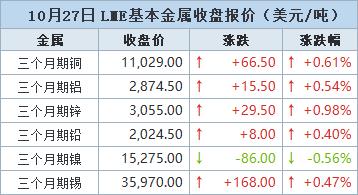
Group 1 - LME copper prices reached a 17-month high due to signs of easing global trade tensions and strong economic growth expectations, with three-month copper rising by $66.5 to $11,029.0 per ton [1] - The three-month aluminum price increased by $15.5 to $2,874.5 per ton, while zinc rose by $29.5 to $3,055.0 per ton, indicating a positive trend in base metal prices [2][7] - A recent survey of 30 industry analysts projected an increase in average copper prices, estimating 2025 LME spot copper at $9,752 per ton, up from previous estimates [6] Group 2 - The Chinese economy showed signs of strengthening, with September industrial profit growth being the fastest in nearly two years, which may enhance demand for industrial metals [4] - The weakening of the US dollar against the Chinese yuan made dollar-denominated commodities cheaper for Chinese buyers, although the copper premium in China has decreased, indicating a slower purchasing pace [5] - Zinc inventories in LME registered warehouses have dropped to 37,050 tons, the lowest level since March 2023, reflecting supply concerns [8]

日韩股指创下纪录,油价铜价同步上扬,中美经贸磋商成果提振国际市场
Huan Qiu Shi Bao· 2025-10-27 22:47
Group 1 - The easing of China-US trade tensions has led to a significant increase in market optimism, resulting in a rebound across global markets, including stock prices, oil, and copper [1][2][3] - Asian stock markets saw substantial gains, with the KOSPI index surpassing 4000 points and the Nikkei index reaching a historical high of 50,000 points, reflecting investor confidence in improved trade relations [2] - The positive sentiment from the China-US trade discussions has also influenced commodity prices, with agricultural products like soybeans and corn expected to benefit from a potential trade agreement [3][4] Group 2 - The progress in China-US trade negotiations has alleviated concerns about economic weakness, leading to a rise in US stock futures and European stock index futures [3][5] - China's industrial profits showed a year-on-year increase of 3.2% for the first nine months of the year, with a notable 21.6% growth in September, exceeding market expectations [4] - The stability and cooperation between China and the US are crucial for global market confidence, as their trade accounts for nearly one-fifth of the global total, highlighting the interconnectedness of supply chains [5]
How earnings and a potential US-China trade deal are driving markets
Youtube· 2025-10-27 17:56
Core Insights - Corporate profits are stable, with S&P 500 net profit margins above the 5-year average for six consecutive quarters, and analysts expect this trend to continue into next year [1][3] Earnings Performance - The earnings season has been solid, particularly for financials and money center banks, driven by trading and investment banking [3] - Industrial companies are reporting strong earnings, supported by demand for AI infrastructure [3] - Tech earnings are anticipated to be a significant market driver this week, with high expectations set [4][5] Market Reactions - Recent earnings reports, such as those from GE Vernova, showed volatility, with stocks initially gapping up but then selling off sharply before stabilizing [8] - Market positioning and options trading are influencing stock movements at both individual and index levels [8] Economic Indicators - There are shifting expectations regarding China and potential Federal Reserve rate cuts, which could impact market dynamics [4][10] - The removal of trade-related overhangs is allowing markets to focus on earnings rather than trade headlines [11][12] Consumer Behavior - The economy is holding up well, with a K-shaped recovery observed; higher-income consumers are faring better than lower-income consumers, who are struggling with inflation [16] - There is caution in hiring, but mass layoffs are not being reported [16] Federal Reserve Outlook - A 25 basis point rate cut is largely expected, with discussions around the end of quantitative tightening (QT) gaining traction [17][18] - Markets are pricing in further rate cuts, with expectations for a third cut in January being slightly better than a coin flip [20]

泰国与美国就贸易问题达成框架协议
Shang Wu Bu Wang Zhan· 2025-10-27 16:28
Core Points - The United States and Thailand announced a reciprocal trade framework agreement, maintaining a 19% tariff on Thai products while identifying categories for potential tariff adjustments or reductions to zero [1] - Thailand will eliminate tariff barriers on approximately 99% of goods, including various industrial products, food, and agricultural products from the United States [1] - Thailand is committed to removing obstacles to U.S. product exports, including the acceptance of American-made automobiles [1]
What we know about Trump's ‘virtually done' trade deal with China so far
MarketWatch· 2025-10-27 15:27
Core Viewpoint - The Trump administration is anticipated to finalize a new trade agreement with China this week, leading to a rally in U.S. stocks [1] Group 1 - The expected trade agreement is likely to have a positive impact on market sentiment, contributing to the rise in U.S. stock prices [1]