
碳市场

Search documents
(经济观察)中国碳市场中长期发展的时间表和路线图出炉
Zhong Guo Xin Wen Wang· 2025-08-26 08:04
Core Viewpoint - The recently published "Opinions on Promoting Green and Low-Carbon Transition and Strengthening National Carbon Market Construction" marks the first central document in China's carbon market sector, outlining a roadmap for the long-term development of the national carbon market [1] Group 1: National Carbon Market Development - The document provides a clear roadmap for building a more effective, vibrant, and internationally influential carbon market, detailing the requirements for establishing a national voluntary greenhouse gas emission reduction trading market [1] - The establishment of both the national carbon emission trading market (mandatory carbon market) and the national voluntary greenhouse gas emission reduction trading market (voluntary carbon market) has been achieved, creating a comprehensive national carbon market system [1][2] - As of August 22, 2025, the cumulative transaction volume of carbon emission allowances (CEA) in the national carbon market reached 680 million tons, with a total transaction value of 47.41 billion yuan [2] Group 2: Regulatory Framework and Market Expansion - Over 30 regulations and technical standards have been developed, forming a multi-level and relatively complete regulatory framework for the carbon market [2] - The coverage of the mandatory carbon market is set to expand, with the steel, cement, and aluminum smelting industries being included this year, effectively managing over 60% of national carbon emissions [2] - The carbon allowance allocation method will transition from free allocation to a combination of free and paid allocation, gradually increasing the proportion of paid allocation [2] Group 3: Financial Instruments and Market Vitality - The introduction of carbon pledge and carbon repurchase systems aims to enhance financing channels for key emission units, activate carbon assets, and reduce financing costs [3] - Financial institutions will be encouraged to participate in the national carbon market transactions, with the potential inclusion of non-compliance entities and eligible individuals in the voluntary carbon market [3] - The Ministry of Ecology and Environment will continue to strengthen the institutional foundation for carbon market construction, aiming to build a more effective, vibrant, and internationally influential national carbon market [3]
碳市场建设迎来政策利好 金融创新与价格机制双轮联动
Zhong Guo Jing Ying Bao· 2025-08-26 07:15
Core Viewpoint - The release of the "Opinions on Promoting Green and Low-Carbon Transition and Strengthening National Carbon Market Construction" injects new momentum into the development of China's carbon market, highlighting the acceleration of carbon asset financialization and the importance of carbon pricing in guiding green development [1] Group 1: Carbon Pledge Financing - Financial institutions are encouraged to engage in carbon pledge financing, with a focus on compliance and risk control while participating in the national carbon market [2] - As of July 2025, Guangdong Province has conducted 34 carbon pledge financing transactions, involving 8.4997 million tons of carbon emissions rights and raising 114 million yuan, primarily in the paper and power generation sectors [2] Group 2: Diverse Financing Models - Various operational models for carbon pledge financing have emerged, such as Jiujing Bank issuing a 3 million yuan green loan backed by CCER forestry carbon sink rights [3] - Beijing Bank's Nanjing branch successfully executed its first marine carbon sink pledge loan, utilizing future revenue rights as collateral to activate dormant "blue assets" [3] Group 3: Carbon Pricing Mechanism - The comprehensive operation of the national carbon emissions trading market and the introduction of carbon financial products will enhance the role of carbon pricing in optimizing green investment decisions and improving credit risk for enterprises [4] - The establishment of a robust carbon pricing mechanism is essential for providing effective price signals to support green low-carbon development [4] Group 4: Carbon Price Dynamics - The carbon price should not be excessively high or low; a balanced approach is necessary to facilitate the transition of high-emission industries while supporting the growth of the renewable energy sector [5] - The clear "dual carbon" goals necessitate higher carbon prices to guide enterprises in their transformation and to mobilize financial resources for deep green transitions [5] Group 5: Market Performance - As of August 25, the national carbon market's comprehensive price was 70.34 yuan per ton, with a trading volume of 59,665,129 tons and a transaction value of approximately 4.4047 billion yuan from January 1 to August 25, 2025 [6]
全国碳市场建设提速:2027年工业全覆盖,2030年定型
2 1 Shi Ji Jing Ji Bao Dao· 2025-08-26 07:01
Core Points - The document outlines a clear timeline for the expansion and finalization of the national carbon market by 2027 and 2030, respectively, providing a roadmap for government and enterprises [1][2][3] - The national carbon market has officially operated for four years, with carbon prices exceeding 100 yuan/ton and the inclusion of steel, cement, and aluminum industries, covering approximately 8 billion tons of emissions [1][2] - The document emphasizes the need for a dual approach of expanding the market and improving its quality, with a focus on including high-energy-consuming industries and introducing a paid allocation mechanism [6][9] Industry Impact - The expansion of the carbon market is expected to accelerate the inclusion of high-energy-consuming industries, which will enhance the market's contribution to social emissions reduction and the effectiveness of price signals [6][11] - The anticipated carbon price is projected to rise steadily, potentially reaching 150-200 yuan/ton by 2030, driven by the tightening of allocation quotas and the introduction of paid distribution [2][9] - High-emission enterprises are urged to prepare for the challenges posed by rising carbon prices, as failure to reduce emissions could lead to significantly increased costs [11][12] Market Dynamics - The document indicates that financial institutions will play a crucial role in the carbon market, with the introduction of various green financial products and services to support greenhouse gas reduction efforts [7][8] - The carbon market's pricing mechanism is expected to evolve, with a focus on establishing a reasonable pricing level that aligns with international standards [10] - The introduction of a more diverse range of market participants, including financial institutions and non-compliance entities, is anticipated to enhance market liquidity and pricing efficiency [7][8] Regulatory Framework - The document outlines the need for a scientifically sound and rational allocation of carbon quotas, emphasizing the importance of a complete carbon trading market mechanism [11][12] - The establishment of a robust carbon pricing mechanism is crucial for driving investments in deep decarbonization technologies, with the government expected to implement measures to prevent excessive speculation and volatility in carbon prices [10]
中泰期货晨会纪要-20250826
Zhong Tai Qi Huo· 2025-08-26 03:05
Report Industry Investment Rating There is no information provided in the content about the report industry investment rating. Core Viewpoints of the Report - **Stock Index Futures**: Consider long - term buying on dips and focus on short - term supplementary gains opportunities for IH. The A - share market is strong, and overseas market risk preference has increased due to Powell's dovish stance. [11] - **Treasury Bond Futures**: Short - term trading is expected to be volatile, and the medium - term curve steepening strategy can still be held. The bond market has risen significantly, showing a situation of both stocks and bonds rising. [12] - **Black Commodities**: Overall, the black commodity market is expected to remain volatile. Policy and supply - demand factors jointly affect prices, with different trends for different varieties. [14][16][17][18] - **Non - ferrous Metals and New Materials**: Aluminum is expected to be volatile and bullish, while alumina is expected to be volatile and bearish. Zinc is expected to weaken, and other varieties also have their own trends based on supply - demand and policy factors. [20][21][22][23] - **Agricultural Products**: Different agricultural products have different trends. For example, cotton has short - term upward momentum but long - term supply pressure, while sugar is restricted by inventory and supply factors. [25][28] - **Energy and Chemicals**: Crude oil is likely to enter a supply - surplus pattern, and other energy and chemical products also have their own price trends based on supply - demand and geopolitical factors. [39][40][41][43][44] Summary by Related Catalogs Macro News - Shanghai introduced a "combination punch" of real - estate policies, including relaxed housing purchase restrictions, increased housing provident fund loan limits, and adjusted mortgage interest rates and property tax policies. [9] - The CPC Central Committee General Office and the State Council General Office issued an opinion on promoting green - low - carbon transformation and strengthening the construction of the national carbon market. [9] - Trump met with South Korean President Yoon Suk - yeol, expressing willingness to renegotiate the trade agreement and considering ordering ships from South Korea. Trump's administration also planned to impose a 50% tariff on Indian products. [9] - In July, the annualized sales volume of new homes in the US decreased by 0.6% to 652,000 units, and the median price of new homes decreased by 5.9% year - on - year to $403,800. [9] - Japanese postal services will temporarily stop receiving some mail destined for the US due to new regulations. [9] - Henan coking enterprises will implement voluntary production cuts from August 25th to September 3rd, with an estimated reduction of 20 - 35%. [10] Stock Index Futures - Strategy: Long - term buying on dips, focusing on short - term supplementary gains opportunities for IH. The A - share market is strong, with the Shanghai Composite Index approaching 3900 points, and the market turnover is close to 3.2 trillion yuan. Overseas, Powell's dovish stance at the global central bank annual meeting has increased market risk preference. [11] Treasury Bond Futures - Strategy: Short - term trading is expected to be volatile, and the medium - term curve steepening strategy can still be held. The capital market is balanced and loose, and the bond market has risen significantly under the influence of interest - rate cut expectations and loose capital. [12] Black Commodities Spiral Steel and Iron Ore - Market fluctuations are due to the dovish remarks of the Fed Chairman and the relaxation of real - estate policies in Shanghai. The market is expected to remain volatile in the future, with seasonal demand improving and supply remaining strong. [14] Coal and Coke - The price of coal and coke may enter a high - level volatile stage in the short term. Supply is expected to be tight in the short term, but there are also potential downward pressures. [16] Ferroalloys - Short - term attention should be paid to the fluctuations of ferrosilicon. In the medium term, a short - selling strategy on rallies is recommended. [17] Soda Ash and Glass - For soda ash, a short - selling strategy on rallies can be maintained. For glass, it is advisable to wait and see for the time being. [18] Non - ferrous Metals and New Materials Aluminum and Alumina - Aluminum is expected to be volatile and bullish, while alumina is expected to be volatile and bearish. [20] Zinc - Zinc prices are expected to weaken due to increasing inventory and supply. [21] Lithium Carbonate - After the sentiment cools down, lithium carbonate prices are expected to trade in a wide range. [22] Industrial Silicon and Polysilicon - Industrial silicon is expected to trade in a volatile range, and polysilicon is mainly affected by policy progress and is expected to trade in a wide range. [23][24] Agricultural Products Cotton - In the short term, cotton prices are bullish, but there are long - term supply pressures. A short - selling strategy on rallies for the long - term is recommended. [25] Sugar - Domestic sugar prices are restricted by inventory and supply, and attention should be paid to potential short - covering opportunities during the Mid - Autumn and National Day holiday stocking period. [28] Eggs - The egg market has high supply pressure. A short - selling strategy on rallies for the near - term is recommended, and caution is needed when buying at the bottom. [31][32] Apples - A light - position positive - spread strategy is recommended. [33] Corn - Short - selling the 01 contract on rallies or a 11 - 1 positive - spread strategy is recommended. [33] Red Dates - It is advisable to wait and see. [35] Pigs - A short - selling strategy on rallies for the near - term contracts is recommended. The spot price may rebound at the end of the month, but the upside is limited. [36] Energy and Chemicals Crude Oil - Crude oil is likely to enter a supply - surplus pattern, and a short - selling strategy on rallies can be considered. [39] Fuel Oil - Fuel oil prices will follow the trend of oil prices, and the short - term trading range is estimated to be between 65 and 70 US dollars. [40] Plastics - Polyolefins are expected to be volatile and bearish from a supply - demand perspective, but market sentiment may be affected by the expectation of eliminating backward production capacity. [41] Rubber - There are opportunities to buy on dips, but caution is needed when chasing high prices. [43] Methanol - Methanol prices are expected to be volatile and bearish due to inventory accumulation, but market sentiment may be affected by the expectation of eliminating backward production capacity. It is recommended to exit short positions and wait and see. [44] Caustic Soda - A strategy of taking profits on rallies for long positions is recommended. [45] Asphalt - Asphalt prices will follow the trend of oil prices, and its fundamentals are in the transition from the off - season to the peak season. [46] Polyester Industry Chain - A strategy of buying on dips is recommended. The cost support is strengthening, and the demand in the industry chain is gradually recovering. [47][48] Liquefied Petroleum Gas (LPG) - In the long term, a bearish view is maintained as supply is abundant and demand growth is limited. [49] Pulp - Observe whether the de - stocking at ports continues and whether the spot trading and demand improve after Chenming's resumption of production. [50] Logs - The fundamentals are expected to be volatile. It is recommended to observe and consider hedging on rallies according to one's own spot situation. [51] Urea - A bearish view is maintained, and attention should be paid to changes in China's urea export details. [52] Synthetic Rubber - The fundamentals are gradually improving, and opportunities for low - level buying can be considered. [53]
四大证券报精华摘要:8月26日
Zhong Guo Jin Rong Xin Xi Wang· 2025-08-26 00:21
Group 1 - The rare earth industry is experiencing positive mid-year performance due to policy support and growing demand, with the Wande Rare Earth Concept Index rising by 19.41% since August 18 [1] - Analysts believe the rare earth sector will benefit from increasing demand in applications such as electric vehicles and robotics, highlighting the scarcity of resources and potential price increases [1] - The Central Committee and State Council's recent opinions support the development of a national carbon market, aiming for comprehensive coverage of major industrial sectors by 2027 and a robust carbon pricing mechanism by 2030 [1] Group 2 - During the 14th Five-Year Plan period, China's customs will manage an average of 5.2 billion tons of imports and exports annually, with a total value of 41.5 trillion yuan, making it the largest globally [2] - The customs authority, in collaboration with over 20 ministries, has launched annual cross-border trade facilitation initiatives, expanding participation to 25 cities across 17 provinces [2] Group 3 - Over 1600 listed companies reported their mid-year results, with insurance funds entering the top ten shareholders of over 120 companies, particularly favoring sectors like chemicals, machinery, and electrical equipment [3] - The onshore RMB strengthened against the USD, closing at 7.1517, a rise of 288 basis points, influenced by a decline in the dollar index and improved market sentiment [3] Group 4 - The bond market is under pressure, with rising yields leading to capital losses, and traditional investment logic failing, prompting a shift towards a risk preference-driven pricing state [4] - Analysts suggest that the most pessimistic phase for the bond market may be over, indicating potential trading and allocation opportunities [4] Group 5 - Agricultural Bank of China announced a tender for AI quality inspection capabilities, reflecting the banking sector's active engagement in AI development [5] - The white liquor market faces challenges due to a lack of unified standards for vintage liquor, leading to issues of trust and quality [6] Group 6 - The implementation of personal consumption loan interest subsidies is set for September 1, with banks preparing to assist customers despite pending policy details [7] - Public fund institutions have been actively purchasing their own products, with equity funds making up a significant portion of these purchases [7] - The total scale of equity ETFs in China reached a historical high of 4.117 trillion yuan, marking a 24.05% increase since the beginning of the year [7]
上证早知道|央行等三部门 最新印发!中办、国办 公布重要文件!上海楼市新政 今起施行
Shang Hai Zheng Quan Bao· 2025-08-25 23:31
Group 1: Financial Support for Forestry and Carbon Market Development - The People's Bank of China, financial regulatory authorities, and the National Forestry and Grassland Administration jointly issued a notice to enhance financial support for high-quality development in forestry, focusing on expanding mortgage loan products and services related to forest rights [2] - The notice encourages the establishment of forest rights storage institutions and the involvement of social capital in guarantee services, as well as the optimization of forest rights value assessment mechanisms [2] - The State Council's opinion on promoting green and low-carbon transformation emphasizes the importance of the carbon market as a policy tool for addressing climate change and accelerating green transformation [2] Group 2: Real Estate Policy Adjustments in Shanghai - Shanghai's housing and urban construction authorities issued a notice to optimize and adjust real estate policies, including reducing housing purchase restrictions and improving housing provident fund and personal housing loan policies, effective from August 26, 2025 [4] Group 3: Innovation in Pharmaceutical Industry - The innovation drug sector is experiencing increased activity, with notable stock price increases for companies such as Hitec Biotech, which rose by 20%, and several others reaching their daily limit [6] - The National Medical Products Administration reported that China's pharmaceutical industry ranks second globally, with approximately 30% of innovative drugs under development [6] Group 4: Developments in the Photovoltaic Industry - The photovoltaic sector is seeing a surge in activity following the China Photovoltaic Industry Association's initiative to strengthen industry self-discipline and promote fair competition [7] - Leading companies in the photovoltaic industry, such as Robotech and Daqo New Energy, have experienced significant stock price increases as a result of this initiative [7] Group 5: Company Performance and Strategic Moves - Zhangyuan Tungsten's revenue for the first half of the year reached 2.399 billion yuan, a year-on-year increase of 32.27%, while net profit grew by 2.54% [8] - Xizang Zhuofeng reported a revenue of 1.123 billion yuan, up 53.53%, with net profit increasing by 135.08% [8] - Aoyijin and Sleek signed a strategic cooperation agreement for production equipment and services, with an expected total investment of 500 million yuan over five years [9] - Huayi Technology is planning to issue H-shares and list on the Hong Kong Stock Exchange to enhance its international presence and competitiveness [11]
中共中央办公厅国务院办公厅关于推进绿色低碳转型加强全国碳市场建设的意见 (二〇二五年五月二十四日)
Jing Ji Ri Bao· 2025-08-25 21:47
Overall Requirements - The carbon market is a crucial policy tool for addressing climate change and promoting a green transition in economic and social development [1] - The establishment of a national carbon emissions trading market and a voluntary greenhouse gas reduction trading market aims to enhance the effectiveness and international influence of the carbon market [1][2] Goals and Objectives - By 2027, the national carbon emissions trading market will cover major industrial sectors, while the voluntary reduction trading market will achieve full coverage in key areas [2] - By 2030, a comprehensive carbon emissions trading market will be established, featuring a transparent and unified pricing mechanism that aligns with international standards [2] Development of Carbon Emissions Trading Market - The coverage of the national carbon emissions trading market will be expanded based on industry development, emission reduction contributions, and data quality [3] - A transparent carbon emissions quota management system will be established, transitioning from intensity control to total control of emissions quotas by 2027 [3] Voluntary Reduction Trading Market - The development of a voluntary reduction trading market will focus on creating a comprehensive methodology to support sustainable development and social expectations [5] - Encouragement for government agencies and enterprises to utilize certified voluntary reduction credits to offset emissions [5] Market Vitality Enhancement - Financial institutions will be encouraged to develop green financial products related to carbon emissions trading [7] - The introduction of new trading participants, including individuals and financial institutions, will be supported to enhance market participation [7] Capacity Building - A management system will be established to ensure effective supervision and management of the national carbon market [8] - The carbon emissions accounting and reporting system will be improved to ensure accurate emissions data [8] Organizational Implementation - Local governments and relevant departments will be responsible for implementing the carbon market policies and ensuring compliance [10] - Legal frameworks will be developed to support the carbon market, including regulations for voluntary reduction trading [11] International Cooperation - Active participation in international carbon market mechanisms and cooperation to promote global green and low-carbon transitions [11][12]
免费有偿结合 全国碳市场建设提速
Bei Jing Shang Bao· 2025-08-25 16:06
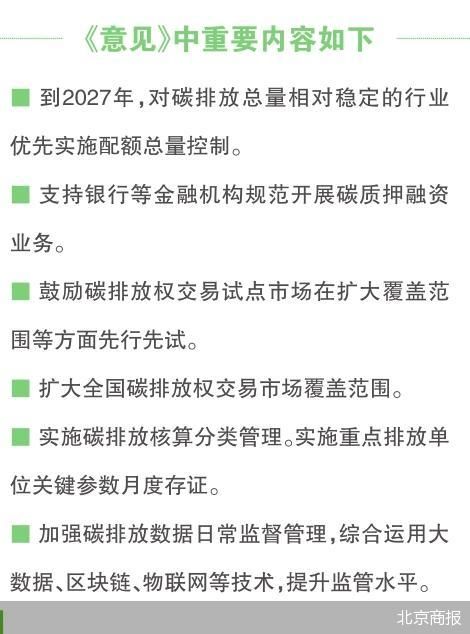
全国碳市场建设正在进一步加快。8月25日,中共中央办公厅、国务院办公厅《关于推进绿色低碳转型 加强全国碳市场建设的意见》(以下简称《意见》)对外公布。《意见》提出,到2027年,全国碳排放 权交易市场基本覆盖工业领域主要排放行业,全国温室气体自愿减排交易市场实现重点领域全覆盖。到 2030年,基本建成以配额总量控制为基础、免费和有偿分配相结合的全国碳排放权交易市场,建成诚信 透明、方法统一、参与广泛、与国际接轨的全国温室气体自愿减排交易市场,形成减排效果明显、规则 体系健全、价格水平合理的碳定价机制。其中,《意见》明确,稳妥推行免费和有偿相结合的碳排放配 额分配方式,有序提高有偿分配比例。 《意见》明确,碳市场是利用市场机制积极应对气候变化、加快经济社会发展全面绿色转型的重要政策 工具。目前,我国已建立重点排放单位履行强制减排责任的全国碳排放权交易市场和激励社会自主减排 的全国温室气体自愿减排交易市场。 《意见》针对碳市场多方面提出具体举措。《意见》包括总体要求、加快建设全国碳排放权交易市场、 积极发展全国温室气体自愿减排交易市场、着力提升碳市场活力、全面加强碳市场能力建设、加强组织 实施保障等六个方面17条 ...

中办、国办重磅文件!事关全国碳市场建设
Zhong Guo Zheng Quan Bao· 2025-08-25 15:41
Core Viewpoint - The document outlines the Chinese government's strategy to enhance the national carbon market as a crucial tool for addressing climate change and promoting a green low-carbon transition in the economy [4][6]. Summary by Sections Overall Requirements - The strategy emphasizes the importance of adhering to Xi Jinping's thoughts on socialism with Chinese characteristics and aims to balance green low-carbon transformation with economic development needs [7]. - Key goals include achieving basic coverage of major industrial sectors in the national carbon emission trading market by 2027 and establishing a comprehensive carbon pricing mechanism by 2030 [7]. Accelerating the National Carbon Emission Trading Market - The plan includes expanding the coverage of the carbon emission trading market based on industry development, pollution reduction contributions, and carbon emission characteristics [8]. - A transparent carbon emission quota management system will be established, transitioning from intensity control to total control of carbon emissions by 2027 [8]. Developing the National Voluntary Greenhouse Gas Reduction Trading Market - The document calls for the establishment of a comprehensive methodology system for voluntary reduction projects, focusing on areas with significant sustainable development benefits [10]. - It encourages the use of certified voluntary reduction credits in various sectors, including government and enterprises, to offset carbon emissions [10]. Enhancing Market Vitality - The strategy promotes the development of financial products related to carbon emissions and encourages financial institutions to participate in the carbon market [11]. - It aims to expand the range of trading participants, including individuals and financial institutions, while ensuring regulatory oversight to maintain market order [11]. Strengthening Carbon Market Capacity - A robust management system will be established to support the development of the carbon market, including digital and intelligent management systems [12]. - The document emphasizes the need for accurate carbon emission accounting and reporting, with a focus on improving data quality and regulatory oversight [13]. Organizational Implementation Support - Local governments are tasked with implementing the strategy and providing policy support for carbon market operations [14]. - The document highlights the importance of legal frameworks to support carbon market development and the need for international cooperation in carbon market mechanisms [15][17].
中办、国办重磅发布!
Jin Rong Shi Bao· 2025-08-25 14:08
Group 1 - The core viewpoint of the article emphasizes the importance of the carbon market as a policy tool for addressing climate change and promoting a green transition in the economy and society [1] - The main goals set forth in the recent opinion include achieving basic coverage of major industrial sectors in the national carbon emissions trading market by 2027 and establishing a comprehensive voluntary emissions reduction trading market by 2030 [1][2] - The expansion of the national carbon emissions trading market will include new sectors such as steel, cement, and electrolytic aluminum, which are significant contributors to emissions and are heavily influenced by international green trade [2][3] Group 2 - The opinion outlines the need to improve the carbon emissions quota management system, including establishing a transparent quota management framework and gradually shifting from intensity control to total control of emissions quotas [4] - The introduction of carbon finance is highlighted as a key strategy to enhance market vitality, allowing financial institutions to develop green financial products related to carbon emissions rights [5][6] - The article references the EU carbon market as a model for integrating financial attributes into carbon markets, which has led to a diverse range of trading products and active market participation [7]