
美联储货币政策

Search documents
五矿期货:有色金属日报-20260204
Wu Kuang Qi Huo· 2026-02-04 01:45
1. Report Industry Investment Rating No relevant content is provided in the report. 2. Core Viewpoints of the Report - Copper prices are expected to fluctuate strongly due to positive sentiment, a tight copper - mine supply, and high growth in domestic refined copper supply [3][4]. - Aluminum prices are expected to gradually stabilize and rise as LME aluminum inventory is at a relatively low level and the US aluminum spot premium remains high, despite weak downstream demand [5][6]. - The lead industry's current situation is weak with rising inventories, but the higher - than - expected US ISM manufacturing PMI has alleviated some panic [8][9]. - Zinc prices are currently following the sector to make up for the macro - attribute increase. After the market sentiment stabilizes, the trading focus may return to the industrial logic [10][11][12]. - Tin prices are expected to maintain a long - term upward trend but will mainly operate in a wide - range shock in the short term due to the marginal relaxation of supply and demand and rising inventory [13][14]. - Nickel prices are expected to mainly operate in a wide - range shock in the short term as they face fundamental pressure and increasing domestic nickel inventory [16][17][18]. - Lithium carbonate prices are expected to be strongly supported by off - season de - stocking, but due to large market fluctuations, it is recommended to be cautious and observe or take a light - position attempt [20][21]. - Alumina prices are recommended to be observed in the short term as the over - capacity pattern is difficult to change, and there are multiple dilemmas for continuous rebound [23][24]. - Stainless steel prices are expected to rise as the cost support is strong and the supply is shrinking [26][27]. - Cast aluminum alloy prices are expected to be supported in the short term due to supply - side disturbances and seasonal tightness of raw material supply [29][30]. 3. Summary by Related Catalogs Copper Market Information - The price of LME copper 3M rose 3.95% to $13,410/ton, and the main contract of SHFE copper closed at 105,180 yuan/ton. LME copper inventory increased by 1,450 to 176,125 tons, with the increase from Asian warehouses. The proportion of cancelled warrants decreased, and the Cash/3M discount narrowed. SHFE daily warehouse receipts increased by 0.05 to 159,000 tons. The spot in Shanghai and Guangdong regions was at a discount to the futures, and the spot import was at a loss of about 500 yuan/ton. The refined - scrap copper price difference widened to 3,280 yuan/ton [3]. Strategy Viewpoint - With the US planning to promote the commercial reserve of critical minerals and China strengthening the copper reserve expectation, along with better - than - expected manufacturing PMIs in the US and the Eurozone, the sentiment is positive. Although the new Fed Chairman's monetary policy is moderately hawkish, long - term prospects are not pessimistic. The copper - mine supply remains tight, and the domestic refined copper supply maintains high growth. Copper prices are expected to fluctuate strongly. The reference range of the main SHFE copper contract is 102,000 - 108,000 yuan/ton, and the LME copper 3M is 13,000 - 13,800 dollars/ton [4]. Aluminum Market Information - The price of LME aluminum rose 1.39% to $3,099/ton, and the main contract of SHFE aluminum closed at 23,865 yuan/ton. The position of the weighted SHFE aluminum contract increased by 0.9 to 676,000 lots, and the futures warehouse receipts increased slightly to 151,000 tons. Domestic aluminum ingot and aluminum rod inventories increased, the aluminum rod processing fee fluctuated up, and the spot trading was dull. The spot in the East China region was at a discount of 220 yuan/ton to the futures, and the LME aluminum inventory decreased by 0.2 to 495,000 tons [5]. Strategy Viewpoint - Although domestic aluminum ingot and aluminum rod inventories continue to accumulate and downstream demand is weak in the off - season, it does not constitute a major negative for prices. With the LME aluminum inventory at a relatively low level and the US aluminum spot premium remaining high, aluminum prices are strongly supported. In the context of eased market sentiment, aluminum prices are expected to gradually stabilize and rise. The reference range of the main SHFE aluminum contract is 23,500 - 24,200 yuan/ton, and the LME aluminum 3M is 3,050 - 3,130 dollars/ton [6]. Lead Market Information - The SHFE lead index fell 0.26% to 16,670 yuan/ton on Tuesday, with a total unilateral trading position of 105,900 lots. The LME lead 3S rose by 13.5 to $1,973/ton, with a total position of 170,900 lots. The average price of SMM1 lead ingot and recycled refined lead was 16,450 yuan/ton, and the refined - scrap price difference was at par. The average price of waste electric vehicle batteries was 9,975 yuan/ton. The SHFE lead ingot futures inventory was 33,400 tons, and the LME lead ingot inventory was 204,100 tons [8]. Strategy Viewpoint - The visible inventory of lead ore has increased, high - price silver supports smelting profits, and the TC remains at a low level. The operating rate of primary lead smelters remains relatively high, and primary lead ingots are accumulating. The inventory of recycled waste materials has increased, the profit of recycled smelting has slightly decreased, but the operating rate of recycled lead has increased marginally. The operating rate of downstream battery enterprises has slightly decreased. Both smelter finished - product inventory and social inventory have increased, indicating a weak industrial situation. The US ISM manufacturing PMI on February 2nd was higher than expected, which alleviated some panic [9]. Zinc Market Information - The SHFE zinc index rose 1.91% to 24,993 yuan/ton on Tuesday, with a total unilateral trading position of 203,800 lots. The LME zinc 3S rose by 79.5 to $3,348/ton, with a total position of 235,700 lots. The average price of SMM0 zinc ingot was 25,050 yuan/ton, and the basis in different regions varied. The SHFE zinc ingot futures inventory was 28,900 tons, and the LME zinc ingot inventory was 109,100 tons [10]. Strategy Viewpoint - In the industrial aspect, the inventory of zinc ore raw materials has increased, and the decline of zinc ore prices has slowed down. The accumulation of LME zinc ingot inventory has slowed down, the 3 - 15 month spread of LME zinc has increased, and the SHFE - LME ratio has declined again. The rise in overseas natural gas prices has raised concerns about the cost of European smelters. The new government in Bolivia has halted a zinc - mine development project. Currently, the zinc - copper ratio and zinc - aluminum ratio are at absolute lows. Zinc prices are still in the process of making up for the macro - attribute increase following the sector. After the market sentiment stabilizes, the trading focus may return to the industrial logic [11][12]. Tin Market Information - On February 3rd, the tin price rebounded after reaching the bottom. The main SHFE tin contract closed at 383,340 yuan/ton, down 2.37% from the previous day. The SHFE inventory decreased by 209 to 7,788 tons. The operating rate of smelters in Yunnan remained stable at a high level, while the refined tin output in Jiangxi was still low due to the shortage of scrap tin raw materials. The downstream demand was still weak as the overall price was at a high level, and the terminal industry faced cost pressure [13]. Strategy Viewpoint - In the short term, the price of precious metals has stabilized and rebounded, and the tin price has also recovered. In the long term, the tin price will maintain an upward trend, but in the short term, it is expected to mainly operate in a wide - range shock due to the marginal relaxation of supply and demand and the recent rise in inventory. It is recommended to observe. The reference range of the domestic main contract is 370,000 - 430,000 yuan/ton, and the overseas LME tin is 47,000 - 51,000 dollars/ton [14]. Nickel Market Information - On February 3rd, the nickel price stabilized and rebounded. The main SHFE nickel contract closed at 134,830 yuan/ton, up 4.0% from the previous day. In the spot market, the premium and discount of each brand remained stable, and the cost of nickel ore was stable, while the price of nickel iron fluctuated up [16]. Strategy Viewpoint - Although the price of precious metals has stabilized and the prices of the non - ferrous metal sector have generally recovered, the nickel price still faces fundamental pressure in the short term, and the upward space is expected to be limited. Due to the high premium of refined nickel over nickel iron and the conversion of nickel iron to high - grade nickel matte, the output of refined nickel in January is expected to increase significantly. The domestic nickel inventory has increased significantly for three consecutive weeks, which significantly drags down the nickel price. It is expected that the nickel price will mainly operate in a wide - range shock. The reference range of the SHFE nickel price is 120,000 - 150,000 yuan/ton, and the LME nickel 3M contract is 16,000 - 18,000 dollars/ton [17][18]. Lithium Carbonate Market Information - The MMLC lithium carbonate spot index closed at 146,173 yuan in the evening session, up 3.55% from the previous working day. The average price of battery - grade lithium carbonate increased by 5,050 yuan (+3.57%), and the industrial - grade increased by 3.46%. The LC2605 contract closed at 148,100 yuan, up 11.82% from the previous day [20]. Strategy Viewpoint - On Tuesday, the pessimistic sentiment in the commodity market eased, and the market rebounded significantly. The expectation of fundamental improvement in lithium carbonate remains unchanged. Affected by the Spring Festival in February, the production of the cathode segment is expected to decrease by only about 10% month - on - month. After the short - term price risk is released, with the low inventory of downstream enterprises, the bargaining power for pre - festival raw material procurement is low. The off - season de - stocking is expected to strongly support the lithium price. Due to large market fluctuations, it is recommended to be cautious and observe or take a light - position attempt. The reference range of the GZCE lithium carbonate 2605 contract is 137,000 - 156,000 yuan/ton [21]. Alumina Market Information - On February 3rd, 2026, the alumina index rose 1.31% to 2,808 yuan/ton, with a total unilateral trading position of 531,600 lots, down 27,000 lots from the previous day. The Shandong spot price was 2,555 yuan/ton, at a discount of 254 yuan/ton to the main contract. The overseas MYSTEEL Australia FOB price was $304/ton, and the import loss was 78 yuan/ton. The futures warehouse receipts increased by 0.72 to 189,400 tons. The CIF price in Guinea remained at $61/ton, and that in Australia decreased by 2 to $58/ton [23]. Strategy Viewpoint - Workers at a mine in Guinea's Boké region have launched an indefinite strike. Currently, production and shipping are normal, and the impact needs to be observed. The over - capacity pattern in the alumina smelting end is difficult to change in the short term, and the inventory accumulation trend continues. The market's expectation of supply - contraction policies has increased, but there are still three dilemmas for continuous rebound. It is recommended to observe in the short term. The reference range of the domestic main contract AO2605 is 2,700 - 2,950 yuan/ton, and attention should be paid to domestic supply - contraction policies, Guinea's ore policies, and the Fed's monetary policy [24]. Stainless Steel Market Information - The main stainless - steel contract closed at 13,585 yuan/ton on Tuesday afternoon, up 1.23% (+165). The unilateral position was 240,600 lots, down 11,405 lots from the previous day. The spot prices in different markets varied, and the raw material prices were mostly stable. The futures inventory increased by 4,641 to 43,579 tons, and the social inventory increased to 904,500 tons, with the 300 - series inventory increasing by 2.86% [26]. Strategy Viewpoint - Last week, market fluctuations increased significantly. The sharp decline in precious - metal prices on Friday dragged down the non - ferrous metal sector, impacting market sentiment. As the Spring Festival approaches, the purchasing enthusiasm of the middle and lower reaches is low, and the market is in a wait - and - see mood. The supply side has significantly contracted. The cost support of the industrial chain is still strong, and the price has strong support below. The bullish view remains unchanged, and the reference range of the main contract is 13,000 - 14,000 yuan/ton [27]. Cast Aluminum Alloy Market Information - The price of cast aluminum alloy stabilized and rebounded. The main AD2603 contract closed at 22,215 yuan/ton, up 1.72%. The weighted contract position increased to 23,900 lots, the trading volume was 23,000 lots, and the warehouse receipts decreased by 0.08 to 66,900 tons. The price difference between the AL2603 and AD2603 contracts widened. The average price of domestic mainstream ADC12 decreased, and the price of imported ADC12 decreased by 300 yuan/ton. The domestic three - place inventory increased by 0.01 to 41,400 tons [29]. Strategy Viewpoint - The cost of cast aluminum alloy has stabilized. Although the demand is relatively average, the price is supported in the short term due to continuous supply - side disturbances and seasonal tightness of raw material supply [30].
宝城期货贵金属有色早报(2026年2月4日)-20260204
Bao Cheng Qi Huo· 2026-02-04 01:43
宝城期货贵金属有色早报(2026 年 2 月 4 日) ◼ 品种观点参考 时间周期说明:短期为一周以内、中期为两周至一月 | 品种 | | 短期 | 中期 | 日内 | 观点参考 | 核心逻辑概要 | | --- | --- | --- | --- | --- | --- | --- | | 黄金 | 2604 | 震荡 | 震荡 | 震荡 偏强 | 观望 | 短期宏观预期走弱,前期多头资 金了结意愿强 | | 铜 | 2603 | 强势 | 震荡 | 强势 | 长线看强 | 短期宏观预期走弱,前期多头资 金了结意愿强 | 说明: 投资咨询业务资格:证监许可【2011】1778 号 1.有夜盘的品种以夜盘收盘价为起始价格,无夜盘的品种以昨日收盘价为起始价格,当日日盘收盘价为终点价格, 计算涨跌幅度。 2.跌幅大于 1%为弱势,跌幅 0~1%为震荡偏弱,涨幅 0~1%为震荡偏强,涨幅大于 1%为强势。 3.震荡偏强/偏弱只针对日内观点,短期和中期不做区分。 主要品种价格行情驱动逻辑—商品期货 品种:黄金(AU) 日内观点:震荡偏强 中期观点:震荡 参考观点:观望 核心逻辑:继上周五宏观氛围走弱,贵金属有色普跌以 ...
贵金属日评-20260204
Jian Xin Qi Huo· 2026-02-04 01:21
1. Industry Investment Rating - No investment rating information is provided in the report 2. Core Viewpoints - The long - term upward driving force of precious metals remains unchanged. Investors are advised to go long after the downward momentum of precious metals weakens. However, due to the large influx of investment funds and high price volatility recently, investors are advised to reduce positions to avoid short - term risks. Also, be vigilant against the medium - term risk of the Fed tightening monetary policy to end the precious metals bull market [4][6] 3. Summary by Directory 3.1 Precious Metals Market Quotes and Outlook 3.1.1 Intraday Market - After three consecutive days of sharp adjustments in the precious metals market due to the nomination of a hawkish Fed chair candidate by Trump and the easing of the US - Iran conflict risk, the precious metals sector rebounded. On February 3, Asian session, London gold returned above $4,900 per ounce. This was because the internal adjustment risk was fully released, attracting some bottom - fishing funds, and the Trump administration announced the launch of the Vault Project, boosting the strategic value expectation of key minerals [4] 3.1.2 Medium - term Market - Trump's confirmation of the next Fed chair candidate eliminated the market's hedging demand for this uncertainty. The hawkish stance of the candidate also alleviated concerns about the loss of US fiscal discipline, so the precious metals correction was reasonable. The previous sharp rise in precious metals also needed a large retracement. However, the hawkish stance has no fundamental impact on the long - term bull market of gold and may mainly compress the duration of the medium - term bull market. It is bullish for silver, platinum, and palladium compared to gold. The report maintains the view that gold will rise in the medium and long term, and silver, platinum, and palladium will be stronger than gold in the medium term [6] 3.1.3 Domestic Precious Metals Market Quotes | Contract | Previous Closing Price | Highest Price | Lowest Price | Closing Price | Change Rate (%) | Open Interest | Change in Open Interest | | --- | --- | --- | --- | --- | --- | --- | --- | | SHFE Gold Index | 1,008.88 | 1,099.95 | 1,034.88 | 1,095.29 | 8.56 | 315,593 | 3,738 | | SHFE Silver Index | 24,549 | 21,659 | 20,313 | 20,979 | - 14.54 | 583,536 | - 65,359 | | GZFE Platinum Index | 550.99 | 575.14 | 539.71 | 570.52 | 3.54 | 31,822 | - 1,995 | | GZFE Palladium Index | 412.91 | 449.05 | 413.73 | 448.62 | 8.65 | 11,715 | - 526 | [5] 3.2 Precious Metals Market - related Charts - The report provides multiple charts including Shanghai gold and silver futures indexes, London gold and silver spot prices, the basis of Shanghai futures indexes to Shanghai Gold Exchange T+D, gold and silver ETF holdings, gold - silver ratio, and the correlation between London gold and other assets. All data sources are from Wind and the Research and Development Department of CCB Futures [8][10][16] 3.3 Main Macroeconomic Events/Data - Trump reached a trade agreement with India, reducing the US tariff on Indian goods from 50% to 18%. India will lower trade barriers, stop buying Russian oil, and buy from the US and Venezuela. The US will revoke the 25% punitive tariff, and India promises to buy over $500 billion of US products [17] - Trump is about to launch a strategic key mineral reserve plan called the Vault Project with an initial capital of $12 billion, integrating $2 billion of private funds and a $10 - billion loan from the US Export - Import Bank [17] - The US manufacturing activity expanded for the first time in a year in January. The ISM's January PMI rebounded to 52.6, breaking through the 50 mark for the first time in 12 months and reaching the highest level since August 2022. The new orders sub - index jumped from 47.4 in December to 57.1 in January, the highest since February 2022 [17] - Iran and the US will restart nuclear negotiations in Turkey on Friday. US envoy Witkoff and Iranian Foreign Minister Araghchi will meet in Istanbul, and representatives from Saudi Arabia, Egypt and other countries will also participate [18]
“再通胀”担忧卷土重来 美联储货币政策迷雾重重
2 1 Shi Ji Jing Ji Bao Dao· 2026-02-03 23:38
Economic Data and Inflation Concerns - Recent economic data from the U.S. indicates renewed inflation concerns, with the Producer Price Index (PPI) rising by 0.5% month-on-month in December, the largest increase in five months, and a year-on-year increase of 3% [1][10] - The core PPI, excluding food and energy, increased by 0.7% month-on-month and 3.3% year-on-year, both exceeding market expectations [1][10] - The ISM's Purchasing Managers' Index (PMI) for January rebounded to 52.6, marking the first time it has surpassed 50 in 12 months and the highest level since August 2022 [1][10] Manufacturing Expansion and Cost Pressures - The manufacturing sector's expansion in January was the fastest since 2022, attributed to the transmission effects of import tariffs, with companies passing on tariff-related costs to production [4][14] - This cost pressure may continue to push consumer inflation higher in the coming months, potentially allowing the Federal Reserve to maintain stable interest rates for a period [4][14] Market Reactions and Investment Strategies - Major investment firms like BlackRock, Bridgewater Associates, and PIMCO are adjusting their portfolios in anticipation of a new wave of inflation [4][14] - BlackRock is shorting U.S. Treasuries and UK gilts to hedge against falling interest rate expectations, while Bridgewater favors equities over bonds, and PIMCO is optimistic about U.S. Treasuries with embedded inflation protection [4][14] Federal Reserve's Monetary Policy Outlook - The outgoing Atlanta Fed President Bostic believes the Fed should not lower interest rates this year due to the strong economy and stable labor market, which could hinder efforts to bring inflation back to target levels [5][15] - Concerns about the impact of tariffs on inflation have a lagging effect, with many companies still uncertain about the true costs of tariffs [5][15] Future Inflation Projections - Looking ahead to 2026, inflation is expected to exhibit a "front-high, back-low" characteristic, with potential stronger inflation persistence in the first half of the year due to tariff transmission and tax cuts [6][16] - If the tariff transmission rate approaches 70%, the core PCE price index could end 2026 at 2.6% year-on-year [6][16] Federal Reserve Leadership and Policy Direction - The potential nomination of Kevin Warsh as the next Fed Chair could influence monetary policy, as he has historically advocated for a strong monetary policy stance [8][18] - Warsh's leadership may alleviate market concerns about inflation management being overshadowed by political priorities, promoting a data-driven approach to policy [8][18]

美联储新掌门上任,2026年江西节奏将如何影响跨境电商?
Sou Hu Cai Jing· 2026-02-03 13:55
Group 1 - The new Federal Reserve chair, Kevin Walsh, is expected to maintain a hawkish stance, leading to 2-3 interest rate cuts by 2026, which will influence foreign exchange rates [1] - The Chinese yuan has recently depreciated past the 7 mark, indicating a potential trend as the Federal Reserve's monetary policy shifts historically [1] - China's foreign trade demonstrated resilience in 2025, with total import and export value exceeding $7.5 trillion and a record trade surplus of $1.02 trillion, equivalent to one-fifth of Germany's annual GDP [1] Group 2 - The trade surplus is anticipated to grow in 2026, prompting companies to accelerate currency conversion and contributing to the appreciation of the yuan [1] - The internationalization of the yuan is progressing, with its share in global payment settlements rising to 6.8% by the end of 2025, surpassing the Japanese yen to become the third-largest international currency [1] Group 3 - Unexpected factors that could influence exchange rates include the U.S. Supreme Court's ruling on Trump's "reciprocal tariffs," potential new wars, and the complex dynamics of the yuan against the euro, all significantly affected by the dollar [3]
长江有色:3日铝价延续暴跌行情 买方多询价再补但实际成交难以匹配
Xin Lang Cai Jing· 2026-02-03 08:28
CCMN现货市场评述:今日长江现货成交价格23270-23310元/吨,跌410元,贴水240-贴水200,持平; 广东现货23275-23325元/吨,跌400元,贴水225-贴水175,涨20元;上海地区23260-23300元/吨,跌410 元,贴水250-贴水210,持平。 宏观层面,尽管特朗普信任提名主席沃什主张的货币政策框架鸽派立场不及预期,但业内专家指出,美 联储现有的利率管理机制高度依赖充裕的流动性环境,在不影响市场稳定的前提下收缩流动性面临重重 挑战。削减债券持仓本质上是紧缩行为,可能与降低利率的诉求相悖。金银市场巨震使全球市场风险偏 好急剧降温,而沃什的大规模缩表计划也与美联储当前依赖充裕流动性的利率管理机制存在冲突。此 外,特朗普计划启动战略关键矿产储备项目,供美国汽车企业、科技公司和制造商等采购并存储关键矿 产资源,以帮助企业对冲原材料价格波动风险,减少自行囤积库存的需求。国内方面,中国1月 RatingDog制造业PMI升至三个月高位50.3,销售价格14个月来首次回升,提振了市场多头信心,限制了 铝价跌幅。 CCMN国际市场:今日伦铝探底回升,LME三个月北京时间14:51报于30 ...

大摩:沃什执掌下美联储或“少说话” 美债市场波动将加剧
Zhi Tong Cai Jing· 2026-02-03 02:06
现任美联储主席鲍威尔就在去年10月表示,货币政策在"公众理解美联储在做什么以及为何这么做"的情 况下会"更加有效"。美联储上月维持利率不变。交易员普遍认为,至少要到7月,美联储才会再次调整 基准借贷成本。 (原标题:大摩:沃什执掌下美联储或"少说话" 美债市场波动将加剧) 智通财经APP获悉,摩根士丹利表示,由凯文·沃什领导的美联储可能因央行对外沟通减少而推高美国 国债市场的波动性。该行策略师马修·霍恩巴赫和马丁·托比亚斯在1月30日的一份报告中写道:"沃什并 不喜欢让市场过度依赖美联储的观点。如果市场的看法与他的判断不同,他未必会去强化市场的观 点。" 美国总统特朗普在上周提名沃什为下一任美联储主席,以接替将于5月结束主席任期的鲍威尔。沃什曾 在2006年至2011年期间担任美联储理事。摩根士丹利对当时联邦公开市场委员会(FOMC)会议记录的回 顾显示,沃什希望投资者自行形成对经济增长、通胀以及货币政策的判断。 过去一年里,尽管美国国债收益率的绝对水平随着经济增长、劳动力市场和通胀变化而波动,但市场对 利率变动的反应幅度却大幅下降。这在很大程度上源于美联储政策路径的可预期性,以及其清晰的对外 沟通。 Mar ...

有色金属日报-20260203
Wu Kuang Qi Huo· 2026-02-03 01:08
1. Report Industry Investment Rating No information provided in the report. 2. Core Views of the Report - Copper prices are expected to stabilize. The supply of copper mines remains tight, the supply of refined copper in China maintains high growth, and the downstream consumption willingness recovers after the copper price drops, alleviating the surplus expectation [4]. - Aluminum prices are supported. Although the domestic aluminum ingot and aluminum rod inventories continue to accumulate and the downstream demand is still weak, the LME aluminum inventory is at a relatively low level, and the US aluminum spot premium remains high. If the volatility of precious metals decreases and the domestic inventory performance is better than the seasonality, the aluminum price is expected to stabilize [6]. - The lead industry is currently weak. The apparent inventory of lead ore rises, the smelting profit is supported by high - priced silver, the TC remains low, the production rate of primary lead remains at a relatively high level, and the primary lead ingot accumulates. The waste inventory of secondary lead rises, the secondary lead smelting profit declines slightly, but the production rate of secondary lead rises marginally. The production rate of downstream battery enterprises declines slightly, and both the smelting finished product inventory and social inventory rise [8]. - Zinc prices are still in the process of making up for the macro - attribute rise of the sector. The raw material inventory of zinc ore rises, the decline rate of zinc ore slows down, the inventory accumulation of LME zinc ingots slows down, the spread between 3 - 15 months of LME zinc rises, and the Shanghai - London ratio drops again. The rise in overseas natural gas prices causes concerns about the cost of European smelting enterprises. The zinc - copper ratio and zinc - aluminum ratio are at absolute lows. After the market sentiment fades, the trading focus of zinc prices may return to the industrial logic [10][11]. - Tin prices are expected to fluctuate widely in the short term. The supply and demand of tin ingots are marginally loose, and the inventory has been rising steadily recently. It is recommended to wait and see [13]. - Nickel prices are expected to be weak in the short term. The market may return to real - world trading from expected trading. The premium of refined nickel over ferronickel remains high, and the production of refined nickel is expected to increase significantly in January. The continuous increase of domestic nickel inventory in the past three weeks has significantly dragged down the nickel price [16]. - For lithium carbonate, although the fundamental improvement expectation remains unchanged, the current commodity market has large fluctuations, and the market atmosphere has a greater impact than the fundamental changes. It is recommended to wait and see cautiously or try with a light position [20]. - For alumina, the ore price is expected to fluctuate downward, the over - capacity pattern of the smelting end is difficult to change in the short term, and the inventory accumulation trend continues. It is recommended to wait and see mainly, and pay attention to the supply - side policy, Guinea ore policy, and the Fed's monetary policy [23]. - For stainless steel, although the market fluctuated significantly last week and the price of precious metals fell sharply on Friday, dragging down the non - ferrous metal sector, the cost support of the industrial chain is still strong, and the core upward logic has not changed. It is recommended to maintain a bullish view [26]. - For cast aluminum alloy, although the demand is relatively average, the short - term price is supported under the background of continuous supply - side disturbances and seasonal tightness of raw material supply [29]. 3. Summary According to Relevant Catalogs Copper Market Information - The US dollar index continued to rise, precious metals and non - ferrous metals declined. The LME 3M copper closed down 1.3% to $12,900/ton, and the Shanghai copper main contract closed at 100,820 yuan/ton. The LME copper inventory decreased by 300 to 174,675 tons, with Asian inventory decreasing and European and American inventory increasing. The cancellation warrant ratio declined, and Cash/3M remained at a discount. The domestic electrolytic copper social inventory increased slightly month - on - month, the bonded area inventory decreased month - on - month, the SHFE daily warrant increased by 0.2 to 159,000 tons. The spot in Shanghai was at a discount of 130 yuan/ton to the futures, and the spot in Guangdong was at a discount of 265 yuan/ton to the futures. The import loss of Shanghai copper spot was about 500 yuan/ton, and the refined - scrap copper price difference was 2,350 yuan/ton, narrowing month - on - month [3]. Strategy View - Trump plans to launch a strategic critical mineral reserve plan, and the gold price has stabilized. The manufacturing PMIs of the US and the eurozone are better than expected, and the sentiment has eased marginally. Although the new Fed Chairman's monetary policy is moderately hawkish, interest rate cuts are still an important means to promote the reshaping of the US manufacturing industry, and the long - term outlook is not pessimistic. The supply of copper mines remains tight, the supply of refined copper in China maintains high growth, and the downstream consumption willingness recovers after the copper price drops, alleviating the surplus expectation. The reference range for the Shanghai copper main contract today is 99,000 - 103,000 yuan/ton; the reference range for the LME 3M copper is $12,600 - 13,300/ton [4]. Aluminum Market Information - The sharp decline in silver led to the spread of pessimistic sentiment, and the decline in crude oil caused the aluminum price to drop significantly. The LME aluminum closed down 2.52% to $3,056/ton, and the Shanghai aluminum main contract closed at 23,530 yuan/ton. The position of the Shanghai aluminum weighted contract decreased by 75,000 to 668,000 lots, and the futures warrant increased by 5,000 to 150,000 tons. The domestic aluminum ingot social inventory increased by 29,000 tons compared with last Thursday, and the aluminum rod inventory increased by 14,000 tons. The processing fee of aluminum rods was raised, and the demand was weak. The spot in East China was at a discount of 220 yuan/ton to the futures, and the downstream procurement sentiment was cautious. The LME aluminum ingot inventory increased by 1,000 to 497,000 tons, the cancellation warrant ratio declined, and Cash/3M remained at a discount [5]. Strategy View - The domestic aluminum ingot and aluminum rod inventories continue to accumulate, and the downstream demand is still weak due to high prices and the off - season, but it does not constitute a major negative for the price. The LME aluminum inventory remains at a relatively low level, and the US aluminum spot premium remains high, so the aluminum price is still strongly supported. If the volatility of precious metals decreases and the domestic inventory performance is better than the seasonality, the aluminum price is expected to stabilize. The reference range for the Shanghai aluminum main contract today is 23,000 - 24,000 yuan/ton; the reference range for the LME 3M aluminum is $3,000 - 3,120/ton [6]. Lead Market Information - On Monday, the Shanghai lead index closed down 1.21% to 16,714 yuan/ton, with a total unilateral trading position of 104,900 lots. As of 15:00 on Monday, the LME 3S lead fell 44.5 to $1,959.5/ton compared with the previous day, with a total position of 171,300 lots. The average price of SMM1 lead ingots was 16,575 yuan/ton, the average price of recycled refined lead was 16,525 yuan/ton, the refined - scrap price difference was 50 yuan/ton, and the average price of waste electric vehicle batteries was 9,975 yuan/ton. The SHFE lead ingot futures inventory was 29,400 tons, the domestic primary basis was - 175 yuan/ton, and the spread between the continuous contract and the first - continued contract was - 95 yuan/ton. The LME lead ingot inventory was 205,600 tons, and the LME lead ingot cancellation warrant was 18,600 tons. The basis of the overseas cash - 3S contract was - 45.87 dollars/ton, and the 3 - 15 spread was - 131.5 dollars/ton. After excluding the exchange rate, the Shanghai - London ratio of the disk was 1.232, and the import profit and loss of lead ingots was 339.74 yuan/ton. According to Steel Union data, the social inventory of lead ingots in major domestic markets on February 2 was 39,000 tons, an increase of 600 tons compared with January 29 [7]. Strategy View - The apparent inventory of lead ore rises, the smelting profit is supported by high - priced silver, the TC remains low, the production rate of primary lead remains at a relatively high level, and the primary lead ingot accumulates. The waste inventory of secondary lead rises, the secondary lead smelting profit declines slightly, but the production rate of secondary lead rises marginally. The production rate of downstream battery enterprises declines slightly, and both the smelting finished product inventory and social inventory rise. The expectation of Wash being nominated as the Fed Chairman on January 30 led to the ebb of market sentiment, and the prices of the non - ferrous metal sector are currently fluctuating greatly. The US ISM manufacturing PMI on February 2 was 52.6, higher than the previous forecast, which alleviated the panic sentiment to some extent [8]. Zinc Market Information - On Monday, the Shanghai zinc index closed down 5.17% to 24,524 yuan/ton, with a total unilateral trading position of 215,300 lots. As of 15:00 on Monday, the LME 3S zinc fell 130.5 to $3,268.5/ton compared with the previous day, with a total position of 239,400 lots. The average price of SMM0 zinc ingots was 24,970 yuan/ton, the Shanghai basis was - 45 yuan/ton, the Tianjin basis was - 95 yuan/ton, the Guangdong basis was - 15 yuan/ton, and the Shanghai - Guangdong spread was - 30 yuan/ton. The SHFE zinc ingot futures inventory was 28,800 tons, the domestic Shanghai - area basis was - 45 yuan/ton, and the spread between the continuous contract and the first - continued contract was - 90 yuan/ton. The LME zinc ingot inventory was 110,000 tons, and the LME zinc ingot cancellation warrant was 13,500 tons. The basis of the overseas cash - 3S contract was - 8.41 dollars/ton, and the 3 - 15 spread was 70.48 dollars/ton. After excluding the exchange rate, the Shanghai - London ratio of the disk was 1.083, and the import profit and loss of zinc ingots was - 2,579.4 yuan/ton. According to Steel Union data, the social inventory of zinc ingots in major domestic markets on February 2 was 111,200 tons, an increase of 3,800 tons compared with January 29 [9]. Strategy View - In the industrial end, the raw material inventory of zinc ore rises, and the decline rate of zinc ore slows down. The inventory accumulation of LME zinc ingots slows down, the spread between 3 - 15 months of LME zinc rises, and the Shanghai - London ratio drops again. The rise in overseas natural gas prices causes concerns about the cost of European smelting enterprises. On January 29, the new government of Bolivia stopped a zinc ore development project awarded to a Chinese consortium, with a designed processing capacity of 150,000 tons of concentrates. Coupled with the fact that the zinc - copper ratio and zinc - aluminum ratio are at absolute lows, the zinc price is still in the process of making up for the macro - attribute rise of the sector. The expectation of Wash being nominated as the Fed Chairman on January 30 led to the ebb of market sentiment, and the prices of the non - ferrous metal sector are currently fluctuating greatly. The US ISM manufacturing PMI on February 2 was 52.6, higher than the previous forecast, which alleviated the panic sentiment to some extent. The trading focus of zinc prices may return to the industrial logic in the future [10][11]. Tin Market Information - On February 2, the tin price dived in the morning and then hit the daily limit. The Shanghai tin main contract closed at 392,650 yuan/ton, a decrease of 4.0% compared with the previous day. The SHFE inventory was 8,097 tons, a decrease of 527 tons compared with the previous day. In terms of supply, the operating rate of smelters in Yunnan remained stable at a high level last week, and the refined tin output in Jiangxi was still low due to the shortage of scrap tin raw materials. However, after the two places recovered from maintenance, the upward momentum was insufficient, and there were both constraints on the scrap end and high - price wait - and - see from downstream. The short - term supply was difficult to increase significantly. In terms of demand, although the price decline released some rigid procurement demand and the spot trading recovered slightly, the overall price was still at a high level, and the downstream's willingness to replenish inventory before the Spring Festival was still not obvious, mostly holding a cautious wait - and - see attitude. Coupled with the cost pressure brought by the overall rise of the metal sector to the terminal industry, the upward transmission speed of demand was slow, and the actual support for the现货 market was limited. As of January 23, 2026, the social inventory of tin ingots in major domestic markets was 11,556 tons, an increase of 555 tons compared with last Friday [12]. Strategy View - The price of precious metals fell sharply on Friday, and the market may return to real - world trading in the short term. Under the background of the marginal relaxation of tin ingot supply and demand and the recent steady increase in inventory, it is expected that the tin price will fluctuate widely in the short term. It is recommended to wait and see. The reference operating range for the domestic main contract is 370,000 - 430,000 yuan/ton, and the reference operating range for overseas LME tin is $47,000 - 51,000/ton [13]. Nickel Market Information - On February 2, the nickel price dropped significantly. The Shanghai nickel main contract closed at 129,650 yuan/ton, a decrease of 7.39% compared with the previous day. In the spot market, the premium and discount of each brand remained stable. The average premium and discount of Russian nickel spot to the near - month contract was - 50 yuan/ton, a decrease of 100 yuan/ton compared with the previous day. The average premium of Jinchuan nickel spot was 7,250 yuan/ton, the same as the previous day. In terms of cost, the price of nickel ore remained stable. The ex - factory price of 1.6% grade Indonesian domestic red clay nickel ore was $54.54/wet ton, the same as the previous day, and the ex - factory price of 1.2% grade Indonesian domestic red clay nickel ore was $23/wet ton, the same as the previous day. In terms of ferronickel, the price fluctuated upward. The average price of 10 - 12% high - nickel pig iron was 1,054 yuan/nickel point, the same as the previous day [15]. Strategy View - It is believed that the nickel price will be weak in the short term. On the one hand, although the expectation of the reduction of the RKAB quota in Indonesia still exists, with the end of the phased upward trend of precious metals and non - ferrous metals, the market may return to real - world trading from expected trading. On the other hand, the premium of refined nickel over ferronickel remains high. Under the background of the conversion of ferronickel to high - grade nickel matte, it is expected that the production of refined nickel will increase significantly in January. At present, the domestic nickel inventory has increased significantly for three consecutive weeks, which significantly drags down the nickel price. Therefore, whether from the perspective of the overall surplus or the high premium of refined nickel in the structure, the nickel price has a large risk of decline. The short - term operating range of the Shanghai nickel price is 120,000 - 150,000 yuan/ton, and the operating range of the LME 3M nickel contract is $16,000 - 18,000/ton [16][17]. Lithium Carbonate Market Information - The Wuganglian lithium carbonate spot index (MMLC) closed at 141,158 yuan in the evening session, a decrease of 8.99% compared with the previous working day. Among them, the MMLC battery - grade lithium carbonate was quoted at 132,500 - 150,600 yuan, with the average price decreasing by 13,900 yuan (- 8.94%) compared with the previous working day. The industrial - grade lithium carbonate was quoted at 130,000 - 147,500 yuan, with the average price decreasing by 9.31% compared with the previous day. The closing price of the LC26
有色板块遭遇“抛售潮”!分析人士:市场波动加剧,需谨慎交易
Qi Huo Ri Bao· 2026-02-03 01:07
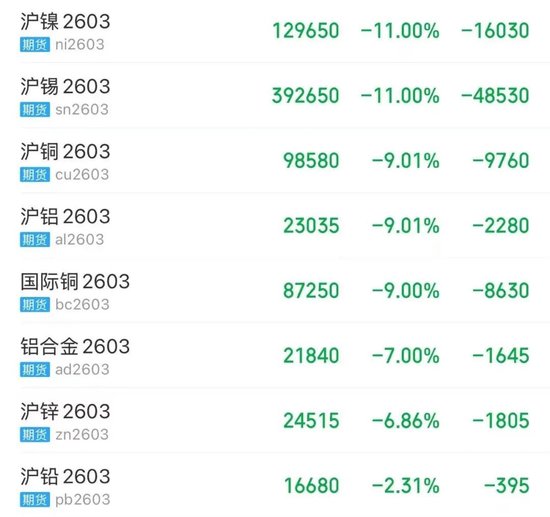
Core Viewpoint - The non-ferrous metal sector is experiencing a significant sell-off, driven by falling gold and silver prices, with major contracts hitting their daily limits and other varieties also declining [1][3]. Market Performance - As of the latest trading session, major contracts for copper, aluminum, tin, nickel, and alloy have seen substantial declines, with copper futures down 9.01% and aluminum futures down 9.01% [2]. - The trading volume in the non-ferrous metal sector reached a recent high last Friday but has since decreased, although it remains elevated compared to previous days [2]. Price Trends and Influences - The night trading session continued the downward trend, with international copper futures down 1.11% and domestic copper futures down 1.01% [3]. - The nomination of Kevin Walsh as the new Federal Reserve Chair has strengthened expectations for tighter monetary policy, leading to a surge in the dollar and U.S. Treasury yields, which has negatively impacted non-ferrous metals priced in dollars [3]. Supply and Demand Dynamics - Year-to-date, absolute inventories of copper, aluminum, and nickel are significantly higher than in previous years, indicating weak price support from supply-demand dynamics [4]. - Global copper inventories exceed 1.3 million tons, putting upward pressure on prices, while domestic aluminum inventories have reached 1 million tons, reflecting weaker supply-demand structures compared to previous years [4]. Market Sentiment and Future Outlook - Recent rapid increases in copper prices have led to a cooling of bullish sentiment, with the market potentially shifting towards fundamental trading [5]. - Seasonal demand suppression and inventory accumulation are expected to pressure prices leading up to the Chinese New Year, with a potential rebound in March if downstream recovery exceeds expectations [5][6].
申万宏源证券晨会报告-20260203
Shenwan Hongyuan Securities· 2026-02-03 00:44
Market Overview - The report highlights significant fluctuations in global assets following the hawkish nomination of Kevin Warsh as the Federal Reserve Chairman by Trump, leading to a strong market reaction [2][8] - The short-term market may be overpricing the Fed's hawkish shift, with expectations of interest rate cuts likely preceding any balance sheet reduction [8] Economic Policy Insights - The report suggests that the Fed's ability to successfully reduce its balance sheet will depend on structural changes in fiscal policy and the real economy, rather than solely on the Fed's intentions [8] - It emphasizes that the core issue remains how inflation will be managed, potentially through fiscal discipline or production reforms [8] Stock Market Implications - The report anticipates increased volatility in the U.S. stock market, with a shift towards a more balanced investment style [8] - Key variables affecting the stock market include earnings validation and inflation trends, with a focus on the performance of the S&P 500 [8] Commodity Market Analysis - The report maintains that the bullish logic for gold, silver, and commodities remains intact, despite short-term volatility [8] - It notes that the speculative sell-off in precious metals was triggered by geopolitical signals and the Warsh nomination, impacting industrial metals as well [8] Sector Performance - The report identifies sectors such as electric grid equipment and liquor as outperformers in the recent market, while precious metals and industrial metals have seen significant declines [1][8] - It highlights the resilience of supply-demand dynamics in non-ferrous metals, despite recent liquidity shocks [8]