
美国通胀

Search documents
铺路降息 美国核心通胀回落
Bei Jing Shang Bao· 2025-10-26 14:26
Core Insights - The U.S. inflation data for September indicates persistent inflation above the Federal Reserve's 2% target, but both overall and core inflation metrics fell below expectations, suggesting a potential for gradual interest rate cuts by the Fed [1][6][8] Inflation Data Summary - The Consumer Price Index (CPI) rose by 3% year-on-year and 0.3% month-on-month in September, with core CPI increasing by 3% year-on-year and 0.2% month-on-month [3][4] - Energy prices were the main driver of the price increase, with the energy price index rising by 1.5% month-on-month, and gasoline prices up by 4.1% [3][4] - Core CPI's year-on-year growth rate decreased from 3.1% in August to 3% in September, marking the lowest level since June [3][4] Impact of Tariffs - The analysis indicates that the tariff policies from the Trump administration continue to affect domestic consumption, with clothing prices showing significant increases due to higher tariffs [4][9] - The core inflation metrics reveal a divergence, with service sector inflation cooling down while core goods inflation remains elevated, particularly in categories like clothing and home goods [4][7] Federal Reserve's Monetary Policy Outlook - The Fed is likely to face a dilemma as controlled inflation may allow for more policy easing, while tariff-induced cost pressures could slow down the rate of cuts [6][8] - Recent comments from Fed officials suggest a cautious approach to rate cuts, emphasizing the need to balance inflation risks with a softening labor market [7][8] Future Data Uncertainty - The ongoing government shutdown raises concerns about the timely release of economic data, with the potential for the October CPI report to be delayed, complicating policy decisions for the Fed [8][9] - The IMF forecasts that U.S. inflation may rise again starting in the second half of 2025 as tariff impacts become more pronounced, although it expects inflation to return to the Fed's target by 2027 under certain conditions [9]


美国9月CPI点评:通胀低于预期,后续两降信号渐明
Guoxin Securities· 2025-10-26 13:51
Inflation Overview - In September, the overall CPI increased by 3.0% year-on-year, up 0.1 percentage points from the previous month, while the core CPI remained at 3.0%, down 0.1 percentage points from August[2] - Month-on-month, the CPI decreased by 0.3%, a decline of 0.1 percentage points compared to the previous month, while the core CPI rose by 0.2%, down 0.1 percentage points from August[2] Market Implications - The September inflation data is seen as a "light brake," indicating a potential path for two interest rate cuts later this year, especially following the government shutdown[4] - The inflation level remains above the Federal Reserve's target of 2%, but the current trend does not suggest a significant acceleration in inflationary pressures[4] Sector Contributions - Food prices rose by 3.1% year-on-year, slightly down from 3.2% in August, with household food prices stable at 2.7%[5] - Energy prices saw a year-on-year increase of 2.9%, a significant rise from 0.4% in August, contributing notably to the overall inflation increase[5] - Core services inflation showed signs of cooling, with contributions from services decreasing from 2.18% to 2.12%[11] Federal Reserve Outlook - Recent comments from Federal Reserve officials indicate a shift in focus from "controlling inflation" to "stabilizing employment," suggesting a more dovish stance on future monetary policy[18] - Market expectations are leaning towards two additional rate cuts by the end of the year, supported by the latest inflation data[18] Risk Factors - Potential risks include uncertainties in overseas economic policies and a decline in external demand, which could impact inflation and economic stability[23]
美国通胀或阶段性见顶——美国9月CPI数据点评
一瑜中的· 2025-10-26 13:15
Core Viewpoint - The article suggests that US inflation may have reached a temporary peak, with expectations of a decline in the coming months due to manageable tariff impacts and a stabilizing job market [1][3][13]. Inflation Trends - Over the past six months, US inflation has experienced a slight recovery, with the CPI rising from 3% in January to 3% in September, after a low of 2.3% in April [1][5]. - Core CPI also showed a similar trend, increasing from 2.8% in May to 3% in September [1][5]. Tariff Impact - The price impact of tariffs is relatively controllable, with the effective tariff rate rising from 2.3% to 9.5% between February and July, which is lower than initial market expectations [1][6]. - As of September, the tariff price effect on core goods prices is estimated to be close to 90%, with a potential remaining impact of about 0.5 percentage points on core goods and 0.1 percentage points on overall CPI if tariffs rise to 17% [2][7]. Labor Market Dynamics - The marginal weakening of the job market has prevented a wage-price spiral, with wage growth slowing and rental prices stabilizing around 0.2-0.3% [2][6]. - The rental growth rate has decreased, with primary residence rent rising only 0.2%, the smallest monthly increase since January 2021 [19][22]. Inflation Expectations - Consumer inflation expectations remain high in the short and medium term but have decreased compared to earlier in the year, with market pricing for long-term inflation expectations remaining stable or even declining [11][13]. Future Inflation Projections - If US tariff policies do not experience significant fluctuations, inflation is expected to stabilize around 3% in Q4 of this year and decline to approximately 2.5% and 2.8% for CPI and core CPI, respectively, in Q2 of next year [3][13]. Monetary Policy Implications - The controllable impact of tariffs and the peak in inflation may support the Federal Reserve's decision to continue "preemptive" rate cuts, with potential cuts of 25 basis points in October and December [15][25]. - Future rate cuts may slow down if inflation declines at a moderate pace and employment stabilizes [15][25].

美国9月CPI点评:通胀低于预期,后续“两降”信号渐明
Guoxin Securities· 2025-10-26 12:31
Inflation Overview - In September, the overall CPI increased by 3.0% year-on-year, up 0.1 percentage points from the previous month, while the core CPI also rose by 3.0%, down 0.1 percentage points from August[2] - Month-on-month, the CPI decreased by 0.3%, a decline of 0.1 percentage points compared to the previous month, while the core CPI increased by 0.2%, down 0.1 percentage points from August[2] Market Reaction - The September inflation data was below market expectations of 3.1%, indicating a slight easing of inflation concerns[4] - The data suggests that inflation risks are manageable, providing a signal for potential interest rate cuts later in the year[18] Sector Contributions - Food prices rose by 3.1% year-on-year, slightly down from 3.2% in August, contributing 0.42% to the overall CPI[11] - Energy prices saw a significant year-on-year increase of 2.9%, compared to just 0.4% in August, contributing 0.19% to the CPI[11] Core Inflation Insights - Core services showed a notable slowdown, contributing 2.12% to the CPI, down from 2.18% in the previous month[11] - The core CPI remains stable at 3.0%, indicating that while inflation is present, it is not accelerating significantly[4] Future Outlook - The Federal Reserve is expected to consider two interest rate cuts within the year, supported by the current inflation data[18] - Market expectations indicate a high probability of rate cuts in October and December, reflecting a shift in focus from controlling inflation to stabilizing employment[18]
美国9月CPI数据点评:美国通胀或阶段性见顶
Huachuang Securities· 2025-10-26 12:13
Inflation Data Overview - In September, the U.S. CPI increased year-on-year from 2.9% to 3%, below the expected 3.1%[1] - Core CPI decreased year-on-year from 3.1% to 3%, matching the forecast[1] - Month-on-month CPI rose by 0.3%, below the expected 0.4%[1] Price Trends - Core goods prices rose by 0.2%, down from 0.3%, with used car prices falling by 0.4%[2] - Rent growth slowed, with primary residence rent increasing by 0.2%, the smallest increase since January 2021[2] - Super core services prices remained stable at 0.3%, with notable price increases in medical services (0.3%) and entertainment services (0.4%)[2] Inflation Peak Insights - Inflation has likely peaked temporarily, with CPI rising from 2.3% in April to 3% in September, a total increase of 0.7 percentage points[3] - The effective tariff rate has increased from 2.3% to 9.5% from February to July, indicating manageable tariff impacts on inflation[3] - The remaining tariff effects on core goods prices are estimated to be around 0.5 percentage points, contributing only about 0.1 percentage points to overall CPI[4] Future Projections - Inflation is expected to stabilize around 3% in Q4 2023, with a projected decline to approximately 2.5% for CPI and 2.8% for core CPI by Q2 2024[5] - The Federal Reserve may continue to implement preventive rate cuts, with potential reductions of 25 basis points in October and December[5] Market Reactions - Following the inflation report, market expectations for rate cuts have slightly increased, with the number of anticipated cuts rising from 1.92 to 2.0 for the year[34] - U.S. stock indices reached new highs, with the Nasdaq up 1.15% and the S&P 500 up 0.79%[34]
燕翔:核心通胀放缓——9月美国CPI数据点评
Sou Hu Cai Jing· 2025-10-26 04:04
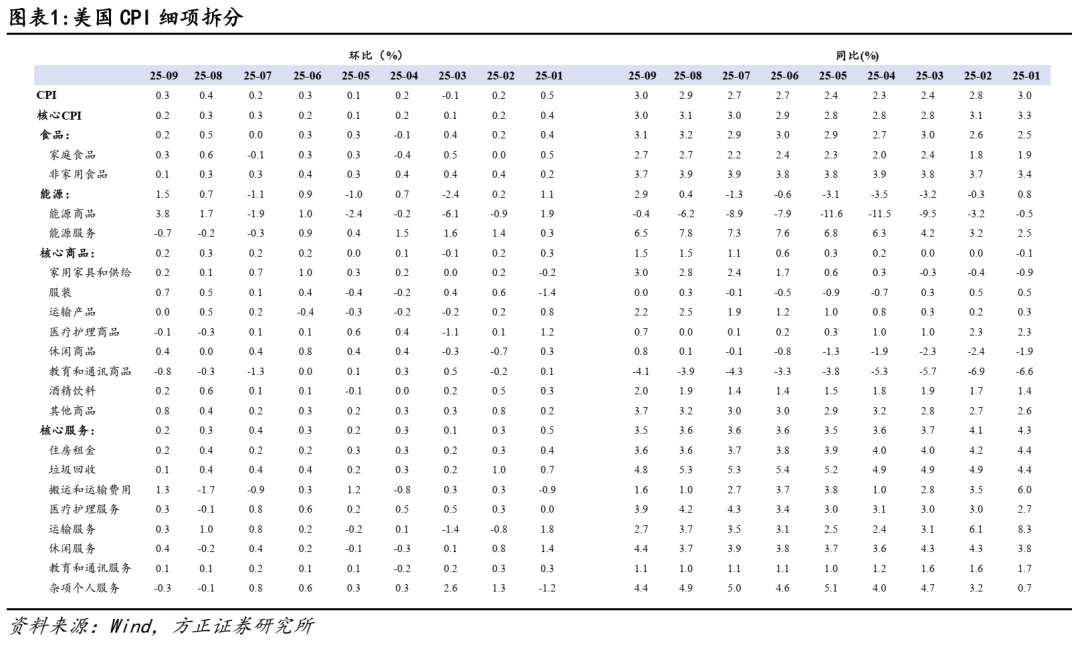
燕翔、石琳(燕翔系方正证券首席经济学家、中国首席经济学家论坛理事) 核心结论 事件: 9月美国CPI同比3%,预期3.1%,前值2.9%;CPI环比0.3%,预期和前值均为0.4%;核心CPI同比3%,预期和前值均为3.1%;核心CPI环比0.2%,预期和前 值均为0.3%。 投资要点: 美国:CPI:季调:同比(%) -- 美国:核心CPI:季调:同比(%) 9 8 7 6 5 4 3 2 l 0 21-08 21-02 22-08 23-08 24-08 25-08 23-02 24-02 25-02 22-02 资料来源: Wind, 方正证券研究所 价格指数:进口商品 =价格指数:国内商品 1.04 1.03 1.02 1.01 1.00 0.99 0.98 0.97 25-04 25-06 25-10 4-12 25-02 25-05 25-08 25-09 24-10 24- 1 1 25-03 25-07 25-01 资料来源: Cavallo,Llamas & Vazquez (2025), 方正证券研究所 美国政府停摆下9月通胀数据发布对市场意义重大,年内美联储大概率降息2次,10年美债利率 ...
2025年9月美国CPI数据点评:美国通胀不及预期,为降息铺平道路
EBSCN· 2025-10-25 11:36
Inflation Data Summary - In September, the U.S. CPI increased by 3.0% year-on-year, up from 2.9% in the previous month, but below the market expectation of 3.1%[2] - The seasonally adjusted CPI rose by 0.3% month-on-month, down from 0.4% previously and below the expected 0.4%[2] - Core CPI also increased by 3.0% year-on-year, down from 3.1% last month, and the month-on-month increase was 0.2%, down from 0.3%[2] Economic Implications - The mild inflation data reduces the risk of the Federal Reserve making uninformed decisions amid the government shutdown affecting non-farm data releases[3] - The overall inflation increase is tempered by declines in housing, used car, and truck prices, while tariff impacts continue to be felt in categories like appliances and furniture[3] - Market expectations are set for two rate cuts within the year, with probabilities of 96.7% for October and 94.4% for December, indicating a strong belief in easing monetary policy[7] Sector-Specific Insights - Food prices saw a month-on-month increase of only 0.2%, down from 0.5% in the previous month, with notable declines in beef prices[4] - Energy prices increased by 1.5% month-on-month, influenced by rising international oil prices due to geopolitical tensions, although overall price increases remain limited[4] - Core goods prices fell to a month-on-month increase of 0.2%, primarily due to a drop in used car and truck prices, which decreased from 1.0% to -0.4%[5]
美国9月CPI数据点评:通胀为何低预期?
Changjiang Securities· 2025-10-25 11:34
Inflation Overview - In September 2025, the overall CPI in the U.S. increased by 3.0% year-on-year, slightly above the previous value of 2.9% but below the market expectation of 3.1%[8] - Core CPI also rose by 3.0% year-on-year, matching the previous value and falling short of the market expectation of 3.1%[8] Price Trends - Food CPI showed a month-on-month increase of 0.3%, while energy CPI experienced a notable rise, primarily due to a significant increase in gasoline prices, contributing 0.12 percentage points to the overall CPI[11] - Core goods CPI increased by 0.2% month-on-month, with clothing prices rising by 0.7%, contributing 0.02 percentage points to the overall CPI, while used car prices fell by 0.4%[11] Housing and Services - Housing inflation has cooled, with the housing CPI increasing by only 0.2% month-on-month, contributing 0.07 percentage points to the overall CPI[11] - Core services CPI rose by 0.2% month-on-month, with limited inflationary pressure observed in most service categories[11] Monetary Policy Outlook - The overall inflation data being lower than expected strengthens the likelihood of two interest rate cuts within the year, with a 25 basis point reduction anticipated in both October and December[11] - The Federal Reserve may adjust its stance on further rate cuts in the first half of next year based on employment performance and the impact of tariffs on inflation[11]
9月美国通胀数据解读:通胀缺乏上行动力
CAITONG SECURITIES· 2025-10-25 11:24
Inflation Trends - September CPI year-on-year growth increased to 3%, while month-on-month growth slightly decreased to 0.3%[4] - Core CPI year-on-year fell by 0.1 percentage points to 3%, with a month-on-month decline as well[4] - Energy inflation rose, with the CPI energy component year-on-year growth increasing to 2.8%, up 2.6 percentage points from the previous month[10] Commodity and Service Inflation - Core commodity year-on-year growth remained stable at 1.5%, with a slight month-on-month decline[11] - Used car prices showed a slowdown in growth, indicating a lack of sustained upward momentum in future automotive inflation[11] - Core service year-on-year growth decreased to 3.5%, down 0.1 percentage points from the previous month, with transportation services also declining by 1 percentage point to 2.5%[16] Economic Outlook - The expectation for two more interest rate cuts within the year has been reinforced following the inflation data release[20] - The overall inflation performance is moderate, lacking significant upward momentum, which paves the way for the Federal Reserve to continue lowering interest rates[20] - Risks include potential unexpected downturns in the U.S. economy and tighter monetary policy from the Federal Reserve[22]
美国9月CPI点评:美联储继续降息或无悬念
KAIYUAN SECURITIES· 2025-10-25 09:56
Group 1: Inflation Data Overview - In September 2025, the US CPI increased by 3.0% year-on-year and 0.3% month-on-month, while core CPI also rose by 3.0% year-on-year and 0.2% month-on-month, all below market expectations[2] - Overall inflation shows a marginal rebound, but core inflation is declining, indicating a potential easing impact from tariffs on US inflation[3] - Energy inflation rose significantly, with a year-on-year increase of 2.8%, while food inflation increased by 3.1%, showing a slight decline from August[4] Group 2: Future Inflation Trends and Federal Reserve Actions - The report suggests that inflation may trend downward in the future, with core inflation expected to remain stable or decrease slightly[5] - The Federal Reserve is likely to continue lowering interest rates by 25 basis points, with a total expected reduction of 75 basis points for 2025, due to ongoing risks in the labor market and low consumer confidence[6] - Consumer confidence index recorded a low of 55 in October, indicating pessimism about future economic conditions[42] Group 3: Key Economic Indicators - The Michigan University inflation expectation remained stable at 4.6%, with a 5-year expectation at 3.7%, suggesting consumers do not anticipate rapid cost transfers to them despite income pressures[46] - The core services inflation, excluding housing, showed a year-on-year decline, reflecting significant differences across various consumption sectors[23] - Risks include potential inflation surprises due to international tensions and unexpected economic downturns in the US[47]