
两新政策

Search documents
【广发宏观王丹】9月经济的中观面拆解
郭磊宏观茶座· 2025-10-09 04:06
Core Viewpoint - The manufacturing PMI for September indicates a marginal improvement in the economy, with a month-on-month increase of 0.4 points, although the absolute level remains below 50, suggesting ongoing challenges in economic conditions [1][5][6]. Economic Characteristics - The manufacturing PMI rose to 49.8 in September, with 8 out of 15 sub-sectors showing expansion, while 7 sectors contracted [1][6]. - The improvement in economic conditions is attributed to several macro factors, including the implementation of "two heavy" projects, increased consumer demand during the holiday season, AI-related policies, and resilient export orders [1][9]. Sector Performance - Industries experiencing a downturn include raw materials (black and non-ferrous metals, chemicals), certain equipment manufacturing sectors, and textiles [2][16]. - Leading sectors in terms of absolute economic performance include petroleum refining, computer communication electronics, automotive, and agricultural products, driven by cost reductions, AI trends, policy benefits, and holiday consumption [2][17]. Emerging Industries - New generation information technology and energy-saving environmental sectors show the highest economic performance, linked to demand growth from AI computing power and green transformation projects [18]. - The new energy vehicle sector has seen a month-on-month increase in economic performance, aligning with retail data trends [18]. Construction Industry Insights - The construction sector, particularly civil engineering, has seen a significant drop, with a 4.2-point decrease in PMI, falling below the 50 mark for the first time outside of the Spring Festival month since March 2013 [3][19]. - Despite the downturn, new orders in the construction sector have increased for two consecutive months, indicating potential recovery as funding for new policy projects begins to flow [19][22]. Service Industry Trends - The service sector PMI decreased by 0.4 points to 50.1, with high activity in online information technology services and financial services, while travel-related services saw seasonal declines [26][27]. - The financial services sector remains robust, with a business activity index above 60, reflecting high market activity [26].


新车吸引“尝新”消费者,补贴政策驱动消费升温
Xin Jing Bao· 2025-10-06 11:48
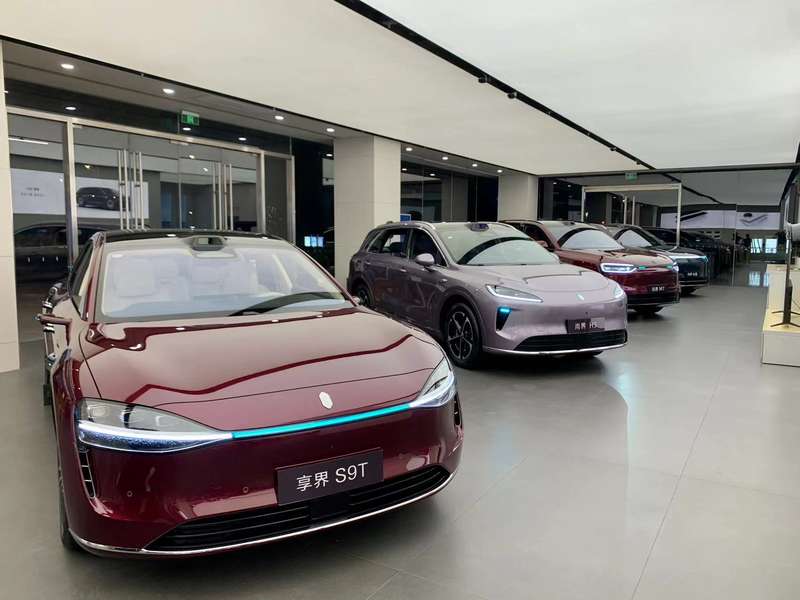
Core Insights - The automotive market is experiencing a surge in new car launches ahead of the "Golden October" sales season, with a focus on both new energy and traditional fuel vehicles across various segments [1][2] - Consumer interest is heightened during the holiday season, with key factors such as vehicle pricing, range, safety, and advanced driving assistance features being the main points of consideration [1][2] - Unlike previous years where cash discounts were common, this year's vehicle promotions are primarily driven by government subsidies and policies rather than price wars among manufacturers [1][8] Group 1: New Car Launches - Over 70 new car models were launched in September, with 30 models debuting between September 22 and 28, contributing to increased market activity [2] - New energy vehicle showrooms prominently display new models to attract consumers, resulting in a noticeable increase in foot traffic [2][4] - Specific models, such as BYD's second-generation Qin PLUS and NIO's new ES8, are strategically placed in showrooms to maximize visibility and consumer engagement [2][5] Group 2: Consumer Engagement and Promotions - Sales personnel from various brands report that consumer inquiries focus on vehicle specifications, including range and smart features, indicating a shift in consumer priorities [2][5] - NIO offers unique trade-in policies, allowing customers to exchange older luxury models for new vehicles at little to no cost, enhancing the appeal of their offerings [5][7] - Promotional strategies include nationwide uniform pricing and additional incentives such as gifts or lottery participation during the holiday season [7] Group 3: Policy Impact on Market Dynamics - The "Golden September and Silver October" period is critical for automakers to achieve annual sales targets, with government policies playing a significant role in driving consumer purchases [8][9] - The implementation of the "old-for-new" vehicle policy has led to a substantial increase in applications, with 8.3 million applications recorded by September 10 [8] - Local governments are also introducing consumer vouchers and subsidies, further stimulating automotive sales in various regions [8][9]

“两新”政策持续释放扩内需效能
Sou Hu Cai Jing· 2025-09-28 01:09
Core Insights - The focus of China's policy this year is to expand domestic demand, with the implementation of the third batch of consumer goods replacement policies aimed at stimulating consumer demand and driving sales growth in related products [1][2] - The "Two New" policies initiated in 2024 and expanded in 2025 have effectively unleashed domestic consumption potential and investment momentum, promoting a virtuous cycle of supply and demand, industrial upgrading, and green development [1][2] Policy Implementation Effects - The expansion of domestic demand has led to explosive growth in key consumption categories such as automobiles and home appliances, with sales in categories like home appliances and furniture achieving monthly year-on-year growth rates exceeding 20% [2] - The consumer goods replacement policy has stimulated over 2 trillion yuan in related product consumption since its implementation [2] - Equipment updates supported by long-term special government bonds have led to investments exceeding 1 trillion yuan, with approximately 8,400 projects initiated [2] Economic Circulation and Resource Utilization - The government has allocated long-term special bond funds to support high-level circular economy projects, promoting a "reverse invoicing" system to reduce tax burdens on recycling companies [3] - The establishment of over 14,000 new intelligent community recycling facilities has significantly increased the volume of scrapped vehicles and improved the recycling of old household appliances [3] Mechanism Innovation and Implementation Pathways - Various measures have been introduced to amplify the effects of the "Two New" policies, including the establishment of a project screening mechanism and financial support for equipment updates [4][5] - The introduction of the "reverse invoicing" system addresses tax deduction challenges for resource recovery companies, while local governments enhance policy coordination and financial support for consumer subsidies [5] Economic Recovery and Growth - The series of policies represented by the "Two New" initiatives have contributed to a sustained recovery in China's economy, enhancing the internal driving force and reliability of the national economic cycle [6] Unified Market and Efficiency Improvement - The establishment of a unified circulation standard system aims to optimize logistics and reduce costs for durable consumer goods and second-hand equipment [7] - The integration of data across departments and the application of artificial intelligence technologies are expected to streamline processes and enhance regulatory oversight [7] Resource Recycling and Service Enhancement - Efforts are being made to improve the entire process of product equipment recycling, disposal, trading, and reuse, promoting the development of a one-stop recycling service system [7]
崔东树:1-8月汽车行业利润率4.5%仍偏低 主流车企盈利压力仍将急剧增大
智通财经网· 2025-09-27 23:42
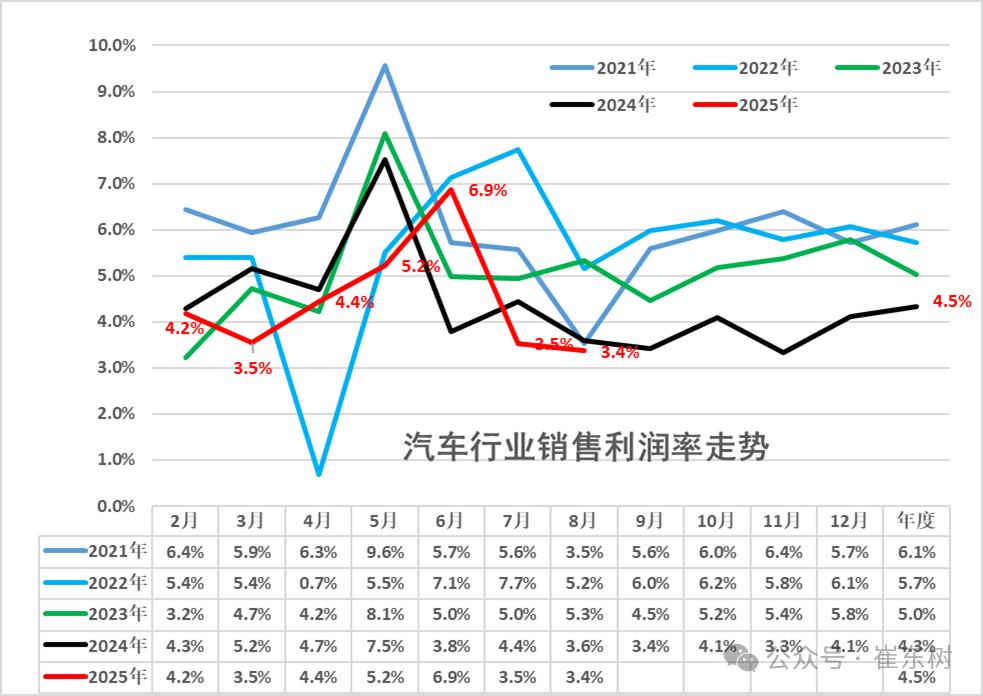
Core Insights - The automotive industry in China has shown a slight profit increase of 0.9% year-on-year for large-scale industrial enterprises from January to August 2025, driven by various factors including the "two new" policy and a low base from the previous year [1][8] - The automotive sector produced 20.83 million vehicles from January to August 2025, marking an 11% increase year-on-year, with total revenue reaching 680.49 billion yuan, an 8% increase [1] - The profit margin for the automotive industry remains low at 4.5%, compared to the average profit margin of 6% for downstream industrial enterprises [1][4] Automotive Industry Performance - From January to August 2025, the automotive industry reported revenues of 68,049 million yuan, with costs amounting to 59,889 million yuan, resulting in a profit of 3,035 million yuan, which is a slight decrease of 0.3% year-on-year [1] - In August 2025, the automotive industry generated revenue of 8,856 million yuan, a 7.5% increase year-on-year, but profits fell by 10% to 298 million yuan, indicating a significant decline in profitability [1] - The automotive industry's profit margin in August 2025 was recorded at 3.4%, a noticeable drop from 3.6% in August 2024, marking a historical low for that month [1][4] Policy Impact and Future Outlook - The implementation of the "two new" policies has effectively stimulated domestic demand, particularly in the automotive sector, which has lagged behind other consumer goods in terms of profitability [2] - The government is actively promoting the consumption of fuel vehicles and the scrapping and updating of older vehicles, which is expected to stabilize the automotive market [2] - The overall profit performance of the automotive industry in 2024 is projected to remain weak, with a sales profit margin of only 4.3%, significantly lower than historical averages [4] Industry Cost and Revenue Structure - The average single vehicle revenue in the automotive industry for January to August 2025 was 327,000 yuan, with a single vehicle profit of 15,000 yuan [6] - The overall industrial enterprises' revenue for the same period reached 89.62 trillion yuan, with a profit margin of 5.24%, reflecting a slight decline compared to previous years [8][9] - The cost pressures on mid and downstream industries have eased due to low commodity prices, contributing to a more stable cost structure for the automotive sector [6]
“金动力”护航民企破浪前行
Jin Rong Shi Bao· 2025-09-25 03:00
Core Viewpoint - The article highlights the significant role of private enterprises in Hunan Province's economy, emphasizing the support provided by Postal Savings Bank to address financing challenges and promote growth [1][2]. Group 1: Private Enterprises in Hunan - As of the end of 2024, there are 7.35 million private enterprises in Hunan, which are crucial for employment, market prosperity, and improving livelihoods [1]. - The Postal Savings Bank of Hunan has a loan balance of nearly 87 billion yuan for the private economy, serving approximately 130,000 private enterprises [1]. Group 2: Financial Support and Innovation - A specific intelligent technology company received over 70 million yuan in funding from Postal Savings Bank, enabling it to focus on research and development and scale up operations [2]. - The bank provided a 10 million yuan "Science and Technology Credit Loan" and additional credit of 60 million yuan to help a company expand production amid increasing orders [3]. - The bank's customized financial services are designed to assist enterprises in understanding and utilizing government policies and subsidies effectively [3][4]. Group 3: Case Studies of Beneficiary Companies - A high-tech optical company in Changde has invested 3% of its sales revenue in R&D and achieved an order volume of 160 million yuan in the first quarter of the year [4]. - The bank has developed innovative evaluation systems focusing on R&D capabilities and patent numbers to address funding challenges for tech enterprises [4]. - A new materials company in Shaoyang, recognized as a "little giant" enterprise, received 1.6 million yuan in loans to support its initial operations and has since expanded its credit to 16 million yuan [5][6]. Group 4: Future Outlook - The bank aims to continue supporting private enterprises, enhancing their growth and development through financial services, and contributing to the overall economic vitality of Hunan Province [6].

“924”一周年经济回顾与展望:如何重塑增长和提振就业
Lian He Zi Xin· 2025-09-24 11:09
Economic Overview - The "924" policy has shown resilience in the Chinese economy amidst complex domestic and international environments, with macroeconomic policies stabilizing growth and prices[4] - The need to reassess the 5.0% growth target based on economic momentum and to prioritize employment in policy adjustments is emphasized[5] Consumption and Retail - Social retail sales grew by 4.6% year-on-year as of August 2025, a 1.2 percentage point increase from August 2024, aligning with the 5.0% economic growth target[6] - Specific retail categories such as home appliances and communication equipment saw significant growth, with increases of 28.4% and 22.3% respectively compared to the previous year[6] Investment Trends - Fixed asset investment growth was only 0.5% year-on-year as of August 2025, a decline of 2.9 percentage points from August 2024, primarily due to a 12.9% drop in real estate investment[9] - Infrastructure and manufacturing investments also saw declines of 2.5 and 4 percentage points respectively, indicating limited effectiveness of investment policies[9] Trade Performance - Total goods import and export volume increased by 2.5% year-on-year as of August 2025, with exports rising by 5.9%, a 1.2 percentage point increase from the previous year[10] - Exports of electromechanical products grew by 9.2%, accounting for 60.2% of total exports, showcasing resilience in external trade[10] Capital Market Stability - The Shanghai Composite Index rose by 39% year-on-year to 3821.83 points as of September 23, 2025, while the ChiNext Index surged by 103%[12] - The ten-year government bond yield decreased by 0.16 percentage points to 1.877%, reflecting a stable capital market environment[12] Employment and Structural Challenges - The urban unemployment rate averaged 5.18% from January to August 2025, a slight increase from the previous year, indicating challenges in job creation[17] - The youth unemployment rate for ages 16 to 24 rose to 16.43%, highlighting the need for targeted employment strategies[17] Policy Recommendations - Future policies should shift focus from "scale stimulus" to "employment priority" to achieve high-quality economic development[22] - Fiscal policies must prioritize job creation, with proposals for special funds to support new employment initiatives and tax incentives for businesses hiring new employees[27][28]
肖宏伟:政策协同驱动“两新”显效
Sou Hu Cai Jing· 2025-09-22 23:24
Group 1 - The core viewpoint of the articles emphasizes the effectiveness of China's macroeconomic policies, particularly the issuance of ultra-long special government bonds and the implementation of the "Two New" policies, which are crucial for stabilizing the economy and stimulating domestic demand [1][2][3] - The "Two New" policies leverage fiscal funds as a "lever" to reduce financing costs for enterprises through subsidies and interest discounts, significantly enhancing banks' willingness to lend [1][2] - From January to August, investment in equipment and tools increased by 14.4% year-on-year, contributing 2.1 percentage points to overall investment growth, indicating a positive impact on effective investment [1] Group 2 - The combination of subsidies and consumer finance, such as zero-interest installments and low-interest loans, effectively transforms potential demand into immediate purchasing power, thereby upgrading the consumption market structure [2] - The policies also extend to the supply side, providing loan interest subsidies to production, circulation, and service enterprises, which alleviates financial pressure and encourages inventory increase and service optimization [2][3] - A well-structured financial and fiscal collaboration mechanism has been established to ensure efficient implementation of the "Two New" policies, preventing fund idling and effect attenuation [3] Group 3 - The next phase requires a continued focus on problem-oriented and goal-oriented approaches to deepen the "fiscal + financial" collaborative model, aiming to elevate the effectiveness of the "Two New" policies [3] - Future expectations include the rollout of the fourth batch of funds for replacing old consumer goods and the introduction of more innovative financial tools, which are anticipated to further unleash policy effectiveness [3] - The sustained drive of fiscal and financial collaboration is expected to fully tap into the vast potential of the domestic market, solidifying the pace of industrial upgrades and enhancing the endogenous momentum and resilience of economic development [3]
政策协同驱动“两新”显效
Sou Hu Cai Jing· 2025-09-22 22:49
Group 1 - The core viewpoint of the articles emphasizes the effectiveness of China's macroeconomic policies, particularly the issuance of ultra-long special government bonds and the implementation of the "Two New" policies, which are crucial for stabilizing the economy and stimulating domestic demand [1][2][3] - The "Two New" policies leverage fiscal funds as a "lever" to reduce financing costs for enterprises through subsidies and interest discounts, significantly enhancing banks' willingness to lend [1][2] - From January to August, investment in equipment and tools increased by 14.4% year-on-year, contributing 2.1 percentage points to overall investment growth, showcasing the positive impact of the fiscal subsidy and bank credit model [1] Group 2 - The combination of subsidies and consumer finance effectively stimulates immediate demand, with significant growth in retail sales of home appliances, furniture, and office supplies in August [2] - The introduction of personal consumption loan subsidies further reduces financing costs, successfully guiding consumption towards green and intelligent upgrades in sectors like new energy vehicles and smart home appliances [2] - The "Two New" policies create a high-efficiency closed-loop mechanism for financial collaboration, ensuring that policy benefits reach the intended recipients quickly and effectively [3] Group 3 - The articles highlight the importance of a multi-faceted financing structure that includes government leadership, financial follow-up, and market dominance to ensure the scale and efficiency of policy implementation [3] - Future expectations include the release of additional innovative financial tools and the fourth batch of funds for replacing old consumer goods, which are anticipated to further stimulate domestic demand and support industrial upgrades [3] - The ongoing financial collaboration is expected to enhance the resilience and internal driving force of economic development in China [3]
国开行“十四五”以来累计发放超6万亿元基础设施中长期贷款
Xin Hua Wang· 2025-09-22 04:46
Core Insights - The National Development Bank has issued over 6 trillion yuan in medium to long-term loans for infrastructure since the beginning of the "14th Five-Year Plan" period, along with an investment of 425.6 billion yuan from the National Development Bank Infrastructure Investment Fund, increasing the proportion of infrastructure financing balance by 9 percentage points compared to the end of the "13th Five-Year Plan" [1][2] Group 1 - The bank focuses on supporting 102 major projects outlined in the national "14th Five-Year Plan," including significant cross-province and cross-basin projects, as well as projects related to national strategic implementation and key area security capacity building [1] - Customized financial services are provided through differentiated credit policies, with a tailored approach for each project [1] - The bank enhances collaboration between its headquarters and branches, utilizing various financial products and services to strengthen comprehensive financial support [1] Group 2 - Future plans include reinforcing functional positioning, focusing on core responsibilities, and actively supporting the implementation of "two heavy" constructions and the expansion and quality improvement of "two new" policies [2] - The bank aims to continuously improve financial services throughout the entire lifecycle of infrastructure projects and promote innovation in market-oriented investment and financing models [2] - There is an emphasis on tracking major projects for the "15th Five-Year Plan" to support the establishment of a modern infrastructure system [2]
金发科技股价6天涨幅超41% 增长趋势向好年营收有望首超700亿
Chang Jiang Shang Bao· 2025-09-21 22:57
Core Viewpoint - The news highlights the significant impact of Yushu Technology's IPO news on the stock price of Jinfat Technology, which has a minimal indirect stake in Yushu Technology. The company has shown strong revenue growth and is expected to exceed 700 billion yuan in annual revenue for 2025. Group 1: Company Performance - In the first half of 2025, Jinfat Technology achieved operating revenue of 31.636 billion yuan, a year-on-year increase of 35.50%, and a net profit of 585 million yuan, up 54.12% year-on-year [1][11] - For the full year of 2024, Jinfat Technology reported operating revenue of 60.514 billion yuan, a 26.23% increase, and a net profit of 825 million yuan, which represents a 160.36% year-on-year growth [7] - The company is expected to surpass 700 billion yuan in operating revenue for the first time in 2025, marking a new milestone [2][11] Group 2: Investment in Yushu Technology - Jinfat Technology has an indirect holding of 0.32% in Yushu Technology, which is considered very low [1][5] - The company is a limited partner in the Jinshi Growth Fund, which has a target size of 5 billion yuan, with Jinfat Technology committing 300 million yuan [4] - The Jinshi Growth Fund holds a 4.77% stake in Yushu Technology, indicating Jinfat Technology's indirect exposure to Yushu's growth [4][5] Group 3: Market Reaction and Stock Performance - Jinfat Technology's stock experienced significant volatility, with a cumulative price increase of 20% over two consecutive trading days, and a total increase of over 41% from September 11 to the announcement date [3] - Despite a recent drop in stock price, Jinfat Technology's stock has risen by 163% since 2015 [4] - The company's static price-to-earnings ratio is 69.99, significantly higher than the industry average of 27.36 [3] Group 4: Global Expansion and R&D - Jinfat Technology has made significant strides in its global strategy, with production facilities in Vietnam, Spain, and Indonesia enhancing its competitive edge [9] - In the first half of 2025, the company's overseas business achieved a sales volume of 161,000 tons, a year-on-year increase of 33.17% [10] - The company has increased its R&D expenditure, with 2.493 billion yuan and 1.293 billion yuan spent in 2024 and the first half of 2025, respectively, reflecting growth rates of 26.20% and 34.56% [11]
