
市场避险情绪

Search documents
贵金属有色金属产业日报-20251029
Dong Ya Qi Huo· 2025-10-29 10:21
1. Report Industry Investment Rating No relevant content provided. 2. Core Views of the Report - The precious metals market is in a phase of correction due to reduced short - term safe - haven premiums for gold and strong market wait - and - see sentiment, but there is still medium - term buying support [3]. - The copper market is expected to maintain high - level oscillatory consolidation in the short term, as the conversion of market attention into actual transactions and macro - level support are needed for price increases [15]. - The aluminum market has seen strong price performance due to the resonance of macro and fundamental factors. Future price trends depend on the Fed's interest rate decision and potential capital movements [36]. - The zinc market shows a pattern of strong supply and weak demand in China compared to overseas. Low inventory supports prices, and short - term attention should be paid to the opening of the export window and macro - level upward drivers [59]. - The nickel industry has different trends for different products. Nickel ore prices may continue to be strong, nickel iron prices have declined, and stainless steel may experience wide - range oscillations [74]. - The tin market is expected to remain strong in the short term as supply is weaker than demand and supply - side disruptions are difficult to resolve quickly [89]. - The lithium carbonate market is expected to see increased demand, which may support prices. If the supply of lithium concentrate cannot be replenished, prices may rise [102]. - The industrial silicon market may see a slight increase in price as production cuts are expected during the dry season, but price increases are limited by inventory. The polysilicon market has a weak fundamental outlook [113]. 3. Summary by Related Catalogs Precious Metals - **Price and Market Conditions**: The short - term safe - haven premium of gold is weakened, and the precious metals market is in a correction phase. The实物贴水 has expanded to 6.18 yuan/gram, but there is still medium - term buying support [3]. - **Data Charts**: Include SHFE and COMEX gold and silver prices, price ratios, and inventory data [4][11][14]. Copper - **Market Outlook**: The spot price and premium are weak, and the market needs to convert attention into actual transactions and have macro - level support for price increases. It will maintain high - level oscillatory consolidation in the short term [15]. - **Data**: The latest prices of Shanghai and London copper futures and spot, price changes, and inventory data are provided [16][22][32]. Aluminum - **Market Analysis**: Macro policies are the core factors affecting the price of Shanghai aluminum. The domestic fundamentals are stable, and overseas supply disruptions have driven up prices. Alumina is in an oversupply situation, and cast aluminum alloy has strong support [36]. - **Data**: Include the latest prices of aluminum and alumina futures and spot, price differences, and inventory data [37][46][53]. Zinc - **Market Situation**: The supply - demand situation has not changed significantly. The domestic supply is stable, and overseas production has been cut. The price difference has widened, and low inventory supports prices. Short - term attention should be paid to the export window and macro - level drivers [59]. - **Data**: Provide the latest prices of zinc futures and spot, price changes, and inventory data [60][67][71]. Nickel - **Industry Trends**: Nickel ore prices may continue to be strong due to new regulations and high downstream demand. Nickel iron prices have declined, and stainless steel may experience wide - range oscillations [74]. - **Data**: Include the latest prices of nickel and stainless steel futures, trading volume, open interest, and inventory data [75]. Tin - **Market Forecast**: The supply of tin is weaker than demand, and short - term supply - side disruptions are difficult to resolve. The Shanghai tin market is expected to remain strong, with support around 276,000 yuan [89]. - **Data**: Provide the latest prices of tin futures and spot, price changes, and inventory data [90][92][97]. Lithium Carbonate - **Market Outlook**: Market demand is good, and inventory is decreasing. If the supply of lithium concentrate cannot be replenished, prices may rise [102]. - **Data**: Include the latest prices of lithium carbonate futures and spot, price differences, and inventory data [103][107][111]. Silicon Industry - **Market Analysis**: Industrial silicon prices may rise slightly during the dry season, but are limited by inventory. The polysilicon market has a weak fundamental outlook [113]. - **Data**: Provide the latest prices of industrial silicon and polysilicon, price differences, and inventory data [114][123][142].
暴跌!金价大跳水!
Sou Hu Cai Jing· 2025-10-28 13:48
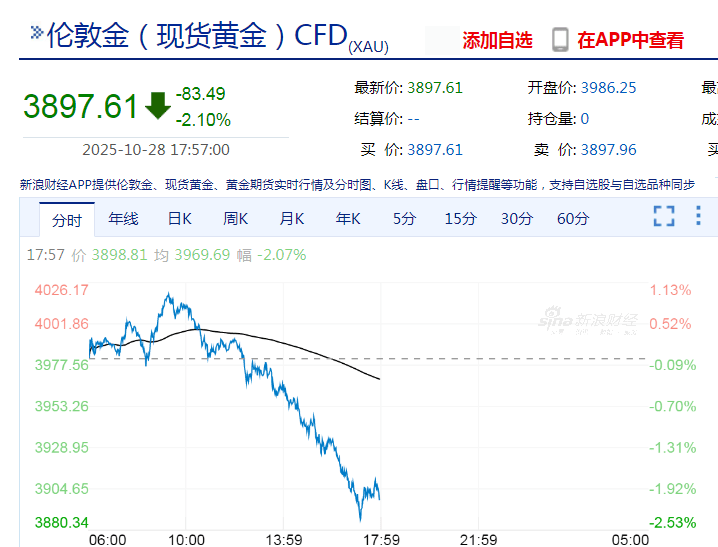
28日,现货黄金跌破3900美元/盎司,为10月6日以来首次,日内跌幅扩大至2%。截至17时58分,伦敦金现报3897.61美元/盎司。近6个交易日,现货黄金 有5个交易日录得下跌。 经济学家盘和林表示:"如果普通人在一个合理的价位介入,是可以投资的。但当前黄金投机气氛浓厚,普通人的对手是国外投机资本和全球央行,我认 为此时普通投资人'玩不赢'。"因此在他看来,现阶段普通百姓仍不宜参与黄金炒作。 来源 经济日报 智通财经等 校对 珵智 编辑 苏洋 周晨 点 点 鼓励小编继续搬砖 国内金饰价格今日(28日)也大幅下调 部分品牌金饰克价单日下跌超20元 ▪周大福金饰挂牌价调至1198元/克,较昨日下跌25元/克; ▪六福珠宝金饰调至1189元/克,较昨日下跌34元/克。 ▪周生生金饰调至1199元/克,较昨日下跌24元/克; ▪老庙黄金金饰调至1192元/克,较昨日下跌28元/克。 | C | 金饰排行 | | × | | --- | --- | --- | --- | | 银行/品牌排序 | 金饰价格 = | 较上日涨跌 = 综合评分 = | | | 11 周大福 | 1198.00 | -25.00 | 4. ...

黄金时间·观点:黄金急跌为哪般?后期是否还有冲高可能?
Xin Hua Cai Jing· 2025-10-28 05:28
Group 1 - The core viewpoint of the articles indicates that the recent sharp decline in gold prices is primarily due to two factors: the significant increase in gold prices during the U.S. government shutdown and the easing of geopolitical tensions, which has reduced market risk aversion [1][2] - Gold prices fell below $4000 per ounce for the first time in nearly 10 trading days, marking a decline of over 3% for the second time since October 21 [1] - The cumulative increase in gold prices reached 12.69% during the U.S. government shutdown, which is significantly higher than historical norms, leading to profit-taking by some investors [1] Group 2 - Despite the recent decline, the bullish outlook for gold is not over, as challenges related to the U.S. government shutdown and high federal debt levels continue to pose risks [2] - The U.S. consumer confidence index fell to a five-month low in October, indicating potential economic concerns, while expectations for interest rate cuts are increasing due to the liquidity crisis [2] - Short-term focus should be on the $4000 per ounce support level for gold, while the broader economic factors include trade developments and the Federal Reserve's interest rate decisions at the end of the month [2]
市场避险情绪降温,驱动黄金回调,黄金ETF基金(159937)今日回调超2%
Sou Hu Cai Jing· 2025-10-28 03:24
Group 1 - The core viewpoint of the articles indicates a significant decline in gold prices, with the international gold market experiencing a sharp drop, impacting gold ETFs negatively [1][2][3] - As of October 27, 2025, the gold ETF fund (159937) saw a decrease of 2.33%, with a latest quote of 8.69 yuan, while over the past two weeks, it has accumulated a slight increase of 0.60% [1] - The trading volume for the gold ETF fund was 9.22 billion yuan, with a turnover rate of 2.42%, and an average daily transaction of 23.83 billion yuan over the past month, ranking it among the top three comparable funds [1] Group 2 - The international gold market faced a significant setback on October 27, with spot gold prices dropping by 3.05% to $3987.28 per ounce, marking the largest single-day decline recently [1][2] - The upcoming Federal Reserve meeting is anticipated to influence gold prices, with expectations of a 25 basis point rate cut, which may have limited positive effects on gold [2] - Recent data indicates a net outflow of 2.30 billion yuan from gold ETFs, although there has been a net inflow of 13.96 billion yuan over the last five trading days, suggesting fluctuating investor sentiment [3]
智昇黄金原油分析:关税接近尾声 谨防避险消退
Sou Hu Cai Jing· 2025-10-27 09:48
Group 1: Gold Market - Gold is currently experiencing a downward trend, with signs of deterioration in its price pattern due to potential concessions from the U.S. on tariff issues, which may reduce safe-haven demand [1] - Recent statements from U.S. Treasury Secretary indicate optimism regarding U.S.-China negotiations, suggesting that the imposition of new tariffs may be reconsidered, which could further impact gold prices negatively [1] - Technical analysis shows that gold prices are facing resistance around $4095, with a likelihood of further declines in the short term [1] Group 2: Oil Market - India's cessation of Russian oil purchases may lead to increased buying from other oil-producing countries, providing weak support for oil prices [2] - Reliance Industries, India's largest private refiner, has stopped purchasing approximately 629,590 barrels of Russian oil daily, indicating a shift in sourcing for crude oil imports [2] - The halt in Russian oil purchases could disrupt the supply chain for Europe, which may need to seek alternative energy imports [2] Group 3: U.S. Economic Indicators - The focus of global financial markets is on the Federal Reserve and other central banks, with expectations of a 25 basis point rate cut in December due to recent inflation data [3] - The latest CPI data shows U.S. core inflation at 3%, with a slowdown in growth, creating conditions favorable for a rate cut [3] - The dollar index is showing weak upward momentum, with significant resistance from long-term moving averages [3] Group 4: Market Events and Data - California Governor Newsom has officially acknowledged his presidential campaign intentions [5] - U.S. Treasury Secretary has confirmed that the U.S. is no longer considering imposing 100% tariffs on Chinese goods, indicating a significant development in trade relations [5] - Scope Ratings has downgraded the U.S. sovereign credit rating to AA- [5]
23日国际金价上涨近2%
Sou Hu Cai Jing· 2025-10-24 00:36
Core Viewpoint - The intensification of geopolitical risks has heightened market risk aversion, leading to a technical rebound in gold prices after a significant decline of approximately 6.7% over the previous two trading days [1] Group 1 - As of the close on Thursday (23rd), the December gold futures price on the New York Mercantile Exchange settled at $4145.6 per ounce, reflecting an increase of 1.97% [1]
银行板块或再度转入“顺风局”,为何?
Mei Ri Jing Ji Xin Wen· 2025-10-23 05:20
Core Viewpoint - The recent escalation of China-U.S. trade tensions has heightened market risk aversion, increasing the attractiveness of the banking sector due to its defensive characteristics [1] Group 1: Market Trends - In the second quarter of this year, the banking sector experienced a significant upward trend amid increasing external uncertainties, demonstrating structural allocation advantages [1] - The current trading environment for technology growth sectors is crowded, leading some funds to shift towards undervalued, high-dividend sectors, supporting bank stocks through a "high to low" rotation [1] Group 2: Historical Performance - A review of the past ten years indicates that the banking sector has a 70% probability of generating absolute returns from November to January, with an 80% success rate, ranking it among the top industries [1] - The banking sector is entering a seasonal "tailwind" period, suggesting favorable conditions for investment [1] Group 3: Investment Strategy - The current fluctuations in the China Securities Bank Index tracked by bank ETFs present potential opportunities for investment during dips [1]
百利好晚盘分析:黄金短线受挫 长线逻辑完整
Sou Hu Cai Jing· 2025-10-22 09:59
Gold Market - Gold experienced its largest single-day drop in over a decade, with December futures closing at $4109.10 per ounce, down 5.7%. However, the overall bullish logic for gold remains intact, and it is premature to declare a peak in gold prices [1] - The recent decline is likely a result of extreme market sentiment, exacerbated by widespread opposition to Trump's new tariffs and a court ruling that undermines his authority to impose such tariffs. This has led to a reduction in risk aversion in the market, prompting many traders to close profitable long positions, resulting in a short-term sell-off [1] - Analysts believe that the fundamentals supporting gold, such as interest rate cuts and a potential dollar crisis, continue to drive capital into the gold market, indicating that the long-term upward trend is not yet over [1] - Technically, gold formed a bearish engulfing pattern on the daily chart, but there is potential for a correction due to excessive short-term divergence. The price may test resistance around $4186 [1] Oil Market - Oil prices showed a slight rebound, indicating a potential halt in the downtrend, but the weak fundamentals suggest limited upside potential, with a preference for short positions in the medium term [2] - A significant oversupply issue looms over the oil market, with the International Energy Agency projecting an unprecedented surplus of nearly 4 million barrels per day in 2026, as supply continues to outpace demand [2] - The U.S. Energy Information Administration has issued a bearish outlook for oil prices, anticipating substantial declines in the coming months due to increased production from both OPEC+ and non-OPEC+ countries, particularly the U.S., which is on track for record production levels [2] - Technically, oil formed a small bullish candle on the daily chart, suggesting a potential stop in the downtrend, with short-term support around $57.50 [2] Dollar Index - The dollar index has shown lackluster performance, with indications that the recent rebound may have ended, suggesting a continuation of the downtrend with significant downward potential remaining [3] - Major investment banks, including Citigroup, Goldman Sachs, and Morgan Stanley, have analyzed the long-term bearish outlook for the dollar, citing factors such as valuation, trade deficits, and interest rate differentials. Goldman Sachs noted that the dollar's real trade-weighted exchange rate is still 15% above its long-term average [3] - The uncertainty surrounding Federal Reserve leadership changes is adding downward pressure on the dollar [3] Federal Reserve Outlook - Recent comments from Federal Reserve officials indicate that interest rate cuts are highly likely, with a 99.4% probability of a 25 basis point cut in October and a 98.6% probability of a cumulative 50 basis point cut by December [4] - Technically, the dollar index formed a small bullish candle on the daily chart but faced significant resistance at previous highs, indicating a potential continuation of the downtrend [4] Nikkei 225 - The Nikkei 225 index closed with a small bullish candle, showing a clear upward trend supported by a bullish moving average arrangement. The short-term outlook appears to be bullish, with support around 49130 [5] Copper Market - Copper prices have shown a series of small declines but have not significantly dropped, indicating strong long-term support. There is potential for an upward continuation pattern, with short-term support around $4.88 [6] Market Overview - The Trump administration is preparing to investigate pharmaceuticals to pave the way for new tariffs, which may reignite global trade tensions [7] - Most economists expect the Bank of Japan to raise key interest rates in October or December, with nearly 96% predicting at least a 25 basis point increase by the end of March next year [7] - India and the U.S. are nearing a trade agreement to reduce punitive tariffs, potentially lowering current tariffs on Indian exports from 50% to 15-16% [7] Upcoming Events - ECB President Lagarde is scheduled to speak at a financial summit in Frankfurt [8] - The EIA will release weekly crude oil inventory data, with expectations of an increase of 1.205 million barrels [9]

铜冠金源期货商品日报-20251022
Tong Guan Jin Yuan Qi Huo· 2025-10-22 02:37
1. Report Industry Investment Rating No relevant content provided. 2. Core Views of the Report - Overseas, the Russia-Ukraine peace talks have hit a snag, and European countries advocate an "immediate ceasefire" at the current front line. The US government shutdown has led to a lack of economic data, and the market is digesting the situation. Domestically, A-shares have risen, but the trading volume is still low. In the short term, the stock market is expected to be volatile and weak, while in the long term, it is cost-effective to buy on dips. The bond market has also recovered [2]. - The silver squeeze has ended, and the Sino-US economic and trade relations are showing signs of easing. The precious metal prices are entering an adjustment phase, and the adjustment slope may be steeper, especially for silver [3][4]. - The copper price has slightly declined due to the rebound of the US dollar index and the weakening of market risk aversion. The supply of copper is increasing, while the demand is mainly for rigid replenishment. The copper price is expected to remain volatile in the short term [6][7]. - The aluminum price is oscillating. The macro - sentiment is stable, and the supply - demand situation is favorable. The aluminum price is expected to maintain a high - level oscillation [8]. - The alumina price is weakly oscillating. The winter procurement by aluminum plants in the northwest is putting downward pressure on the price. The theoretical loss of northern alumina production capacity is expanding, and the price is expected to have limited further downside [9]. - The zinc market shows an external - strong and internal - weak pattern. The domestic supply is increasing, while the demand is weak. The LME has a low - inventory and strong - structure. The zinc price is expected to stabilize and oscillate narrowly in the short term [10]. - The lead price is oscillating narrowly. The supply in the domestic market is regionally tight, but the import window has opened, and the supply pressure is expected to increase gradually, causing the lead price to decline [11]. - The tin price is oscillating narrowly. The supply improvement of tin ore is limited, and the downstream procurement is cautious. The tin price is expected to maintain a high - level narrow - range oscillation in the short term [12]. - The industrial silicon price is oscillating narrowly. The supply is stable, and the demand is mixed. The social inventory has increased, and the price is expected to continue to oscillate at a low level in the short term [14][15]. - The lithium carbonate price is oscillating. The supply increase is limited, and the demand is improving marginally. The lithium price may adjust in the short term after the first upward rush is blocked [16][17]. - The nickel price is oscillating. The inventory is increasing, but the price is at the lower end of the range with cost support. The nickel price is expected to oscillate strongly in the short term [18][19]. - The price difference between soda ash and glass is expected to widen. The soda ash fundamentals are slightly better than those of glass, and both are facing inventory accumulation pressure [20]. - The steel price is under pressure. The terminal demand is weak, and the supply pressure is increasing. The steel price is expected to oscillate under pressure [21]. - The iron ore price is oscillating weakly. The port inventory has increased, and the demand is weakening. The iron ore price is expected to adjust in an oscillating manner [22][23]. - The soybean meal price is weakly oscillating. The Brazilian rainy season is expected to return in November, and the domestic supply is sufficient. The soybean meal price is expected to maintain a weak oscillation in the short term [24]. - The palm oil price is oscillating widely. The production and demand of palm oil in Malaysia are increasing slightly, and the market driving force is limited. The palm oil price is expected to oscillate widely in the short term [25][26]. 3. Summary by Relevant Catalogs 3.1 Macro - Overseas, the Russia - Ukraine peace talks are complicated. The US government shutdown has affected economic data. The market is waiting for the CPI data on the 24th and the APEC Sino - US summit at the end of the month. Domestically, A - shares have risen, the bond market has recovered, and the short - term stock market is expected to be volatile and weak [2]. 3.2 Precious Metals - The silver squeeze has ended, and the Sino - US economic and trade relations are easing. The precious metal prices have fallen sharply, and the adjustment slope may be steeper, especially for silver [3][4]. 3.3 Copper - The copper price has slightly declined. The market risk aversion has weakened, and the supply is increasing. The copper price is expected to remain volatile in the short term [6][7]. 3.4 Aluminum - The aluminum price is oscillating. The macro - sentiment is stable, the supply - demand situation is favorable, and the aluminum price is expected to maintain a high - level oscillation [8]. 3.5 Alumina - The alumina price is weakly oscillating. The winter procurement by aluminum plants in the northwest is putting downward pressure on the price. The theoretical loss of northern alumina production capacity is expanding, and the price is expected to have limited further downside [9]. 3.6 Zinc - The zinc market shows an external - strong and internal - weak pattern. The domestic supply is increasing, while the demand is weak. The LME has a low - inventory and strong - structure. The zinc price is expected to stabilize and oscillate narrowly in the short term [10]. 3.7 Lead - The lead price is oscillating narrowly. The supply in the domestic market is regionally tight, but the import window has opened, and the supply pressure is expected to increase gradually, causing the lead price to decline [11]. 3.8 Tin - The tin price is oscillating narrowly. The supply improvement of tin ore is limited, and the downstream procurement is cautious. The tin price is expected to maintain a high - level narrow - range oscillation in the short term [12]. 3.9 Industrial Silicon - The industrial silicon price is oscillating narrowly. The supply is stable, and the demand is mixed. The social inventory has increased, and the price is expected to continue to oscillate at a low level in the short term [14][15]. 3.10 Lithium Carbonate - The lithium carbonate price is oscillating. The supply increase is limited, and the demand is improving marginally. The lithium price may adjust in the short term after the first upward rush is blocked [16][17]. 3.11 Nickel - The nickel price is oscillating. The inventory is increasing, but the price is at the lower end of the range with cost support. The nickel price is expected to oscillate strongly in the short term [18][19]. 3.12 Soda Ash and Glass - The price difference between soda ash and glass is expected to widen. The soda ash fundamentals are slightly better than those of glass, and both are facing inventory accumulation pressure [20]. 3.13 Steel - The steel price is under pressure. The terminal demand is weak, and the supply pressure is increasing. The steel price is expected to oscillate under pressure [21]. 3.14 Iron Ore - The iron ore price is oscillating weakly. The port inventory has increased, and the demand is weakening. The iron ore price is expected to adjust in an oscillating manner [22][23]. 3.15 Soybean and Rapeseed Meal - The soybean meal price is weakly oscillating. The Brazilian rainy season is expected to return in November, and the domestic supply is sufficient. The soybean meal price is expected to maintain a weak oscillation in the short term [24]. 3.16 Palm Oil - The palm oil price is oscillating widely. The production and demand of palm oil in Malaysia are increasing slightly, and the market driving force is limited. The palm oil price is expected to oscillate widely in the short term [25][26].
金油比逼近历史高位,机构认为强金价弱油价长期或难扭转
Sou Hu Cai Jing· 2025-10-21 23:32
Core Viewpoint - The international gold and oil markets are experiencing a stark divergence, with gold prices surging to historical highs while oil prices are under pressure, indicating a significant shift in market dynamics [1] Group 1: Gold Market - Gold prices have recently soared, with COMEX gold futures reaching over $4,300 per ounce, marking a new historical high [1] - The increase in gold prices is attributed to heightened expectations of interest rate cuts by the Federal Reserve, rising market risk aversion, and a weakening of the dollar's credibility [1] - The rapid increase in gold prices may face short-term profit-taking pressure, which could lead to a potential correction in the gold-to-oil ratio [1] Group 2: Oil Market - In contrast, WTI crude oil futures have fallen below $56 per barrel, reaching the lowest level since early May, indicating ongoing pressure in the oil market [1] - The decline in oil prices is primarily driven by fundamental industry factors, including oversupply and weakening demand, which highlight the issue of excess production capacity [1] - The long-term outlook suggests that the current strong gold prices and weak oil prices may not fundamentally reverse in the near future [1]