
即时零售

Search documents
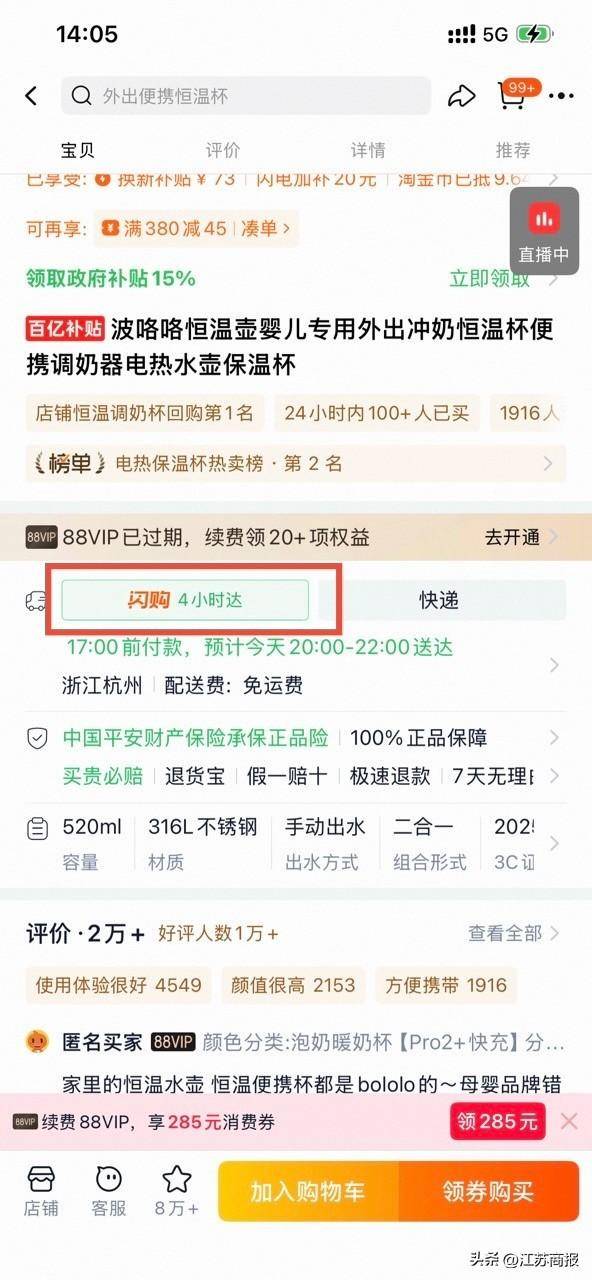
10城覆盖、4小时送达!天猫联手50家电品牌开启“闪购时代”
Sou Hu Cai Jing· 2026-01-29 17:24
Group 1 - The Tmall New Year Festival offers significant discounts on home appliances, with official reductions starting at 8.8% and additional coupons available, allowing prices to drop to as low as 50% after combining various promotions [1] - Major home appliance brands such as Philips, Joyoung, Gree, Midea, Hisense, Siemens, and others are participating in the Tmall event, providing fast delivery services [1] - The "4-hour delivery" service is now available in ten major cities, including Shanghai, Guangzhou, and Beijing, enhancing consumer convenience and satisfaction [4] Group 2 - The integration of Tmall brands into Taobao Flash Sale reflects a growing trend in instant retail, with approximately 3,500 Tmall brands connecting their offline stores to the service [5] - The collaboration has resulted in a significant increase in consumer orders, with daily orders for instant retail on Tmall seeing a 198% month-over-month growth compared to September [5] - The fast delivery service has led to a notable increase in sales for participating brands, with some products experiencing over a 30% rise in sales due to improved logistics and delivery efficiency [4]


抖音电商货架场景增速持续下跌,原因有很多
3 6 Ke· 2026-01-29 13:43
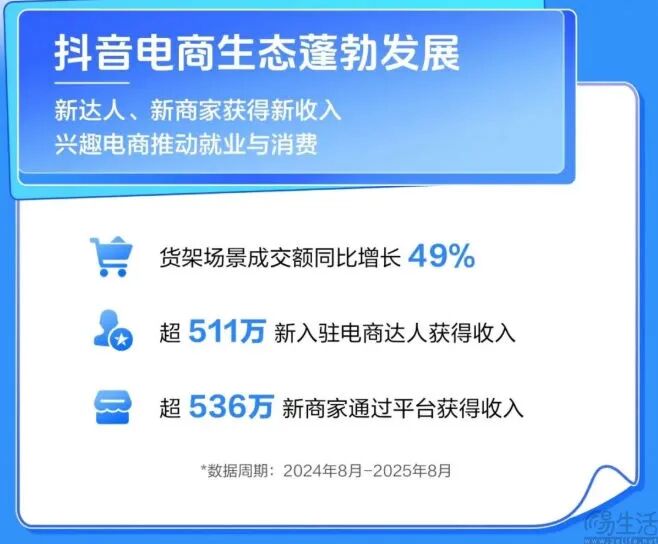
Core Insights - Douyin E-commerce reported a 45% year-on-year increase in the number of merchants achieving revenue growth through live streaming, with over 80,000 new merchants generating sales exceeding 1 million yuan [1] - The platform's shelf scene transaction volume grew by 49% from August 2024 to August 2025, marking a significant development in its e-commerce strategy [3] - The transition to a comprehensive interest-based e-commerce model aligns with industry trends, focusing on both impulse buying through content and clear demand through static scenes [5] Group 1 - The shelf scene's GMV growth has significantly slowed, dropping from 140% in September 2023 to 86% in October 2024, and further to 49% [5][8] - Douyin E-commerce's strategic focus has shifted towards live streaming, as the content scene remains its core strength, especially in light of challenges faced by top influencers in 2024 [8] - The platform's ability to leverage algorithm-driven content to stimulate impulse purchases is contrasted by the more rational decision-making process in the shelf scene, which diminishes its traffic advantage [10] Group 2 - External competition from platforms like Taobao and JD.com, particularly in instant retail, has intensified the challenges for Douyin E-commerce, as these competitors enhance their local supply chains [12] - The delay in Douyin E-commerce's entry into the instant retail space has resulted in a dual pressure on its shelf scene, facing both existing competition and new challenges from instant retail offerings [12]
万辰集团预计2025年业绩实现增长,全年预计录得营收500亿元-528亿元
Huan Qiu Wang· 2026-01-29 12:23
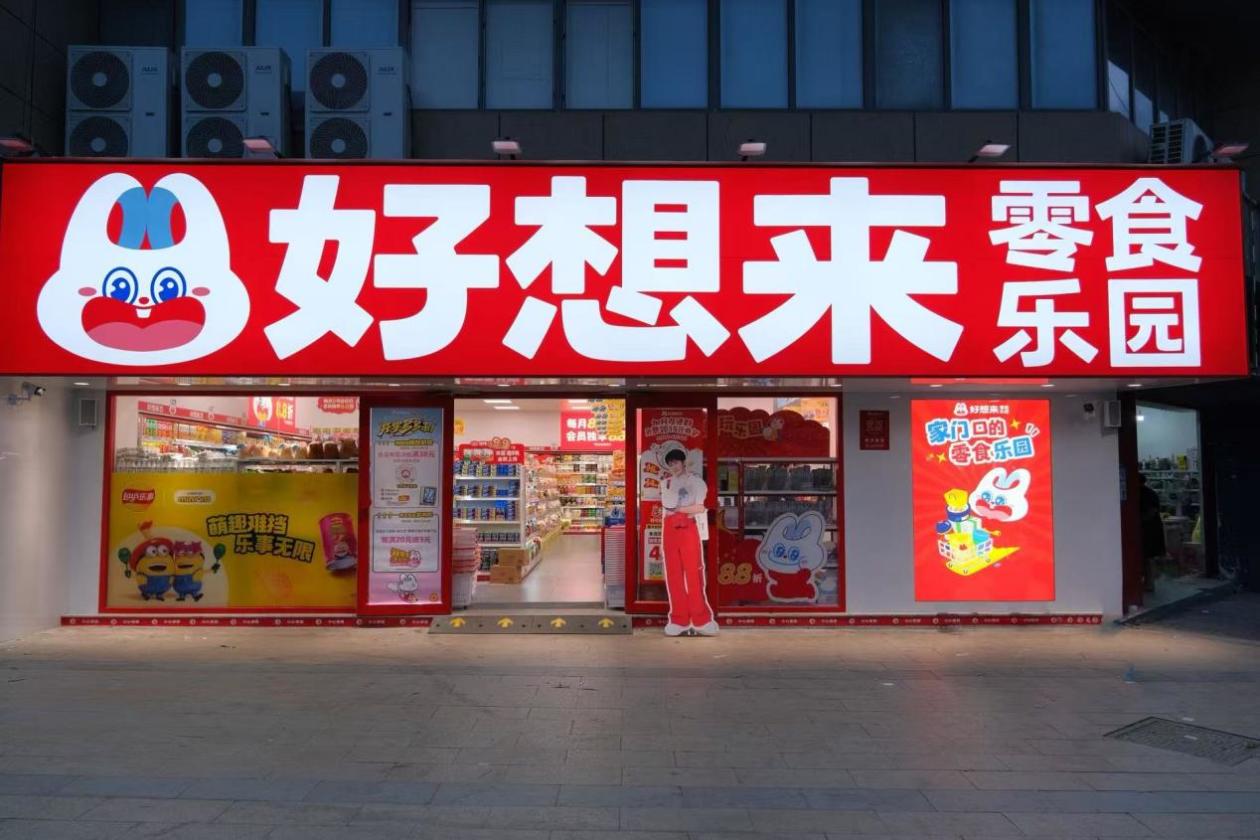
Group 1 - The core viewpoint of the article is that Wancheng Group (300972.SZ) is expected to achieve significant revenue growth in 2025, with projected annual revenue between 50 billion to 52.8 billion yuan, representing a year-on-year increase of 54.66% to 63.32% [1] - The net profit attributable to shareholders is anticipated to reach between 1.23 billion to 1.4 billion yuan, indicating a strong financial performance [1] - The snack brand "Haoxianglai" under Wancheng Group has experienced rapid development due to its extensive store network and refined operational strategies, with projected revenue for the snack business expected to be between 50 billion to 52 billion yuan, reflecting a year-on-year growth of 57.28% to 63.57% [1] Group 2 - Haoxianglai has built a large and active membership ecosystem with over 150 million registered members as of August 31, 2025, and 110 million active members in the first eight months of 2025 [3] - Members contributed approximately 78% of the total merchandise transaction volume (GMV) in the first eight months of 2025, with an average monthly consumption frequency of 2.9 times per active member in August 2025 [3] - Following deep collaborations with instant retail platforms like Meituan and Taobao, nearly 10,000 Haoxianglai stores have integrated into the instant retail business, leading to a significant increase in orders and sales across various product categories [3]
茅台酱香酒与美团闪购升级合作:近3000家官方门店上线年货补贴
Xin Lang Cai Jing· 2026-01-29 09:28
Core Viewpoint - The collaboration between Guizhou Moutai Sauce Wine Marketing Co., Ltd. and Meituan Flash Purchase aims to enhance the distribution and accessibility of authentic Moutai Sauce Wine through a significant increase in certified stores and a focus on consumer experience [1] Group 1: Partnership and Expansion - Guizhou Moutai has upgraded its partnership with Meituan Flash Purchase, expanding the number of official certified stores from over 1,000 to nearly 3,000, covering 245 cities nationwide [1] - The collaboration is part of a strategy to build an instant retail network and drive channel transformation for Moutai Sauce Wine [1] Group 2: Consumer Engagement and Promotions - The partnership will focus on core values of "genuine products and exceptional service," with plans to implement source tracing, official authentication, and one-on-one urgent delivery services by 2026 [1] - A joint subsidy activity will be launched during the traditional peak season for purchasing liquor, particularly around the Spring Festival [1]


锅圈发盈喜 预期2025年度取得净利润约4.43亿元至4.63亿元 同比增加约83.7%至92.0%
Zhi Tong Cai Jing· 2026-01-29 09:14
Core Viewpoint - The company expects significant growth in revenue and profit for the fiscal year 2025, driven by market expansion and operational efficiency improvements [1][2] Group 1: Financial Projections - The company anticipates revenue for the fiscal year 2025 to be approximately RMB 77.5 billion to RMB 78.5 billion, representing an increase of about 19.8% to 21.3% compared to RMB 64.7 billion for the fiscal year 2024 [1] - The expected net profit for 2025 is projected to be around RMB 4.43 billion to RMB 4.63 billion, marking an increase of approximately 83.7% to 92.0% from RMB 2.41 billion in 2024 [1] - Core operating profit (non-IFRS measure) is expected to be between RMB 4.5 billion and RMB 4.7 billion, reflecting a growth of about 44.8% to 51.2% from RMB 3.11 billion in 2024 [1] Group 2: Growth Drivers - The primary reasons for the anticipated increase in revenue, net profit, and core operating profit include the company's ongoing efforts to expand into rural markets and steadily grow its presence in other regions [2] - The number of stores is expected to reach 11,566 by December 31, 2025, an increase of 1,416 stores compared to December 31, 2024 [2] - The company's community central kitchen strategy, combined with a multi-channel approach that integrates online and offline operations, has contributed to the expansion of its instant retail store network and improved store operational efficiency [2]
鸿星尔克、斯凯奇、中乔全国超千家门店接入淘宝闪购
Xin Lang Cai Jing· 2026-01-29 04:32
Core Insights - During this year's Tmall New Year Festival, sports brands such as Hongxing Erke, Skechers, and China Jordan have integrated into Taobao Flash Sale [1][2] Company Developments - Hongxing Erke has completed the integration of over 1,000 offline stores and plans to expand to approximately 2,000 stores by the end of the year [1][2] - Skechers has integrated 282 self-operated stores across 54 cities including Shanghai, Beijing, Guangzhou, Shenzhen, and Hangzhou, with plans to continue expanding its presence in Taobao Flash Sale by 2026 [1][2] - China Jordan plans to gradually integrate over 1,000 offline stores nationwide [1][2] Product Offerings - Hongxing Erke has launched its 2026 new product "Elite" series casual shoes and "Park Run" series running shoes through Flash Sale [1][2] - Skechers has introduced the "Cheng Yi Celebrity Style" series and "Flash Walk" series hiking shoes, offering a limited-time free delivery within an 8-kilometer range [1][2] - China Jordan is providing discounts with an official 8.8% off and additional promotions, with over a thousand products starting at 50% off, also offering limited-time free delivery [1][2] Market Trends - By 2025, leading brands such as Anta, 361°, Decathlon, and Taobo have already integrated into the platform, indicating that Taobao Flash Sale is becoming a core area for sports brands to establish instant retail [1][2] - The integration of online and offline operations on Tmall is aimed at providing consumers with a new shopping experience [1][2]
济青烟消费试点激活内需新潜力
Qi Lu Wan Bao· 2026-01-28 12:08
Core Viewpoint - The Shandong provincial government aims to enhance service consumption by launching the "Qilu Service Consumption Season" with 500 events and 100 new product launches, focusing on innovative consumption models in Jinan, Qingdao, and Yantai [1] Group 1: Online Consumption Initiatives - The government plans to strengthen online sales through live streaming, instant retail, and social e-commerce, with a focus on large commercial complexes [1] - Jinan has developed the "Quancheng Purchase" platform, issuing 160 million yuan in consumption vouchers by 2025, which is expected to drive direct consumption exceeding 10 billion yuan [1] - Qingdao issued 160 million yuan in targeted consumption vouchers, resulting in a year-on-year sales increase of over 15% in retail and dining sectors [1] Group 2: Financial Support and Subsidies - The Ministry of Finance allocated subsidies based on city size, with Qingdao receiving 250 million yuan for first-launch economy and scenario innovation [1] - Jinan and Yantai also received corresponding subsidies to support the pilot projects [1] Group 3: Offline Consumption Innovations - Qingdao is cultivating high-level flagship stores and creating night-time consumption zones [2] - Yantai plans to establish 15 first-launch economic clusters and develop a coastal metaverse consumption street [2] - Jinan is expanding the categories of home appliance and digital subsidies while enhancing service functions in commercial areas [2] Group 4: Supply Chain and Logistics Enhancements - The three cities are simultaneously upgrading the circulation network at county, township, and village levels, optimizing logistics and rural store operations to sustain urban and rural consumption vitality [2]
货拉拉企业版“快稳”运力,让年货“早一步”到家
Sou Hu Cai Jing· 2026-01-28 08:59
Core Insights - The upcoming Spring Festival has ignited a consumption boom, with the New Year shopping festival becoming a battleground for online and offline retailers [1] - Major platforms like Douyin and Taobao have launched their New Year promotions, while offline supermarkets are also actively participating [1] - The logistics sector faces challenges due to the surge in consumer demand and freight requirements during this peak shopping period [1] Group 1: Retail Strategies - Various retailers have extended their promotional periods, with JD.com starting a two-month campaign from late December, which increases inventory and logistics pressure [3] - Walmart has created a series of popular New Year products centered around themes of family gatherings and gifting, available across all channels [1][3] - Retailers are focusing on fast and stable logistics solutions to meet the heightened demand for timely deliveries [1][3] Group 2: Logistics Solutions - Huolala's enterprise version offers instant transportation solutions and customized freight services, leveraging a vast network of 1.4 million active drivers and an average order acceptance time of 30 seconds [3] - The company has developed a real-time dispatch system to meet short-distance transportation needs, ensuring that frequently consumed goods are replenished promptly [3] - For urgent cross-regional deliveries, Huolala employs a combination of air and city distribution to provide door-to-door services, achieving same-day and next-day delivery options [3] Group 3: Fresh Produce and Special Goods - Fresh produce and prepared dishes are critical for New Year celebrations, necessitating precise temperature control and refrigerated transport [5] - Huolala has prepped cold chain vehicles to ensure the freshness of these goods throughout the delivery process [5] - The company also offers multi-vehicle delivery services for large items like smart appliances and custom furniture, enhancing last-mile delivery efficiency [5] Group 4: E-commerce and Consumer Behavior - The instant retail model is reshaping the New Year market, with consumers increasingly expecting rapid delivery times [6] - The competitive edge for businesses is shifting from price and variety to the quality of fulfillment services [6] - Huolala aims to address transportation pain points for businesses by providing dynamic capacity allocation and tailored service plans, facilitating smooth supply chains for the New Year [6]

未知机构:国联民生交运周报260126即时零售再起势重视顺丰同城布局机会航空量价-20260128
未知机构· 2026-01-28 02:25
【国联民生交运*周报260126】即时零售再起势,重视顺丰同城布局机会;航空量价环比回升预热春运 #阿里即时零售领域长期投入的决心坚定,抖音、拼多多入局,即时零售再起势。 1)阿里:持续加码大消费和服务电商赛道,即时零售领域长期投入的决心坚定。 25H2淘宝闪购日订单峰值达1.2亿单,8月周度日均订单突破8000万单。 2025Q3,即时零售收入同比增长60%。 【国联民生交运*周报260126】即时零售再起势,重视顺丰同城布局机会;航空量价环比回升预热春运 #阿里即时零售领域长期投入的决心坚定,抖音、拼多多入局,即时零售再起势。 1)阿里:持续加码大消费和服务电商赛道,即时零售领域长期投入的决心坚定。 25H2淘宝闪购日订单峰值达1.2亿单,8月周度日均订单突破8000万单。 2025Q3,即时零售收入同比增长60%。 2)抖音&拼多多:抖音整合即时零售业务,抖音超市合并至小时达,开展"直播带货 #顺丰同城:即时零售"必争之地"趋势渐明,重视顺丰同城布局机会。 公司为独立第三方即配龙头,享即配行业规模持续快速扩张和快递业务量高增双β红利,2030年中国即时零售市场 规模有望超过2万亿元,在品牌化趋势下其竞争 ...

数字化驱动 2026年购物中心客流量预计持续上涨
Bei Jing Shang Bao· 2026-01-27 12:37
北京商报讯(记者 刘卓澜)1月27日,中国连锁经营协会发布2025年度中国购物中心行业景气度概览调 研结果显示,2025年购物中心行业在销售、客流、租金等核心指标上呈现温和复苏态势,会员消费占比 持续提升,数字化转型进程加速。不过,购物中心经营仍面临诸多挑战,空铺率及运营成本上涨等问题 需要持续关注。同时,如何平衡品牌级次与租金收益?如何提升客流转化效率?如何应对消费分级趋 势?都是企业普遍关注的重点。 租金方面,64.7%的项目实现租金收入增长,但大部分增长低于5%,增长超过10%的项目合计仅占 19.4%。同时,有二成项目租金收入下降。提袋率方面,41.0%的项目提袋率上升,我提袋率普遍提 升。购物中心通过精准营销、服务增强和场景营造有效提升了到场客流的转化效率。渠道方面,51.8% 的项目线上销售占比上升,41.7%的项目线上销售占比与上一年相比持平,线上渠道已从应急之举发展 为标准配置和增量来源。即时零售逐渐成为线上销售中新的增长点。 对于2026年上半年,调研显示,行业普遍乐观。76.3%的项目预计客流量将继续增长,64.7%的项目预 计销售情况将进一步提升,54.7%的项目看好未来6个月租赁表现。 ...