
基建投资

Search documents
核电投资加速或提振基建景气度,基建ETF(159619)盘中涨超1%
Mei Ri Jing Ji Xin Wen· 2025-06-06 05:47
Group 1 - The core viewpoint of the article highlights the significant improvement in the nuclear power industry, with the State Council approving five nuclear power projects and ten units in 2025, marking the fourth consecutive year of approving ten or more units annually [1] - From January to April 2025, the completed investment in nuclear power reached 36.256 billion yuan, a year-on-year increase of 36.64%, significantly outpacing the 1.6% growth in power source investment, indicating a new boom cycle in nuclear power construction [1] - The third-generation nuclear power units are expected to enter a peak construction phase, with modular construction technology showing promising prospects for shortening construction periods and improving efficiency [1] Group 2 - In the construction and decoration sector, the cement shipment rate has continuously rebounded to 47.8%, reflecting an acceleration in physical construction work [1] - The article suggests focusing on investment opportunities in key industries such as infrastructure in central and western regions, nuclear power, and coal chemical industries, while also monitoring improvements in orders from central state-owned enterprises and the subsequent realization of physical work [1] - The Infrastructure ETF (code: 159619) tracks the CSI Infrastructure Index (code: 930608), which selects listed companies involved in infrastructure construction from the A-share market, covering industries such as construction, building materials, and engineering machinery [1]
区域经济与银行股系列:三项动能支撑:基建+产业升级+新兴,金融需求持续性强
ZHONGTAI SECURITIES· 2025-06-04 12:39
Investment Rating - The report maintains an "Overweight" rating for the industry [2] Core Insights - The correlation between regional economic conditions and bank valuations is increasing, with banks focusing on serving the local real economy [5] - Shandong's strategic position is highlighted by national-level initiatives such as the new and old kinetic energy conversion pilot zone, driving strong infrastructure and industrial momentum [5] - The dual task of upgrading traditional industries and fostering emerging sectors in Shandong is expected to sustain strong financial demand, with projected credit growth of 8%-11% in 2025 [5] - The regional risk situation is manageable, with city investment risks concentrated in specific counties and a significant improvement in the credit environment [5] - Recommended focus on quality banks within the province, such as Qilu Bank and Qingdao Bank, which are maintaining high credit growth and improving market share [5] Summary by Sections Economic Dynamics - The "Seven Networks" plan establishes long-term infrastructure momentum, driving traditional and new infrastructure financial demand [5][18] - Shandong's economic structure is more traditional compared to Jiangsu and Zhejiang, with a strong demand for green finance and technological upgrades [5][30] - The province's credit growth is expected to remain stable, with a 9.7% growth rate in Q1 2025, second only to Sichuan and Jiangsu among major provinces [5][15] Infrastructure Investment - Infrastructure loan growth in Shandong is projected to surpass that of Sichuan and Jiangsu by 2024, with significant investment targets set for 2025 [23][26] - The government aims for 3,900 key projects to be operational by 2025, exceeding the 2,600 projects planned for 2024 [26] Industry Transformation - Shandong is the only national-level pilot zone for new and old kinetic energy conversion, fostering both traditional upgrades and emerging economic demands [30][32] - The province's industrial structure is gradually optimizing, with traditional industries still dominant but new sectors gaining traction [5][30] Regional Banking Landscape - Qilu Bank and Qingdao Bank are highlighted for their robust credit growth and improving market share, with a focus on the manufacturing and retail sectors [6][11] - The asset quality of regional banks is stable, with a decreasing trend in non-performing loans [6][11]

热点思考|财政“前置”后该关注什么?(申万宏观·赵伟团队)
赵伟宏观探索· 2025-06-01 02:31
Group 1 - The core feature of the 2025 fiscal policy is the significant "front-loading" of fiscal debt financing and expenditure structure, which has stabilized economic performance in the first half of the year [1][2][4] - From January to April 2025, the broad fiscal expenditure growth rate reached 7.2%, with a spending progress of 28.4%, exceeding the five-year average of 28.2%, indicating strong fiscal support for the economy [2][8] - The growth in broad fiscal expenditure is primarily supported by the rapid issuance of government debt, particularly treasury bonds, with net financing of 4.8 trillion yuan from January to April, an increase of 3.6 trillion yuan year-on-year [3][21] Group 2 - The fiscal policy for 2025 is more proactive, with a planned net financing scale of 13.86 trillion yuan for government debt, of which 6.3 trillion yuan has been financed by the end of May, leaving 7.5 trillion yuan to be issued [4][32] - The issuance of treasury bonds has accelerated, with 42.7% of the budget target achieved by May 24, 2025, significantly higher than the average of 16.9% from 2020 to 2024 [3][21] - The government is expected to maintain high levels of net financing through the third quarter, with projections of 2.3 trillion yuan in the second quarter and 3.8 trillion yuan in the third quarter [4][35] Group 3 - The government may introduce incremental policies to smooth fiscal expenditure and ensure the achievement of annual economic goals, especially given uncertainties in economic recovery in the second half of the year [5][37] - Policy tools such as budgetary and non-budgetary measures will be utilized to stabilize economic fluctuations, with a focus on service consumption, fertility policies, and infrastructure investment as key areas for fiscal support [6][50] - The government aims to enhance consumer spending by reducing burdens and increasing income, with significant potential for recovery in service consumption, which currently stands at only 87.7% of historical trends [50][51]


基建,狂飙!
第一财经· 2025-05-30 15:26
2025.05. 30 本文字数:2119,阅读时长大约4分钟 导读 :基建投资不仅是当期固投的重要实现途径,也为未来经济增长打下基础。 作者 | 第一财经 何涛 本周二(5月27日),备受深圳人期待的春风隧道主线正式通车。深圳市市长覃伟中专程前去调研, 并强调要积极扩大有效投资,大力推进"两重"建设,助力经济高质量发展。 投资、消费、出口是拉动经济增长的"三驾马车"。今年以来,在外贸挑战陡然增大的情况下,多个省 市通过加大投资力度,有效对冲经济下行的压力。其中,基础设施建设成为各地投资的重点。 第一财经记者注意到,截至5月30日,全国31个省份(不含港澳台)均已公布今年前4个月固定资产投资 情况,其中28个省份取得同比正增长,7个省份的增速达双位数。内蒙古、新疆、西藏、宁夏、吉 林、黑龙江等西部和东北部省份表现尤其亮眼,北京则以21.2%的同比增速拔得头筹。 有21个省份公布了基础设施投资情况,其中16个省份的同比增速达双位数,占到已公布省份的七成 以上。基建投资高速增长的省份分布较为均匀,东、中、西部和东北地区都有。增速排名靠前的青 海、河北、内蒙古、海南、福建、北京、天津,同比增速分别达43.8%、37 ...

热点思考|财政“前置”后该关注什么?(申万宏观·赵伟团队)
申万宏源宏观· 2025-05-30 14:20
Group 1 - The core feature of the 2025 fiscal policy is the significant front-loading of fiscal debt financing, which has positively impacted expenditure performance. From January to April, the broad fiscal expenditure growth rate reached 7.2%, with a spending progress of 28.4%, exceeding the five-year average of 28.2% [2][8][72] - The broad fiscal expenditure growth is primarily supported by the rapid issuance of government debt, particularly treasury bonds. From January to April, the net financing of government debt was 4.8 trillion yuan, an increase of 3.6 trillion yuan year-on-year, becoming the core support for broad fiscal expenditure [3][21][73] - The fiscal policy for 2025 is more proactive, with a planned net financing scale of 13.86 trillion yuan for government debt. As of the end of May, 6.3 trillion yuan has been net financed, leaving 7.5 trillion yuan to be issued [4][32][74] Group 2 - The growth in broad fiscal expenditure is not due to improved revenue, as the cumulative fiscal revenue from January to April showed a year-on-year decline of 1.3%, falling short of the budget target by 1.5 percentage points, mainly due to declines in tax and land transfer revenues [2][14][72] - The government is expected to maintain a high level of net financing for government debt until the end of September, with the second quarter's net financing expected to increase by 2.3 trillion yuan year-on-year, and the third quarter maintaining a historically high level of 3.8 trillion yuan [4][35][74] - To smooth out economic fluctuations in the second half of the year, the government may introduce incremental policies to stabilize broad fiscal expenditure growth, especially given the uncertainties in economic recovery [5][37][74] Group 3 - Various policies are available to mitigate fluctuations in the second half of the year, including flexible budgetary tools and policy financial instruments that can be deployed quickly. The effectiveness of these tools has been validated in practice since 2022 [6][39][74] - The focus of incremental funding will be on service consumption, fertility policies, and infrastructure investment, with an emphasis on reducing burdens and increasing income for residents to stimulate consumption [7][50][74] - The government is likely to consider additional funding if fiscal revenue falls short of budget targets, which could impact the support of fiscal expenditure for nominal GDP [7][44][74]

四川路桥20250526
2025-05-26 15:17
Summary of Sichuan Road and Bridge Group Conference Call Company Overview - **Company**: Sichuan Road and Bridge Group - **Industry**: Infrastructure and Construction Key Points Financial Performance - In Q1 2025, the company reported revenue of 23 billion yuan, a year-on-year increase of 4%, and a net profit of 1.774 billion yuan, up 1% year-on-year, marking four consecutive quarters of growth [2][3] - For the full year 2024, the company achieved revenue of 107.2 billion yuan and a net profit of 7.2 billion yuan, with total assets of 239.7 billion yuan and earnings per share of 0.83 yuan [3] New Contracts and Orders - The company secured 77 new projects in Q1 2025, totaling 34.7 billion yuan, a nearly 20% increase year-on-year [2] - The total backlog of orders exceeded 290 billion yuan by the end of 2024, with expectations to surpass new highs in 2025 [2][3] Infrastructure Investment in Sichuan - Sichuan's infrastructure investment is projected to reach 268 billion yuan in 2025, with a goal of 280 billion yuan [2][5] - The focus on highway construction is emphasized to offset slowdowns in rail and water transport investments, providing business support for Sichuan Road and Bridge [2][5] Strategic Business Adjustments - The company divested its mining, new materials, and clean energy businesses, completing the transaction on February 26, 2025, which is expected to enhance financial performance [2][7] - The company retains a 40% stake in these divested businesses, which could provide future earnings support if they become profitable [7] Collaboration with Shudao Group - Shudao Group plays a dominant role in highway construction in Sichuan, with over 80% of its projects pending, and plans to invest over 192 billion yuan in 2025 [2][8] - This partnership is expected to enhance the company's market competitiveness and provide high-quality project opportunities [8] Cash Flow Management - The company improved cash flow management, reducing accounts receivable from over 27 billion yuan at the end of 2024 to around 20 billion yuan in Q1 2025 [4][13] - The impact of Sichuan's debt resolution on the company is minimal, as project funding primarily relies on major shareholder investments [14][15] Future Outlook - The company commits to a dividend payout ratio of no less than 60% over the next three years, supported by the synergistic effects of its collaboration with Shudao Group [4][20] - The company anticipates stable growth in the next 3 to 5 years, with expected project totals exceeding 500 billion yuan [21][22] Challenges and Responses - The company faces challenges in project quality and timely execution but has received supportive policies from various government departments to facilitate development [23] - Sichuan Road and Bridge aims to optimize internal assets and focus on its core business to enhance financial performance [23] Market Position - Sichuan Road and Bridge is a leading player in the western infrastructure sector, with a strong focus on investor returns and a high dividend rate compared to peers [24][26] - The company is optimistic about future growth, bolstered by policy support and a focus on core operations [26] Geographic Focus - The company primarily operates in the Sichuan-Chongqing region, with about 86% of its business concentrated locally, while also expanding into other provinces and overseas markets [18] International Projects - The company has engaged in international projects, including a recent contract for a bridge in Tunisia worth 1.4 billion yuan and ongoing projects in the UAE and Bangladesh [19] This summary encapsulates the key insights from the conference call, highlighting the company's financial performance, strategic initiatives, market position, and future outlook.

数读基建深度2025M4:基建投资增速波动,关注后续资金落地
Changjiang Securities· 2025-05-22 12:13
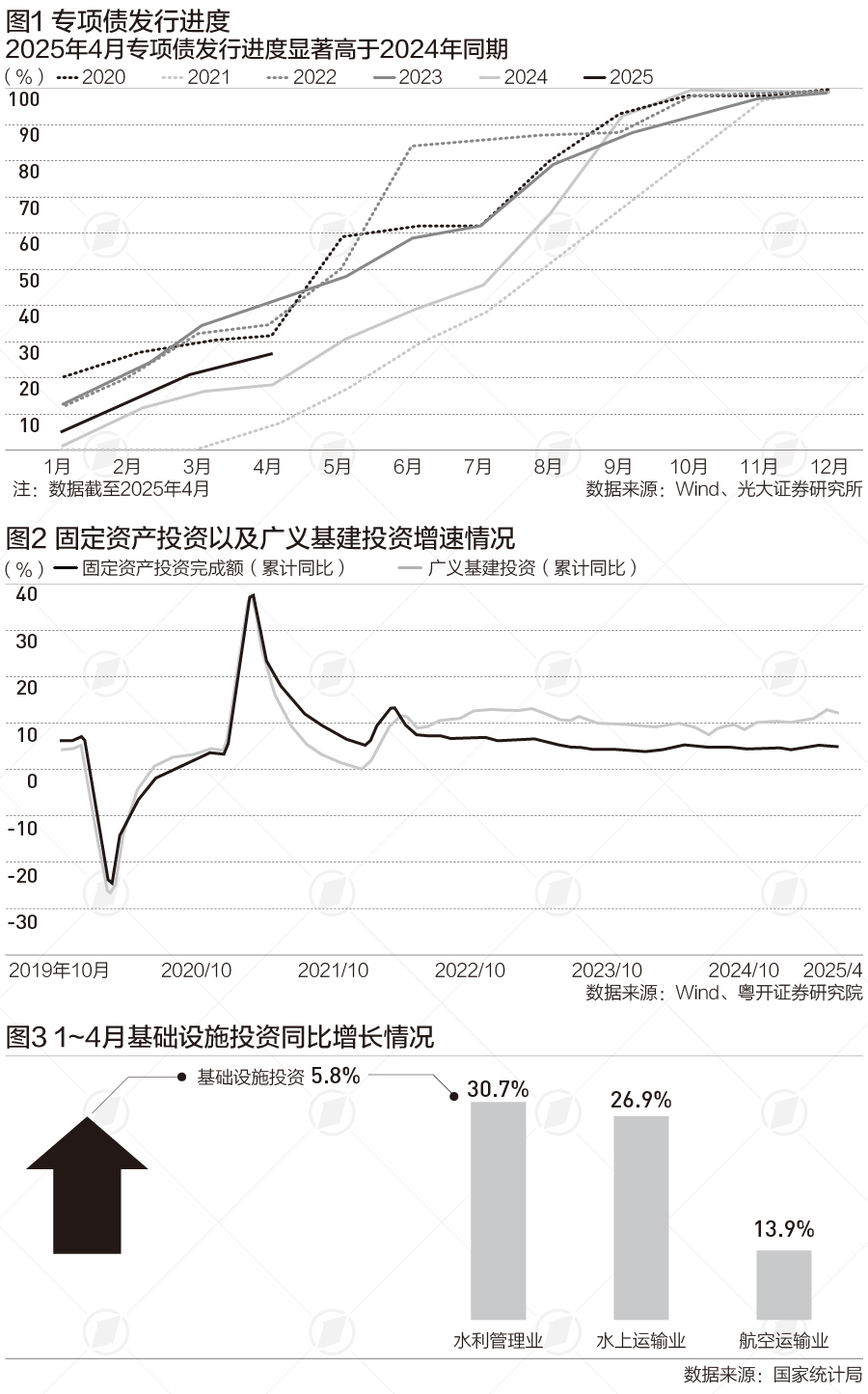
Investment Rating - The report maintains a "Positive" investment rating for the construction and engineering industry [11]. Core Insights - The report highlights fluctuations in infrastructure investment growth and emphasizes the importance of subsequent funding implementation [2]. - Fixed investment growth is declining, with a drop in the PMI for both manufacturing and construction sectors [6][19]. - The construction sector is experiencing pressure on orders, with a notable decline in new orders and employment indices [6][39]. Summary by Sections Investment & Orders - In April, the manufacturing PMI fell below 50, and the construction PMI also decreased, with new orders and employment indices at 39.6% and 37.8% respectively. The construction PMI was 51.9%, down 4.4 percentage points year-on-year and 1.5 percentage points month-on-month [6][19]. - Fixed asset investment from January to April reached CNY 14.7 trillion, a year-on-year increase of 4.0%, with narrow infrastructure investment at CNY 4.9 trillion, up 5.8% year-on-year [22][23]. Physical Workload - Cement output has shown a year-on-year decline, while demand for cement in infrastructure remains relatively stable. From January to April, cement production decreased by 2.8% year-on-year [8][30]. Project Funding - The funding availability rate for construction projects is stable, with a slight improvement in housing construction. As of May 13, the funding availability rate was 59.1%, with non-housing projects at 60.65% and housing projects at 51.33% [9][30]. - The issuance of special bonds has accelerated, with a total of CNY 13.68 trillion issued year-to-date, which is CNY 5.12 trillion more than the previous year [9][30].





前4个月广义基建投资同比增长10.9%,二季度有望维持高位|财税益侃
Di Yi Cai Jing· 2025-05-22 11:52
Core Viewpoint - Infrastructure investment in China has shown significant growth in the first four months of this year, contributing to economic stability amidst external pressures, with broad infrastructure investment increasing by 10.9% year-on-year, surpassing the fixed asset investment growth rate of 4% [1] Group 1: Infrastructure Investment Growth - Infrastructure investment (excluding electricity, heat, gas, and water production and supply) grew by 5.8% year-on-year in the first four months, which is 1.8 percentage points higher than the overall investment growth [1] - The contribution rate of infrastructure investment to overall investment growth is 32.6%, an increase of 2.3 percentage points from the first quarter [1] - Specific sectors such as water management, water transport, and air transport saw substantial investment growth rates of 30.7%, 26.9%, and 13.9% respectively [1] Group 2: Government Debt and Financing - The net financing of government bonds reached 4.85 trillion yuan in the first four months, an increase of 3.58 trillion yuan year-on-year [3] - Local governments issued approximately 1.2 trillion yuan in new special bonds, with 31% allocated to municipal and industrial park infrastructure, 20% to transportation infrastructure, and 9% to shantytown renovations [3] Group 3: Policy and Future Outlook - The issuance of local government special bonds has accelerated, with 27% of the annual quota of 4.4 trillion yuan completed in the first four months, which is significantly higher than the 19% completion rate in the same period of 2024 [6] - The Central Political Bureau has called for more proactive macro policies, including the accelerated issuance of special bonds and long-term treasury bonds [6] - Analysts expect that infrastructure investment will maintain a high level of activity, with a projected year-on-year growth rate of around 10% in the second quarter [7]
基数因素or另有原因——如何看待4月财政收支改善
2025-05-21 15:14
Summary of Key Points from the Conference Call Industry Overview - The conference call primarily discusses the fiscal situation in China for April 2025, focusing on government spending, revenue, and infrastructure investment trends. Core Insights and Arguments - **Fiscal Spending Growth**: In April 2025, fiscal spending growth accelerated, primarily due to government debt financing support. The issuance of central ordinary and special government bonds has increased, with local governments shifting focus towards project investments, especially in infrastructure [3][5][8]. - **Local Government Investment**: Local governments have actively engaged in infrastructure investments through special bonds, with significant increases in government fund budget expenditures corresponding to local infrastructure investments. Social welfare-related expenditures have also risen, indicating increased pressure to maintain employment [5][6]. - **Revenue Improvement**: There was a marginal improvement in fiscal revenue in April 2025, although it remained in negative growth territory overall. Corporate income tax and export-related taxes provided some support, with corporate income tax improvements likely linked to corporate profit growth [6][9]. - **Structural Changes in Public Finance**: Public finance expenditures have shown structural changes, with a slight recovery in transportation spending and a decline in agricultural and forestry-related expenditures. This indicates a more proactive approach by local governments towards infrastructure investments [7][8]. - **Land Sale Revenue**: Land sale revenue growth remained negative in the first quarter of 2025, but micro-level data showed a recovery in land transaction prices across 330 cities. Fiscal confirmation of revenue lagged behind, only showing improvement in April [10]. - **Future Policy Outlook**: The future policy outlook suggests a preference for utilizing existing policies before considering any new measures. The second quarter will see continued acceleration in the implementation of existing policies, with potential new policies dependent on external pressures and upcoming political meetings [4][11][12]. Other Important but Potentially Overlooked Content - **Export Tax Revenue**: The first quarter of 2025 saw historically low export-related tax revenues, primarily due to high export tax rebates. This situation is linked to the "rush to export" phenomenon [9]. - **Monitoring Future Developments**: The upcoming political meetings in July and August will be critical in determining whether additional fiscal measures will be introduced, especially if export growth approaches zero [13].
水电燃热、水利投资高增,关注基建实物工作量转化
Tianfeng Securities· 2025-05-20 06:13
Investment Rating - The industry rating is "Outperform the Market" (maintained rating) [5] Core Viewpoints - Infrastructure investment continues to show high growth, with significant increases in water, electricity, fuel, and thermal investments, as well as water conservancy investments, which have seen year-on-year growth rates of +25.5% and +30.7% respectively in the first four months of 2025 [1][2] - The issuance of special bonds has accelerated, with a cumulative increase of 1,190.4 billion yuan in special bonds in the first four months of 2025, an increase of 467.9 billion yuan year-on-year, leading to optimism about the conversion of physical workload in infrastructure [1] - The report emphasizes the cyclical investment opportunities in coal chemical industries and suggests paying attention to the transformation opportunities of certain small and medium-sized construction companies [1] Summary by Sections Real Estate and Construction Data - From January to April 2025, real estate sales area decreased by 2.8% year-on-year, with new construction area down by 23.8% and construction area down by 9.7% [2] - In the same period, the completion area saw a year-on-year decline of 16.9% [2] Cement Industry - Cement production in the first four months of 2025 was 495 million tons, a decrease of 2.8% year-on-year, with April's production down by 5.3% [3] - The average cement shipment rate was 36%, remaining stable year-on-year, but the price pressure continues due to weak market demand [3] Glass Industry - Flat glass production from January to April 2025 was 31.86 million weight boxes, down 4.8% year-on-year, with April's production also declining [4] - The market demand for float glass was weak, leading to increased inventory levels among producers [4]


