
戴维斯双击

Search documents
首批北交所主题基金成立四周年,累计收益率最高达138%
Bei Jing Shang Bao· 2025-11-23 12:07
Core Insights - The first batch of North Exchange thematic funds has shown impressive performance since its establishment on November 23, 2021, with some products achieving cumulative returns of over 100%, the highest being 138% [1][4] - The North Exchange 50 Index has reached new highs, with a year-to-date increase of 32.72% as of November 21, 2025, contributing to the strong performance of the thematic funds [3] - The average year-to-date return for the first batch of thematic funds is 46.56%, with leading funds like Huaxia North Exchange Innovation Small and Medium Enterprises Fund achieving 77.53% [3][4] Thematic Fund Performance - As of November 23, 2025, all but one of the first batch of thematic funds have positive cumulative returns, with an average return of 60.13% [4] - The cumulative return of the Huaxia North Exchange Innovation Small and Medium Enterprises Fund is 138.62%, while other funds like Huatai North Exchange Innovation Fund are close to doubling their returns at 92.68% and 89.62% [4] - Newer funds established in August 2022 and April 2023 have also performed well, with cumulative returns exceeding 100% for all three funds [5] Market Dynamics - The North Exchange thematic funds are considered more flexible compared to other fund products, primarily focusing on core assets of the North Exchange, which enhances their competitiveness in a bull market [5][6] - The liquidity issues that previously affected these funds have been gradually resolved, with turnover rates now comparable to other growth sectors in the Shanghai and Shenzhen markets [6] - The performance of North Exchange thematic funds is expected to continue benefiting from favorable market conditions, with adjustments needed based on market environment and investment styles [6]


创新实业暗盘大涨超30%,顶级机构扎堆认购,港股IPO受热捧
Zhi Tong Cai Jing· 2025-11-21 11:59
Core Viewpoint - The IPO of Innovation Industry (02788) has generated significant market enthusiasm, driven by a strong cornerstone investor lineup, oversubscription, and a clear global strategy, positioning it as a potential star stock in the Hong Kong market this year [1][2]. Group 1: IPO Performance - The IPO saw substantial trading activity, with the dark market trading of Huida and Futu rising by 30.57% and 26.02% respectively, totaling a transaction amount of 650 million HKD (approximately 83 million USD) [1]. - The public offering phase experienced overwhelming demand, with international placements being oversubscribed by over 40 times and retail subscriptions reaching nearly 450 times, marking it as one of the hottest IPOs of the year [1]. Group 2: Investment Support - The IPO was backed by 17 heavyweight cornerstone investors, including Hillhouse Capital and China Hongqiao, who collectively invested 351 million USD, underscoring the company's core position and investment value in the industry [2]. - The dual empowerment from the industry cycle and international strategy enhances the investment value of Innovation Industry, as it capitalizes on the global manufacturing recovery and the growth of the new energy sector [2]. Group 3: Financial Performance - Financial projections indicate that revenue will increase from 13.49 billion RMB in 2022 to 15.16 billion RMB in 2024, with net profit rising from 0.91 billion RMB to 2.63 billion RMB during the same period [3]. - The company ranks in the top 5% among Chinese electrolytic aluminum smelting companies in terms of cash cost management per ton of aluminum, providing strong support for capacity expansion and industrial upgrades [3]. Group 4: Valuation Advantage - The IPO is priced at a projected P/E ratio of 7.9 times for 2025, representing a 30% discount compared to comparable companies in the Hong Kong market, creating a favorable entry point for investors [3]. - The ongoing uptrend in the electrolytic aluminum industry and the release of capacity in Saudi Arabia are expected to drive strong valuation recovery for the company, with potential for significant future growth [3].
中信建投万字报告!展望2026年经济、债市、全产业链投资策略
Sou Hu Cai Jing· 2025-11-20 23:47
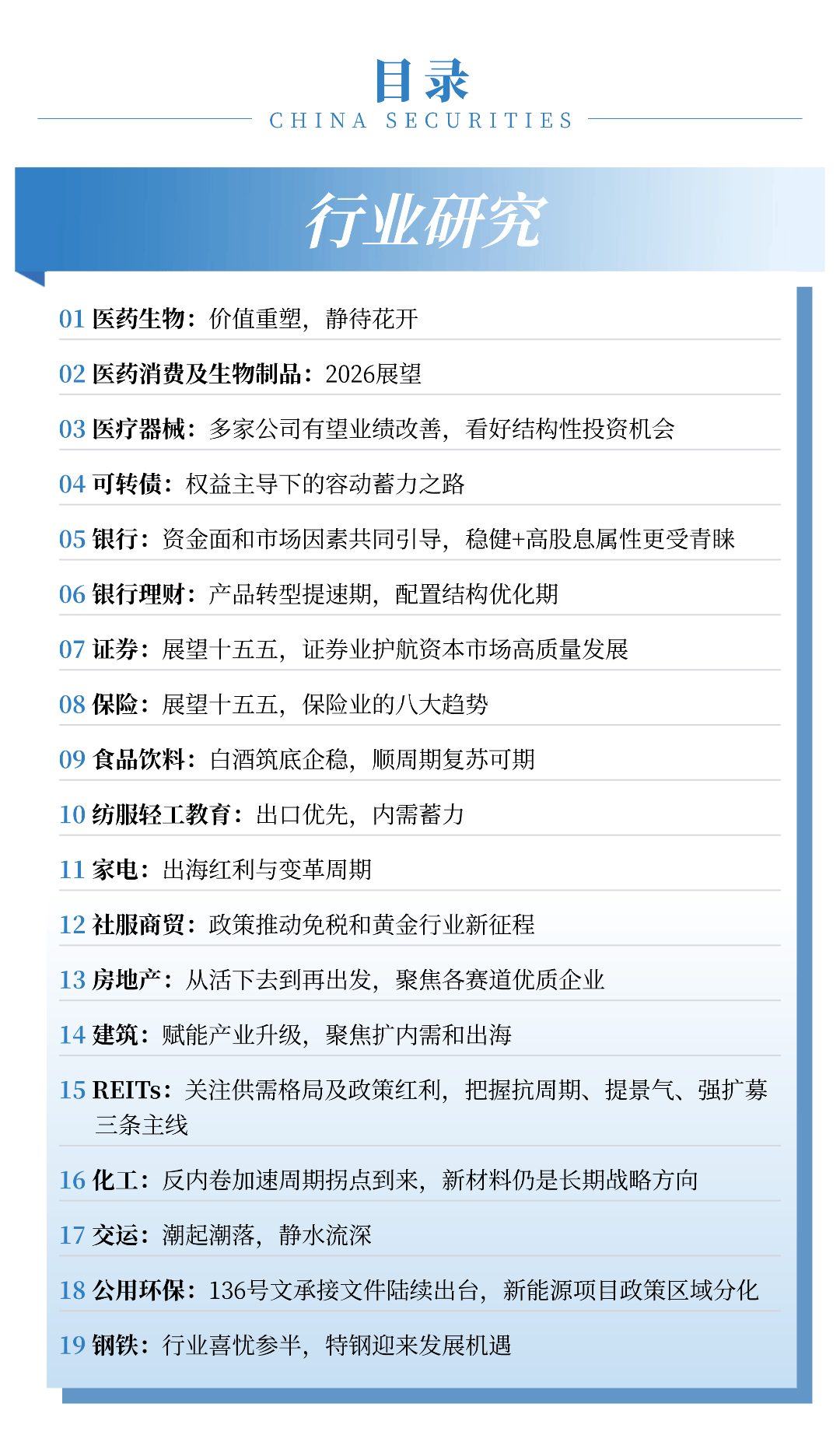
Group 1: Investment Strategies Overview - CITIC Securities released a comprehensive report on investment strategies for 2026, covering global capital markets, macroeconomic policies, A-shares, overseas markets, bond markets, asset allocation, and industry investment strategies [1] - The report includes insights from 19 research teams and spans approximately 30,000 words [1] Group 2: Pharmaceutical and Biotech Investment Strategies - The Chinese pharmaceutical industry is entering a critical phase characterized by "innovation realization + global layout," supported by population and domestic demand, as well as manufacturing capabilities [3][4] - The industry needs to focus on internal supply chain security and compliance while exploring diversified international expansion [3] - Key investment opportunities for 2026 include innovation commercialization, global breakthroughs, policy optimization, and industry mergers and acquisitions [3][5][6] Group 3: Medical Device Investment Strategies - The medical device sector is expected to see performance improvements in 2026 due to policy easing, new product launches, and international expansion [14] - The long-term investment opportunities in this sector stem from innovation, internationalization, and mergers and acquisitions [14] - The industry is witnessing a shift towards high-value consumables and innovative technologies such as brain-computer interfaces and AI in healthcare [14][15] Group 4: Consumer Healthcare and Bioproducts - The traditional Chinese medicine sector is expected to recover from short-term pressures, with improved demand anticipated by year-end [9] - The blood products industry is focusing on supply growth and consolidation, with significant demand for immunoglobulin and factor products [10] - The vaccine sector is under pressure but is expected to improve with new product sales and international expansion [10] Group 5: Banking Sector Investment Strategies - The banking sector is expected to continue its weak recovery in 2025, with a focus on high dividend strategies [25][26] - The sector's fundamentals are stabilizing, with credit growth projected at 7%-8% and non-interest income expected to improve [26] - High dividend yield strategies are favored, particularly for state-owned banks and those with solid fundamentals [27] Group 6: Wealth Management and Financial Products - The wealth management sector is entering a phase of product transformation and structural optimization, with an expected growth rate of 10% in 2026 [28][33] - The focus is on multi-asset and multi-strategy products, with a significant increase in mixed product offerings anticipated [29][30] - The integration of AI and digital technologies is expected to enhance risk management and operational efficiency in wealth management [30] Group 7: Non-Banking Financial Institutions - The securities industry is poised for a new growth cycle, driven by policies that enhance capital market inclusivity and adaptability [35][36] - The industry is experiencing a shift from self-operated models to collaborative, light-asset business strategies [36][37] - The internationalization of Chinese securities firms is gaining momentum, providing new opportunities for growth [38][39] Group 8: Insurance Sector Trends - The insurance industry is expected to undergo significant changes during the "14th Five-Year Plan" period, focusing on balancing interests among insurers, channels, and customers [43][44] - Key trends include the transformation of savings products, innovation in health insurance, and the development of new distribution channels [43][44] - The sector is anticipated to benefit from improved performance and valuation recovery, presenting investment opportunities [43][44] Group 9: Food and Beverage Sector - The food and beverage sector is recovering from a prolonged downturn, with a focus on premium products like liquor and health-oriented snacks [48][49] - The liquor industry is expected to stabilize as consumer confidence improves, with a focus on high-quality brands [49][50] - The snack and beverage segments are seeing growth driven by health trends and innovative product offerings [52][53]

重磅!又一家券业巨头诞生,中金公司拟换股吸收两家券商!顶流券商ETF(512000)近60日狂揽135亿元
Xin Lang Ji Jin· 2025-11-20 01:09
Core Viewpoint - The brokerage industry is experiencing significant positive developments with the announcement of major asset restructuring plans by China International Capital Corporation (CICC), Xinda Securities, and Dongxing Securities, which will lead to a merger creating a new brokerage giant with nearly 1 trillion yuan in total assets [1] Group 1: Industry Developments - The restructuring is a crucial step in consolidating securities licenses under Central Huijin and aligns with the financial power strategy to build a first-class investment bank [1] - Regulatory support for industry consolidation is evident, with mergers and acquisitions seen as effective means for brokerages to achieve external growth and enhance overall industry competitiveness [1] - The merger is expected to improve resource allocation and promote healthy market development, contributing to higher industry concentration and economies of scale [1] Group 2: Market Performance - Despite a recovering market and improving fundamentals, the brokerage sector's stock performance has lagged behind broader market indices, with the CSI Securities Company Index rising only 3.25% year-to-date compared to significant gains in other indices [1][2] - The disparity between performance and stock price has created a notable valuation gap, with expectations for a "Davis Double" in 2026 as the sector's valuation remains at historical lows [2] - Significant capital inflows have been observed, with the brokerage ETF (512000) seeing a net inflow of 13.521 billion yuan over the past 60 days [2] Group 3: Investment Tools - The brokerage ETF (512000) and its linked funds provide an efficient investment tool that tracks the CSI Securities Company Index, encompassing 49 listed brokerage stocks [4] - The ETF has reached a historical milestone with its fund size surpassing 40 billion yuan, indicating strong liquidity and interest in the sector [4]



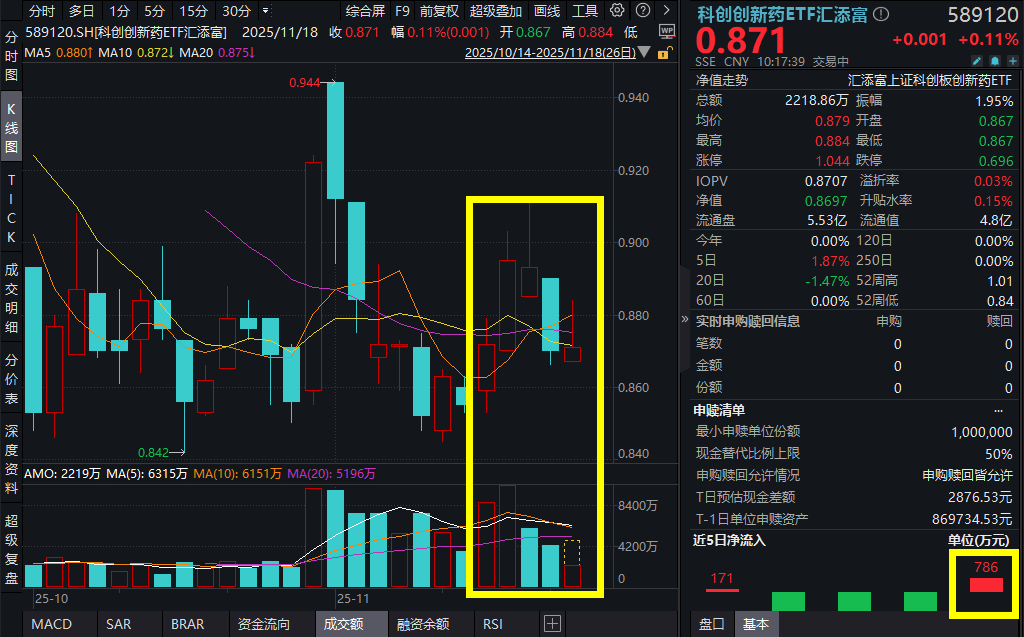
百济神州新药3期临床研究告捷!科创创新药ETF汇添富(589120)早盘大幅震荡,资金小跑进场!创新药研发成果不断,戴维斯双击机会如何把握?
Sou Hu Cai Jing· 2025-11-18 03:05
Core Viewpoint - The innovation drug sector in China is experiencing significant growth, with companies transitioning from followers to leaders in the global market, driven by strong clinical results and increasing international competitiveness [4][5][6]. Group 1: Market Performance - As of November 18, the Sci-Tech Innovation Drug ETF (589120) showed volatility with a near 2% fluctuation, currently up by 0.11%, and attracted 7.86 million yuan in investments the previous day [1][3]. - The component stocks of the ETF displayed mixed performance, with notable gains from Baiyi Tianheng (up over 2%) and Baiyi Shenzhou (up over 1%), while others like Junshi Biosciences and Borui Pharmaceuticals experienced declines [3]. Group 2: Clinical Developments - Baiyi Shenzhou announced positive results from its Phase III HERIZON-GEA-01 study, evaluating the efficacy and safety of its HER2-targeted bispecific antibody in treating advanced gastric cancer [4]. - Baiyi Tianheng reported that its innovative EGFR×HER3 dual antibody ADC achieved significant results in a Phase III trial for esophageal squamous cell carcinoma, marking a milestone as the first ADC to meet dual endpoints in this indication [4]. Group 3: Industry Trends - The Chinese innovative drug sector is evolving, with companies like Heng Rui Pharmaceutical and Han Sen Pharmaceutical successfully transitioning to innovation-driven models, while new entrants like Baiyi Tianheng are emerging as global leaders [5]. - The trend of Chinese pharmaceutical companies expanding internationally is accelerating, with increasing recognition from multinational corporations as a source of innovative solutions [6]. Group 4: Financial Performance - The A-share pharmaceutical and biotechnology sector reported a total revenue of 600.4 billion yuan and a net profit of 40.6 billion yuan in Q3 2025, with the Sci-Tech Innovation Drug Index showing a remarkable net profit growth of 68.44% year-on-year [6][7]. - The diversification of revenue models is enhancing the potential for profitability among innovative drug companies, with expectations for companies like Baiyi Shenzhou and Xinda Biopharmaceuticals to achieve profitability by 2025-2027 [6][7]. Group 5: Investment Potential - The innovative drug sector is seen as having "double-click" potential, driven by supportive policies, technological advancements, and the increasing trend of international business development [7]. - The combination of profit growth and valuation improvement is expected to drive stock price increases in the innovative drug sector, with the Sci-Tech Innovation Drug ETF positioned to capitalize on these trends [7].


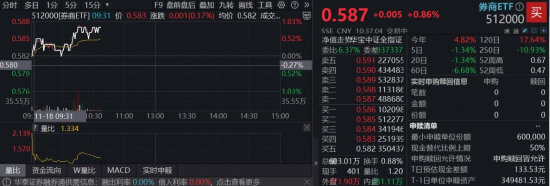
机构密集看好!券商迎业绩与估值的“戴维斯双击”,顶流券商ETF(512000)单日再揽3.5亿元,居同类首位!
Xin Lang Ji Jin· 2025-11-18 03:05
Group 1 - The core logic behind the recent surge in brokerage stocks is the strong performance of their Q3 reports, while their stock prices have not kept pace with the broader market [2][5] - As of November 14, 2023, the Shanghai Composite Index, Shenzhen Component Index, and ChiNext Index have increased by 19.06%, 26.90%, and 45.29% respectively, while the CSI Securities Company Index has only risen by 4.24%, indicating a significant lag behind the market [2][3] - This phenomenon of "performance rising, stock prices lagging" has resulted in a notable "scissors gap" between the sector's valuation and profitability [2][3] Group 2 - There has been substantial capital inflow into brokerage ETFs, with a net inflow of 3.52 billion yuan recently, making it the top performer among 14 ETFs tracking the same index [4] - Over the past 20 days, the cumulative net inflow into brokerage ETFs has reached 25.17 billion yuan [4] - Institutions are optimistic about the brokerage sector for 2026, anticipating a "Davis Double Play" where both performance and valuation improve due to a recovering market and ongoing fundamental improvements [5] Group 3 - The brokerage ETF (512000) has seen its fund size exceed 40 billion yuan for the first time, with an average daily trading volume of over 1 billion yuan this year, making it a leading investment tool in the A-share market [7] - The ETF passively tracks the CSI Securities Company Index, encompassing 49 listed brokerage stocks, providing an efficient investment option for both large and small brokerages [7]
反内卷重构千亿赛道,这个板块悄悄逆袭!
Ge Long Hui· 2025-11-17 10:50
Core Insights - The chemical industry is experiencing a significant transformation, moving away from its previous image of being low-profit and heavily polluting, now recognized as a foundational element of high-end manufacturing and a growth sector worth 4 trillion yuan [3][10]. Supply and Demand Dynamics - The chemical sector has shifted from chaotic overproduction to a more balanced supply-demand relationship, driven by policy changes, industry adjustments, and resource constraints [5][6]. - The Ministry of Industry and Information Technology's "14th Five-Year Plan" has curtailed blind capacity expansion, reducing industry capacity growth from double digits to below 7% [5]. - Key resources like phosphate rock and fluorite are in tight supply, with demand from emerging industries such as electric vehicles and energy storage expected to drive material demand growth by over 50% in 2024 [5][10]. Competitive Landscape - The competition in the chemical industry has evolved from merely increasing production capacity to focusing on technological advancements and high-value products [6][7]. - Leading companies are investing in high-margin sectors, with over 30% of Wanhua Chemical's 25.24 billion yuan investment directed towards fine chemicals and emerging materials [7]. - China's chemical products now account for over 60% of the global market share in basic and fine chemicals, with increasing international pricing power [8][10]. Investment Opportunities - The chemical sector is undergoing a strategic revaluation, with expectations of improved profitability and valuation recovery, particularly in segments like refrigerants and pesticides [8][9]. - Companies with strong supply-demand management, high technological barriers, and comprehensive global strategies are positioned to benefit from the ongoing market changes [9][12]. - The global chemical market is projected to exceed $5.2 trillion by 2030, with China's market reaching $1.9 trillion, indicating significant growth potential [11][12].

吉祥航空(603885):入境大市场,盈利高成长,扩大免签,入境游高增长
Tianfeng Securities· 2025-11-17 10:12
Investment Rating - The report maintains a "Buy" rating for the company [4][6]. Core Views - The inbound tourism market is expected to grow significantly, driven by the expansion of visa-free policies, with a projected 52% year-on-year increase in visa-free foreign visitors from January to September 2025 [1]. - The company's revenue for Q1-Q3 2025 was 17.48 billion yuan, showing a slight year-on-year decline, with a net profit of 1.09 billion yuan, down 14% [2]. - The company is expected to benefit from high return on equity (ROE) and increased international capacity, with a projected ROE of 15.28% for 2026 [3]. Financial Data and Forecasts - Revenue is forecasted to grow from 20.1 billion yuan in 2023 to 27.9 billion yuan in 2027, with a compound annual growth rate (CAGR) of approximately 11.56% [5][10]. - The net profit attributable to the parent company is expected to increase from 751.3 million yuan in 2023 to 2.35 billion yuan in 2027, reflecting a significant growth trajectory [5][10]. - The company's earnings per share (EPS) is projected to rise from 0.34 yuan in 2023 to 1.08 yuan in 2027 [5][10].

内容×场景×科技三线共振,巨星传奇(6683.HK)加速扩展全球IP生态版图
Ge Long Hui· 2025-11-14 00:57
Core Insights - The company is accelerating the construction of a global IP ecosystem, with significant progress in commercialization, including strategic investments and partnerships [1][2] - The company has established a joint venture with Yushu Technology to develop consumer-level IP robots and related products, enhancing its technological capabilities [10][11] - The company is transitioning from an "IP operator" to a "happiness experience ecosystem operator," indicating a shift in its valuation framework [14] Group 1: IP Strategy and Partnerships - The company has become a strategic shareholder in G-Dragon's management company, Galaxy, acquiring up to 7% of its issued share capital [1] - The company has received commercial orders for its quadruped robot from two clients, totaling over 120 million yuan [1] - The company plans to raise approximately 369 million HKD, with 67.7% allocated for hosting international concerts and exhibitions, aligning with its strategy to collaborate with globally recognized artists [1][2] Group 2: Cultural and Technological Integration - The company is enhancing its IP business strategy by integrating the "Zhou Classmate" IP into urban cultural tourism, creating immersive experiences that extend beyond traditional events [3][5] - The company has developed a strong IP matrix with core IPs like "Zhou Classmate" and "Coach Liu," amassing around 280 million fans and generating over 1 billion RMB in licensed product sales [7][9] - The joint venture with Yushu Technology aims to create innovative entertainment and technology experiences, leveraging advanced robotics and the company's rich IP resources [10][11] Group 3: Future Outlook - The company is building a sustainable ecosystem that combines IP empowerment with venue experiences, enhancing the value of its cultural assets [13] - The company is positioned for a "Davis double-click" effect, anticipating growth in performance and valuation as global IP asset values are released [14]

——2026年中国宏观经济展望:底部夯实,亮点引领未来方向
Shan Jin Qi Huo· 2025-11-13 09:49
1. Report Industry Investment Rating No relevant content provided. 2. Core Viewpoints of the Report - In 2026, the macro - economy will consolidate its bottom. It will be a year of weak recovery, featuring export support, stable investment, and weak consumption. Policy will remain positive, with fiscal policy staying active and a low - interest - rate environment continuing. In terms of asset allocation, stocks are preferred over commodities, and commodities over bonds [83]. - The Chinese economy is entering a new cycle from 2026, led by artificial intelligence, with new technologies evolving and being transformed into product advantages through China's industrial chain [84]. 3. Summary by Directory 3.1 Macro - economic Fundamentals - **Industrial Production**: Except for automobiles, the growth rate of major industrial products remains low. The increase in automobile production this year supports the growth of industrial added value. Next year, the growth rate of domestic automobile sales may decline, but the overall automobile industry will be supported by exports, and the growth rate of automobile industrial added value is likely to fall but not decline [6]. - **Fixed - asset Investment**: The decline in fixed - asset investment growth has accelerated, and it turned negative from January to September. In 2026, more powerful policies will be introduced to boost investment, and many projects postponed this year will start construction [9]. - **Consumption**: The growth rate of total retail sales of consumer goods has declined, and consumer confidence is hovering at a low level. The reasons include weak income and income expectations, high household leverage, imperfect social security, and a low proportion of household disposable income in GDP [14]. - **Inflation**: The inflation situation will remain weak for a long time. Downstream commodity consumption is poor, while service consumption such as tourism performs better. PPI faces downward pressure on production material prices, and the overall manufacturing scale keeps industrial product prices under long - term pressure [20]. - **Employment**: Unemployment has seasonally increased with the entry of college graduates into the labor market. The cumulative year - on - year growth of newly - added urban employment has flattened, and creating new jobs is becoming more difficult [26]. - **Manufacturing PMI**: Manufacturing PMI has been continuously weak. In the PMI sub - items, the sub - item of the purchase price of major raw materials is above the boom - bust line, and the sub - item of purchase volume fluctuates with the production sub - item, with a larger fluctuation range. Other sub - items are below the boom - bust line [30]. - **Inventory**: Production is significantly stronger than consumption, finished - product inventory is rising, and downstream demand is weaker [34]. - **Construction and Service Industry PMI**: The PMI of the construction industry and its important sub - items are at a low level in recent years, indicating the industry's downturn [38]. - **Foreign Trade**: The growth rate of imports and exports is better than expected. Exports are resilient, and China's share in global exports is increasing. New "new three items" (robots, artificial intelligence, and innovative drugs) are becoming new drivers of industrial upgrading and foreign trade growth [41][44]. - **Chip Industry**: The effect of chip import substitution has emerged in recent years. The growth rate of chip exports is much higher than that of imports, and a complete Chinese chip industry chain independent of the US is rising. It is expected to become a net exporter in 5 - 10 years [46]. 3.2 Macro - economic Highlights - **Automobile Industry**: Automobile production, sales, and exports will reach new highs this year. Although the growth rate of domestic sales may face pressure due to the withdrawal of subsidies, it may be maintained with the launch of new technologies and models. This year's automobile exports are expected to reach 750 - 800 million vehicles, with a year - on - year growth of about 18%, and the growth rate of overseas exports is expected to remain at a good level next year [51]. - **Industrial Enterprise Profits**: The profit growth rate of industrial enterprises above a designated size has rebounded. From January to August, the cumulative year - on - year growth rate of total profits of industrial enterprises above a designated size turned positive, and the year - on - year growth rate in August was 20%. With the implementation of "anti - involution" policies and interest - rate cuts, enterprise profits are expected to improve [54]. - **Stock Market and Economy**: When the M1 - M2 spread turns positive, PPI may also turn positive, indicating a possible bull market in both stocks and commodities. "Anti - involution" may end the decline of PPI. The growth rate of M1 is basically synchronous with the rise of the stock market [57]. - **Real Estate**: The data reflecting the scale of ongoing real estate projects has returned to the level of 2005, and housing prices are still falling month - on - month. The real estate market is in the process of bottom - building. The new housing start - up area may gradually stabilize, and there is a possibility of a retaliatory rise in housing prices in the future [60]. - **Stock Market and Asset Allocation**: There is still room for "deposit migration". The ratio of the total market value of the stock market to household deposits is low, and the trend of households allocating more assets to the stock market has just begun. A bull market can stimulate economic growth, assist economic transformation, improve the corporate financing environment, relieve debt pressure, and enhance international competitiveness [63][64]. - **Technological Progress and Stock Market**: Technologies such as artificial intelligence and robots are likely to be first applied in China. The chip industry is the last major short - board before China becomes a technological superpower. Technological innovation and manufacturing are the core of the "14th Five - Year Plan", and new technologies will promote productivity and expand industrial chain advantages [65]. 3.3 Policy Outlook for 2026 - **Fiscal Policy**: The government's leverage ratio is relatively low and there is room for further leverage. Loose fiscal policy is expected to last for a long time. Consumption subsidies are likely to continue in some form for 2 - 3 years, and other measures such as increasing the deficit scale and transfer payment intensity will also be taken [69]. - **Monetary Policy**: The 7 - day reverse repurchase rate has remained low for a long time, and the money supply will remain loose with room for further decline in interest rates. The Fed's interest - rate cuts provide space for China's central bank to cut interest rates, and domestic commercial banks have already lowered deposit rates [71][82]. - **Exchange Rate Policy**: The US dollar has opened up a downward space, and bank settlement and sales of foreign exchange have turned into a surplus. Overseas hot money is flowing into China, causing the RMB to face more appreciation pressure than depreciation pressure. The RMB's share in international trade is increasing [77][79]. 3.4 Main Conclusions and Suggestions - **Economic Outlook**: In 2026, the macro - economy will be in a weak recovery. Real estate investment will gradually stabilize, infrastructure investment growth will pick up, and exports will maintain a high growth rate. Policy will remain positive, and consumption will be a lagging variable [83]. - **Economic Cycle**: The Chinese economy is entering a new cycle, with artificial intelligence leading the way, and new technologies being transformed into product advantages [84]. - **Risk Analysis**: In 2026, there may be new Sino - US trade frictions, the risk of the bursting of the US artificial intelligence bubble and its spill - over effects, and the risk of a significant correction in the Chinese stock market due to high valuations [85].