
产能去化

Search documents
农林牧渔:养殖陷入亏损状态,去产能预期增强
Huafu Securities· 2025-09-28 12:36
Investment Rating - The industry rating is "Outperform the Market" [5][78]. Core Viewpoints - The pig farming sector is experiencing continued price declines, leading to negative profits for farmers. As of September 26, the pig price was 12.50 CNY/kg, down 0.19 CNY/kg week-on-week. The profits for self-breeding and purchased piglet farming were -74.11 CNY/head and -236.57 CNY/head, respectively, with week-on-week declines of -49.66 CNY and -37.25 CNY [2][11][36]. - In the beef sector, prices for calves and fattened bulls have stabilized after recent increases, with calf prices at 32.36 CNY/kg and fattened bull prices at 25.96 CNY/kg, both unchanged week-on-week. The long-term supply of beef is expected to tighten, with a potential price upturn anticipated in 2026-2027 [3][38]. - The poultry sector is seeing mixed trends, with white feathered chicken prices experiencing slight fluctuations due to steady demand ahead of the holidays. As of September 26, the price was 6.90 CNY/kg, up 0.02 CNY/kg week-on-week [4][44]. Summary by Sections Pig Farming - Continued price decline in pig farming, with significant losses reported for farmers. The average weight of pigs being sold has shown a mixed trend, with group farms seeing slight increases while smallholders have decreased [2][11][24]. - The supply pressure remains high, and prices are expected to remain weak in the short term, although long-term adjustments in production capacity may lead to price recovery [36][32]. Beef Industry - The beef market is stabilizing after a period of price increases, with expectations of tightening supply in the medium to long term due to previous losses in the industry [3][38]. - The price of calves has increased by 34% since the beginning of the year, indicating a potential recovery in the market [38]. Poultry Sector - The white chicken market is experiencing stable prices with slight increases in certain areas due to tight supply. The egg price has decreased slightly, reflecting market conditions [4][44]. - The ongoing avian influenza situation may impact supply chains, but there is potential for recovery in consumption due to government policies promoting domestic demand [47]. Agricultural Products - The Argentine government's recent policy changes regarding export tariffs have significantly impacted soybean meal prices, leading to a sharp decline followed by a rebound [4][58]. - The focus on enhancing grain production and food security is emphasized, with potential growth in agricultural technology sectors [54].
农产品日报-20250926
Guo Tou Qi Huo· 2025-09-26 12:22
Report Industry Investment Ratings - **Bullish**: ★★★ for soybean oil, palm oil, rapeseed meal, and rapeseed oil; ★★☆ for soybean and soybean meal; ★☆☆ for corn and live pigs; ☆☆☆ for eggs [1] - **Bearish**: None - **Neutral**: None Core Views - The report analyzes the market conditions of various agricultural products, including soybeans, soybean meal, soybean oil, palm oil, rapeseed meal, rapeseed oil, corn, live pigs, and eggs, and provides investment suggestions based on the analysis [2][3][4] Summary by Related Catalogs Soybean - The domestic soybean futures price continued to rebound with decreasing positions, outperforming imported soybeans, and the price difference widened. New domestic soybeans are about to be listed, with weak quotes. Argentina's agricultural policy fluctuated greatly this week, and China accelerated the purchase of Argentine soybeans. The domestic soybean supply may tighten in Q1 next year, but the supply gap risk will ease. Focus on the purchase volume and price of domestic soybeans and the performance of imported soybeans in the short term [2] Soybean & Soybean Meal - The main contract of Dalian soybean meal futures continued to decline by 0.81% today. After Argentina's export policy was introduced on Monday, the futures price dropped significantly. As of Wednesday, the sales volume of related products reached the $7 billion limit, and Argentina cancelled the soybean tax exemption policy. During this period, China imported more than 2.2 million tons of Argentine soybeans. The soybean meal market is greatly affected by foreign policies, so continue to wait and see. In the long term, maintain a cautious bullish view on Dalian soybean meal [3] Soybean Oil & Palm Oil - Argentina's agricultural policy fluctuated greatly this week, and China accelerated the purchase of Argentine soybeans. The domestic soybean supply may tighten in Q1 next year, but the supply gap risk will ease. The EU decided to postpone the implementation of the anti - deforestation regulations for one year, and the medium - to - long - term demand expectation for palm oil improved. Palm oil is in the production reduction cycle in Q4. The medium - term soybean and palm oil prices are expected to move within a range, and a protective call strategy can be considered to hedge against unexpected risks [4] Rapeseed Meal & Rapeseed Oil - The domestic rapeseed market maintained the pattern of strong oil and weak meal. The demand for rapeseed meal was mediocre, affected by the seasonal decline in aquaculture feed demand and the low unit protein price difference between soybean meal and rapeseed meal. The oil - to - meal ratio of rapeseed products is expected to continue to rebound, and rapeseed oil will maintain a slow decline. The domestic rapeseed inventory has dropped to a very low level, and coastal oil mills may shut down on a large scale after the National Day. The rapeseed futures will fluctuate in the short term [6] Corn - The Dalian corn futures opened low and closed high, rising 0.55% today. The market is optimistic about the new - season corn yield. As the listing volume of new corn in Northeast China increases, the opening price has been falling. Around the National Day, the Dalian corn futures may continue to be weak at the bottom [7] Live Pigs - The live pig futures increased positions by nearly 10,000 lots, and all contracts continued to decline to new lows. The spot price continued to weaken, reaching a new low this year, and the enthusiasm for secondary fattening and slaughter was high. The futures price is still at a premium to the spot price. Fundamentally, the supply pressure is high in the second half of the year. Pay attention to when secondary fattening will enter the market again and the government's willingness to support the pig price. In the long term, if the reduction of fertile sows starts in September, it is expected to improve the pig price expectation in the second half of next year. Currently, the live pig futures price is bearish [8] Eggs - The spot price of eggs is low, and the futures price is weak. The funds continued to reduce positions by nearly 50,000 lots. The spot price rebound since the peak season in September reached a phased high last Wednesday. After the National Day, the egg demand will return to a weak state. The industry's high - inventory problem requires deep capacity reduction. Consider taking long positions in the far - month contracts for next year's H1 and pay attention to the exit of short - position funds in the near - month contracts [9]
农林牧渔行业双周报(2025/9/12-2025/9/25):阿根廷暂时零税出口农产品-20250926
Dongguan Securities· 2025-09-26 09:19
Investment Rating - The report maintains an "Overweight" rating for the agricultural, forestry, animal husbandry, and fishery industry [42] Core Viewpoints - Recent declines in pig prices and continuous profit decreases for breeding companies will force upstream breeding sows to reduce stock. The current stock of breeding sows remains relatively high, indicating significant potential for future reduction. The valuation of pig breeding companies is still at a historically low level, presenting an opportunity for investment based on capacity reduction expectations. In the chicken breeding sector, overall capacity is relatively high, and profitability remains under pressure. There is a potential for capacity reduction in the future, with attention to marginal profit improvement opportunities. In the feed sector, opportunities arise from increased market concentration and overseas expansion. The domestic pet market still has expansion potential, with leading domestic companies expected to maintain rapid growth [42][43] Summary by Sections 1. Market Review - The SW agricultural, forestry, animal husbandry, and fishery industry slightly underperformed the CSI 300 index, declining by 5.07% from September 12 to September 25, 2025, lagging behind the index by approximately 6.07 percentage points [10] - All sub-sectors recorded negative returns during this period, with declines of 2.89% in planting, 3.59% in animal health, 4.36% in feed, 5.32% in agricultural product processing, 5.95% in breeding, and 6.73% in fisheries [13][14] 2. Industry Key Data - **Pig Farming**: The average price of external three-way cross pigs fell from 13.31 CNY/kg to 12.51 CNY/kg during the reporting period. The cost of corn was 2365.1 CNY/ton, and soybean meal was 3002 CNY/ton, both showing slight declines. As of September 26, 2025, the profit for self-bred pigs was -74.11 CNY/head, and for purchased piglets, it was -236.57 CNY/head, indicating a decrease in profitability [22][24][27] - **Poultry Farming**: The average price of broiler chicks was 3.29 CNY/chick, showing a slight increase, while the average price of white feather broilers was 6.9 CNY/kg, reflecting a slight decline. The profit for white feather broilers was -2.22 CNY/chick, also indicating a decrease [29][33] - **Aquaculture**: The average wholesale prices for crucian carp and carp were 21.09 CNY/kg and 14.2 CNY/kg, respectively, both showing slight declines [35] 3. Industry News - Argentina announced a temporary zero-export tax on agricultural products, effective from September 23, 2025, until October 31, or until exports reach 7 billion USD. This measure aims to address domestic foreign exchange pressures and currency devaluation, significantly lowering export costs and enhancing competitiveness in the global market [37]





养殖ETF(159865)净流入超2000万份,盘中涨超1%,“含猪量”约60%
Mei Ri Jing Ji Xin Wen· 2025-09-26 05:58
Group 1 - The article highlights a significant inflow of 24 million units into the Livestock ETF (159865), indicating strong investor interest in livestock assets [1] - The swine breeding industry is experiencing ongoing supply pressure, with a 0.80% month-on-month decrease in the number of breeding sows in August, and a notable decline in pork prices, with the price per kilogram dropping by 2.74% to 13.15 yuan as of September 18 [1] - The Ministry of Agriculture and Rural Affairs, along with the National Development and Reform Commission, held a meeting on September 16, 2025, to discuss swine production capacity control, emphasizing a reduction in production tasks for major breeding groups by the end of the year [1] Group 2 - The poultry farming sector is facing uncertainties due to frequent outbreaks of avian influenza, which has led to a 20.69% month-on-month increase in the number of grandparent stock updates in August, positively impacting the white feather chicken industry chain prices in the medium to long term [1] - The recent low pork prices are crucial for stabilizing the Consumer Price Index (CPI), as pork accounts for over 20% of its weight, highlighting the macroeconomic significance of price stability [1] - Investors without stock accounts are encouraged to consider the Guotai CSI Livestock Breeding ETF Connect A (012724) and Connect C (012725) as alternative investment options [1]
养殖ETF(159865)盘中上涨1.2%,生猪养殖行业产能去化节奏有望加快
Sou Hu Cai Jing· 2025-09-26 05:55
Group 1 - The core viewpoint is that the pig farming industry is expected to accelerate capacity reduction due to changes in fundamentals and policy guidance, leading to a short-term decline in profitability and the elimination of inefficient capacity [1] - The "anti-involution" policy will further drive the reduction of breeding sow inventory, with a target to reduce 1 million breeding sows within six months [1] - By the first half of 2025, an increase in pig supply is anticipated to cause a slight year-on-year decline in pig prices, but the industry is expected to improve performance through "volume compensating price" strategies and cost reduction [1] Group 2 - The industry is entering a phase of stable and high-quality development, with expectations for an increase in the profitability baseline and stability, leading to improved cash flow and reduced debt ratios for leading pig farming companies [1] - The livestock ETF (159865) tracks the CSI Livestock Index (930707), which reflects the overall performance of listed companies involved in livestock farming and feed processing [1] - Investors without stock accounts can consider the Guotai CSI Livestock Farming ETF Connect A (012724) and Connect C (012725) [1]
肉牛:大周期、大周期、大周期
2025-09-24 09:35
Summary of the Conference Call on the Beef Cattle Industry Industry Overview - The beef cattle industry is experiencing significant capacity reduction due to deep losses in 2024, leading to the culling of young and pregnant cows. The trend of capacity reduction is expected to continue into 2025, albeit at a slower pace. The southern regions have seen an 8% decline in cow inventory, with some areas experiencing reductions of up to 30% [1][2][3] - The supply of calves has noticeably decreased, with calf prices doubling at the beginning of 2025, indicating a future tightening of beef supply [1][2] Key Supporting Factors for the Beef Cattle Cycle 1. **Capacity Reduction**: The domestic beef cattle farming industry has faced supply shocks, leading to the culling of inefficient cows and the introduction of new breeding stock. The trend of culling continues into 2025, with calf supply significantly reduced [2][3] 2. **Global Price Transmission**: Major beef-producing countries like the US, Brazil, and Australia have also undergone capacity reductions. The CME live cattle futures price has doubled since 2020, and this global price increase is transmitted to the domestic market, supporting domestic beef prices [2][3] 3. **Policy Support**: The Chinese government is implementing measures to protect domestic farming, including an investigation into import safeguards that has affected import volumes, allowing the domestic market time to adjust [3] Market Conditions for 2025 and Beyond - In 2025, there will be a shortage of calves but an adequate supply of fattened cattle and finished meat. The impact of previous capacity reductions has not fully materialized, leading to a continued influx of cow meat into the market [4] - The price uptrend is expected to officially begin in 2026, with prices anticipated to rise significantly due to the effects of the severe capacity reduction in 2024, continuing through 2027 and possibly into 2028 [4] Characteristics of the Beef Cattle Industry Chain - The beef cattle industry chain includes upstream feed, midstream fattening and slaughter, and downstream consumption. Feed costs account for 50%-70% of farming costs, with a long growth cycle and low breeding efficiency [5] - The industry is characterized by low concentration, with the top 50 companies holding a small share of total inventory [5] Global and Domestic Meat Trade Dynamics - The top ten beef-producing countries account for 87% of global production, with the US being the largest producer at over 12 million tons. China produces around 8 million tons but still imports approximately 2.8 million tons, primarily from South America [6] - China's demand significantly influences global trade structures, with Brazil being the largest supplier, followed by Argentina and Australia [6] Cost Disparities in Beef Cattle Farming - Domestic beef cattle farming costs are significantly higher than in Brazil due to factors such as scarce pasture resources and high feed and labor costs. Domestic costs range from 10,000 to 20,000 yuan, while Brazilian costs are between 5,000 to 8,000 yuan [8] - The low level of industrialization and efficiency in domestic beef production contributes to these high costs [7][8] Historical Price Trends - Since 2000, domestic beef prices have generally trended upward, with a notable decline in 2023 due to increased supply and reduced consumption growth. This marked the first historical price drop, with inventory levels declining for two consecutive years [9] Current and Future Supply-Demand Situation - Domestic per capita beef consumption remains low compared to countries like Japan and South Korea, indicating significant growth potential. The consumption of high-quality beef is growing faster than that of regular beef, with premium varieties seeing growth rates of up to 30% [10] Investment Opportunities - The current phase represents a critical price turning point in the Chinese beef cattle market. Companies such as YouRan MuYe, China Shengmu, and Modern Farming are recommended for investment due to their ability to generate cash flow through the culling of dairy cows and their growth potential in the beef market [11][12]
养殖油脂产业链日报策略报告-20250924
Fang Zheng Zhong Qi Qi Huo· 2025-09-24 05:22
Report Industry Investment Rating No relevant information provided. Report's Core View - **Soybean Oil**: The intraday soybean oil futures price dropped significantly due to Argentina's decision to cancel export taxes on soybeans, soybean meal, and soybean oil before October 31. With sufficient domestic supply and the fermentation of negative news, the price has a technical breakdown. It is expected to fluctuate widely in the near term. The Y2601 contract is recommended for temporary observation, with support at 7950 - 8000 yuan/ton and resistance at 8330 - 8350 yuan/ton [3]. - **Rapeseed Oil**: China's temporary anti - dumping measures on Canadian rapeseed imports may reduce Canadian rapeseed purchases. Russian/Dubai rapeseed oil and Australian rapeseed imports can partially compensate. If Canadian rapeseed imports are significantly reduced, domestic rapeseed oil will continue the de - stocking process. It is recommended to go long with a light position, with support at 9655 - 9698 and resistance at 10300 - 10333 [3]. - **Palm Oil**: Argentina's temporary cancellation of export taxes on soybeans and their derivatives brings cost - side negatives. Combined with phased sales pressure, the oil and oilseed sector has a need for a bearish adjustment. Although Malaysian palm oil production in September 1 - 20 decreased, exports increased, and there is no obvious inventory accumulation pressure. Indonesia may increase the mandatory palm oil blending ratio in biodiesel. It is expected to have a bearish adjustment, with support at 8756 - 8800 and resistance at 9570 - 9590 [4]. - **Soybean Meal and Soybean No. 2**: Due to Argentina's cancellation of export taxes and potential delays in biofuel rules, with high domestic inventories and negative news, the prices are expected to be weak in the near term. It is recommended to exit long positions in the main contracts [5]. - **Rapeseed Meal**: With the expected increase in Canadian rapeseed production, the price of rapeseed at the origin is under pressure. If Canadian rapeseed imports are significantly reduced, domestic rapeseed meal may have a de - stocking expectation. It is expected to have a bearish adjustment, with support at 2300 - 2365 and resistance at 2552 - 2572 [6]. - **Corn and Corn Starch**: The external market has both positive and negative factors, and the domestic market is in a game between low - channel inventory procurement enthusiasm and seasonal pressure. The 11 - contract is expected to continue to find the bottom. Options strategies such as selling wide - straddle combinations or out - of - the - money call options are recommended [7]. - **Soybean No. 1**: With the new domestic soybeans gradually coming onto the market and Argentina's export tax cancellation, the price is under pressure. It is recommended to hold short positions, with resistance at 3950 - 4000 yuan/ton and support at 3800 - 3830 yuan/ton [8]. - **Peanut**: With an expected increase in production and a decrease in planting costs, there is seasonal supply pressure. However, the futures price has partially reflected the increase in production, and Mid - Autumn Festival stocking has boosted demand. It is expected to fluctuate in the short term, with support at 7500 - 7510 and resistance at 8020 - 8162 [9]. - **Live Pig**: The futures price is in a process of finding the bottom. It is recommended to wait for capacity reduction to be confirmed and then consider buying at low prices. Cautious investors can hold long - short spreads, and it is advisable to wait and see for single - side trading [10]. - **Egg**: The futures price has fallen below historical lows. It is not recommended to chase short positions. Cautious investors can wait and see, while aggressive investors can consider buying the 2511 contract at low prices, with a reference range of 3000 - 3200 points [10]. Summary by Relevant Catalogs First Part: Sector Strategy Recommendation 1. Market Judgment - Various varieties in the feed, livestock, and oil sectors are analyzed, including their market logic (supply - demand), support and resistance levels, market trends, and reference strategies. For example, the soybean No. 1 11 - contract is expected to fluctuate bearishly, and it is recommended to hold short positions [13]. 2. Commodity Arbitrage - Cross - period and cross - variety arbitrage strategies for different sectors are provided, including reference strategies and target levels. For example, for the 01 - contract soybean oil - palm oil spread, a bearish operation is recommended [15]. 3. Basis and Spot - Futures Strategies - Spot prices, price changes, and basis changes of different varieties in each sector are presented [16]. Second Part: Key Data Tracking Table 1. Oil and Oilseed - **Daily Data**: Import costs of soybeans, rapeseeds, and palm oil from different origins and shipping periods are provided, including arrival premiums, CBOT or ICE futures prices, CNF prices, and arrival - duty - paid prices [17]. - **Weekly Data**: Inventory and operating rates of various oil and oilseed products are given, such as soybean port inventory, soybean meal factory inventory, etc. [19]. 2. Feed - **Daily Data**: Import costs of corn from Argentina and Brazil in different months are presented [19]. - **Weekly Data**: Consumption, inventory, operating rates, and other data of corn and corn starch in deep - processing enterprises are provided [20]. 3. Livestock - **Daily Data**: Spot prices, price changes, and other data of live pigs and eggs in different regions are given [21][22]. - **Weekly Data**: Key weekly data of live pigs and eggs, including prices, costs, profits, inventory, and sales, are provided [23][25]. Third Part: Fundamental Tracking Charts - **Livestock (Live Pigs and Eggs)**: Charts show the closing prices of live pig and egg futures contracts, spot prices, and related prices such as piglet prices and chicken fry prices [28][29]. - **Oil and Oilseed**: - **Palm Oil**: Charts display Malaysian palm oil production, exports, inventory, import profits, and domestic inventory and trading volume [37][38]. - **Soybean Oil**: Charts show US soybean crushing volume, soybean oil inventory, domestic soybean oil factory operating rates, and inventory [45][46]. - **Peanut**: Charts present peanut arrival and shipment volumes, processing profits, and inventory [54][57]. - **Feed**: - **Corn**: Charts show corn futures and spot prices, inventory, import volume, and processing profits [60][64]. - **Corn Starch**: Charts display corn starch futures and spot prices, operating rates, and inventory [67][68]. - **Rapeseed**: Charts show rapeseed meal and rapeseed oil spot prices, inventory, and basis [70][74]. - **Soybean Meal**: Charts present US soybean growth indicators, domestic inventory, basis, and spreads [77][89]. Fourth Part: Feed, Livestock, and Oil Options Situation - Charts show the historical volatility of various products such as rapeseed meal, rapeseed oil, and soybean oil, as well as the trading volume, open interest, and put - call ratio of corn options [92][93]. Fifth Part: Feed, Livestock, and Oil Warehouse Receipt Situation - Charts display the warehouse receipt situations of various products such as rapeseed meal, rapeseed oil, and soybean oil, as well as the futures warehouse receipt volume and open interest of corn, live pigs, and eggs [95][96].
当前猪周期走到了哪里?
Mei Ri Jing Ji Xin Wen· 2025-09-24 01:38
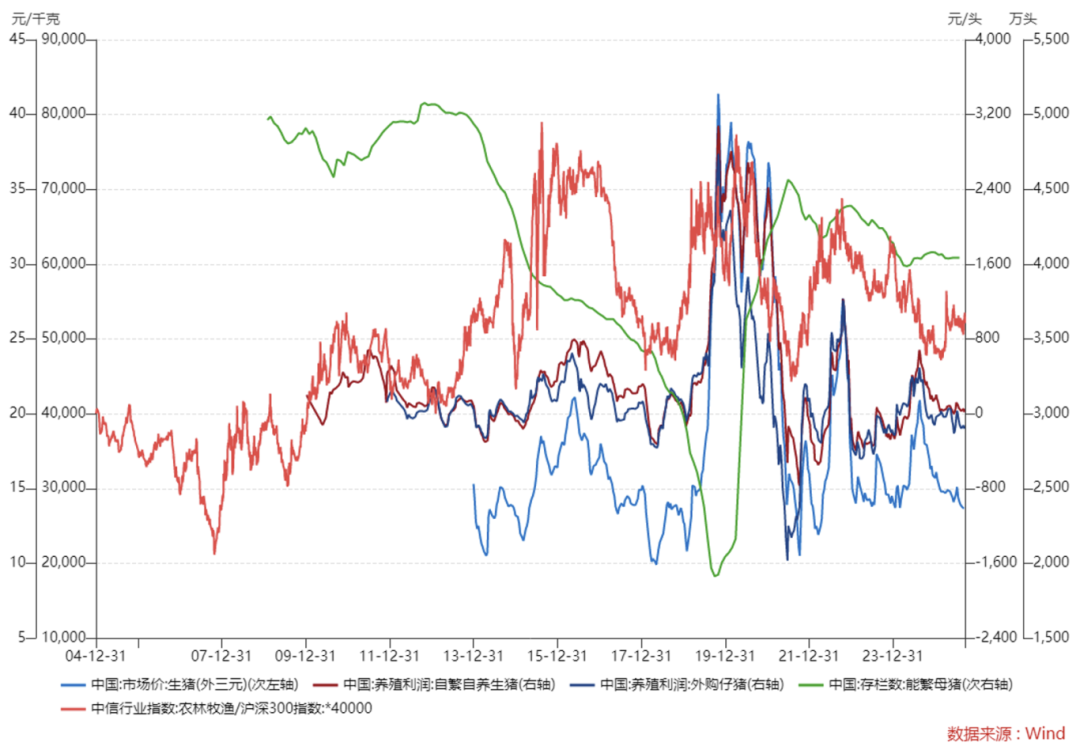
Core Viewpoint - The current stage of the pig cycle indicates a potential turning point for the pig farming industry, with prices expected to continue declining in the short term, leading to a likely acceleration in capacity reduction [1][2][5] Industry Analysis - The pig price has been on a downward trend since August 2024, with current prices around 13 CNY/kg, yet leading companies remain profitable due to cost control measures [1] - The overall pig farming industry is approaching a breakeven point, with major players reducing costs below 12 CNY/kg, indicating that many farms are now operating at a loss [1][2] - The number of breeding sows has been increasing, suggesting ongoing supply pressure, which is likely to keep pig prices under pressure in the short term [1][2] - The industry is entering a phase of active capacity reduction, driven by both voluntary and involuntary factors, including policy enforcement and market conditions [2][5] Policy Impact - Recent policy measures are being implemented to control production capacity, with major companies expected to reduce output by 1 million pigs by the end of the year [2][6] - The industry is moving towards comprehensive capacity management, with penalties for non-compliance including the cessation of subsidies and credit [2][6] Market Dynamics - The pig farming sector is experiencing consolidation, with large-scale farms now accounting for 70% of the market share, as smaller players exit due to high costs and regulatory challenges [6] - The focus of large enterprises is shifting from expansion to cost reduction and efficiency improvement, indicating a more rational and gradual process of capacity reduction [6] Investment Opportunities - The livestock ETF is highlighted as a preferred investment tool, tracking the livestock index and covering various segments of the industry, with a significant portion of its assets in leading pig farming companies [7]

国投期货农产品日报-20250923
Guo Tou Qi Huo· 2025-09-23 12:03
Report Industry Investment Ratings - Douyi: ☆☆☆ [1] - Doupo: ☆☆☆ [1] - Douyou: ☆☆☆ [1] - Palm Oil: ☆☆☆ [1] - Caipo: ★☆☆ [1] - Caiyou: ★☆☆ [1] - Corn: ★☆☆ [1] - Live Pigs: ★☆☆ [1] - Eggs: ☆☆☆ [1] Core Views - The overall supply of new soybeans this year is expected to be good, and the supply gap of soybeans in China in the first quarter of next year is likely to disappear. The export of Argentine soybeans and related products will impact the US soybean market, and the price of US soybeans needs to test the phased low point. The market's concern about the tight supply of domestic soybeans in the first quarter of next year is likely to ease. The domestic oil market is expected to be stronger than the meal market, and palm oil is stronger than soybean oil. The short - term trend of the vegetable oil and meal sector may be weak. The Dalian corn futures may continue to run weakly at the bottom around the National Day. The fundamentals of live pigs are weak, and the futures price is bearish. The egg futures are weakly adjusted, and the far - month contracts in the first half of next year can be considered for long positions [2][4][8][9] Summary by Related Catalogs Soybeans - Short - term attention should be paid to the purchase volume and price of domestic soybeans. The new soybean supply is expected to be good. The price difference between domestic and imported soybeans has rebounded, and the price of imported soybeans is weak. The export of Argentine soybeans will increase significantly in the short term, and the supply gap of soybeans in China in the first quarter of next year is likely to disappear. The export of Argentine soybeans will impact the US soybean market, and the price of US soybeans needs to test the phased low point [2] Soybeans & Doupo - On September 22, the Argentine government temporarily cancelled the export tax on soybeans and their derivatives until October 31 or the export volume reaches $7 billion. The previous export tax rates were 26% and 24.5% respectively. The import volume is worthy of continuous attention. The import of Argentine doupo may impact the current cost system. The short - term market is bearish, and it is recommended to wait and see. In the long term, there is still a cautious bullish view on the continuous contract [3] Douyou & Palm Oil - The export of Argentine soybeans will increase significantly in the short term, and the supply gap of soybeans in China in the first quarter of next year is likely to disappear. As long as the Brazilian soybean production in the 25/26 season is normal, the subsequent production will be connected. In October, attention should be paid to the actual sales and export of Argentine soybeans, and the export volume of douyou and doupo is likely to increase. The supply of domestic soybeans is expected to be marginally loose. The domestic oil market is expected to be stronger than the meal market, and palm oil is stronger than soybean oil. The export of Argentine soybeans will impact the US soybean market, and the price of US soybeans needs to test the phased low point. The supply of US soybeans is marginally loose, which will drag down the US douyou market. The final policy of US douyou for biodiesel will be announced in October, so the US douyou market is likely to be weaker than the Malaysian palm oil market in the short term [4] Caipo & Caiyou - The domestic vegetable oil and meal sector fell today. The zero - tariff measure of Argentina on grains and finished products still has a negative impact. Caiyou is still in the inventory reduction stage. Due to the time required for Australian rapeseed to arrive at the port, coastal oil mills may face shutdown in October. Caiyou is expected to be relatively stronger than other oils. The unit protein price difference between soybean meal and caipo is low, and the demand for caipo is suppressed. The demand for aquatic feed will decline seasonally, and the demand is expected to be mediocre. The Canadian rapeseed is in the harvest period, and its export is lower than the annual average for five consecutive weeks due to the lack of demand from the Chinese market. The overall short - term trend of the vegetable oil and meal sector may be weak [6] Corn - The Dalian corn futures rebounded slightly today. The weather in the main domestic corn - producing areas this year is mostly good, and the new - season corn production is relatively optimistic. However, as the listing volume of new corn in Northeast China increases, the opening price has continued to fall and has not stopped falling. Around the National Day, the Dalian corn futures may continue to run weakly at the bottom [7] Live Pigs - The futures contracts of live pigs all fell to new lows, and funds increased short positions. The spot price is still weak, and the average selling price has reached a new low. The government has carried out another round of frozen pork procurement this week, but the volume is still limited. The overall supply pressure in the second half of the year is large, and the fundamentals are weak. There is no inflection point in the number of fertile sows yet. The futures price is bearish [8] Eggs - The egg futures are weakly adjusted, and funds have reduced positions by more than 20,000 lots. The spot price is stable and weak, and the spot quotes in many places have been lowered. Since the peak season in September, the rebound of the spot price reached a phased high last Wednesday. With the approaching of the Mid - Autumn Festival and National Day, the driving force for the spot price to rise significantly is insufficient. After the National Day, the egg demand will return to a weak state. The industry still needs to deeply reduce production capacity. Although the elimination speed has accelerated since August, there is still a long way to go. The number of chick replenishment in July and August was at a low level, and the pressure of newly - laid hens is expected to decrease by the end of the year. It is estimated that the peak of this round of production capacity will be reached in the fourth quarter of this year. For the far - month contracts in the first half of next year, long positions can be considered, and for the near - month contracts, attention should be paid to the exit of short - selling funds [9]
猪价创年内新低、养殖利润跌破成本线 政策推动产能去化 畜牧养殖或迎布局窗口?
2 1 Shi Ji Jing Ji Bao Dao· 2025-09-23 06:12
Core Insights - The pig prices have reached a new low for the year, with average prices at 12.83 yuan/kg and piglet prices at 24.08 yuan/kg as of September 23 [1] - The livestock farming ETF (516670) has seen a decline of 1.66% in early trading, with significant capital inflow of over 81 million yuan in the past five trading days, indicating a counter-trend investment strategy [1] - The profitability of pig farming has dropped below cost levels, with external piglet farming losses at -199.31 yuan per head and self-breeding losses at -24.44 yuan per head, marking a return to losses after over 16 months of profitability [2] - A meeting on pig production capacity control was held on September 16, with plans to reduce the breeding sow population by approximately 1 million heads, bringing the total to about 39.5 million heads [2] - The industry is expected to undergo accelerated capacity reduction due to the dual pressures of "anti-involution" policies and losses leading to production cuts, suggesting a potential upward trend in pig prices and sector performance [3] Industry Summary - The pig farming sector is experiencing a significant downturn, with prices and profits declining sharply, leading to a comprehensive loss situation for farmers [2] - The current market conditions indicate an oversupply of pigs, with increased supply from group farms and stricter environmental regulations affecting piglet replenishment sentiment [1][2] - The livestock farming ETF closely tracks the swine farming industry, with a significant portion of its holdings in major pig farming companies, indicating a concentrated investment in this sector [3]