AI科技

Search documents
当下如何布局AI科技?——结合三季度的预期
2025-10-15 14:57
Summary of Key Points from Conference Call Industry Focus - **AI Technology Sector**: The call discusses various aspects of the AI technology sector, including overseas and domestic computing power, edge AI, and application endpoints [1][4][5]. Core Insights and Arguments 1. **Investment Opportunities in AI Technology**: - Four key areas to focus on: overseas computing power (e.g., Xuchuang, New Yisheng), domestic computing power (e.g., SMIC, Huahong), edge AI (e.g., Luxshare Precision, Lens Technology), and application endpoints [1][4]. - Overseas computing power is currently undervalued, while domestic computing power has high long-term certainty due to China's need to catch up with the U.S. in AI capabilities [1][4]. - Edge AI companies are expected to benefit from major tech firms launching new AI smartphones, although their Q3 performance may not fully reflect this potential [1][4]. 2. **Market Adjustment and Timing**: - The technology sector has been adjusting since September 3, with historical adjustments lasting between 40 to 60 trading days. The current adjustment is nearing its end, with many leading stocks approaching a 20-30% decline [2][3]. 3. **Storage Industry Performance**: - The storage industry is experiencing strong price trends, with significant price increases for DDR4 and SSD products. The outlook for Q3 and Q4 remains optimistic due to AI-driven demand [3][19]. 4. **Gaming Sector Insights**: - The gaming sector performed well during the National Day holiday, with revenues exceeding summer levels by 50%. Q3 is noted as the strongest quarter since 2019, with several companies showing triple-digit profit growth [3][15]. 5. **Quantum Computing**: - Quantum computing holds significant importance in global academia and research, with key players like Guandun Quantum and Hexunqi being highlighted for their potential [1][5]. 6. **Domestic Software Development**: - The domestic software sector is still at a low level but has substantial growth potential. Key areas include Xinchuang, Hongmeng, industrial software, and EDA [1][6]. 7. **Impact of U.S.-China Relations**: - The technology sector's volatility is influenced by U.S.-China tensions, but the AI computing direction remains strong. The supply chain for optical modules is stable, and demand is robust [3][7]. 8. **Future Market Recovery**: - A market recovery is expected by Q4 2026, with overseas computing power companies like Xuchuang and New Yisheng showing strong performance despite current market concerns [10][12]. Other Important Insights - **AI's Influence on Gaming**: AI technology is expected to significantly impact the gaming industry, with potential for cost reduction and efficiency improvements leading to blockbuster AI game products by 2026 [18]. - **Investment Recommendations**: Companies such as Giant Network, Kaiyin Network, and ST Huayun are recommended for their strong performance and growth potential [15][17]. - **Price Trends in Storage**: Recent price increases in the storage industry are driven by supply control and demand from AI applications, indicating a long-term positive outlook [19]. This summary encapsulates the key points discussed in the conference call, providing insights into the AI technology sector, market trends, and specific company performances.
宽松预期支撑下,现货黄金价格续创历史新高,港股消费ETF(513230)现涨近2.5%
Mei Ri Jing Ji Xin Wen· 2025-10-15 06:27
Group 1 - The Hong Kong stock market opened higher on October 15, driven by expectations of interest rate cuts by the Federal Reserve, with both the Hang Seng Index and the Hang Seng Tech Index rising over 1% [1] - Popular ETFs, particularly the Hong Kong Consumer ETF (513230), saw an increase of nearly 2.5%, with leading stocks such as Chow Tai Fook, Haidilao, and Bilibili showing significant gains [1] - The price of gold surged, with spot gold exceeding 1210 yuan per gram, marking an increase of approximately 400 yuan per gram year-to-date, prompting brands like Chow Sang Sang and Chow Tai Fook to raise their gold jewelry prices by 10% to 35% [1] Group 2 - Changjiang Securities suggests that the Hong Kong stock market may reach new highs driven by three key areas: AI technology and new consumption, which have substantial growth potential [2] - Continuous inflow of southbound funds into the Hong Kong market is expected to enhance marginal pricing power, especially if domestic interest rates remain low [2] - The transition from loose monetary policy to loose credit in China, along with potential further interest rate cuts in the U.S., could improve global liquidity and support the Hong Kong market's upward trajectory [2]
美股深“V”大逆转!美联储,释放降息大消息
Zhong Guo Ji Jin Bao· 2025-10-14 22:43
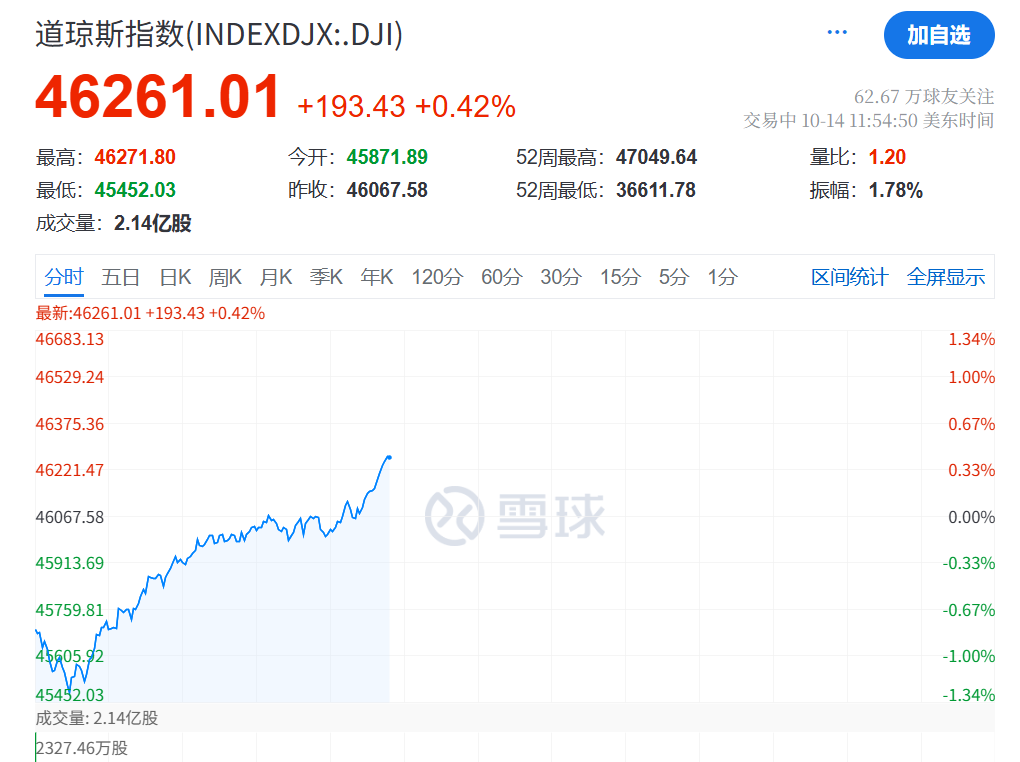
Market Overview - On October 14, U.S. stock indices opened sharply lower due to trade disputes but later recovered, with the Dow Jones Industrial Average closing up 202.88 points, a 0.44% increase, while the Nasdaq Composite fell 172.91 points, down 0.76% [1] - The Dow initially dropped nearly 600 points before reversing course, with the Nasdaq's decline narrowing to under 0.5% and the S&P 500 also rebounding [1] Sector Performance - AI technology stocks led the decline, with Nvidia dropping over 3%, and Tesla and Oracle falling by 1.79% and 2.22%, respectively [4] - The financial sector showed resilience, indicating a healthy consumer backdrop despite the overall market volatility [6] Trade Relations Impact - Recent tensions in U.S.-China trade relations have influenced market sentiment, with Trump's previous threats of imposing additional tariffs causing significant market drops [6] - However, Trump's recent comments suggested a more optimistic outlook, stating, "Don't worry about China, everything will be fine!" [6] Federal Reserve Outlook - Federal Reserve Governor Bowman indicated expectations for two more rate cuts by the end of the year, following a recent reduction in the benchmark interest rate to a range of 4.00%-4.25% [9] - The next Federal Reserve policy meeting is scheduled for October 28-29, with market expectations reflecting a potential 25 basis point cut at both upcoming meetings [9]

今夜,大逆转!美联储,降息大消息!
中国基金报· 2025-10-14 16:14
Market Overview - On October 14, U.S. stock markets experienced a significant reversal after initially opening lower due to trade tensions, with the Dow Jones Industrial Average dropping nearly 600 points before recovering [1][10] - The Nasdaq index narrowed its losses to under 0.5%, while the S&P 500 also showed signs of recovery [1] Stock Performance - The Nasdaq Composite Index opened at 22,388.04 and reached a high of 22,595.51, closing at 22,584.24, down 0.49% [6] - Major AI technology stocks led the decline, with Nvidia dropping over 3%, and Tesla and Oracle falling by 1.79% and 2.22%, respectively [8][9] Federal Reserve Insights - Federal Reserve Governor Bowman indicated expectations for two interest rate cuts by the end of 2025, with potential cuts occurring before the year ends [13][14] - The Fed recently lowered the benchmark interest rate by 25 basis points to a range of 4.00%-4.25%, marking the first reduction since December of the previous year [13] - Market expectations reflect a likelihood of two additional 25 basis point cuts in the upcoming meetings scheduled for late October and December [13]

恒生科技午后跌超3%,恒生科技指数ETF(513180)持续溢价,资金“抄底”特征显著
Mei Ri Jing Ji Xin Wen· 2025-10-14 06:23
Core Viewpoint - The Hang Seng Technology Index has experienced a significant decline, with semiconductor stocks facing substantial losses, while the market outlook remains cautiously optimistic due to potential future growth in AI technology and new consumption trends [1][2]. Group 1: Market Performance - As of October 14, the Hang Seng Technology Index fell over 3%, with notable declines in semiconductor stocks such as Hua Hong Semiconductor down over 12% and SMIC down over 8% [1]. - The Hang Seng Technology Index ETF (513180) also saw a decline of over 2.5% in the afternoon session, indicating a strong demand for the ETF despite the market downturn [1]. Group 2: Future Outlook - Long-term prospects for the Hong Kong stock market are supported by three key factors: the potential for AI technology and new consumption to drive market growth, continued inflow of southbound capital, and the impact of monetary policy changes in both China and the US [1]. - The Hang Seng Technology Index ETF (513180) is currently valued at a P/E ratio of 23.36, which is approximately 31.75% below its historical average, suggesting it remains undervalued [2]. - The anticipated benefits from AI trends, coupled with potential foreign capital inflows due to a favorable interest rate environment, could lead to a revaluation of the Hang Seng Technology Index in the fourth quarter [2].
政策利好叠加产业突破,港股科技板块蓄力上攻
Mei Ri Jing Ji Xin Wen· 2025-10-14 02:21
Core Insights - The Hong Kong stock market shows positive momentum with the Hang Seng Index opening up by 0.31% and the Hang Seng Tech Index rising by 0.56%, indicating a rebound in tech stocks, particularly with Hua Hong Semiconductor increasing by nearly 3% [1] Group 1: Policy and Market Dynamics - Recent capital market policies have intensified, focusing on supporting technological development and optimizing resource allocation to serve the new productive forces [1] - The strategic competition in technology between China and the U.S. has escalated, with the U.S. increasing technology restrictions on China, which has paradoxically accelerated China's pace of independent innovation [1][2] Group 2: Technological Advancements - China has achieved significant breakthroughs in key technology sectors since 2024, with Huawei's Ascend chips nearing international performance levels and domestic humanoid robots breaking foreign monopolies [2] - The smart vehicle supply chain has demonstrated strong competitiveness in the global market, with companies like iFlytek surpassing international counterparts in core capabilities of large models and BYD's electric platform technology being exported to international giants [2] Group 3: Investment Outlook - Dongwu Securities maintains a positive outlook on AI technology, suggesting that while U.S. tech leaders may influence the trading rhythm of Hong Kong's AI tech stocks, the acceleration of China's AI progress offers recovery potential for Hong Kong tech leaders [2] Group 4: Investment Products - The Hong Kong Stock Connect Technology ETF (159101) covers the entire technology industry chain, while the Hang Seng Internet ETF (513330) focuses on leading internet companies [3]
港股日评:“TACO”交易重现,港股修复缓慢-20251014
Changjiang Securities· 2025-10-13 23:31
Core Insights - The Hong Kong stock market experienced a significant trading volume of HKD 490.37 billion on October 13, 2025, with net inflows from southbound funds amounting to HKD 19.804 billion. Major indices in the Hong Kong market saw a general decline, primarily influenced by geopolitical tensions following Trump's announcement of 100% tariffs and export controls on China, despite subsequent easing statements from Trump and Vance, which left market sentiment affected [10][10]. Market Performance - The Hang Seng Index fell by 1.52% to 25,889.48, while the Hang Seng Tech Index decreased by 1.82% to 6,145.51. The Hang Seng China Enterprises Index dropped by 1.45% to 9,222.54, and the Hang Seng High Dividend Yield Index saw a slight decline of 0.18%. In the A-share market, the Shanghai Composite Index fell by 0.19%, the CSI 300 decreased by 0.50%, and the Wind All A Index dropped by 0.35%, with the Dividend Index slightly up by 0.02% [6][10]. Sector Analysis - In terms of sector performance, the non-ferrous metals sector led gains with an increase of 2.28%, followed by light industry manufacturing and basic chemicals, both up by 0.60%. Conversely, the electronics sector fell by 2.66%, the home appliances sector decreased by 2.37%, and non-bank financials dropped by 2.08%. Among concepts, the local brokerage index surged by 17.08%, the financial IC index rose by 7.96%, and the software outsourcing index increased by 5.18%, while the Foxconn index fell by 6.47%, the smart home index decreased by 5.70%, and the smart terminal index dropped by 5.50% [6][10]. Future Outlook - The report suggests that the ongoing trade tensions will not alter the slow bull market trend in Hong Kong stocks. Potential avenues for future growth include: 1) AI technology and new consumption sectors, which are expected to have significant growth potential; 2) Continued inflows from southbound funds, enhancing marginal pricing power; and 3) The transmission from loose monetary policy to loose credit in China, alongside potential US interest rate cuts, which could improve global liquidity and support further gains in the Hong Kong market [10].
邀用户亲测!双11买海尔空调,享政企双补贴
Sou Hu Wang· 2025-10-13 06:38
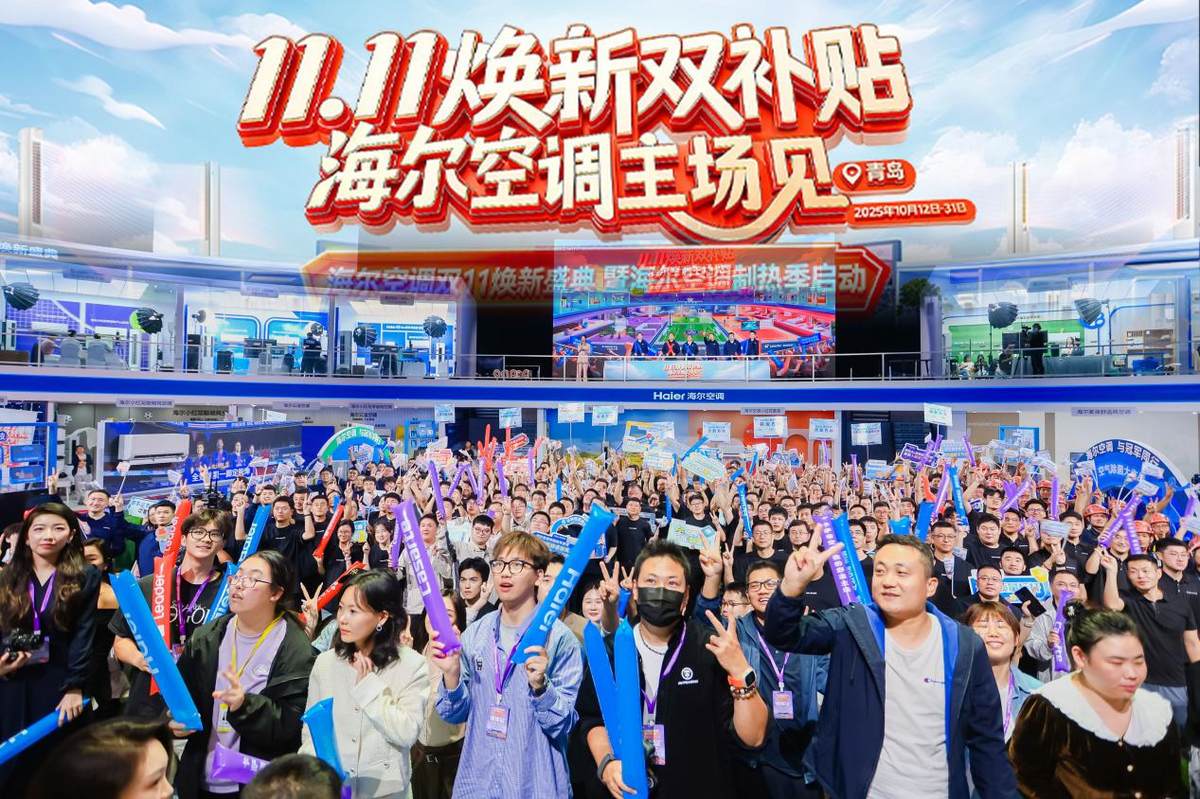
Core Viewpoint - Haier Air Conditioning is innovating user experience by allowing customers to directly test air conditioning products in a real-life setting, enhancing decision-making for purchases during the Double 11 shopping festival [1][3]. Group 1: User Experience Innovation - Haier's new approach includes a "thousand-person testing event" where users can experience air conditioning features firsthand, moving beyond traditional parameter comparisons [1][3]. - The event showcases Haier's commitment to user experience, with a 31% year-on-year increase in all-channel sales from January to September, surpassing the total net income for 2024 within just nine months [3]. Group 2: Product Features and Technology - The air conditioning units feature advanced AI technology, such as the "Comfort Wind" that adjusts airflow based on user proximity and breathing patterns, ensuring a comfortable experience [4]. - The "Lazy Person Key" on the Leader AI air conditioner automates air quality management and energy-saving functions, potentially saving users 295 kWh of electricity annually, translating to nearly 200 yuan in cost savings [6]. - The Casarte air conditioner offers a unique design with minimal visible air vents, providing a new experience where users feel airflow without seeing the source [8]. - The Haier Warm Sun Pro central air conditioning system is designed to operate efficiently in extreme cold, maintaining heating performance at temperatures as low as -35°C while also being energy efficient [10]. Group 3: Promotional Strategies - During the Double 11 event, Haier is offering multiple incentives, including government subsidies, a 10-year warranty, interactive rewards, and discount coupons, making it easier for users to purchase their products [12]. - The testing event serves as a direct reference for consumers, allowing them to make informed decisions based on personal experience, while also promoting transparency and enhancing user experience in the industry [12].

港股震荡调整,仍处上行趋势中,下行有底
Mei Ri Jing Ji Xin Wen· 2025-10-13 05:25
Market Overview - The Hang Seng Index fell by 3.49% to 25,373.43 points, while the Hang Seng Tech Index dropped by 4.54% and the Hang Seng China Enterprises Index decreased by 3.48% during the midday session on October 13 [1] - The market's half-day trading volume was HKD 281.82 billion [1] Stock Performance - The Hong Kong Stock Connect Tech ETF (159101) experienced a decline of approximately 4% [1] - Notable declines among component stocks included Sunny Optical Technology down 8.16%, Xiaomi Group-W down 7.82%, Bilibili-W down 7.19%, BYD Electronics down 7.15%, and Kuaishou-W down 6.91% [1] - In contrast, Kingsoft rose by 10.09% and Hua Hong Semiconductor increased by 3.61% [1] Market Sentiment and Future Outlook - Despite the short-term adjustment in the Hong Kong stock market, it remains in a trend of oscillating upward with a solid bottom [1] - Following the Federal Reserve's interest rate cuts, global capital is expected to flow into stock markets, potentially leading to new highs [1] - The upward momentum in the Hong Kong market is primarily driven by positive news from the industry, with a focus on sectors experiencing growth [1] - Investors are awaiting more fundamental signals, with the upcoming Fourth Plenary Session and the 15th Five-Year Plan expected to influence market sentiment [1] - Dongwu Securities maintains a positive outlook on AI technology, noting that while U.S. tech giants may impact the trading rhythm of Hong Kong's AI sector, the acceleration of China's AI progress offers recovery potential for local tech leaders [1] Investment Strategy - For ordinary investors, direct individual stock investment poses high barriers and risks; thus, participating through related ETFs is recommended [2] - The Hong Kong Stock Connect Tech ETF (159101) closely tracks the National Index of Hong Kong Stock Connect Technology, selecting 30 large-cap, high R&D investment tech leaders, with the top ten weighted stocks accounting for 77% [2] - The ETF encompasses major players like Tencent and Alibaba, as well as emerging forces such as Li Auto and BeiGene, covering popular sectors including "software and hardware + new consumption + innovative pharmaceuticals + new energy vehicles" [2]
帮主郑重盘中解盘:A50强力回升、沪指低开高走!半仓策略才是真“压舱石”
Sou Hu Cai Jing· 2025-10-13 02:51
Group 1 - The A50 index has shown a strong rebound, with the Shanghai Composite Index quickly recovering from the low opening around 3800 points, indicating a gradual repair of market sentiment [1][3] - The market is not experiencing systemic panic compared to the tariff war period in early April, with clear bottom-fishing intentions from funds, as evidenced by the early rise of the Sci-Tech Innovation 50 index [3] - AI technology stocks are expanding from hardware to software, with application-level stocks beginning to take the lead, which is a trend worth noting for medium to long-term investors [3] Group 2 - The recommendation for investors is to maintain a half-position strategy, emphasizing the importance of risk control and not rushing to bottom-fish during market fluctuations [3] - Investors are advised to avoid blind adjustments if heavily invested without risk management, as hasty actions during low openings can lead to missteps [3] - The logic of A-share revaluation remains unchanged in the medium to long term, suggesting that the trend will eventually revert [3]