太空算力

Search documents
兴业证券:后续还有哪些催化值得期待?
智通财经网· 2026-01-25 11:55
Core Viewpoint - The report from Industrial Securities emphasizes that the recent cooling in the market affects the rhythm and structure rather than the overall trend, with the core logic supporting the upward spring market remaining unchanged. The current spring market is still in progress, and although the market rhythm has slowed, the upward trend continues, with the profit effect expanding to a broader range [1]. Group 1: Liquidity and Catalysts - A liquidity-rich environment is the core driving force supporting the upward trend of the spring market, stemming from the strong performance of insurance funds and the influx of foreign capital due to the appreciation of the RMB [1][2]. - Insurance funds have shown impressive performance in the "opening red" period, with individual insurance premium growth rates exceeding 30% for leading companies, and some companies' individual insurance premiums surpassing 10 billion [1]. - The first half of this year is expected to see a peak in the maturity of residents' fixed deposits, creating an important window for residents to increase their allocation to equity assets [2]. - The continuous appreciation of the RMB is attracting foreign capital back to the market, with a record high of $99.9 billion in bank foreign exchange settlement surplus in December 2025, including a $11.5 billion surplus in securities investment [2]. Group 2: Market Structure and Performance - The current market is characterized by a warm macro environment and supportive policies, which are enhancing market risk appetite and driving the profit effect to expand across various sectors [3]. - The upcoming week will feature a concentrated window for industry catalysts, particularly with the earnings reports from North American tech giants, which may influence the domestic market [4]. - The earnings preview period is approaching its peak, with a disclosure rate expected to reach around 55%, which will significantly impact market structure [4][7]. Group 3: Earnings Forecasts and Sector Focus - As of January 23, 2025, 889 A-share listed companies have released earnings forecasts, with 304 companies expecting net profit growth exceeding 50%, primarily in sectors such as computing, chemicals, new energy, pharmaceuticals, and computer technology [5][6]. - The sectors with high growth or exceeding expectations in earnings forecasts include storage, new energy (battery storage, grid equipment), chemicals, and innovative pharmaceuticals [6][7]. - The report highlights that industries with low price increases during the current market rally include AI hardware, new energy, and various cyclical sectors [8]. Group 4: Future Market Outlook - February is anticipated to be a core window for bullish market activity, with a typical pattern of market volatility driven by liquidity and risk appetite, particularly in small-cap and growth sectors [9]. - The report suggests that themes such as AI applications, commercial space, and energy narratives should be revisited as they may gain renewed attention in February [9].

机构论后市丨市场信心持续恢复;A股维持震荡偏强趋势
Di Yi Cai Jing· 2026-01-25 10:13
Core Viewpoint - The A-share market is experiencing a mixed performance, with various institutions providing insights on future trends and investment strategies. Group 1: Market Trends and Predictions - CITIC Securities indicates that market confidence is gradually recovering, suggesting that sectors with logical narratives and not heavily weighted in broad indices may see a recovery [1] - Zhongtai Securities notes that the short-term market will continue to show a differentiated pattern, supported by high elasticity sectors attracting new capital, while the overall liquidity remains relatively loose [2] - Huajin Securities states that the short-term spring market is ongoing, with A-shares maintaining a strong trend amid weak economic recovery and potential increases in profitability [3] Group 2: Investment Strategies - CITIC Securities recommends focusing on a combination of resources and traditional manufacturing sectors, particularly in chemicals, non-ferrous metals, new energy, and power equipment, while also suggesting to increase allocations in non-bank sectors [1] - Zhongtai Securities emphasizes that the market's pricing logic may shift from risk preference and valuation expansion to performance verification and profit growth as companies begin to disclose annual reports [2] - Everbright Securities advises investors to maintain a steady approach and hold stocks through the holiday period, predicting a new upward momentum post-Spring Festival [4] Group 3: Sector Focus - Everbright Securities highlights sectors such as electronics, power equipment, and non-ferrous metals as key areas of interest, depending on market styles [4] - The commercial aerospace sector is noted for its recent recovery, with specific sub-sectors like space computing and upstream materials expected to remain active despite overall limited upward potential [5]
广东省政协常委陈娇:广东布局太空算力有基础,不能掉队
2 1 Shi Ji Jing Ji Bao Dao· 2026-01-25 09:53
Core Viewpoint - The focus on space computing power is emerging as a significant topic in the context of technological innovation and future industries, particularly in Guangdong, where there is a strong push for development in artificial intelligence and commercial space applications [1][4]. Group 1: Industry Insights - Space computing power is recognized as a massive future industry with significant potential, as demonstrated by successful pilot projects that integrate real-time algorithms with satellite capabilities [5][6]. - Guangdong has a solid industrial foundation for developing space computing power, with ongoing investments in satellite industry bases and a leading position in artificial intelligence applications [10][11]. - The advantages of space computing power include unlimited solar energy, lower cooling costs due to cold temperatures in space, and flexible deployment options that are not constrained by geographical limitations [6][7]. Group 2: Challenges and Recommendations - Current challenges in the development of space computing power include a lack of systematic planning, weak links in the industrial chain, and insufficient technological advancements in satellite capabilities [12][9]. - Recommendations for Guangdong include integrating space computing power into provincial infrastructure planning, establishing key projects, and fostering collaboration between government, enterprises, and research institutions [13][14]. - There is a need for focused efforts on core technology breakthroughs, such as satellite design and manufacturing, and the establishment of a sustainable innovation ecosystem to support the growth of the space computing industry [14].



商业航天强势行情持续演绎,全面看多国产大飞机产业链
ZHONGTAI SECURITIES· 2026-01-25 08:53
Investment Rating - Maintain "Buy" rating for the industry [6] Core Viewpoints - The commercial aerospace sector is experiencing strong momentum, with short-term fluctuations providing investment opportunities. The industry is expected to enter a period of explosive growth over the next two years, driven by technological advancements and increasing demand for launch services, satellite networking, and space computing [9][30] - The domestic large aircraft industry is expected to see a dual increase in delivery and localization rates, with key milestones in certification and international cooperation becoming critical in 2026 [15][34] Summary by Sections 1. Policy Developments - The "14th Five-Year Plan" emphasizes the development of strategic emerging industries, including aerospace, and the establishment of a dedicated regulatory body for commercial aerospace [10][28] - New measures have been introduced to promote the development and utilization of satellite remote sensing data, encouraging mergers and acquisitions in the satellite data industry [10][28] 2. Technological Advancements - The successful maiden flight of the "Zhuque-3" rocket and the Long March 12 rocket marks significant progress in China's launch capabilities, with the latter achieving its mission of placing 19 low-orbit satellites into orbit [11][29][50] - The CJ-1000A engine is nearing certification, with expectations for small-scale production to begin soon [18][36] 3. Market Dynamics - The commercial aerospace sector is projected to grow significantly, with the integration of artificial intelligence and space computing driving demand for satellite manufacturing and launch services [12][32] - The upcoming Beijing International Commercial Aerospace Exhibition is expected to generate substantial procurement demand, showcasing advancements across the aerospace industry [13][32] 4. Key Companies to Watch - In the missile and military electronics sector, companies such as Hongyuan Electronics, Torch Electronics, and Huada Electronics are highlighted [24][37] - For aircraft manufacturing, focus on domestic large aircraft manufacturers like AVIC Xi'an Aircraft Industry Group and Guanglian Aviation [38][39] 5. International Competition - The global competition for space resources is intensifying, with significant developments from both China and the U.S. in satellite constellations and launch capabilities [14][33]
大芯片,再度崛起?
智通财经网· 2026-01-25 06:24
Core Insights - In early 2025, significant developments in the AI chip sector were reported, including Elon Musk's confirmation of Tesla's (TSLA.US) revival of the Dojo 3 supercomputer project, aiming to become the largest AI chip manufacturer globally, and Cerebras Systems' multi-year procurement agreement with OpenAI worth over $10 billion, promising 750 megawatts of computing power by 2028 [1][2]. Group 1: AI Chip Evolution - The evolution of AI chips is characterized by two distinct designs: Cerebras' wafer-scale integration and Tesla's Dojo, which represents a hybrid approach between single-chip and GPU clusters [3]. - The divergence stems from different solutions to the "memory wall" and "interconnect bottleneck" challenges, with traditional GPU architectures facing limitations in memory bandwidth compared to computational power [3][4]. Group 2: Cerebras' Innovations - Cerebras' WSE-3 chip features 40 trillion transistors, 900,000 AI cores, and 44GB of on-chip SRAM, achieving a bandwidth of 214 Pb/s, significantly outperforming NVIDIA's H100 [4]. - The design addresses yield issues associated with large wafers by minimizing the size of each AI core and employing redundancy to maintain performance despite defects [4]. Group 3: Tesla's Strategic Shift - Tesla's Dojo project faced setbacks but was revived with a new focus on "space AI computing," moving away from its original goal of competing with NVIDIA's GPU clusters [7][8]. - The AI5 chip, designed with a 3nm process, is expected to be produced by the end of 2026, aiming for performance comparable to NVIDIA's Hopper architecture [8]. Group 4: Market Dynamics and Competition - The AI chip market is becoming increasingly crowded, with competitors like AMD and NVIDIA rapidly advancing their offerings, which poses challenges for alternative architectures like wafer-scale systems [16][19]. - Cerebras aims to differentiate itself by focusing on low-latency inference systems, capitalizing on the growing demand for real-time AI applications [16][14]. Group 5: Strategic Partnerships - Cerebras' partnership with OpenAI, involving a $10 billion commitment for computing power, highlights the increasing importance of low-latency inference capabilities in the AI landscape [11][12]. - The collaboration reflects a broader trend of established tech companies integrating promising AI chip startups into their ecosystems, which may reshape the competitive landscape [20][21].


商业航天事件点评:北京发布未来5年重磅措施,助推商业航天产业发展
Guolian Minsheng Securities· 2026-01-25 05:46
Investment Rating - The report maintains a "Recommendation" rating for the industry [2] Core Insights - Beijing has announced significant measures to promote the development of the commercial aerospace industry from 2026 to 2030, focusing on satellite data resource development and utilization [7] - The measures encourage capable enterprises to engage in mergers and acquisitions within the satellite data industry, aiming to create globally competitive leading companies [7] - The report highlights the importance of strengthening space infrastructure and supports the planning and construction of commercially viable satellite constellations [7] - The first satellite of the space computing constellation, "Chenguang No. 1," is expected to be launched in early 2026, marking a significant step in the establishment of a space data center [7] - The report suggests focusing on key players in the space computing sector, such as Shunhao Co., Ltd., and other members of the Beijing Space Computing Innovation Consortium [7] Summary by Sections - **Policy Measures**: The report outlines Beijing's initiatives to support the commercial aerospace sector, including financial support for qualifying space infrastructure projects and the integration of new technologies like AI and big data [7] - **Technological Advancements**: The report details advancements in core technologies for space computing, including energy supply and heat dissipation solutions, which are crucial for the operation of space data centers [7] - **Investment Opportunities**: The report identifies potential investment opportunities in companies involved in space computing and satellite data services, emphasizing the strategic importance of these sectors in the coming years [7]
商业航天-太空光伏专题汇报
2026-01-23 15:35
Summary of Commercial Aerospace Conference Call Industry Overview - The commercial aerospace industry is experiencing significant growth, particularly in satellite demand, driven by advancements in space computing and satellite technology [1][2] - The industry is supported by national policies aimed at catching up with SpaceX's advancements [2] Key Points on Satellite Technology - Space computing is a new engine for commercial aerospace, increasing satellite demand from hundreds to thousands [1][3] - Satellite solar wings are evolving towards larger areas, with Musk's V3 version potentially reaching 400 square meters, 20 times larger than the V1 version [1][5] - Solar wings account for 12%-24% of the overall satellite value, with potential for increased future contributions [1][5] Differences in Technology Approaches - The U.S. favors cost-effective solutions like the "golden turtle" approach, while China focuses on battery performance with more expensive options like biochemical gallium [1][6] - China leads in perovskite battery commercialization but is still in the testing phase [1][6][7] - Perovskite batteries are expected to significantly reduce costs to 30,000-50,000 RMB per square meter, outperforming gallium arsenide and crystalline silicon batteries in power-to-weight ratio [1][8] Market Dynamics - The Chinese satellite solar wing system is dominated by state-owned enterprises, with significant market shares held by institutions like the 811 Institute and CETC 18 [1][9] - Shanghai Port is the only publicly listed company in this sector, with extensive experience in on-orbit verification [1][11] Key Players in the Industry - Major companies in the space photovoltaic equipment manufacturing sector include: - **Maiwei Co.**: Specializes in customized heterojunction equipment and has strong ground application advantages [1][12] - **Yujing Co.**: Focuses on multi-wire cutting machine manufacturing and is increasingly involved in space photovoltaic business [1][12] - **Jiejia Weichuang**: Known for TOPCON technology and has international collaborations, including potential partnerships with SpaceX [1][13] Emerging Technologies - New materials in component manufacturing include: - **UTG Glass**: Developed by Lens Technology for aerospace-grade packaging, offering durability [1][15] - **CPI Film**: Being validated by Ruihua Tai and Woge Optoelectronics, lighter and cheaper than UTG glass but with lower durability [1][15] Conclusion - The commercial aerospace sector is poised for substantial growth, driven by technological advancements and strategic national support, with key players and emerging technologies shaping the future landscape of satellite energy systems and solar wing development [1][2][3]
2026太空赛道杀疯了!可回收火箭突破临界点,商业航天千亿产业链全曝光
材料汇· 2026-01-23 15:18
Core Viewpoint - The article emphasizes that commercial aerospace is poised for explosive growth by 2026, driven by government support, technological breakthroughs, capital influx, and market demand [6][8]. Group 1: Policy Support - The establishment of a Commercial Aerospace Department by the National Space Administration and supportive policies from over ten provinces have created a favorable environment for the industry [7][22]. - The government has included commercial aerospace in its work reports for two consecutive years, indicating a strategic focus on this sector [22]. Group 2: Technological Breakthroughs - Key advancements include successful tests of reusable rockets and the transition of satellite production to a "mass production" model, significantly enhancing launch capabilities [23][25]. - The Hainan launch site is now operational, supporting up to 16 high-density launches annually [23]. Group 3: Capital Influx - In 2025, the commercial aerospace sector saw a total financing of 18.6 billion yuan, a year-on-year increase of 32%, with significant investments in satellite applications and rocket manufacturing [28]. - More than ten companies are accelerating their IPO processes, indicating a robust interest from investors [28][29]. Group 4: Market Demand - The demand for low-orbit satellite constellations is increasing, with applications in satellite communication, space computing, and space tourism becoming more viable [7][35]. - The article highlights that there are 286 million non-internet users in China, representing a significant market opportunity for satellite communication services [7]. Group 5: Reusable Rocket Technology - Reusable rocket technology is expected to reduce launch costs by up to 60%, marking a shift towards "flight-like launches" in commercial aerospace [41]. - The first successful tests of vertical landing and recovery for rockets have been completed, with multiple rocket types set to debut in 2026 [42]. Group 6: Industry Structure - The commercial aerospace industry is characterized by a collaborative model involving state-owned enterprises, private companies, and local governments, creating a diversified ecosystem [16][22]. - The article outlines the differences between traditional and commercial aerospace, emphasizing the market-driven approach of the latter [15][16].

提前洞悉 !2026年商业航天核心大事件全梳理(值得收藏)
Xin Lang Cai Jing· 2026-01-23 13:10
Core Insights - The commercial space industry is poised for significant growth, with key events and technological advancements expected to drive investment opportunities and industry evolution [1][4]. Recent Catalysts (January to March) - The Third Beijing International Commercial Space Exhibition (January 23-25) will showcase cutting-edge technologies such as reusable rockets and low-orbit satellite constellations, promoting "space computing" as a new industry hotspot [1][28]. - Tianbing Technology's Tianlong-3 vertical recovery test in February marks a critical step in reducing rocket launch costs through reusable technology, benefiting the rocket manufacturing and recovery systems [2][27]. - The Second Commercial Space Industry Development Conference (March 19-20) will focus on reusable rockets and satellite internet, gathering resources to accelerate technology implementation and industry standardization [3][28]. Yearly Highlights - Multiple commercial rockets, including Zhuque-3, Zhishen-1, and Yingli-2, are set for their maiden or second flights in the first half of the year, transitioning China's commercial space sector from "single launches" to "regular operations," thus opening long-term growth potential [29]. - SpaceX plans to raise over $30 billion in its largest IPO, with an estimated valuation of approximately $1.5 trillion, which is expected to attract global capital attention to the commercial space sector and boost domestic industry heat, particularly in satellite internet and rocket manufacturing [4][29]. Industry Opportunities - The combination of technological breakthroughs and capital influx is creating unprecedented development opportunities in the commercial space sector, with a focus on reusable technology and satellite internet [4][29].
A股五张图:我是飞天茅台,申请加入航天组!
Xuan Gu Bao· 2026-01-23 10:31
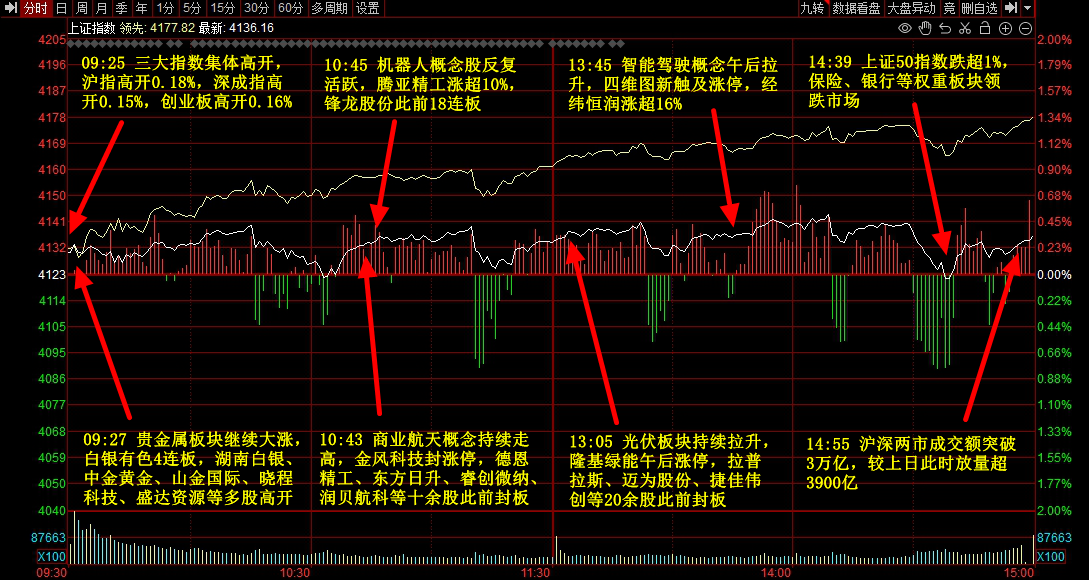
一、行情 今日市场温度大幅回暖,赚钱效应迎来明显增强。 题材方面,光伏板块集体暴涨,钧达股份2连板,明阳智能、双良节能、拓日新能、协鑫集成、金辰股份、赛伍技术、迈为股份(20CM)、东 方日升(20CM)、福斯特、捷佳伟创(20CM)、亚玛顿、亿晶光电、隆基绿能、乾照光电(20CM)、爱旭股份、沃格光电、金晶科技等集体 涨停; 航天板块也同样大幅反弹,巨力索具3连板,中超控股、润贝航科、西部材料等均2连板,上海港湾、瑞华泰(20CM)、德恩精工(20CM)、 飞沃科技(20CM)、金风科技、通宇通讯、江顺科技、臻镭科技(20CM)、航天电子、中国卫星等先后涨停; 以白银为首的有色股大涨,白银有色4连板,豫光金铅、盛大资源、铜陵有色等集体涨停,兴业银锡、湖南白银、株冶集团、国城矿业等大涨; 此外,锂矿、无人驾驶、金刚石、AI营销等均有局部大涨表现,半导体、保险、传统行业等跌幅居前。 截至收盘,沪指、深成指、创业板指、北证50分别收涨0.33%、0.79%、0.63%、3.82%,市场近4000股上涨,近1400股下跌,三市累计成交量重回3万亿。 2、光伏 | | स्त्र | 历史走势 | | | | | | ...