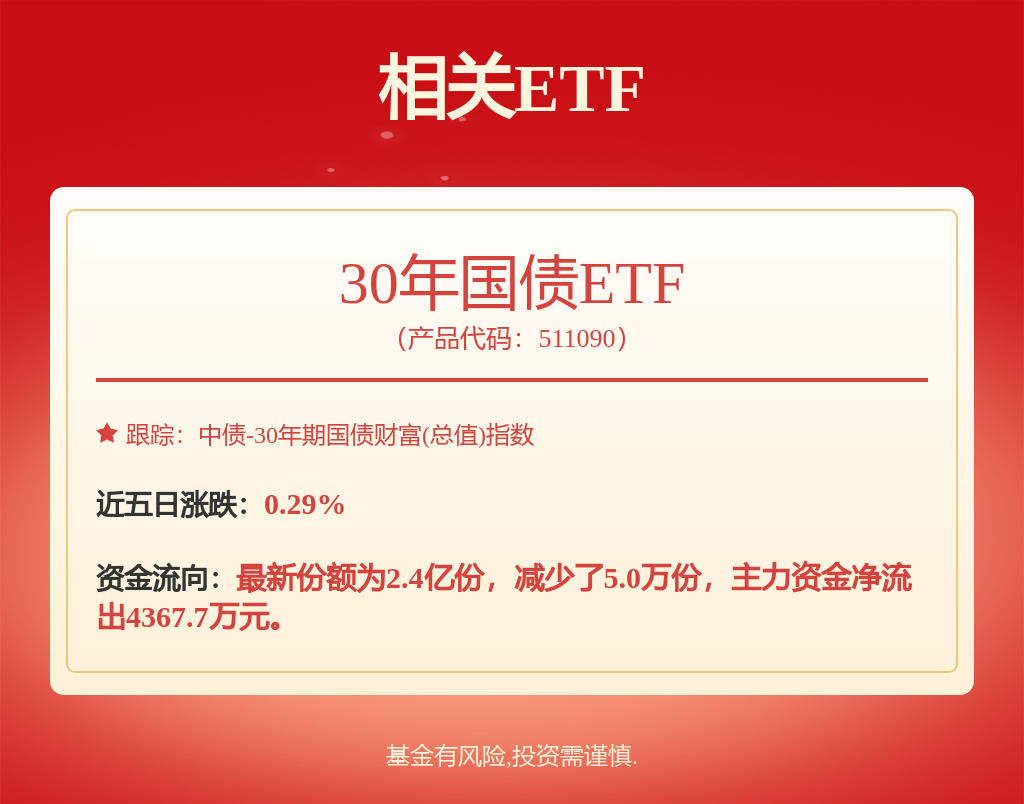
货币政策宽松

Search documents
固收- 宽松预期再升温?
2025-09-09 14:53
Summary of Conference Call Notes Industry Overview - The discussion primarily revolves around the Chinese bond market and its relationship with monetary policy, particularly in the context of potential easing measures by the People's Bank of China (PBOC) in response to external economic conditions and domestic growth needs [1][2][4]. Key Points and Arguments 1. **Monetary Policy Correlation**: Historically, there has been a synchronization between the monetary policies of the US Federal Reserve and the PBOC. For instance, after the Fed's rate cuts in 2019 and 2024, the PBOC followed suit by lowering rates [2]. 2. **Current Economic Environment**: The external environment in 2025 differs from previous years, with a stronger RMB against the USD since April, reducing external balance pressures. This may lead to a weaker correlation between US and Chinese monetary policies [2][4]. 3. **Liquidity Tools**: The PBOC has been utilizing tools like reverse repos and Medium-term Lending Facility (MLF) to meet liquidity needs, indicating that the urgency to restart government bond purchases is relatively low [1][4]. 4. **Market Stability**: In a stable market with little change in the yield curve, there is no immediate need for the PBOC to alter interest rates. However, unexpected market shifts could prompt a reassessment [5][6]. 5. **Economic Performance**: The Chinese economy has shown signs of weakness in domestic demand, particularly after Q2 2025, necessitating potential monetary easing to stabilize growth [7]. 6. **Stock and Bond Market Dynamics**: The current stock market has not significantly impacted bond market sentiment. As long as bank liabilities remain stable, the likelihood of a major adjustment in the bond market is low [8]. 7. **Investment Strategy Recommendations**: It is suggested to adopt a leveraged coupon strategy and remain flexible in trading operations, especially if external demand weakens further [9]. 8. **Bond Switching Conditions**: Both 10-year and 30-year bonds are eligible for switching to the next active bond, but the pace for 30-year bonds is faster. The current spread between new and old bonds has narrowed, limiting further arbitrage opportunities [10]. Other Important Insights - The potential for the PBOC to restart government bond purchases is being discussed, but it is viewed more as a protective measure rather than a catalyst for growth [2][4]. - The market's expectation for monetary easing remains subdued despite recent economic adjustments, indicating a cautious outlook [7][9].
五矿期货贵金属日报-20250908
Wu Kuang Qi Huo· 2025-09-08 01:41
1. Report Industry Investment Rating - No information provided in the given content. 2. Core Viewpoints of the Report - The significant deterioration of the US labor market, as indicated by key employment data, has strengthened market expectations for the Federal Reserve's further loose monetary policy. Even if the US CPI and PPI data in August are resilient, it is difficult to affect the Fed's interest - rate cut operation in September [2]. - During the process of the Fed's monetary policy turning loose, silver prices will have a stronger upward drive compared to gold. The current external gold - silver ratio is 87, significantly higher than the historical average of 62.1 since 1971. The market has almost fully priced in a 25 - basis - point interest - rate cut by the Fed in the September FOMC meeting, and there is a 55% probability of a further 25 - basis - point cut in the October meeting. The Fed may conduct more than three interest - rate cuts in the remaining FOMC meetings this year, exceeding market expectations. It is recommended to maintain a long - on - dips strategy for the precious metals sector, with a focus on the upward opportunities of silver prices. The reference operating range for the main contract of Shanghai gold is 801 - 840 yuan/gram, and for the main contract of Shanghai silver is 9526 - 11000 yuan/kilogram [3]. 3. Summary According to Related Catalogs Market Quotes - Shanghai gold rose 1.01% to 822.78 yuan/gram, and Shanghai silver rose 0.07% to 9770.00 yuan/kilogram. COMEX gold fell 0.56% to 3633.00 dollars/ounce, and COMEX silver fell 0.57% to 41.32 dollars/ounce. The US 10 - year Treasury yield was reported at 4.1%, and the US dollar index was reported at 97.88 [2]. - The closing prices, trading volumes, open interests, and inventories of various gold and silver products such as COMEX gold, LBMA gold, SHFE gold, COMEX silver, LBMA silver, and SHFE silver, as well as the changes compared with the previous trading day and their historical quantiles, are presented in detail [4][6]. Market Outlook - The US labor market has shown clear signs of deterioration. The non - farm payrolls data in August was significantly lower than expected, with multiple industries experiencing a decline in employment. This situation is in line with the statements of Powell and other Fed officials, indicating that the Fed is likely to cut interest rates in September [2]. - With the Fed's monetary policy becoming more accommodative, silver is expected to outperform gold. The market has priced in the Fed's interest - rate cut actions, and the Fed may cut interest rates more times than expected in the remaining meetings of this year [3]. Charts and Data Analysis - Multiple charts are provided, including the relationship between gold and silver prices and various factors such as the US dollar index, real interest rates, trading volumes, open interests, and the near - far month structure of gold and silver futures contracts, as well as the internal and external price differences of gold and silver [8][11][22][54].
薛鹤翔:降息预期“提前落地” 衰退叙事尚有距离-20250906全球宏观经济观察
Sou Hu Cai Jing· 2025-09-07 10:45
Core Viewpoint - The U.S. labor market shows signs of weakness, with non-farm employment increasing by only 22,000 in August, significantly below the market expectation of 75,000, leading to increased speculation about potential interest rate cuts by the Federal Reserve [3][11][17]. Economic Data - The U.S. ISM manufacturing index rose slightly to 48.7 in August from 48 in July, but remains below the neutral level of 50, indicating ongoing contraction [10]. - The Eurozone's CPI increased by 2.1% year-on-year in August, while core CPI slightly decreased to 2.3%, aligning with market expectations [10]. - U.S. job openings fell to 7.181 million in July, a ten-month low, and the trade deficit surged by 32.5% to $78.3 billion in July [10]. - The ADP employment report showed an increase of 54,000 jobs in August, below the expected 65,000 [10]. Federal Reserve Outlook - Federal Reserve Governor Waller suggested that the Fed should begin cutting rates this month and continue to do so in the coming months, depending on future economic data [3][6][17]. - Market expectations for a 50 basis point cut in September have intensified following the weak employment data, although there are concerns about the potential for a "recession trade" if economic slowdown expectations become too pronounced [4][18]. Market Reactions - U.S. equities, silver, and copper experienced volatility, reflecting uncertainty between easing expectations and economic slowdown narratives [5][19]. - Gold prices rose, and the U.S. dollar weakened, indicating clearer expectations regarding monetary policy direction [5][19]. International Central Bank Actions - The European Central Bank's President Lagarde stated that the 2% inflation target has been achieved, and necessary measures will continue to ensure price stability [6]. - The Bank of Japan's Deputy Governor indicated that further rate hikes may be appropriate given the improving economic and price conditions [7]. Trade and Policy Developments - The U.S. and Japan are finalizing a trade agreement that includes measures to alleviate tariff burdens, with Japan committing to increase U.S. rice imports by 75% [15][16]. - Concerns about the independence of the Federal Reserve have risen due to President Trump's attempts to influence its leadership [6][18].


美国总统突然宣布特朗普明确表示没说过一定会选哈塞特,但他确实是前三候选人之一,原本的第四人选财长贝森特已退出
Sou Hu Cai Jing· 2025-09-06 14:17
Core Viewpoint - The article discusses the influence of political pressure on the Federal Reserve's decision-making, particularly in the context of potential changes in leadership and monetary policy under President Trump. Group 1: Federal Reserve Leadership - Trump has indicated three potential candidates for the Federal Reserve chairmanship: Hassett, Waller, and Walsh, all of whom have pro-business and accommodative monetary policy stances [3][4] - Current Fed Chair Powell's term lasts until 2026, but Trump has expressed dissatisfaction with him since 2018, particularly during the COVID-19 pandemic when he pressured for aggressive rate cuts [4][6] Group 2: Monetary Policy and Economic Implications - The U.S. is facing high interest rates, with projected interest costs exceeding $1 trillion in the 2024 fiscal year, accounting for about 13% of the federal budget [6] - Market expectations indicate that investors anticipate at least two rate cuts by the end of 2025, reflecting skepticism about the Fed's ability to resist political pressure [6] - Historical precedents show that political interference in Fed decisions can lead to long-term economic issues, such as the inflation crisis of the 1970s [8] Group 3: Independence of the Federal Reserve - The article raises concerns about the potential loss of the Fed's independence if it becomes a tool of the White House, which could undermine its credibility and the integrity of its monetary policy [8][12] - The current economic environment, with core inflation around 3%, suggests that hasty rate cuts could reignite inflation, negatively impacting the public [10][12]
首破3600美元,现货黄金再创纪录!
Di Yi Cai Jing Zi Xun· 2025-09-06 02:12
Group 1 - The latest US non-farm employment data significantly underperformed expectations, leading the market to almost confirm that the Federal Reserve will initiate interest rate cuts in September [2][3] - Spot gold prices surged past $3600 per ounce, reaching a historical record and recording the largest weekly gain since mid-June, driven by expectations of monetary easing and safe-haven demand [2][3] - Analysts suggest that the weak labor market will likely overshadow inflation concerns, resulting in a bullish outlook for gold prices in the short to medium term, although a significant market misalignment is needed for gold to approach $4000 [2][3] Group 2 - The probability of maintaining interest rates in September has dropped to 0%, with an 88.3% chance of a 25 basis point cut and an 11.7% chance of a 50 basis point cut [3] - Lower borrowing costs are expected to diminish the attractiveness of dollar-denominated assets, enhancing the appeal of gold as a non-yielding asset [3] - Gold prices have outperformed most commodities this year, having risen over 37% year-to-date, reflecting its unique allure amid monetary policy easing and macroeconomic uncertainties [3] Group 3 - Goldman Sachs predicts that if the independence of the Federal Reserve is compromised, it could lead to rising inflation, increasing long-term interest rates, declining stock prices, and a weakened status of the dollar as a reserve currency [4] - The bank forecasts gold prices to reach $3700 by the end of 2025 and $4000 by mid-2026, assuming strong demand from central banks continues [4] - In extreme scenarios, if just 1% of the funds from the US Treasury market were to flow into gold, prices could approach $5000 per ounce [4]

布米普特拉北京投资基金管理有限公司:非农数据预期改善,但难阻美联储降息步伐
Sou Hu Cai Jing· 2025-09-05 09:42
Group 1 - The market's expectation for a rate cut by the Federal Reserve in September remains unchanged despite potentially strong employment data, primarily due to underlying weakness signals in the labor market and the Fed's recent dovish stance [1][5] - The forecast for August indicates an increase of 90,000 non-farm jobs, surpassing July's 73,000 and the market's expectation of 75,000, supported by stable initial jobless claims and a decline in continuing claims [3] - The focus will be on the revision of July's data, as previous months' non-farm data have been adjusted downwards, raising the possibility of a significant downward revision for July, which could indicate a more persistent weakness in the labor market [3] Group 2 - Powell's speech at the Jackson Hole global central bank conference has set the tone for a potential policy shift, with a strong data requirement to prevent a rate cut in September, despite the official forecast suggesting rates will remain unchanged [5] - The unemployment rate will be a critical variable in assessing the rate cut threshold; a drop to 4.1% would lower the job growth requirement, while a rise to 4.3% would necessitate stronger job data to alleviate rate cut expectations [5] - The August employment market is expected to show mixed results, with public sector jobs anticipated to slightly recover after a loss of 10,000 in July, and improvements expected in the tourism and hospitality sectors [5][7] Group 3 - Certain sectors are still showing signs of weakness, particularly in professional and business services, which may continue to experience hiring challenges due to the accelerated application of AI technology and reduced labor market fluidity [7] - Manufacturing employment is expected to remain sluggish due to labor supply shocks and tariff uncertainties [7] - Wage growth is projected to remain stable, with an expected month-over-month increase of 0.3% in average hourly earnings and average weekly hours stable at 34.3 hours, indicating no overheating in the labor market [7]

土耳其8月通胀放缓幅度不及预期 央行进一步降息空间或受限
Zhi Tong Cai Jing· 2025-09-03 09:13
Group 1 - Turkey's inflation rate showed a slower decline than expected, with the year-on-year increase dropping from 33.5% in July to 33% in August, which was higher than analysts' forecast of 32.6% [1] - The core inflation rate, excluding volatile items like food and energy, decreased to 33% from 34.7% in July, indicating persistent inflationary pressures [1] - Key contributors to the inflation included food, transportation, and rental services, with rental prices being influenced by past inflation levels, making them difficult to control through monetary policy [1] Group 2 - The Turkish central bank had previously lowered the benchmark interest rate by 300 basis points to 43% in July, marking the first rate cut in four months, amidst political turmoil [2] - The central bank has indicated a potential for further rate cuts, but the governor warned that the bank is not on "autopilot" and highlighted the importance of consumer and business inflation expectations [2] - Turkey's GDP grew by 4.8% year-on-year in the second quarter, driven by domestic demand, raising concerns about the adequacy of the central bank's rate cuts [2]
美国财长贝森特宣布,美联储理事提名人斯蒂芬·米兰极有可能在9月美联储会议前正式就职,这位米兰来头不小
Sou Hu Cai Jing· 2025-09-02 16:27
Core Viewpoint - The potential appointment of Stephen Milan, a close ally of Trump, to the Federal Reserve Board raises concerns about the independence of the Fed and its future monetary policy direction [1][3][10]. Group 1: Appointment Implications - Milan's background as a supporter of Trump's policies and his involvement in trade agreements suggests he may prioritize a more accommodative monetary policy [3][5]. - If Milan is confirmed before the September meeting, he could influence discussions on interest rates and asset balance sheet reduction towards a more dovish stance [5][10]. - The historical context shows that political pressure on the Fed can lead to adverse long-term economic consequences, as seen during Nixon's presidency [8][11]. Group 2: Economic Context - The current U.S. benchmark interest rate is above 5%, and inflation, while reduced from a peak of over 9%, remains around 3% [5][6]. - A significant reduction in interest rates could risk reigniting inflation, which may not align with Trump's electoral priorities [6][11]. - The U.S. fiscal deficit is projected to exceed $1.7 trillion for the 2024 fiscal year, raising concerns about the implications of a more lenient monetary policy [11]. Group 3: Market Reactions - The potential for Milan to push for quicker rate cuts could lead to a reevaluation of global market pricing, impacting the dollar's value and U.S. Treasury yields [10][11]. - The perception of the Fed as a tool of the White House could undermine confidence in U.S. debt as a safe-haven asset, leading to possible market sell-offs [13][15]. - The ongoing politicization of the Fed may erode its credibility and independence, which are crucial for maintaining market stability [13][15].
通胀超预期放缓+内需偏弱 韩国央行10月重启降息预期升温
智通财经网· 2025-09-02 01:17
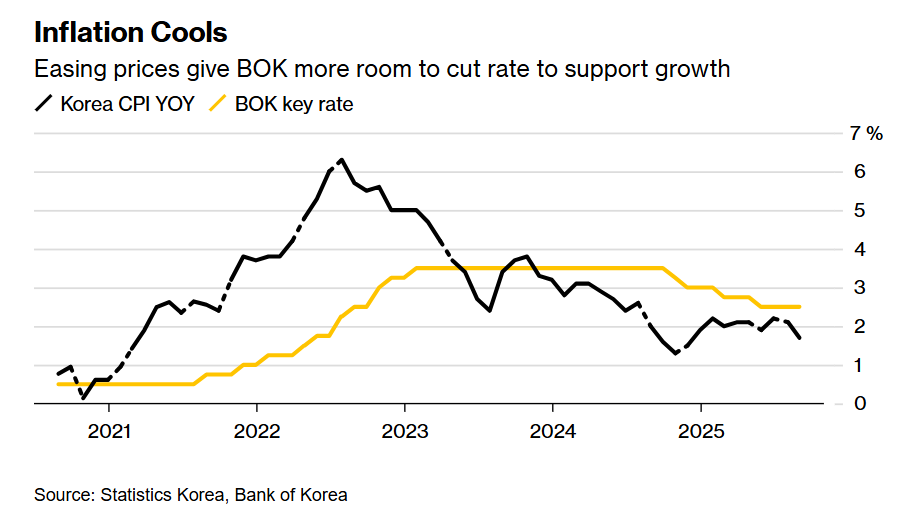
Group 1 - South Korea's consumer inflation has slowed to its lowest growth rate this year, with the Consumer Price Index (CPI) rising by 1.7% year-on-year in August, down from 2.1% in July, and below economists' expectations of around 1.9% [1][4] - The core inflation rate, excluding food and energy, increased by 1.3% year-on-year in August, significantly lower than the expected 1.7% and marking the slowest growth in four years [1][4] - The decline in communication costs, particularly due to SK Telecom's reduction of mobile phone bills for over 20 million affected users, contributed to the inflation slowdown, offsetting rising food costs [4][5] Group 2 - Despite higher tariffs imposed by the U.S., South Korea's export data remains robust, with semiconductor exports increasing by 27.1% year-on-year in August, supported by strong demand in the semiconductor and automotive sectors [5][6] - The Bank of Korea is considering more policy stimulus as businesses prepare for potential impacts from U.S. tariffs, with the central bank maintaining the benchmark interest rate at 2.5% amid concerns over the real estate market and rising mortgage levels [5][6] - The recent inflation data is expected to provide the Bank of Korea with more room to implement accommodative monetary policy to support economic growth, especially if housing market pressures ease [5][6][7]
近期股债出现一定同步上涨,30年国债ETF早盘小幅上涨
Zheng Quan Zhi Xing· 2025-09-01 03:20
Group 1 - The bond market showed slight upward movement, with the 30-year government bond ETF rising by 0.05% and the 30-year government bond futures contract increasing by 0.09% [1] - The central bank conducted a 7-day reverse repurchase operation of 182.7 billion yuan at a stable interest rate of 1.40%, indicating a stable monetary policy environment [1] - The yields on major government bonds, including the 10-year and 30-year bonds, experienced slight declines, reflecting a downward trend in interest rates [1] Group 2 - The bond market faced headwinds in August, with the 10-year government bond yield increasing by 7.35 basis points, despite the Shanghai Composite Index rising by 7.97% [2] - Analysts suggest that the recent synchronized rise in stocks and bonds may be attributed to increased support from the central bank and a loosening of the funding environment at the end of the month [2] - The Pengyang 30-year government bond ETF is highlighted as the first ETF tracking the 30-year government bond index, offering T+0 trading attributes and serving as a flexible cash management tool for investors [2]