
中美经贸谈判

Search documents
吉隆坡谈判结束,贝森特:美方不再对华加税,中方将采购美国大豆
Sou Hu Cai Jing· 2025-10-27 16:43
Core Viewpoint - The recent negotiations between China and the U.S. in Kuala Lumpur have concluded with significant implications for trade relations, particularly regarding tariffs and agricultural purchases, indicating a complex interplay of mutual interests and pressures from both sides [1][3]. Group 1: China's Position - China's stance during the negotiations was characterized by clear "bottom line signals," emphasizing that while they are open to discussions, they will not compromise on core interests for short-term agreements [3]. - Vice Premier He Lifeng highlighted that the essence of Sino-U.S. economic relations is mutual benefit, indicating a willingness to negotiate but with firm boundaries [3]. - The discussions revealed specific contentious issues, such as U.S. maritime logistics fees and fentanyl-related tariffs, showcasing the complexity of the negotiations [3][9]. Group 2: U.S. Position - U.S. Treasury Secretary Becerra's announcement of not imposing additional tariffs should be viewed in context, as it reflects a pause in escalating tensions rather than a complete removal of existing high tariffs [5]. - The urgency for the U.S. to secure soybean purchases from China is driven by inventory pressures in major soybean-producing states, which have been exacerbated by previous tariff policies [7]. - U.S. Trade Representative Greer mentioned that both sides are working on finalizing the details of their agreement, indicating that critical terms are still pending and require further high-level discussions [9]. Group 3: Negotiation Dynamics - The negotiations are marked by a rational compromise under pressure from both sides, with the U.S. needing to address agricultural state concerns and China aiming to stabilize its trade environment [11]. - There are significant hurdles to achieving a lasting consensus, including the need for internal approvals and the outcomes of future high-level meetings on key issues like rare earth elements and tariff measures [11]. - The discussions have shifted the focus from broad disagreements to specific issues, indicating a more structured approach to resolving trade tensions, although fundamental differences remain unresolved [9].


棕榈油震荡运行,逢低做多
Ning Zheng Qi Huo· 2025-10-27 09:10
1. Report Industry Investment Rating - Not provided 2. Core Viewpoints of the Report - The palm oil price is expected to fluctuate in the short - term, and it is advisable to buy on dips. The supply - side is expected to be loose, which suppresses the vegetable oil price. The latest export data of Malaysian palm oil from the 1st to the 25th shows a month - on - month decline, increasing inventory pressure and weighing on the palm oil price. The domestic price is stable, with light trading volume, mainly executing previous contracts [2]. 3. Summary According to the Directory 3.1 Palm Oil Price Market Review - The report shows a chart of the domestic soybean - palm oil futures price difference trend (yuan/ton), but specific data analysis is not provided [4]. 3.2 Supply Situation Analysis - The report presents a chart of China's palm oil import data, but specific data analysis is not provided [6]. 3.3 Demand Situation Analysis - The report shows a chart of the average transaction price statistics of palm oil (yuan/ton), but specific data analysis is not provided [8]. 3.4 Cost - Profit Analysis - The report presents a chart of palm oil import cost and profit (yuan/ton), but specific data analysis is not provided [10]. 3.5 Market Outlook - The domestic spot price remains low, the basis fluctuates weakly, and there has been a long - term situation of having prices but no market. The continuous increase in ship purchases for the near - term, especially for the November shipment, has led to an overly loose near - end supply. Coupled with weak spot demand, even if the futures price drops significantly, the basis still has no chance to rise. To relieve inventory pressure, middle - and upstream enterprises sell at discounted prices, and terminal low - price replenishment increases. Waiting for the realization of the expected production reduction in the producing areas or news guidance, the palm oil price has certain support at the bottom in the short - term and is expected to mainly fluctuate [12].
有色金属周报:缅甸锡矿复产缓慢和中美经贸谈判缓和支撑锡价-20251027
Hong Yuan Qi Huo· 2025-10-27 08:34
1. Report Industry Investment Rating No relevant content provided. 2. Core Viewpoints of the Report - The slow resumption of tin mines in Myanmar and the easing of Sino-US economic and trade negotiations support tin prices. The expectation of future interest rate cuts and the halt of balance - sheet reduction by the Fed, along with the initial agreement in Sino - US economic and trade negotiations, suggest that the resumption of tin mines in Myanmar may not change the tight supply - demand situation. The Shanghai tin price is expected to be cautiously bullish. Investors are advised to build long positions after price pullbacks, paying attention to support and resistance levels [3]. - The negative basis and monthly spread of Shanghai tin are due to high tin prices suppressing downstream demand with only rigid procurement. Given the Fed's future policies and the slow resumption of tin mines in Myanmar, investors are advised to focus on short - term, light - position, low - buying arbitrage opportunities for the Shanghai tin basis. For LME tin, the positive (0 - 3) and (3 - 15) contract spreads are in a reasonable range, and it is recommended to temporarily wait and see for arbitrage opportunities [9][10]. 3. Summary by Directory 3.1 First Part: Spread and Inventory Situation - Shanghai tin basis is negative and at a relatively low level, and the monthly spread is negative and basically within a reasonable range. LME tin (0 - 3) and (3 - 15) contract spreads are positive and in a reasonable range, and the Shanghai - London tin price ratio is at the 50% quantile of the past five years [9][10]. - The inventory of refined tin on the Shanghai Futures Exchange decreased compared to last week; the social inventory of tin ingots in China decreased compared to last week; the inventory of refined tin on the London Metal Exchange increased compared to last week; the total inventory of refined tin at home and abroad decreased compared to last week [12]. 3.2 Second Part: Mid - upstream Supply Situation - The daily processing fee of domestic tin concentrates is oscillating downward, indicating a tight supply expectation of domestic tin mines. The production (import) volume of domestic tin mines in October increased (increased) month - on - month. The production volume of recycled tin in China in October may increase month - on - month [19][21][24]. - The capacity utilization rate of refined tin in China increased compared to last week. The production (inventory) volume of refined tin in China in October increased (decreased) month - on - month, and the import volume may increase month - on - month [26][28][29]. 3.3 Third Part: Downstream Demand Situation - The daily processing fee of photovoltaic solder strips decreased month - on - month, which may lead to an increase in the capacity utilization rate (inventory) of tin solder in China in October. The import (export) volume of solder strips in China in October may decrease (decrease) month - on - month [35][38]. - The production volume of tin - plated sheets in China in October may increase month - on - month, while the import and export volumes may decrease month - on - month. The capacity utilization rate of lead - acid batteries in China increased compared to last week [41][43][46].

美信用危机引爆谈判场:AA-评级戳破美国神话,中美攻守悄然易位
Sou Hu Cai Jing· 2025-10-26 04:27
Core Viewpoint - The recent downgrade of the U.S. sovereign credit rating by Scope Ratings to AA- reflects growing concerns over the country's debt levels and governance issues, coinciding with ongoing U.S.-China trade negotiations in Kuala Lumpur [1][3][4]. Group 1: Credit Rating Downgrade - Scope Ratings downgraded the U.S. sovereign credit rating from its previous level to AA-, which is three levels below the highest rating [1][3]. - The U.S. national debt has surpassed $38 trillion, approaching the $40 trillion mark, leading to increased interest payment burdens due to the federal funds rate of 4%-4.25% [3]. - The downgrade is seen as a necessary response to the unsustainable debt levels and interest obligations faced by the U.S. government [3]. Group 2: Governance Crisis - The ongoing government shutdown, which has lasted over three weeks, has exacerbated the situation, with significant political divisions between the Republican and Democratic parties [4][5]. - A government that frequently shuts down struggles to maintain market trust, raising concerns among investors about potential defaults [4]. Group 3: Implications for U.S.-China Trade Negotiations - The downgrade of U.S. credit strength presents a strategic opportunity for China in the ongoing trade negotiations, as the U.S. may be more eager to reach an agreement to stabilize its situation [7]. - The shift in power dynamics, with the U.S. losing its traditional economic dominance, allows China to negotiate from a position of strength, potentially securing more favorable terms [7][9]. - Historical patterns indicate that credit rating adjustments can lead to market reactions, affecting U.S. debt yields and global confidence in dollar assets, which may influence the broader context of U.S.-China negotiations [9]. Group 4: Future Negotiation Dynamics - The balance of power at the negotiation table has shifted, with the U.S. no longer holding the same level of authority it once did, while China benefits from its stable economic governance and credit accumulation [11]. - The credit rating event may lead to significant changes in the negotiation process, requiring both parties to adapt their strategies to leverage the new dynamics effectively [11].

美国的电话,中国接了,如释重负后特朗普松口风:计划明年初访华
Sou Hu Cai Jing· 2025-10-22 08:47
Core Viewpoint - The recent announcements from China's Ministry of Commerce and Customs regarding rare earth export controls are significant, requiring global companies to obtain approval for exporting rare earth magnets or semiconductor materials containing 0.1% or more of controlled rare earth metals originating from China [1] Group 1: U.S.-China Trade Relations - Following China's announcement, Trump threatened to impose a 100% tariff on Chinese goods, but after a lack of response from China, U.S. officials sought to initiate talks, which were delayed by China [3] - After nearly 10 days, a video call between U.S. and Chinese trade leaders took place, leading to a decision to hold face-to-face negotiations in Malaysia [9] - The U.S. is eager to ease pressure in areas like rare earths, with hopes of extending tariff exemptions in exchange for concessions from China [9][15] Group 2: U.S. Domestic Impact - Trump's tariff policies, initially aimed at strengthening the U.S. economy, have backfired, increasing costs for American consumers and manufacturers, leading to calls for a reassessment of these strategies [7][13] - The backlash against high tariffs is growing domestically, with businesses and consumers feeling the financial strain, prompting the White House to consider a more conciliatory approach [13][15] Group 3: China's Stance - China has maintained a firm position, emphasizing that negotiations must be based on equality, respect, and mutual benefit, rejecting unilateral pressure from the U.S. [9][15] - Despite the U.S. seeking to negotiate, China's commitment to its core interests remains unwavering, indicating a readiness to engage in conflict if necessary [15][18] Group 4: Future Negotiations - The upcoming talks in Malaysia are seen as a potential pathway to easing tensions ahead of the APEC summit, but skepticism remains regarding the U.S.'s commitment to genuine concessions [17] - China's strengthened position and ability to counter U.S. pressure suggest that any continued attempts to coerce China through tariffs may lead to further complications for the U.S. [18]
国际金价、银价再度大涨;苹果股价创历史新高丨盘前情报
2 1 Shi Ji Jing Ji Bao Dao· 2025-10-21 00:42
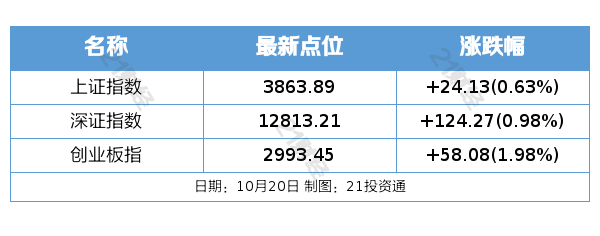
Market Performance - On October 20, the A-share market experienced a pullback after an initial rise, with the ChiNext Index rising over 3% at one point. The Shanghai Composite Index closed up 0.63%, the Shenzhen Component Index up 0.98%, and the ChiNext Index up 1.98% [1][2] - The total trading volume in the Shanghai and Shenzhen markets was 1.74 trillion yuan, a decrease of 200.5 billion yuan compared to the previous trading day, marking the lowest trading volume since August 8 [1] Sector Performance - Key sectors that performed well included computing hardware, superhard materials, coal, and gas stocks, while non-ferrous metals and gold concepts saw significant declines [1] - The diamond cultivation, coal, and gas sectors had the highest gains, while non-ferrous metals experienced the largest losses [1] International Market Overview - The three major U.S. stock indices rose on October 20, with the Dow Jones Industrial Average increasing by 515.97 points (1.12%), the S&P 500 up 71.12 points (1.07%), and the Nasdaq Composite up 310.57 points (1.37%) [2][4] - European stock indices also saw gains, with the FTSE 100 up 49.00 points (0.52%), the CAC 40 up 31.87 points (0.39%), and the DAX up 427.81 points (1.80%) [3][4] Commodity Prices - International oil prices fell on October 20, with WTI crude oil down 2 cents to $57.52 per barrel (a decrease of 0.03%) and Brent crude down 28 cents to $61.01 per barrel (a decrease of 0.46%) [3][4] - Gold futures on COMEX rose by 3.82% to $4,374.30 per ounce, with spot gold increasing by 2.48% to $4,357.36 per ounce, reaching historical highs during the session [6] Key Company Updates - CATL reported a net profit of 18.5 billion yuan for the third quarter, representing a year-on-year increase of 41% [8] - Apple’s stock reached an all-time high, with a market capitalization of $3.89 trillion, driven by strong demand for the iPhone 17 series, which saw a 14% increase in sales compared to the iPhone 16 series [6] Market Sentiment and Trends - The market is experiencing a shift towards defensive sectors, with a focus on semiconductor equipment, AI, batteries, and precious metals, while maintaining positions in gold and large financials to hedge against uncertainties in U.S.-China relations [8]

铜周报:中美经贸谈判变化左右市场情绪-20251018
Wu Kuang Qi Huo· 2025-10-18 13:00
1. Report Industry Investment Rating No information provided in the content. 2. Core View of the Report - The copper valuation is slightly bullish with a neutral bias, as the domestic and foreign basis has risen, the refined - scrap spread has narrowed, and the global visible inventory has continued to increase. In terms of drivers, the decline in the global manufacturing PMI is bearish, while the US dollar index and copper concentrate processing fees are bullish. - Sino - US trade negotiations are still uncertain, but the mood has marginally improved after the weekend meeting of the two countries' trade negotiators. Industrially, the supply of copper raw materials remains tight, and overseas copper mine production cuts have tightened future supply expectations. Coupled with the improvement in downstream consumption as copper prices fall, there is strong price support. Short - term copper prices may run strongly. - The reference range for the main contract of Shanghai copper this week is 83,000 - 88,000 yuan/ton; the reference range for LME copper 3M is 10,450 - 11,000 US dollars/ton [12]. 3. Summary by Directory 3.1 Week - on - Week Assessment and Strategy Recommendation - **Supply**: The spot processing fee for copper concentrates has declined, the processing fee for blister copper is flat, and the supply of cold materials remains tight. In August, Peru's copper production decreased by 1.6% year - on - year to 243,000 tons, and the cumulative production from January to August was 1.81 million tons, a year - on - year increase of 2.6% [11]. - **Inventory**: The total inventory of the three major exchanges increased by 0.4 million tons week - on - week. The inventory of the Shanghai Futures Exchange increased by 0.1 to 1.1 million tons, the LME inventory decreased by 0.2 to 1.37 million tons, and the COMEX inventory increased by 0.5 to 3.14 million tons. The inventory in the Shanghai Free Trade Zone increased by 1.2 million tons. On Friday, the domestic spot in Shanghai was at a premium of 55 yuan/ton over the futures, and the LME market's Cash/3M was at a discount of 16.8 US dollars/ton [11]. - **Imports and Exports**: The spot import loss of domestic electrolytic copper first widened and then narrowed, and the Yangshan copper premium fluctuated and declined. In August 2025, China's refined copper imports were 307,000 tons, and the net imports were 270,000 tons, a month - on - month increase of 54,000 tons and a year - on - year increase of 10.0%. From January to August, the cumulative imports were 2.53 million tons, and the net imports were 2.071 million tons, a year - on - year decrease of 1.3% [11]. - **Demand**: The operating rate of domestic downstream refined copper rod enterprises rebounded, and the spot trading gradually improved as the market price first rose and then fell. In the scrap copper market, the domestic refined - scrap spread narrowed, reducing the substitution advantage of scrap copper. The operating rate of recycled copper rod enterprises rebounded after the National Day holiday [11]. 3.2 Futures and Spot Markets - **Futures Prices**: The price of the main contract of Shanghai copper fell 1.77% week - on - week (as of Friday's close), while LME copper rose 2.25% to 10,607 US dollars/ton [21]. - **Spot Prices**: The spot price data of various copper products such as electrolytic copper, copper materials, and recycled copper are provided, showing price changes over different time points [23]. - **Premiums and Discounts**: On Friday, the spot copper in East China was at a premium of 55 yuan/ton over the futures. The LME's Cash/3M premium first strengthened and then weakened, reporting a discount of 16.8 US dollars/ton on Friday. The spot import loss of domestic electrolytic copper first widened and then narrowed, and the Yangshan copper premium (bill of lading) declined [26]. 3.3 Profit and Inventory - **Smelting Profit**: The spot rough smelting fee (TC) for imported copper concentrates slightly declined to - 41.0 US dollars/ton. The sulfuric acid price in East China stabilized, still having a positive impact on copper smelting revenue [34]. - **Import - Export Ratio**: No specific analysis content is provided in the text. - **Import - Export Profit and Loss**: The spot import loss of copper first widened and then narrowed [39]. - **Inventory**: The total inventory of the three major exchanges was 561,000 tons, a week - on - week increase of 4,000 tons. The inventory in the Shanghai Free Trade Zone was 100,000 tons, a week - on - week increase of 12,000 tons. The decrease in the Shanghai Futures Exchange's inventory came from Jiangsu and Guangdong, while the inventory in Shanghai increased. The number of copper warehouse receipts increased by 12,885 to 42,849 tons. The LME inventory decreased, with the decrease coming from Asian and European warehouses, and the proportion of cancelled warehouse receipts declined [42][45][48]. 3.4 Supply Side - **Electrolytic Copper Monthly Output**: According to SMM research data, China's refined copper output decreased month - on - month in September 2025, and it is expected to continue to decline in October. According to National Bureau of Statistics data, in August 2025, the domestic refined copper output was 1.301 million tons, a year - on - year increase of 14.8%, and the cumulative output from January to August was 9.891 million tons, a year - on - year increase of 10.1% [53]. - **Import and Export Situation**: In August 2025, China's copper ore imports were 2.76 million tons, a month - on - month increase and a year - on - year increase of 7.3%. The cumulative imports from January to August were 20.054 million tons, a year - on - year increase of 7.9%. The import volume of unwrought copper and copper products was 425,000 tons, a month - on - month decrease of 55,000 tons and a year - on - year increase of 1.2%. The import volume of anode copper was 62,000 tons, a month - on - month decrease of 22,000 tons and a year - on - year decrease of 18.2%. The import volume of refined copper was 307,000 tons, and the net import volume was 270,000 tons, a month - on - month increase of 54,000 tons and a year - on - year increase of 10.0%. The export volume of refined copper was 37,000 tons, a month - on - month decrease of 81,000 tons. The import volume of recycled copper was 179,000 tons, a month - on - month decrease of 11,000 tons and a year - on - year increase of 5.9% [56][59][62][68][71]. 3.5 Demand Side - **Consumption Structure**: China's official and Caixin manufacturing PMIs both rebounded in September, indicating a continued improvement in manufacturing sentiment. The manufacturing sentiment of major overseas economies has weakened marginally, with the manufacturing PMIs of the Eurozone, the UK, Japan, and India all declining [78]. - **Downstream Industry Production Data**: In August, the year - on - year production of automobiles, air conditioners, refrigerators, and power generation equipment increased, while that of color TVs, washing machines, AC motors, and freezers decreased. From January to August, the cumulative year - on - year production of power generation equipment, air conditioners, washing machines, refrigerators, and AC motors increased, while that of color TVs and freezers decreased [81]. - **Real Estate Data**: From January to August, domestic real estate data remained weak, with new construction, construction, sales, and completion all declining year - on - year, and the decline rates all widened. The national real estate climate index continued to decline in August [84]. - **Downstream Enterprise Operating Rates**: The operating rate of various downstream copper - related enterprises such as refined copper rod, scrap copper rod, enameled wire, wire and cable, copper tube, brass rod, copper strip, and copper foil enterprises showed different trends in September and expected trends in October [87][90][93][96]. - **Refined - Scrap Spread**: No specific analysis content is provided in the text. 3.6 Capital Side - **Shanghai Copper Positions**: The total position of Shanghai copper decreased by 95,302 to 1,061,152 lots (bilateral), and the position of the near - month 2511 contract was 287,706 lots (bilateral) [104]. - **Foreign Fund Positions**: As of September 23, CFTC funds maintained a net long position, with a net long ratio of 12.3%. The proportion of long positions of LME investment funds declined (as of October 10) [107].
中方罕见主动出牌,中美谈判有望加快:国内宏观周报(第2期)-20251012
Huafu Securities· 2025-10-12 05:18
Group 1: Trade Relations and Economic Impact - China has implemented export controls on rare earths and related technologies, responding to U.S. threats of increased tariffs and export restrictions[2] - China dominates 70% of global rare earth mining and 93% of rare earth permanent magnet production, leveraging this advantage in trade negotiations[3] - The U.S. economy is facing significant challenges, including a slowdown due to tariffs, a cooling labor market, and political divisions leading to government shutdowns[4] Group 2: Consumer Behavior and Market Trends - During the Mid-Autumn and National Day holidays, domestic travel reached 888 million trips, with total spending of 809 billion yuan, reflecting a year-on-year increase of 1.6% and 1.0% respectively[16] - Consumer spending in related industries grew by 4.5% year-on-year, but the growth rate has declined compared to previous holidays, indicating a need for further stimulus measures[21] - The automotive sector remains in a low growth range, with retail and wholesale sales showing minimal year-on-year changes[30]
船舶费、稀土管制连环出 中美博弈升温如何影响全球贸易格局?丨夜话
Di Yi Cai Jing· 2025-10-11 01:17
Core Viewpoint - The ongoing US-China economic and trade tensions are escalating, drawing global market attention, with both countries implementing export controls and tariffs on each other's entities and goods [1] Group 1: US Actions - The US Department of Commerce has added multiple Chinese entities to its export control "entity list" [1] - Starting from October 14, the US will impose port service fees on vessels owned or operated by Chinese companies, Chinese-built ships, and vessels with Chinese nationality [1] Group 2: China's Response - In retaliation, the Chinese Ministry of Commerce has placed foreign entities, including those involved in anti-drone technology, on an unreliable entity list [1] - China will implement export control measures on superhard materials and rare earths, in coordination with the General Administration of Customs [1] Group 3: Focus Areas - The aviation and semiconductor sectors have emerged as key areas of contention in the ongoing US-China trade dispute [1]
沪铅产业日报-20250925
Rui Da Qi Huo· 2025-09-25 13:05
Report Summary 1) Report Industry Investment Rating No specific industry investment rating is provided in the report. 2) Core View of the Report The overall supply of Shanghai lead has decreased slightly, demand is slowly increasing. After the market digests the news from the Federal Reserve and takes profits, the market shows a high - level consolidation. It is recommended to go long on lead prices at low levels [2]. 3) Summary by Relevant Catalogs a. Futures Market - The closing price of the Shanghai lead main contract is 17,090 yuan/ton, up 25 yuan; the 11 - 12 month contract spread for Shanghai lead is - 25 yuan/ton, unchanged; the Shanghai lead open interest is 93,632 lots, down 1,182 lots; the net position of the top 20 in Shanghai lead is 541 lots, up 261 lots; the Shanghai lead warehouse receipts are 38,160 tons, down 3,450 tons; the SHFE inventory is 57,332 tons, down 9,229 tons; the LME 3 - month lead quote is 2,002.5 dollars/ton, up 3.5 dollars; the LME lead inventory is 219,725 tons, down 250 tons [2]. b. Spot Market - The spot price of 1 lead from Shanghai Non - ferrous Metals Network is 16,950 yuan/ton, unchanged; the spot price of 1 lead from Yangtze River Non - ferrous Metals Market is 17,200 yuan/ton, up 60 yuan; the basis of the lead main contract is - 140 yuan/ton, down 25 yuan; the LME lead (0 - 3) spread is - 40.08 dollars/ton, up 2.05 dollars [2]. c. Upstream Situation - The price of lead concentrate (50% - 60%) in Jiyuan is 16,471 yuan, up 175 yuan; the domestic recycled lead (≥98.5%) price is 16,830 yuan/ton, unchanged; the number of recycled lead production enterprises is 68, unchanged; the capacity utilization rate of recycled lead is 37.88%, up 0.61 percentage points; the monthly output of recycled lead is 22.42 tons, down 6.75 tons; the average weekly operating rate of primary lead is 80.56%, down 0.96 percentage points; the weekly output of primary lead is 3.59 tons, unchanged; the processing fee of lead concentrate (60%) at major ports is - 90 dollars/kiloton, unchanged; the ILZSG lead supply - demand balance is - 0.5 thousand tons, up 1.3 thousand tons; the global lead ore output is 395.9 thousand tons, up 15.7 thousand tons; the monthly lead ore import volume is 13.48 tons, up 1.27 tons [2]. d. Industry Situation - The monthly refined lead import volume is 1,820.55 tons, down 1,596.29 tons; the monthly refined lead export volume is 2,752.22 tons, up 957.7 tons; the average domestic processing fee of lead concentrate to the factory is 370 yuan/ton, unchanged; the average price of waste batteries in the market is 10,091.07 yuan/ton, down 23.22 yuan [2]. e. Downstream Situation - The monthly export volume of batteries is 49,680 thousand units, up 1,925 thousand units; the average price of lead - antimony alloy (for batteries, 2% antimony content) is 20,075 yuan/ton, unchanged; the Shenwan industry index of batteries and other cells is 2,188.73 points, up 55.3 points; the monthly automobile output is 275.24 tons, up 24.24 tons; the monthly new - energy vehicle output is 133.3 tons, up 15.7 tons [2]. f. Industry News - US Treasury Secretary Yellen believes that the Fed's interest rates have been too high for too long and the US will enter an easing cycle; FOMC voter Goolsbee warns against a series of rate cuts due to inflation concerns; San Francisco Fed President Daly thinks further rate cuts may be needed; the US has officially lowered tariffs on EU cars to 15% since August 1, 2025; the US has launched a 232 - clause investigation on imported medical devices and industrial machinery; the Kremlin criticizes Trump for trying to force the world to buy US oil and gas at higher prices; the "Fed whisperer" indicates that Powell's remarks suggest further rate cuts may be possible; Sino - US economic and trade negotiations have made initial progress [2]. g. View Summary - The Fed's news has opened up rate - cut space, which has a positive impact on the market sentiment; on the supply side, some primary lead smelters are in maintenance, the raw material market is in tight balance, and the recycled lead production is restricted; on the demand side, the traditional consumption peak season is approaching, the demand in emerging fields is good, but the overall demand is still in a slow - recovery stage; the overall inventory has decreased, indicating that demand has effectively reduced inventory [2].
