
政策协同

Search documents
政策协同显身手 经济活力持续释放
Zhong Guo Zheng Quan Bao· 2025-12-03 20:28
Economic Recovery Indicators - In November, the manufacturing PMI rose to 49.2%, indicating an improvement in economic conditions [1] - The new export orders index increased by 1.7 percentage points to 47.6%, reflecting strong resilience in foreign trade [1] Consumer Market Dynamics - The consumption upgrade policy has driven sales exceeding 2.4 trillion yuan, benefiting over 360 million people in the first ten months of the year [2] - Retail sales of new energy passenger vehicles reached 10.15 million units, a year-on-year increase of 21.9% [2] Logistics and Delivery Growth - The express delivery business volume surpassed 180 billion pieces for the first time, indicating robust consumer activity [3] - The average monthly express delivery volume since 2025 has exceeded 16 billion pieces, showcasing a new growth trajectory in consumption [3] Policy Support for Economic Growth - The government has allocated 500 billion yuan for local government debt to enhance financial capacity and stimulate effective investment [4] - New policy financial tools have been implemented to support over 2,300 projects with a total investment of approximately 7 trillion yuan, focusing on digital economy and AI [4] Future Economic Outlook - The upcoming Central Economic Work Conference is expected to set a proactive macroeconomic policy for 2026, emphasizing domestic demand and technological self-reliance [5] - Fiscal and monetary policies are anticipated to remain supportive, with potential for further reductions in reserve requirements and interest rates [5]
深度专题|2026年:财政货币政策展望
赵伟宏观探索· 2025-12-02 16:03
Group 1: Policy Review for 2025 - Fiscal policy shows increased strength, with a historical high financing scale of 14.36 trillion yuan, accounting for 10.2% of GDP [1][8] - General fiscal expenditure grew by 7.9% year-on-year in the first three quarters of 2025, indicating a high level of spending [11][12] - Monetary policy returned to a "moderately loose" tone, with a focus on guiding expectations and improving transmission efficiency [1][23] Group 2: Fiscal Policy Outlook for 2026 - Fiscal policy is expected to become more proactive in supporting economic growth and structural transformation, with a deficit rate maintained around 4% [2][61] - Special bonds and new special debt scales are anticipated to expand slightly compared to 2025, aiming to keep fiscal expenditure growth in line with or above nominal GDP growth [2][63] - The focus will be on investing in social welfare and new infrastructure, particularly in areas like elderly care and child welfare [2][61] Group 3: Tax and Fiscal System Reform - Fiscal reforms will address structural contradictions, focusing on macro tax burden, central-local relations, and social security systems [3][61] - The aim is to maintain a reasonable macro tax burden and regulate tax incentives to curb excessive competition among local governments [3][61] Group 4: Monetary Policy Outlook for 2026 - Monetary policy is likely to maintain a "moderately loose" stance, with an emphasis on liquidity support and precise policy implementation [4][6] - The social financing scale is expected to increase, with M1 growth slightly rebounding due to fiscal input [4][6] - The central bank may implement a rate cut of about 10 basis points to maintain liquidity [4][6] Group 5: Policy Coordination and Macro Governance - The central bank's operations in government bond trading reflect a flexible response to market changes, enhancing policy effectiveness [1][42] - Fiscal injections into commercial banks are aimed at stabilizing their capital adequacy ratios and facilitating monetary policy transmission [49][51] - The collaboration between fiscal and monetary policies is evolving, with a focus on improving the overall governance system [1][42]

以政策协同,驱动广东新型储能高质量发展
2 1 Shi Ji Jing Ji Bao Dao· 2025-12-01 09:49
Core Viewpoint - Guangdong's new energy storage industry is experiencing rapid manufacturing expansion but faces challenges in local installation and consumption, leading to a "high capacity, low utilization" phenomenon. The province needs to enhance policy coordination and performance orientation to transition from rapid expansion to high-quality development [2][7]. Group 1: Policy Evolution and Key Analysis - Guangdong has established a leading "1+N+N" policy system for new energy storage, shifting from initial catalytic support to market-oriented arrangements since the release of the "Guiding Opinions" in 2023 [3][4]. - The development of energy storage in Guangdong has gone through three phases: early cultivation (2022 to early 2023), scale expansion (2023), and quality enhancement (post-2024) [4][5]. Group 2: Industry Logic Upgrade - The province has developed battery industry clusters in cities like Guangzhou and Shenzhen, but the market application scenarios for energy storage products remain underdeveloped, leading to a disconnect between supply and demand [5][6]. - To address this, Guangdong is promoting diverse application scenarios for energy storage, such as low-carbon industrial parks and data centers, to expand demand [6][7]. Group 3: Market Rules and Safety Standards - As Guangdong enters the quality enhancement phase, the focus has shifted from expanding scale to validating the value of energy storage through quantifiable system benefits and performance [8][9]. - The province is also strengthening safety management for energy storage stations, establishing a comprehensive lifecycle management system [10]. Group 4: Policy and Electricity Policy Coordination - There is a misalignment between the aggressive push of industrial policies and the slower pull of electricity policies, leading to structural contradictions in the energy storage sector [11][12]. - The industrial policy emphasizes scale and capacity, while electricity policy focuses on the actual value and contribution of energy storage to the power system [13][14]. Group 5: Recommendations - To resolve the "high investment, low consumption" dilemma, Guangdong should create a more systematic and coordinated policy framework that integrates both push and pull mechanisms [18][22]. - Establishing a planning and evaluation system based on the actual value of energy storage in the power system is essential for guiding investment and ensuring operational efficiency [19][20].
以政策协同,驱动广东新型储能高质量发展丨能源之声
2 1 Shi Ji Jing Ji Bao Dao· 2025-12-01 09:03
Core Viewpoint - Guangdong's new energy storage industry is experiencing rapid manufacturing expansion but faces challenges in local installation and consumption, leading to a "high capacity, low utilization" phenomenon. The province has established a leading "1+N+N" policy system for new energy storage, shifting focus from industry cultivation to electricity market mechanism construction to promote deep integration of storage and power systems [2][3]. Group 1: Policy Evolution and Key Analysis - Guangdong has positioned the new energy storage industry as a new economic growth driver, with the "Guiding Opinions" issued in 2023 marking a transition from catalytic support to market-oriented institutional arrangements [3][4]. - The development of energy storage policies in Guangdong has gone through three stages: early cultivation (2022 to early 2023), scale expansion (2023), and quality enhancement (post-2024) [4][5]. - The second stage aims to establish energy storage as a strategic pillar industry, leading to a complete "1+N+N" policy system, while the third stage focuses on integrating storage with the power system through performance-based subsidies and market participation rules [4][5]. Group 2: Industry Logic Upgrade - Guangdong has developed battery industry clusters in cities like Guangzhou and Shenzhen, but the market application scenarios for energy storage products remain underdeveloped, leading to a disconnect between supply and demand [5][6]. - To address this, the provincial government has launched initiatives to promote diverse application scenarios for energy storage, including low-carbon industrial parks and data centers, aiming to expand demand-side opportunities [6][7]. - The transition from a single manufacturing focus to a closed-loop model of manufacturing, application, and operation is crucial for sustainable development [6][7]. Group 3: Policy and Market Coordination - The rapid expansion of energy storage capacity has led to a misalignment between industry policies that push for growth and electricity policies that focus on operational efficiency and market returns [11][12]. - The current policy framework emphasizes hardware metrics like capacity and investment, while electricity policies prioritize operational contributions, creating a disconnect in objectives and evaluation [17][18]. - This misalignment has resulted in a structural dilemma where production capacity exceeds market demand, leading to underutilized projects and reduced investment confidence [15][18]. Group 4: Recommendations - To resolve the "high investment, low consumption" dilemma, a more systematic and coordinated policy framework is needed, combining push and pull mechanisms to foster high-quality development in the energy storage sector [19][20]. - Establishing a planning and evaluation system based on the actual value of energy storage in the power system is essential, guiding the layout of storage projects according to regional demand [20][21]. - Enhancing the synergy between storage policies and market dynamics, while promoting innovative business models, will broaden revenue sources and improve overall operational efficiency [21][22].
山东经济结构优化升级蕴含重大机遇
Da Zhong Ri Bao· 2025-11-30 00:38
Core Insights - Shandong's economic structure optimization during the "14th Five-Year Plan" period presents significant investment opportunities for various stakeholders [2][6] Strategic Advantages - Shandong benefits from multiple national strategic layouts, with strong policy dividends and resource aggregation enhancing its economic position [2][3] - The province has been recognized by national leadership, with six visits from President Xi Jinping since the 18th National Congress, providing direction for high-quality development [2] Policy Collaboration - Systematic thinking and policy collaboration are driving economic growth, with a focus on expanding and upgrading consumption, particularly in new consumption scenarios [3] - Government investments are being strategically directed towards manufacturing, green energy, and new infrastructure, laying a foundation for future industrial upgrades [3] Industrial Structure - Shandong's comprehensive industrial system is increasingly advantageous in a rapidly changing external environment, providing a "passport" for investors to access a complete industrial ecosystem [3][4] - The province is committed to optimizing its industrial structure, promoting intelligent, green, and integrated development to foster new technologies and business models [3][4] Technological Innovation - Shandong is investing 259.7 billion yuan in research and development in 2024, reflecting an 8.9% increase, and is home to a significant number of high-level talents [4] - The province is seeing improved patent conversion efficiency and breakthroughs in key technologies, which are essential for elevating industrial capabilities [4] Dual-Driving Economy - As of October, Shandong's state-owned enterprises have total assets of 5.7 trillion yuan and revenues exceeding 2.1 trillion yuan, providing a stable economic environment [4] - Private enterprises account for 98.9% of the market, driving high-quality development and enhancing competitive vitality [4] Open Economy - Shandong is accelerating its development as a high-level open economy, leveraging its strategic location in the "Belt and Road" initiative and Northeast Asia [5] - The province is establishing a logistics corridor to reduce logistics costs and attract industry clusters, facilitating global market access for local businesses [5] Green Transformation - Shandong is embedding the concept of "green development" into its growth strategy, with non-fossil energy generation capacity reaching 134 million kilowatts, accounting for 53.4% of total capacity [5] - This shift towards renewable energy signifies a new era for the province, enhancing the international competitiveness of "Shandong manufacturing" [5]
罗志恒:“供给配不配、时间够不够”,把居民消费率从40%推向更高水平
Di Yi Cai Jing Zi Xun· 2025-11-25 11:08
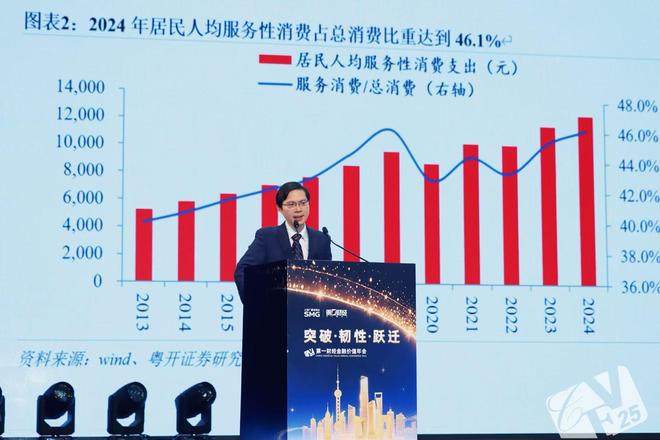
Core Viewpoint - The increase of the resident consumption rate is a key goal in China's economic and social development, aiming to elevate it from the current 40% to a higher level, which is crucial for domestic circulation and transforming China from a "world factory" to a "world market" [1] Group 1: Current Consumption Rate Analysis - China's current resident consumption rate is relatively low, at 39.6% in 2024, which is 28 percentage points lower than the United States, and 30 percentage points lower than its peak in the 1970s [3] - The service consumption ratio in China is significantly lower than that of the United States, with only 46% of resident consumption being service-related, compared to higher averages in similarly developed countries [3][4] Group 2: Factors Limiting Consumption Rate Improvement - The limited consumption capacity of residents is a major constraint, with only 60% of national income distribution going to residents, compared to 75%-80% in developed countries [5] - The disparity in social security systems, particularly in pension coverage between urban and rural residents, leads to cautious consumer behavior among lower-income groups [5] - The slow urbanization process restricts household consumption potential, as many migrant workers are unable to relocate their families, limiting demand for services and large consumer goods [6] Group 3: Policy Recommendations for Enhancing Consumption - Reforming the fiscal and tax system is essential, shifting from production-based to consumption-based tax sharing to encourage local governments to promote consumption [7] - Increasing residents' financial income through stabilizing the real estate and capital markets, and improving pension benefits for urban and rural residents is necessary to enhance consumption capacity [7] - Accelerating the urbanization of migrant workers and addressing welfare provision based on the household registration system is crucial for boosting consumption [7] - Optimizing time allocation by increasing public holidays and improving the holiday adjustment system can also enhance consumer spending [8]
强化金融保障促进民间投资
Sou Hu Cai Jing· 2025-11-19 22:43
Group 1 - The core viewpoint of the news is that the recent measures issued by the State Council aim to enhance private investment by increasing support through central budget investments and innovative financial tools, facilitating deeper participation of private capital in high-quality development [1][3] - The new policy measures focus on addressing the high capital threshold and financing costs that have historically hindered private enterprises from participating in major projects, thereby enabling them to engage in key sectors like advanced manufacturing and digital economy [1][2] - The innovative financial tools introduced are designed to lower the initial investment pressure on private capital and improve the financing qualifications of projects, thus attracting more social capital to follow [1][2] Group 2 - Policy coordination is emphasized as a crucial support for the effective implementation of financial guarantees, combining access openness and service optimization to create a comprehensive support system for private investment [2] - The measures include clarifying unreasonable restrictions on service industry operators and requiring financial institutions to set annual service goals for private enterprises, which aims to alleviate lending concerns [2] - There are existing challenges in the implementation of these measures, such as lengthy project approval processes and unclear application details for financial tools, which need to be addressed to fully realize the policy benefits [2][3] Group 3 - Private investment plays a significant role in stabilizing economic growth, and financial guarantees are seen as catalysts to activate this potential [3] - The deployment of these measures responds to the real demands of private capital and injects market vitality into high-quality development [3] - As new financial tools are accurately implemented and policy coordination deepens, private capital is expected to play a larger role in developing new productive forces and promoting industrial upgrades [3]
用精准政策促进消费提质升级(记者手记)
Ren Min Ri Bao· 2025-11-16 22:05
Group 1 - The core viewpoint of the news is the implementation of the "National Subsidy" policy for personal consumption loans, which aims to reduce the cost of consumer credit through fiscal funds, reflecting the policy's inclusiveness and addressing diverse consumer needs [1] - The policy has been in effect for over two months, combining consumption promotion with livelihood benefits, alleviating consumer burdens, and boosting confidence in pursuing a higher quality of life [1][2] - The policy is not isolated; it works in conjunction with existing industrial, regional, and social policies to create a synergistic effect, enhancing overall consumption [3] Group 2 - Precise execution is crucial for assessing the policy's effectiveness, requiring accurate targeting, scenario precision, and robust risk control [4] - Financial institutions are leveraging technology, such as big data and AI, to provide tailored consumer credit services and maintain low default rates, ensuring sustainable policy implementation [4] - There is a need to foster a rational borrowing mindset among consumers while continuing to promote policies that enhance consumer quality and welfare, supporting economic recovery [4]
为民营经济发展筑牢法治后盾
Jing Ji Ri Bao· 2025-10-30 22:16
Group 1 - The core viewpoint is that China's private enterprises have shown robust growth in imports and exports, particularly in high-tech products, indicating a strong momentum towards high-quality development [1] - In the first three quarters of this year, private enterprises' export of high-tech products increased by 15.3%, accounting for 54.2% of the total export value of similar goods in China [1] - The continuous optimization of the market-oriented, rule-of-law, and international business environment is a crucial factor contributing to the thriving private economy [1] Group 2 - Significant improvements have been made in China's business environment, with the number of registered business entities reaching 1.89 million by the end of November 2024 [2] - The implementation of the Civil Code provides comprehensive protection for the civil and commercial rights of various business entities, while the "Regulations on Optimizing the Business Environment" elevate effective local practices to regulatory status [2] - The introduction of the "Promotion Law of Private Economy" further clarifies the important status of the private economy and provides legal support for its high-quality development [2] Group 3 - Key policies and regulations have been introduced to support the development of the private economy, including the "Fair Competition Review Regulations" and the "Regulations on Payment of Small and Medium-sized Enterprises' Funds" [3] - In 2024, over 7,312 policy measures were modified or adjusted, and more than 14,000 unfair competition cases were investigated, promoting the construction of a unified national market [3] - Future efforts should focus on enhancing policy coordination, improving market access mechanisms, and ensuring that new industries receive appropriate regulatory frameworks [3] Group 4 - Companies are encouraged to strengthen legal compliance and risk management capabilities, while legal services should be enhanced to help businesses identify and prevent legal risks [4] - The establishment of diversified dispute resolution mechanisms, including online mediation and arbitration, is essential to reduce the cost of rights protection for enterprises [4] - Strengthening consumer rights protection and optimizing the market development environment are critical for the sustained growth of private enterprises [4]
赵刚主持召开省政府第三十六次常务会议
Shan Xi Ri Bao· 2025-10-27 23:12
Core Viewpoint - The provincial government is focusing on maintaining stable economic growth and enhancing development quality in the fourth quarter, emphasizing the implementation of the 14th Five-Year Plan and addressing key areas and industries to achieve the best possible outcomes [1][2]. Group 1: Economic Performance and Strategy - The overall economic operation of the province is stable, with continuous improvement in development quality and positive results in high-quality development during the first three quarters [1]. - The government aims to enhance policy coordination and effectiveness, ensuring that policy dividends translate into tangible development results [2]. Group 2: Industrial and Investment Focus - There is a strong emphasis on stabilizing production in key industries such as coal, oil, gas, and electricity, while expanding electricity export capacity and promoting industrial stability and efficiency [2]. - The government plans to accelerate key project construction and improve project management mechanisms to increase effective investment [2]. Group 3: Consumption and Employment Measures - Multiple measures will be taken to stabilize consumption, including promotional activities and enhancing the role of service sectors like culture, tourism, and modern logistics [2]. - The government is committed to ensuring employment for key groups such as college graduates, the impoverished population, and migrant workers, while managing risks in finance and government debt [2]. Group 4: Governance and Planning - The provincial government emphasizes a unified approach to growth responsibilities, enhancing supervision and collaboration among departments to address challenges and achieve set goals [2]. - There is a focus on scientifically preparing the province's 15th Five-Year Plan to better guide high-quality development in Shaanxi [2].