
新兴产业

Search documents
多地陆续出台“十五五”规划建议,“路线图”愈加明晰
Ren Min Ri Bao Hai Wai Ban· 2026-02-11 00:21
Core Insights - Economic provinces in China play a crucial role in stabilizing the national economy and driving high-quality development, with a clear roadmap emerging from recent "14th Five-Year" planning proposals [1][2] Group 1: Economic Performance - The top ten economic provinces contribute nearly 20% of the national area and over 60% of the GDP, acting as stabilizers and leaders in high-quality development [2] - In the first three quarters of this year, all nine provinces in the top ten exceeded or matched the national average GDP growth rate, showcasing strong development momentum [2] - Jiangsu's GDP surpassed 10 trillion yuan for the first time, while Shanghai and Hunan both exceeded 4 trillion yuan, raising the entry threshold for the "four trillion club" [2] Group 2: Future Planning - Five of the ten economic provinces have set ambitious goals to lead in various aspects, such as Guangdong aiming for economic doubling by 2035 and Jiangsu focusing on high-quality development and technological innovation [3] - Zhejiang plans to achieve significant progress in high-quality development and common prosperity within five years [3] Group 3: Structural Optimization and New Momentum - Economic provinces are at the forefront of structural optimization and new momentum, with policies promoting the growth of emerging industries like digital economy and artificial intelligence [4] - Guangdong has outlined a digital economy development plan with specific targets, including a core AI industry scale exceeding 440 billion yuan by 2027 [4] Group 4: Domestic Demand and Investment - Economic provinces are enhancing domestic demand and stabilizing investment through consumption activities and major engineering projects [6] - Guangdong has allocated an additional 3.5 billion yuan for fiscal policies, while Jiangsu plans to distribute over 400 million yuan in consumption vouchers [7] Group 5: Reform and Innovation - To further stimulate growth potential, economic provinces need to focus on breaking regional collaboration barriers and innovating in areas like low-altitude economy [8] - Continuous efforts are being made to improve the business environment and integrate into the national market, with specific measures being implemented in provinces like Sichuan and Henan [7]
川渝篇:四大增长极经济与产业洞察报告(2025)
GUOTAI HAITONG SECURITIES· 2026-02-10 14:59
产业深度 [table_Header]2026.02.10 [Table_Summary] 川渝:依托区域协同提升产业链供应链能级。2025 年 10 月,《中共中央关 于制定国民经济和社会发展第十五个五年规划的建议》明确提出"提升成 渝地区双城经济圈发展能级";2025 年 11 月,《成渝地区双城经济圈国土 空间规划(2021-2035 年)》明确提出支撑双城经济圈建设成为具有全国影 响力的重要经济中心、科技创新中心、改革开放新高地、高品质生活宜居 地。"十五五"时期,川渝区域还将迎来西部大开发战略实施三十周年、长 江经济带发展战略实施十周年、成渝地区双城经济圈建设十周年等一系列 重要节点。四川"十五五"规划建议紧扣"经济建设"中心与"高质量发 展"主题,聚焦于构建富有四川特色和优势的现代化产业体系,并加快推 动制造业高端化、智能化、绿色化转型;重庆"十五五"规划建议则明确 提出"迭代升级'33618'现代制造业集群体系",并将"打造具有全球影 响力的智能网联新能源汽车之都"列为首要任务。2019-2024 年,川渝区 域加快构建高效分工、错位发展、有序竞争、相互融合的产业体系。第一 产业方面,两地协同推 ...
大类资产配置周报:美国就业会更差吗?-20260210
Western Securities· 2026-02-10 08:54
Economic Outlook - The weighted economic growth target for 2026 has decreased from 5.28% in 2025 to 5.04%[7] - Only one province, Jiangxi, has increased its target, while 18 regions have lowered their targets or set them as ranges, indicating a focus on structural adjustments and new industry development[10] Labor Market Analysis - The January ADP employment report showed an increase of 22,000 jobs, below the expected 45,000 and the previous month's increase of 41,000[14] - The decline in job vacancies and a surge in layoffs suggest that the Federal Reserve may have underestimated the risks in the labor market[14] Monetary Policy Insights - In January, the central bank's net liquidity injection totaled 1.27 trillion yuan, ensuring ample liquidity at the start of the year[18] - The expectation for comprehensive interest rate cuts has weakened, despite increased liquidity measures[18] International Developments - The Japanese ruling party achieved a two-thirds majority in the House of Representatives, potentially initiating a constitutional amendment agenda, although challenges remain in the Senate[19] - The geopolitical risks in Japan have increased due to rising fiscal pressures and a shift towards a more conservative society[19] Market Performance - The Shanghai Composite Index fell by 1.27% last week, with the majority of major indices in decline, reflecting a cautious market sentiment ahead of the holiday[25] - The U.S. stock market showed mixed results, with the Nasdaq down 1.84% while the Dow Jones increased by 2.50%[27] Bond Market Trends - The 10-year U.S. Treasury yield decreased by 3 basis points to 4.21%, influenced by weak labor market data[29] - European bond yields showed varied movements, with German 10-year bonds yielding 2.84%[29] Commodity Market Movements - WTI crude oil prices fell by 2.55% to $63.6 per barrel, while gold prices increased by 1.43% to $4,964.4 per ounce[32] - The decline in oil prices is attributed to reduced geopolitical risks, while gold rebounded from previous lows[32] Currency Fluctuations - The U.S. dollar index rose by 0.66% to 97.6, while the onshore yuan appreciated by 0.32% to 6.94[34] - The appreciation of the yuan is driven by pre-holiday settlement demand[34] Risk Factors - Potential risks include unexpected changes in global macroeconomic data, geopolitical developments, and the pace of technological advancements[36]

化工景气提升-化工物流弹性几何
2026-02-10 03:24
Summary of Chemical Logistics Industry Conference Call Industry Overview - The chemical logistics industry is currently under pressure, with demand primarily driven by raw material transportation, intermediate production, and downstream applications in coastal regions. The mismatch in capacity layout has resulted in significant transportation demand [2][6]. - The overall profitability of the chemical logistics sector has been impacted since 2023 due to macroeconomic demand pressures [2]. Key Insights and Arguments - **Chemical Product Price Index (CCPI)**: The CCPI has shown a significant rebound trend since December 2025, indicating an improvement in the operating rates of key chemical products such as methanol and ethylene glycol, which reached their highest levels in recent years by early 2026 [1][5]. - **Supply and Demand Dynamics**: The demand for liquid chemical transportation is growing at approximately 8% annually, while supply is increasing at about 7%. Delays in capacity approval can lead to mismatches, creating opportunities for price increases during periods of rapid demand growth [3][9]. - **Regulatory Environment**: The domestic coastal liquid chemical transportation sector is subject to strict capacity control, with annual adjustments based on demand and company qualifications. This has led to a more concentrated market, with 80% of leading companies generating less than 1 billion yuan in revenue [3][6][8]. Structural Opportunities - Despite a slowdown in growth, there are structural opportunities in the industry, such as the "going out" strategy and the development of emerging industries. Some logistics companies have already benefited from these changes, with expectations of continued improvement in road transportation and warehouse rental rates [7][15]. Key Segments to Watch - **Warehousing**: Companies involved in warehousing, liquid chemical transportation, and tank storage are highlighted as having stable profitability due to high asset intensity and licensing barriers [4][15]. - **Major Companies**: - **Milky Way**: Expected to see gradual recovery starting in 2025, with projected profits of 760 million to 860 million yuan by 2026-2027, indicating significant upside potential compared to historical valuation ranges [12][15]. - **Xintong Co.**: Focused on coastal liquid chemical and LPG transportation, with expected profits of 370 million and 450 million yuan in 2026 and 2027, respectively [13][15]. - **Hongchuan Wisdom**: As a tank service provider, the company is anticipated to improve performance in 2026 due to recovering demand [14][15]. Additional Important Points - The chemical logistics supply side is currently in a phase of stock optimization, with limited growth in hazardous chemical warehouses and tank storage due to regulatory constraints [1][6]. - The road transportation sector for hazardous chemicals is facing intense competition, with a decline in per capita annual transport volume, but prices are nearing a bottom, suggesting a potential turning point [11][15].
21评论|短期稳定性无法改变日本经济长期结构性困境
2 1 Shi Ji Jing Ji Bao Dao· 2026-02-09 10:02
Group 1 - The ruling coalition of the Liberal Democratic Party (LDP) and Japan Innovation Party secured a majority in the recent House of Representatives election, with the LDP winning 316 seats and the Japan Innovation Party 36 seats, indicating continued governance stability for Japan [1] - The election was marked by a record short interval of 16 days from the dissolution of the House to the voting, the shortest since World War II, aimed at consolidating power for the ruling party to facilitate policy implementation [1] - Japan's GDP growth is projected at approximately 1.1% for the year 2025, suggesting a sustained low growth trend, with expectations for the government to maintain a moderately expansionary fiscal policy to support economic growth in the short term [1] Group 2 - Japan is gradually exiting its ultra-loose monetary policy by 2025, but faces challenges in balancing interest rate hikes with economic stability, as core inflation remains weak at around 1.8% [2] - The Consumer Price Index (CPI) is expected to rise by 2.4% year-on-year in December 2025, primarily driven by energy and food prices, indicating a reliance on imported inflation [2] - Japan's economy is confronted with long-term structural challenges, including an aging population, declining labor force, and rising social security expenditures, which limit potential growth rates [2] Group 3 - While the LDP's continued governance provides short-term stability and potential policy benefits, long-term structural issues such as labor shortages, aging population, government debt, and sluggish economic growth remain significant constraints [3] - The manufacturing sector shows signs of weakness, with a PMI of 49.8 in December 2025, indicating contraction, while Japan lags behind the US and China in emerging industries like AI and biotechnology [2][3]
超110亿 加仓
Zhong Guo Ji Jin Bao· 2026-02-09 04:56
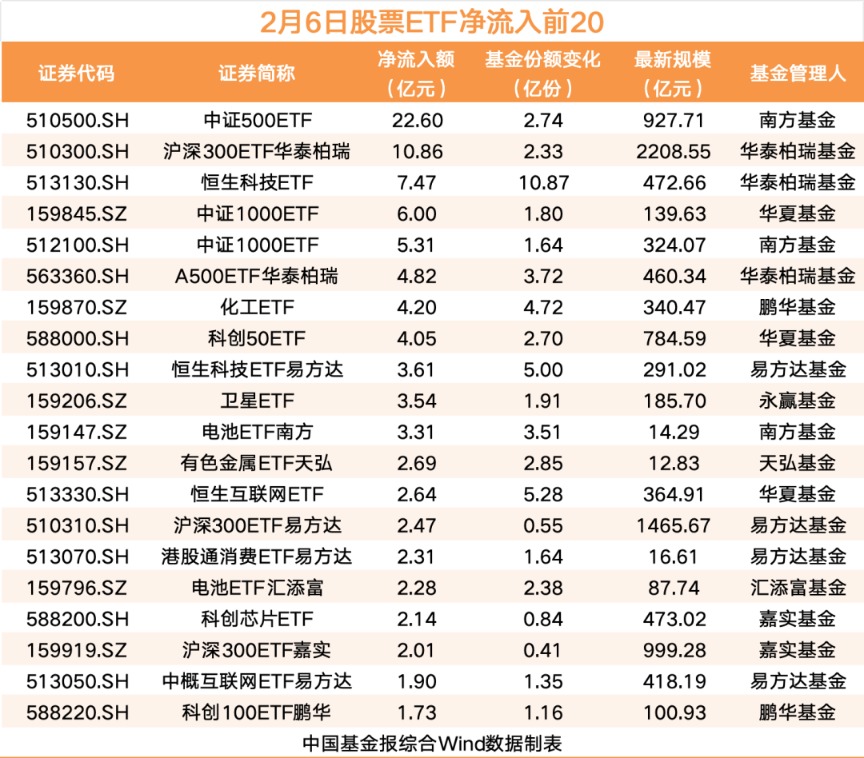
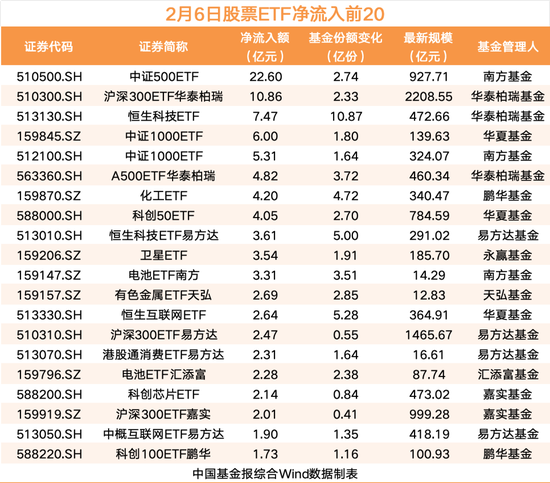
Core Viewpoint - The A-share market experienced a collective decline on February 6, with significant net inflows into stock ETFs, exceeding 11 billion yuan on that day [1]. Group 1: ETF Market Overview - As of February 6, the total scale of 1,333 stock ETFs in the market reached 4.1 trillion yuan, with a net inflow of 11.764 billion yuan and an increase of 9.347 billion fund shares [3]. - The leading categories for net inflows were broad-based ETFs and Hong Kong stock ETFs, with inflows of 7.112 billion yuan and 2.518 billion yuan, respectively [3]. - The CSI 500 Index ETF saw the highest net inflow at 2.585 billion yuan, while the Hang Seng Technology Index ETF and the Sci-Tech 50 Index ETF attracted over 11.2 billion yuan and 5 billion yuan, respectively, over the past five trading days [3]. Group 2: Top ETFs by Net Inflow - On February 6, 35 ETFs recorded net inflows exceeding 1 billion yuan, with the top three being the CSI 500 ETF (2.26 billion yuan), the CSI 300 ETF by Huatai-PB (1.086 billion yuan), and the Hang Seng Technology ETF (747 million yuan) [4]. - Notable inflows were also observed in the China Securities 1000 ETF and the Sci-Tech 50 ETF, with net inflows of 600 million yuan and 405 million yuan, respectively [5]. Group 3: ETFs with Net Outflows - The gold stock ETF experienced the largest net outflow, totaling 812 million yuan on February 6 [5]. - Other ETFs with significant outflows included the Tongwen Stock ETF (-559 million yuan), the SSE 50 ETF (-331 million yuan), and the Food and Beverage ETF (-324 million yuan) [6]. Group 4: Market Outlook - Fund managers from E Fund expressed optimism about the domestic macroeconomic outlook, expecting continued stability and progress, with emerging industries likely to see further development [7]. - Bosera Fund noted that financial conditions remain favorable for equity assets, suggesting that ETF outflows may have reached a turning point, with a potential return to growth in financing balances [7].

超110亿,加仓
Xin Lang Cai Jing· 2026-02-09 04:00
Core Viewpoint - On February 6, the A-share market saw a collective decline in the three major indices, while the stock ETF market experienced a net inflow of over 110 billion yuan, indicating continued bottom-fishing by investors [10][11]. Group 1: ETF Market Overview - As of February 6, the total scale of 1,333 stock ETFs in the market reached 4.1 trillion yuan, with a net inflow of 117.64 billion yuan on that day [2][11]. - The largest inflows were seen in broad-based ETFs and Hong Kong stock markets, with net inflows of 71.12 billion yuan and 25.18 billion yuan, respectively [2][11]. - The CSI 500 Index ETF led the inflows with 25.85 billion yuan, while the Hang Seng Technology Index ETF saw inflows exceeding 112 billion yuan over the past five trading days [2][11]. Group 2: Top ETFs by Net Inflow - On February 6, 35 ETFs had net inflows exceeding 1 billion yuan, with the top three being: - CSI 500 ETF: 22.6 billion yuan - CSI 300 ETF by Huatai-PB: 10.86 billion yuan - Hang Seng Technology ETF: 7.47 billion yuan [3][12]. - Other notable inflows included the CSI 1000 ETF and the Sci-Tech 50 ETF, which saw net inflows of 6 billion yuan and 4.05 billion yuan, respectively [13]. Group 3: ETFs with Net Outflows - The gold stock ETF experienced the largest net outflow, totaling 8.12 billion yuan on February 6 [6][14]. - Other ETFs with significant outflows included: - SSE 50 ETF: -3.31 billion yuan - Food and Beverage ETF: -3.24 billion yuan - Securities and Insurance ETF by E Fund: -2.78 billion yuan [7][14]. Group 4: Market Outlook - Fund managers from E Fund and Bosera Fund expressed optimism about the market, citing favorable financial conditions for equity assets and the potential for growth in financing balances [8][16]. - They noted that the domestic macroeconomic environment is expected to maintain a trend of "steady progress," with emerging industries likely to see further development [8][16].
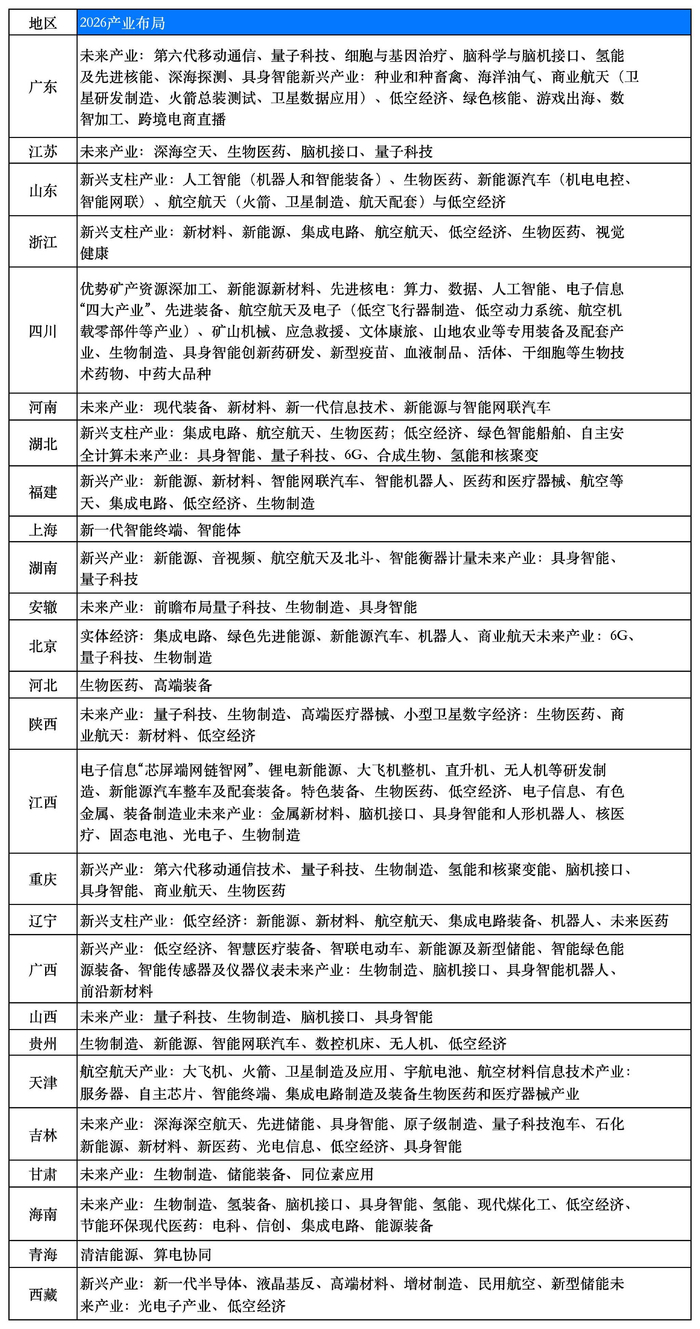
2026年31省“强产业”图景:传统、新兴、未来三维并进,推进智能化和绿色化
Xin Lang Cai Jing· 2026-02-09 03:24
| 地区 | 2026产业布局 | | --- | --- | | 广东 | 未来产业:第六代移动通信、量子科技、细胞与基因治疗、脑科学与脑机接口、氢能 及先进核能、深海探测、具身智能新兴产业:种业和种畜禽、海洋油气、商业航天(卫 | | | 星研发制造、火箭总装测试、卫星数据应用)、低空经济、绿色核能、游戏出海、数 | | | 智加工、跨境电商直播 | | 江苏 | 未来产业:深海空天、生物医药、脑机接口、量子科技 | | 山东 | 新兴支柱产业:人工智能(机器人和智能装备)、生物医药、新能源汽车(机电电控、 | | | 智能网联)、航空航天(火箭、卫星制造、航天配套)与低空经济 | | 浙江 | 新兴支柱产业:新材料、新能源、集成电路、航空航天、低空经济、生物医药、视觉 健康 | | 四川 | 优势矿产资源深加工、新能源新材料、先进核电:算力、数据、人工智能、电子信息 "四大产业"、先进装备、航空航天及电子(低空飞行器制造、低空动力系统、航空机 载零部件等产业)、矿山机械、应急救援、文体康旅、山地农业等专用装备及配套产 | | | 业、生物制造、具身智能创新药研发、新型疫苗、血液制品、活体、干细胞等生物技 ...
加仓!资金大幅涌入这些方向
Zhong Guo Zheng Quan Bao· 2026-02-08 23:07
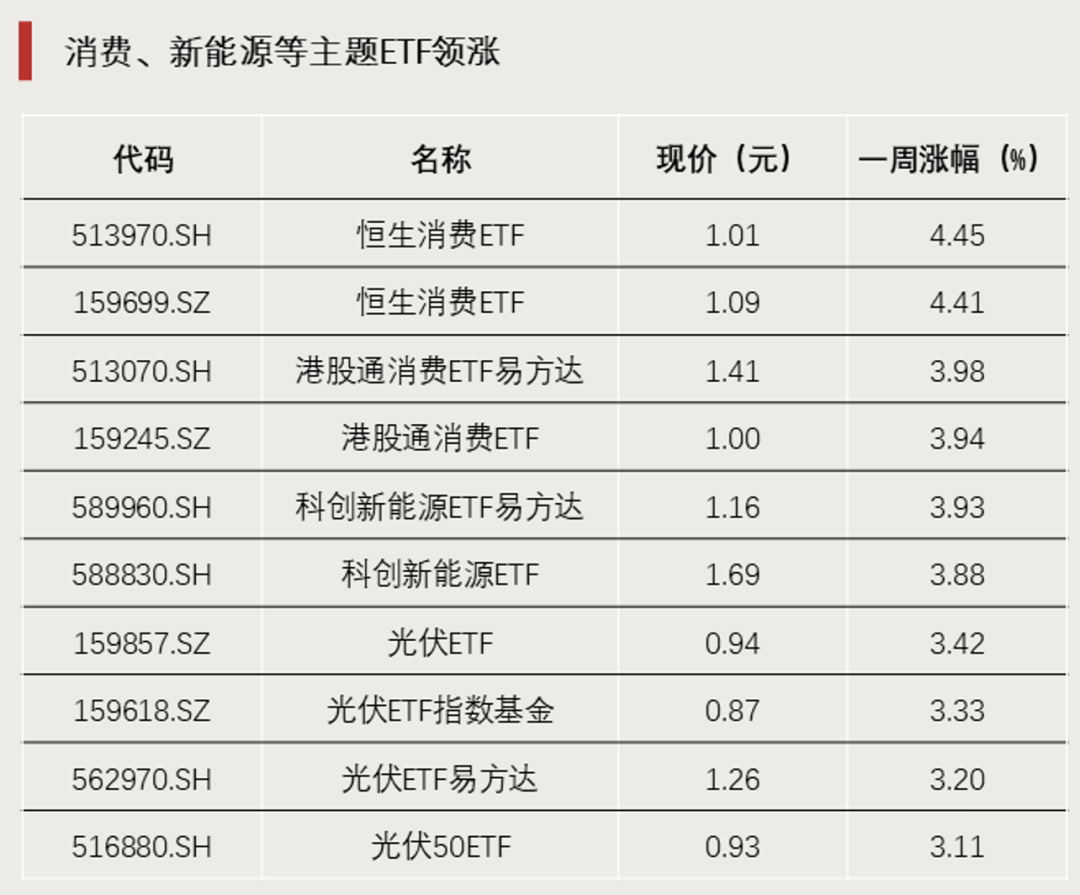
Group 1: Market Performance - The consumption and photovoltaic sectors saw significant gains last week, with several related ETFs, such as the E Fund Consumption ETF (513070) and E Fund New Energy ETF (589960), recording over 3% weekly increases [1][4] - Conversely, gold and artificial intelligence sectors experienced notable adjustments, with multiple related ETFs declining over 9% [1][6] Group 2: Trading Activity - The A-share market saw active trading in broad-based products, with the A500 ETF (159361) and others tracking the CSI A500 index achieving a total trading volume exceeding 254.8 billion yuan [2][8] - The Hang Seng Technology sector attracted significant capital inflow, with ETFs like the E Fund Hang Seng Technology ETF (513010) seeing substantial net inflows [3][10] Group 3: Sector Highlights - The Hang Seng Consumption ETF (513070) tracked the CSI Hong Kong Consumption Index, which rose over 4%, while the E Fund New Energy ETF (589960) and E Fund Photovoltaic ETF (562970) tracked indices that increased over 3% [4][5] - The gold sector showed weakness, with all 14 commodity gold ETFs declining over 5%, and some gold stock ETFs dropping more than 13% [6][7] Group 4: Future Outlook - Industry experts express optimism for the Hong Kong consumption sector in 2026, focusing on high-dividend consumer stocks, resilient domestic demand sectors like education, and timing strategies for new consumption sectors [5] - The market is expected to shift focus towards macroeconomic and industrial cues post-holiday, with a clearer framework for high-quality development and new-old kinetic energy conversion [12]
跻身国际科技创新中心行列
Xin Lang Cai Jing· 2026-02-08 00:58
(来源:新安晚报) 安徽省发展和改革委员会主任、党组书记陈军介绍,在打造科技创新策源地方面,安徽跻身国际科技创 新中心行列,合肥综合性国家科学中心建设成绩斐然,一批世界级的原创成果接续涌现,"政产学研金 服用"深度融合发展生态加快打造,区域创新能力稳居全国第一方阵。 "在打造新兴产业聚集地方面,安徽因地制宜发展新质生产力,产业发展格局发生了深刻转变,规上工 业营收跃升至全国第5位。"陈军在接受记者提问时表示,我省新兴产业亮点突出,产值占规上工业比重 达到45.4%,特别是汽车产业实现了从跟跑到领跑的跨越式发展,汽车、新能源汽车产量双双跃居全国 首位,去年安徽汽车产量368.6万辆、平均每天一万多辆,这当中新能源汽车占比接近一半;整车出口 稳居全国第一,全国每出口4辆汽车中就有1辆"安徽造";全省汽车产业链企业营收突破1.8万亿元,16 个市都超过了百亿元。 提及下一步的重点发展方向,陈军表示,安徽将推动科技创新和产业创新深度融合,坚持智能化、绿色 化、融合化方向,聚焦10大新兴产业、10大未来产业、8大传统优势产业和8大现代服务业,深入实施一 批工程、行动,为奋力谱写中国式现代化安徽篇章筑牢产业技术基础。 转 ...