
科创

Search documents
A股大利好,狂买400亿!
Zhong Guo Ji Jin Bao· 2025-11-24 06:21
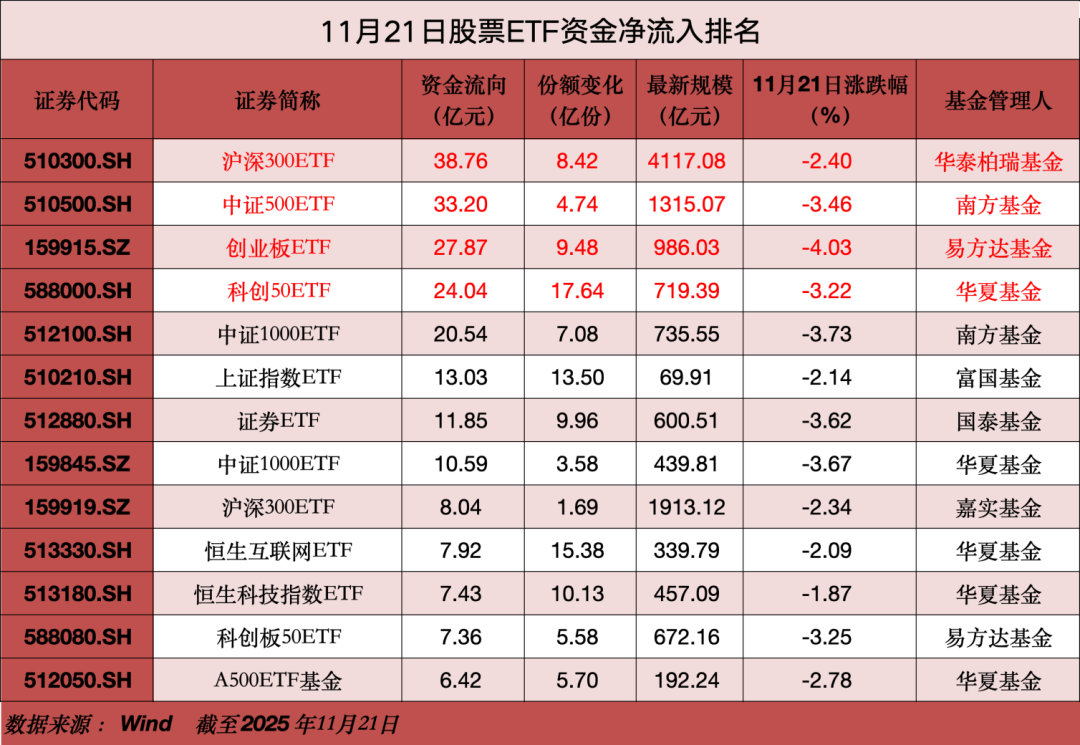
Core Insights - On November 21, the stock ETF market saw a net inflow exceeding 40 billion yuan, indicating a trend of investors "bottom-fishing" during market corrections [1][2] Summary by Category Market Overview - The three major A-share indices experienced significant declines, with the ChiNext Index dropping over 4%, the Shenzhen Component Index down 3.41%, and the Shanghai Composite Index falling 2.45% [1] - The total scale of 1,262 stock ETFs in the market reached 4.47 trillion yuan, primarily affected by the market downturn [1] Fund Inflows - On November 21, the overall net inflow into stock ETFs was 407.57 billion yuan, with significant contributions from broad-based ETFs and thematic industry ETFs [1] - The net inflows for broad-based ETFs and industry-themed ETFs were 272.7 billion yuan and 73.57 billion yuan, respectively [1] - Specific ETFs tracking major indices saw substantial inflows: - 48.9 billion yuan for the CSI 300 ETF - 39 billion yuan for the CSI 500 ETF - 38.6 billion yuan for the STAR Market 50 ETF - 37.8 billion yuan for the ChiNext ETF - 33.3 billion yuan for the CSI 1000 ETF [1] Notable ETF Performances - The E Fund's ChiNext ETF had a net inflow of 27.87 billion yuan on the same day, totaling 46 billion yuan for the week [2] - The Huaxia Fund's STAR 50 ETF and CSI 1000 ETF saw net inflows of 24.04 billion yuan and 10.59 billion yuan, respectively [2] - Over the past five days, the Hang Seng Technology Index attracted over 10.5 billion yuan, while the CSI 500 Index received over 6.4 billion yuan [2] Sector Analysis - The artificial intelligence sector also attracted significant inflows, with a total of 9.1 billion yuan for AI-related ETFs and 10.2 billion yuan for robotics ETFs [2] - The brokerage sector, often seen as a "bull market flag bearer," also experienced inflows, with the Guotai Fund's securities ETF receiving 11.85 billion yuan [2] Fund Outflows - The banking sector faced notable outflows, with a total of 4.6 billion yuan leaving the sector on November 21 [4] - The top outflowing ETFs included the Battery 50 ETF with a net outflow of 4.22 billion yuan and the Bank ETF with 3.21 billion yuan [5] Future Outlook - Short-term market fluctuations may occur due to expectations of a Federal Reserve interest rate cut, but the potential for significant declines is limited due to policy support [6] - Mid-term prospects for A-shares appear stable, with opportunities in dividend sectors and areas supported by innovation policies [6]

A股大利好,狂买400亿!
中国基金报· 2025-11-24 06:17
Core Viewpoint - On November 21, the stock ETF market saw a net inflow exceeding 40 billion yuan, indicating a trend of investors increasing their positions in ETFs amid market volatility [2][4]. Group 1: Market Overview - On November 21, A-share indices experienced significant declines, with the ChiNext Index dropping over 4%, the Shenzhen Component Index down 3.41%, and the Shanghai Composite Index falling 2.45% [2]. - The overall scale of the stock ETF market reached 4.47 trillion yuan, with a notable reduction in size due to the market downturn [4]. Group 2: Fund Inflows - On November 21, the net inflow for broad-based ETFs was 272.7 billion yuan, while industry-themed ETFs saw a net inflow of 73.57 billion yuan [5]. - Specific ETFs tracking major indices attracted substantial inflows, including 48.9 billion yuan for the CSI 300 ETF, 39 billion yuan for the CSI 500 ETF, and 38.6 billion yuan for the STAR 50 ETF [5]. Group 3: Notable ETF Performance - The E Fund's ChiNext ETF recorded a net inflow of 27.87 billion yuan on November 21, with a total inflow of 46 billion yuan for the week [5]. - The Huaxia Fund's STAR 50 ETF and CSI 1000 ETF saw net inflows of 24.04 billion yuan and 10.59 billion yuan, respectively [5]. Group 4: Sector-Specific Inflows - Over the past five days, the Hang Seng Technology Index attracted over 10.5 billion yuan, while the CSI 500 Index saw inflows exceeding 6.4 billion yuan [6]. - The artificial intelligence sector also performed well, with a total net inflow of 9.1 billion yuan, and the robotics sector attracted 10.2 billion yuan [6]. Group 5: Outflows from Specific Sectors - The banking sector experienced significant outflows, totaling 4.6 billion yuan on November 21, indicating a shift in investor sentiment [10]. - The net outflow for the Bank ETF was 3.21 billion yuan, reflecting broader trends in the financial sector [11]. Group 6: Future Outlook - Short-term market fluctuations may occur due to expectations of a Federal Reserve interest rate cut, but the potential for significant declines is limited by policy support and stabilization measures [12]. - Mid-term prospects for A-shares appear positive, with anticipated growth driven by policies aimed at stabilizing the economy and supporting key sectors [12].

郑永年:“十五五”期间,广州经济发展要以科创为中心
Jing Ji Wang· 2025-11-18 08:41
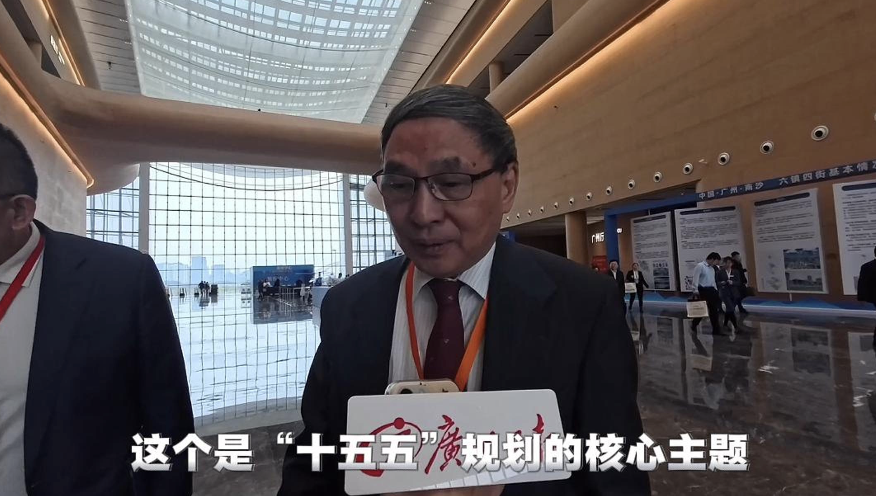
文/广州日报新花城记者:赵方圆 图/广州日报新花城记者:赵方圆、陈馨 视频/广州日报新花城记者:陈馨、赵方圆 广州日报新花城编辑:龙嘉丽 0:00 / 0:47 11月18日,第二十届中国经济论坛在广东省广州市南沙经济技术开发区举行。会后广州粤港澳大湾区研究院理事长、香 港中文大学(深圳)公共政策学院院长郑永年在接受广州日报全媒体记者采访时表示,高质量的发展就是新质生产力,来构 建现代化产业体系。"十五五"期间,广州经济发展依然要以科创为中心。 "梳理一下,广东有那么多高校、企业、科研院所,基础科研、应用技术转化也很强大。尤其是在金融方面,能否借助 香港的力量,将风投体系建立起来。广州的自身条件很好,希望通过一些体制机制的改革,将既有优势更好地发挥出来。" ...
2026年中国及海外经济展望
Sou Hu Cai Jing· 2025-11-17 01:02
Global Economic Outlook - The global economy is expected to enter a period of easing after experiencing trade frictions, with a pattern of "pressure in the first half, recovery in the second half" [2] - Major economies will show divergent growth dynamics, with the US facing pressure from tariffs and fiscal stimulus, but a potential recovery in the second half due to tax rebate policies and interest rate cuts by the Federal Reserve [2][3] - European and Japanese economies are projected to have weak growth in early 2026, with Japan possibly facing a brief technical recession, but expected improvements later in the year due to fiscal stimulus [2] China Economic Outlook - China's economy is projected to grow around 4.5% in 2026, with a narrowing contribution from exports, particularly to non-US markets [3][21] - Consumer spending is expected to maintain moderate growth despite pressures from limited income growth and wealth effects, supported by policy measures such as expanded subsidies for trade-ins [3] - Investment in infrastructure and manufacturing is anticipated to recover from an overheated state, showing moderate growth, while the real estate sector continues to face challenges [3][21] New Economy and Structural Changes - The new economy is becoming a significant growth engine for China, currently accounting for 15%-20% of GDP and contributing to a quarter of economic growth over the past five years [3][4] - Increased R&D investment and leading growth in fixed asset investment are driving rapid development in the technology sector, which is crucial for economic resilience [3] - Structural policies aimed at enhancing consumption, such as improving the social security system and optimizing income distribution, are expected to gradually release consumption potential [3][4] Long-term Themes - In the medium to long term, China's economic focus will be on four main themes: technological innovation, consumption, green development, and opening up to the outside world [4] - The potential for the consumption market will be gradually released through various policies, while foreign investors show increased interest in the Chinese market, particularly regarding innovation and real estate stabilization [4]

经济学家刘煜辉:今年A股涨幅较大,到年末收官阶段止盈需求强烈!人生发财靠科创,明年春季布局看好国产算力链等四大方向
Sou Hu Cai Jing· 2025-11-07 06:08
Group 1 - The core viewpoint is that November and December are expected to be a period of declining market sentiment, with strong profit-taking demand as the A-share market has seen significant gains this year [1] - The market is likely to adjust in a "time for space" manner, presenting a pattern of oscillation with reduced trading volume, with an expected index pullback of around 200 to 300 points [1] - The probability of a "space for time" deep V adjustment is low unless an external event occurs, such as a critical accumulation of contradictions in the US AI bubble leading to a liquidity contraction [1] Group 2 - In terms of asset allocation, gold is considered an ideal long-term investment under the backdrop of the prolonged G2 competition, suitable for long-term holding [3] - Chinese core equity assets, such as stocks, are viewed as the most aggressive and dividend-rich investment opportunities in the context of the east rising and west declining trend [3] - For spring 2024, four key areas are highlighted for investment: domestic computing power chain, energy storage, circular economy, and materials industry, with expectations of significant breakthroughs and potential for substantial stock price increases [4]
分论坛:卓越龙头方法论|启航新征程·国泰海通2026年度策略会
国泰海通证券研究· 2025-10-30 21:00
Core Insights - The article discusses the rapid evolution of the technology and innovation sector, highlighting the transition from mobile internet to AI, smart devices, and new consumption trends. It aims to analyze historical stock performance in the tech industry to identify key characteristics of leading companies and their valuation patterns, providing insights for current and future stock selection in the tech sector [1]. Agenda Summary - The agenda includes a series of presentations by analysts from Guotai Junan Securities, focusing on various sectors: - The first session discusses "Outstanding Leaders in the New AI Cycle" [2]. - The second session examines how beauty industry leaders, specifically Proya, have been developed [3]. - The third session focuses on the electronic semiconductor sector and strategies for identifying high-growth stocks [5]. - The fourth session analyzes the characteristics of outstanding leaders, including their business models and valuation rules [6]. - The fifth session looks into the shipping industry, exploring the causes of a super bull market and investment insights [7].

知名基金经理出手!10月超70只新基发行
Zhong Guo Zheng Quan Bao· 2025-10-10 03:13
Core Insights - The first trading day after the National Day holiday saw the launch of 23 new funds, with a total of 73 new funds expected to debut in October, managed by well-known fund managers [1][2]. Fund Distribution - In October, 73 new funds are set to be issued, with 23 launched on October 9 alone. Equity funds dominate the new offerings, with 38 stock funds accounting for over half of the total. Most of these are passive index or enhanced index funds, including major products like E Fund's Shanghai Stock Exchange 380 ETF and others focused on various sectors [2]. - Additionally, there are 16 mixed funds (15 equity-oriented and 1 flexible allocation), 8 bond funds, 8 FOFs, 2 REITs, and 1 QDII fund scheduled for release in October [2]. Notable Fund Managers - Noteworthy fund managers are launching new products in October. Yan Siqian from Penghua Fund is managing the Penghua Manufacturing Upgrade A, which started issuing on October 9. She is optimistic about the A-share market and sees potential in AI and technology sectors [3]. - Jin Zicai from Caitong Fund will launch the Caitong Quality Selection A on October 16, marking his return to fund management after two years [3][4]. Market Outlook - Institutions maintain an optimistic outlook for the market, expecting high levels of fund issuance to continue. Huabao Fund suggests that the upward trend in the market may not be over, focusing on strong technology sectors, while Huaxia Fund anticipates that upcoming quarterly reports and economic data will build upward momentum without significant adjustment risks [5].
募集资金约19亿元 占公司最新市值比例不到1% 胜宏科技“袖珍定增”引争议
Mei Ri Jing Ji Xin Wen· 2025-09-29 21:13
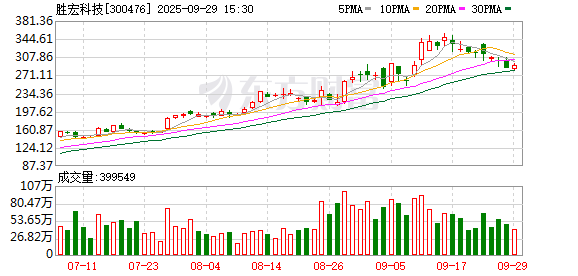
Group 1 - The core point of the article is the controversy surrounding Shenghong Technology's recent fundraising plan, which raised approximately 1.9 billion yuan, accounting for less than 1% of its latest market value, amidst a significant stock price increase of over 580% this year [2][3][8] - Market expert Xu Li raised concerns about the timing and scale of the fundraising, suggesting it may not be prudent given the company's high stock price [3][4] - Despite the controversy, some industry insiders argue that raising funds when a company's market value is high can be efficient and minimizes dilution for major shareholders [3] Group 2 - Other technology companies, including Cambrian-U, Chipone, Zhongke Feicai, and Lexin Technology, are also pursuing refinancing plans, with some already receiving approval from the regulatory authority [6] - The trend of multiple technology companies seeking refinancing simultaneously indicates a rapid development phase in the tech sector, with the potential to cool down high valuations in the secondary market [6] - Notable tech firms like Yushu Technology and Moore Threads are approaching significant milestones in their IPO processes, with Yushu currently in the counseling stage and Moore Threads having recently passed its IPO application [6][7] Group 3 - The overall IPO activity on the Sci-Tech Innovation Board has been low this year, with a significant decline in the total amount raised compared to previous years, indicating a gradual recovery process [8] - Major brokerage firms, such as CITIC Securities, are playing crucial roles in the financing processes of these technology companies, highlighting the importance of institutional support in capital market activities [8]

募集资金约19亿元 占公司最新市值比例不到1% 年内大涨超580% 胜宏科技“袖珍定增”引争议
Mei Ri Jing Ji Xin Wen· 2025-09-29 14:02
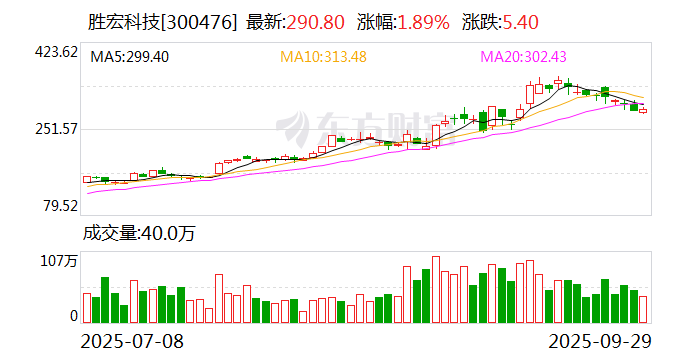
Core Viewpoint - The recent fundraising by Shenghong Technology has sparked controversy in the market due to its small scale relative to its high market valuation, raising questions about the timing and necessity of such a capital increase [2][3]. Group 1: Shenghong Technology's Fundraising - Shenghong Technology completed a private placement, raising approximately 1.9 billion yuan, which is less than 1% of its latest market capitalization of 250.9 billion yuan [2][3]. - The company has seen a significant stock price increase of over 580% year-to-date as of September 29, leading to debates about the appropriateness of this fundraising at such a high valuation [3]. - Market analyst Xu Li expressed concerns regarding the risks associated with this fundraising, although his views are considered to represent a minority opinion [3][4]. Group 2: Broader Market Context - Other technology companies, including Cambrian-U, Chipone, and Lexin Technology, are also pursuing refinancing plans, indicating a trend of capital raising within the tech sector [5]. - The concurrent timing of these fundraising efforts suggests that the technology sector is in a rapid growth phase, with companies seeking to capitalize on high market valuations [5]. - Notable tech firms like Yushu Technology and Moore Threads are also approaching significant milestones in their IPO processes, reflecting ongoing interest in tech investments [5][6]. Group 3: Regulatory and Market Trends - The China Securities Regulatory Commission (CSRC) has been actively promoting reforms to support innovation and facilitate capital raising for high-quality enterprises, aligning with national policy directions [6][7]. - Despite the push for IPOs, the overall number of IPOs on the Sci-Tech Innovation Board remains low, with a significant decline in fundraising compared to previous years [7]. - Major brokerage firms are playing crucial roles in the financing processes of these technology companies, indicating their importance in the current market landscape [7].
固收点评20250920:绿色债券周度数据跟踪(20250915-20250919)-20250920
Soochow Securities· 2025-09-20 11:35
1. Report Industry Investment Rating No industry investment rating is provided in the report. 2. Core View of the Report The report conducts a weekly data tracking of green bonds from September 15 to September 19, 2025, covering primary market issuance, secondary market trading, and the valuation deviation of the top 30 individual bonds [1][2][3]. 3. Summary by Related Catalogs 3.1 Primary Market Issuance - **Number and Scale**: 34 new green bonds were issued in the inter - bank and exchange markets, with a total issuance scale of about 3.1388 billion yuan, an increase of 1.1336 billion yuan compared to last week [1]. - **Issuance Term**: Most issuance terms are 3 years [1]. - **Issuer Nature**: Issuers include local state - owned enterprises, large - scale private enterprises, and central enterprise subsidiaries [1]. - **Subject Rating**: Most subject ratings are AAA and AA+ [1]. - **Issuer Region**: Issuers are from Beijing, Fujian, Hunan, Guangdong, Guizhou, Hainan, Hebei, Jiangxi, Shandong, Shanghai, Sichuan, Tianjin, Xinjiang Uygur Autonomous Region, and Zhejiang [1]. - **Bond Types**: Bond types include general corporate bonds, commercial bank ordinary bonds, enterprise ABS, medium - term notes, private placement corporate bonds, and ultra - short - term financing bills [1]. 3.2 Secondary Market Trading - **Total Turnover**: The weekly turnover of green bonds totaled 6.04 billion yuan, an increase of 0.95 billion yuan compared to last week [2]. - **By Bond Type**: The top three in trading volume are non - financial corporate credit bonds, financial institution bonds, and interest - rate bonds, with trading volumes of 2.64 billion yuan, 2.56 billion yuan, and 0.74 billion yuan respectively [2]. - **By Issuance Term**: Green bonds with a term of less than 3 years had the highest trading volume, accounting for about 83.10%, indicating continuous market popularity [2]. - **By Issuer Industry**: The top three industries in trading volume are finance, public utilities, and transportation equipment, with trading volumes of 2.45 billion yuan, 1.14 billion yuan, and 0.18 billion yuan respectively [2]. - **By Issuer Region**: The top three regions in trading volume are Beijing, Guangdong, and Hubei, with trading volumes of 1.53 billion yuan, 0.74 billion yuan, and 0.44 billion yuan respectively [2]. 3.3 Valuation Deviation of the Top 30 Individual Bonds - **Overall Situation**: The overall deviation of the weekly average trading price valuation of green bonds is not large. The discount trading amplitude is smaller than the premium trading, and the discount trading proportion is less than the premium trading [3]. - **Discount Bonds**: The top three discount bonds are 25 Shui Neng G1 (- 0.7382%), 24 Nan Hu Green Bond 01 (- 0.4538%), and GC San Xia K3 (- 0.3254%). The issuer industries are mainly finance, public utilities, and building materials, and the regions are mainly Beijing, Fujian, and Jiangsu [3]. - **Premium Bonds**: The top four premium bonds are 25 Shui Neng G3 (0.9662%), 24 Kang Fu Lease MTN004 (Carbon - neutral Bond) (0.5175%), 22 Guangdong Bond 07 (0.4758%), and 25 Fuzhou Metro GN003 (Carbon - neutral Bond) (0.4274%). The issuer industries are mainly finance, public utilities, and transportation, and the regions are mainly Guangdong, Beijing, Shanghai, and Tianjin [3].