门罗主义

Search documents
2026年美国《国家安全战略》解读:特朗普引领下的美国战略方向在哪?
Shenwan Hongyuan Securities· 2026-01-28 13:43
2026 年 01 月 28 日 特朗普引领下的美国战略方向在 哪? ——2026 年美国《国家安全战略》解读 券 研 究 报 告 证券分析师 程翔 A0230518080007 chengxiang@swsresearch.com 傅静涛 A0230516110001 fujt@swsresearch.com 王胜 A0230511060001 wangsheng@swsresearch.com 联系人 程翔 A0230518080007 证 chengxiang@swsresearch.com 策 略 研 究 本研究报告仅通过邮件提供给 中庚基金 使用。1 请务必仔细阅读正文之后的各项信息披露与声明 A 股 策 略 相关研究 - ⚫ 2025 年年底白宫发布《国家安全战略》,以下我们简称为 NSS(National-Security- Strategy)。本次 NSS 报告主要涉及"美国核心诉求"、"优先事项"、"地区战略" 三部分: ⚫ 在开篇美国核心诉求部分,关键词包括"移民、安全、科技"。(1)移民部分,NSS 提 及"西半球保持适度稳定与良好治理,预防和遏制大规模移民潮涌入美国";(2)安全 部分 ...
格林大华期货早盘提示:全球经济-20260127
Ge Lin Qi Huo· 2026-01-27 01:16
Morning session notice 早盘提示 更多精彩内容请关注格林大华期货官方微信 格林大华期货研究院 证监许可【2011】1288 号 2026 年 1 月 27 日 星期二 研究员: 于军礼 从业资格: F0247894 交易咨询资格:Z0000112 本报告中的信息均源于公开资料,格林大华期货研究院对信息的准确性及完备性不作任何保 证,也不保证所包含的信息和建议不会发生任何变更。我们力求报告内容的客观、公正,但 文中的观点、结论和建议仅供参考,报告中的信息和意见并不构成所述期货合约的买卖出价 和征价,投资者据此作出的任何投资决策与本公司和作者无关,格林大华期货有限公司不承 担因根据本报告操作而导致的损失,敬请投资者注意可能存在的交易风险。本报告版权仅为 格林大华期货研究院所有 任何机构和个人不得以任何形式翻版 如引用、转载、刊发,须注明出处为格林大华期货有限公司。 美国回归门罗主义,在全球收缩,将对全球经济、美债、美股、美元、贵金属、 工业金属等大类资产产生颠覆式深远影响。 鉴于美国连续的错误政策,全球经济已越过顶部区域,开始向下运行。 重要事项: 联系方式:yujunli@greendh. ...

环球圆桌对话:“新门罗主义”是美国霸权的进一步帝国主义化
Xin Lang Cai Jing· 2026-01-26 23:12
袁东振:广东外语外贸大学教授、中国拉丁美洲学会副会长 确立霸权的"进攻性"外交工具 编者按:2026年伊始,美国一系列动作让"新门罗主义"成为世界关注的焦点,也让外界看清"新门罗主 义"的底色是要霸权、不要公理。"新门罗主义"的破坏性和危害性到底在哪?本期"环球圆桌对话"邀请 三位中外学者就相关议题展开讨论。 李海东:外交学院国际关系研究所教授 哈维尔·瓦德尔:巴西米纳斯吉拉斯天主教大学国际关系学教授 李海东 美国国家安全战略报告的发布,将"特朗普推论"的"门罗主义"推到公众视野。"门罗主义"内涵在不断演 变的过程中,最终成为引领美国外交的最核心主张之一,也是人们准确判断当前美国政府外交本质及趋 势的关键。 "门罗主义"表面上看是美国防范欧洲对美洲事务进行干预,实质上是促使美国在美洲乃至全球扩张和确 立美国霸权的"进攻性"外交工具。"美洲是美洲人的美洲"的内核,是"美洲是美国人的美洲"。与强 者"互不干预",对弱者"恃强凌弱"可说是"门罗主义"的突出特征。"门罗主义"的诸多"推论"无一不是美 国提醒欧洲列强不要干预美国主宰美洲"后院"的产物。1917年4月的"威尔逊推论"则将"门罗主义"全球 化界定为美国外交 ...
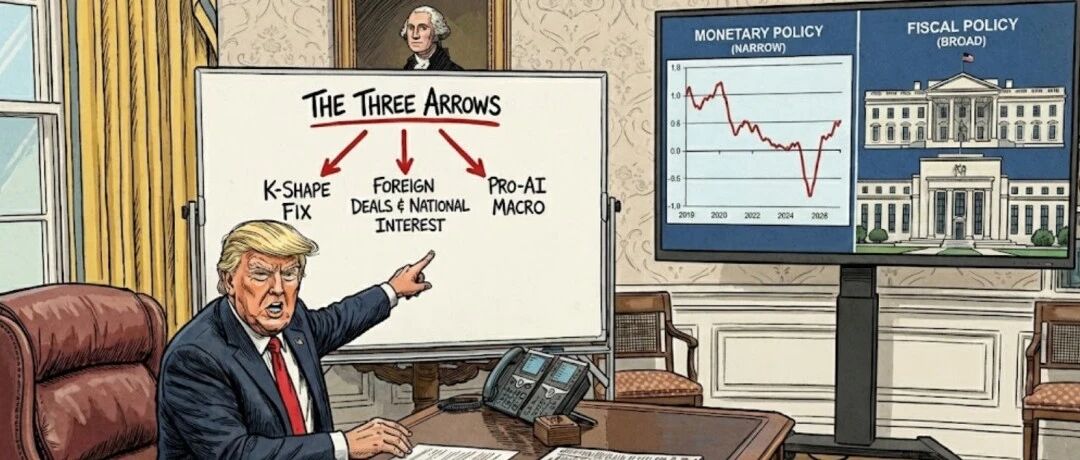
特朗普的“新三支箭”(国金宏观钟天)
雪涛宏观笔记· 2026-01-26 13:21
Core Viewpoint - The article discusses Trump's expansion of executive power in 2026, focusing on domestic policies aimed at improving affordability and external policies that seek to align personal political interests with national benefits [4]. Group 1: Domestic Policies - Trump aims to control living costs through administrative measures rather than relying on the Federal Reserve's monetary policy, recognizing the limitations of traditional monetary policy [5][9]. - The labor income share for the American working class fell to 53.8% in Q3 2025, marking a historical low and continuing a downward trend since 2000, which may increase fiscal deficit pressures due to higher government transfer payments [6]. - Key policies to improve affordability include capping credit card interest rates at 10% and introducing 50-year mortgages, alongside interventions in the oil market and immigration policies to support low-income wages [9][10]. - The proposed 10% credit card interest rate cap could save households $100 billion in interest payments, but may also lead to reduced credit supply and increased risks of moral hazard [10][12]. Group 2: External Policies - Trump's foreign policy actions, such as the arrest of Maduro and interest in Greenland, aim to maximize U.S. national interests and align with voter concerns, reflecting a strategy of "energy as governance" [16][17]. - The approach to Greenland is driven by political ambitions and strategic goals, including securing strategic minerals and enhancing trade routes [16][17]. - Trump's negotiation tactics, exemplified by the Greenland situation, demonstrate a pattern of extreme pressure to achieve favorable outcomes without significant costs [19]. Group 3: AI and Economic Strategy - Trump emphasizes the importance of maintaining AI leadership, advocating for a patriotic spirit among tech companies to prioritize U.S. interests [20][21]. - The domestic and foreign policies are designed to create a favorable macro environment for AI sustainability, with significant investments in AI-related sectors [21][22]. - The rapid growth of private credit investments in AI firms raises concerns about potential credit risks, as the disparity between stock prices and bond valuations may lead to market corrections [26]. Group 4: Overall Economic Implications - The costs of Trump's policies will ultimately be borne by U.S. dollar credit, with increasing fiscal, inflationary, and deficit pressures complicating the economic landscape [27][28]. - The article suggests that Trump's administrative measures, while potentially effective in the short term, may not address underlying economic realities, leading to future inflation and volatility risks [28].

解析关键矿产安全与大宗定价:地缘博弈之西半球变局
Southwest Securities· 2026-01-26 09:10
Group 1: Geopolitical Trends - The intensification of global power competition has highlighted the security and scarcity of strategic minerals, leading to a continuous reassessment of their value as core assets in geopolitical games[3] - The U.S. has added copper and silicon to its list of critical minerals and plans to establish a $2.5 billion "strategic resilience reserve" to secure these resources[3] - Strategic resources such as copper, silver, lithium, cobalt, nickel, gallium, germanium, palladium, silicon, tungsten, antimony, and rare earths are expected to experience significant price volatility, especially during periods of heightened geopolitical risk[3] Group 2: Economic Relationships - The U.S. remains the primary trading partner for Latin America, with exports to the U.S. rising from approximately $198.61 billion in 2002 to $599.97 billion in 2023, although the share of total exports has decreased from 57% to 44%[26] - In contrast, exports to China have increased significantly, from $6.5 billion in 2002 to approximately $192.8 billion in 2023, raising its share of total exports from less than 2% to around 14%[26] - The U.S. is still the largest investor in Latin America, with investments accounting for about 38% of total foreign direct investment in 2024, up from 34% in 2023[33] Group 3: Political Dynamics - The political landscape in Latin America is shifting rightward, influenced by economic stagnation and increased U.S. geopolitical influence, with significant elections expected in 2026[6] - The U.S. has engaged in a series of trade agreements with Latin American countries, emphasizing comprehensive, secure, and exclusive frameworks to prevent non-Western competitors from accessing critical assets and supply chains[20] - The Trump administration's "Monroe Doctrine" has re-emerged, focusing on military threats and trade ties to consolidate U.S. dominance in the Western Hemisphere[12]

特朗普中选年的三支箭
SINOLINK SECURITIES· 2026-01-26 09:03
Report Industry Investment Rating - Not provided in the content Core View of the Report - Trump's policies in the new year aim to address domestic and international issues, providing a more favorable macro - environment for the AI narrative. The role of monetary policy is narrowing, and fiscal policy is expanding. The traditional economic policy framework is being replaced by the White House's executive power. In 2026, Trump will maximize his executive power, and the success of domestic policies will be judged by voters, while the international affairs will affect the US dollar credit [2][4]. Summary by Relevant Catalogs First Arrow: Improving Affordability Domestically - Trump uses administrative means to control living costs instead of relying on the Fed's monetary policy, aiming to stimulate the "cold" end of the K - shaped economy (low - income groups and suppressed employment) [5]. - The labor income share of the US "working class" dropped to 53.8% in Q3 2025, continuing the downward trend since 2000. Tax cuts or direct cash - handouts will increase the government transfer payment ratio and cause greater fiscal deficit pressure [6]. - Trump's direct policies include setting a 10% credit - card interest - rate cap and intervening in the housing market (launching 50 - year mortgages and having "Fannie & Freddie" buy $200 billion of MBS). The 10% credit - card interest - rate cap is controversial and likely to backfire, causing a decline in credit supply and potential moral hazards, as well as increased inflation pressure. The purchase of MBS by "Fannie & Freddie" can increase mortgage demand and compress mortgage spreads to some extent [10][14]. - Trump's administrative means rely on the Fed's support, but his attempt to force Powell to resign may backfire. His control over the new Fed chair candidate is increasing, which is more "friendly" to the capital market [16]. Second Arrow: Seeking the "Greatest Common Divisor" of US Interests Abroad - Trump's actions in Venezuela and his interest in Greenland are to seek the greatest common divisor of "US national interests, voter concerns, and his political demands". The "Absolute Determination Operation" in Venezuela aims to build a US - led "Western Hemisphere energy fortress", and his interest in Greenland is for personal political gain and to achieve national strategic goals [19]. - Trump advocates an economic nationalism model to replace the Davos globalist model. His negotiation art often involves extreme pressure, and he may use various means such as tariffs and military intervention. Assets like gold and Bitcoin will face more frequent event - driven shocks [20]. - As the marginal utility of Trump's threats decreases, he may issue secondary threats, which may lead to the selling of US assets, rising long - term US Treasury yields, and increased liquidity pressure on the US stock market [21]. Third Arrow: Maintaining AI Leadership - Trump requires AI companies to prioritize US national interests, and his domestic and international policies are to create a better macro - environment for AI development. The investment proportion of computer and related equipment and data centers is increasing [22][23]. - In 2026, the importance of external financing for AI companies has increased, and the risk of private - credit funds investing in AI is also gathering. The current stock - price increase of AI companies far exceeds the debt - market pricing, and there is a potential risk of a significant stock - price correction [27][30]. Finally: The High Cost Borne by the US Dollar Credit - Trump's policies aim to maintain the stability of the US economic system, but their dynamic impacts are complex and uncertain, including fiscal, inflation, and deficit pressures. These policies are similar to the "Modern Monetary Theory" (MMT) previously advocated by the far - left [31]. - Administrative logic can temporarily overcome economic logic, but economic laws cannot be cancelled. The costs suppressed by administrative orders may turn into future inflation, default risks, and higher systemic volatility. The cost of Trump's policies will be borne by the US economy and the US dollar credit [32].
“保卫本土!”美国新版国防战略出炉,一次没提“台湾”
Xin Lang Cai Jing· 2026-01-24 08:14
Core Viewpoint - The U.S. Department of Defense has released a new "National Defense Strategy" that prioritizes the defense of the U.S. homeland and interests in the Western Hemisphere, adopting a more conciliatory tone towards China compared to previous strategies [1][3]. Group 1: Strategic Focus - The new strategy emphasizes four pillars: defending the U.S. homeland, deterring China through strength rather than confrontation, urging allies to take on more responsibilities, and significantly enhancing the U.S. defense industrial base [1]. - The document reflects a significant shift from the previous administration's focus on countering China, instead criticizing past governments for neglecting U.S. interests and calling for a focus on the "real interests" of the American public [3]. Group 2: Regional Considerations - The strategy presents a cautious view of Europe, acknowledging its importance while noting its declining share in the global economy, and emphasizes the need to prioritize the defense of the U.S. homeland and deter China [4]. - Russia is described as a manageable threat to NATO's eastern members, with the strategy ensuring U.S. military readiness against potential threats from Russia to the U.S. homeland [4]. Group 3: China Relations - The document indicates a desire for a stable and fair trade relationship with China, emphasizing the importance of negotiating from a position of strength [5]. - The Pentagon plans to engage in broader military communications with the Chinese military to achieve strategic stability and de-escalation of tensions [6]. - Notably, the strategy does not mention Taiwan, which marks a departure from previous drafts and indicates a potential shift in U.S. policy towards the region [7][11].
“对所有人都有利”? 在格陵兰岛美国得到了一切?
Xin Lang Cai Jing· 2026-01-24 00:00
羊城晚报国际评论员 钱克锦 美国和北约在格陵兰岛问题上"达成共识",是2026年1月达沃斯论坛上令人瞩目的事件,也让欧美在这个问题上的争端暂时得到平息。当然,问题并没有完 全解决,只是告一段落。 特朗普为什么对格陵兰岛念念不忘?和北约达成"共识",又让美国得到了什么? 特朗普的"夺岛"情结 特朗普对格陵兰岛的占有欲,在第一任期就展现出来。不过,这一事件成为引人瞩目的国际事件,是在他重返白宫之后。 去年刚就任,特朗普就展现出咄咄逼人的领土野心。从"收回巴拿马运河",到称加拿大是美国第51个州,再到"必须得到格陵兰岛",特朗普看上去是要真正 实现加强版的"门罗主义",也有人称之为"唐罗主义"。 从过去一年的言行和政策看,特朗普之所以想占领格陵兰岛,大概有以下三个原因: 第一,特朗普所声称的安全因素。格陵兰岛地处北极,从这里发射导弹,可以在最短的时间内到达北半球各大国。不仅节约发射成本,还能有效规避一些反 导系统。另外,北极地区也很适合部署潜艇,所以控制格陵兰岛在防务方面有重要意义。 第二,格陵兰岛的丰富矿产资源和未来商业价值。格陵兰岛的矿产资源丰富,不仅有煤炭、石油和天然气,更有稀土资源。全球变暖趋势不仅可能让矿 ...

张耀:格陵兰岛风波折射美战略逻辑
Xin Lang Cai Jing· 2026-01-23 22:58
在今年达沃斯论坛期间,美国总统特朗普宣布,他已同北约秘书长吕特就未来达成有关格陵兰岛的协议 制定了框架。他同时强调,格陵兰岛是美国的"核心国家安全利益",这显示出其战略定位的显著升级。 这一系列表态和动作,可视为美国推进"西半球霸权"战略的连续步骤。从对委内瑞拉的军事打击到在北 极地区的战略布局,华盛顿正重构美洲及邻近区域的地缘控制体系。格陵兰岛也因此成为观察美国战略 逻辑的重要窗口。 实际上,按照此前美国与丹麦之间的相关安全合作协议,美国已经在格陵兰岛上有包括皮图菲克太空基 地在内的很多军事存在,岛上的美军也远超丹麦驻军数量。丹麦还允许美军在岛上军事行动范围不受限 制并给予其治外法权。美国为何还一定要直接获取它呢? 美国对格陵兰岛的"野心"并非一时兴起,而是基于对其多重战略价值的长期考量。其一是地缘与军事价 值。格陵兰岛是北极地区的战略支点,扼守连接北大西洋和北冰洋的关键航道。随着气候变暖,北极航 道的经济和军事价值剧增。该岛也是北美防空的关键前哨。其二是资源与经济价值。岛上蕴藏丰富的稀 土、铜、镍、石墨等关键矿产,以及潜在的石油和天然气资源。这些资源对能源转型和高科技产业至关 重要。对于美国现在追求的制造 ...
若不支持割让领土,将被加税,特朗普话音刚落,欧洲8国齐声抗议
Sou Hu Cai Jing· 2026-01-19 09:23
Group 1 - The core viewpoint of the articles revolves around the increasing geopolitical tensions between the United States and European countries over Greenland, particularly in light of the U.S. plans to impose tariffs on goods from Denmark, Norway, Sweden, France, Germany, the UK, the Netherlands, and Finland due to their opposition to the U.S. acquisition of Greenland [1][3][5] - Greenland's strategic value is highlighted, especially its rich natural resources, including the Tamboritz rare earth mine, which has a reserve of 28.2 million tons of rare earth oxides, making it one of the largest rare earth deposits globally [1][3] - The potential for the Arctic shipping routes to be utilized on a large scale could further enhance Greenland's strategic position, which is critical for U.S. military and economic interests [3][5] Group 2 - The internal political divisions within Europe are noted, indicating that European countries may struggle to effectively counter U.S. pressure regarding Greenland [5][7] - The article discusses the implications of U.S. interference in foreign affairs and how European nations have historically aligned with U.S. policies, which may lead to negative consequences for Europe in the context of Greenland [5][7] - There is a call for Europe to reassess its relationship with the U.S. and consider aligning more closely with China to counteract U.S. hegemonic practices, particularly in light of the recent tariff actions [7]