顺周期板块

Search documents
券商资管,公募规模出炉!东方红、华泰领跑,增超30%
券商中国· 2026-01-22 23:34
Core Viewpoint - The public fund management scale of several securities asset management companies has shown steady growth in 2025, with notable increases from major players like Dongfanghong Asset Management and Huatai Securities Asset Management, both exceeding 30% growth compared to the previous year [2][3]. Group 1: Public Fund Management Scale - As of the end of 2025, five securities asset management companies have public fund management scales exceeding 100 billion yuan, with Dongfanghong Asset Management leading at 216.27 billion yuan, a 30.05% increase from the end of 2024 [3]. - Huatai Securities Asset Management ranks second with a total scale of 180.82 billion yuan, reflecting a growth of 31.59% compared to the previous year [3]. - Other notable companies include Bank of China Securities and Caitong Asset Management, with scales of 133.96 billion yuan and 119.76 billion yuan, respectively, both experiencing slight declines [3]. Group 2: Product Structure and Performance - Dongfanghong Asset Management's equity products dominate its portfolio, with a scale exceeding 100 billion yuan, while its corporate bond fund has seen significant growth, reaching 62.5 billion yuan, a 43% increase [4]. - Huatai Securities Asset Management excels in money market funds, which have reached 154.77 billion yuan, a 37% increase from the end of 2024 [5]. - Caitong Asset Management focuses on bond funds, which constitute about 70% of its total scale, with equity funds showing substantial growth [5]. Group 3: Fund Manager Insights - Fund managers express optimism about cyclical sectors, indicating that while the market is currently in a "weak recovery, low inflation" state, there is potential for significant upward movement once the economic cycle turns [7][8]. - The performance of various indices in 2025 has shown significant divergence, with some sectors being overvalued while others remain undervalued, suggesting a need for careful stock selection [8].



博时基金2026年展望:总量修复方向确定,聚焦成长周期双主线
2 1 Shi Ji Jing Ji Bao Dao· 2026-01-17 14:33
Group 1: Investment Strategy and Market Outlook - The core viewpoint of the conference is the emphasis on multi-asset allocation for 2026, with a focus on the macroeconomic trends and investment opportunities in the technology sector [1][2] - The Chief Investment Officer of Bosera Fund highlighted that the technology investment framework involves two key valuation phases: initial valuation elasticity during the early growth stage and quality of growth during the profit realization phase [1] - Artificial intelligence is identified as a significant investment direction for 2026, with opportunities in overseas computing power, domestic computing power, AI large models, commercial aerospace, humanoid robots, quantum computing, and controlled nuclear fusion [1] Group 2: Fixed Income and Equity Market Analysis - The Senior Investment Director of Bosera Fund expects a marginal improvement in bond market returns in 2026, with fiscal policy maintaining a reasonable expansion and monetary policy keeping interest rates low [2] - The equity market is projected to show signs of stabilization in 2025, with A-share profits expected to maintain a growth rate above 0%, and a recovery in profitability indicated by a 11.3% growth rate in the latest quarterly reports [2][3] - The report suggests that while there may be short-term fluctuations in A-share earnings in Q4 2025, leading indicators point towards a clearer direction for profit recovery in 2026, supported by a weak recovery in PPI [3] Group 3: Sector Rotation and Investment Opportunities - The report indicates that cyclical sectors are likely to become important rotation themes, with communication, electronics, and non-ferrous metals sectors expected to maintain balanced valuations amid high prosperity [3][4] - The investment landscape for 2026 suggests a more balanced style between large and small-cap stocks, influenced by the recovery of PPI and liquidity trends [4]

高盛闭门会-美股2026展望看好顺周期板块-ai交易从资本支出到生产力提升
Goldman Sachs· 2026-01-16 02:53
Investment Rating - The report maintains a positive outlook on the cyclical sectors and anticipates a strong growth trajectory for the S&P 500 index, targeting a level of 7,600 points by 2026 with a total return rate of 12% [1][3]. Core Insights - The S&P 500 index is expected to achieve a total return of 18% in 2025, driven primarily by earnings growth, with a projected 12% earnings growth leading to an EPS target of $305 [3]. - The report highlights the importance of healthy economic fundamentals, strong profitability of large-cap stocks, and the incremental profits from AI applications as key drivers of market performance [1][3]. - Despite high current market valuations, the report argues that high-profitability stocks deserve higher valuations, and there are no significant signs of speculative bubbles [1][4]. Summary by Sections Economic Outlook - The U.S. economy is projected to grow at nearly 3% this year, with a slight slowdown expected in the second half of the year [3][6]. - The report emphasizes that while there may be fluctuations due to interest rate changes, the overall economic cycle is unlikely to end soon [5][6]. Market Valuation - Current market valuations are high, but the report suggests that this is not a barrier to future performance, as high-profitability stocks are justified in their valuations [4][7]. - The concentration risk in the market is deemed manageable, with the top ten stocks accounting for 31% of earnings, and their valuations, while above average, remain below historical peaks [7]. Sector Recommendations - The cyclical sectors are expected to benefit from favorable economic conditions, with particular attention on the middle-income consumer segment and non-residential construction [1][8]. - The report suggests that healthcare and consumer staples are undervalued and recommends allocating defensive assets to balance risk [2][11]. AI and Capital Expenditure - AI-related transactions are anticipated to continue evolving, with significant capital expenditures expected to rise to approximately $540 billion in 2026, despite a slowdown in growth rate [9][10]. - The report categorizes AI-related investments into four stages, highlighting the potential for differentiation among companies within the AI space [9]. Specific Investment Strategies - The report outlines three specific investment strategies: focusing on companies that have demonstrated AI productivity gains, targeting cyclical sectors benefiting from infrastructure investments, and identifying consumer companies likely to benefit from tax refund spending [13][14].
干货满满!瑞银预测中国资本市场将再迎“丰年”,AI模型发展加速、应用场景拓宽、泡沫可控
Zhong Guo Ji Jin Bao· 2026-01-14 13:18
Group 1: Market Outlook - UBS analysts express optimism for the Chinese stock market in 2026, citing macroeconomic improvements, strong policy support, optimized market structure, and continued capital inflows as key factors [2][3] - The Chinese stock market is expected to experience a significant rebound, with a projected 10% growth in earnings per share (EPS) driven by revenue growth, share buybacks, and improved profit margins [3] - The A-share market is anticipated to see an 8% growth in earnings, with a shift in growth drivers from financial sectors to a broader range of non-financial enterprises [3][4] Group 2: Investment Opportunities - Key investment opportunities identified include artificial intelligence (especially hardware and semiconductor equipment), leading internet companies, brokerage firms, and companies with strong international capabilities [3][4] - The growth potential in cyclical sectors, such as certain metals and chemicals, is highlighted, alongside a cautious outlook for consumer sectors that may require more time to show substantial improvement [4] Group 3: IPO and M&A Trends - The IPO market in Hong Kong is expected to remain active in 2026, with over 300 companies having submitted listing applications, and a potential increase in financing scale compared to 2025 [6][7] - The M&A market is projected to continue its active trend, driven by domestic state-owned enterprise restructuring, large private equity transactions, and a resurgence in cross-border M&A activities [8] Group 4: Economic Outlook - China's GDP growth is forecasted at approximately 4.5% for 2026, with inflation expected to rise to around 0.4% and a narrowing decline in the Producer Price Index (PPI) [9] - The structural rebalancing theme is emphasized, with expectations for infrastructure investment to recover, supporting overall investment cycles [9] Group 5: AI Industry Development - The Chinese AI industry is set for significant advancements in 2026, with improvements in model capabilities and a broader range of application scenarios anticipated [10][11] - The focus on practical applications of AI, such as cloud services and advertising, is expected to drive commercialization efforts [11] - Concerns about an "AI bubble" in China are deemed low, as leading model firms rely on existing business cash flows for R&D, and there is a pragmatic approach to capital expenditures [11][12]

寻找共识 拥抱趋势 警惕泡沫
Zhong Guo Zheng Quan Bao· 2026-01-11 20:49
Core Insights - The current A-share market rally is driven by a combination of policy expectations, industry trends, capital flow, and market sentiment, indicating a complex and critical new phase in the market [1][2] - The influx of incremental capital is a key factor in the ongoing market strength, with significant net inflows from northbound capital and increased trading volumes [2][3] Market Dynamics - The strong market performance is attributed to a multi-dimensional resonance of policies, industry developments, and capital dynamics, with a notable shift from a focus on existing capital to new incremental capital [2][3] - Northbound capital has seen multiple days of net inflows exceeding 10 billion yuan since January, with daily trading volumes rising from 1.7 trillion yuan to over 2.8 trillion yuan [2] Investment Strategies - Private equity firms are actively adjusting their portfolios, focusing on both offensive and defensive strategies, with a clear emphasis on sectors like AI and cyclical industries [4][5] - Investment in technology sectors is expanding from hardware to applications, with a focus on areas such as innovative pharmaceuticals, brain-computer interfaces, and commercial aerospace [4][5] Sector Focus - High-growth sectors such as AI applications, commercial aerospace, innovative pharmaceuticals, and non-ferrous metals are repeatedly highlighted as key investment areas [6][7] - There is a growing interest in cyclical assets due to expectations of economic recovery, with private equity firms increasing their holdings in sectors like non-ferrous metals and chemicals [5][6] Investor Sentiment - Institutional investors maintain a strategic optimism, while individual investors exhibit anxiety and indecision, reflecting a dichotomy in market sentiment [4][8] - Recommendations for individual investors emphasize the importance of professional management, focusing on long-term trends, and utilizing standardized investment tools to mitigate selection difficulties [8][9] Conclusion - The current market environment presents a comprehensive test of cognitive depth, strategic flexibility, and investment discipline, with private equity firms adapting their strategies to navigate the complexities of the evolving market landscape [9]
2025年12月PPI环比改善,工程机械ETF富国(516250)涨近3%!
Mei Ri Jing Ji Xin Wen· 2026-01-09 08:18
Core Viewpoint - The National Bureau of Statistics released the PPI data for December 2025, showing a month-on-month increase of 0.2%, marking three consecutive months of growth, which positively impacted cyclical sectors like engineering machinery [1] Group 1: Market Performance - The engineering machinery ETF, FuGuo (516250), saw an intraday increase of 2.91% and closed with a gain of 2.33%. Since its listing on December 22, 2025, it has accumulated a total increase of 5.72% over 13 trading days [1] - Key constituent stocks such as HeZhuang Intelligent, Weichai Power, Hainan Huatie, Sany Heavy Industry, and XCMG all performed strongly, with gains exceeding 3% [1] Group 2: Future Outlook - Research institutions predict a gradual recovery in PPI during the first half of 2026. Historically, when PPI transitions from negative to positive, cyclical sectors like non-ferrous metals, real estate, building materials, and machinery tend to benefit [1] - The engineering machinery ETF FuGuo (516250) closely tracks the CSI Engineering Machinery Theme Index, with 78% of its constituent stocks classified under mechanical equipment according to Shenwan's primary industry classification, focusing on complete engineering machinery and core component enterprises, making it a high-purity choice for investing in the machinery sector [1]
每日市场观察-20260108
Caida Securities· 2026-01-08 05:37
Market Overview - On January 7, the Shanghai Composite Index recorded a slight increase of 0.05%, marking its 14th consecutive day of gains, while the Shenzhen Component rose by 0.06% and the ChiNext Index increased by 0.31%[4] - The total trading volume in the Shanghai and Shenzhen markets exceeded 2.88 trillion yuan, an increase of 492 billion yuan compared to the previous trading day[1] Sector Performance - The market saw a mixed performance across sectors, with industries such as coal, electronics, telecommunications, machinery, and power equipment experiencing gains[1] - Over 2,100 stocks rose, accounting for approximately 40% of the total stocks traded, indicating a healthy market breadth despite some technical adjustment signals emerging[1] Investment Trends - The core sectors of the computing power industry, including photolithography machines and storage chips, are showing strong market certainty due to robust demand and technological advancements[2] - The cyclical sectors, such as energy, controlled nuclear fusion, coal, and lithium carbonate, are also highlighted as recent star sectors, suggesting a coherent investment logic along technology and cyclical themes[2] Fundraising Activity - From January 5 to January 7, 38 new public funds were launched, with a total of 77 funds planned for issuance in January 2026, indicating a significant increase in fundraising activity[14] - The first trading week of January is expected to see 48 new products launched, representing 62.33% of the total planned for the month, with equity products dominating the new fund landscape[14] ETF Trading Volume - The total trading volume of ETFs in both markets reached 480.618 billion yuan, with stock ETFs accounting for 186.7 billion yuan and bond ETFs for 167.924 billion yuan[15]
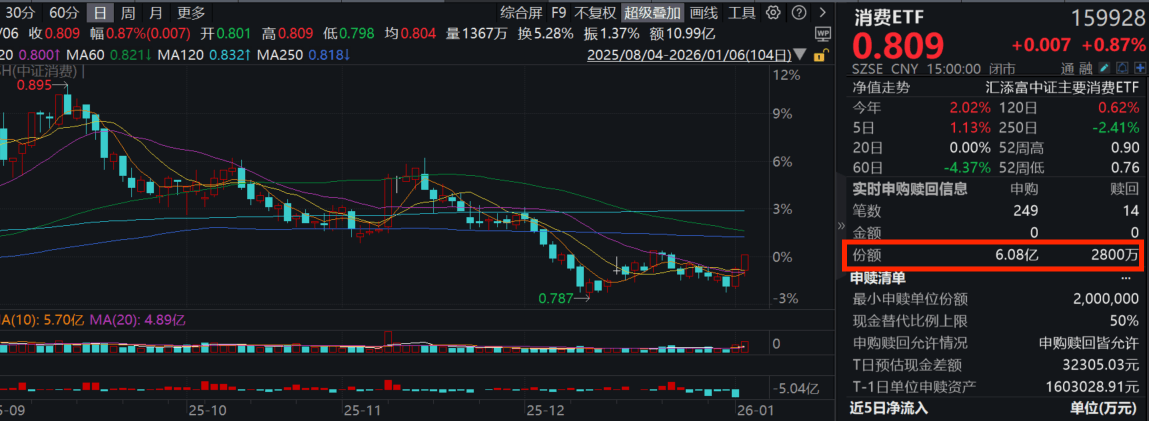
沪指劲升1.5%创逾10年新高!消费ETF(159928)涨近1%两连阳,近5亿元资金狂涌!i茅台普茅购买政策调整,限购量减半!
Xin Lang Cai Jing· 2026-01-06 09:59
Group 1 - The Shanghai Composite Index rose by 1.5%, reaching a new high not seen in over 10 years, with significant inflows into the consumer sector, particularly the Consumption ETF (159928), which saw a net inflow of over 460 million yuan [1][3] - The Consumption ETF (159928) has a current scale exceeding 20.7 billion yuan, leading its peers in the same category [1][3] - Kweichow Moutai's digital marketing platform "i Moutai" launched a new product, which sold out quickly, indicating strong consumer demand [3][6] Group 2 - Goldman Sachs predicts that China's GDP growth rate in 2026 will exceed market consensus, recommending an overweight position in A-shares and Hong Kong stocks, with expected annual increases of 15% to 20% for the stock market in 2026 and 2027 [3] - The valuation of the Consumption ETF (159928) is attractive, with a TTM price-to-earnings ratio of 19.38, placing it in the 3.36% percentile over the past decade, indicating it is cheaper than 96% of the historical time [3][13] - The Hong Kong Stock Connect Consumption 50 ETF (159268) also saw a rise of 0.97%, with significant trading volume, highlighting investor interest in consumer stocks [5] Group 3 - Recent meetings among liquor distributors indicate a stable supply strategy for 2026, with a focus on adjusting product offerings to meet market demand [6][10] - The white liquor sector is experiencing a V-shaped recovery, with expectations for improved supply-demand dynamics compared to 2025 [6][10] - The dairy sector is anticipated to see a recovery in milk prices, with leading companies expected to benefit from improved performance and dividend support [6][10]

2025年末港股“反常”逻辑:谁在撤离?谁将归来?
Sou Hu Cai Jing· 2026-01-06 03:45
Core Viewpoint - The abnormal behavior of the Hong Kong stock market at the end of 2025 is primarily attributed to liquidity tightening due to "deposit migration" and a reduction in southbound capital inflows, which are the main reasons for the market's weakness in recent months. Looking ahead to 2026, the Hong Kong stock market is expected to benefit from improved liquidity and stable macroeconomic conditions in mainland China, with a focus on cyclical and technology-oriented companies [2][12][15]. Group 1: Market Dynamics - The relationship between the offshore RMB exchange rate and the Hang Seng Index has historically been strong, but this correlation broke down at the end of November 2025, leading to unexpected market behavior [6]. - Despite a decrease in the Hong Kong Interbank Offered Rate (HIBOR), the stock market experienced contraction, indicating that the decline in HIBOR was not due to improved liquidity but rather to deposit migration [5][11]. - A significant outflow of funds from Hong Kong was observed at the end of 2025, coinciding with a rise in the USD/HKD exchange rate, which further contributed to the market's volatility [7][8]. Group 2: Future Outlook for 2026 - The southbound capital inflow is expected to increase in 2026, driven by the listing of quality companies, which will help mitigate the volatility caused by foreign capital movements [12][15]. - The macroeconomic outlook for 2026 is anticipated to be better than in the previous year, with cyclical sectors likely to dominate the market as geopolitical tensions ease [15]. - Companies that combine cyclical growth with technological advancements, such as Alibaba, are expected to be key focus areas, as they can leverage retail growth to support investments in technology [15][16].

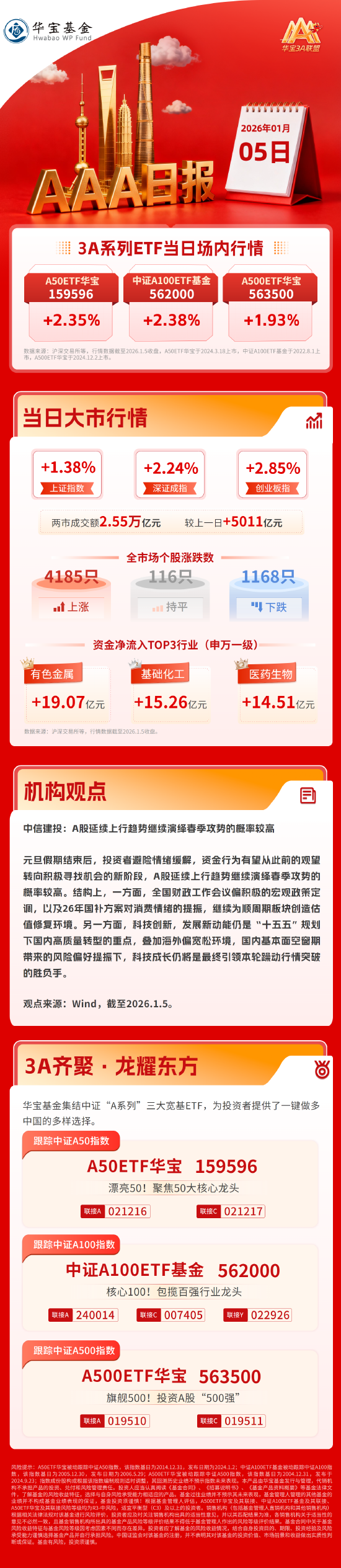
沪指重回4000点!2026年开门红,A50、A100指数均涨超2% | 华宝3A日报(2026.1.5)
Xin Lang Cai Jing· 2026-01-05 09:54
Core Viewpoint - The A-share market is expected to continue its upward trend, with a high probability of a spring rally as investor risk aversion eases and funds shift from a cautious stance to actively seeking opportunities [2][7]. Market Performance - On the trading day, the total market turnover reached 2.55 trillion yuan, an increase of 501.1 billion yuan compared to the previous day [7]. - The major indices showed positive performance: - Shanghai Composite Index increased by 1.38% - Shenzhen Component Index rose by 2.24% - ChiNext Index gained 2.85% [7]. Sector Analysis - The top three sectors for net capital inflow were: - Non-ferrous metals: +1.907 billion yuan - Basic chemicals: +1.526 billion yuan - Biopharmaceuticals: +1.526 billion yuan [2][7]. Institutional Insights - CITIC Securities suggests that the positive macro policy tone from the national financial work conference and the 2026 national subsidy plan will boost consumer sentiment, creating a favorable environment for cyclical sectors [2][8]. - The focus on technological innovation and new growth drivers is emphasized as a key aspect of China's high-quality transformation under the 14th Five-Year Plan, with a supportive overseas monetary environment enhancing risk appetite domestically [8].