高技术产业

Search documents
前三季度成都工业投资增长18% 位居副省级城市第二
Sou Hu Cai Jing· 2025-10-29 01:46
Core Insights - Chengdu's industrial economy is experiencing rapid growth, with industrial investment increasing by 18% and overall investment rising by 19.9% in the first three quarters of 2023 [2][3][4] Group 1: Industrial Growth - The city's GDP reached 18,226.9 billion yuan, reflecting a year-on-year growth of 5.8% [2] - The added value of large-scale industrial enterprises grew by 7.5% year-on-year [2] - The five major advanced manufacturing industries saw an increase in added value of 8.9% [4] Group 2: High-Tech Manufacturing - The added value of high-tech manufacturing industries increased by 11.2% [2][3] - Investment in high-tech manufacturing grew by 21.6% year-on-year [3] - Chengdu has established 67 national-level enterprise technology centers, with 5 new centers added this year [4] Group 3: Project Development - A total of 1,060 reserve projects with a total investment of 3,849.3 billion yuan have been identified, with 73 projects approved [3] - Major industrial and information technology projects worth over 672 billion yuan are accelerating construction, with investments reaching 1,154.7 billion yuan [3] Group 4: Future Focus - The city plans to focus on key industries and strengthen growth support, implementing tailored strategies for each of the five major advanced manufacturing sectors [4] - Efforts will be made to enhance market expansion and support local products in international markets [5]

越秀证券每日晨报-20251027
越秀证券· 2025-10-27 05:58
Market Performance - The Hang Seng Index closed at 26,160, up 0.74% with a year-to-date increase of 30.41% [1] - The Hang Seng Tech Index rose by 1.82% to 6,059, with a year-to-date increase of 35.63% [1] - The Shanghai Composite Index closed at 3,950, up 0.71%, marking a 17.86% year-to-date increase [1] Key Economic Indicators - The US annual inflation rate for September rose to 3%, slightly below market expectations of 3.1% [10] - Energy prices increased by 2.8% year-on-year, the highest since May 2024 [10] - The core inflation rate decreased from 3.1% to 3%, contrary to expectations of stability [10] Company-Specific Developments - Xiaomi announced a tax subsidy plan for its entire vehicle lineup, with an expected investment exceeding 2 billion yuan [15] - Li Ning reported a decline in retail sales for the third quarter, with a high single-digit percentage drop year-on-year [17] - WuXi AppTec's net profit for the first three quarters reached 12.076 billion yuan, an increase of 84.8%, prompting an upward revision of its annual revenue forecast [19] Sector Performance - Semiconductor stocks saw significant gains, with SMIC and ASMPT rising over 8% [4] - The gaming and real estate sectors performed well, while pharmaceutical stocks generally declined [4] - In the A-share market, storage chips and aerospace stocks showed strong performance, while sectors like retail and coal experienced declines [5] IPO and Market Trends - Recent IPOs showed varied performance, with some stocks like "Zijin Gold International" performing well, while others like "Guanghe Tong" faced declines [27] - The Hong Kong stock market saw a significant increase in trading volume, with the stock connect program contributing to a notable share of total trading [24]
十五五”规划点名,十万亿级市场启幕,脑机接口升维“国家战略
Hua Xia Shi Bao· 2025-10-26 00:38
Group 1: Core Economic and Social Development Strategies - The "15th Five-Year Plan" emphasizes the construction of a modern industrial system, a strong domestic market, and coordinated regional development [1] - The plan aims to cultivate emerging and future industries, with a focus on sectors like quantum technology, bio-manufacturing, hydrogen energy, nuclear fusion, brain-machine interfaces, embodied intelligence, and 6G mobile communication [2][5] Group 2: Brain-Machine Interface (BMI) Industry Development - The BMI technology is recognized for its potential to transform economic structures and improve social welfare, with applications in medical rehabilitation and industrial manufacturing [2] - The "Implementation Opinions" issued in July 2025 will elevate the BMI industry to a national strategic level, aiming for breakthroughs in core technologies by 2027 and positioning the industry among the world's leaders by 2030 [3][5] - The BMI industry is projected to create a market scale in the hundreds of billions, generating numerous high-skilled jobs and enhancing China's competitive edge in global technology [5][6] Group 3: Policy and Market Support - The policy framework for BMI has evolved from local pilot projects to a comprehensive national strategy, fostering a collaborative environment among various government departments [3] - Local governments are responding rapidly, with initiatives like the establishment of specialized action plans and funding to support BMI innovation and development [3][4] - The integration of AI with BMI is expected to enhance the efficiency of brain signal decoding, leading to significant advancements in the industry [5][6] Group 4: Commercialization and Market Applications - Companies are exploring diverse business models in the BMI sector, including partnerships for clinical applications and consumer products, indicating a dual focus on B2B and B2C markets [6] - The BMI technology is anticipated to transition from niche applications to widespread use, aligning with China's goals for health and digital economy [6][7] - The current trajectory of BMI development in China highlights significant advancements in medical applications, particularly in areas like Parkinson's disease and mental health, supported by strong policy and market demand [6][7]
江苏前三季度服务业经济平稳增长,发展质效持续提升
Yang Zi Wan Bao Wang· 2025-10-25 09:05
Core Insights - Jiangsu Province's service industry added value reached 56,119 billion yuan in the first three quarters of the year, showing a year-on-year growth of 5.6% and accounting for 54.6% of the regional GDP, an increase of 0.9 percentage points from the previous year [1] - The contribution rate of the service industry to economic growth was 56.1%, driving a 3.0 percentage point increase in regional GDP [1] Group 1: Productive Service Industry - The productive service industry provided strong support, with revenue from large-scale productive service enterprises growing by 9.0% year-on-year from January to August, contributing 6.2 percentage points to the growth of the province's large-scale service industry [2] - Business service revenue increased by 15.6% year-on-year, continuing its rapid growth [2] Group 2: Emerging Service Industry - In the first three quarters, the value added of information transmission, software, and IT services grew by 8.9%, while scientific research and technical services increased by 6.3% year-on-year [3] - From January to August, revenue from large-scale high-tech service industries grew by 7.5%, contributing 3 percentage points to the growth of large-scale service industries [3] - The internet and related services, as well as software and IT services, saw revenue growth of 15.0% and 11.1% year-on-year, respectively [3] - Internet information services grew by 17.8%, contributing 0.6 percentage points to the growth of large-scale service industries [3] - Revenue from research and experimental development and technology promotion services grew by 19.9% and 21.9% year-on-year, respectively, contributing 0.8 percentage points to large-scale service industry growth [3] Group 3: Cultural, Sports, and Tourism Consumption Market - The cultural, sports, and tourism consumption market showed increased vitality, with significant growth in performances, sports events, and tourism [4] - From January to August, revenue from large-scale art performance venues and museums grew by 10.7% and 20.2% year-on-year, respectively [4] - The sports service industry grew by 13.0%, with sports organizations and facility management increasing by 27.9% and 10.0% year-on-year, respectively [4] - Revenue from travel agencies and related services grew by 11.9%, while the entertainment industry saw a 9.2% increase in revenue [4]
中共中央新闻发布会:加快新能源发展,推动氢能和核聚变能成为新的经济增长点
中关村储能产业技术联盟· 2025-10-24 11:55
Core Insights - The most significant outcome of the 20th Central Committee's Fourth Plenary Session is the approval of the "Suggestions on Formulating the 15th Five-Year Plan for National Economic and Social Development" [3] Group 1: Economic Development Strategy - The "15th Five-Year Plan" emphasizes the importance of innovation and nurturing new industries, with a target for the "three new" economy's contribution to GDP exceeding 18% by 2024 [5] - The plan aims to develop strategic emerging industries such as new energy, new materials, aerospace, and low-altitude economy, which are expected to create several trillion-yuan markets [5] - Future industries like quantum technology, biomanufacturing, hydrogen energy, nuclear fusion energy, brain-computer interfaces, embodied intelligence, and sixth-generation mobile communication are identified as new economic growth points [5]
20cm速递|未来10年将再造一个中国高技术产业!创业板新能源ETF华夏(159368)上涨1.88%
Mei Ri Jing Ji Xin Wen· 2025-10-24 09:59
Group 1 - The core viewpoint of the articles highlights the positive performance of the ChiNext New Energy ETF (159368), which rose by 1.88%, with significant gains in its holdings such as Penghui Energy and Maiwei Shares, which increased by over 8% [1] - The Central Committee's proposal for the 15th Five-Year Plan emphasizes the development of emerging pillar industries, including new energy, new materials, and aerospace, which is expected to create several trillion-yuan markets [1] - Dongwu Securities expresses optimism regarding large-scale energy storage demand, anticipating that the implementation of compensation electricity prices will lead to sustained growth in this sector [1] Group 2 - The ChiNext New Energy ETF (159368) is the largest ETF tracking the ChiNext New Energy Index, covering various sectors such as batteries and photovoltaics, with a total scale of 1.085 billion yuan as of October 16, 2025 [2] - This ETF has the highest trading volume, averaging 85.76 million yuan in daily transactions over the past month, and features a low management and custody fee of only 0.2% [2] - The ETF's composition includes 51% energy storage and 30% solid-state batteries, aligning with current market trends [2]

未来5年蕴藏哪些新机遇?透过数个“新增长点”看中国经济值得期待
Yang Shi Wang· 2025-10-24 09:58
Core Insights - The upcoming five years in China are expected to unveil new economic growth opportunities, particularly in emerging industries and technologies [1][3]. Group 1: Emerging Industries - The development of strategic emerging industries such as new energy, new materials, aerospace, and low-altitude economy is anticipated to create several trillion-yuan markets [3]. - Future industries like quantum technology, biomanufacturing, hydrogen energy, nuclear fusion, brain-computer interfaces, embodied intelligence, and sixth-generation mobile communication are identified as new growth points [3][5]. Group 2: Blue and Green Economies - The "blue economy" and "green economy" are highlighted as new growth areas, with China's marine economy exceeding 10 trillion yuan and the scale of green low-carbon industries reaching approximately 11 trillion yuan [5]. - There is significant potential for growth in green low-carbon industries, which could double or even exceed current levels in the next five years [5]. Group 3: Traditional Industries - Optimizing and enhancing traditional industries is projected to generate around 10 trillion yuan in new market space over the next five years, leading to new technologies, products, and job opportunities [7]. Group 4: Investment Opportunities - The next five years will focus on integrating investments in physical assets and human capital, presenting numerous new opportunities [9]. - The plan includes the construction and renovation of over 700,000 kilometers of underground pipelines, with an additional investment demand exceeding 5 trillion yuan [9]. Group 5: Economic Outlook - China's economic total is expected to reach approximately 140 trillion yuan this year, marking a new historical high and indicating a positive outlook for the economy [11].
十年新高!A股盘面释放两大信号,下周沪指重返4000点?
Mei Ri Jing Ji Xin Wen· 2025-10-24 09:26
Market Performance - The A-share market saw all three major indices rise, with the Shanghai Composite Index increasing by 0.71% to close at 3950.31 points, marking a new high for the year and the highest point in nearly a decade [1][3] - The Shenzhen Component Index rose by 2.02% to 13289.18 points, while the ChiNext Index surged by 3.57% to 3171.57 points [1] - The total trading volume in the Shanghai and Shenzhen markets reached 19,742 billion yuan, a significant increase of 3,303 billion yuan compared to the previous day [1] Sector Performance - Over 3,000 stocks rose, with more than 70 stocks hitting the daily limit up [1] - The semiconductor, electronic chemicals, electronic components, communication equipment, aerospace, consumer electronics, and computer equipment sectors showed the highest gains, while coal, real estate services, gas, and mining sectors experienced declines [1] Policy and Economic Outlook - The upcoming "14th Five-Year Plan" is expected to drive new economic growth points, focusing on industries such as quantum technology, biomanufacturing, hydrogen energy, nuclear fusion, brain-computer interfaces, embodied intelligence, and 6G mobile communication [3][12] - The plan aims to unify market regulations, eliminate local protectionism, and address "involution" competition, which could enhance market efficiency [3][12] Stock Highlights - The stock price of Cambrian Technology surpassed that of Kweichow Moutai, indicating a strong performance in the technology sector [5][7] - New stock N Chaoying saw a dramatic increase of 397.6% on its debut, reflecting heightened market enthusiasm for new listings [8][10] Investment Sentiment - The strong performance of new stocks is seen as a barometer of market sentiment, with the current environment favoring risk-taking and investment in growth sectors [10] - Analysts suggest that the recent policy announcements and market movements could lead to a sustained bullish trend, potentially pushing the Shanghai Composite Index above 4000 points in the near future [4][11]


前三季度浙江GDP同比增长5.7%
Guo Ji Jin Rong Bao· 2025-10-24 06:06
Economic Overview - Zhejiang Province's GDP for the first three quarters reached 68,495 billion yuan, with a year-on-year growth of 5.7% at constant prices [1] - The primary industry added value was 1,735 billion yuan, growing by 3.7%; the secondary industry added value was 26,086 billion yuan, growing by 5.2%; and the tertiary industry added value was 40,674 billion yuan, growing by 6.0% [1] Agricultural Sector - The agricultural, forestry, animal husbandry, and fishery sectors saw a value-added growth of 3.8% [1] - Vegetable production increased by 3.7%, while total meat production (pork, beef, lamb, poultry) decreased by 5.2% to 855,000 tons [1] - Egg production rose by 11.0% to 322,000 tons, and milk production increased by 4.2% to 166,000 tons [1] - Total aquatic product output was 4,258,000 tons, growing by 5.2% [1] Industrial Sector - The industrial added value for large-scale enterprises grew by 7.1%, with private enterprises contributing 76.2% to this growth [2] - Among 37 major industrial categories, 28 saw an increase in added value, with a growth rate of 75.7% [2] - Key manufacturing sectors such as automotive, computer communication electronics, and instruments saw increases of 17.7%, 16.5%, and 13.6% respectively [2] - High-tech manufacturing and digital economy core industries grew by 12.4% and 11.6% respectively [2] Investment Trends - Fixed asset investment decreased by 3.8%, but excluding real estate development, it grew by 7.7% [3] - Manufacturing investment increased by 10.7%, with significant growth in automotive (34.2%) and general equipment (24.9%) [3] - Infrastructure investment rose by 7.9%, accounting for 27.5% of total investment, an increase of 3.0 percentage points year-on-year [3] Consumer Market - Total retail sales of consumer goods reached 28,408 billion yuan, with a year-on-year growth of 5.2% [3] - Retail sales through public networks grew by 23.4%, indicating a strong shift towards online shopping [3] - Significant growth was observed in the sales of home appliances (57.0%) and communication equipment (64.2%) [3] Price Trends - The Consumer Price Index (CPI) decreased by 0.2% year-on-year, with four categories of goods and services experiencing price increases [4] - The Producer Price Index (PPI) for industrial producers fell by 2.0% year-on-year [4] Employment and Income - The urban surveyed unemployment rate averaged 4.7%, with 925,000 new urban jobs created [5] - Per capita disposable income for residents reached 54,653 yuan, a nominal increase of 4.7% [5] - Urban residents' income was 63,079 yuan, while rural residents' income was 36,383 yuan, reflecting a nominal growth of 4.2% and 5.3% respectively [5]
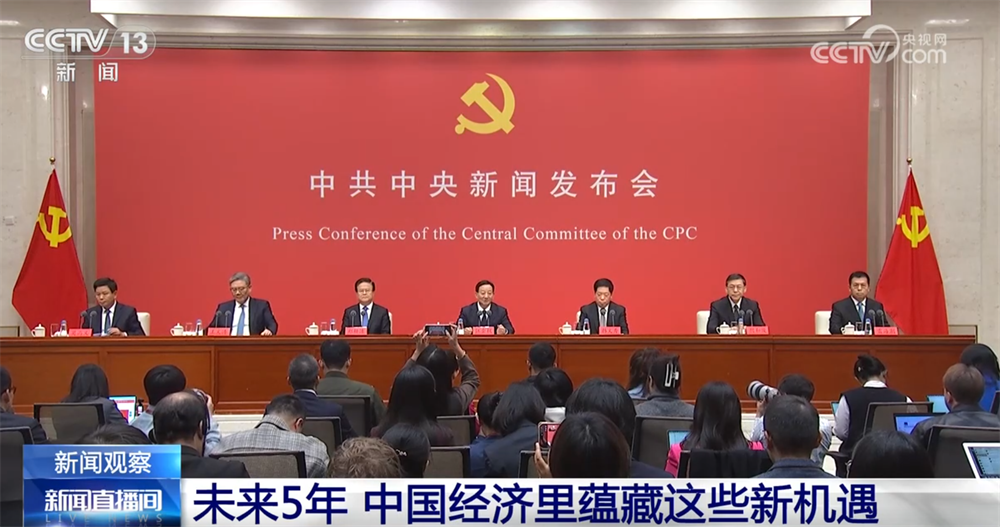
中共中央新闻发布会
证券时报· 2025-10-24 03:16
Core Points - The article discusses the key outcomes of the 20th Central Committee's Fourth Plenary Session, focusing on the "15th Five-Year Plan" and its implications for China's economic and social development [2][3]. Group 1: Overview of the "15th Five-Year Plan" - The "15th Five-Year Plan" consists of 15 parts and 61 articles, divided into three main sections: general principles, specific strategies, and tasks to strengthen the leadership of the Party [2]. - The plan emphasizes the significance of economic and social development during the "15th Five-Year" period, building on the achievements of the "14th Five-Year" period [2]. Group 2: Economic Outlook - The long-term positive conditions and trends supporting China's economy remain unchanged, with a solid economic foundation and strong resilience [3]. - The plan aims to create new pillar industries and accelerate the development of strategic emerging industries, which could generate several trillion-yuan markets [4]. Group 3: Market Reforms - The plan proposes comprehensive measures to address "involution" competition and to unify market regulations, which will help unlock the benefits of China's vast market [5]. - It is projected that over 700,000 kilometers of underground pipelines will be constructed or renovated during the "15th Five-Year" period, requiring an investment of over 5 trillion yuan [6]. Group 4: Marine Economy - The total volume of China's marine economy has surpassed 10 trillion yuan, with initiatives to enhance marine development and ecological protection outlined in the plan [7]. Group 5: Service Sector and Trade - The plan focuses on expanding market access and opening up the service sector, aligning with international high-standard trade rules [9]. - It emphasizes innovation in trade, covering goods, services, and digital trade as key pillars for a strong trade nation [9]. Group 6: Population and Family Policies - The plan includes measures to create a family-friendly society, optimizing support and incentive policies for childbirth and child-rearing [10]. Group 7: Technological Development - The plan highlights the importance of technological modernization, proposing actions to enhance innovation capabilities and integrate technology with various industries [11]. - It aims to implement the "Artificial Intelligence+" initiative to empower multiple sectors [11].