
企业出海

Search documents
直击中资“出海”金融痛点,临港举办跨境金融超链大会
Guo Ji Jin Rong Bao· 2025-10-28 11:24
Core Insights - The conference focused on addressing the financial pain points faced by Chinese enterprises going global, with the theme "Cross-border without boundaries, linking for win-win" [1][2][4] - The event aimed to enhance the global layout of Chinese enterprises by providing tailored financial services and resources [4][5] Group 1: Financial Challenges and Solutions - Chinese enterprises are experiencing strong demand for overseas expansion, but face challenges such as unmet funding needs, low cross-border settlement efficiency, and high exchange rate risks [2][4] - The Lingang New Area has recorded over 450 non-financial foreign direct investment projects, with a total investment of nearly $7 billion, showcasing its commitment to supporting enterprises in their global endeavors [4][9] Group 2: Conference Structure and Activities - The conference included various formats such as keynote speeches, roundtable discussions, lightning pitches, parallel forums, and a financial marketplace to facilitate resource matching and idea exchange [4][6] - Specific forums focused on "Data Empowerment for SMEs in Cross-border Financial Services" and "Insurance and New Patterns in Cross-border Finance" to explore technological and risk management aspects [5] Group 3: Resource Matching and Financial Products - Innovative features like "lightning pitches" and a "financial marketplace" were introduced to streamline the connection between enterprises and financial institutions, allowing for immediate communication and resource matching [6] - Major financial institutions presented a range of cross-border financing, insurance, leasing, and payment services, enhancing the financial options available to enterprises [6] Group 4: Strategic Goals and Future Directions - The Lingang New Area aims to establish itself as a financial hub and strategic platform for Chinese enterprises going global, focusing on institutional innovation and service optimization [5][8] - The "Going Global" comprehensive service platform is set to enhance cross-border financial services, aiming to reduce transaction costs and financing barriers for enterprises [9]


企业出海导航来了!5部门16项举措构建全链条海外服务生态
Di Yi Cai Jing· 2025-10-28 10:39
Core Viewpoint - The "Guiding Opinions" aim to establish a comprehensive service system that aligns with China's scale and development trends in foreign investment and trade, addressing the increasing demand for high-quality overseas services from expanding enterprises [1][3]. Group 1: Overview of the Guiding Opinions - The document is the first of its kind in the overseas comprehensive service sector, proposing 16 specific measures across 6 areas to create a multi-dimensional and full-chain service ecosystem [1][5]. - The six areas include optimizing public services, integrating local services, extending overseas services, enhancing economic and trade cooperation guarantees, improving professional services, and boosting the capabilities of outbound enterprises [5][6]. Group 2: Current Context and Demand - There is a significant increase in demand for comprehensive overseas services as Chinese enterprises expand into diverse markets [1][4]. - China's foreign trade has maintained a leading position globally for eight consecutive years, with cumulative foreign investment reaching $3.1 trillion and over 52,000 enterprises established abroad [3][4]. Group 3: Challenges and Risks - The external environment is increasingly complex, with rising global conflicts and uncertainties, necessitating enhanced service support for enterprises venturing abroad [3][4]. - The risk index for small and medium-sized foreign trade enterprises has increased by 5.8 points, marking the largest rise since 2021, indicating heightened overall risks [3][4]. Group 4: Systematic Service Ecosystem - The guiding opinions emphasize a coordinated approach across various levels, from central to local and domestic to international, to enhance service quality for outbound enterprises [5][6]. - The integration of foreign investment and trade services aims to facilitate a unified supply of policy consultation, business processing, and market development [6][7]. Group 5: Enhancing Enterprise Capabilities - The opinions also stress the importance of improving the capabilities of outbound enterprises, including developing international strategies and enhancing compliance with international regulations [7]. - There is a focus on training and support to help enterprises navigate foreign legal, financial, and operational environments effectively [7].

产融协同 出海赋能 2025大湾区企业家交流会将于11月举行
Zheng Quan Shi Bao Wang· 2025-10-28 08:41
Core Insights - The 19th Shenzhen International Financial Expo will be held from November 19 to 21, focusing on global financial wisdom and resources for industrial development [1] - The 2025 Greater Bay Area Entrepreneurs Exchange will take place on November 19, emphasizing the theme of "Collaborative Financial Development and New Momentum for Enterprises Going Global" [1] - The event aims to create a high-end dialogue platform integrating policy interpretation, case sharing, and trend analysis, highlighting Shenzhen's core advantages as an innovation hub [1] Group 1: Event Overview - The Shenzhen International Financial Expo has become one of the largest and most comprehensive financial exhibitions in China since its inception, with the 2025 Greater Bay Area Entrepreneurs Exchange as a key component [5] - The event will feature keynote speeches from prominent figures, including former Deputy Director of the Central Financial Committee Office, Yin Yanlin, and President of the Unity Hong Kong Foundation, Li Zhengyi [1][5] - The expo will facilitate deep exchanges and cooperation among government, industry, academia, and research sectors to promote collaborative financial development in the Greater Bay Area [5] Group 2: Thematic Dialogues - The first thematic dialogue will focus on "Global Economic New Landscape, Resilience of Industrial and Supply Chains, and Financial Technology Empowerment," discussing the construction of resilient supply chains and financial stability mechanisms [2] - The second dialogue will explore "Shenzhen-Hong Kong Pivot and Institutional Opening of the Greater Bay Area," analyzing Hong Kong's pivotal role in the globalization of Chinese enterprises [3] - The third dialogue will address "Innovation Leading New Journeys: Exploring the Path for Chinese New Energy Enterprises Going Global," focusing on the challenges and policies in the internationalization of the new energy sector [4]
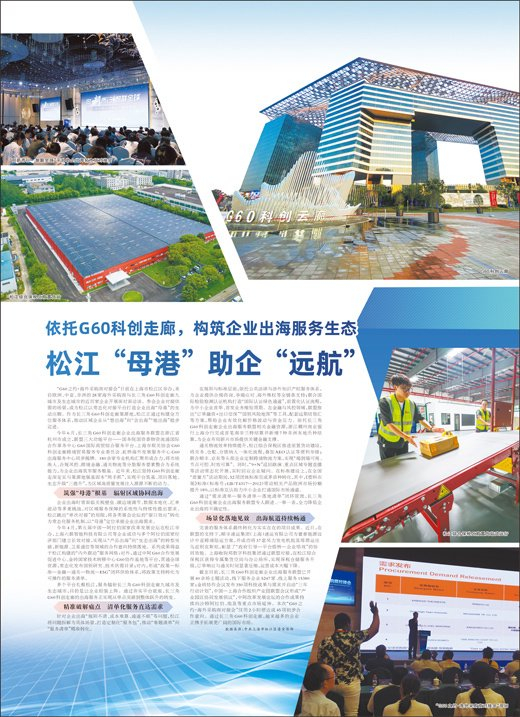
松江“母港”助企“远航”
Ren Min Wang· 2025-10-28 01:24
Core Insights - The "G60 Agreement: Overseas Buyers Matching Conference" was held in Shanghai, facilitating face-to-face discussions between 28 overseas buyers from Europe, Central Asia, and Africa and nearly 100 enterprises from the Yangtze River Delta G60 Science and Technology Innovation Corridor [3] - The event exemplifies the establishment of a regularized platform in Songjiang, aiming to transform the region into a "mother port" for enterprises looking to expand internationally [3][4] - The Long Triangle G60 Science and Technology Innovation Corridor is enhancing its service system to support local enterprises in their international ventures, transitioning from "wanting to go abroad" to "being able to go abroad" [3][4] Service Alliance and Platforms - In June, the Long Triangle G60 Science and Technology Innovation Corridor Enterprise Overseas Service Alliance was established, integrating over 180 professional institutions to provide comprehensive services for enterprises venturing abroad [3][5] - The alliance features three main functional platforms, including the G60 International Trade Comprehensive Service Platform and the G60 Overseas Service Center, which collectively enhance market access, compliance risk control, cross-border finance, and logistics [3][5][6] Systematic Support and Solutions - Songjiang is addressing challenges faced by enterprises, such as tariff barriers and data localization, by creating a systematic and sustainable service framework [4][6] - The alliance offers tailored "service packages" to address specific issues like unclear rules and high costs, transforming problem lists into actionable service lists [5][6] Financial and Logistical Enhancements - Financial tools such as "order financing + export credit insurance" and "country risk maps" have been introduced to help enterprises manage price fluctuations and funding pressures [6] - The efficiency of customs logistics is being improved through integrated processes and partnerships with leading logistics companies, ensuring visibility and control over cross-border shipments [6][8] Project Outcomes and Achievements - The service system has led to tangible project outcomes, such as the successful transportation of wind turbine components to Uzbekistan and enhanced warehousing services for local enterprises [8] - The G60 Overseas Service Alliance has conducted over 40 themed activities, serving more than 20,000 enterprises and facilitating numerous initial cooperation intentions during events like the recent conference [8][9]
易点天下三季度营收增速近50%,帮助新赛道企业拓展海外市场
Huan Qiu Wang· 2025-10-28 01:02
Core Insights - The company Yidian Tianxia (301171.SZ) reported a revenue of 2.717 billion yuan for the first three quarters of 2025, representing a year-on-year growth of 54.94% [1] - The trend of Chinese companies going global is evolving towards diversification and sustainability, with a focus on cross-border e-commerce, new energy, and digital content [1] - Yidian Tianxia is enhancing its "service + product" model to strengthen its market position and expand its share in the e-commerce sector [1] Financial Performance - In Q3 2025, the company achieved a revenue of 980 million yuan, a year-on-year increase of 46.80% [1] - The adjusted profit, excluding foreign exchange gains and share-based payment, was 106 million yuan in Q3, reflecting a growth of 25.31% [1] Market Trends - The global programmatic advertising market is projected to reach 2.753 trillion USD by 2030, with a compound annual growth rate of 22.8% from 2024 to 2030 [2] - The Asia-Pacific region is expected to be the fastest-growing market for programmatic advertising [2] Client Engagement and Product Development - The company has successfully assisted clients like Kwai and WYBOT in expanding their overseas markets, with WYBOT's sales in North America doubling monthly [2] - Yidian Tianxia's zMaticoo programmatic advertising platform has increased its user base and market share, now covering over 20 billion devices and 1.33 billion unique users [2] Technological Advancements - The company is integrating its new algorithms with unique ecological assets to enhance customer experience and create a growth loop from data to algorithms to clients [3]
以长效服务机制护航企业出海
Sou Hu Cai Jing· 2025-10-27 22:35
Core Insights - The article discusses the issuance of the first national-level guidance document aimed at enhancing overseas service systems for Chinese enterprises, marking a new phase in supporting companies to "go global" [1][2] Group 1: Guidance Document Overview - The guidance document aims to address not only individual challenges faced by enterprises but also to establish a long-term service mechanism to support Chinese companies in the global market [1] - It emphasizes extending services from the initial stages of going abroad to the operational phase, addressing issues such as intellectual property disputes, labor compliance, and financing challenges [1][2] Group 2: Collaborative and Innovative Services - The document highlights the importance of collaborative services, encouraging innovative explorations in free trade zones and ports, exemplified by the establishment of the North China Outbound Center [2] - This center utilizes policies from the Hebei Free Trade Zone to reduce overseas direct investment (ODI) costs and links to cross-border financial advantages, providing a comprehensive support chain for enterprises [2] Group 3: Professional Service Enhancement - The guidance calls for enhancing the cross-border service capabilities of legal, financial, and accounting institutions, promoting the transition from basic consulting to high-value solutions [2] - This shift aims to empower enterprises to better navigate international market changes and enhance their competitiveness [2] Group 4: Digitalization and Capacity Building - The document proposes the establishment of a national-level overseas comprehensive service platform, creating a "1+N" service network that improves efficiency in policy inquiries and risk management [3] - It emphasizes the need to enhance the capabilities of outbound enterprises through training and compliance guidance, shifting their approach from passive response to proactive management [3] Group 5: Systematic Support for Global Engagement - The improvement of the overseas comprehensive service system is seen as a crucial step in building an international business environment from the policy supply side [3] - This system integrates public services, local innovations, and professional support, transforming previous isolated efforts into a cohesive support framework for enterprises venturing abroad [3]
产融协同 出海赋能 2025大湾区企业家交流会将于11月启动
2 1 Shi Ji Jing Ji Bao Dao· 2025-10-27 12:07
Core Insights - The 19th Shenzhen International Financial Expo will take place from November 19 to 21, focusing on global financial wisdom and resources for industrial development [1] - The 2025 Greater Bay Area Entrepreneurs Exchange will be launched at the expo, emphasizing themes such as industrial-financial collaboration and enterprises going global [1] - The event aims to provide a high-end dialogue platform for policy interpretation, case sharing, and trend analysis in key areas like technology finance and Greater Bay Area collaboration [1] Group 1: Event Overview - The Shenzhen International Financial Expo has become one of the largest and most comprehensive financial exhibitions in China since its inception, with 18 successful editions [4] - The 2025 Greater Bay Area Entrepreneurs Exchange is a key component of the expo, promoting deep exchanges and cooperation among government, industry, academia, and research sectors [4] - The event is organized by several prestigious institutions, including The Chinese University of Hong Kong (Shenzhen) and Shenzhen Data Economy Research Institute [4] Group 2: Thematic Dialogues - The first thematic dialogue will focus on the resilience of industrial and supply chains in the context of global economic restructuring and the role of financial technology [2] - The second dialogue will explore Hong Kong's pivotal role in the globalization of Chinese enterprises, discussing its advantages in tax systems, legal services, and international standards [2] - The third dialogue will address the challenges and opportunities for Chinese renewable energy companies in their internationalization efforts, emphasizing the application of cutting-edge technologies [3]
慢牛预期下,下一步重点该配置什么?| 市场观察
私募排排网· 2025-10-26 03:04
Group 1: Market Overview - The A-share market has shown a stable upward trend since October, with the Shanghai Composite Index surpassing 3950 points, approaching the 4000-point mark, supported by the 20th Central Committee's emphasis on technological self-reliance and comprehensive reform [4] - The macroeconomic environment is characterized by moderate inflation, declining interest rates, and ample liquidity, which are solidifying the valuation bottom for risk assets [4] - Northbound capital transactions reached 1.1 trillion yuan this week, maintaining a high level despite a decrease from 1.5 trillion yuan the previous week [4] Group 2: Global Monetary Policy - Major global central banks have shifted towards easing monetary policy, with expectations of further rate cuts from the Federal Reserve in October or December [8] - The U.S. September CPI rose by 3.0%, below market expectations, indicating a stable trend of declining inflation [8] - Historical trends suggest that a rate-cutting cycle combined with a weak dollar often leads to significant recovery in the A-share market [8] Group 3: Policy and Economic Growth - The 20th Central Committee's meeting has injected new medium- to long-term confidence into the market, focusing on high-quality development and emphasizing technological self-reliance and modernization [15] - Policies are increasingly supporting structural and long-term growth, with a focus on technological innovation, expanding domestic demand, and enhancing the capital market's resilience [12][15] - The current macroeconomic environment is expected to lead to a "steady upward" phase in corporate profits, particularly in manufacturing and technology sectors [12] Group 4: Investment Opportunities - The A-share market is transitioning from short-term speculation to medium-term positioning, with technology growth and dividend stability forming the dual investment focus [14] - Technology manufacturing remains a core driver of market momentum, benefiting from policy support and increased R&D investment [16] - Dividend assets are seen as a stable foundation for growth, with state-owned enterprises enhancing their dividend payout ratios [17] - The CSI A500 index represents a balanced growth opportunity, combining growth potential with stability [18]

产业赋能、育才兴教 侨胞归乡献力添彩家乡建设
Xin Lang Cai Jing· 2025-10-25 06:25
Group 1 - Overseas Chinese are increasingly returning to their hometowns to support local development in areas such as industrial upgrading, talent cultivation, and cultural tourism innovation [1] - A recent cross-border e-commerce training program was launched in Haining, Zhejiang, led by overseas Chinese businessman Yang Yaozhong, focusing on current trends in international business expansion and compliance [1][2] - Yang identified challenges faced by local SMEs, including resource shortages, operational skill gaps, and unclear regulations, which hinder their ability to expand internationally [1] Group 2 - Yang's training incorporates lessons from his entrepreneurial experiences, guiding businesses on qualification certification and effective overseas logistics cost control [2] - In Guangdong, the Guangzhou Software College's Jiangmen campus aims to meet local industrial demands by focusing on electronic information, intelligent manufacturing, and smart logistics [2] - The college collaborates with industry professionals to provide practical training opportunities for students, enhancing their employability and encouraging entrepreneurship [2] Group 3 - The "C77" cultural and creative industry park in Shanghai was transformed from a paper factory to capitalize on the growing online live-streaming economy [3] - The park promotes local products, such as green vegetables and traditional cakes, through live-streaming, leveraging overseas Chinese networks for market expansion [3] - Future plans include developing an IP industry park and resort to further enhance local economic development [4]
中企加速布局泰国市场 金融机构护航“走出去”
Zhong Guo Jing Ying Bao· 2025-10-25 02:57
Core Insights - Thailand has become a significant destination for Chinese enterprises expanding overseas, with continuous growth in China's exports to Thailand and increasing market share of Chinese goods in Thailand's import market [1] - Chinese investments in Thailand have reached new highs, particularly in sectors such as automotive manufacturing, electronic components, and rubber processing [1] - The Thai government promotes a business-friendly environment, making it an attractive opportunity for Chinese companies, especially in automotive manufacturing, digital economy, and clean energy [1] Group 1: Investment Trends - There is a rising trend of Chinese companies investing in Thailand, exemplified by Haier New Energy organizing a delegation to explore business opportunities and projects in the country [2] - Chinese banks, such as Bank of China and Industrial and Commercial Bank of China (ICBC), are providing comprehensive financial services to support Chinese enterprises in Thailand, including cross-border financial services and investment information [2] Group 2: Financial Cooperation - A multi-layered coordination framework for financial cooperation has been established between China and ASEAN, with initiatives like the Chiang Mai Initiative Multilateralization (CMIM) and the Belt and Road Initiative (BRI) facilitating large-scale infrastructure financing [3] - The Regional Comprehensive Economic Partnership (RCEP) has created unified rules for cross-border financial transactions, enhancing regional financial integration [3] Group 3: Challenges Faced - Despite the opportunities, Chinese enterprises face challenges in cross-border fund management and foreign exchange risks when entering the Thai market [4] - Large enterprises encounter complex registration processes and high banking fees, while small and medium-sized enterprises (SMEs) struggle with foreign exchange regulations and cash flow management [4][5] Group 4: Foreign Exchange Risk Management - Effective foreign exchange risk management is crucial for Chinese enterprises in Thailand, with large enterprises employing diverse strategies, yet many still lack formal hedging practices [5] - SMEs have limited access to foreign exchange risk management tools, making them vulnerable to currency fluctuations [5] Group 5: Recommendations for Enterprises - Chinese enterprises are advised to integrate into the local market, adapt culturally, enhance their corporate image, and comply with local laws [6] - Emphasis is placed on the importance of collaboration with local SMEs and optimizing financing strategies [6] Group 6: Role of Financial Institutions - Financial institutions are encouraged to build comprehensive service systems for enterprises going abroad, with large banks collaborating with local banks to enhance service capabilities [7] - Domestic banks should strengthen partnerships with overseas banks to better serve diverse needs of outbound enterprises [7]