
稳增长政策

Search documents
中国6月PMI超预期,关注美欧6月制造业PMI终值
Hua Tai Qi Huo· 2025-07-01 03:19
Report Industry Investment Rating No relevant content provided. Core Viewpoints - China's economic sentiment has rebounded during Trump's tariff grace period, but economic pressure remains. With the implementation of policy dividends, investment and consumption demand are expected to be continuously released. Attention should be paid to the possibility of the Politburo meeting in July further increasing policies to stabilize growth [1]. - As the deadline for the US to postpone tariffs approaches, the EU is preparing more tariff counter - measures. The UK - US trade agreement has come into effect, Canada has cancelled the digital service tax, and the India - US trade negotiation is at a deadlock. The subsequent progress of trade negotiations among countries needs continuous attention [2]. - The Fed is not in a hurry to act due to the unprecedented tariffs and the difficulty in predicting the impact on inflation. The "Big Beautiful" bill has passed the procedural vote in the US Senate, and the US retail sales in May declined significantly [3]. - Macro - inflation trading has heated up. The non - ferrous sector with supply constraints and the gold price related to inflation expectations are worthy of attention. The black sector focuses on domestic policy expectations. Attention should be paid to the OPEC meeting on July 6th [4]. - For commodities and stock index futures, it is recommended to allocate industrial products and gold on dips [5]. Summary by Related Catalogs Market Analysis - In May, China's investment data weakened, especially in the real estate sector, which may drag down fiscal revenue and the entire real estate chain. Exports were also under pressure, while consumption showed resilience. The third - batch of consumer goods replacement funds will be issued in July. China's official manufacturing PMI, non - manufacturing business activity index, and comprehensive PMI output index in June all increased compared to the previous month, but the manufacturing PMI has been below the boom - bust line for three consecutive months [1]. - The People's Bank of China made a net injection of 30.58 billion yuan on June 26th, the highest since April 30th [1]. Trade Negotiations - The Trump administration admitted the flexibility of the tariff schedule on June 12th. The EU is preparing counter - measures, and the EU Commission President is confident of reaching an agreement by July 9th. The UK - US trade agreement has reduced tariffs on UK exports to the US. Canada has cancelled the digital service tax to promote trade negotiations with the US. The India - US trade negotiation is deadlocked over auto parts taxes [2]. US Economic Situation - Powell reiterated that the Fed is not in a hurry to act. The "Big Beautiful" bill has passed the procedural vote in the Senate, and the Senate will vote on the tax reform bill on Monday morning local time. US retail sales in May decreased by 0.9% month - on - month, the largest decline since March 2023 [3]. Macro - inflation Trading - From the 2018 tariff review, tariff events first lead to a decline in demand trading and then an increase in inflation trading. Recently, with the increasing expectation of the "Big Beautiful" bill passing and the approaching of important domestic meetings, macro - inflation trading has heated up again. The non - ferrous sector and gold are worthy of attention, and the black sector focuses on domestic policy expectations [4]. Energy - The EU will extend sanctions against Russia for six months until January 31, 2026. Trump said that due to low oil prices, a cease - fire agreement with Russia is expected to be reached. The IEA predicts that the oversupply of oil in 2025 may continue until the end of this decade. Attention should be paid to the OPEC meeting on July 6th [4][7]. Strategy - For commodities and stock index futures, it is recommended to allocate industrial products and gold on dips [5]. Important News - China's manufacturing PMI, non - manufacturing business activity index, and comprehensive PMI output index in June all increased compared to the previous month [7]. - The UK - US trade agreement has come into effect, reducing tariffs on UK auto and aerospace product exports to the US [7]. - Canada has cancelled the digital service tax to promote trade negotiations with the US, and the two sides will restart negotiations to reach an agreement by July 21, 2025 [2][7]. - The US Senate has completed the reading of the "Big Beautiful" bill and started the debate, and will vote after the debate [3][7]. - China will continue to impose anti - dumping duties on imported stainless steel billets and hot - rolled stainless steel sheets/coils from the EU, the UK, South Korea, and Indonesia for five years starting from July 1, 2025 [4][7]. - The EU will extend sanctions against Russia for six months until January 31, 2026 [7]. - Trump said that due to low oil prices, a cease - fire agreement with Russia is expected to be reached [4][7].
6月份PMI三大指数均有所回升— 我国经济景气水平总体保持扩张
Jing Ji Ri Bao· 2025-06-30 22:10
Group 1: Manufacturing Sector - The manufacturing PMI for June increased to 49.7%, marking a rise for two consecutive months, with 11 out of 21 surveyed industries in the expansion zone, an increase of 4 from the previous month [1][2] - The new orders index returned to the expansion zone at 50.2%, up 0.4 percentage points from last month, indicating a recovery in market demand [2] - The production index rose to 51%, reflecting stable expansion in production activities, while the purchasing volume index increased significantly by 2.6 percentage points to 50.2% [2] Group 2: Non-Manufacturing Sector - The non-manufacturing business activity index for June was 50.5%, up 0.2 percentage points, indicating continued expansion [3] - The service sector's business activity index was 50.1%, slightly down by 0.1 percentage points, attributed to seasonal declines in consumer travel demand post-holidays [3] - The construction sector showed accelerated expansion with a business activity index of 52.8%, up 1.8 percentage points, driven by ongoing infrastructure projects [3] Group 3: Economic Outlook - The comprehensive PMI output index rose to 50.7%, indicating an overall acceleration in production and business activities [5] - The second quarter's average non-manufacturing business activity index was 50.4%, consistent with the first quarter, suggesting stable expansion in the first half of the year [4] - Analysts emphasize the need for continued macroeconomic policy support to stimulate growth and address demand shortages in the manufacturing sector [5][6]
6月制造业PMI回升至49.7% 稳增长政策效应显现
Zhong Guo Jing Ying Bao· 2025-06-30 14:09
中经记者 谭志娟 北京报道 我国制造业景气水平继续改善。 6月30日,国家统计局发布的数据显示,6月份,制造业采购经理指数(PMI)为49.7%,比上月上升0.2 个百分点,好于季节性。 数据同时显示,6月份,非制造业商务活动指数和综合PMI产出指数分别为50.5%和50.7%,比上月上升 0.2和0.3个百分点。三大指数均有所回升,这表明我国经济景气水平总体保持扩张。 东方金诚首席宏观分析师王青对《中国经营报》记者表示,6月宏观经济继续处于稳中偏强状态。 制造业"淡季不淡" 对于6月制造业PMI的回升原因,王青认为,6月稳增长政策效应显现叠加贸易局势缓和,共同带动当月 宏观经济景气度延续回升。 据记者了解,本月五大分项指数出现四升一降。其中,生产指数、新订单指数、原材料库存、供应商配 送时间指数均较上月回升,但从业人员指数小幅回落0.2个百分点至47.9%,与4月持平。 总体来看,业界认为,市场需求回到扩张区间带动生产继续上行,价格指数有所反弹,这些都反映了我 国经济有足够的韧性,在对等关税暂缓和政策靠前发力的结合下,二季度经济比去年同期表现更有韧 性。 从企业规模看,6月大、中型企业PMI指数都出现一定幅 ...
49.7%、50.5%、50.7%! 6月PMI三大指数均回升
Mei Ri Jing Ji Xin Wen· 2025-06-30 13:44
Group 1: Economic Indicators - In June, China's manufacturing PMI, non-manufacturing business activity index, and comprehensive PMI output index were 49.7%, 50.5%, and 50.7%, respectively, indicating a slight recovery with increases of 0.2, 0.2, and 0.3 percentage points from the previous month, suggesting overall economic expansion [1] - The production index, new orders index, and supplier delivery time index for manufacturing were 51.0%, 50.2%, and 50.2%, all above the critical point, with increases of 0.3, 0.4, and 0.2 percentage points from the previous month [3] - The non-manufacturing business activity index remained at 50.5%, reflecting continued expansion, while the service industry index was at 50.1%, down 0.1 percentage points from the previous month [5] Group 2: Sector Performance - The equipment manufacturing, high-tech manufacturing, and consumer goods industry PMIs were 51.4%, 50.9%, and 50.4%, respectively, all remaining in the expansion zone for two consecutive months [4] - The high-tech manufacturing PMI remained stable at 50.9%, indicating strong growth and resilience in the face of market demand and policy support [4] - The small enterprise PMI fell by 2 percentage points to 47.3%, indicating lower economic sentiment in this sector, which is crucial for employment [3] Group 3: Policy and Future Outlook - Economists suggest accelerating the issuance and use of local government special bonds and new policy financial tools to support domestic demand and stabilize foreign trade [2] - The macroeconomic policy is focusing on promoting service consumption as a key point to boost domestic demand, with various supportive measures being implemented [5] - Future projections indicate that the manufacturing PMI may remain around 49.7% in July, with potential downward risks due to cooling export momentum [6]

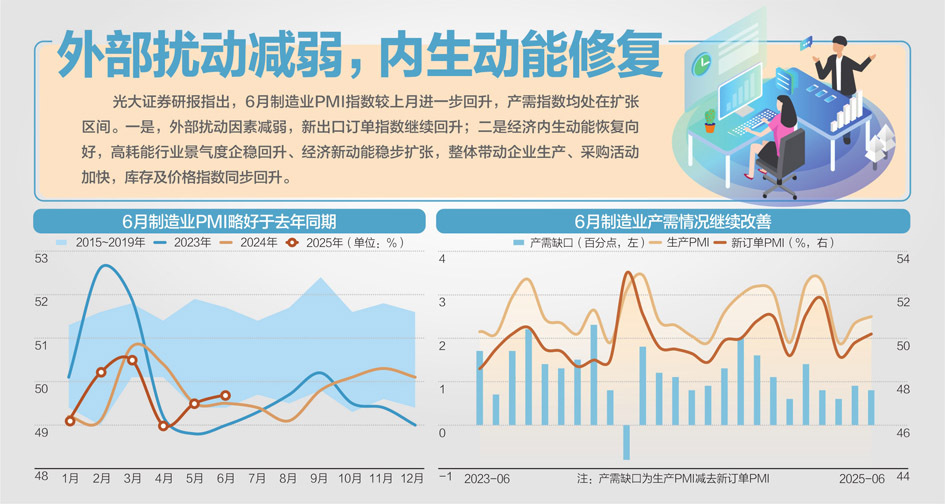
2025年6月PMI数据点评:稳增长政策效应显现叠加贸易局势缓和,6月宏观经济景气度延续回升
Dong Fang Jin Cheng· 2025-06-30 09:09
Economic Indicators - In June 2025, China's manufacturing PMI was 49.7%, up 0.2 percentage points from May[1] - The non-manufacturing business activity index in June was 50.5%, also up 0.2 percentage points from May[1] - The comprehensive PMI output index rose to 50.7%, an increase of 0.3 percentage points from May[1] Policy Impact - The rebound in manufacturing PMI is attributed to the ongoing effects of growth-stabilizing policies, including a series of financial measures announced on May 7, which led to a sustained increase in social financing[2] - The new orders index increased by 0.4 percentage points, returning to the expansion zone, indicating strong market demand[2] Trade Environment - The easing of trade tensions, particularly following the May 12 de-escalation of the "tariff war," contributed to a slight recovery in the new export orders index, which rose to 47.7%, up 0.2 percentage points from the previous month[2] Sector Performance - The construction PMI in June was 52.8%, up 1.8 percentage points, indicating robust activity despite a slight decline in civil engineering indices[6] - The high-tech manufacturing PMI remained stable at 50.9%, reflecting strong demand and policy support[4] Challenges Ahead - Despite the positive indicators, the overall export slowdown may continue due to high tariffs exceeding 40% on Chinese goods[3] - The real estate market shows signs of intensified adjustment, which may limit the PMI's rebound potential[3] Future Outlook - GDP growth for the first half of the year is projected at around 5.2%, with no major new policy measures expected in the short term[7] - The manufacturing PMI is anticipated to remain around 49.7% in July, but with significant downward risks due to external pressures[8]
铁矿石半年度报告:供需维持宽松,矿价宽幅震荡
Yin He Qi Huo· 2025-06-27 09:50
1. Report Industry Investment Rating No relevant information provided. 2. Core Viewpoints of the Report - The supply of iron ore in China decreased while demand increased in the first half of 2025. The consumption of iron ore reached a record high, supporting the high valuation of iron ore among the black commodities. [2][93] - In the second half of the year, the global iron ore supply is expected to increase slightly, with a total increment of about 13 million tons from the Big Four mines and non - Australia and Brazil regions. The supply pressure is not significant. [2][93] - The demand for construction steel in China is expected to continue to decline, while the demand for manufacturing steel is expected to remain resilient. Overseas demand, especially from India, is expected to contribute more than 10 million tons of incremental demand throughout the year. [2][93] - The trading logic in the second half of the year mainly involves the Fed's interest - rate cuts and global tariff policies. The fundamentals of iron ore supply and demand will remain neutral, and the Platts iron ore price will fluctuate widely between $90 - $105. [3][94] - The trading strategy suggests speculatively buying at the bottom of the iron ore price and for spot enterprises to hedge at high prices. [5][95] 3. Summary by Relevant Catalogs 3.1 Iron Ore Supply and Demand Analysis 3.1.1 Production and Sales of the Big Four Mines in H1 2025 - The total production of the Big Four mines in the first half of the year was estimated at 545 million tons, a year - on - year decrease of 0.3% (2 million tons), and the total shipment was 544 million tons, a year - on - year decrease of 0.1% (0.6 million tons). The overall production and sales were lower than market expectations. [12] - In the second half of the year, the production may accelerate, with the increment mainly from Rio Tinto and BHP, but the overall increment may be only about 7 million tons. [12] 3.1.2 Domestic Iron Ore Imports - From January to May 2025, China's cumulative imports of iron ore and its concentrates were 513 million tons, a year - on - year decrease of 5% (26 million tons). Imports from Australia, Brazil, and non - Australia and Brazil all declined. [13] 3.1.3 Non - Australia and Brazil Global Shipments - The current non - Australia and Brazil global shipments depend on the remaining gap in global total demand after subtracting the shipments of the Big Four mines. The marginal cost of non - mainstream mine shipments may be above $90. [29][30] - Australia and Brazil's non - mainstream mines are unlikely to see large increments. Non - Australia and Brazil global shipments are likely to decline. [33][37] 3.1.4 Domestic Iron Concentrate Production and Scrap Steel Consumption - From January to May 2025, domestic iron concentrate production decreased by 5.4% year - on - year (6 million tons). In 2025, it is expected to continue to contribute to the reduction. [49] - In 2025, domestic scrap steel consumption is unlikely to see a significant increase due to the continuous decline in real estate investment. [49] 3.1.5 Terminal Steel Demand - The real estate market is still at the bottom, and the infrastructure may contribute a small reduction. The manufacturing investment remains at a relatively high level, and the demand for manufacturing steel is expected to maintain its resilience. [56][61] - Overseas iron element consumption has been at a high level. India's steel demand is expected to contribute more than 10 million tons of incremental demand throughout the year. [73][74] 3.1.6 Imported Iron Ore Port Inventory - The total inventory of imported iron ore ports is relatively high, but the low total iron element inventory and the resilience of overseas demand support the iron ore price. The port iron ore inventory is expected to remain balanced in the third quarter. [80][83] 3.2 Iron Ore Market Outlook - The supply of iron ore in China decreased while demand increased in the first half of 2025. In the second half of the year, the supply is expected to increase slightly, and the demand is expected to maintain a certain level. [93] - The trading logic in the second half of the year mainly involves the Fed's interest - rate cuts and global tariff policies. The fundamentals of iron ore supply and demand will remain neutral, and the Platts iron ore price will fluctuate between $90 - $105. [94] - The trading strategy suggests speculatively buying at the bottom of the iron ore price and for spot enterprises to hedge at high prices. [95]



【机构策略】预计A股市场将呈现震荡修复格局
Zheng Quan Shi Bao Wang· 2025-06-27 00:55
Group 1 - The market showed a mixed performance with the Shanghai Composite Index facing resistance around 3461 points, while sectors like communication equipment, cultural media, tourism, and electronic components performed well, whereas chemical pharmaceuticals, semiconductors, beauty care, and biological products lagged [1] - Long-term capital inflow is accelerating, with a steady increase in ETF size and continuous inflow of insurance funds, providing significant support to the market [1] - The Federal Reserve maintained interest rates in June, but uncertainty remains regarding the path of potential rate cuts, which could significantly boost global risk appetite if clear signals are released [1] Group 2 - The three major indices in the market experienced a collective pullback, but the Shanghai Composite Index remains above the 5-day moving average, indicating a stabilizing upward trend [2] - With ongoing policies aimed at stabilizing growth, steady progress in infrastructure investment, and effective consumer stimulus policies, the macroeconomic recovery trend is becoming clearer [2] - The likelihood of a systemic large-scale adjustment in the market is relatively low due to enhanced policy support for stable capital market operations and reasonable liquidity [2]
商品市场:上周整体涨2.29%,多板块走势分化
Sou Hu Cai Jing· 2025-06-23 22:12
Group 1: Overall Market Performance - The commodity market saw an overall increase of 2.29% last week, with significant gains in the energy sector at 4.11% [1] - Agricultural products and black metals rose by 2.10% and 0.91% respectively, while precious metals and non-ferrous metals experienced declines of 1.76% and 0.09% [1] Group 2: Specific Commodity Movements - Crude oil, methanol, and short fibers had the highest closing price increases at 8.82%, 5.86%, and 5.31% respectively [1] - Precious metals like gold, pulp, and silver saw notable declines of 1.99%, 1.50%, and 1.44% respectively [1] Group 3: Market Outlook and Influencing Factors - The evolving situation in the Middle East, particularly the U.S. attack on Iranian nuclear facilities, is expected to influence short-term asset pricing and market direction [1] - There are expectations of Iranian responses that could impact energy prices, with a focus on monitoring implied volatility in energy markets and offshore dollar liquidity [1] Group 4: Precious Metals and Investment Trends - International gold prices are stabilizing at high levels, supported by dovish signals from Federal Reserve officials and rising expectations for interest rate cuts [1] - Geopolitical tensions and ongoing global central bank gold purchases continue to provide support for gold prices, while silver is affected by fluctuations in manufacturing data [1] Group 5: Non-Ferrous Metals and Market Dynamics - The non-ferrous metals sector is experiencing narrow fluctuations, with copper prices stabilizing due to tight overseas inventories and ongoing global investment in new energy [1] - Aluminum prices are supported near the cost line for electrolytic aluminum, with market attention on electricity costs and inventory depletion [1] Group 6: Black Metals and Policy Impacts - Steel futures are rebounding, driven by expectations of "stabilizing growth" policies and production restrictions in Tangshan [1] - Iron ore prices are influenced by seasonal rainfall in Brazil, leading to decreased port inventories and price stabilization alongside steel [1] Group 7: Energy Sector Developments - Crude oil futures have surged significantly due to geopolitical tensions in the Middle East and unexpected declines in U.S. oil inventories [1] - OPEC+ production cuts are being effectively implemented, with positive expectations for summer oil demand driving prices higher [1] Group 8: Chemical and Agricultural Products - The chemical sector is generally strong, buoyed by rising energy prices, with methanol, PTA, and fuel oil seeing price increases [1] - Agricultural products show a mixed performance, with oilseeds and oils experiencing strength due to domestic production cuts and policy support, while corn faces pressure from import competition [1]
商品市场:上周涨2.29%,后续各板块走势不一
Sou Hu Cai Jing· 2025-06-23 22:12
Market Overview - The commodity market saw an overall increase of 2.29% last week, with significant gains in the energy sector at 4.11% [1] - Agricultural products and black metals rose by 2.10% and 0.91% respectively, while precious metals and non-ferrous metals experienced declines of 1.76% and 0.09% [1] Specific Commodity Performance - Crude oil, methanol, and short fibers had the highest closing price increases at 8.82%, 5.86%, and 5.31% respectively [1] - Precious metals like gold, pulp, and silver saw notable declines of 1.99%, 1.50%, and 1.44% respectively [1] Capital Flow and Market Sentiment - There was a decrease in capital flow, primarily influenced by outflows from precious metals [1] - The evolving situation in the Middle East, particularly the U.S. attack on Iranian nuclear facilities, is expected to impact short-term asset pricing and market dynamics [1] Energy Sector Insights - Oil prices surged due to tensions in the Middle East and a larger-than-expected drop in U.S. inventories, with OPEC+ effectively executing production cuts [1] - Positive expectations for summer oil demand have led to increases in fuel and asphalt prices [1] Chemical Sector Trends - The chemical sector generally strengthened due to rising energy prices, with methanol and other products experiencing a rebound [1] - However, the recovery of downstream demand remains uncertain, indicating a market driven by trading rather than sustained growth [1] Agricultural Sector Analysis - The oilseed and oil sector showed a strong upward trend, supported by domestic production cuts and policy expectations, despite weak soybean exports [1] - Corn prices faced pressure due to import substitution and declining profitability, while the hog market experienced fluctuations amid seasonal consumption declines [1]
大宗商品周度报告:流动性和需求均承压,商品短期或震荡偏弱运行-20250623
Guo Tou Qi Huo· 2025-06-23 14:02
1. Report Industry Investment Rating No relevant content provided. 2. Core Viewpoints of the Report - The commodity market may fluctuate weakly in the short - term due to pressure on liquidity and demand [1]. - The evolution of the Israel - Iran situation is crucial, determining the short - term direction and pricing logic of major asset classes. There is uncertainty in the short - term, and the subsequent counter - attack strength of Iran needs to be observed [1]. - Risk appetite is under short - term pressure, but the impact is limited with a stable RMB. The implied volatility of energy and the stability of offshore US dollar liquidity should be continuously tracked [1]. 3. Summary by Related Catalogs 3.1 Market Performance Review - The overall commodity market rose 2.29% last week. The energy and chemical sector had a relatively large increase of 4.11%, while the agricultural products and black sectors rose 2.10% and 0.91% respectively. The precious metals and non - ferrous metals sectors fell 1.76% and 0.09% respectively [1][5]. - Among specific varieties, crude oil, methanol, and short - fiber led the gains with increases of 8.82%, 5.86%, and 5.31% respectively. Gold, pulp, and silver were the top decliners with drops of 1.99%, 1.50%, and 1.44% respectively [1][5]. - The funds in the market decreased, mainly affected by the outflow of funds from precious metals [1][5]. 3.2 Market Outlook by Sector Precious Metals - International gold prices consolidated at high levels due to dovish signals from Fed officials, increased market expectations of interest rate cuts this year, a decline in the US dollar index, and continued gold purchases by global central banks. Silver showed a relatively differentiated performance, fluctuating within a range affected by manufacturing data [2]. Non - Ferrous Metals - The non - ferrous metals sector fluctuated narrowly. Copper prices consolidated at high levels, supported by tight overseas inventories and continued global new energy investment, but the upward momentum slowed due to the Fed's interest rate policy and weak high - level consumption. Aluminum prices found support near the electrolytic aluminum cost line, and the market focused on power costs and inventory destocking [2]. Black Metals - Steel futures continued to rebound, driven by increased expectations of "stable growth" policies and the fermentation of Tangshan production restriction news. Iron ore prices stabilized following steel as port inventories decreased due to the Brazilian rainy season. The fifth round of coke price increases was implemented, and coking coal was more willing to follow the price increase, maintaining the resilience of the black metal industry chain, but the recovery of terminal demand still requires policy support [2]. Energy - Crude oil futures rose significantly due to the escalating geopolitical tensions in the Middle East and the unexpected decline in US crude oil inventories. OPEC+ implemented production cuts well, and the market had positive expectations for the summer oil - using peak season, keeping oil prices strong in the short - term and driving the联动上涨 of fuel oil, asphalt and other varieties [3]. Chemicals - Driven by rising energy prices, the chemical sector generally strengthened. Some varieties such as methanol, PTA, and fuel oil made up for lost ground, and the inventory destocking speed accelerated due to some device overhauls and cost increases. Weak varieties such as PVC and ethylene glycol got short - term support, but the substantial recovery of the downstream has not been clear, and the market is more trading - driven [3]. Agricultural Products - The oil and oilseed sector fluctuated strongly. Although US soybean export data was weak, domestic rapeseed varieties rose supported by domestic production cuts and policy expectations, with rapeseed meal and rapeseed oil leading the gains. Corn prices were under pressure due to import substitution and declining deep - processing profitability. Pig prices fluctuated and corrected due to the off - season consumption and the pressure of slaughter, and industry confidence was still insufficient [3]. 3.3 Commodity - Related Fund Situation - Most gold ETFs had negative weekly returns, with the overall gold ETF having a - 1.86% to - 1.95% decline, and the total scale decreased by 1.06%. The trading volume of gold ETFs decreased significantly [42]. - The energy - chemical futures ETF had a positive weekly return of 5.34%, and its scale increased by 2.07%, but the trading volume decreased by 78.24% [42]. - The soybean meal futures ETF had a weekly return of 0.73%, and its scale increased slightly by 0.17%, with a small decrease in trading volume [42]. - The non - ferrous metal futures ETF had a weekly return of - 0.20%, and its scale increased by 1.19%, with a 23.67% decrease in trading volume [42]. - The silver futures (LOF) had a weekly return of - 0.99%, and its trading volume increased by 64.13% while the scale remained unchanged [42].