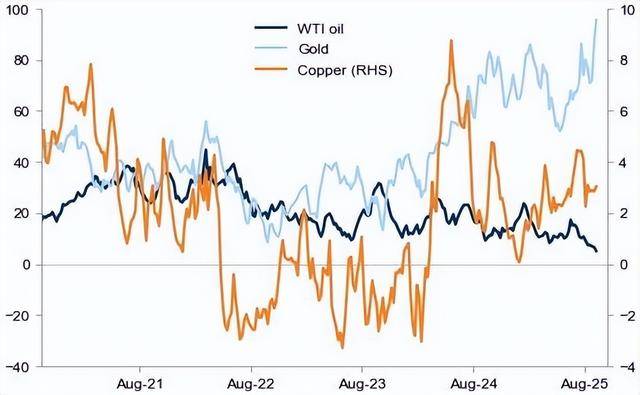
美元贬值

Search documents
Gold keeps hitting record highs, so how far could it climb, and what could kill the rally?
Youtube· 2025-09-24 19:46
Core Insights - Gold prices have recently reached new highs, with significant inflows into ETFs, but the potential for volatility remains a key factor that could amplify price movements [1][3][12] Gold Price Trends - Gold rallied to an all-time high of over $1,900 per ounce in 2020, followed by a three-year period of sideways movement before breaking out again [1][4] - The current breakout shows a steep trend, with gold prices up approximately 250% from the 2016 lows, but still below the 650% increase seen earlier in the century [5][6] Central Bank Influence - Central banks have been the largest buyers of gold over the past decade, with countries like China and Russia leading the trend of dollarization [6] - A pause or sell-off by central banks could pose a significant challenge to gold prices [7] Economic Factors - A weaker dollar and lower government treasury yields generally support gold prices, with current conditions indicating potential dollar weakness [7][10] - The Federal Reserve's interest rate cuts are typically bullish for gold, while elevated long-term rates may lead some investors to shift from gold to bonds [8][10] Volatility and Market Dynamics - Gold volatility, represented by the GVZ index, is currently low, but an increase in volatility alongside rising gold prices could create a bullish feedback loop [9][10] - Monitoring gold flows and GVZ is essential, as extreme conditions may signal potential price pullbacks [10] Geopolitical and Inflation Factors - Gold serves as a hedge against inflation and geopolitical uncertainty, both of which can drive prices higher [8][11] - Monthly inflation reports and geopolitical developments are critical for short-term trading strategies in the gold market [11]

美元失宠,美股走强:这局能维持多久?
伍治坚证据主义· 2025-09-24 09:23
Core Viewpoint - Investors are increasingly favoring U.S. stocks while simultaneously hedging against dollar risk, reflecting a lack of trust in U.S. fiscal and monetary policies [2][5][9] Group 1: Market Dynamics - The U.S. dollar index has dropped over 10% in 2025, indicating significant depreciation for a global reserve currency [2][5] - Despite the dollar's decline, U.S. stocks remain one of the most attractive assets globally, with over 80% of foreign funds entering the U.S. stock market hedging against currency risk [5][6] - This shift represents a paradigm change, as historically, investors did not pay much attention to currency risk when investing in U.S. stocks [5][6] Group 2: Monetary Policy Concerns - The Federal Reserve has initiated interest rate cuts, while other regions like Europe have ended their easing policies, leading to a loss of interest rate advantage for the dollar [6] - Concerns about the independence of the Federal Reserve are growing, especially with new appointments that align closely with political influences [6][8] - The combination of political influence on monetary policy and rising fiscal deficits raises doubts about the dollar's long-term stability [7][8] Group 3: Fiscal Challenges - The U.S. fiscal deficit is projected to reach 6.2% of GDP in 2024, with total federal debt nearing $36 trillion, over 30% of which will need refinancing within the next year [7] - The Treasury's reliance on rolling over debt raises concerns about fiscal sustainability, especially if monetary policy becomes politicized [7][8] Group 4: Investment Strategy - Investors are opting for a strategy of "buying stocks while avoiding the dollar," indicating a preference for equity exposure over currency risk [6][8] - The current market dynamics suggest that while investors may benefit in the short term, the long-term viability of this strategy is questionable as the credibility of the dollar erodes [8][9]




分化明显,博弈加剧,持仓还是持币?
Ge Long Hui· 2025-09-24 06:07
Market Overview - The market showed increased volatility with a notable divergence between bulls and bears, experiencing a rise followed by a pullback and then another surge. By midday, the Shanghai Composite Index rose by 0.63%, the Shenzhen Component increased by 1.11%, and the ChiNext Index climbed by 1.76%. Over 4,000 stocks in the two markets saw gains, with a total trading volume of 1.41 trillion yuan [1]. Chip Industry - The chip industry chain experienced a significant rally, surging by 7.02% by midday. More than 20 stocks, including ShenGong Co., Jingyi Equipment, and Jiangfeng Electronics, hit the daily limit. Notably, Zhangjiang Hi-Tech achieved a consecutive two-day limit increase, while Huasoft Technology and Xiangrikui both saw four consecutive limit increases, and Changchuan Technology and Shengmei Shanghai reached historical highs [3]. Real Estate Sector - The real estate sector showed signs of strength, with stocks like Dalong Real Estate achieving three limit increases in four days [3]. Robotics Sector - The robotics concept stocks were partially active, with Haoneng Co. hitting the daily limit [3]. Tourism Sector - The tourism sector faced a downturn, with stocks collectively dropping by 1.4% by midday. Companies such as Yunnan Tourism and Xiyu Tourism hit the daily limit down [3]. Other Industries - Several industries, including coal, wheel motors, precious metals, electric motors, synchronous reluctance motors, molten salt energy storage, and pumped storage, experienced slight declines [3]. Box Office Performance - According to data from Maoyan Professional Edition, as of September 23, 17:08, the pre-sale box office for new films during the 2025 National Day holiday has exceeded 5 million yuan [3]. Economic Outlook - Goldman Sachs indicated that as economic and market performance declines, high valuations are no longer justified, predicting further depreciation of the US dollar in the coming months [3]. Semiconductor Pricing - Samsung has significantly increased prices for its DRAM and NAND flash products, with some products seeing price hikes of up to 30% [3].
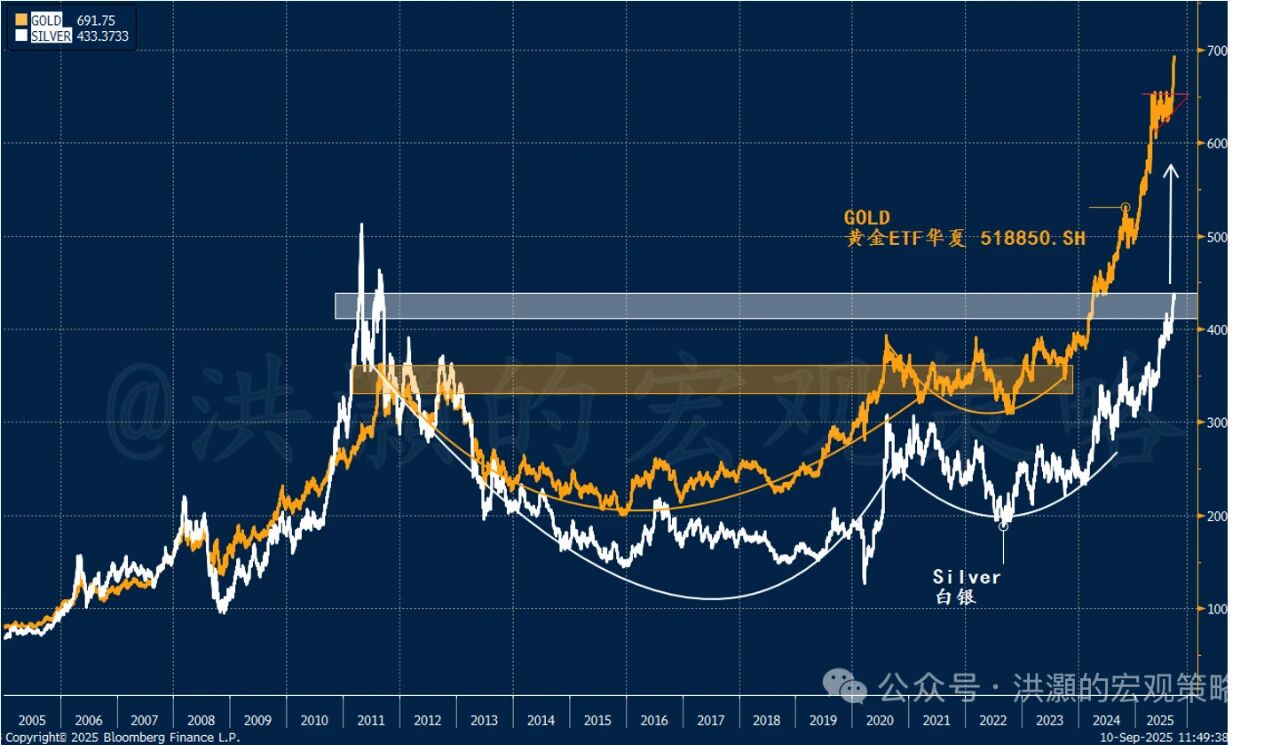
洪灝:未来5~7年美元会大幅贬值,金银上涨将超越市场认知
Di Yi Cai Jing· 2025-09-24 03:01
Group 1: Gold and Silver Price Trends - Gold has increased approximately sevenfold since 2005, while silver has risen over fourfold [1] - The cup and handle pattern observed in gold over the past 20 years suggests a potential breakout around 2024, with a high success rate of over 90% for this pattern [3] - Silver's price structure is mirroring that of gold, indicating a strong correlation between the two precious metals [4] Group 2: Economic Factors Influencing Precious Metals - The U.S. fiscal deficit and trade policies are expected to lead to significant depreciation of the dollar over the next 5 to 7 years [7] - The relationship between the dollar cycle and the U.S. current account deficit aligns closely, indicating that the dollar may have peaked [9] - The rise in gold prices is occurring despite increasing U.S. long-term bond yields, suggesting a shift in market perception of gold as a safe-haven asset [13] Group 3: Central Bank and Institutional Demand - Central banks are diversifying their foreign exchange reserves by increasing gold holdings, as evidenced by the rapid accumulation of gold by the Chinese central bank [15] - Global central bank assets in gold have surpassed those in U.S. Treasury bonds, indicating a long-term trend towards gold accumulation [17] - Gold ETFs are also increasing their holdings, which is expected to drive gold prices higher beyond current market expectations [20] Group 4: Market Dynamics and Future Outlook - The liquidity conditions globally are improving, which historically correlates with rising gold prices [20] - Gold prices have risen 40% this year and over 30% last year, indicating a strong upward trend, but new capital inflows are needed to sustain this momentum [21] - The price increases for precious metals, including gold and silver, are likely to exceed market expectations due to underlying economic factors [21]
2025有色金属行业复盘上世纪70年代黄金大牛市的启示黄金:历史的回响
Sou Hu Cai Jing· 2025-09-24 02:55
Core Insights - The report analyzes the historical context of the 1970s gold bull market, highlighting the impact of fiat currency credit fluctuations and macroeconomic policy adjustments on asset prices. It suggests that the lessons from this period are relevant for understanding the current gold market and macroeconomic conditions. Group 1: Historical Context of the 1970s Gold Bull Market - The shift in U.S. macroeconomic policy during the 1960s and 1970s, influenced by Keynesianism, prioritized economic growth and low unemployment, leading to persistent fiscal stimulus and rising deficits [2][3] - The Federal Reserve's monetary policy independence was challenged, resulting in a loosening of monetary discipline, which contributed to inflation and ultimately the rise in gold prices [2][3][4] - The U.S. faced a balance of payments crisis, with increasing trade deficits and a declining gold reserve, leading to a loss of confidence in the dollar and a subsequent gold price surge after the collapse of the Bretton Woods system in 1971 [3][4] Group 2: Inflation and Gold Demand - The early 1970s saw severe inflation, exacerbated by price controls that ultimately failed, leading to a rebound in inflation rates and increased demand for gold as a hedge against inflation [4][5] - By 1980, gold prices peaked at $850 per ounce, a more than 23-fold increase from $35 per ounce in 1970, driven by both foreign central bank purchases and domestic demand as inflation expectations soared [4][5] Group 3: End of the Gold Bull Market - The gold bull market ended with a fundamental shift in Federal Reserve policy under Chairman Volcker, who implemented tight monetary policies to control inflation, leading to a return of monetary discipline and a strengthening of the dollar [5][6] - Despite ongoing fiscal deficits in the 1980s, the respect for the Fed's independence and the return to monetary discipline marked the end of the gold super bull market [5][6] Group 4: Current Implications - The current U.S. economic landscape shares similarities with the 1970s, including high fiscal deficits and weakened monetary discipline, raising concerns about potential inflation and the stability of fiat currency [5][6][21] - The structure of gold demand has diversified, with emerging market central banks increasingly purchasing gold, which supports current gold prices [5][6][23] - The development of AI and geopolitical changes may introduce new variables affecting the gold market, suggesting that the dynamics of the current gold market differ from those of the 1970s [5][6][25]

果然财经|国际金价屡创新高,含“金”类资产表现如何?
Sou Hu Cai Jing· 2025-09-22 08:54
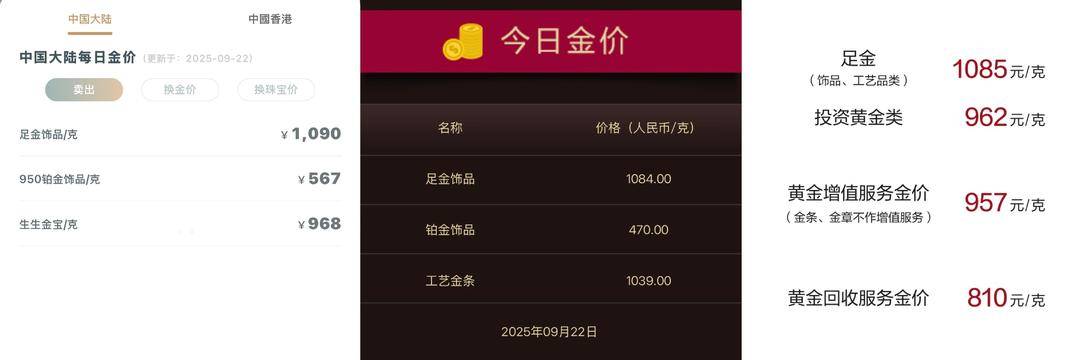
Core Viewpoint - The international gold price has surged significantly, breaking through key thresholds and showing a year-to-date increase of over 41% [1][2]. Gold Price Surge - In September, international gold prices rose rapidly, surpassing $3,500, $3,600, and $3,700 within half a month [1]. - Domestic gold jewelry prices also increased, with notable brands reporting price hikes, such as Chow Sang Sang at 1,090 RMB per gram, up 65 RMB from the beginning of the month [1]. Macro Economic Factors - The expectation of the Federal Reserve initiating a rate cut has contributed to the gold price increase, with the federal funds rate target range lowered by 25 basis points to 4.00% - 4.25% [2]. - The decrease in interest rates reduces the opportunity cost of holding gold, enhancing its attractiveness [2]. Central Bank Purchases - Central banks, particularly in emerging markets, have been significant buyers of gold, with a reported increase of 166 tons in Q2 2023 [2]. - China's central bank has increased its gold reserves for ten consecutive months, currently holding approximately 7,402 million ounces (over 2,000 tons) [2]. Geopolitical Risks - Ongoing geopolitical tensions, such as conflicts in the Middle East and the Russia-Ukraine situation, have heightened investor risk aversion, further driving up gold prices [3]. Related Gold Assets Performance - The A-share gold sector saw an 8.28% increase in the first half of September, with individual stocks like Western Gold rising over 50% [4]. - Gold-themed financial products have gained popularity, with 47 such products currently in the market, and several new products launched since July [4]. Financial Products and Early Profit-Taking - Some gold-linked financial products have experienced early profit-taking due to reaching predetermined conditions, such as the 招银理财 product achieving a target yield of 3.50% [5]. - The trend of early profit-taking has become a popular topic on social media [5]. Gold ETF Growth - The total market size of gold ETFs has surpassed 160 billion RMB, with many ETFs experiencing significant net asset growth [6]. - Companies like Shandong Gold have announced share placements to raise funds, reflecting a trend of financing in the gold mining sector due to favorable market conditions [6]. Investment Considerations - Investors are advised to be cautious in the current high gold price environment, as geopolitical uncertainties and the potential for market volatility may impact future performance [7][8]. - It is suggested that households consider a gold allocation of approximately 5% to 10% of their investment portfolio [8].
截至2025年9月19日,美元兑人民币最新汇率解读
Sou Hu Cai Jing· 2025-09-21 20:01
Core Viewpoint - The recent depreciation of the US dollar against the Chinese yuan, with the exchange rate reaching 7.11 yuan per dollar, indicates a shift in purchasing power favoring the yuan, impacting consumer behavior and economic opportunities [1][2][3]. Currency Exchange Impact - The current exchange rate allows consumers to purchase imported goods at lower prices, enhancing the affordability of overseas products such as electronics and cosmetics [3][4]. - A specific example illustrates that a $500 headphone, previously costing approximately 3,650 yuan at a 7.3 exchange rate, now costs about 3,555 yuan at the new rate, saving consumers nearly 100 yuan [4]. Opportunities for Travelers and Students - The favorable exchange rate presents economic advantages for students and travelers planning to study or travel abroad, as they can obtain more local currency for the same budget, thus covering more expenses [5][7]. Business and Investment Considerations - For businesses, particularly export-oriented companies, the appreciation of the yuan may reduce revenue when converted to yuan, necessitating hedging strategies to mitigate potential profit losses [7][9]. - Conversely, import-oriented businesses may benefit from lower procurement costs, enhancing profitability [7]. Future Exchange Rate Observations - Key indicators to monitor for future exchange rate trends include China's economic performance metrics such as GDP growth, export figures, and consumer market vitality, which could influence the yuan's strength [11]. - The US Federal Reserve's monetary policy, especially interest rate adjustments, will significantly impact the dollar's value [11]. - Global market dynamics, including stock market fluctuations and geopolitical tensions, may also affect short-term exchange rate movements [11].
洪灏最新分享:未来5-7年美元会实现比较大幅的贬值,贵金属价格仍将不断上涨
Sou Hu Cai Jing· 2025-09-20 13:43
Group 1 - The core viewpoint is that the US dollar is expected to weaken significantly over the next 5-7 years due to worsening fiscal and trade deficits, while gold has transitioned into a true safe-haven asset, driven by the weaponization of the dollar and global skepticism about its credibility [1][9][21] - Gold and silver have shown substantial price increases, with gold rising approximately sevenfold and silver over fourfold since 2005 [2][8] - The technical analysis indicates that both gold and silver are forming a "cup and handle" pattern, suggesting that future price increases may exceed market consensus expectations [4][5][49] Group 2 - The US fiscal deficit and trade imbalance are severe, leading to a depreciation of the dollar's value over the next several years [10][12][50] - The relationship between the dollar's cycle and the US current account deficit is closely aligned, indicating a long-term downtrend for the dollar [15][18] - The transition of gold into a genuine safe-haven asset is attributed to the changes in the dollar's credibility, particularly following the US's actions during the Russia-Ukraine conflict [26][27] Group 3 - China's central bank has significantly increased its gold holdings to diversify foreign exchange reserve risks, a trend that is being mirrored by other central banks globally [28][32] - The demand for US Treasury bonds is decreasing as central banks seek to mitigate losses, leading to a shift towards gold [30][32] - The growth of gold ETFs is not keeping pace with the rising gold prices, indicating a strong bullish sentiment for gold [33][35] Group 4 - Global liquidity conditions are improving, which is expected to continue driving gold prices upward [36][40] - The return rates for gold have been notably high, with a 40% increase this year and over 30% last year, suggesting a potential doubling of value since early 2024 [43][44] - Silver is anticipated to continue reaching new highs, following similar trends as gold [48]

降息利好出尽?A股遭遇震荡!别急,这四类资产有望脱颖未出
Sou Hu Cai Jing· 2025-09-19 09:26
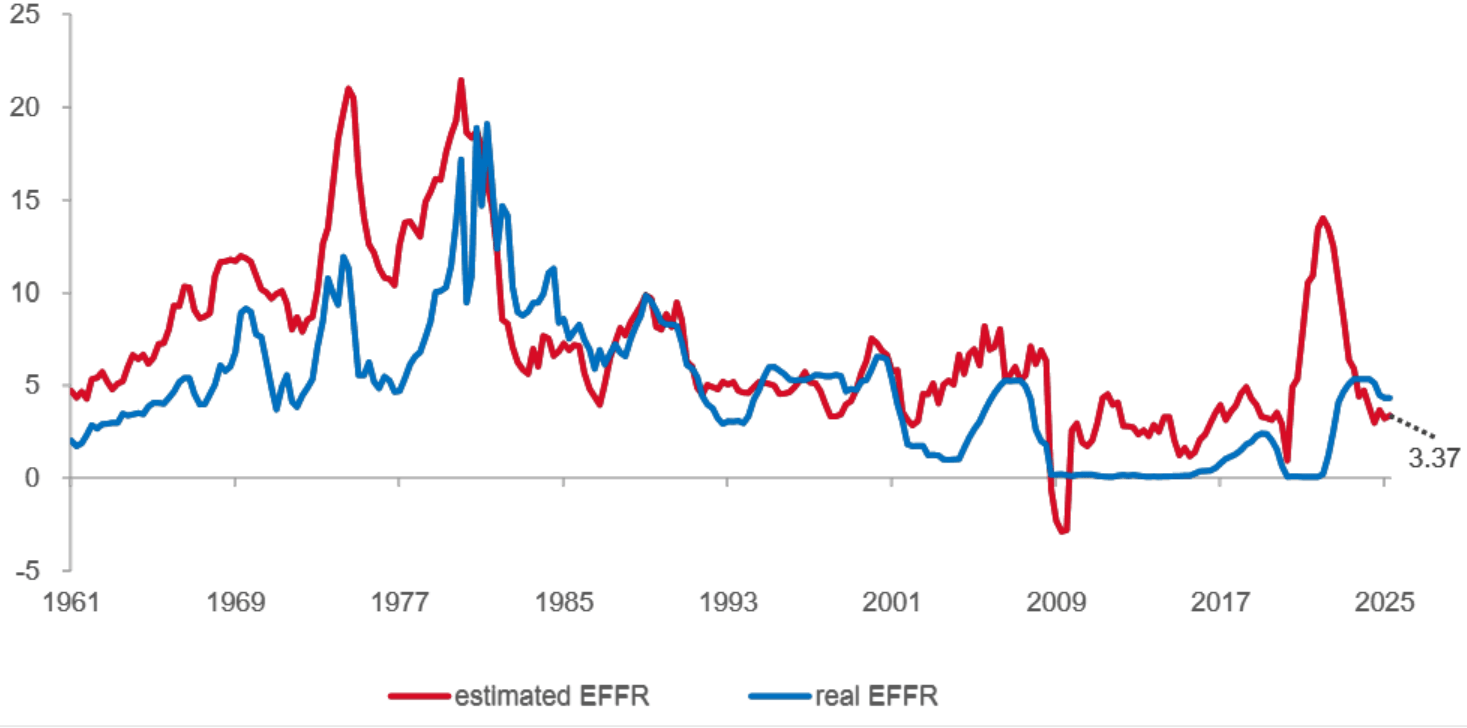
Core Viewpoint - The Federal Reserve announced a 25 basis point cut in the policy interest rate, bringing the federal funds target rate to a range of 4-4.25%, marking the first rate cut in nine months since December 2024. The market has already priced in this cut, and further rate cuts are expected in the coming months, with a total of three cuts anticipated by the end of the year [1][2]. Group 1: Interest Rate Impact - The current appropriate policy benchmark interest rate is estimated to be around 3.37%, indicating that the Federal Reserve has approximately 70 basis points of room for further cuts [1]. - The expectation of future rate cuts may lead to a decline in the dollar index and U.S. Treasury yields, potentially benefiting the A-share market due to a more accommodative dollar liquidity environment [1]. Group 2: Investment Opportunities - In the context of the Fed's rate cut, the focus for investors is on how to invest in quality assets. Historically, rate cuts lower financing costs and enhance liquidity, leading to a depreciation of the dollar, which can boost the prices of dollar-denominated commodities like gold and copper [4]. - Gold and commodities are expected to perform well during the rate cut cycle, as lower real interest rates reduce the opportunity cost of holding non-yielding assets like gold [4]. Group 3: Specific Asset Analysis - **Gold and Commodities**: The market's long-term funds are likely to respond positively to the rate cuts, with gold expected to show strong performance historically during such cycles [4][5]. - **Emerging Markets**: Following the rate cuts, U.S. domestic funds are anticipated to seek new opportunities in emerging markets, leading to increased capital inflows [6][7]. - **A-Share Technology Sector**: The reduction in financing costs is expected to accelerate capital expenditure and technological advancements in the tech sector, with semiconductor stocks showing significant growth [9][10]. - **Hong Kong Tech Stocks**: The Hong Kong market is particularly sensitive to external liquidity conditions, with historical data indicating strong performance during previous Fed rate cut cycles [11][12]. Group 4: Product Recommendations - For gold investments, the Huaan Gold ETF (518880) has shown stable returns, while the Yongying CSI Hong Kong Gold Industry ETF (517520) has a large scale and high market recognition [5]. - In emerging markets, the Huaan Mitsubishi Nikkei 225 ETF (513880) and the Huatai Baichuan Southeast Asia Technology ETF (513730) are recommended for exposure to Japanese and Southeast Asian markets, respectively [9]. - For A-share technology investments, the Tianhong CSI Robotics ETF (159770) and the E Fund CSI Sci-Tech Innovation 50 ETF (159781) are highlighted for their strong performance and low fees [10]. - In the Hong Kong market, the Southern East Asia Technology Index ETF (3033.HK) is noted for its favorable fee structure and scale, while the Fuguo CSI Hong Kong Internet ETF (159792) is recognized for its significant size and institutional backing [12].
股市热得发烫,外国央行却囤黄金抛美债!30年头一遭,藏着啥雷?
Sou Hu Cai Jing· 2025-09-18 12:47
Group 1 - The core market sentiment is positive, with rising stock prices, increasing gold prices, and profitable cryptocurrency investments [1][3] - Foreign central banks are shifting their reserves, now holding more gold than US Treasury bonds for the first time in 30 years, indicating a loss of trust in US government debt [3][5] - The current situation mirrors the late 1960s when central banks began to doubt the reliability of the US dollar, leading to a shift towards gold [3][5] Group 2 - There is a growing concern about the "hidden devaluation" of the dollar, where its purchasing power is diminishing despite stable exchange rates against other currencies [5][10] - The Federal Reserve's potential interest rate cuts are seen as a double-edged sword, historically leading to stock market gains but raising questions about long-term economic stability [8][10] - The current market dynamics are characterized by a focus on liquidity rather than fundamentals, with investors ignoring corporate earnings and fiscal realities [12][15] Group 3 - The rise in gold and cryptocurrency investments reflects a broader fear of inflation and distrust in monetary policy, similar to trends observed in the 1970s [12][14] - The real estate market is facing challenges due to a disparity in mortgage rates, which could hinder the effectiveness of monetary policy [17] - The overall market environment resembles a festive atmosphere, but the sustainability of this situation depends on the stability of long-term bond yields [19]