AI产业链

Search documents
东方财富证券陈果:2026年中国资产重估逻辑将继续演绎,A股新高可期
Zheng Quan Shi Bao Wang· 2025-11-18 11:23
Core Insights - The 2026 strategy report by Dongfang Caifu Securities highlights the ongoing asset revaluation logic in China, suggesting that both domestic and foreign investments are likely to increase in the equity market, indicating a potential for new highs in A-shares [1] Group 1: Market Outlook - The report anticipates a continued expansion of the AI industry chain's prosperity, alongside a recovery in the Producer Price Index (PPI) year-on-year, which is expected to support a warming profit cycle [1] - There is significant room for improvement in domestic residents' allocation to equity assets, which could lead to a resonance in market dynamics [1] Group 2: Economic Indicators - The current phase of broad de-inventory is expected to stabilize, with the real estate inventory-to-sales ratio returning to historical averages in the second half of the year, suggesting a gradual improvement in traditional economic chains [1] - The report emphasizes that the proportion of "new momentum" in the economy is set to increase further, indicating a shift in economic drivers [1]

创业板布局机会受资金关注,创业板ETF(159915)全天净申购超3.6亿份
Sou Hu Cai Jing· 2025-11-18 09:54
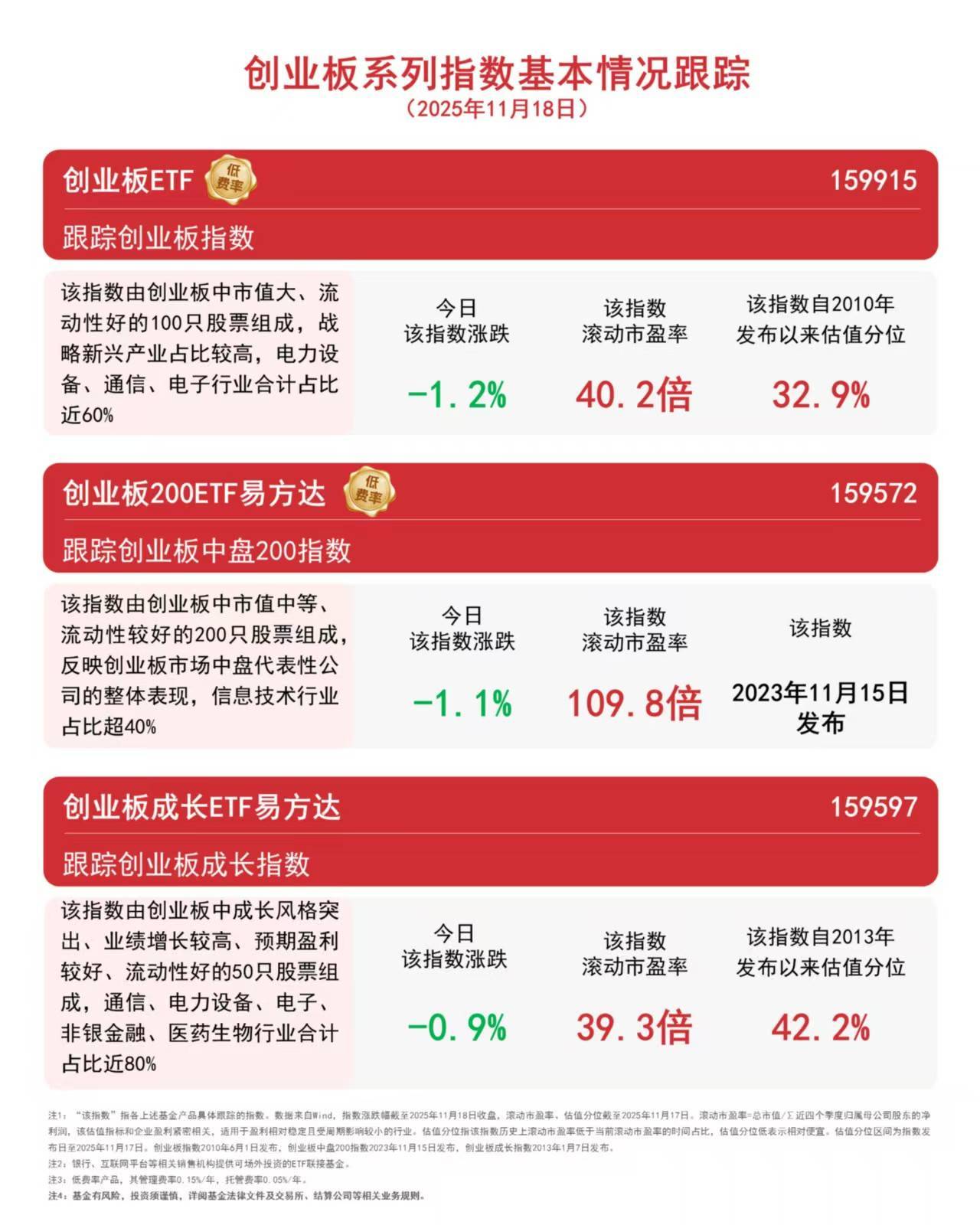
今日市场震荡调整,创业板内部表现分化,光伏、锂电等新能源方向集体下挫,CPO、软件等AI产业链方向相对活跃。截至收盘,创业板成长指数下跌 0.9%,创业板中盘200指数下跌1.1%,创业板指数下跌1.2%。资金"越跌越买",创业板ETF(159915)今日净申购超3.6亿份,该产品此前两个交易日合计净 流入约10亿元。 每日经济新闻 ...


申万宏源傅静涛:A股牛市远未结束 2026年可能启动全面牛
Xin Lang Zheng Quan· 2025-11-18 03:58
Core Viewpoint - The A-share bull market is far from over, with "Bull Market 1.0" expected to peak in spring 2026, followed by a potential "Bull Market 2.0" in the second half of 2026 [1][2] Group 1: Market Dynamics - Global competition is intensifying, necessitating a shift in mindset for A-shares to embrace competitive thinking, which will drive market dynamics [1] - The transition of Chinese residents' asset allocation towards equities is still in its early stages, indicating further potential for A-share liquidity improvement [1][2] Group 2: Bull Market Phases - "Bull Market 1.0" is anticipated to reach a peak in spring 2026, with a subsequent transition to "Bull Market 2.0" in the latter half of 2026 [2] - The second phase, "Bull Market 2.0," is expected to be a comprehensive bull market driven by improvements in fundamental cycles, emerging industry trends, and increased global influence of China [2][3] Group 3: Profit Forecasts - Predictions for 2026 indicate two significant milestones: the first effective rebound in profitability for all A-shares in five years and the first double-digit growth in net profit attributable to shareholders in five years [3] - Forecasted year-on-year growth rates for net profit attributable to shareholders are 7% for 2025 and 14% for 2026, with substantial quarterly growth expected [3] Group 4: Sector Trends - The transition from "Bull Market 1.0" to "Bull Market 2.0" will see high-dividend defensive stocks outperforming, while the latter phase will focus on cyclical recovery and growth sectors [3] - Key structural themes for 2026 include recovery trades in cyclical sectors, technology industry trends with opportunities in AI, and enhanced manufacturing influence [3]

当前或可关注高性价比主线,如恒生科技、国产算力等方向
Mei Ri Jing Ji Xin Wen· 2025-11-17 02:46
Group 1 - A-shares experienced slight declines in early trading on November 17, with the computer and electronics sectors showing the most gains, while lithium mining and related concepts were active [1] - The Cloud Computing 50 ETF (516630) rose over 1%, with top-performing stocks including Dongfang Guoxin (300166) and Yidian Tianxia (301171), the latter seeing a peak increase of over 12% [1] - Hong Kong stocks saw all three major indices decline, with the Hang Seng Technology Index ETF (513180) following suit, led by declines in stocks like Trip.com and Lenovo, while stocks such as Hua Hong and Alibaba showed gains [1] Group 2 - Huatai Securities noted that short-term uncertainties remain, suggesting a market trend characterized by fluctuations, with a shift towards a balanced "dumbbell" structure in asset allocation [2] - Key focus areas include high-cost performance sectors, particularly in the AI industry chain, which has seen a decrease in congestion since July, and low-positioned stocks in sectors like engineering machinery and textiles [2] - Current uncertainties in both domestic and international markets may still present opportunities for investment in banks and certain cyclical dividend stocks [2] Group 3 - The Hang Seng Technology Index ETF (513180) includes core Chinese technology assets such as Xiaomi, NetEase, Tencent, Alibaba, and Meituan, which are relatively scarce compared to A-shares [3] - The Cloud Computing 50 ETF (516630) covers popular concepts in computing power, including optical modules, data centers, and AI servers [3]
海外市场 | 美联储降息预期降温,黄金价格跌破4100美元
Sou Hu Cai Jing· 2025-11-17 02:46
Group 1 - The U.S. stock market showed mixed performance last Friday, with the Dow Jones and S&P 500 slightly down, while the Nasdaq index increased by 0.13% [1] - Technology stocks had varied movements, with Nvidia and Microsoft seeing gains, while some Chinese concept stocks faced pressure and the Nasdaq Golden Dragon China Index significantly retreated [1] - The Federal Reserve ended a 43-day pause, potentially signaling the end of a lack of relevant economic data, with CME predicting a less than 50% probability of a rate cut in December [1] Group 2 - Market attention is focused on Nvidia's earnings report and signals from the Federal Reserve, as their outcomes may influence sentiment in the technology sector [1] - In the medium to long term, the AI industry chain and the valuation recovery of Chinese concept stocks remain the main focus for capital allocation, although short-term volatility risks should be monitored [1] - Gold prices have corrected, with spot gold in London falling below $4,100 per ounce [1]
华泰证券:市场走势或仍以震荡为主,沿高性价比方向布局
Mei Ri Jing Ji Xin Wen· 2025-11-16 15:17
Core Viewpoint - The report from Huatai Securities indicates that short-term uncertainties persist, leading to a market trend characterized by fluctuations. However, there is a shift towards a balanced "barbell" investment structure due to rapid changes in market focus [1] Group 1: Market Focus - The high cost-performance mainline remains one of the market's focal points, with the AI industry chain's congestion level dropping to its lowest since July. Attention is drawn to low-positioned targets in sectors such as Hang Seng Technology, domestic computing power, AI edge applications, and related fields [1] - There are opportunities for left-side positioning in sectors with performance improvement at low levels, including engineering machinery, textile manufacturing, photovoltaic equipment, general equipment, rail and road, building materials, and certain mass consumer sectors [1] Group 2: Investment Opportunities - Given the impact of domestic and international uncertainties, there are still potential investment opportunities in banks and certain cyclical dividend stocks [1]

惠理投资盛今:南向资金定价权提升港股中长期配置价值凸显
Shang Hai Zheng Quan Bao· 2025-11-16 14:02
Core Viewpoint - The Hong Kong stock market is experiencing a significant valuation recovery, driven by a global rebalancing of funds towards non-US markets and asset revaluation led by industry narratives [1][2]. Group 1: Market Trends - The Hang Seng Index has seen a notable decline due to multiple factors, including the strong US dollar impacting emerging market valuations. However, with the weakening dollar and other uncertainties, there is a trend of global funds reallocating towards non-US assets, boosting emerging markets [1]. - As of October 2023, the proportion of overseas active funds allocated to the Chinese market has risen to 7.2%, indicating growing international interest [2]. Group 2: Valuation Insights - The Hang Seng Index's price-to-earnings ratio is projected to be around 10.6 times by the end of 2024, with risk premiums at historical highs, suggesting a high safety margin for investors [2]. - Current valuations of Hong Kong stocks are above historical averages by 1.5 to 1.7 standard deviations, indicating potential short-term pullback pressure, but long-term policy clarity and increased foreign capital inflow are expected to support the market [2]. Group 3: Southbound Capital Influence - Southbound capital's pricing power in the Hong Kong market is strengthening, with daily trading volume from this capital reaching approximately 30% of the main board's total, reflecting its growing influence [3]. - Despite recent volatility in the Hong Kong market, the overall outlook remains optimistic for the medium term [3]. Group 4: Investment Opportunities - Key investment opportunities in the Hong Kong market include: 1. Continued development of the AI industry and improved competition in the internet sector due to "anti-involution" policies, alongside a gradual recovery in certain consumer segments [4]. 2. Strengthening of China's manufacturing advantages and breakthroughs in key technologies, particularly in high-end manufacturing and hard tech sectors [4]. 3. Improved policy environment in the healthcare sector, enhancing competitiveness and growth potential in biopharmaceuticals [4]. 4. Recovery in profit expectations for the chemical and raw materials sectors, making related companies' performance worth monitoring [4]. 5. Potential rotation of capital from high-dividend sectors like telecommunications and utilities towards cyclical and growth assets [4].
风格扩散的两种潜在结局
Xinda Securities· 2025-11-16 03:24
Group 1 - The report indicates that over the past two months, the value style has strengthened significantly, with financial, cyclical, and consumer sectors rotating in performance [2][10][11] - The core reason for this style diffusion is attributed to the performance window before year-end, where sectors lack high-frequency quarterly reports to validate performance, leading to volatility driven mainly by valuation and expectations [2][10] - Historical context shows that in the second half of 2014, a liquidity bull market saw a shift from TMT to value, with cyclical and financial sectors performing well, although this trend was short-lived [2][10][18] Group 2 - The report notes that the current style diffusion is still in a phase driven by valuation, expectations, and capital inflow, which is expected to last at least 1-2 quarters [2][10][25] - For the style diffusion to transition into an annual-level market, the profitability logic of value stocks needs to be validated [2][10][25] - The report suggests that in the later stages of the liquidity bull market, the technology sector, which has a stronger long-term industrial logic, may return to prominence before the stabilization of value stock fundamentals [2][10][25] Group 3 - The report highlights that the financial sector is currently undervalued, with a high probability of outperforming as resident capital accelerates inflow [29][34] - The electrical equipment sector is noted for its potential growth, benefiting from investments in the AI industry and improving supply-demand dynamics [29][34] - The cyclical sector, particularly steel and chemicals, is expected to see opportunities due to stabilizing supply policies and potential demand recovery [29][34]
申万宏源策略一周回顾展望(25/11/10-25/11/15) :牛市“1.0”阶段的高位区域
Shenwan Hongyuan Securities· 2025-11-15 13:37
Core Insights - The report indicates that the current "Bull Market 1.0" phase is at a high level, with insufficient long-term cost-effectiveness in the technology sector, and increasing resistance to further upward breakthroughs. The cyclical market is still in a "running ahead" phase, with mid-term logic showing gaps, and conditions for the initiation of "Bull Market 2.0" are not yet complete. It is advised to focus on small wave rhythms based on short-term cost-effectiveness in a high-level oscillation market [1][4][6] - The A-share AI industry chain is currently in a state of "the major industrial trend has not ended + small fluctuations + long-term low cost-effectiveness area." Historical experience suggests that future trends will typically be divided into "high-level oscillation phase" and "adjustment phase" [1][4][6] - The report outlines three challenges that the A-share market may face in the spring of 2026, which could be a potential peak: 1. Long-term low cost-effectiveness in technology, which may trigger adjustments; 2. A critical verification period for demand-side conditions; 3. Conditions for the transition to "Bull Market 2.0" are not yet mature [1][6][7] Market Phases - The high-level oscillation phase makes it increasingly difficult to earn valuation money, and new industrial catalysts or sustained high growth in performance are less likely to lead to upward breakthroughs. This phase typically lasts at a quarterly level, and adjustments may not occur immediately [4][5][6] - The adjustment phase is usually triggered by intermediate disturbances in industrial trends, which do not signify the end of structural bulls but may adjust to reasonable levels between bull and bear markets [5][6][7] Investment Focus - In the current high-level oscillation zone, both cyclical and technology sectors should focus on Alpha opportunities. Short-term cyclical investments should prioritize sectors with favorable supply-demand dynamics, such as basic chemicals and industrial metals, as well as high-dividend-rewarding coal and leading oil companies in Hong Kong [1][6][7] - Short-term opportunities in technology growth mainly come from small wave rebounds, with a focus on sectors with new catalysts or significant industrial space, particularly energy storage and storage solutions. Additionally, sectors with upward economic outlooks and relatively high cost-effectiveness may see early gains before spring 2026, especially in innovative pharmaceuticals and national defense industries [1][6][8]
华泰研究 | 本周精选:电网设备、全球算力、策略、美国政府、货币政策
Sou Hu Cai Jing· 2025-11-15 05:17
Group 1: Long-term Fund Positioning - In Q3 2025, long-term funds such as insurance funds and state-owned capital increased their positions in low-yield, high-dividend assets like banks and airlines due to asset crowding considerations [1] - There is a renewed focus on technology assets among long-term funds, with insurance funds showing less interest in high-performing sectors like telecommunications and media, while social security funds are more engaged with the AI industry chain, investing in both hardware and software [1] Group 2: A-share Market Strategy - The A-share market experienced fluctuations with manufacturing and cyclical stocks leading the gains, while technology stocks continued to adjust [3] - Historically, the third phase of an upward market is often driven by earnings, indicating a potential shift from a liquidity-driven market to a fundamentals-driven one [3] - Key indicators of economic improvement are found in the AI chain, price increases, capital goods, and consumer goods, suggesting a "barbell" investment strategy with opportunities in relatively low-positioned sectors like electric new energy and chemicals [3] Group 3: Monetary Policy Insights - The central bank is expected to maintain a loose monetary policy in the short term, with no further interest rate cuts anticipated before the end of next year [4] - The central bank will focus on structural policy tools to lower financing costs for the real economy and improve the transmission mechanism of policies [5]