
人民币汇率

Search documents
人民币汇率破7背后
2 1 Shi Ji Jing Ji Bao Dao· 2026-01-04 14:56
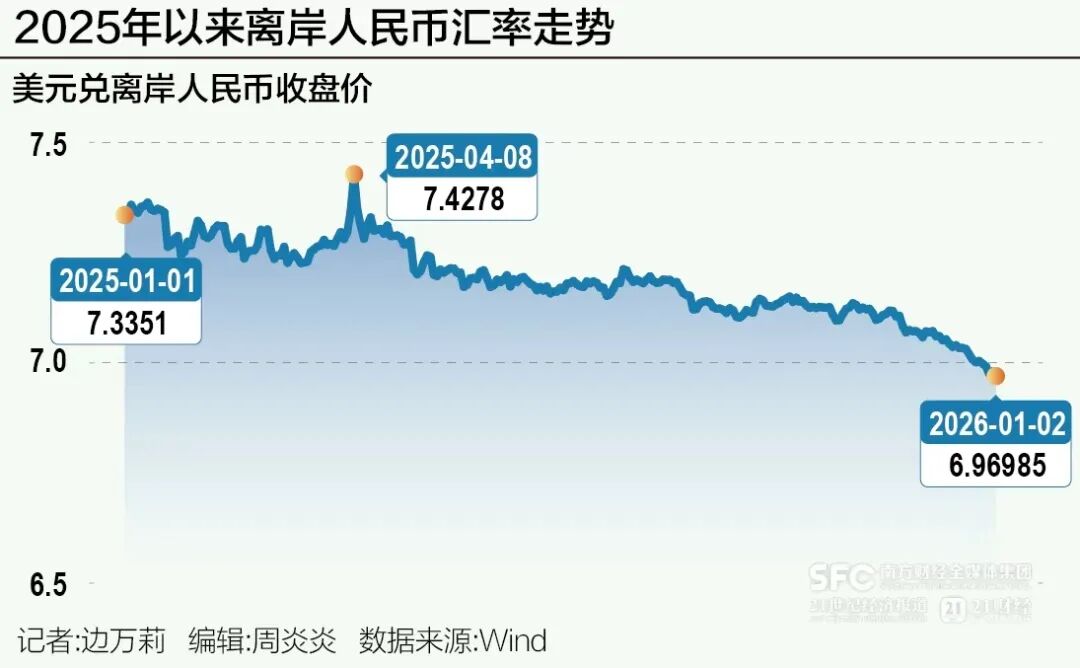
Core Viewpoint - The RMB/USD exchange rate is expected to experience a "weak first, strong later" trend in 2025, with the rate fluctuating between 7.30 and 7.35 until early April, followed by a significant appreciation towards the end of the year, breaking the key psychological level of "7" [1][4][6]. Group 1: Factors Influencing RMB Appreciation - The recent appreciation of the RMB is attributed to multiple factors, including a weakening USD, a stable Chinese economic fundamental, and increased demand for currency settlement at year-end [1][6][8]. - The RMB's rise is supported by the resilience of exports and the attractiveness of RMB-denominated assets, which have contributed to the upward pressure on the currency [8][10]. - The correlation between the USD index and the RMB exchange rate indicates that a 3% depreciation in the USD typically corresponds to a 1% appreciation in the RMB, highlighting the impact of USD movements on RMB valuation [6][8]. Group 2: Seasonal and Market Dynamics - Seasonal factors also play a role in the RMB's appreciation, with historical trends showing stronger appreciation at the end of the year due to increased settlement needs from exporters [7][8]. - The end-of-year settlement demand from export enterprises has been identified as a significant driver for the RMB's rise, as companies accelerate currency conversion to avoid exchange losses [8][10]. - The market sentiment has shifted, with previously bearish views on the RMB reversing as Chinese assets become more attractive compared to US assets, leading to a reversal of previously held foreign capital [8][10]. Group 3: Outlook for 2026 - The People's Bank of China (PBOC) aims to maintain the RMB exchange rate at a reasonable and balanced level, emphasizing the prevention of excessive fluctuations and the need for a stable monetary policy [10][11]. - Factors that may support the RMB in 2026 include a potential weakening of the USD due to economic pressures and a rebound in the Chinese economy, which could sustain the RMB's appreciation momentum [11][12]. - The RMB is expected to maintain a dual-directional fluctuation pattern, with projections indicating a trading range between 6.9 and 7.3 against the USD throughout 2026 [12].

深度|人民币“破7”冷思考
2 1 Shi Ji Jing Ji Bao Dao· 2026-01-04 14:18
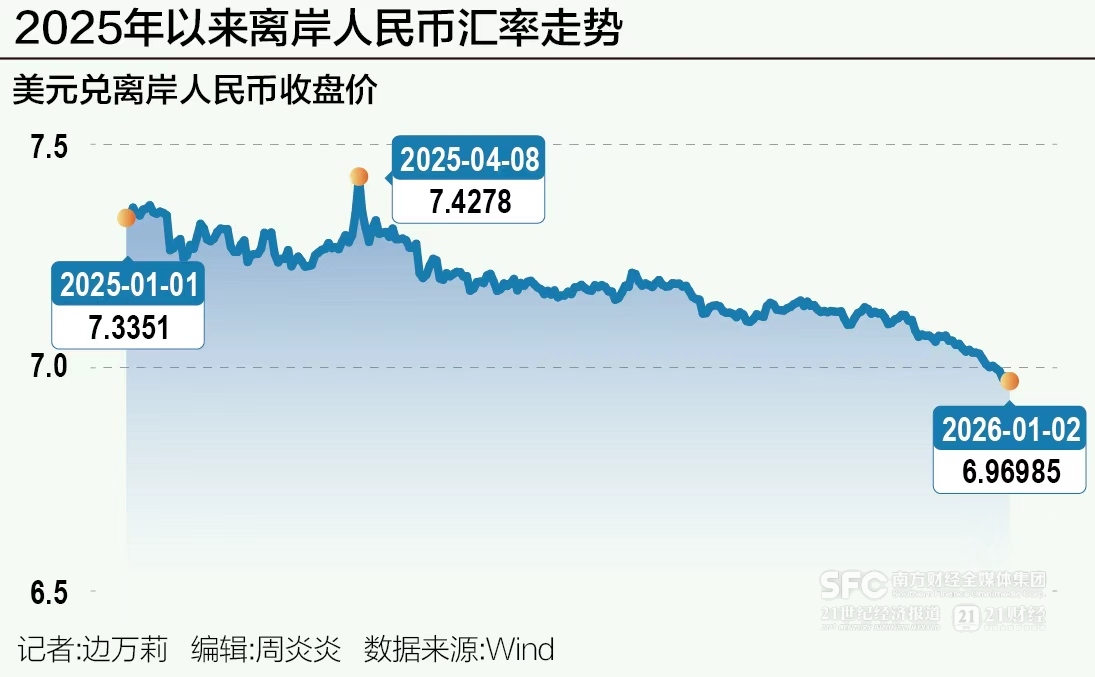
Core Viewpoint - The RMB/USD exchange rate is expected to exhibit a "weak first, strong later" trend in 2025, with a significant appreciation towards the end of the year, breaking the key psychological level of "7" due to multiple factors including a weakening dollar and a stable Chinese economy [1][5][10]. Group 1: Exchange Rate Trends - From early 2025 to early April, the RMB/USD exchange rate fluctuated weakly around 7.30-7.35, before turning to a trend of appreciation starting in April [1][4]. - By December 25, the offshore RMB broke the 7 mark, reaching a new high since September 2024, while the onshore RMB also surpassed 7.0, marking its highest level since May 2023 [4][5]. - The RMB's appreciation is attributed to a weakening dollar, a stable economic performance in China, and increased demand for currency settlement at year-end [5][6]. Group 2: Factors Influencing Exchange Rate - The weakening of the dollar is identified as a primary driver for the RMB's appreciation, with the dollar index dropping significantly in the latter part of 2025 [5][6]. - Seasonal factors also play a role, as historical trends show that the RMB tends to appreciate at the end of the year due to increased settlement needs from exporters [6][7]. - The interplay between the RMB's appreciation and the settlement behavior of export enterprises creates a positive feedback loop, further supporting the currency's strength [7][8]. Group 3: Future Outlook - The People's Bank of China aims to maintain the RMB's stability at a reasonable and balanced level, with a focus on preventing excessive fluctuations and ensuring a dual-directional volatility in the exchange rate [8][9]. - In 2026, the RMB is expected to experience dual-directional fluctuations, influenced by the relative strength of the US and Chinese economies, changes in dollar interest rates, and the evolution of China's foreign trade relationships [1][10]. - Analysts predict that the RMB will likely remain within the range of 6.9-7.3, with various factors contributing to its stability and potential appreciation [10][11].
人民币汇率破7背后
21世纪经济报道· 2026-01-04 14:18
Core Viewpoint - The article discusses the "weak then strong" trend of the RMB against the USD in 2025, highlighting a significant appreciation towards the end of the year due to multiple factors including a weakening USD, stable Chinese economic fundamentals, and increased demand for currency settlement [1][5][6]. Summary by Sections RMB Exchange Rate Trend - In 2025, the RMB/USD exchange rate showed a "weak then strong" trend, fluctuating around 7.35 until early April, before reversing to an upward trend [5][6]. - By December 25, the offshore RMB broke the 7 mark, reaching a new high since September 2024, while the onshore RMB also surpassed 7.0, marking the highest level since May 2023 [6][7]. Factors Driving RMB Appreciation - The appreciation of the RMB is attributed to a weaker USD, a resilient Chinese economy, and increased year-end currency settlement demands [6][7][9]. - The correlation between the USD index and RMB exchange rate indicates that for every 3% depreciation of the USD, the RMB appreciates by approximately 1% [7][8]. Seasonal and Market Dynamics - Seasonal factors contribute to RMB appreciation, particularly at year-end when exporters have higher settlement needs, which boosts demand for RMB [8][9]. - The article notes that the strong performance of exports and the attractiveness of RMB-denominated assets also play significant roles in the recent appreciation [9][10]. Future Outlook for 2026 - The outlook for 2026 suggests that the RMB will likely experience two-way fluctuations rather than a one-sided trend, influenced by the relative strength of the US and Chinese economies, changes in USD interest rates, and the evolution of China's foreign trade relationships [1][11][12]. - Analysts predict that the RMB will maintain a stable range between 6.9 and 7.3, with potential for appreciation if the USD continues to weaken [13][14].

年初人民币冲高!2026年有望偏强运行,单边走势难持续
Bei Jing Shang Bao· 2026-01-04 12:24
北京商报讯(记者 岳品瑜 董晗萱)新年伊始,人民币延续上年末升值走势。2026年1月2日,离岸人民币对 美元汇率时隔两年半首次升破6.97,最高升至6.9664,创2023年5月以来新高。 数据显示,在岸人民币对美元全年累计涨幅约为4.3%,离岸人民币累计升值幅度4.9%;人民币对美元中间价 总计调升1596个基点。 不过同时可以看到,2025全年CFETS等三大人民币对一篮子货币汇率指数分别比上年末下降2.2%至3.8%。东 方金诚首席宏观分析师王青解释道,这种分化背后的主要原因在于,包括美国在全球范围内大幅加征关税在 内,2025年特朗普政府上台后推出一系列重大内外政策,市场对美元信心出现动摇,全年美元指数下跌 9.4%。这就导致2025年非美货币对美元普遍升值,也推升了人民币对美元汇价。这样来看,2025年4月以来 人民币对美元汇价从7.35一路升值到"破7",主要是美元大幅走低带来的被动升值效应所致。2025年人民币对 美元中间价升值2.2%,升值幅度明显低于在岸、离岸市场汇价,波动幅度较小,主要源于中间价在汇市波动 加剧阶段有效发挥了稳汇价作用。 展望未来,王青预测,考虑到春节前企业结汇需求有可能持 ...

人民币破7,是阶段反弹还是趋势变化
Hua Tai Qi Huo· 2026-01-04 12:15
1. Report's Industry Investment Rating - Not provided in the given content 2. Core Viewpoints of the Report - In December, the economic divergence between China and the US became more apparent. The US labor market continued to cool, with the unemployment rate rising to 4.6% in November and non - farm payroll growth slowing. The US stock market corrected at the end of the year. In contrast, China's economy remained stable, with the manufacturing PMI rising slightly and the technology sector performing strongly. The RMB exchange rate and asset prices showed positive resonance [1]. - The attractiveness of US dollar assets has been continuously weakening. The short - end interest rate in the US has been declining, and the risk - return ratio of US dollar assets has decreased. The RMB pricing range has shifted downwards, and the RMB is likely to be strong, have low volatility, and its center of gravity will gradually move down in the short term [3]. - In the context of a weak US dollar and changes in the domestic foreign exchange structure, the RMB will maintain a strong and low - volatility pattern in the short term, and the area around 7.00 will gradually become an important operating range [4]. 3. Summary by Relevant Catalogs Market Analysis - **Economic Divergence between China and the US**: In December, the US labor market cooled, with the November unemployment rate at 4.6% and non - farm payroll growth slowing. The government shutdown and tariff policies affected enterprises, leading to a year - end correction in the US stock market. In China, the economy was stable, the manufacturing PMI rose slightly in December, the technology sector was strong, and A - share risk appetite improved [1]. - **Weakening of US Dollar Assets**: The short - end interest rate in the US has been declining, and the market has priced in a faster rate - cut path in 2026. Fiscal expansion and US Treasury supply pressure limit the decline in long - term yields. The risk - return ratio of US dollar assets has decreased, and cross - border capital allocation is being adjusted [2]. - **Changes in Foreign Exchange Supply**: In 2025, China's foreign trade performance exceeded expectations. In November, exports grew by 5.8% year - on - year, and imports grew by about 1.9% year - on - year. The 12 - month rolling trade surplus was close to $1.2 trillion. The surplus expansion changed the domestic foreign exchange structure, with more foreign exchange remaining in the banking and corporate sectors [2]. - **RMB Exchange Rate Breakthrough**: At the end of December, the on - shore and off - shore RMB both broke through the 7.00 mark, breaking the 7.0 - 7.3 range that had lasted for more than a year. The RMB is likely to be strong, have low volatility, and its center of gravity will gradually move down in the short term, and 7.00 is becoming a new operating center [3]. Strategy - In the context of a weak US dollar and changes in the domestic foreign exchange structure, the RMB will maintain a strong and low - volatility pattern in the short term, and the area around 7.00 will gradually become an important operating range [4]
11月外汇市场分析报告:人民币汇率升值加快,但结汇潮仍缺乏数据支持
Bank of China Securities· 2026-01-04 11:37
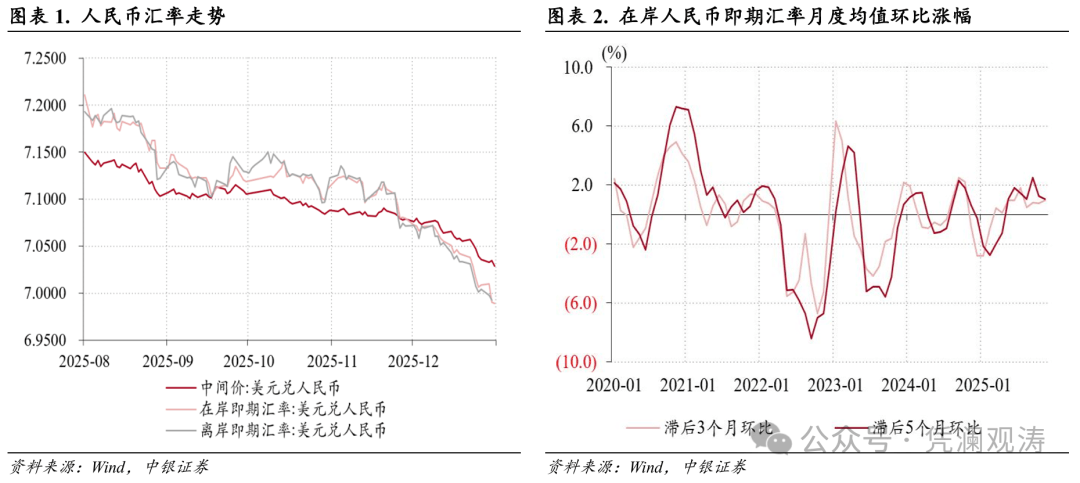
Report Industry Investment Rating - The report does not provide an industry investment rating [1][2] Core Viewpoints - In November 2025, the U.S. dollar index fluctuated and declined. The RMB exchange rate resumed the "three - price" unity, and the market did not accumulate strong exchange - rate appreciation expectations. The RMB led the rise among major non - U.S. currencies, driving the multilateral exchange - rate index to rebound [3]. - The cross - border capital inflow scale narrowed month - on - month. Goods trade and securities investment were the main contributors. The upward swap points of the U.S. dollar against the onshore RMB significantly compressed the foreign capital arbitrage space, and the balance of RMB bonds held by foreign investors decreased for the seventh consecutive month. Foreign investors remained cautious about the stock market but were more confident about its prospects [3]. - Bank settlement and sales of foreign exchange remained basically stable. The willingness of market entities to settle foreign exchange weakened, and the balance of domestic foreign - exchange deposits of financial institutions hit a record high. The recent acceleration of RMB appreciation may lead to exchange losses for domestic investors holding U.S. dollar deposits, inducing relevant entities to accelerate foreign - exchange settlement [3]. - A decline in the real effective exchange rate does not mean the undervaluation of the domestic currency. The weakening of China's real exchange rate is mainly due to strong domestic supply, weak demand, and low price trends. Restoring internal economic balance is the fundamental measure to prevent the intensification of external imbalances, and a significant appreciation of the RMB should not be used as a policy tool [3] Summary by Related Content 1. RMB Exchange Rate Performance - In November, the Fed's interest - rate cut expectations fluctuated greatly. The U.S. dollar index ended its rebound in the previous month, fluctuated between 99 and 100, and fell 0.3% to 99.4 for the whole month. The RMB exchange rate continued its catch - up appreciation. The central parity rate gradually appreciated, accumulating an appreciation of 91 basis points to 7.0789 against the U.S. dollar; the onshore spot exchange rate appreciated faster, accumulating an appreciation of 341 basis points to 7.0794 against the U.S. dollar, reaching a new high since mid - October 2024; the offshore exchange rate appreciated 511 basis points to 7.0713 compared with the end of the previous month. The RMB exchange rate resumed the "three - price" unity, indicating that market expectations remained basically stable [4]. - The average spot exchange rate with a 3 - month lag in November appreciated for the ninth consecutive month, with a gain of 0.9%, a new high in the past four months; the average spot exchange rate with a 5 - month lag appreciated for the seventh consecutive month, and the appreciation rate exceeded 1%, which might increase the negative impact on the financial situation of export enterprises. However, under the goal of exchange - rate stability, the change range of the spot exchange rate in the past three years has significantly narrowed, and the overall impact on the financial situation of export enterprises is limited. In the first 11 months of 2025, the scale of enterprises using foreign - exchange derivatives such as forwards, swaps, and options to manage exchange - rate risks reached 1.75 trillion U.S. dollars, the hedging ratio increased by 3.4 percentage points to 30.2% compared with the previous year, and the proportion of RMB settlement in goods trade was nearly 30%, both reaching record highs, which helped foreign - trade enterprises avoid exchange - rate risks [5]. - In November, the RMB led the rise among major non - U.S. currencies. The RMB multilateral exchange - rate index continued its overall upward trend since July, but the month - on - month increase narrowed. The CFETS RMB exchange - rate index, the RMB exchange - rate index referenced to the BIS currency basket, and the RMB exchange - rate index referenced to the SDR currency basket rose 0.3%, 0.6%, and 0.2% respectively, lower than the previous month's increases of 0.9%, 1.2%, and 1.1%. Affected by the rebound of the nominal effective exchange - rate index, the real effective exchange - rate index of the RMB released by the BIS rebounded for the fifth consecutive month, and the increase expanded to 0.8%, a new high in the past five months. The cumulative decline in the first 11 months narrowed from 5.8% in the first half of the year to 3.2% [6] 2. Cross - border Capital Flows - In November, the surplus of banks' foreign - exchange receipts and payments on behalf of customers continued from the previous month, but the surplus scale dropped sharply from 51.1 billion U.S. dollars in the previous month to 17.8 billion U.S. dollars, lower than the average level of 24 billion U.S. dollars in the previous two months. In terms of currency, the RMB's foreign - exchange receipts and payments changed from a surplus of 1.6 billion U.S. dollars in the previous month to a deficit of 29 billion U.S. dollars, contributing 91% of the month - on - month decline in the surplus of banks' foreign - exchange receipts and payments on behalf of customers. The surplus of foreign - currency foreign - exchange receipts and payments was basically stable, only falling 2.9 billion U.S. dollars month - on - month to 46.7 billion U.S. dollars [14]. - In terms of items, the surplus of foreign - exchange receipts and payments in goods trade decreased by 17.5 billion U.S. dollars month - on - month to 72.7 billion U.S. dollars, but it was still at a historical high and was the main channel for cross - border capital inflow; the foreign - exchange receipts and payments in securities investment had a deficit for the sixth consecutive month, and the deficit scale increased by 14.6 billion U.S. dollars month - on - month to 34.6 billion U.S. dollars. Goods trade and securities investment contributed 52% and 44% respectively to the month - on - month decline in the surplus of banks' foreign - exchange receipts and payments on behalf of customers [14]. - In November, in the goods - trade sector, the trade surplus in customs statistics increased by 21.6 billion U.S. dollars month - on - month to 111.7 billion U.S. dollars, the third - highest in history, and the gap with the comparable foreign - exchange receipts and payments surplus widened to + 38.1 billion U.S. dollars. However, from the perspective of the 12 - month moving average, since the second half of 2024, with the alleviation of the RMB depreciation pressure, the situation of "surplus but no corresponding income" in goods trade has generally improved [15]. - In November, in the securities - investment sector, the activity of cross - border capital increased. The scale of foreign - exchange receipts and payments of banks on behalf of customers increased by 33.8 billion and 48.3 billion U.S. dollars month - on - month to 232 billion and 266.6 billion U.S. dollars respectively, both at historical highs. However, the balance of RMB bonds held by foreign investors continued to decrease. At the end of November, the balance of domestic RMB bonds held by overseas institutions was 3.61 trillion yuan, having decreased for the seventh consecutive month, and decreased by 116.7 billion yuan compared with the end of the previous month, returning to the scale of over 100 billion yuan after three months. The main reason was that the recent upward swap points of the U.S. dollar against the onshore RMB significantly compressed the foreign - capital arbitrage space [20]. - According to IIF data, in November, foreign capital had a net outflow of 18.9 billion U.S. dollars from emerging - market stock markets, the second - largest net outflow this year after March. This was mainly because the stock - market funds of emerging markets other than China changed from a net inflow in the previous two months to a net outflow of 12.1 billion U.S. dollars, and foreign capital had a net outflow of 6.9 billion U.S. dollars from the Chinese stock market for the third consecutive month, indicating that foreign investors remained cautious about the Chinese stock market. However, in 2025, the Chinese stock market performed well. The MSCI China Index had a cumulative increase of nearly 22%, outperforming the overall performance of global stock markets. Recently, many international institutions, including Goldman Sachs, have raised their forecasts for China's economic growth rate, reflecting that foreign investors are more confident about China's economic prospects and RMB assets. Many foreign - funded institutions such as BlackRock said that more funds may flow into the Chinese market in the next year [20][21] 3. Bank Settlement and Sales of Foreign Exchange - In November, the on - and off - forward (including options) settlement and sales of foreign exchange by banks (hereinafter referred to as bank settlement and sales of foreign exchange) had a surplus for the ninth consecutive month. The surplus scale was 29.7 billion U.S. dollars, basically the same as the previous month, only increasing by 2.4 billion U.S. dollars, but far lower than the surplus of 73.4 billion U.S. dollars in September. Both spot transactions and derivatives transactions remained basically stable. The net settlement of foreign exchange in forwards and options increased by 4.5 billion U.S. dollars month - on - month, the deficit of banks' own settlement and sales of foreign exchange decreased by 3 billion U.S. dollars, and the surplus of banks' settlement and sales of foreign exchange on behalf of customers decreased by 5 billion U.S. dollars [28]. - In November, after excluding the forward performance amount, the settlement - rate of foreign exchange receipts and the purchase - rate of foreign exchange payments decreased by 2.1 and 1.8 percentage points respectively month - on - month. This shows that enterprises may avoid exchange - rate risks through natural hedging rather than settlement and sales of foreign exchange. In the context of the accelerating appreciation of the RMB exchange rate, the month - on - month decline of the settlement - rate of foreign exchange receipts was greater than that of the purchase - rate of foreign exchange payments, and the former dropped to 52.0%, the lowest since April, reflecting the normal operation of the exchange - rate leverage adjustment mechanism and indicating that market entities did not accumulate exchange - rate appreciation expectations [28]. - In the goods - trade sector, the settlement - rate of enterprise income increased by 1.4 percentage points month - on - month, and the purchase - rate of enterprise expenditures decreased by 1.1 percentage points. Therefore, the gap between the surplus of foreign - exchange receipts and payments in goods trade and the settlement and sales of foreign exchange narrowed from the historical high of 52.4 billion U.S. dollars in the previous month to 36.8 billion U.S. dollars. However, from the perspective of the 12 - month moving average, since the second half of 2024, even though the scale of goods exports has maintained rapid growth and the collection of export enterprises has accelerated, due to the continuous low settlement - rate of enterprises, the gap between the scale of goods - trade settlement of foreign exchange and foreign - exchange income has continued to expand, that is, the funds of enterprises waiting to be settled have increased. As of the end of November, the balance of domestic foreign - exchange deposits of financial institutions rose to 879.4 billion U.S. dollars, and the balance of domestic foreign - exchange deposits of non - financial enterprises was 561.8 billion U.S. dollars, both hitting record highs. With the recent acceleration of RMB appreciation, there is a need to be vigilant that the strengthening of appreciation expectations may induce market entities to accelerate foreign - exchange settlement and promote further appreciation of the RMB exchange rate [32] 4. Current Special Topic: A Decline in the Real Effective Exchange Rate Does Not Mean the Undervaluation of the Domestic Currency - In the first 11 months of 2025, the RMB real effective exchange - rate index decreased by 3.2% cumulatively, and the scale of China's goods - trade surplus exceeded 1 trillion U.S. dollars, which attracted international attention to China's exchange - rate policy. Many foreign - funded institutions believed that the RMB exchange rate was undervalued and called for a significant appreciation of the RMB [40]. - The decline of the RMB real effective exchange - rate index started in April 2022 and reached a new low of 86.2 in June 2025 since December 2011. The change in the real effective exchange rate can be decomposed into the change in the nominal effective exchange rate and the consumer price index. From April 2022 to November 2025, the RMB real effective exchange - rate index decreased by 16.7% cumulatively, while the RMB nominal effective exchange - rate index only decreased by 5.1%, indicating that China's lower inflation level than its trading partners was the main reason for the weakening of the RMB real exchange rate. In contrast, the decline of the Japanese yen's real effective exchange - rate index started in June 2020, and as of November 2025, it had decreased by 32.9% cumulatively, and the nominal effective exchange - rate index had decreased by 30.2% cumulatively, which was the main reason for the weakening of the real exchange rate [40]. - According to BIS data, the top five weighted currencies in the RMB effective exchange - rate index are the euro, the U.S. dollar, the Japanese yen, the South Korean won, and the New Taiwan dollar. The top five weighted currencies in the Japanese yen effective exchange - rate index are the RMB, the U.S. dollar, the euro, the South Korean won, and the New Taiwan dollar. In recent years, the RMB nominal effective exchange - rate index has remained stable because the bilateral exchange rates of the RMB against major currencies have both risen and fallen, while the significant decline of the Japanese yen nominal effective exchange - rate index is because the exchange rates of the Japanese yen against major currencies have all weakened significantly [41]. - Judging whether the exchange rate is overvalued or undervalued is relative to the equilibrium exchange rate, not simply referring to historical values. The weakening of the RMB real exchange rate is mainly due to strong domestic supply, weak demand, and low prices. Promoting stable economic growth and a reasonable recovery of prices and restoring internal economic balance are the fundamental measures to prevent the intensification of external imbalances. In the past, China's current - account surplus decreased after a series of policies, and the appreciation of the RMB exchange rate was more of a result of economic re - balancing rather than a tool. Currently, guiding the RMB to appreciate against the U.S. dollar to "reduce the surplus and promote balance" may intensify the contradiction between strong supply and weak demand in China and strengthen the downward pressure on prices [42]. - Recently, the IMF completed its Article IV consultation with China in 2025. The IMF Managing Director said that China's lower inflation rate than its trading partners led to a significant depreciation of the real exchange rate, and suggested that China implement more expansionary macroeconomic policies and necessary reforms, which would help promote the appreciation of the real exchange rate, but did not explicitly recommend that China take measures to push up the RMB exchange rate, hoping to see a market - based exchange rate reflecting the fundamentals. That is, the IMF did not pressure the RMB to appreciate but suggested solving economic imbalances from the inside out [43]. - The Central Economic Work Conference at the end of 2025 emphasized "maintaining the basic stability of the RMB exchange rate at a reasonable and balanced level" for the fourth consecutive year, which was the first time in history. Combining with the minutes of the fourth - quarter regular meeting of the Monetary Policy Committee, the specific statement on exchange - rate stability in the fourth - quarter regular meeting of 2025 changed, deleting some previous statements. This was mainly due to the overall easing of the RMB depreciation pressure in 2025 and the obvious improvement of the domestic and foreign - exchange market supply and demand situation. However, since there are still many uncertainties in the external environment, the fourth - quarter regular meeting reiterated "enhancing the resilience of the foreign - exchange market", "stabilizing market expectations", and "preventing exchange - rate overshooting risks", indicating that the exchange - rate policy goal in 2026 is still to prevent excessive appreciation or depreciation of the RMB exchange rate and provide a relatively stable monetary environment for domestic economic operations [44]
管涛:人民币汇率升值加快,但结汇潮仍缺乏数据支持|立方大家谈
Sou Hu Cai Jing· 2026-01-04 11:04
Core Viewpoint - The foreign exchange market in China showed signs of stability in November 2025, with the RMB appreciating against the USD, while market expectations remained stable despite fluctuations in the USD index and interest rate predictions from the Federal Reserve [1][2]. Exchange Rate Trends - In November, the USD index fell by 0.3% to 99.4, while the RMB appreciated, with the onshore spot rate rising by 341 basis points to 7.0794, marking a new high since mid-October 2024 [1] - The RMB's appreciation trend continued, with the average spot exchange rate increasing for the ninth consecutive month, up 0.9%, the highest in four months [2] - The RMB multilateral exchange rate index continued to rise, although the rate of increase slowed compared to previous months [3] Cross-Border Capital Flows - There was a significant decrease in the net inflow of cross-border capital, with the surplus from bank foreign exchange payments dropping from $51.1 billion to $17.8 billion [9] - The trade surplus in goods increased to $111.7 billion, the third highest on record, despite a widening gap with foreign exchange payment surpluses [9] - Foreign investment in RMB-denominated bonds continued to decline, with a reduction of 116.7 billion RMB, marking the seventh consecutive month of decrease [10] Market Participation and Sentiment - Foreign investors showed a cautious approach towards the Chinese stock market, with net outflows reaching $6.9 billion in November, indicating a lack of confidence [10][11] - Despite the cautious sentiment, international institutions have raised their economic growth forecasts for China, suggesting potential future inflows into the market [11] Currency Management and Corporate Behavior - Companies have increasingly utilized foreign exchange derivatives to manage currency risk, with the scale reaching $1.75 trillion, and the hedging ratio rising to 30.2%, a historical high [2] - The willingness of market participants to convert currencies remains weak, with foreign exchange deposits reaching a record high of $879.4 billion [19] Policy and Economic Outlook - The central economic work conference emphasized maintaining the RMB exchange rate at a reasonable and balanced level, reflecting a shift in policy focus towards stability [29] - The International Monetary Fund (IMF) suggested that China's low inflation relative to trading partners has led to a significant depreciation of the real exchange rate, recommending more expansive macroeconomic policies [28]
管涛展望2026年人民币汇率:慎言“新周期”,关注多因素博弈
Xin Lang Cai Jing· 2026-01-04 10:33
炒股就看金麒麟分析师研报,权威,专业,及时,全面,助您挖掘潜力主题机会! 来源:New Economist 管涛展望2026年人民币汇率:慎言"新周期",关注多因素博弈 2025年12月30日,在新经济学家智库主办的闭门研讨会上,中银证券全球首席经济学家管涛对2026年人 民币汇率走势进行了深入分析。 他表示,尽管近期人民币对美元汇率升破7.0关口,市场出现"新周期"等乐观言论,但研判汇率"逻辑比 结论更重要",当前应慎言人民币汇率已进入升值新周期。 管涛首先回顾了2025年人民币走出逆势升值行情的关键驱动力。他指出,这绝非单一因素所致,而是内 外因素共同作用的"综合结果"。从外部层面看,"美元大幅贬值导致了人民币的被动升值"。特朗普政府 政策对美元信用的"政治、资本流动与货币基础"三大基础造成冲击,是美元趋势性走弱的核心。从内部 层面看,中国宏观叙事的积极转向、针对外部冲击的未雨绸缪、经济实现5%左右的稳定增长,以及中 美经贸磋商取得阶段性进展,共同重塑了市场对中国资产的信心,为汇率提供了基本面与情绪面的支 撑。 然而,对于市场的亢奋情绪,管涛保持了高度的理性。他通过结售汇数据、跨境资金流动及市场成交量 等 ...
国联民生宏观:人民币交易指南2026
Xin Lang Cai Jing· 2026-01-04 09:37
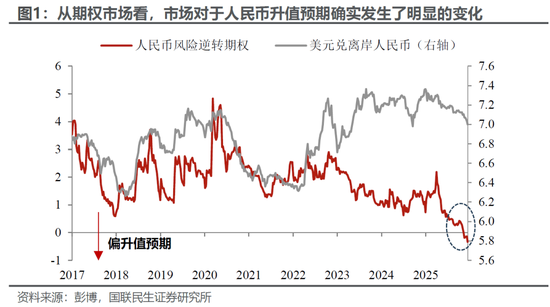
Core Viewpoint - The RMB exchange rate is expected to trend back to the "6" range in 2026, which could significantly impact the economy, policies, and market logic, marking a shift from 2025 when the exchange rate expectations began to change [1][44]. Group 1: RMB Exchange Rate Assessment - Evaluating whether the RMB is overvalued or undervalued is complex and can yield different conclusions based on various dimensions [3][46]. - The financial market and asset price dimensions suggest that the current appreciation of the RMB may be reasonable, as the US dollar index has dropped over 10% since its peak in January 2025 [3][46]. - The narrowing of the 2-year China-US interest rate differential by approximately 110 basis points since the beginning of the year indicates a decrease in the attractiveness of the RMB as a financing currency [4][47]. Group 2: Trade Dimension - The trade perspective supports the argument for RMB undervaluation, especially given China's strong export performance in recent years [7][51]. - The RMB exchange rate index remains at a relatively low level compared to recent years, despite its appreciation against the US dollar [7][51]. - There is a positive correlation between RMB depreciation and the expansion of bilateral surplus shares, indicating that trade dynamics are closely linked to exchange rate movements [7][51]. Group 3: Inflation Impact - The significant gap between the nominal effective exchange rate and the real effective exchange rate since 2022 reflects lower domestic inflation compared to global levels [11][54]. - The real exchange rate is a crucial indicator of a country's export price competitiveness, with lower real exchange rates generally favoring exports [15][58]. - Maintaining a stable real effective exchange rate while allowing for slight nominal depreciation could help avoid unnecessary trade frictions and manage surpluses effectively [15][58]. Group 4: Central Bank's Role in Exchange Rate Management - Historical patterns suggest that the RMB may experience significant appreciation during periods of US dollar depreciation, with the central bank likely to intervene to maintain stability [17][25]. - The central bank's approach to managing the exchange rate involves a balance of maintaining stability while allowing for necessary adjustments based on market conditions [17][27]. - The central bank has been gradually increasing its efforts to manage the RMB's appreciation, particularly in response to rapid increases in the exchange rate [25][27]. Group 5: Market Impact of Exchange Rate Changes - The market has adapted to the constraints imposed by RMB depreciation on monetary policy and liquidity, with expectations of a shift in sentiment during periods of appreciation [31][33]. - Generally, a normal appreciation of the RMB is associated with economic growth, positively impacting the stock market while potentially putting pressure on the bond market [35][36]. - In contrast, during periods of excessive appreciation, the stock market may underperform due to negative economic impacts, while the bond market could benefit [36][37].

资产配置系列:人民币交易指南2026
Guolian Minsheng Securities· 2026-01-04 08:07
Group 1 - The report addresses three core questions regarding the RMB exchange rate in 2026: 1) How to assess the rise of the RMB? 2) How will the exchange rate rise and how will the central bank regulate it? 3) What impact does RMB appreciation have on stocks and bonds? [2][8] - The current appreciation of the RMB is deemed reasonable, supported by a decline in the US dollar index (over 10%), a narrowing of the China-US interest rate differential (approximately 110 basis points), and a decrease in the attractiveness of the RMB as a financing currency [2][7][10]. - The expected central level for the RMB exchange rate is around 6.8, with the central bank's regulation being crucial to avoid unnecessary overshooting [2][23]. Group 2 - The central bank's regulation follows a "symmetrical principle," meaning that just as it previously prevented excessive depreciation, it should also focus on regulating excessive appreciation to balance the economic impact of exchange rate fluctuations [2][23]. - Key regulatory measures include the use of the counter-cyclical factor in the central parity rate, guiding expectations through official channels, and reducing the reserve requirement for forward foreign exchange purchases [2][23][44]. - The report suggests that the RMB's appreciation can be divided into "non-overshooting" and "overshooting" phases, with historical data indicating that after overshooting, the central bank tends to gradually open the door to rate cuts, aiding in the return of liquidity to a neutral environment [2][47]. Group 3 - In the non-overshooting phase, the stock market benefits from cyclical recovery, favoring cyclical sectors, while the bond market may face pressure unless driven by overseas quantitative easing [2][56]. - Conversely, in the overshooting phase, economic expectations may suffer negative impacts, leading to generally subdued stock market performance, while the bond market may see increased probabilities of appreciation [2][56]. - Historical data shows that during non-overshooting phases, the stock market, represented by indices like the CSI 300, tends to perform well, while the bond market may not necessarily decline [2][56].