扩大内需

Search documents
提升金融服务实体经济高质量发展质效 ——访中国人民银行党委书记、行长潘功胜
Jing Ji Ri Bao· 2026-01-22 21:58
Core Viewpoint - The Central Economic Work Conference emphasizes the continuation of a moderately loose monetary policy to support key areas such as domestic demand, technological innovation, and small and medium-sized enterprises as part of the "14th Five-Year Plan" [1][2]. Monetary Policy Implementation - The People's Bank of China (PBOC) will implement a moderately loose monetary policy, focusing on stabilizing economic growth and ensuring reasonable price recovery as key considerations [2]. - The PBOC plans to maintain ample liquidity and match the growth of social financing and money supply with economic growth and price level expectations, indicating room for further cuts in reserve requirements and interest rates [2]. - Structural monetary policy tools will be optimized to enhance support for major strategies and key areas, with recent policy adjustments already made to improve these tools [2]. Financial Market Stability - The PBOC aims to maintain stable financial markets and manage expectations, ensuring the RMB exchange rate remains stable at a reasonable level [3]. - There will be a focus on strengthening supervision across various markets, including bonds, foreign exchange, and gold, while establishing mechanisms to provide liquidity to non-bank institutions under specific scenarios [3]. Monetary Policy Framework - The PBOC will optimize the monetary policy target system, emphasizing intermediate variables and reducing focus on quantitative targets to enhance the effectiveness of interest rate adjustments [4][5]. - A market-oriented interest rate formation and transmission mechanism will be improved to facilitate the flow of central bank policy rates to market rates [4]. Macro-Prudential Management - The PBOC will enhance monitoring and assessment of systemic financial risks, expanding the scope of macro-prudential management to include new areas such as financial markets and internet finance [7]. - A comprehensive macro-prudential management toolbox will be developed, with a focus on standardization and practical application [7]. Support for Key Areas - The PBOC will increase policy support for expanding domestic demand, enhancing consumption, and supporting technological innovation and small enterprises [8]. - Specific measures include a dedicated 500 billion RMB for consumer and elderly care loans, and an increase in the quota for technology innovation loans from 800 billion RMB to 1.2 trillion RMB [8]. - Additional support for small and medium-sized enterprises includes increasing re-loan quotas and enhancing financing accessibility [8]. International Financial Cooperation - The PBOC will actively engage in global financial governance reforms and international cooperation, promoting a fair and inclusive global financial governance system [10]. - Efforts will include enhancing the internationalization of the RMB and developing a secure and efficient cross-border payment system [10].
“五十万亿元”展现的中国大市场(和音) ——解码数字里的“机遇清单”④
Ren Min Ri Bao· 2026-01-22 21:57
Core Viewpoint - China aims to transition from being the "world's factory" to becoming the "world's market," accelerating its development as a major consumer economy, which will inject strong new momentum into mutually beneficial cooperation with countries worldwide [1][3]. Group 1: Domestic Demand and Economic Growth - Domestic demand has become the main driving force and stabilizing anchor for China's economic growth, contributing an average of 93.1% to economic growth from 2013 to 2024 [2]. - In 2025, final consumption expenditure is expected to contribute 52% to economic growth, an increase of 5 percentage points from the previous year [2]. - The share of service consumption expenditure in per capita consumption is projected to reach 46.1% in 2025, indicating a structural optimization in consumption [2]. Group 2: Investment Opportunities and Market Potential - China's market is characterized by its large scale, diverse levels, and significant potential, with substantial investment opportunities in new urbanization, technology industries, and improving livelihoods [3]. - The current consumer rate in China is about 40%, with a potential increase of 10-20 percentage points compared to developed countries, indicating room for growth [3]. - The "old-for-new" consumption policy is expected to benefit over 360 million people, showcasing market size and policy effectiveness [3]. Group 3: Global Economic Impact - Over the past five years, China has imported goods and services worth over $15 trillion, establishing itself as the world's second-largest consumer market [3]. - As income levels rise and demand for a better quality of life increases, new consumption trends will emerge, driving new supply and investment opportunities [3]. - China's commitment to expanding domestic demand will create new opportunities for global cooperation, enhancing its role as a major consumer market [3][4].
以旧换新撬动发展新动能
Ren Min Ri Bao· 2026-01-22 21:57
Group 1 - The "new national subsidy" policy has rapidly taken effect, with significant consumer engagement, such as 16,324 transactions in Chongqing and nearly 16 million yuan in trade-ins in Fuzhou during the New Year holiday, showcasing the policy's impact on consumption upgrade and industrial transformation [1] - By 2025, the sales volume of related goods under the trade-in policy is expected to exceed 2.6 trillion yuan, benefiting over 360 million people, playing a crucial role in expanding domestic demand [1] - The recent notification on implementing large-scale equipment updates and consumer goods trade-in policies for 2026 aims to optimize support scope, subsidy standards, and implementation mechanisms [1] Group 2 - The urgent need for upgrading old residential areas and facilities in elderly care institutions is highlighted, with approximately 22,000 old communities built between 1980 and 2000, and a projected shortage of 46 million nursing beds for the elderly by 2035 [2] - The new policy includes support for installing elevators in old residential buildings and updating facilities in elderly care institutions, linking improvements in people's livelihoods with the expansion of domestic demand [2] - The policy encourages green transformation by linking subsidies to energy efficiency ratings and promoting the electrification of old vehicles, thereby fostering new consumption patterns and driving the development of green applications [2] Group 3 - The combination of optimizing supply and expanding demand is emphasized, with new consumption driving new supply and meeting new demands, facilitating industrial transformation [3] - The trade-in policy has expanded to include digital and smart products, as well as elderly-friendly home products, aligning with the trend of intelligent consumption and addressing health monitoring needs for the elderly [3] - The effective implementation of the trade-in policy is expected to create positive feedback across the economic system, enhancing domestic demand, fostering new growth drivers, and promoting industrial upgrades [3]
中国人民银行行长潘功胜:继续维护好金融市场平稳运行 支持资本市场稳定发展
Zheng Quan Ri Bao· 2026-01-22 16:25
Core Viewpoint - The People's Bank of China (PBOC) will continue to implement a moderately loose monetary policy in 2026, focusing on promoting stable economic growth and reasonable price recovery as key considerations for monetary policy [1] Monetary Policy Implementation - The PBOC plans to flexibly and efficiently use various monetary policy tools such as reserve requirement ratio (RRR) cuts and interest rate reductions to maintain ample liquidity, aligning social financing scale and money supply growth with economic growth and price level expectations [1] - There is still room for further RRR and interest rate cuts this year [1] - The PBOC has optimized and improved the policy elements of structural monetary policy tools at the beginning of the year [1] Structural Monetary Policy Tools - The PBOC has lowered the interest rates of various structural monetary policy tools by 0.25 percentage points [2] - A dedicated 1 trillion yuan relending facility for private enterprises has been established, along with a combined risk-sharing tool for technology innovation and private enterprise bonds [2] - The relending quota for agricultural and small enterprises has been increased by 500 billion yuan to 4.35 trillion yuan, and the quota for technology innovation and technological transformation relending has been increased by 400 billion yuan to 1.2 trillion yuan [2] - The PBOC aims to maintain stable financial markets and manage expectations, ensuring the RMB exchange rate remains stable at a reasonable level [2] Support for Key Areas - The PBOC will guide financial institutions to enhance support for expanding domestic demand, technological innovation, and small and micro enterprises, which are strategic measures for strengthening domestic circulation and promoting high-quality development [3] - Specific measures include a dedicated 500 billion yuan relending facility for service consumption and elderly care, promoting financial product innovation, and improving the consumer finance environment [3] - The PBOC has increased the relending quota for technology innovation and technological transformation, including support for high R&D investment private small and medium enterprises [3] Support for Small and Micro Enterprises - The PBOC aims to enhance the accessibility and convenience of financing for small and micro enterprises by increasing relending and rediscount quotas, and establishing a dedicated 1 trillion yuan relending facility for private enterprises [4] - Financial institutions will be encouraged to issue financial bonds for small and micro enterprises, and the credit enhancement system for private small and medium enterprises will be improved [4] - The PBOC will collaborate with various government departments to strengthen coordination and information sharing, enhancing the effectiveness and coverage of financial services [4]
近期市场连续三万亿成交背后的逻辑思考
Dongguan Securities· 2026-01-22 11:01
Group 1 - The A-share market has shown strong performance, with the Shanghai Composite Index reaching a peak of nearly 4200 points, supported by a significant increase in trading volume, with a record of over 30 trillion yuan in daily transactions during early January 2026 [10][12][39] - The market's upward trend is attributed to multiple factors, including strengthened policy expectations, global capital inflows, and increased domestic liquidity, which have collectively boosted investor confidence [10][12][39] - The economic fundamentals remain robust, with a steady recovery in demand, active service consumption, and resilience in foreign trade, although the recovery foundation still needs to be solidified [13][14][21] Group 2 - Policy expectations have ignited market enthusiasm, with a focus on expanding domestic demand and stabilizing consumption as key tasks for 2026, supported by various policy measures aimed at stimulating demand [13][30][31] - The central bank has indicated potential for further monetary easing, including interest rate cuts, to support economic recovery and market stability, with expectations for a favorable liquidity environment [33][40] - Regulatory measures have been implemented to manage market overheating, transitioning from a liquidity-driven surge to a performance-driven slow bull market, with an emphasis on earnings recovery to sustain high valuations [28][39] Group 3 - The spring market rally is expected to continue, characterized by structural opportunities, with a focus on low-valuation, stable-profit dividend stocks, technology sectors driving new productivity, and domestic demand expansion [41][42] - Key sectors to watch include financials, non-ferrous metals, public utilities, and transportation, as well as technology areas such as semiconductors and AI, which are aligned with national strategic priorities [41][42] - The importance of domestic demand is highlighted, especially in the context of external pressures, with recommendations to focus on sectors benefiting from domestic consumption, such as food and beverage, automotive, and healthcare [41][42]
潘功胜:推动金融机构完善内部激励约束机制,提升金融服务的便捷性、有效性、覆盖面
Xin Lang Cai Jing· 2026-01-22 09:44
Core Viewpoint - The People's Bank of China (PBOC) aims to enhance financial support for key areas such as domestic demand, technological innovation, and small and micro enterprises to strengthen domestic circulation and promote high-quality development [1][3]. Group 1: Support for Domestic Demand and Consumption - The PBOC will implement comprehensive measures to meet diverse financial needs in the consumption sector, including a dedicated 500 billion yuan for consumer and elderly care re-loans [1][3]. - Financial institutions will be encouraged to innovate financial products and improve payment services to enhance consumer finance service levels [1][3]. - A one-time personal credit repair policy will be implemented to improve the consumer finance environment [1][3]. - Qualified financial institutions will be supported in issuing financial bonds to increase funding capacity in the consumption sector [1][3]. Group 2: Support for Technological Innovation - The PBOC will continue to increase policy support for technological innovation, including raising the quota for re-loans aimed at technology innovation and technological transformation [1][3]. - Private small and medium-sized enterprises (SMEs) with high R&D investment levels will be included in the support scope [1][3]. - A risk-sharing tool for bonds related to technological innovation and private enterprises will be established to provide re-loan support and promote the development of a "technology board" in the bond market [1][3]. Group 3: Support for Small and Micro Enterprises - The PBOC will enhance the accessibility and convenience of financing for small and micro enterprises by increasing re-loan and rediscount quotas, with a specific allocation of 1 trillion yuan for private enterprises [2][4]. - Financial institutions will be supported in issuing financial bonds for small and micro enterprises, utilizing financing support tools for private enterprises [2][4]. - The credit enhancement system for private SMEs will be improved, leveraging government financing guarantees and information sharing [2][4]. - Collaboration with various departments such as development reform, commerce, industry, and technology will be strengthened to enhance coordination and information sharing [2][4]. - Financial institutions will be encouraged to improve internal incentive mechanisms to enhance the convenience, effectiveness, and coverage of financial services [2][4]. - Coordination between monetary and fiscal policies will be emphasized to amplify the effects of financial support through measures like fiscal interest subsidies, guarantees, and risk compensation [2][4].
博时市场点评1月22日:三大指数翻红,创业板涨超1%
Xin Lang Cai Jing· 2026-01-22 08:35
Market Overview - The three major indices in the A-share market showed slight gains after narrow consolidation, with total trading volume increasing to 2.7 trillion yuan compared to the previous day [1][7] - The Shanghai Composite Index closed at 4122.58 points, up 0.14%, while the Shenzhen Component Index rose by 0.50% to 14327.05 points, and the ChiNext Index increased by 1.01% to 3328.65 points [10][11] Economic Insights - China's economy successfully achieved a 5% growth target for 2025, with notable recovery in prices during the fourth quarter, although still weak overall [1][7] - Key characteristics include stronger supply than demand and better external demand compared to internal demand, with investment and consumption remaining weak [1][7] - The core issue identified is insufficient domestic demand, which is expected to be a focus for improvement in supply optimization, price recovery, and profit enhancement in the coming year [1][7] International Developments - U.S. President Trump announced a framework for future agreements regarding Greenland and the Arctic region, leading to the cancellation of a planned 10% tariff on goods from Denmark, Norway, and six other European countries [2][8] - This tariff cancellation is seen as a positive signal for global trade, reducing immediate uncertainties and improving market risk appetite [2][8] - However, geopolitical uncertainties related to NATO defense responsibilities and Arctic resource control remain complex and require ongoing attention [2][8] Financial Policy Updates - The People's Bank of China emphasized the acceleration of building a cross-border payment system for the renminbi, aiming for greater connectivity and diversification in cross-border payments [3][9] - This initiative is part of a broader strategy to enhance the internationalization of the renminbi and reduce reliance on traditional international payment systems, potentially benefiting international trade and capital flows [3][9] Consumer Market Initiatives - A new policy was introduced to establish duty-free shops at 41 ports, including Wuhan Tianhe International Airport, allowing travelers from Macau to purchase duty-free goods up to 15,000 yuan [3][9] - This measure aims to stimulate inbound consumption and domestic high-end consumer demand, contributing to the strategy of expanding domestic demand and enhancing the role of consumption in economic growth [3][9]

陈茂波:香港三大增长引擎发展潜力巨大
Xin Hua Wang· 2026-01-22 08:33
Core Viewpoint - The Hong Kong government emphasizes the significant growth potential of finance, trade, and innovation as the three main engines for economic development, highlighting the need to embrace technological advancements like AI and blockchain to drive economic transformation [1]. Group 1: Economic Growth Engines - Finance, trade, and innovation are identified as the three primary growth engines for Hong Kong, with substantial development potential [1]. - The government is actively exploring and experimenting in financial and technological innovation under the "One Country, Two Systems" framework, indicating a strong collaborative potential with cities in the Guangdong-Hong Kong-Macao Greater Bay Area [1]. Group 2: Technological Advancements - Breakthroughs in technologies such as artificial intelligence and blockchain are driving profound industrial changes, necessitating that all economies adapt to these developments [1]. - The emphasis on technological innovation aligns with the broader economic transformation goals, positioning Hong Kong as a favorable investment destination [1]. Group 3: International Trade Dynamics - International trade is undergoing a paradigm shift, with developed countries needing to recognize the changing development models of some developing countries, which are moving beyond merely manufacturing and exporting low-cost products [1]. - China's strategy of promoting high-level two-way opening and expanding domestic demand is expected to inject momentum into its high-quality economic development, creating significant market opportunities for quality products and services from various economies [1]. Group 4: Economic Resilience and Growth Strategies - The Finance Secretary participated in discussions with global leaders on enhancing economic resilience and strategies for promoting growth, indicating a proactive approach to global economic challenges [2].
火速翻红再创近三年新高!化工ETF(516020)赚钱效应火热,资金加仓大提速
Mei Ri Jing Ji Xin Wen· 2026-01-22 06:09
Group 1 - The chemical sector continues to show strong performance, with the Chemical ETF (516020) experiencing a price increase of over 1.5%, reaching a nearly three-year high [1] - As of January 21, the Chemical ETF (516020) has seen a net subscription of over 870 million yuan in the past five days and nearly 1.2 billion yuan in the last ten days [1] - Analysts suggest that the "14th Five-Year Plan" emphasizes expanding domestic demand, which will drive growth in chemical product demand, especially with the onset of a U.S. interest rate cut cycle [1] Group 2 - The Chemical ETF (516020) and its linked fund (012537) track the CSI segmented chemical industry theme index, with nearly 50% of its holdings concentrated in large-cap leading stocks such as Wanhua Chemical and Salt Lake Industry [2] - The remaining 50% of the portfolio includes leading stocks in sub-sectors like phosphate fertilizers, fluorine chemicals, and nitrogen fertilizers, allowing for comprehensive investment opportunities in the chemical sector [2]
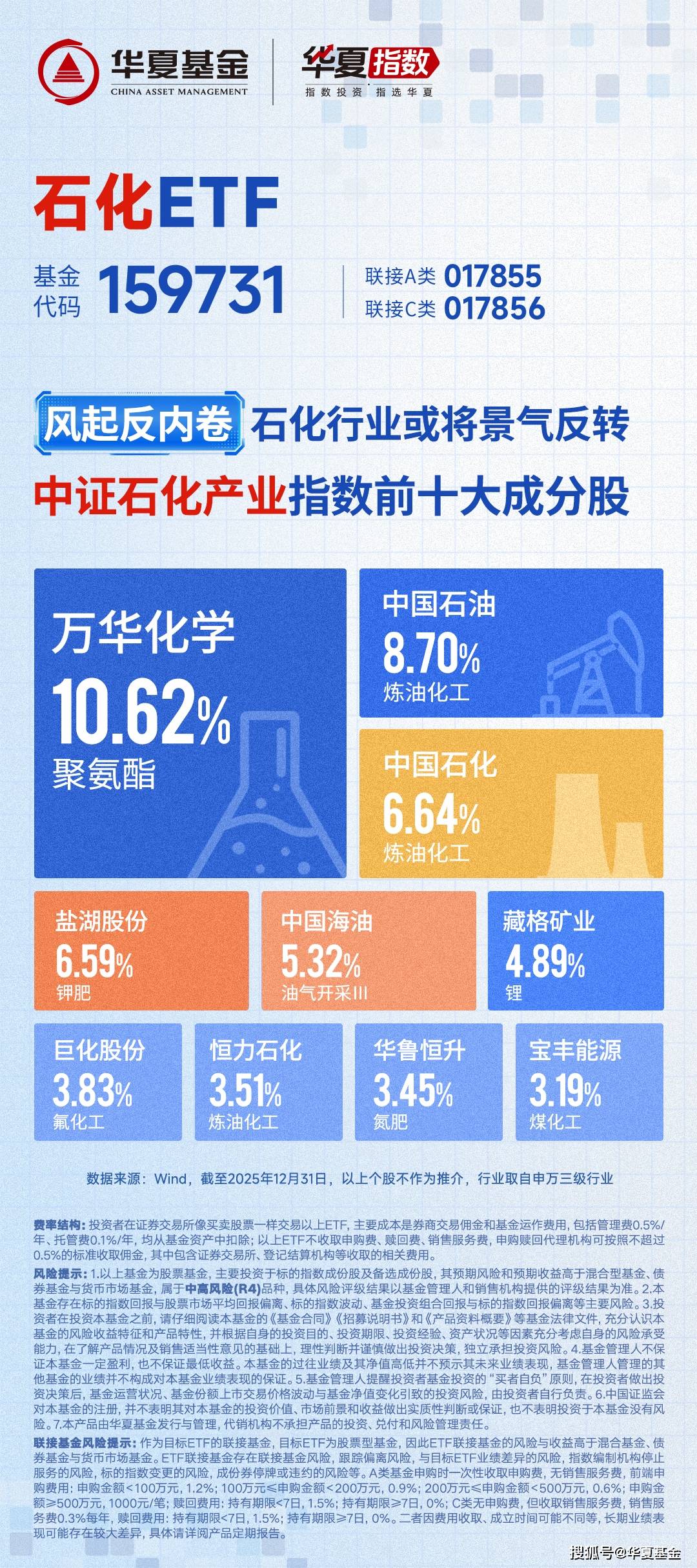
反内卷效果显现,关注石化板块投资机会
Sou Hu Cai Jing· 2026-01-22 03:11
Group 1 - The anti-involution movement has been ongoing for over a year, with varying results across different sectors, showing significant improvement in the petrochemical sector compared to others like large commodities and new energy [1] - The industry has seen effective production cuts that have boosted corporate profitability, with major products like PTA and polyester expected to stabilize in price as new capacity is set to be completed by the end of 2026 [1] - Strong downstream demand is facilitating price recovery, with leading chemical companies recently disclosing positive earnings forecasts for 2025, indicating a rebound in multiple sub-sectors [1] Group 2 - The petrochemical industry is currently at the bottom of a four-year downturn, but the ongoing anti-involution and expansion of domestic demand are expected to accelerate the industry's cyclical recovery [6] - As a crucial industrial raw material, the rise in chemical prices suggests that the industry is gradually moving out of a phase of demand stagnation and inventory adjustment, entering a period of upward momentum, making it an area of significant investment interest [6]