
消费复苏

Search documents
核心CPI温和上涨,消费向好积极信号|新京报快评
Xin Jing Bao· 2025-10-20 11:05
Core Insights - The article highlights the effectiveness of proactive fiscal policies in stimulating consumer demand in China, with a focus on the recent economic data released by the National Bureau of Statistics [2][3]. Economic Data Summary - In the first three quarters of this year, China's Consumer Price Index (CPI) slightly decreased by 0.1% year-on-year, while the core CPI, excluding food and energy, increased by 0.6%, with a notable rise of 1.0% in September, marking the first return to a 1% increase in nearly 19 months [2]. - Final consumption expenditure contributed 53.5% to economic growth, an increase of 9.0 percentage points compared to the previous year, reinforcing its role as a key driver of economic growth [2]. Policy Measures - The "Special Action Plan to Boost Consumption" was introduced in March, outlining 30 key tasks across eight areas, including actions to increase residents' income and enhance service consumption [3]. - The government allocated 300 billion yuan in special long-term bonds to support consumption, particularly through trade-in programs, which have led to double-digit growth in retail sales of household appliances and related goods [3]. Retail Performance - Retail sales of household appliances and audio-visual equipment increased by 4.4% year-on-year in the first three quarters, with a significant jump of 20.5% in September, marking a 17.1 percentage point acceleration from August [4]. - The automotive market is also showing signs of recovery, with over 8.3 million trade-in applications for vehicles submitted by September 10, averaging more than 30,000 applications per day [4]. Financial Policies - The central bank has implemented personal consumption loan interest subsidies and support for service industry loans, effectively reducing credit costs for residents and businesses, thereby stimulating consumption potential [4]. - There is a notable shift in consumer spending from goods to services, with service retail sales growing by 5.2% year-on-year in the first three quarters, outpacing goods retail sales [4]. Future Considerations - There is a need to solidify the foundation for consumer recovery, focusing on improving residents' income and optimizing income distribution to enhance consumption levels [5]. - Improving consumer expectations is crucial, as it significantly influences consumption decisions, and a coordinated policy framework is essential for maximizing the effectiveness of measures aimed at expanding domestic demand and promoting consumption [5].

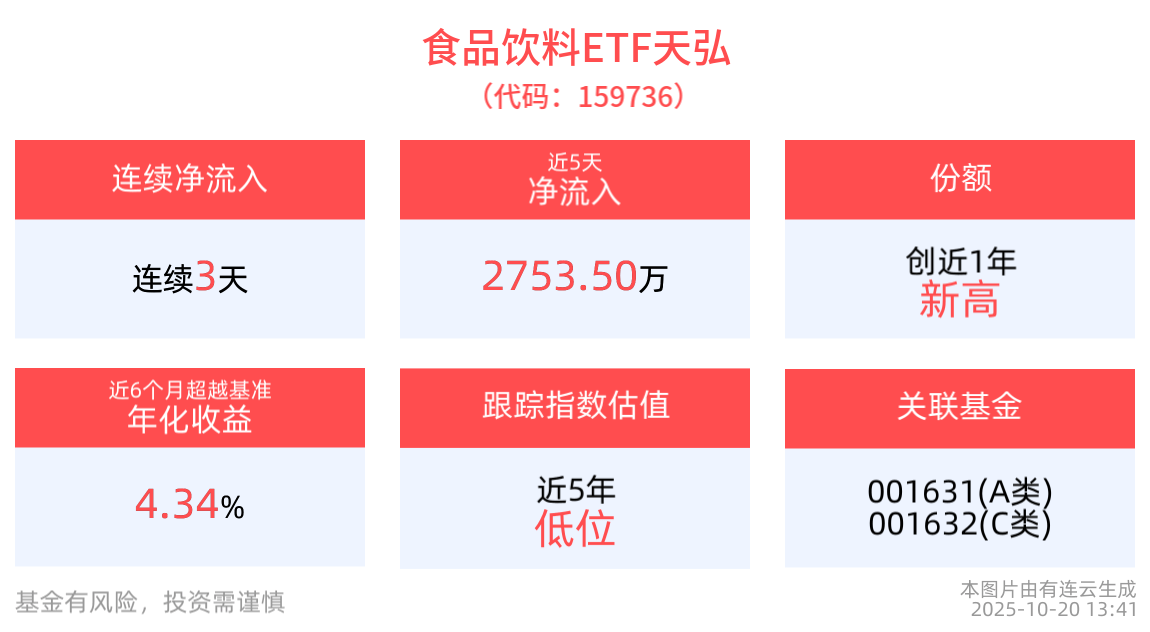
消费复苏态势稳固!食品饮料ETF天弘(159736)有望承接“高低切”资金,近3日连续“吸金”近2200万元,份额再创阶段新高
Sou Hu Cai Jing· 2025-10-20 05:57
Group 1 - The core viewpoint of the news highlights the positive performance of the Tianhong Food and Beverage ETF (159736), which has seen significant net inflows and a record high in shares, indicating strong investor interest in the food and beverage sector [2] - The Tianhong Food and Beverage ETF tracks the CSI Food and Beverage Index, focusing on high-barrier sectors such as liquor, beverages, and fermented products, with top holdings including major liquor brands [2] - Recent data from the National Bureau of Statistics shows a 4.7% year-on-year increase in per capita consumer spending in the first three quarters, reflecting a recovery in consumer confidence and spending power [2] Group 2 - Kweichow Moutai has introduced a new product called "Date Wine," allowing consumers to customize their purchase based on significant dates, which enhances consumer engagement and lowers purchase barriers [3] - Hunan Province is distributing 100 million yuan in consumption vouchers across various sectors to stimulate consumer spending and support economic recovery [4] - Kuaishou has launched its 2024 Double 11 shopping festival with a focus on consumer benefits, offering 2 billion yuan in red envelopes and various discounts to boost sales across multiple product categories [5] Group 3 - Recent policy support for the consumption sector is expected to enhance domestic demand, with analysts noting that the government's focus on stabilizing prices and improving consumer sentiment could benefit the liquor and dining sectors [5]
中医优势病种按病种付费试点工作即将开启
Xiangcai Securities· 2025-10-19 13:45
Investment Rating - The industry maintains an "Overweight" rating [8] Core Insights - The Chinese medicine sector outperformed other pharmaceutical sub-sectors last week, with a 0.38% increase, while the overall pharmaceutical sector declined by 2.48% [2] - The current PE (ttm) for the Chinese medicine sector is 27.9X, which is at the 30.45% percentile since 2013, while the PB (lf) is 2.36X, at the 6.85% percentile since 2013 [3] - The price index for Chinese medicinal materials remained stable due to the National Day holiday, with a total index of 232.77 points [4] - A pilot program for disease-based payment for traditional Chinese medicine (TCM) is set to begin, which may enhance reimbursement for TCM services [5] Summary by Sections Market Performance - The Chinese medicine sector recorded a 0.38% increase, while the overall pharmaceutical sector saw a decline of 2.48% [2] - Top-performing companies in the sector include Guizhou BaiLing, Wanbangde, and Darentang, while underperformers include Tianmu Pharmaceutical and Tailong Pharmaceutical [2] Valuation - The PE (ttm) for the Chinese medicine sector is 27.9X, up 0.1X week-on-week, with a one-year maximum of 30.26X and a minimum of 24.72X [3] - The PB (lf) is 2.36X, unchanged from the previous week, with a one-year maximum of 2.59X and a minimum of 2.17X [3] Policy Developments - The pilot program for TCM payment will select around 15 provinces or cities to test the new payment model over 2-3 years, potentially improving the compatibility of TCM services with existing insurance payment methods [5] Investment Recommendations - The report suggests focusing on three main investment themes: price governance, consumption recovery, and state-owned enterprise reform [6][11][12] - Specific recommendations include companies with strong R&D capabilities and unique products, as well as those less affected by price reductions from centralized procurement [12]
大行评级丨瑞银:奢侈品及珠宝销售出现复苏迹象 上调华润万象生活评级至“买入”
Ge Long Hui· 2025-10-17 06:30
Core Viewpoint - UBS reports signs of recovery in luxury goods and jewelry sales in mainland China and Hong Kong, driven by wealth effects from the stock market and rising gold prices [1] Mainland Retail Sector - The proportion of emerging brands in CR Land's shopping malls is high, including brands like Lao Pu Gold and Pop Mart, allowing the group to adapt quickly to changing consumer habits, giving it a competitive edge over Hong Kong developers [1] - UBS is optimistic about CR Land, CR Vientiane Life, Swire Properties, and Hang Lung Properties, upgrading CR Vientiane Life's rating from "Neutral" to "Buy" [1] - Lao Pu Gold's rating is also upgraded to "Buy" due to valuation pressure and potential product price increases in the last quarter, which may support short-term sales and gross margins [1] Hong Kong Retail Sector - The luxury retail sector in Hong Kong is benefiting from strong stock market performance, which may positively impact Wharf Real Estate [1] - UBS believes that Wharf Real Estate may benefit from the short-term recovery in luxury retail, while Link REIT could be affected by the increasing penetration of e-commerce, receiving "Neutral" and "Buy" ratings respectively [1]
招商证券:白酒延续调整 食品景气分化
智通财经网· 2025-10-17 06:12
Core Viewpoint - The report from China Merchants Securities indicates a decline in participation and investor interest in the 2025 Autumn Sugar Exhibition, reflecting a decrease in industry enthusiasm, while the liquor sector's performance during the holiday season aligns with expectations [1][2]. Liquor Industry - The number of participating liquor companies at the Autumn Sugar Exhibition has decreased, with a shift in investment focus towards the consumer end, leading to a cautious attitude among liquor distributors [2]. - The performance of high-end liquor brands remains resilient, with Moutai's price stabilizing around 1800 yuan, which has positively impacted sales during the holiday season [3]. - The overall sales during the holiday season for liquor have declined, but leading brands have shown better performance compared to the industry average, indicating a trend towards increased industry concentration [3]. Food Industry - The beverage sector has shown significant inventory reduction during the holiday period, with leading brands like Nongfu Spring expected to achieve double-digit growth [4]. - The snack sector continues to expand, particularly in discount store formats, although same-store sales have seen a slight decline [4]. - The dairy sector remains under pressure, particularly for ambient liquid milk, with a need for structural improvements [4]. Investment Recommendations - The report suggests focusing on leading liquor brands such as Kweichow Moutai, Shanxi Fenjiu, Luzhou Laojiao, and Wuliangye, as well as emerging brands like Zhenjiu Lidu and Yingjia Gongjiu, which are expected to contribute positively [5][6]. - In the food sector, recommendations include leading snack brands like Ximai Foods and beverage leaders like Nongfu Spring and Dongpeng Beverage, while also highlighting opportunities in the dairy sector with companies like Yili [6].



产业增持与低估值共铸安全边际,食品饮料ETF(515170)5日“吸金”11亿!
Mei Ri Jing Ji Xin Wen· 2025-10-17 05:27
Group 1 - The food and beverage sector is currently at a critical juncture with multiple favorable factors, making it an important window for medium to long-term investment opportunities [1] - Wuliangye Group has announced a significant stock buyback plan, intending to repurchase between 500 million and 1 billion yuan worth of shares over a six-month period starting April 9, 2025 [1] - The food and beverage ETF (515170) has seen Wuliangye as its largest holding, accounting for 14.86%, which strengthens confidence in the sector [1] Group 2 - The food and beverage ETF (515170) has attracted over 1.1 billion yuan in capital in the last five trading days, indicating strong investor interest [2] - The valuation of the food and beverage sector remains low, suggesting it may be a good time for investment [2]

食品饮料板块分化中寻机遇:高景气赛道领跑,餐饮链复苏引关注
Mei Ri Jing Ji Xin Wen· 2025-10-17 01:57
Core Viewpoint - The consumption data during the holiday period indicates a gradual recovery in the catering industry, which is driving a rebound in the entire industry chain [1] Group 1: Catering Industry Recovery - The first four days of the holiday saw an increase in catering sales, with daily foot traffic exceeding expectations [1] - There are significant signs of recovery in the catering chain, with notable improvements in the sales of condiments, which slightly exceeded expectations during September and the holiday period [1] - The demand for frozen foods in the B-end has also shown slight recovery, reflecting the transmission effect of catering recovery on upstream industries [1] Group 2: Snack Sector Performance - The snack sector continues to show high levels of activity, with some companies benefiting from strong sales in gift-giving scenarios during the holiday [1] - Traditional channels have seen stable growth, and the volume of customers in bulk snack stores during the holiday indicates strong channel vitality and consumer demand, becoming a key driver of growth in the sector [1] Group 3: Market Confidence and Investment Opportunities - The recent rise in the sector is attributed to the dual themes of "snack sector vitality and catering recovery," with data validating the high activity levels in the snack sector [1] - The continuous improvement in catering has boosted expectations for sub-sectors such as condiments and beer, enhancing market confidence in consumer recovery [1] - The food and beverage ETF (515170) has attracted significant capital, with over 1.1 billion yuan raised in the last five trading days, indicating strong investor interest [1] - From a valuation perspective, the food and beverage sector remains at a low level, suggesting a favorable configuration opportunity at present [1]
申万宏源证券晨会报告-20251017
Shenwan Hongyuan Securities· 2025-10-17 00:43
Group 1: Market Overview - The Shanghai Composite Index closed at 3916 points, with a slight increase of 0.1% over one day, but a decrease of 0.45% over the past month [1] - The Shenzhen Composite Index closed at 2464 points, showing a decline of 0.57% over one day and 3.37% over the past month [1] - Large-cap indices have shown a 22.72% increase over the past six months, while mid-cap and small-cap indices have increased by 31.69% and 26.41%, respectively [1] Group 2: Industry Performance - The coal mining industry saw a daily increase of 2.36%, with a 9.26% rise over the past month and a 12.65% increase over the past six months [1] - State-owned large banks increased by 2.28% daily, with a 1.76% rise over the past month and a 7.61% increase over the past six months [1] - The wind power equipment sector experienced a decline of 2.77% daily, with a 14.13% drop over the past month and a 55.28% decrease over the past six months [1] Group 3: Trade Policy Insights - The report highlights adjustments in China's tariff strategy, particularly in response to U.S. non-tariff measures introduced since September [10] - The U.S. political landscape shows increasing concerns regarding export control measures, particularly related to rare earth elements [10] - The report suggests that the U.S. should consider smaller trade agreements rather than large-scale deals, as the latter may not align with U.S. interests [10][11] Group 4: Economic Indicators - The report indicates that the Producer Price Index (PPI) improved in September, primarily due to rising commodity prices, particularly copper [14] - The Consumer Price Index (CPI) showed a 0.1% increase in September, with core CPI rising to 1.1%, driven by higher gold prices [14] - The report anticipates that inflation will maintain a weak recovery trend, with commodity prices continuing to influence PPI positively [14]

餐饮产业大会:外卖行业75%新增订单客单价不足15元
Xin Lang Cai Jing· 2025-10-16 13:46
Core Insights - The takeaway from the article highlights the ongoing price competition in the food delivery industry, with a significant portion of new orders coming from the low-price segment, specifically those under 15 yuan [1] Industry Summary - 70% of new food delivery orders this year are from the low-price range of under 15 yuan [1] - Nearly half of the incremental orders generated through subsidies post the May food delivery battle are for beverages, leading to a surge in sales for many tea and coffee shops [1] - The average transaction value in the restaurant industry has approached levels seen in 2015, indicating a stagnation in price recovery due to aggressive price competition [1] - Since April, the average transaction value has experienced a sharp decline, with the expected price increase during the peak season in July and August failing to materialize, resulting in a continued low average transaction value [1] Company Summary - Meituan's General Manager, Xue Bing, stated that the company aims to assist merchants in maintaining quality and stabilizing profits, ensuring that each order is more stable and valuable [1] - Meituan announced an additional investment of 2 billion yuan to support merchants in sustainable operations and promote healthy growth within the industry [1]

“以旧换新”政策成效显现,消费复苏态势明确,聚焦港股消费ETF(513230)布局机遇
Mei Ri Jing Ji Xin Wen· 2025-10-16 06:23
Core Viewpoint - The Hong Kong stock market is experiencing fluctuations, with the Hang Seng Index down by 0.43% and the Hang Seng Tech Index down by 1.36%, while certain sectors like passenger airlines and home goods are performing well, indicating a mixed market sentiment [1] Market Performance - As of the midday close on October 16, the Hang Seng Index decreased by 0.43% and the Hang Seng Tech Index fell by 1.36% [1] - The consumer ETF (513230) is down approximately 0.5%, with leading stocks such as Lao Pu Gold, Pop Mart, Shenzhou International, and China Wangwang showing gains, while stocks like Giga Bio, Xpeng Motors, and Xiaomi Group are experiencing declines [1] Economic Insights - A recent economic forum emphasized the need to expand domestic demand and strengthen the domestic circulation, with expectations that the upcoming "14th Five-Year Plan" will enhance the long-term development mechanism for consumption [1] - As of May 31, the "trade-in" policy for five major consumer categories has driven sales exceeding 1.1 trillion yuan, indicating a positive trend in consumer spending [1] Capital Flow - There has been a notable acceleration of southbound capital inflow into the Hong Kong stock market this year, driven by policy benefits and increased liquidity [1] - The combination of policy incentives and capital inflow is seen as a dual driving force for market recovery, with a clear trend of consumption recovery supported by the effectiveness of the "trade-in" policy [1] ETF Composition - The Hong Kong consumer ETF (513230) tracks the CSI Hong Kong Stock Connect Consumer Theme Index, encompassing a wide range of sectors including internet e-commerce leaders and new consumption brands [1] - Key components of the ETF include leading new consumption brands like Pop Mart and Lao Pu Gold, as well as major internet e-commerce players such as Tencent, Kuaishou, Alibaba, and Xiaomi, highlighting a strong tech and consumer attribute [1]